Category: Guttering

Everything to do with the Guttering including facia etc.

  • Rubber Liner Installed in Gutters and Tiling Battens Started

    Here is a summary of our work for the last 10 days ..
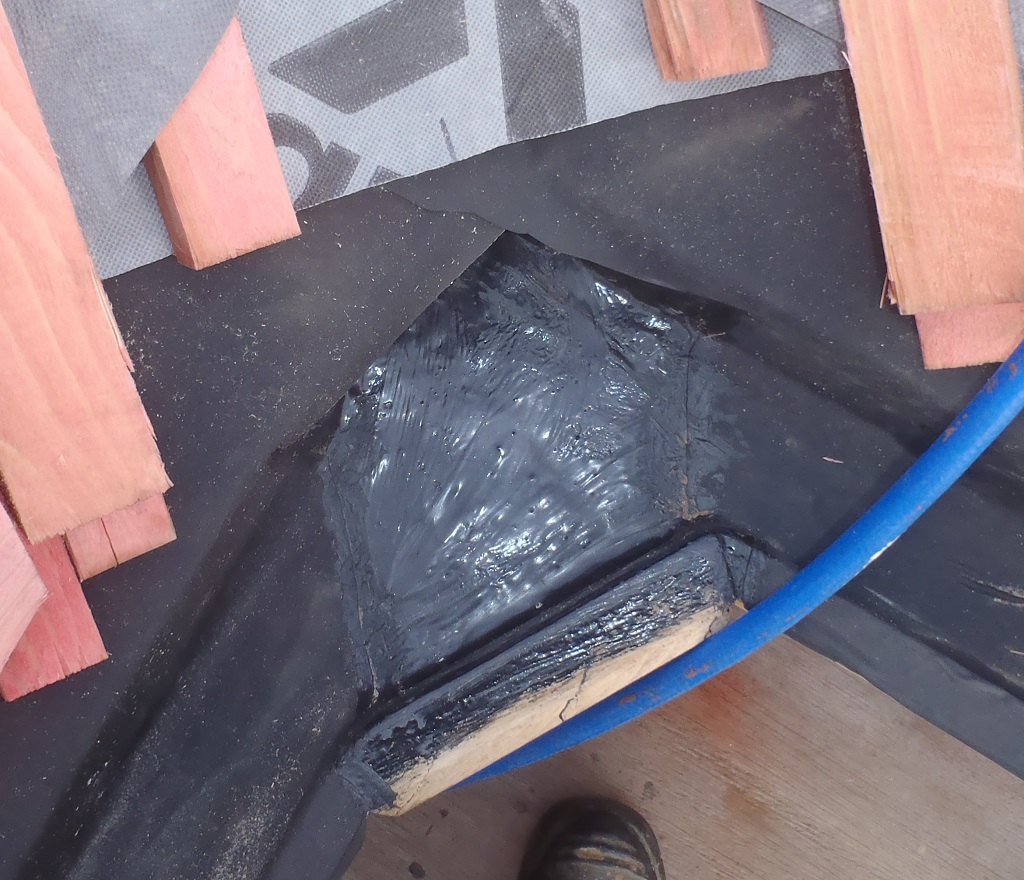
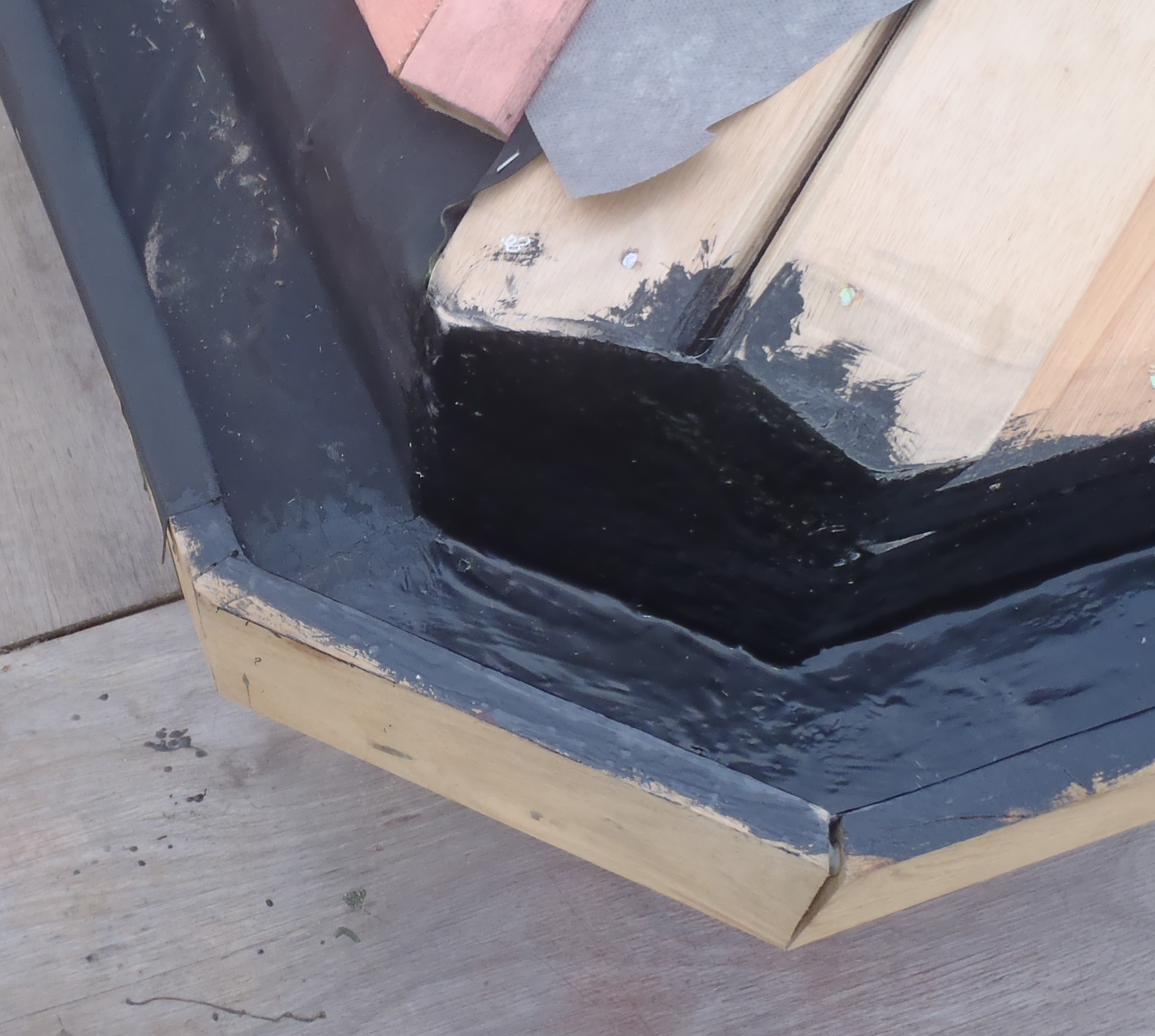
    Using glass fibre and black resin, we sealed the complex downpipe channel three way intersection plus the two outer corners too. We did this to avoid the complicated task of laying the rubber membrane lining the gutters to go around the odd shapes of the corners and joining together the two incoming gutters (off the I and J sections of the roof). Then we glued in two separate straight strips of the rubber membrane, along the bulk of the gutters and sealed the ends onto the glass-fibre surfaces with contact adhesive.
    Rubber Liner Installed in Gutters and Tiling Battens Started

    Fibreglass-and-rubber-on-inside-corner-IJ
    Rubber Liner Installed in Gutters and Tiling Battens Started

    Fibreglass-and-rubber-on-outside-corner-JK


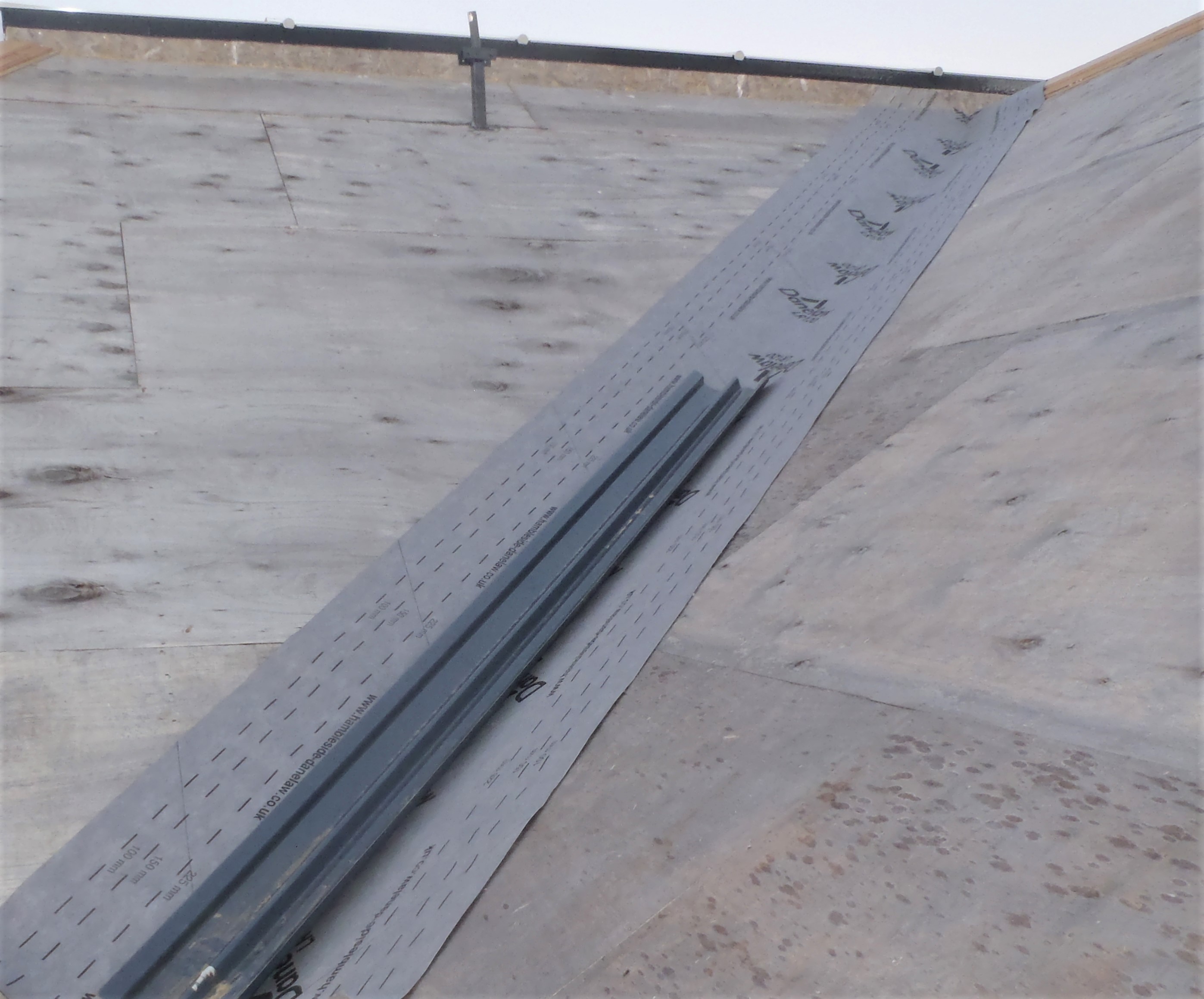
    The first strip of the breathable membrane we put on the roof is for the valley as this is always the lowest point for any water to run downhill so we laid down a metre wide strip with stainless steel staples.
    Rubber Liner Installed in Gutters and Tiling Battens Started

    Membrane-in-the-valley

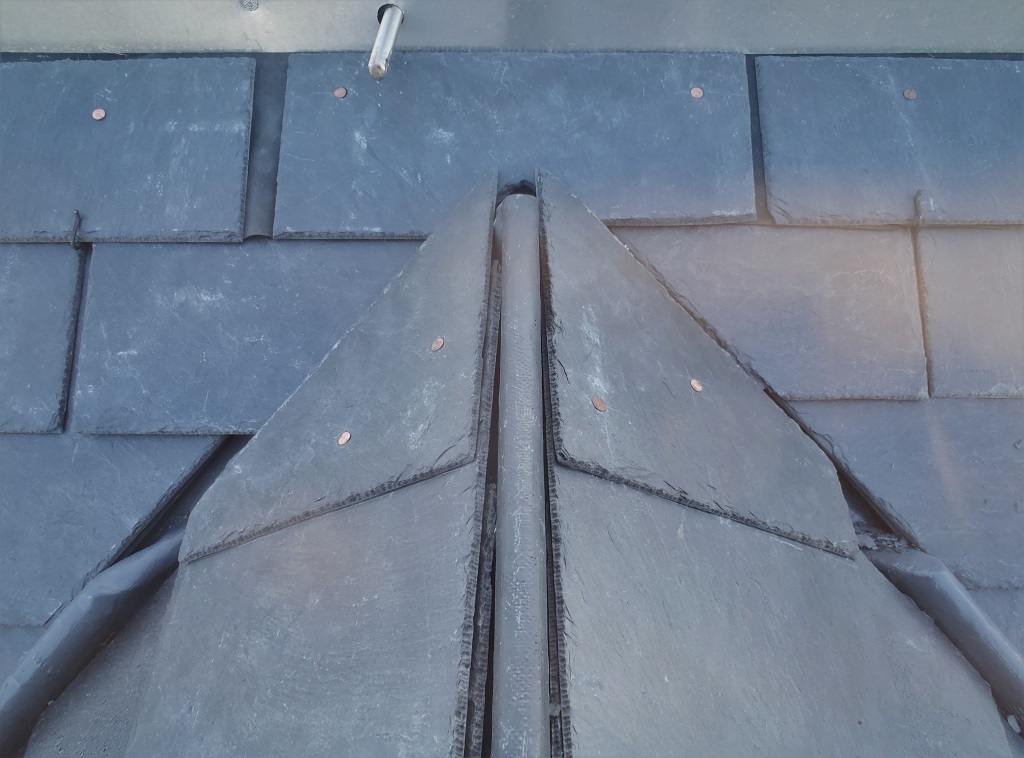
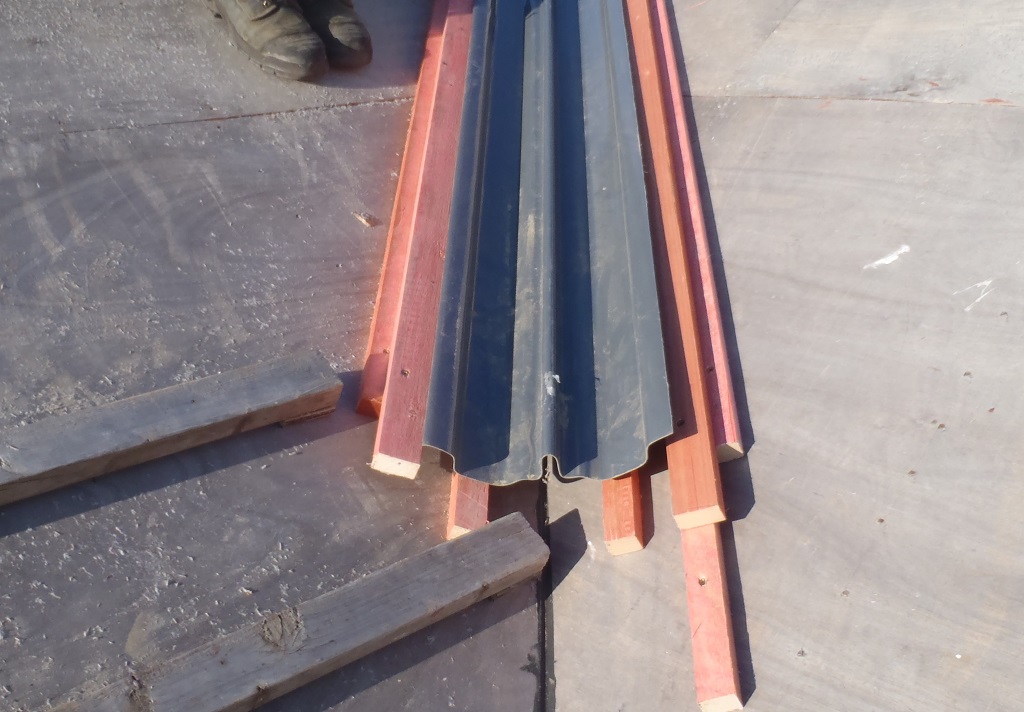
    Next things we had to analyse and test, was the valley trough (a moulded fibre-glass constructed object) that needs to fit underneath the slates, to catch all the rain water flowing down the slope into the valley. It is a deliberate method of allowing the water to “leak” pass the end of the slates and collect together and be diverted in a channel. For this reason, the battens needed to be spaced apart so it is fully supporting the trough on the bottom, and then supporting the two outer edges on the wider tile batten.
    We made a test assembly on another valley on the roof first and worked out that three 38mm wide battens can be placed together (with a gap of 38mm between the inner single batten and the two outer battens) on each side of the valley, with a gap measuring 130mm wide between them. Then a 50mm battens is placed on top of the 2 outer battens to hold the edge of the trough.
    Rubber Liner Installed in Gutters and Tiling Battens Started

    Test-fitting-valley-trough


    Using our research, we proceeded to screw full length battens (4.5metres long) into place, on top of the breathable membrane already there, going up the I-J valley and then we doubled back on ourselves putting 90mm nails into the underlying rafters to provide a strong secured fixing.
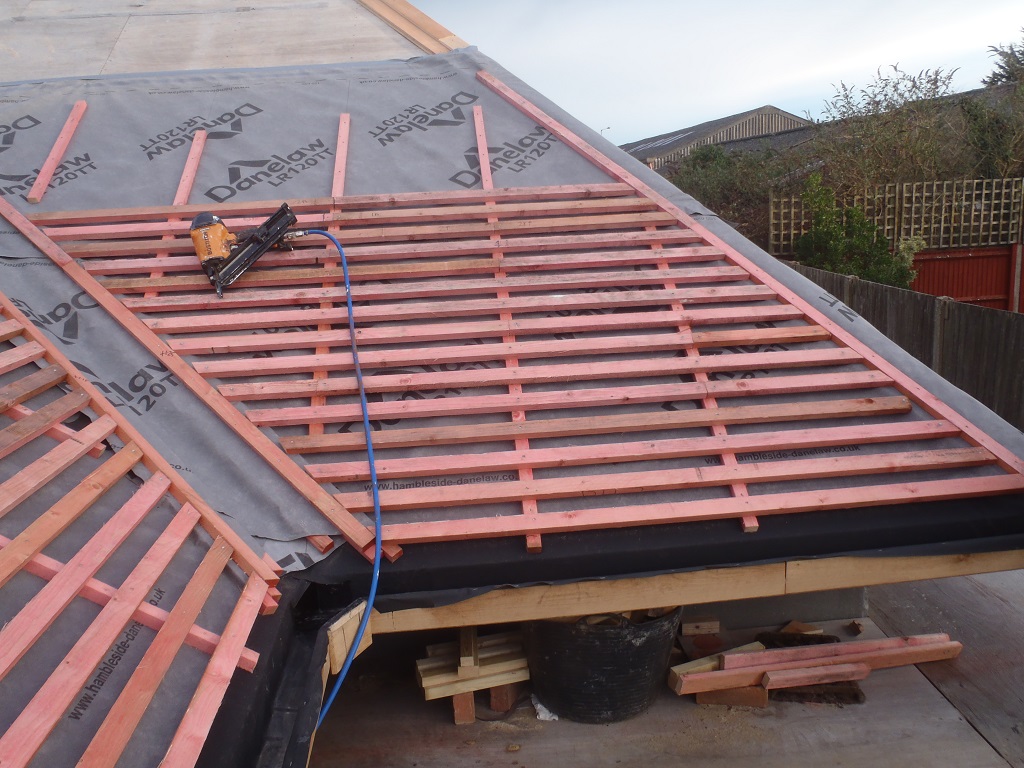
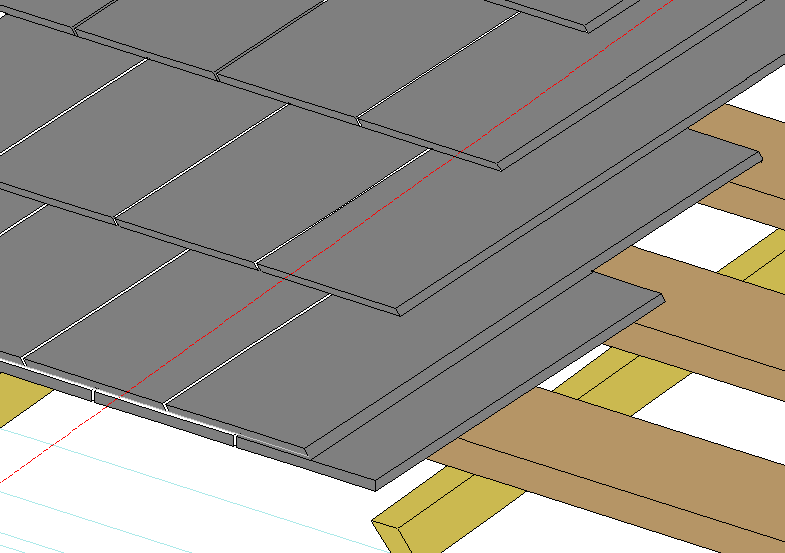
    It now follows that we can start on the task of mounting all the tile battens on to the roof. The breathable membrane goes on first, going flat on to the roof boards, starting the first line, overlapping the lower rubber membrane and running over the Hip and Valley ends. The membrane was held into place with the vertical lines of battens, in short segments that stop just before the top edge (To allow the next piece of membrane to overlap). Then the horizontal tile battens were nailed into place at regular spacing of 112mm apart, so that a slate will sit across three rows of battens and hook onto the hanging nail off the third line.
    Rubber Liner Installed in Gutters and Tiling Battens Started

    Slate-layers


    We managed to get about 20 rows on the I roof and about 16 rows on the J roof sections, just about half way up the slope.
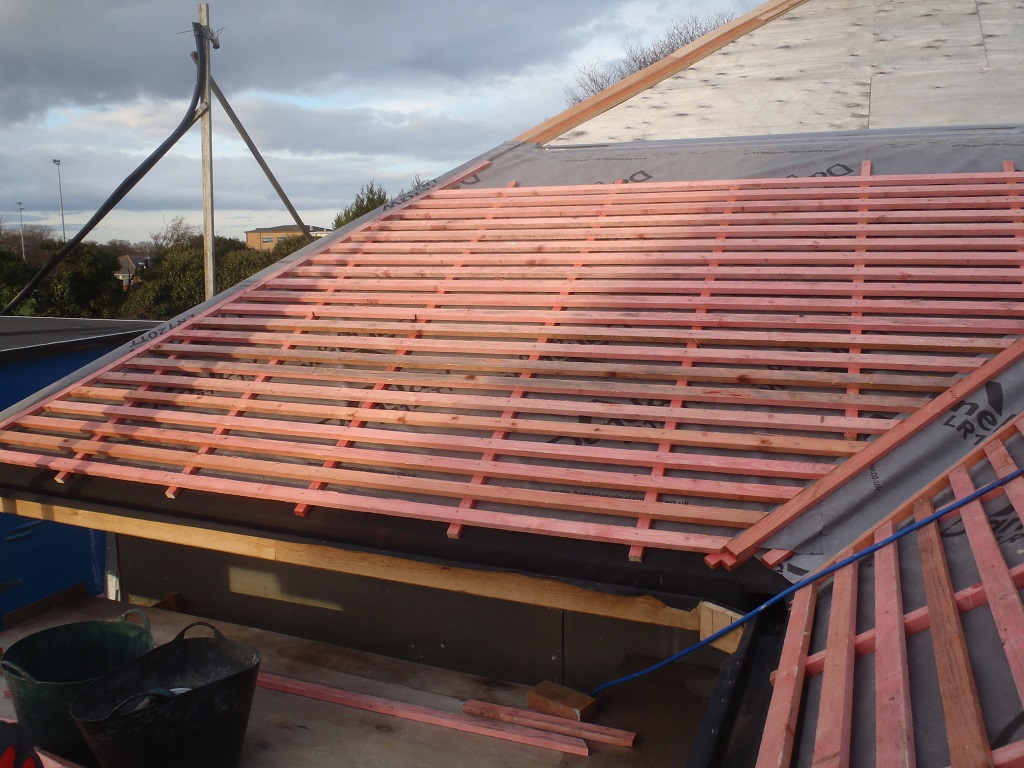
    Rubber Liner Installed in Gutters and Tiling Battens Started

    Battening-started-on-I

    Rubber Liner Installed in Gutters and Tiling Battens Started

    Battening-started-on-J


    On Monday, in the afternoon, we will resume this task of more wooden battens and probably have it all complete by Tuesday.

    We are learning the techniques and methods needed on this section of roofing, and will be getting better and quicker at it as we progress!
  • Installed the First Three Sections of the Gutters

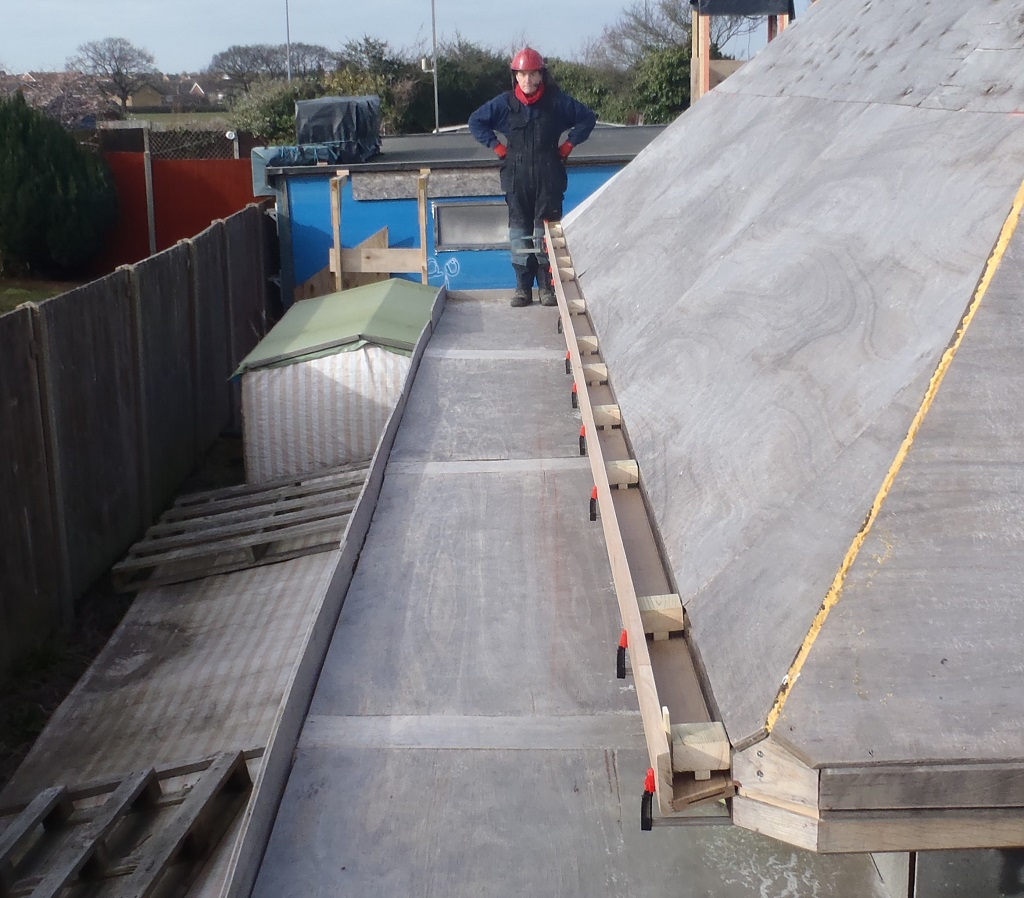
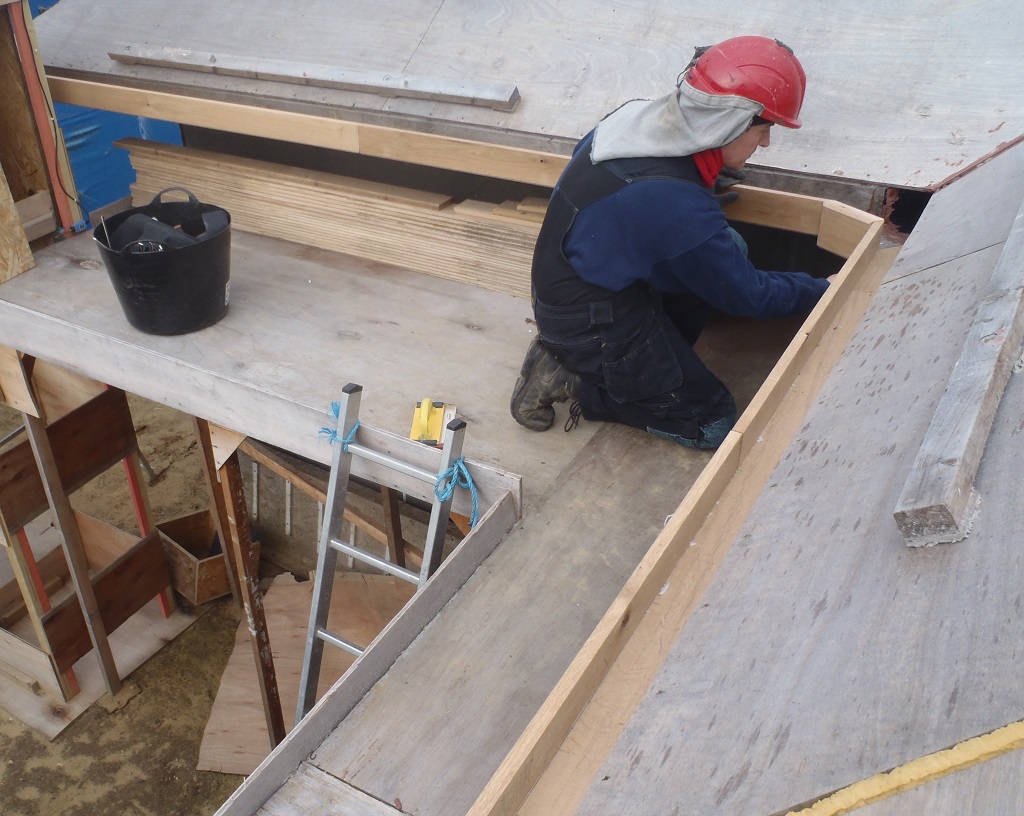
    Over the last 10 days or so (with interruptions), we had installed the new Oak timber pieces to form the Guttering for the roof sections I, J and K.

    Installed the First Three Sections of the Gutters

    Gutter-structure-on-I-J-finished


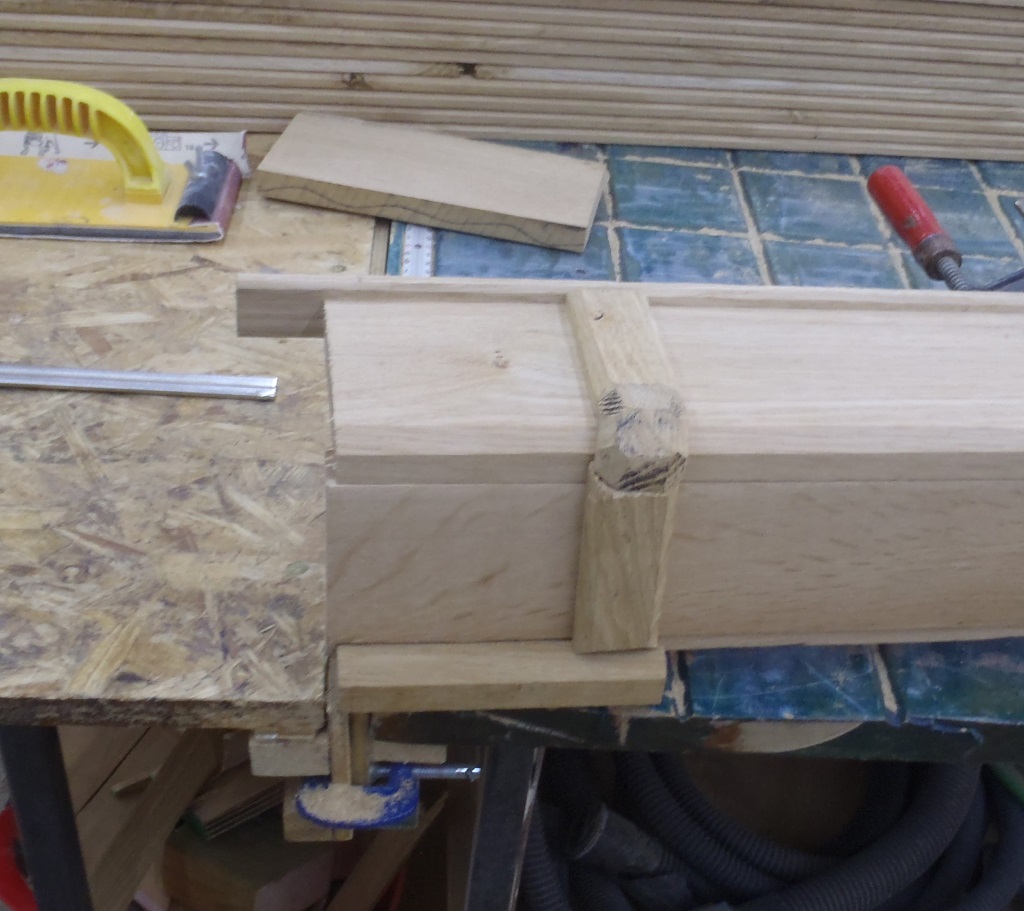
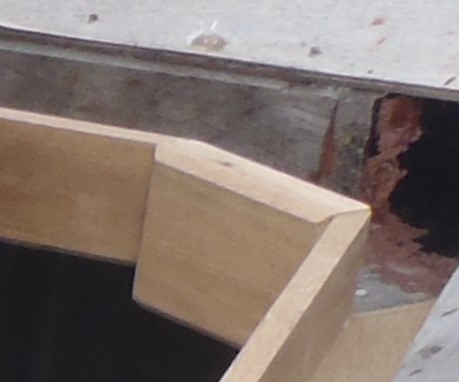
    We carefully measured each section so the base board overlapped the upright pieces in an even way, getting the angles correct for the outside corners (needing approximately a 22.5° angles) and for the joining to the Downpipe channels (needing a 45° angle). We decided that we would put on a much thicker and taller piece of Oak timber to cover up the end of the Downpipe Channels.
    Installed the First Three Sections of the Gutters

    Gutter-inside-corner-cover


    Then using two homemade metal scrapers to spread out the special bulk-filling PU glue, one for the 19mm slot in the Fascia board (with little notches to ensure enough glue is left behind) and the other scraper for the multi-finger tongue and groove joints in the base board and the upright pieces. We used lots of clamps to squeeze the joint nice and tight but we also had spacer blocks inside the guttering to make sure we didn’t bend the vertical fronts inwards.
    Installed the First Three Sections of the Gutters

    Gutter-structure-on-K-finished


    These Gutters being completed now allows us to start work on the roof itself, preparing it for the battens and breathable membranes etc. That will start tomorrow.

  • Processing Oak Timber to produce Guttering pieces

    These last few weeks since the start of the year (January 2019), we have been processing lots of Oak Timber planks and producing finished pieces to build the Guttering System for the roof.

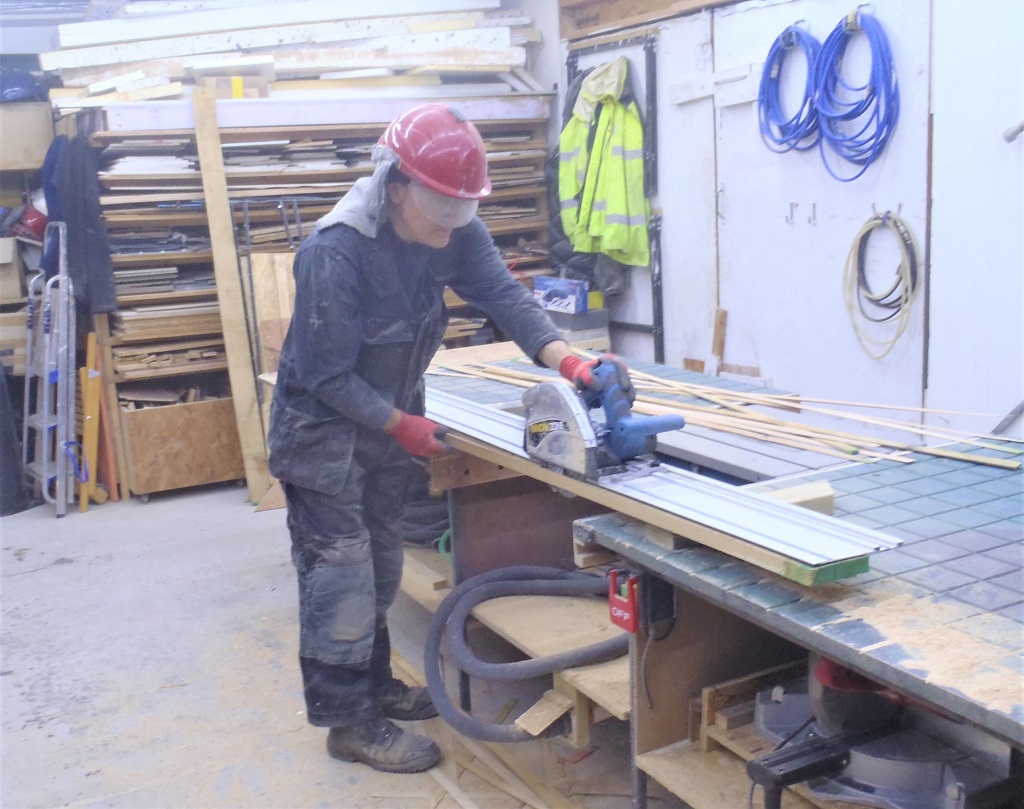
    The Track Saw

    We took 85 planks off our Oak Storage rack, these being a nominal 27mm thick by 2000mm long and selecting them to have a width from 110mm to 160mm wide. We needed to plane down all 85 planks to end up with 100mm wide and 19mm thick. It was the case of using our new circular track saw to slice a straight edge and then using this new edge, slice the excess width off to produce a consistent 105mm width planks with the bench saw.

    Processing Oak Timber to produce Guttering pieces

    Starting-gutter-making-by-straightening-one-edge

    The Planer

    Then our planer, with its two extension tables, took over the job to clean and flatten one flat side before all pieces going through the thickener mode of the planer to clean the other side and generate 21mm thick pieces. We stopped at 21mm thick, as the finish surface was very good so no need to keep going to the target 19mm. The final step was to clean the two edges and passing it through the thickener process to make a set of clean pieces, all 100mm wide.

    Processing Oak Timber to produce Guttering pieces

    Gutter-Planks-ready-for-shaping-

    The Router

    The 85 clean pieces were then split into two piles, the Base board (of the gutters) and the vertical uprights. We needed more consistent and longer ones for the base boards (a total of 43 full length 2metre pieces). The remaining, made up of 34 full length pieces and a collection of random lengths where we had to cut some planks up because they had more twist and warp down the length (to minimise wastage during the planing process).
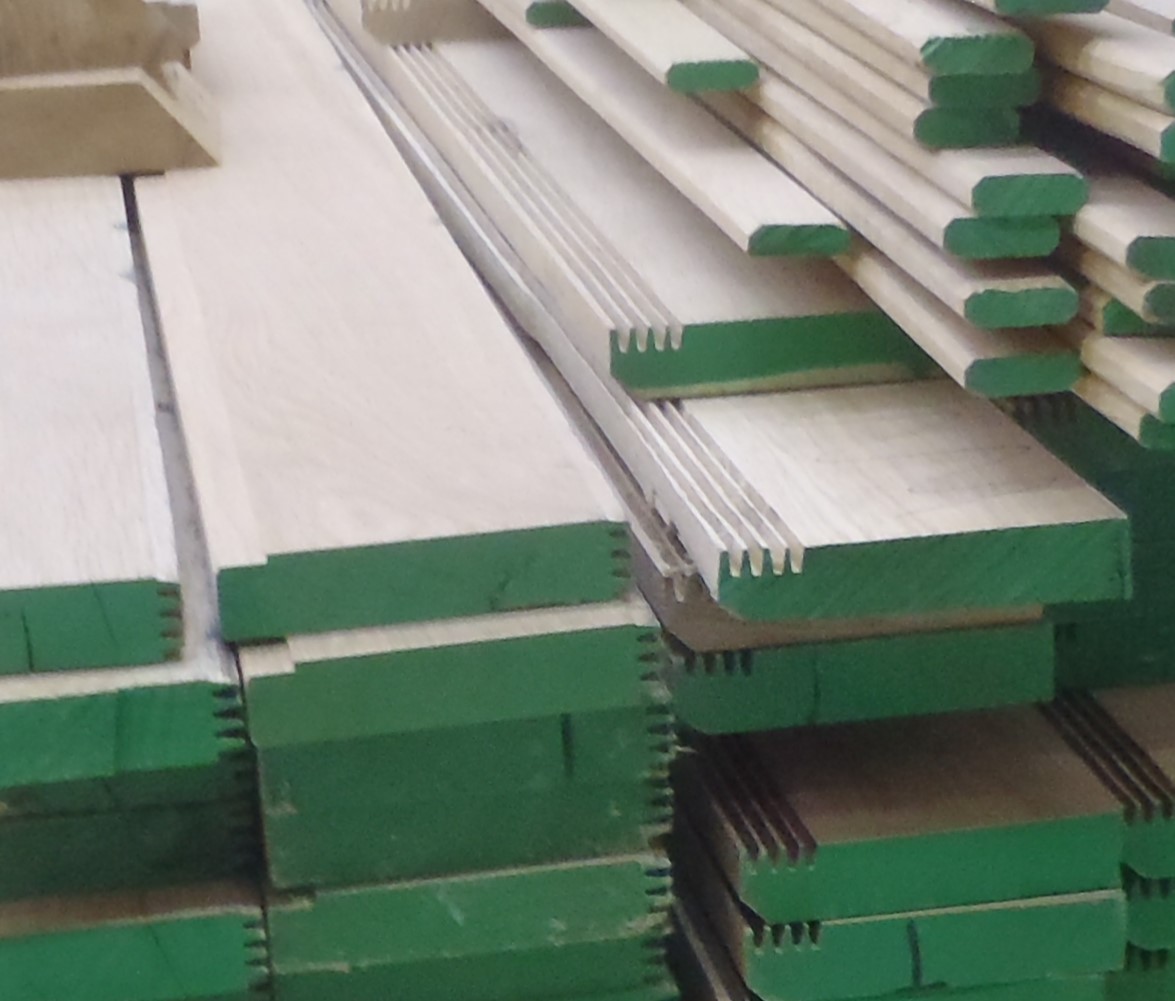
    The first job with the router was to cut tongue and groove joints in both the base boards and the upright pieces. These are made up of four small “fingers”, located on the edge of the base board and on the lower side of the upright pieces so they come together and lock into a right-angle combined object. Then the upright pieces had a 45degree slope trimmed on the bottom edge so it provides a neat corner to the gutters. The final step was to trim a 10mm strip off the back of the base boards to provide a 19mm thick “tongue” that will slot into the Fascia boards.

    The Cap and Covering Strips

    Using the left over pieces from the earlier slicing of the wider planks, and more from our old left-over pile of strips in storage, we then produced lots of thin strips of Oak pieces, one size for capping the Upright sections of the guttering (designed to clamp and hold down the rubber liner and wire mesh), measuring 30mm wide by 10mm thick with all edges trimmed with a small 45degree angles. The second set of strips is for covering up the vertical and horizontal joints in the gutters, to disguise them. These Covers are a little bigger, measuring 35mm wide by 12mm thick, but only the front facing edges having been trimmed with the 45degree angles.

    Processing Oak Timber to produce Guttering pieces

    Pile-of-gutter-parts

    Processing Oak Timber to produce Guttering pieces

    Gutter-part-shapes

    Processing Oak Timber to produce Guttering pieces

    How-all-the-gutter-parts-go-together


    We have finished producing this set of Oak timber pieces for the guttering around the roof but only with the experience of installing the gutters will show us if we have generated enough wood to complete the whole circuit. It is not difficult to make some more, we do have some spare oak planks in storage.

  • Slates on Section D and E Completed and Preparing the Guttering on Last Section At Last

    In these two weeks, there was a big disruption and stoppage to our work. The first week had only one successful day of work and that when we got the “D” section of the roof completed and got started on the “E” roof. The rest of that first week was spent recovering from the flooding we suffered during a very heavy rain storm, see Rain, Rain, Rain. for more details!
    The second week was more successful thank goodness .. ..
    First day, Monday, was spent in the workshop processing five more oak planks to make the remaining guttering pieces. We were short by three base pieces and two front ones. We had some of each type left over so we used those ones as our template to duplicate the extras. It was a 4 stage process to cut the various tongue & groove edges, bevelled angled edge and making the tongue to fit the fascia slot. We finished this task with a morning session on Wednesday.
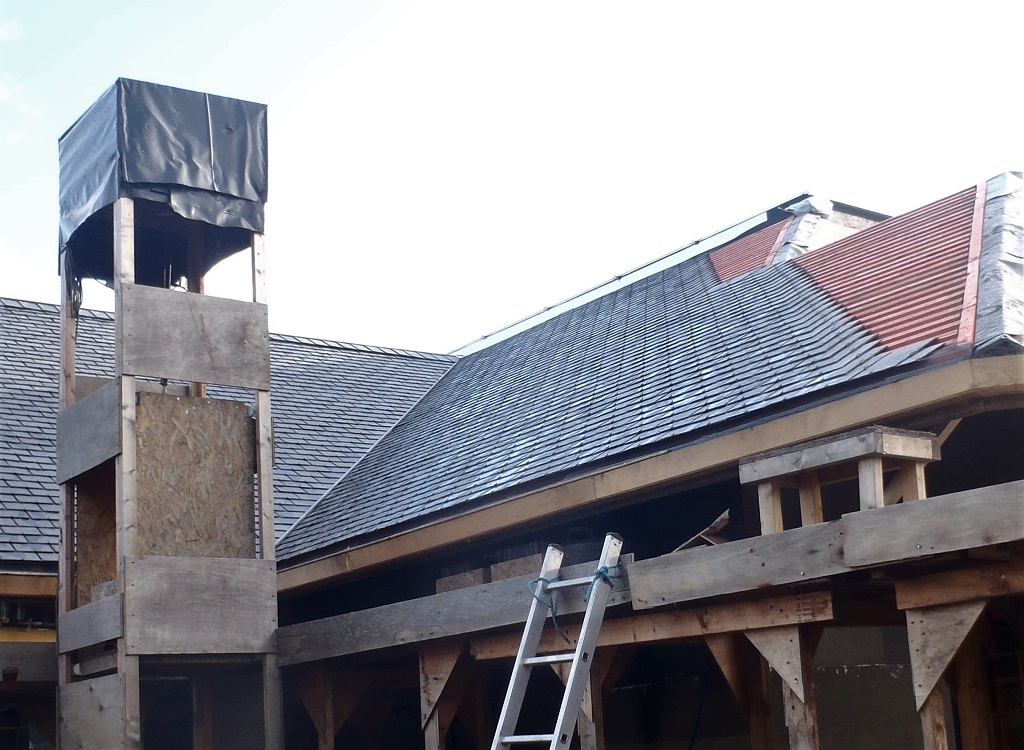
    Fortunately, we had some dry days remaining so we got on with putting up slates up on the “E” section of the roof and got most of it covered by Thursday. We couldn’t go any further as we don’t have any access (safe access) from the other roof surfaces to finish off the section.

    E-mostly-slated

    E-mostly-slated

    The-ABDE-Junction

    The-ABDE-Junction


    Friday was an alternative day of work doing a hand rail for a family member and fitting it to their stairs. We made it using a 3metre plank of 27mm thick oak timber and planed it down to about 80mm wide with a gentle horizontally curving profile. Also we made a 45mm square post with another oak piece we had left-over from a previous job (the window sill).
    And finally, on Saturday, we rearranged two platform modules to extend our walkway and working platform to reach the remaining “H” section of the roof and a bit of the original “I” section where we started this whole job.
    We had to move some empty slate crates and also coiled up two plastic conduit pipes that had been buried underground along the back of the house for various old functions in the past.
    The afternoon saw the base pieces of the guttering cut and test fitted (but not glued) to section “G” and “H”, to rejoin back to where we started all those months ago!
    What was quite odd and amusing is that this last section along “H” saw the most wobbliest stretch of our fascia we have had in the whole of the roof and we had to make some minor adaptions to our base boards to make them fit in a straight line. Nothing complicated.
    (no picture as it got dark!)
    So next week, we will get the gutters finished, fibre-glass and black resin the final three corners, put in the rubber liners and then put up the breathable membrane and wooden battens up the roof.

  • Analysed and Calculated Gutter Flow Direction and Angle of Slope

    This morning, we sat down and did some analysis on the rain collection quantity for each of our roof sections, which totals (including the proposed Conservatory) to 360 square metres. This includes the Skylight region as well. This means that for every 1mm of rain falling on our house roof, we would be collecting 360 litres of water. So for a 10mm rain shower, there would be 3600 litres of water (3.6 tons of the stuff!) pouring into our pipes and down into the rain soak-away modules (or into our rain storage tank when we have made the filtration unit!!).
    The eight down pipe connected to the guttering will handle this quantity of water and our analysis and calculations have assigned which section of roof is combined together for each given Downpipe channel. The other calculation was the angle of the guttering slope or fall. For the longest runs, there will be a 30mm drop from one end to the other (about 10 metres of gettering, making it about 3mm drop for every 1metre or in standardised units, about 1 in 300 angle).
    We then went around all the eight downpipe channel positions to measure the offset of each module again against the Fascia’s bottom edge so we know how much to add these “drops” in relations of that edge, at the start of a run.
    This now means that we have numbers assigned for all the corners of the roof and the next job is to snap a chalk line at the appropriate height and then cut a slot into the Fascia board, ready to receive the Oak guttering pieces.

  • Last Three Fascia Sections Done and Three Downpipe Channels Installed

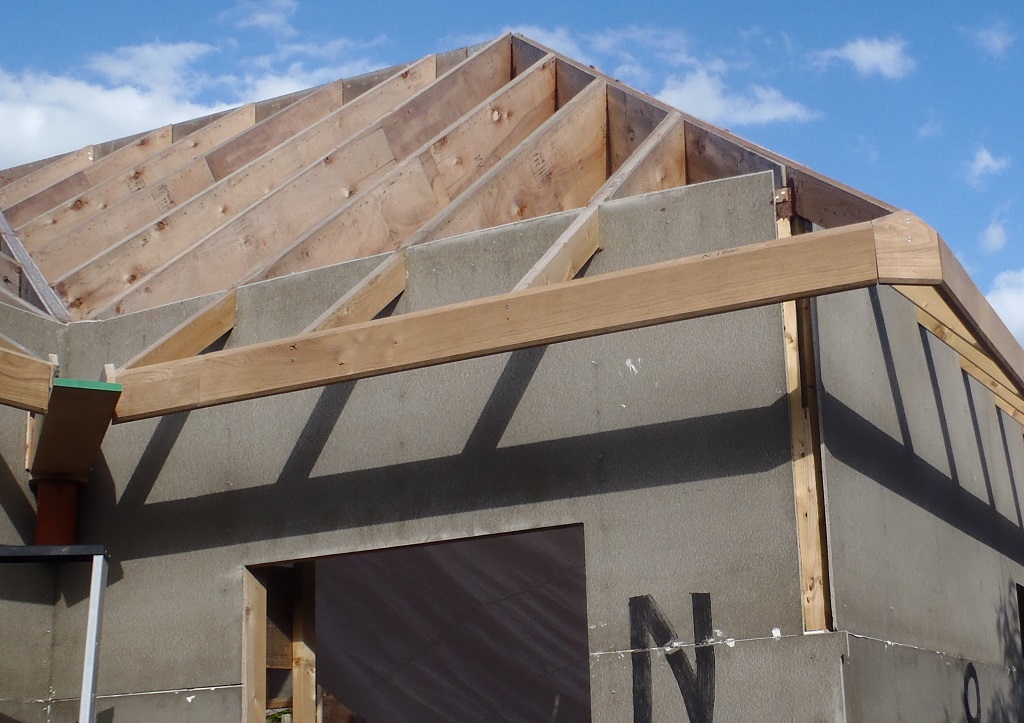
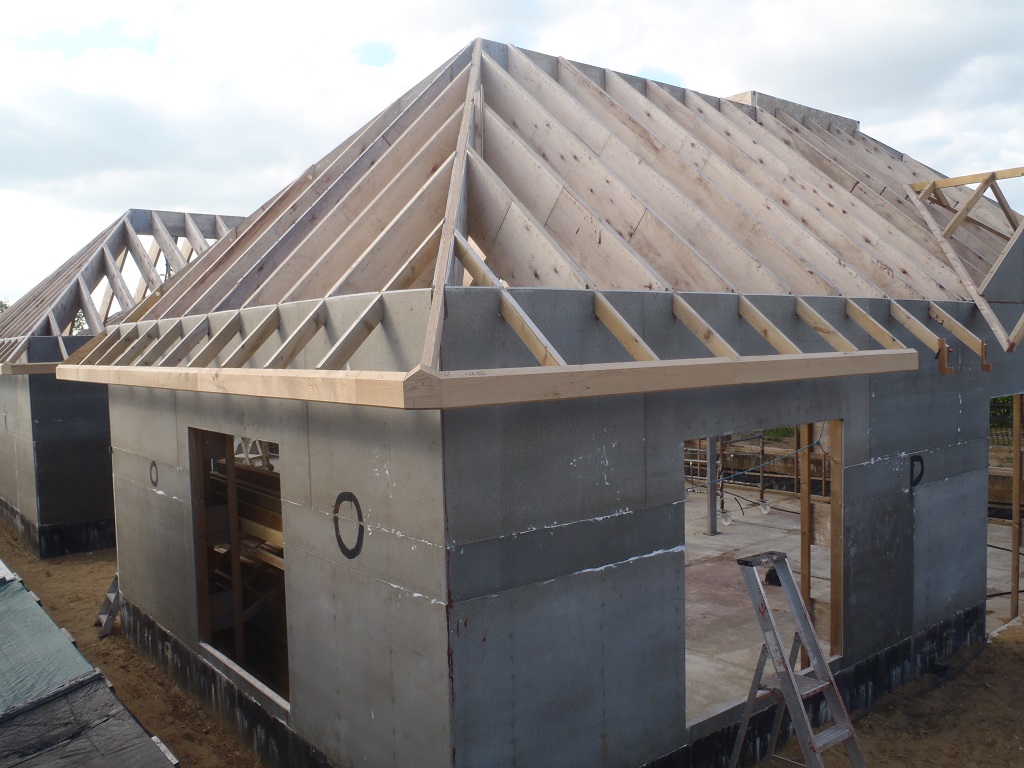
    We carried on with the “N”, “O” and “P” sections of the Fascia boards, getting the last two outside corners up and fitted (on the NO and OP corners) and screwed the Oak pieces into place.

    Last Three Fascia Sections Done and Three Downpipe Channels Installed

    N-Fascia-Installed

    Last Three Fascia Sections Done and Three Downpipe Channels Installed

    OP-Fascias-Installed


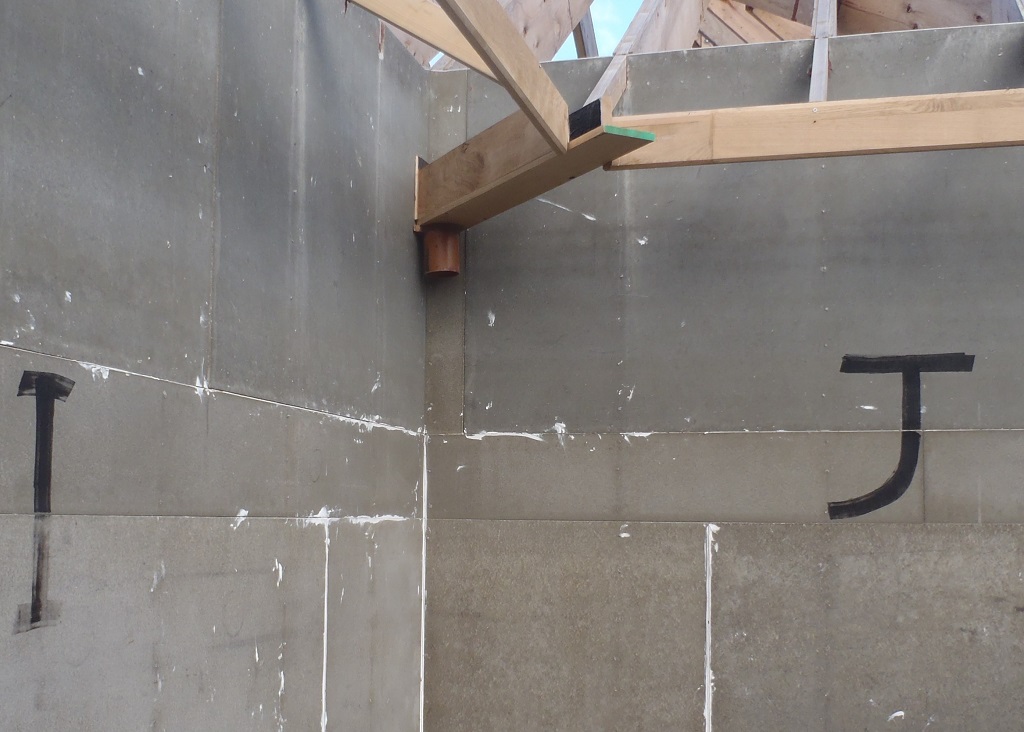
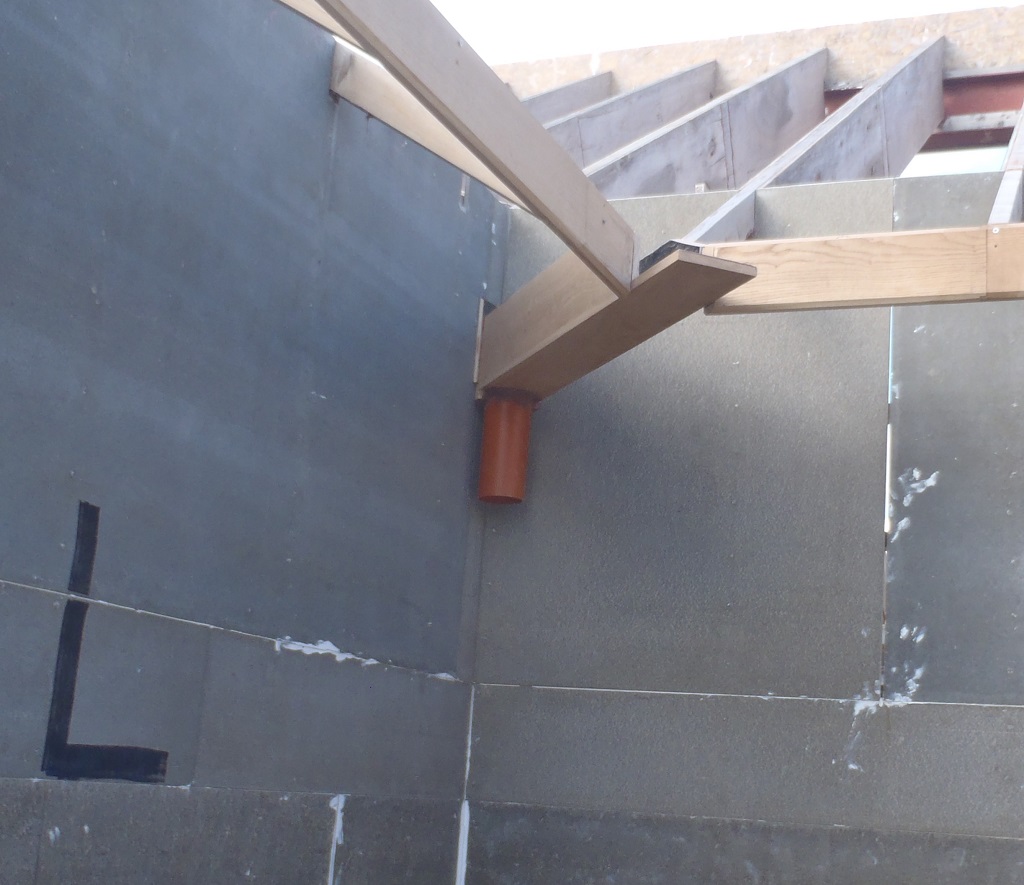
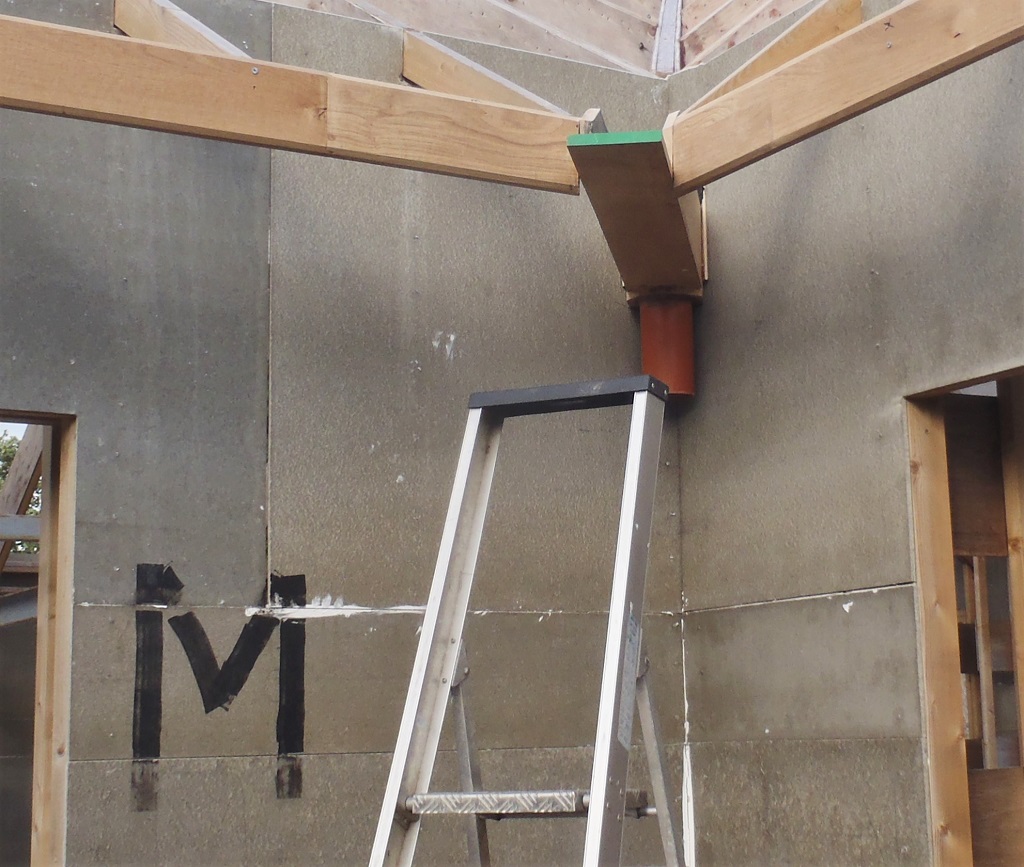
    After lunch, we tackled the three Downpipe Channels, for IJ, LM and MN inner corners, each taking an hour or so to complete. It was very hot work under the blazing sun, and the wind wasn’t really cooling at all, even though it was strong!
    Last Three Fascia Sections Done and Three Downpipe Channels Installed

    IJ-Downpipe-installed

    Last Three Fascia Sections Done and Three Downpipe Channels Installed

    LM-Downpipe-installed

    Last Three Fascia Sections Done and Three Downpipe Channels Installed

    MN-Downpipe-installed


    Tomorrow, we will do the last two Downpipe Channels (the temporary ones) for the conservatory where it would join to the “P” section (in the middle of it) and conclude all the Fascia right around the whole house.

    Finally here’s a Time Lapse of yesterdays work.

  • Final Black Finishing Coat of Glass Fibre Resin Applied to Downpipe Channels

    This morning, we finished off sanding and cleaning up the work we did yesterday on the Downpipe Channels, by removing excess glass fibre here and there and preparing them all for the final “top coat” resin layer.

    Downpipe-channels-finished-with-Black-resin

    Downpipe-channels-finished-with-Black-resin


    The deep black resin is a special formulated resin with a bit of wax added. This causes the surface of the resin to “pull” itself into a very smooth finish which is ideal to make the rain water flow as quickly as possible.
    The next job is to use our new liquid level device and set out our “L” wooden brackets all around the whole building to get the Fascia boards to be aligned at the same height everywhere!

  • Glass Fibre Resin Coating for Downpipe Channels

    Yesterday and today, we have been preparing and starting the process of putting on a fibre glass resin surface on the insides of the Downpipe Channels. Yesterday, we filled in all the right angle joints with filler to make a smooth curved transition so the glass fibre can fit more easily.

    Downpipe-Channels-inner-corders-radiused

    Downpipe-Channels-inner-corders-radiused


    This morning, we rubbed all the filler to take off any sharp bits and then started the glass fibre coating. The first layer was a medium grade glass fibre mesh to provide the core strength to bind and reinforce the resin, and this was followed by a second layer, just on the bottom base board, is a tissue glass fibre to smooth out the ripples.
    Downpipe-channels-glass-fibered

    Downpipe-channels-glass-fibered

    We then waited for the resin to set a bit then trimmed all the excess fibreglass off and sanded thing smooth.

    Downpipe-channels-glass-fiber-trimmed-and-sanded

    Downpipe-channels-glass-fiber-trimmed-and-sanded


    Tomorrow, we will give the whole thing a final layer using a special “top-coat” resin, in a solid black colour, this will give us our glossy smooth finish inside our guttering to encourage the rain water to flow nicely down to the plastic pipe and beyond.

  • Last Three Downpipe Channel’s Made, Corner Eves Cut and Fascia Boards Acquire Bevelled Edges

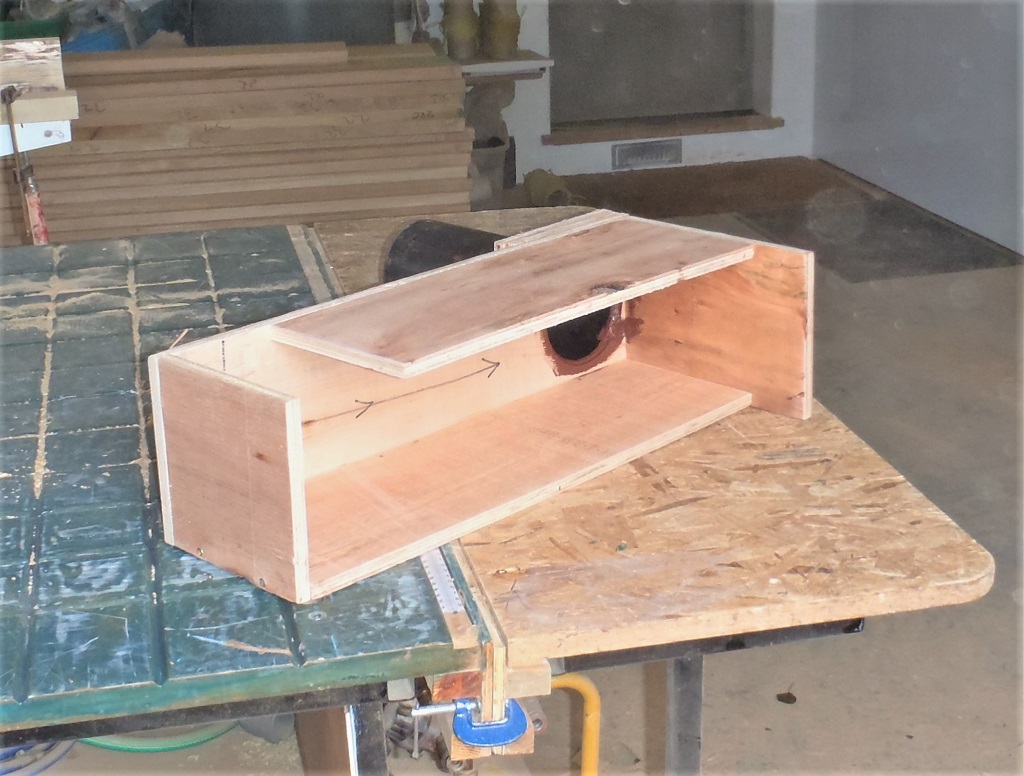
    This blog is a rather long catch-up report of the last few days of work. On Saturday, we made the Sixth Downpipe Channel, this time for the one connecting up the “G” section of the roof next to our Side Door. It is a straight one, all aligned up with the edge of the “G” Fascia but it will still have an extra 45 degrees added on to provide an enlarged collection area to catch the rainwater running down the valley slope of the roof.
    Then, in the morning of Monday, we had a go at installing a rubber membrane inside one of our Downpipe Channel but it proved to be very awkward and we couldn’t get the rubber to fit smoothly down inside on the base of the channel and down into the plastic pipe too. We had to abandoned this idea and switch over to applying fibre glass and poly-ester resin to paint the the inside surfaces in our channels to make them fully water proof and not let the wood rot (We have ordered the materials needed and will finish them when the stuff comes) .
    So instead, we carried on making two more “temporary” downpipe channels, for the point where our Conservatory will be when we get to build that part of the building later on. These temporary channels are just made from plywood pieces and not oak. That was completed by early afternoon on Monday and we spent the rest of the day doing some Charity work making thin wooden Basket weaving bases for a local VI  Craft club in Yarmouth.

    Temporary-downpipe-channels-for-PQ

    Temporary-downpipe-channels-for-PQ


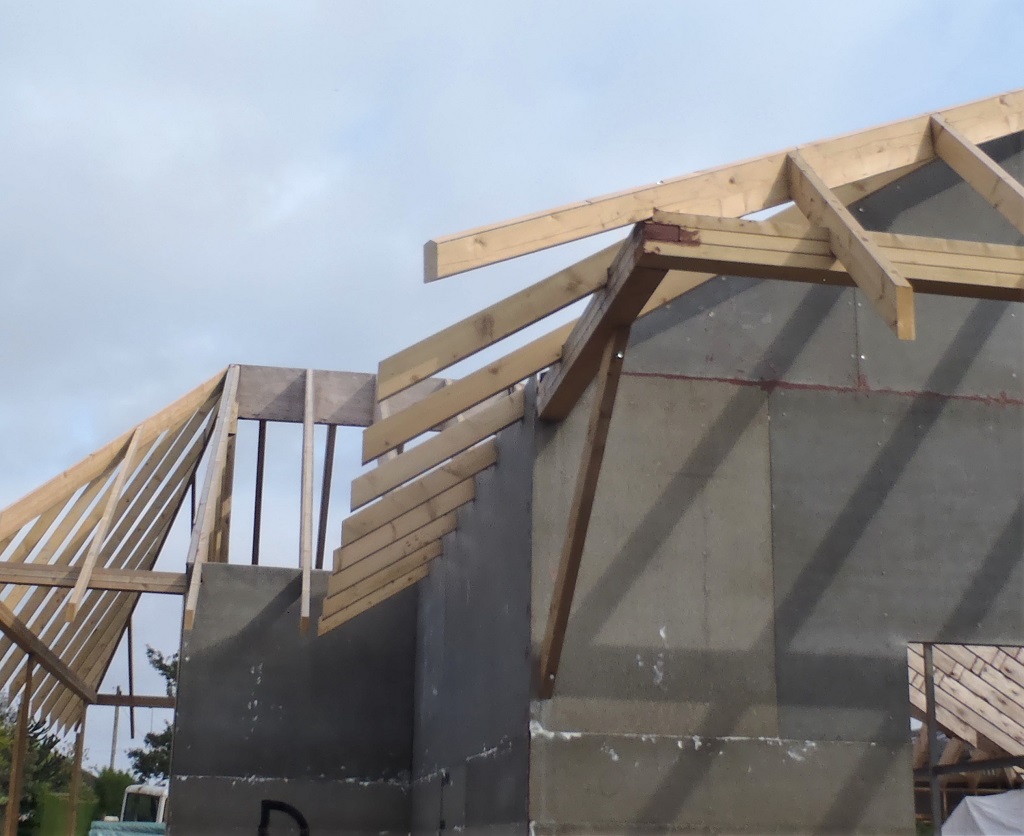
    Yesterday and today, we tackled the job of trimming the ten external “outside” corners of our house and its roof. These corners have long sticking out LVL diagonal rafters and we needed to trim these off at the point when they meet the Fascia board which is coming around the corner at a 45degrees angle. We made a template to allow us to hook it up onto the ends of the two lines of eves (coming off the two sections of the roof that meets at these corners) and marking where to chop off the excess amount.
    Trimmed-corner-of-EF

    Trimmed-corner-of-EF

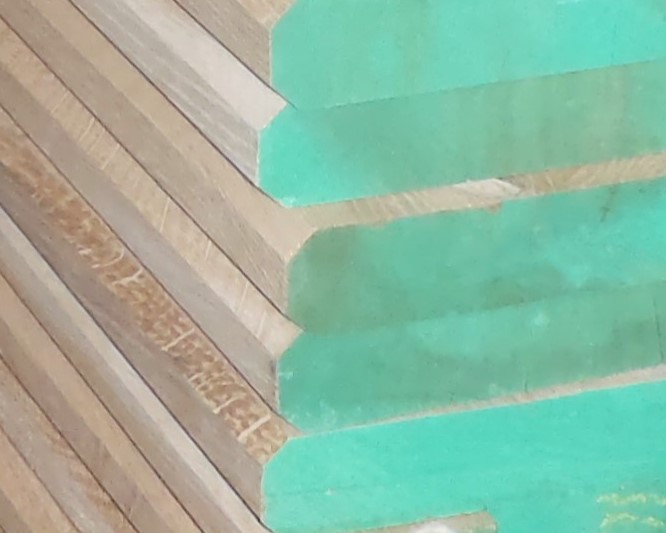
    And finally, this afternoon, we gave all our Fascia boards (41 of them + a wide one too) a double 45degree angled bevel edging so this forms an “interesting” bottom edge of the Fascia when it is all up.

    Chamfered-edge-of-facia

    Chamfered-edge-of-facia

    The next job is to analyse all our Fascia segments, working out how long each one is, what angle of saw cut we would need and matching that requirement with our 41 ready-made lengths we have. We will need to be careful not to waste too much wood as we don’t have an endless supply – grin!!

  • Fifth Downpipe Channel With Pipe Inserted

    A short session only for today. We drilled the large 110mm hole in the Downpipe Channel we made yesterday and fitted the plastic pipe into position. Everything was glued and now curing.
    Tomorrow, we will see how well the rubber has glued together but also we are considering making an mould so we can fold the rubber membrane up around the outside of the mould which will be much easier to do.