Category: Slates

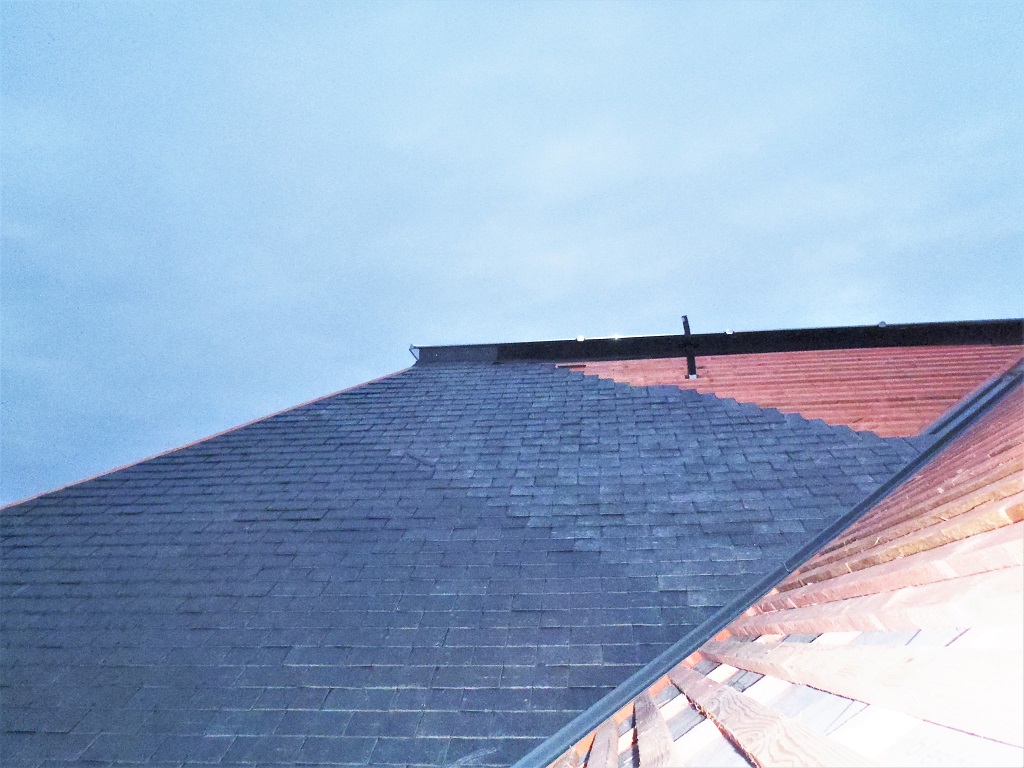
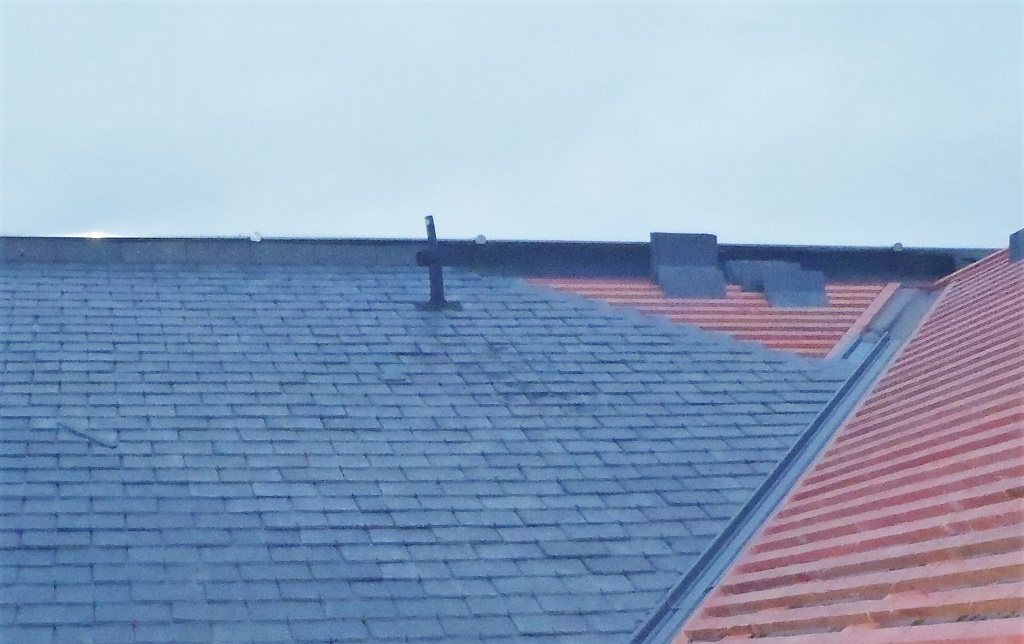
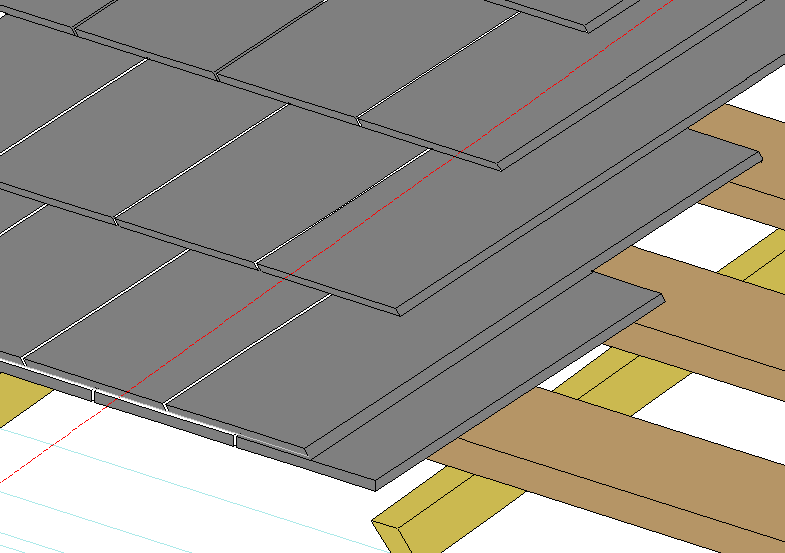
Slate Tiles measuring 300mm by 200mm, 18600 in total, covering 360 square metres.

  • Gutter Mesh Protector Installed, Corrected Alignment of M-N Valley Trough and Hips plus Ridge “Hat” Created for J K and L Roof Sections

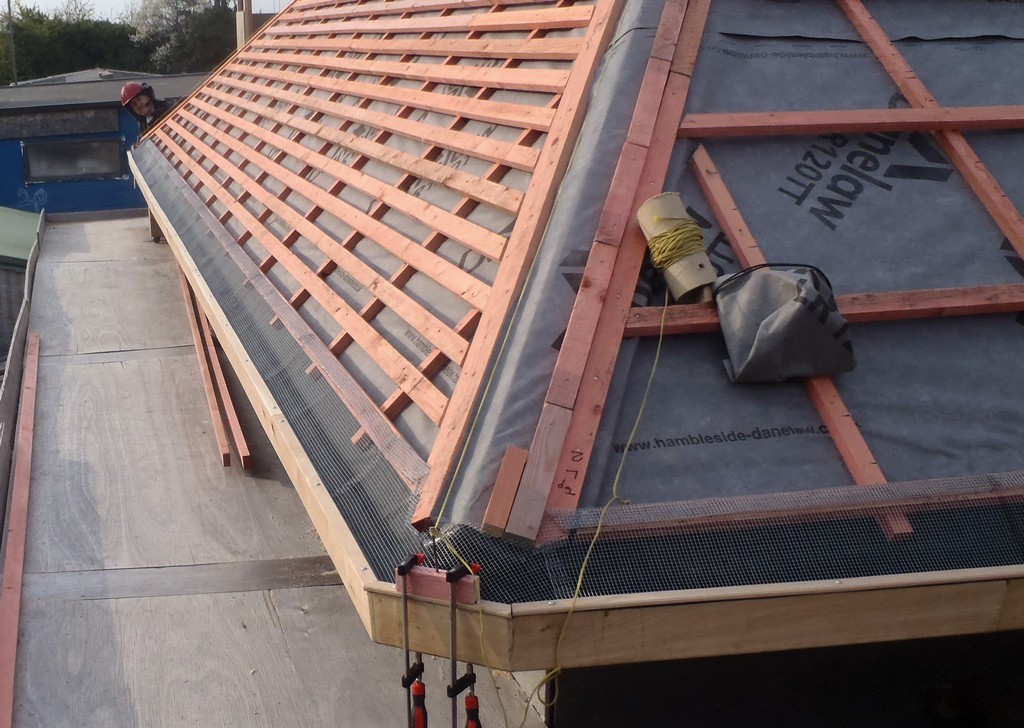
    It was a week of lovely dry weather. We started the week  by tidying the workshop and completing the making of the Ladder Support stainless steel brackets and setting out strings to get the hip flashing straight (The roofs wobble a bit).
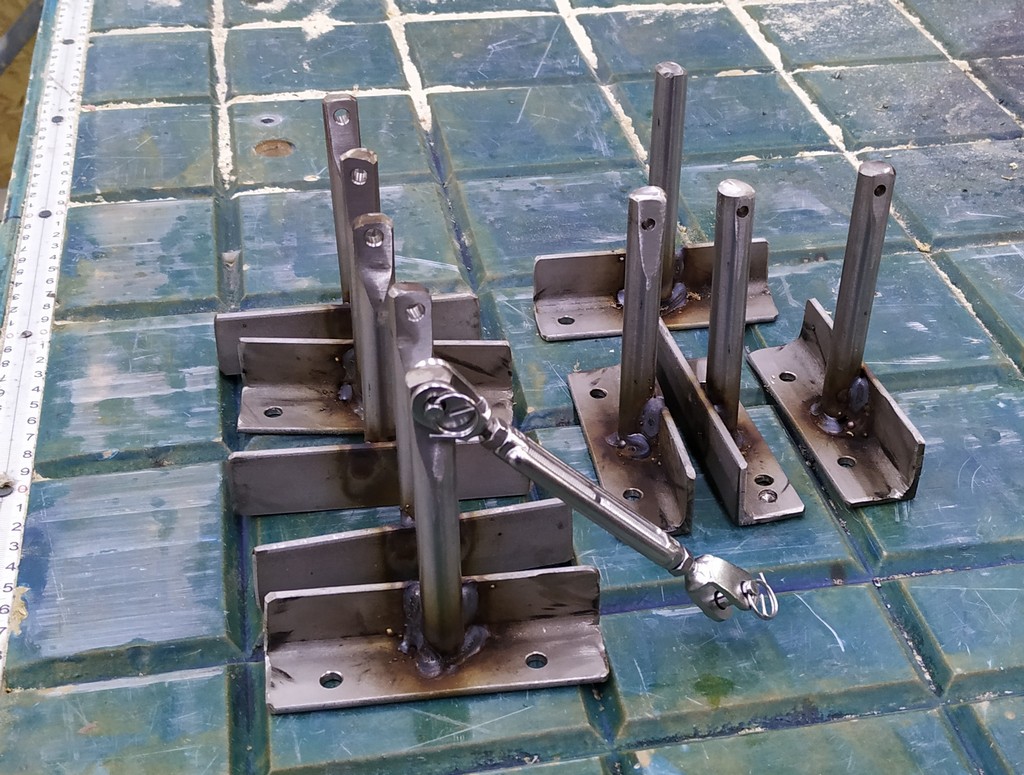
    Skylight-safety-wire-supports
    Skylight-safety-wire-supports

    String-to-align-hips

    String-to-align-hips


    We tackled the next job of putting on the metal Mesh Protector over the guttering where we went along the K section, round the corner into L. Then from one valley (L-M) to the other valley corner (M-N) .. ..
    Gutter-complete-on-K
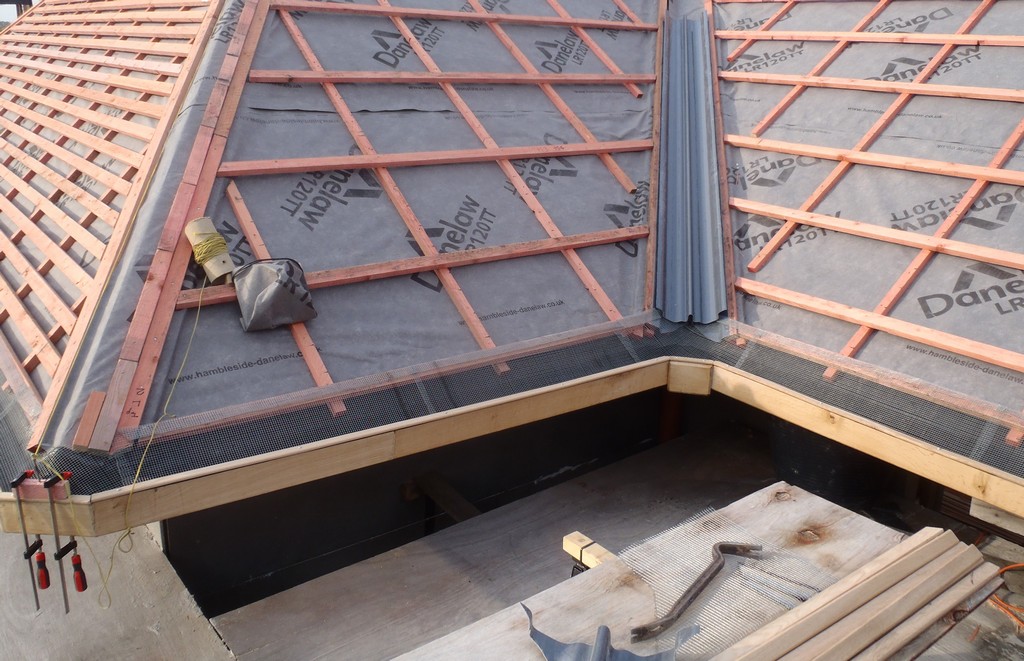
    Gutter-complete-on-K

    Gutter-complete-on-L

    Gutter-complete-on-L


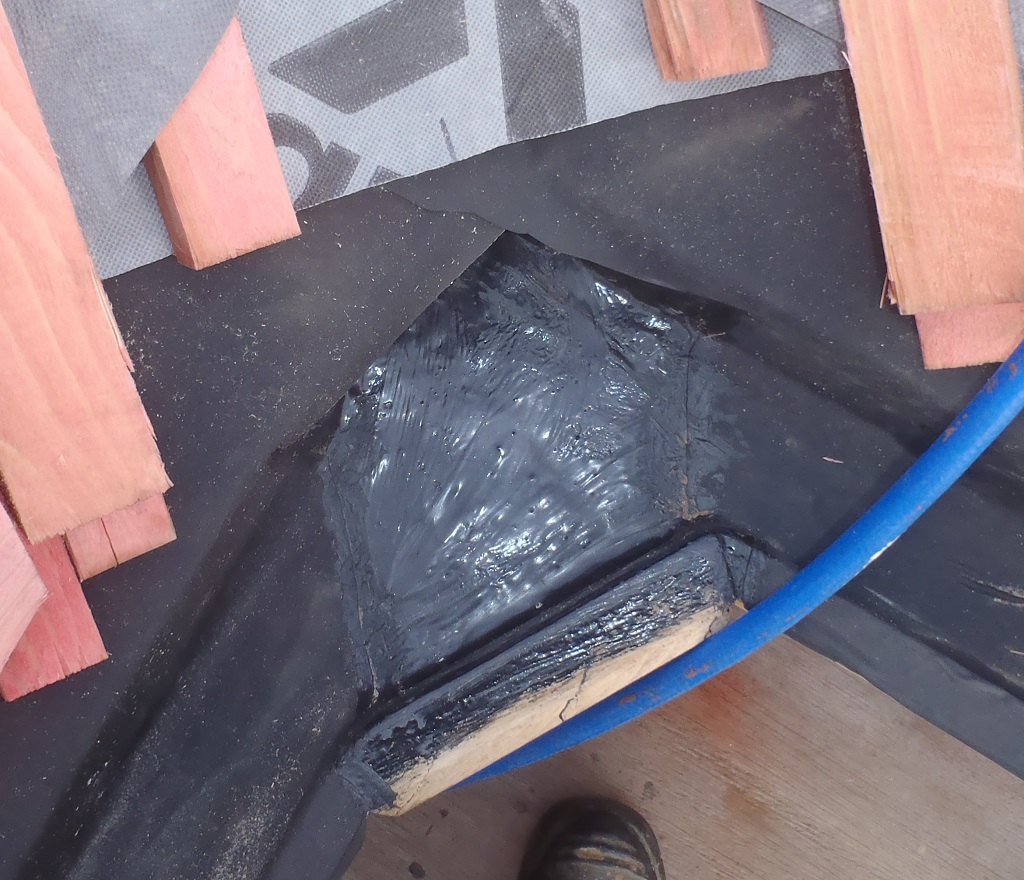
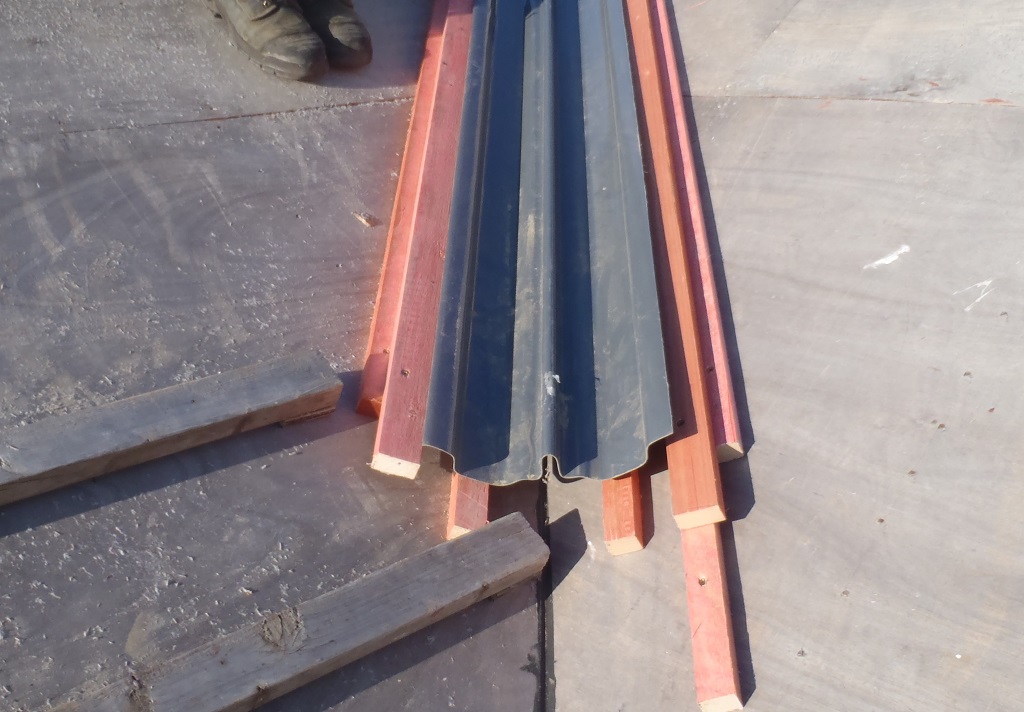
    But before the mesh went down in around the bottom of the valleys, we had to nail into place the glass-fibre trough modules, the first section at least. But we discovered when we came to do the M-N valley that the angle was all wrong. We tried to be too clever when we laid down the counter battens to support the trough, but our lack of experience, and lack of double checking the theory, we shifted the position sideways so that the valley line would be centred to the gutter and downpipe channel! This was Wrong! it made the intersection  of the slates different heights… So we spent the morning doing some open surgery on our roof, peeling back the layers of breathable membranes, moved the wooden battens and realigned it.
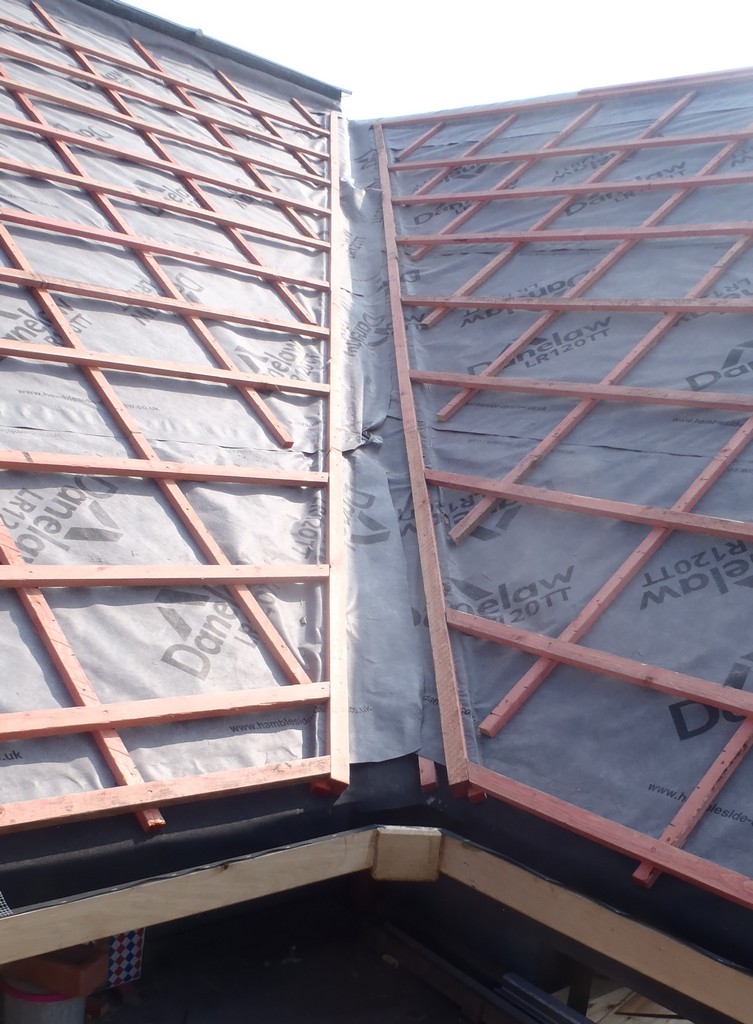
    Incorrect-MN-valley-Before-work
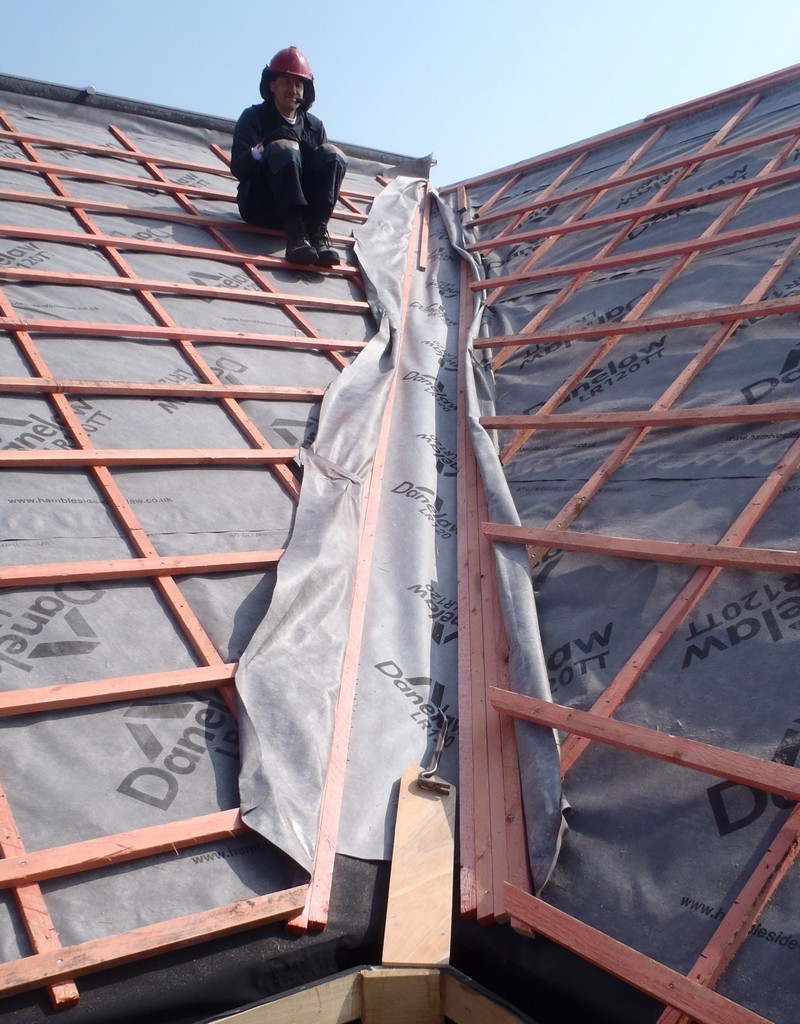
    Incorrect-MN-valley-Before-work

    Incorrect-MN-valley-All-opened-up
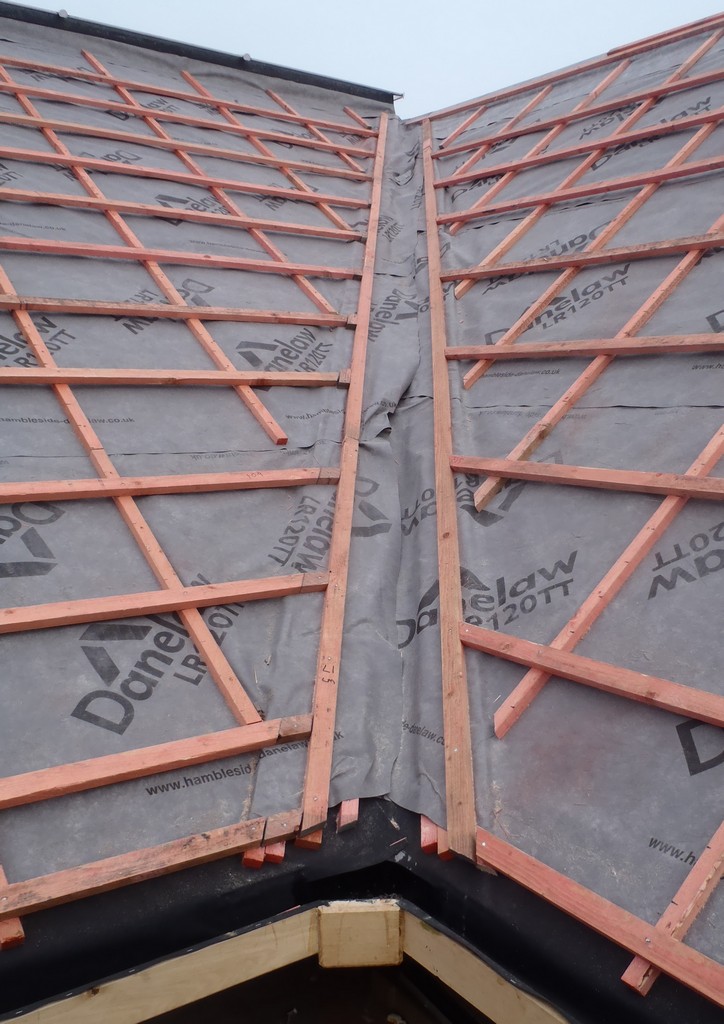
    Incorrect-MN-valley-All-opened-up

    Incorrect-MN-valley-Fixed

    Incorrect-MN-valley-Fixed


    The new angle of the trough now means that the two roof surfaces of the slates coming in towards the valley point are both at the same height and meeting point and makes (will do) a neat line down the valley.
    We resumed the interrupted task of covering up the gutters with the metal mesh and finished three quarters along the N section just before the N-O outside corner. We haven’t done the O gutter with its rubber liner yet.
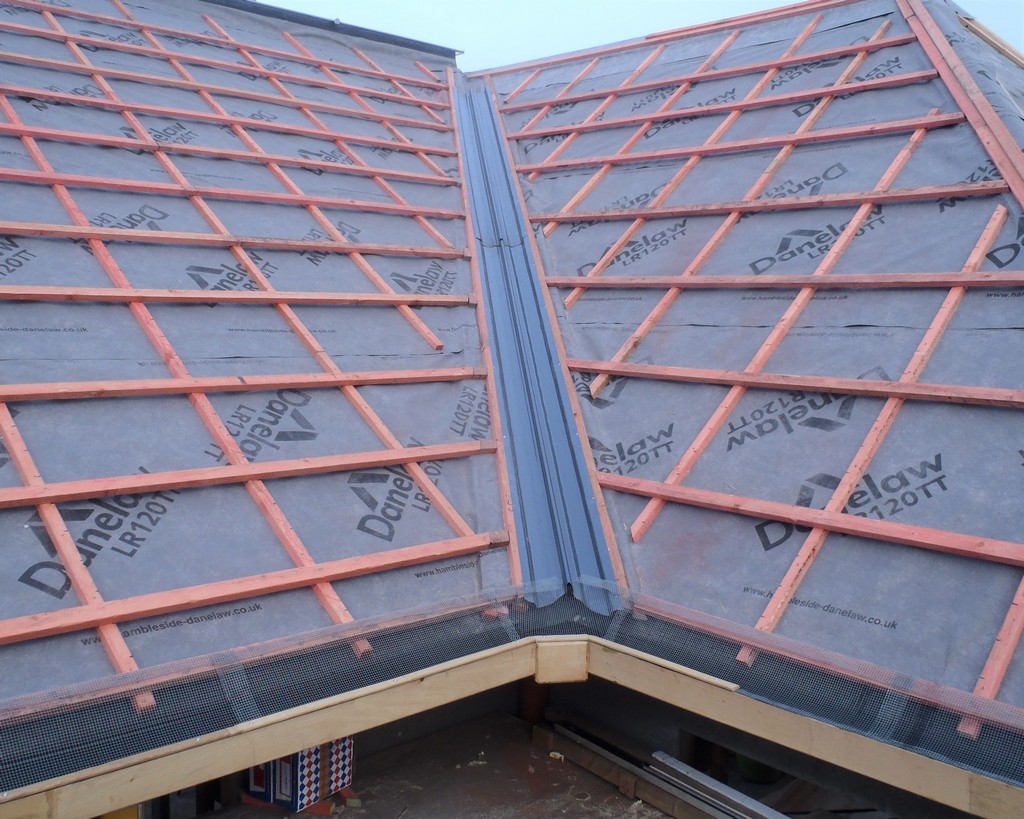
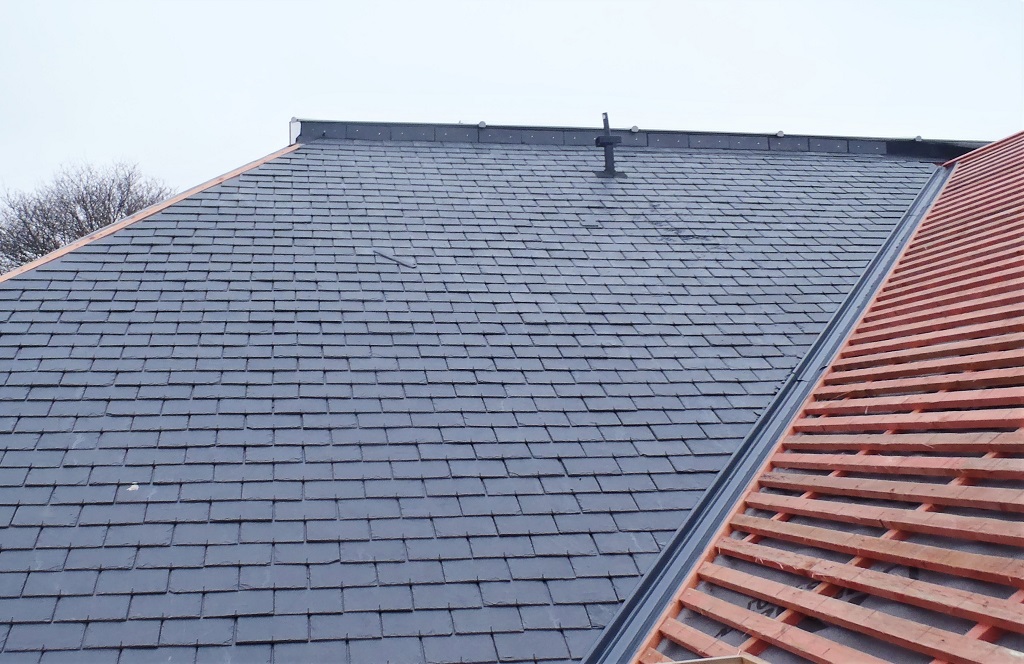
    MN-Valley-installed-and-gutter-finished
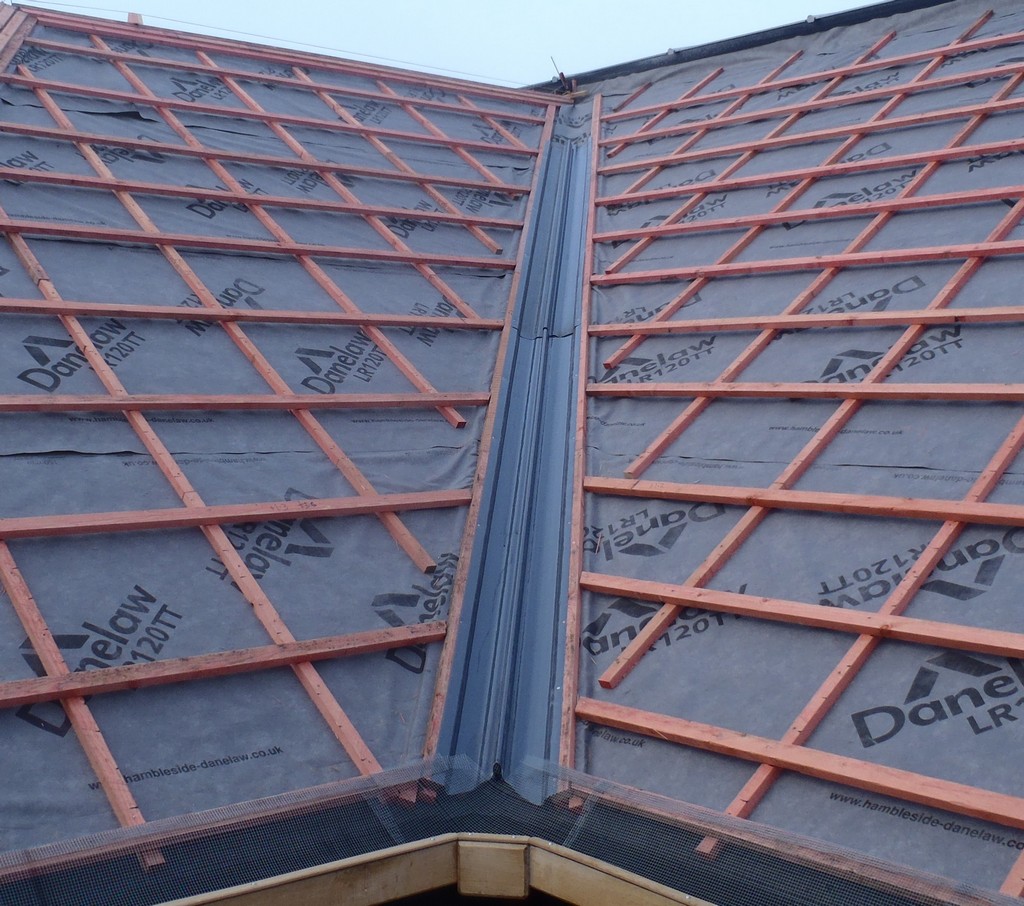
    MN-Valley-installed-and-gutter-finished

    LM-Valley-installed

    LM-Valley-installed


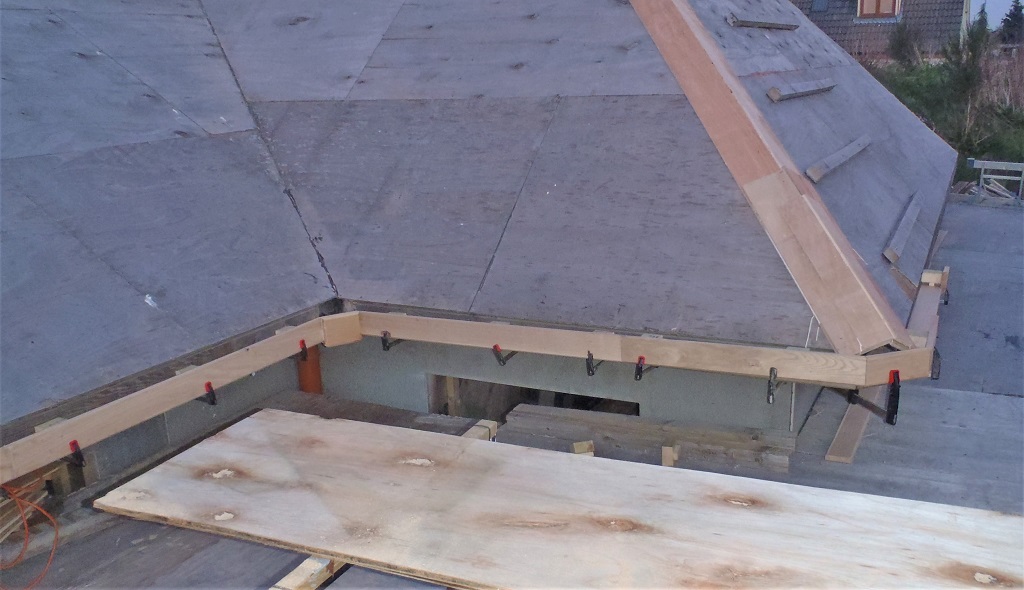
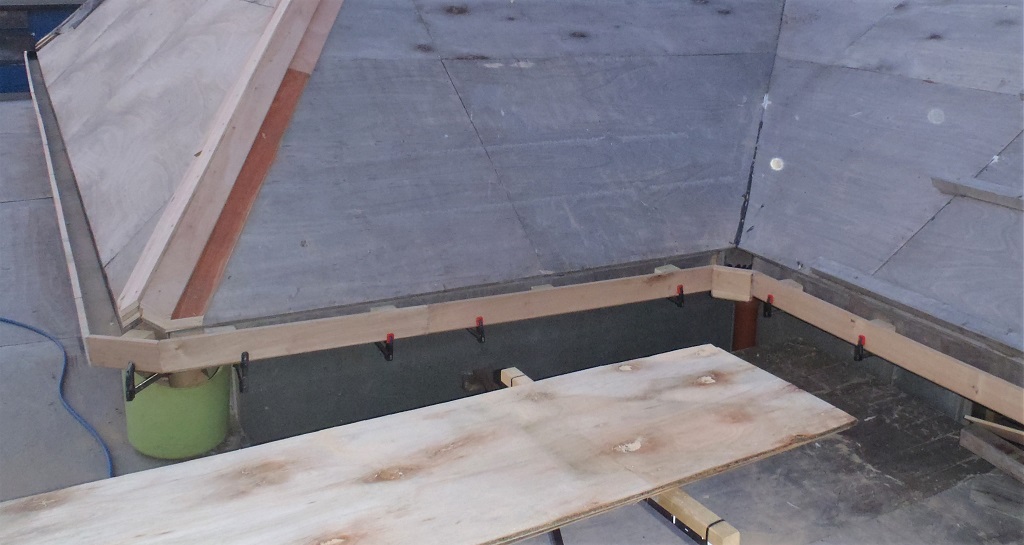
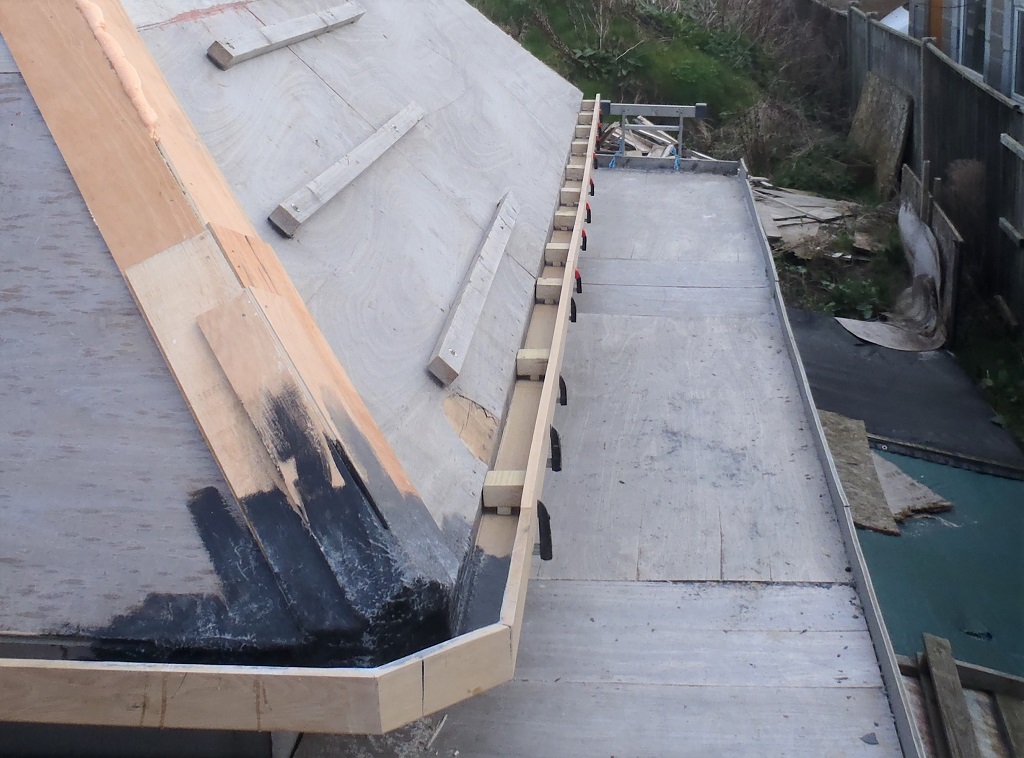
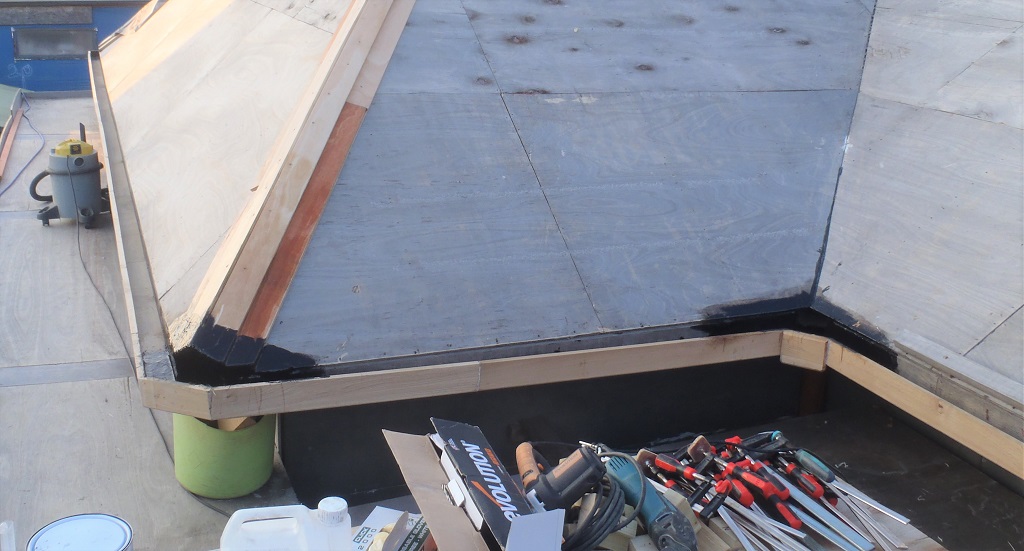
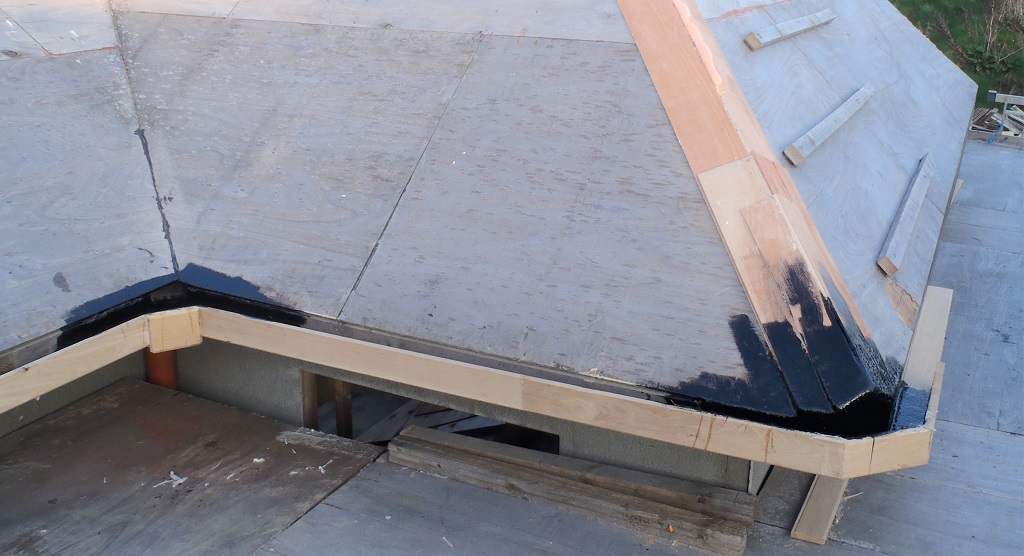
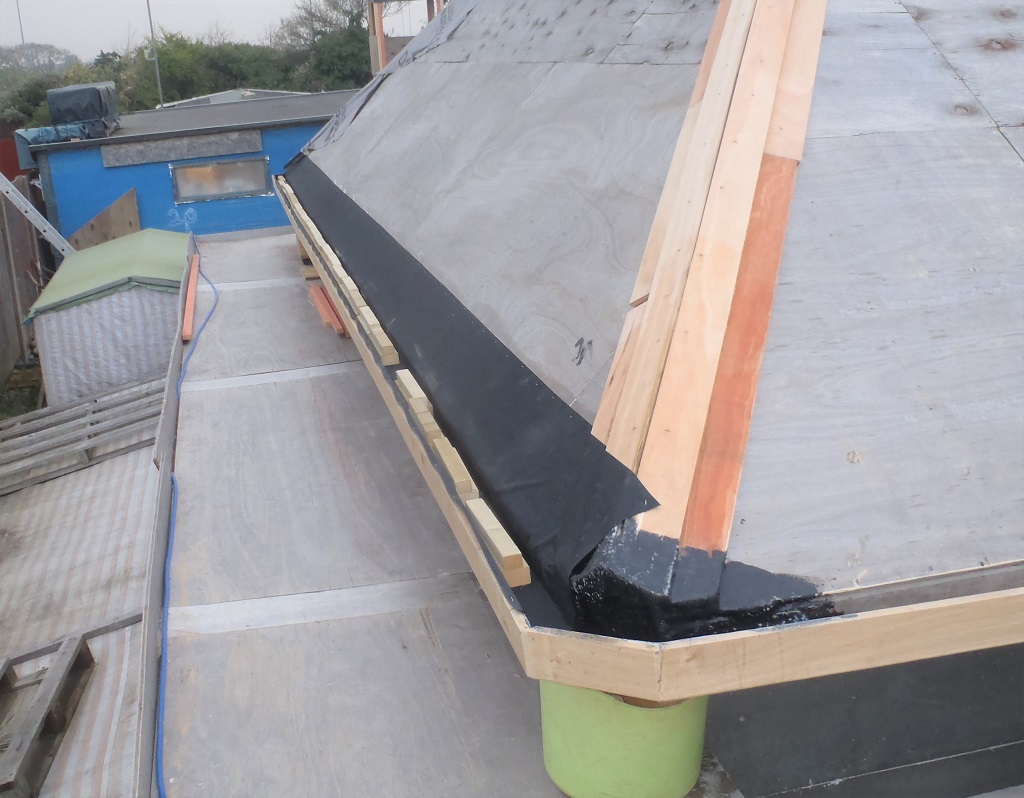
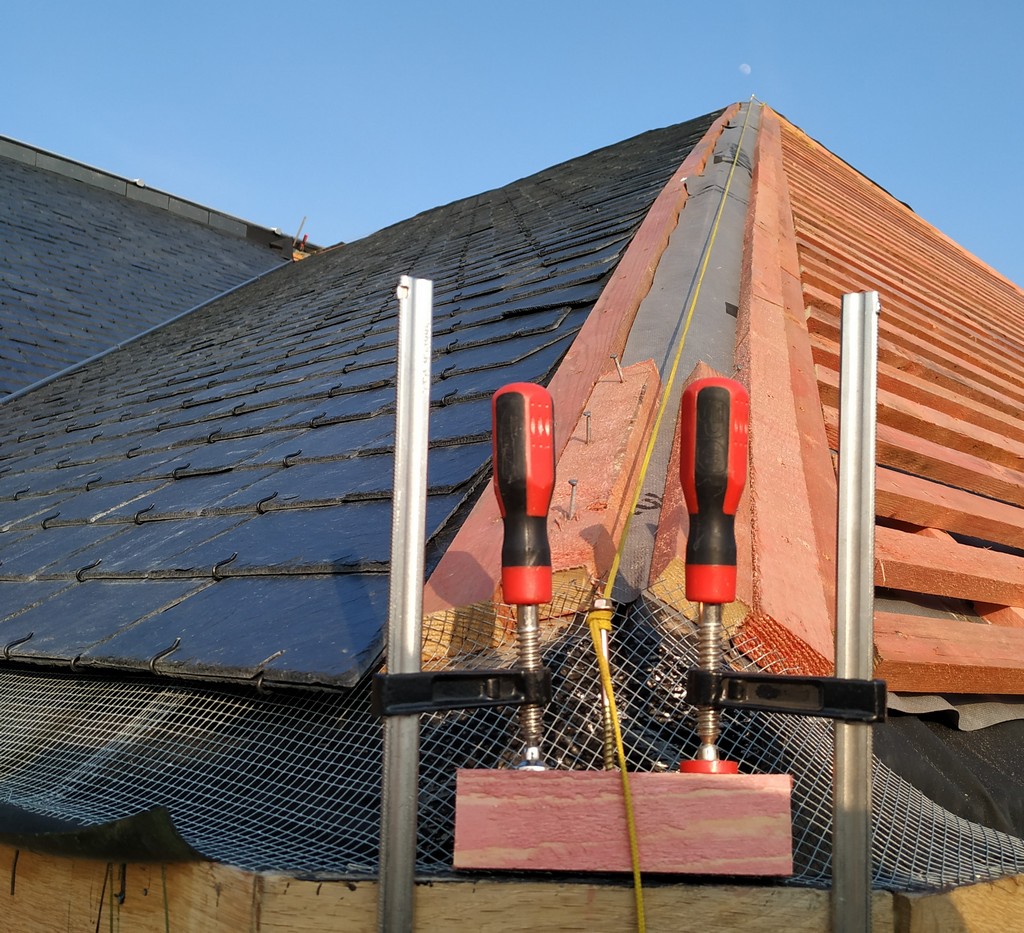
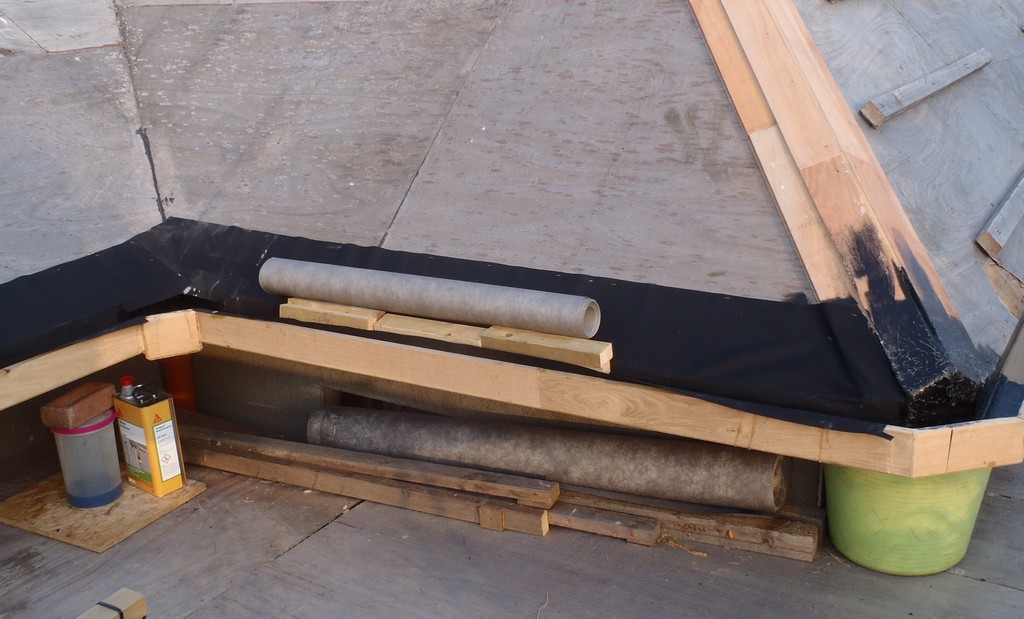
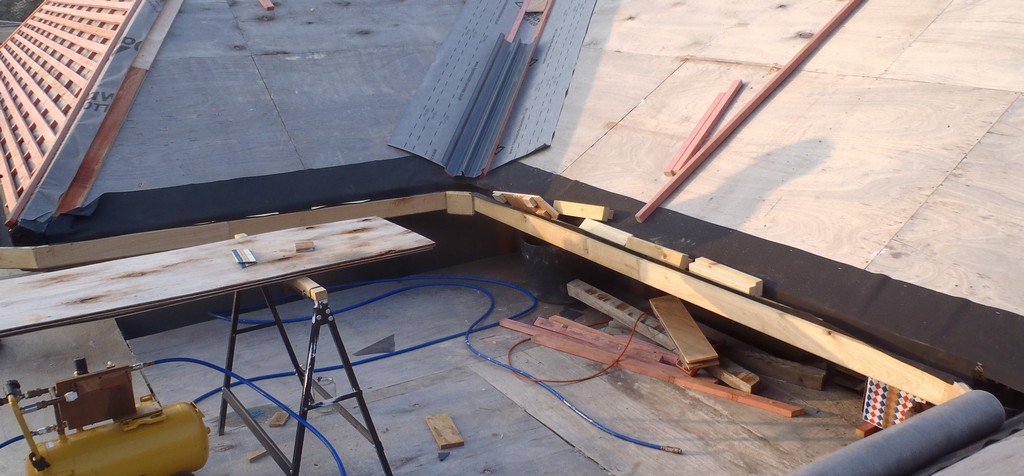
    We had one day of interruptions with a meeting in the morning and putting up the sun shield on our temporary living quarters but we resumed the work, this time, making a rain protective “Hat” for all our Hips and Ridges around the house, we have twelve Hips and five Ridges in total! This is part of providing a flashing system using slates and a layer of rubber membrane and this “hat”. We decided to go with this design because we needed to minimise the effect of the wobbly edges when they come together on the Hips and Ridges, which will be covered up the exposed cut slates of the roof surfaces, with a line of straight slates running up the Hips and along the Ridges. The hat will be a vertical piece of 19mm (¾”), strip with a rounded top (made from an OSB sheet). This is then covered over with a 150mm wide woven glass-fibre ribbon which will get coated in the dark grey resin. This combined object is sitting on top of a 400mm wide strip of rubber membrane.
    We stapled down each of the layers, then using short iron wire pieces, fixed to the underside of the bull nosed strips, was bent to provide a stiff anchorage method of holding the hat upright position against the various angles of the roof surfaces coming together.
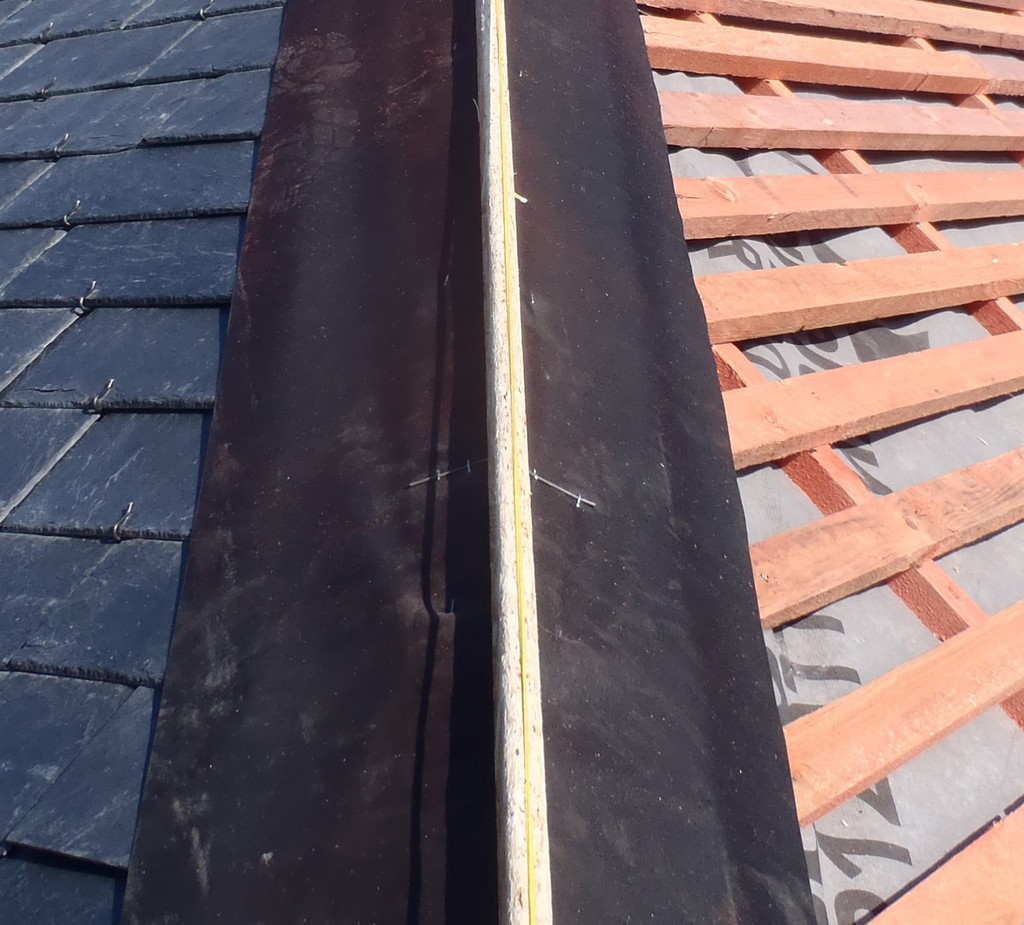
    Hip-hat-support-wood
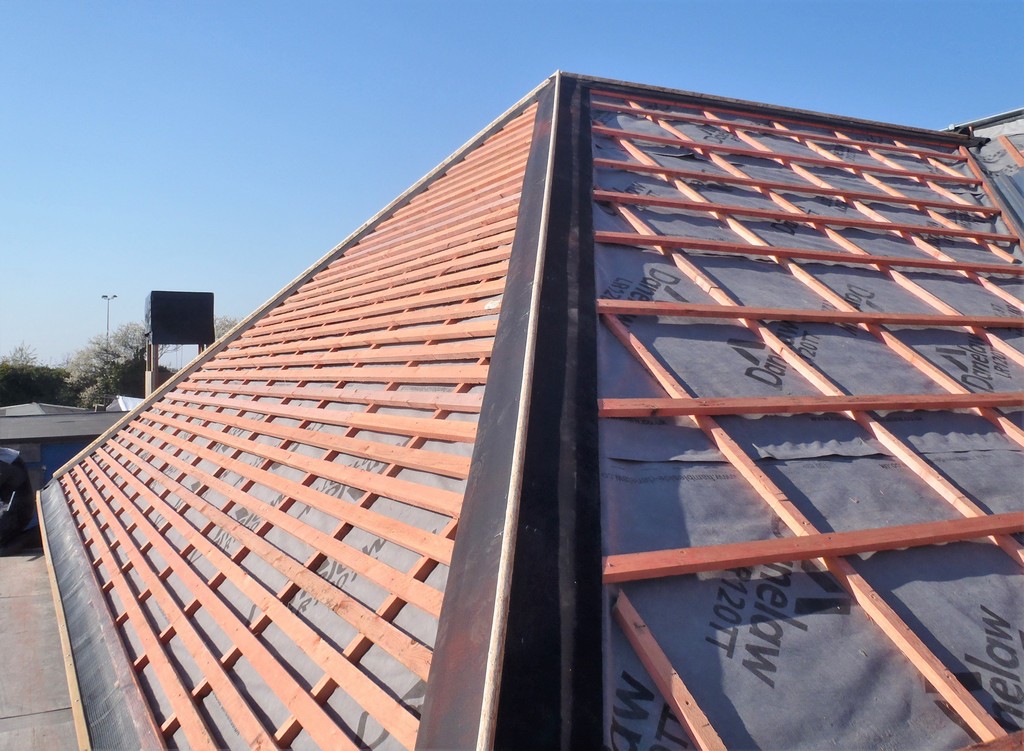
    Hip-hat-support-wood

    Support-wood-installed
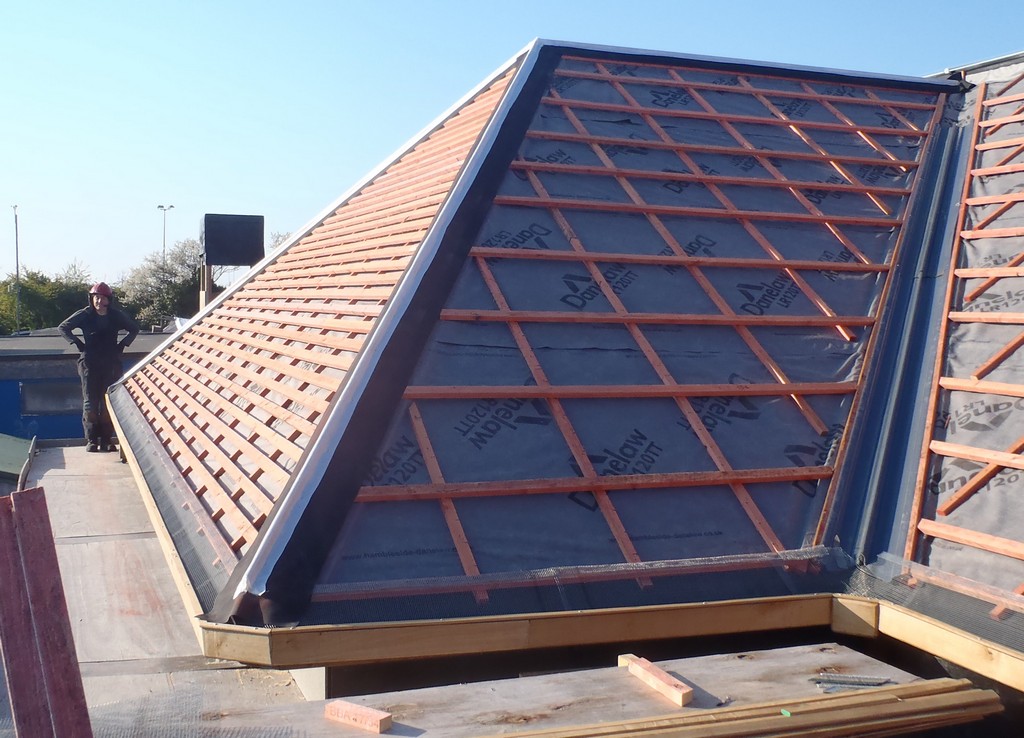
    Support-wood-installed

    Fibreglass-tape-in-place

    Fibreglass-tape-in-place


    The whole thing then got coated with two applications of a flexible roofing resin before applying a top coat finish. Looking at the results, we think we ought to put on another coat of the finishing resin to make sure we haven’t left any pin holes behind to let rain water in.
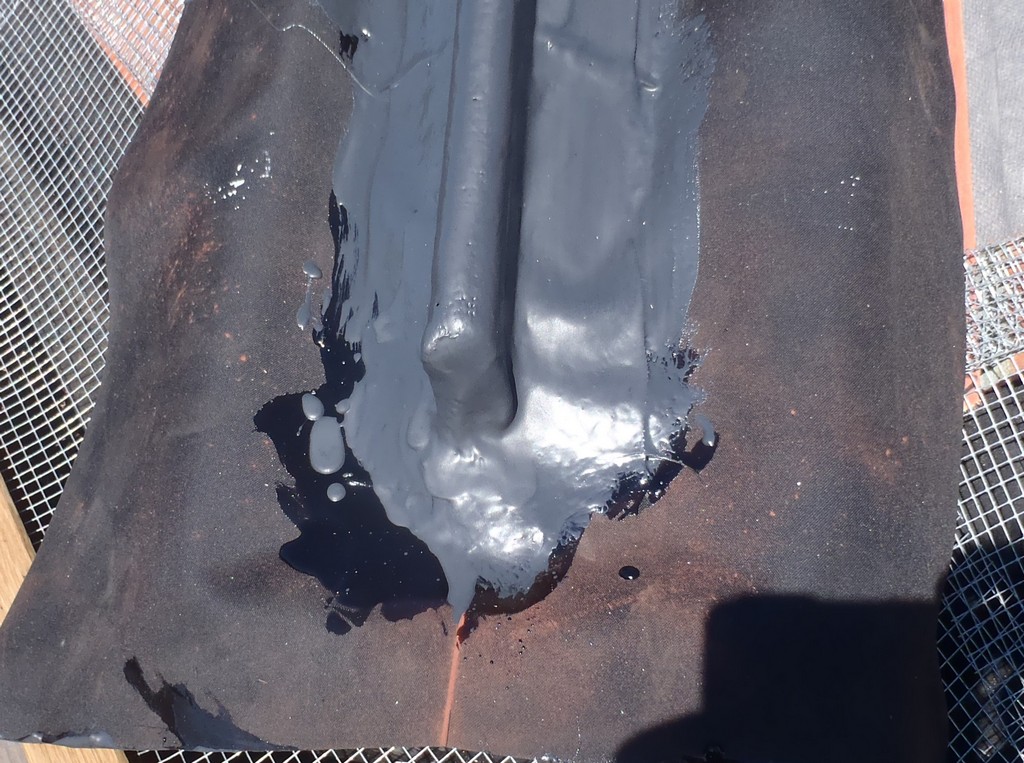
    Hip-hat-finished-1
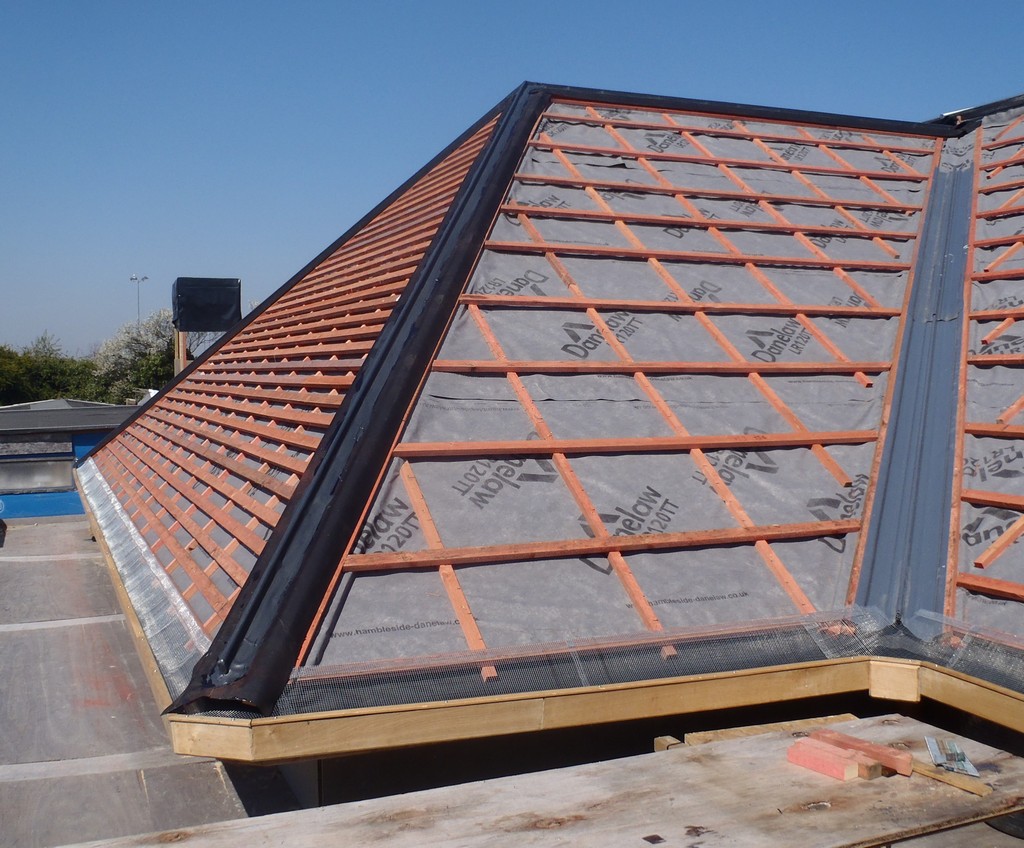
    Hip-hat-finished-1

    Hip-hat-finished-2

    Hip-hat-finished-2


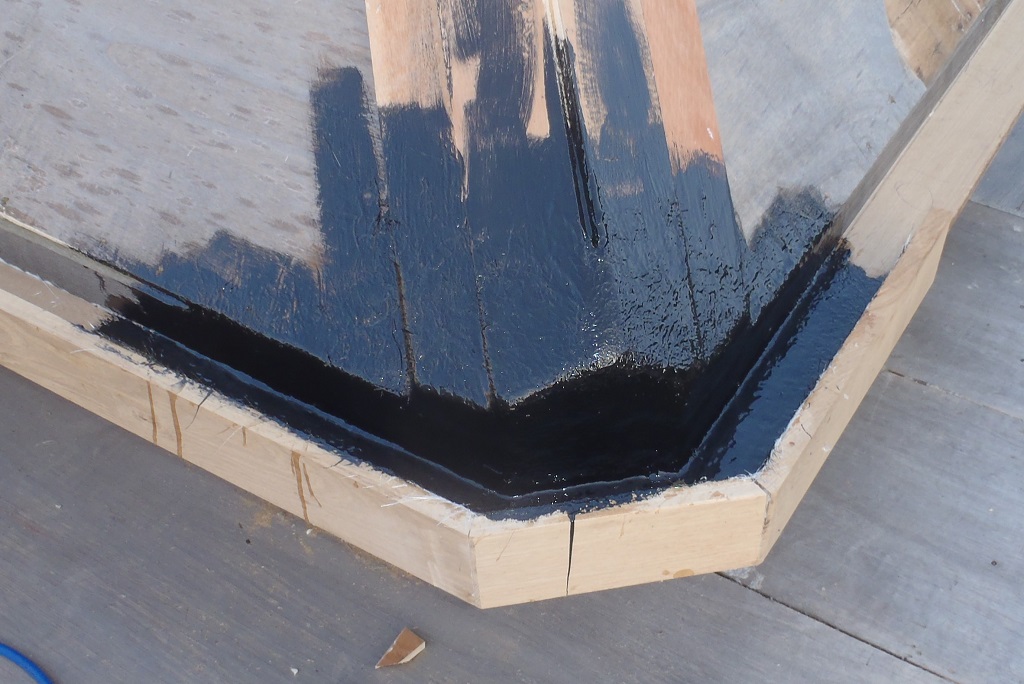
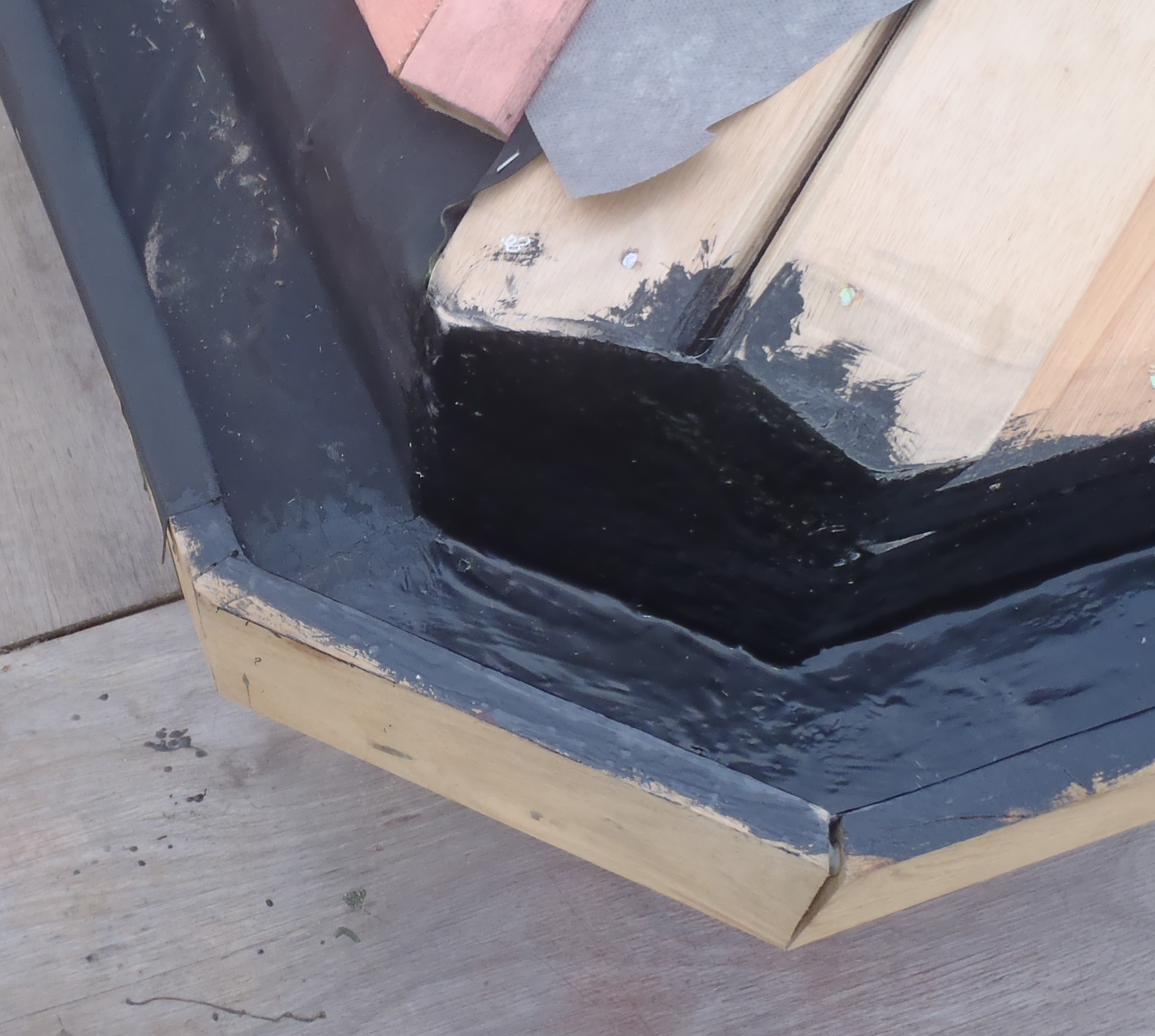
    Finally, on the last corner of the back of the building, the O-P outside corner, we sliced off the layers of plywood that made up the hip support, put on a layer of heavy glass-fibre matting and then coated the whole thing with black top coat finish. All rubbed down and smooth, ready for going along the P section towards the Conservatory.
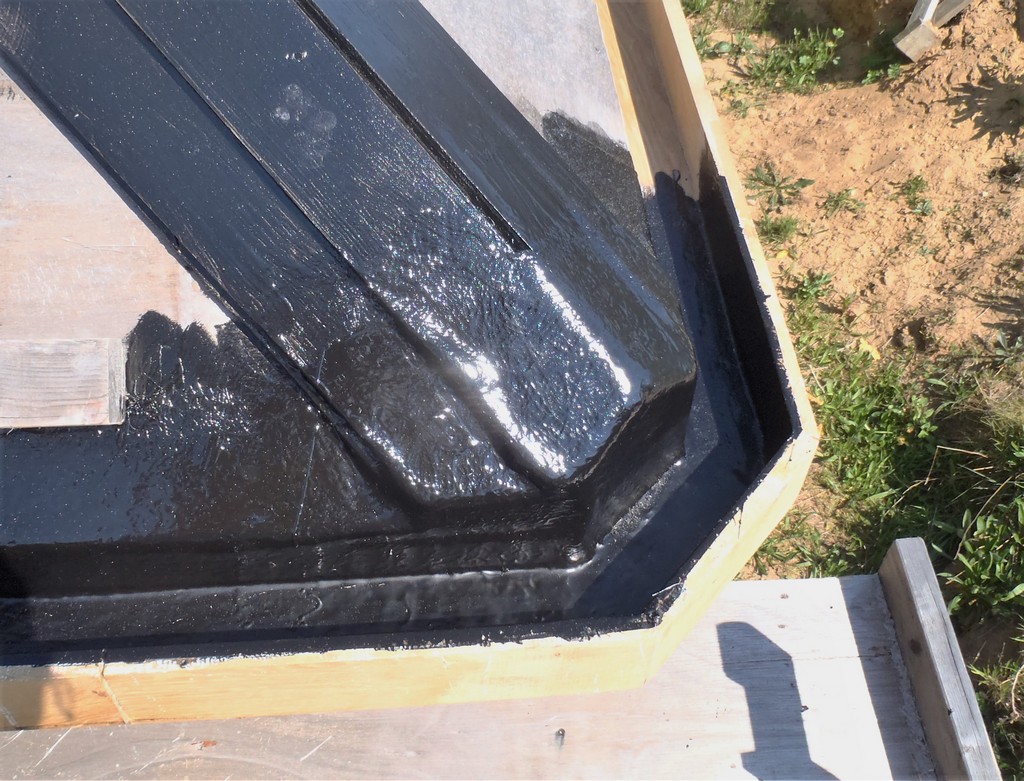
    OP-Gutter-corner-fibreglassed

    OP-Gutter-corner-fibreglassed


    This means now that we can insert the last strip of rubber liner for the gutter along the O section and put on the breathable membrane and battens to have this section of O roof ready for slating too.
    Next week, we can resume the job of putting up thousands of Slates for the K slope (and L, and M, and N, and O too!), and doing the flashing slates a the same time as we climb up the roof. We are Getting There!!
  • Rubber Liner for Gutters and Breathable Membrane Covers L, M and N Roof Sections

    The work this week was to cover the next three sections of the roof surface with the breathable membrane and protect the wooden Oak guttering with the required rubber material.
    The rubber membrane was the first to go into the gutters, doing our usual order of gluing down the bottom surface first (using the wet rubber solution), followed by the much slower use of two layers of contact glue on the ends of each rubber strip. We had to paint the glue on and dry the exposed surfaces using a hair dryer to speed this process up and then carefully smoothly iron the rubber into place (using our hands and fingers). We finished all three gutters on Monday.

    Gutter-rubber-installed-in-LM-N-1

    Gutter-rubber-installed-in-LM-N-1

    Gutter-rubber-installed-in-LM-N-2

    Gutter-rubber-installed-in-LM-N-2


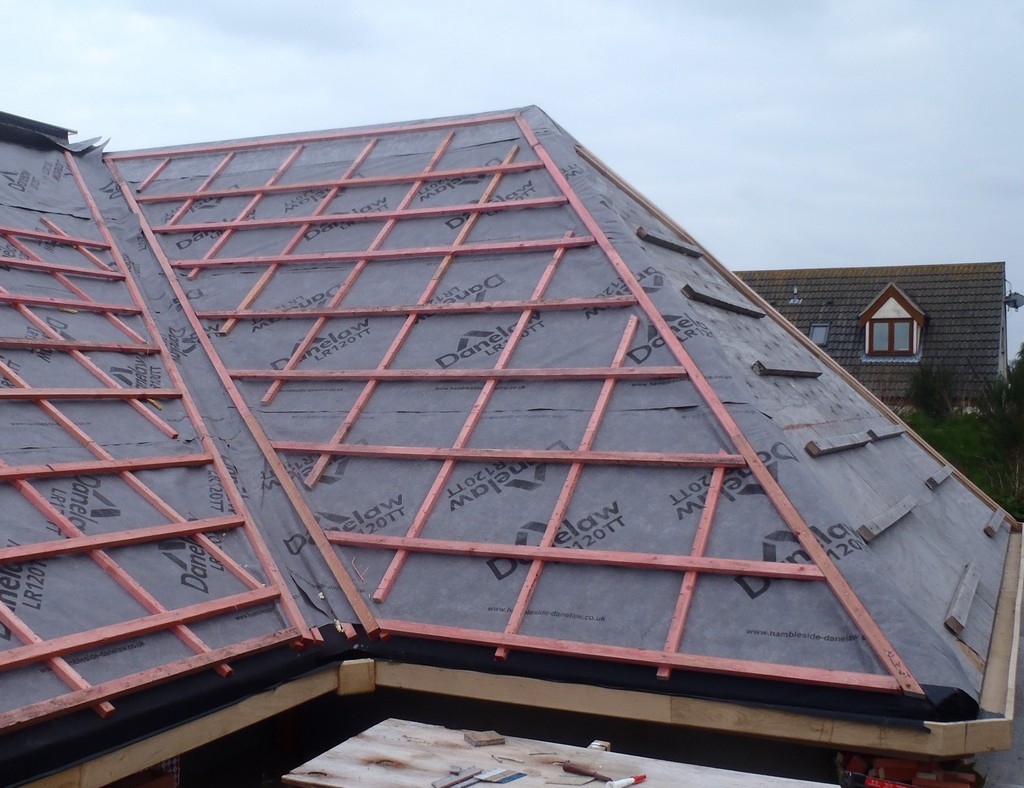
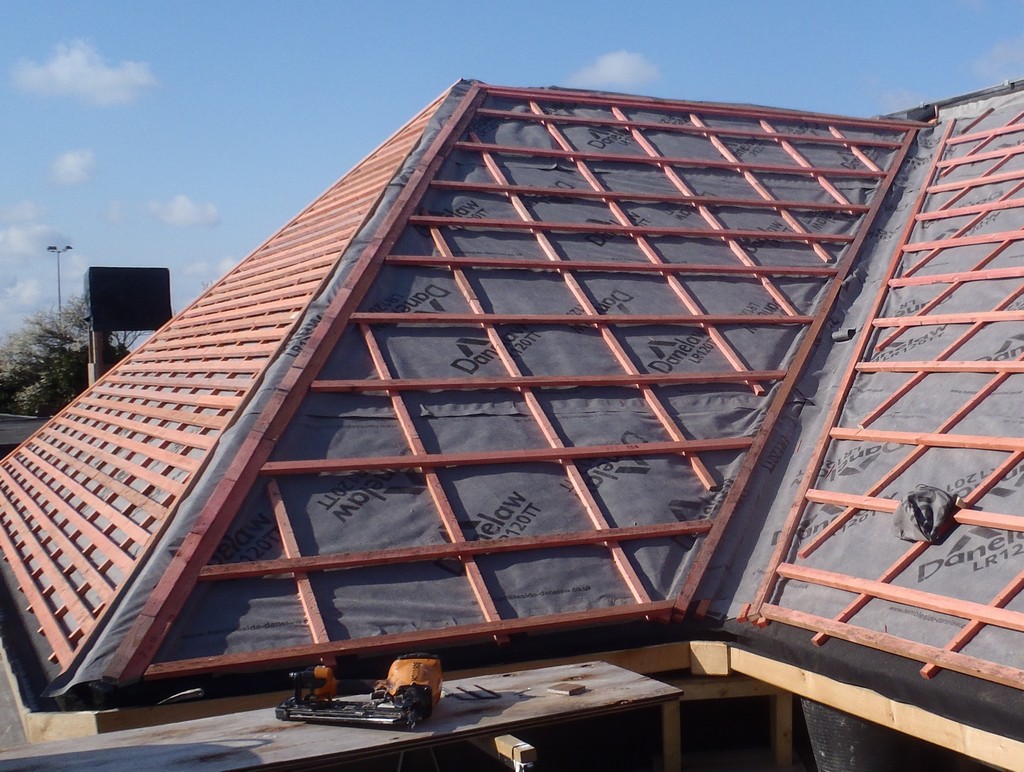
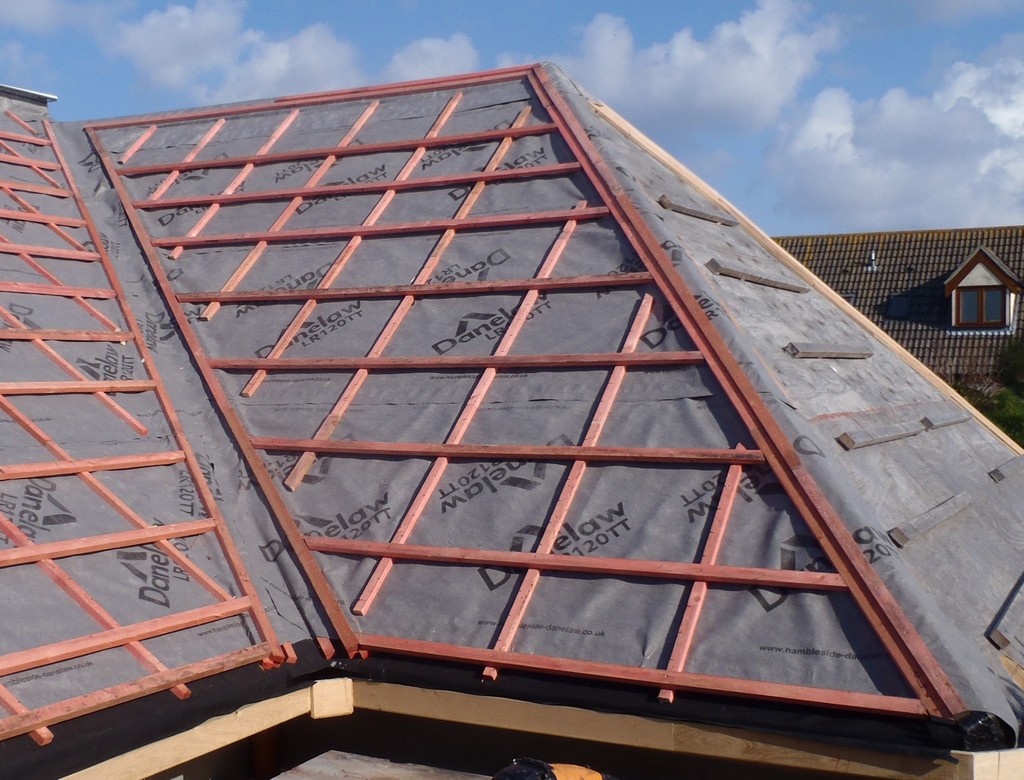
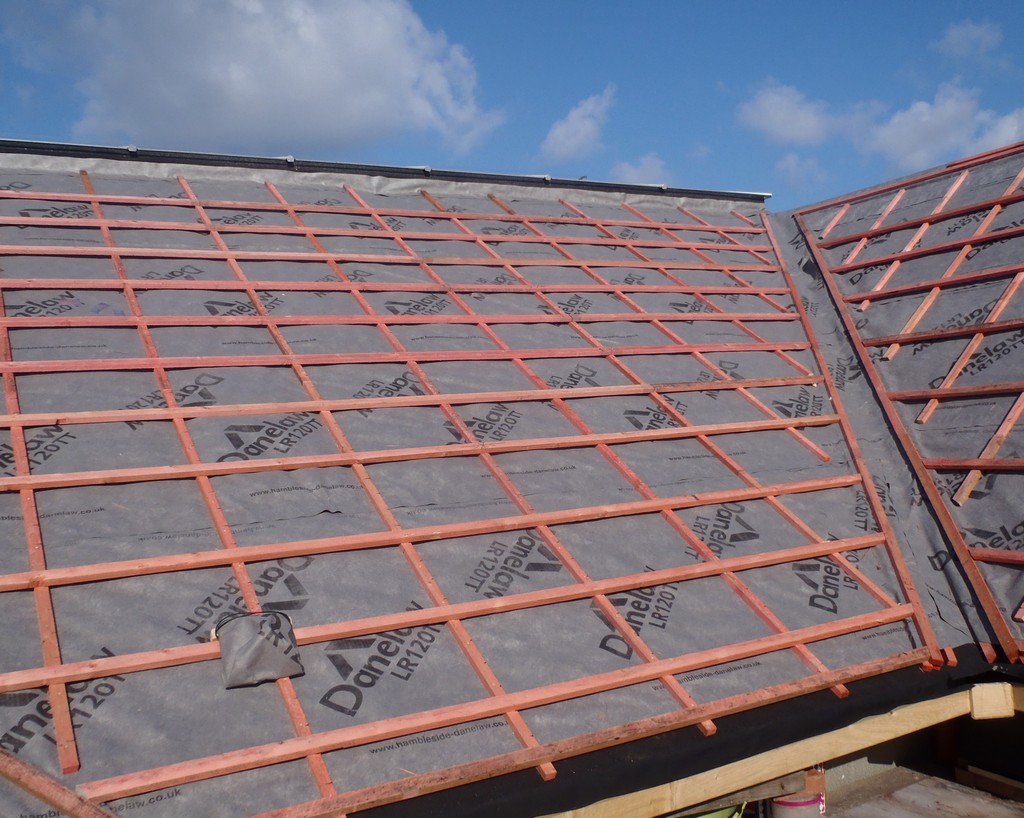
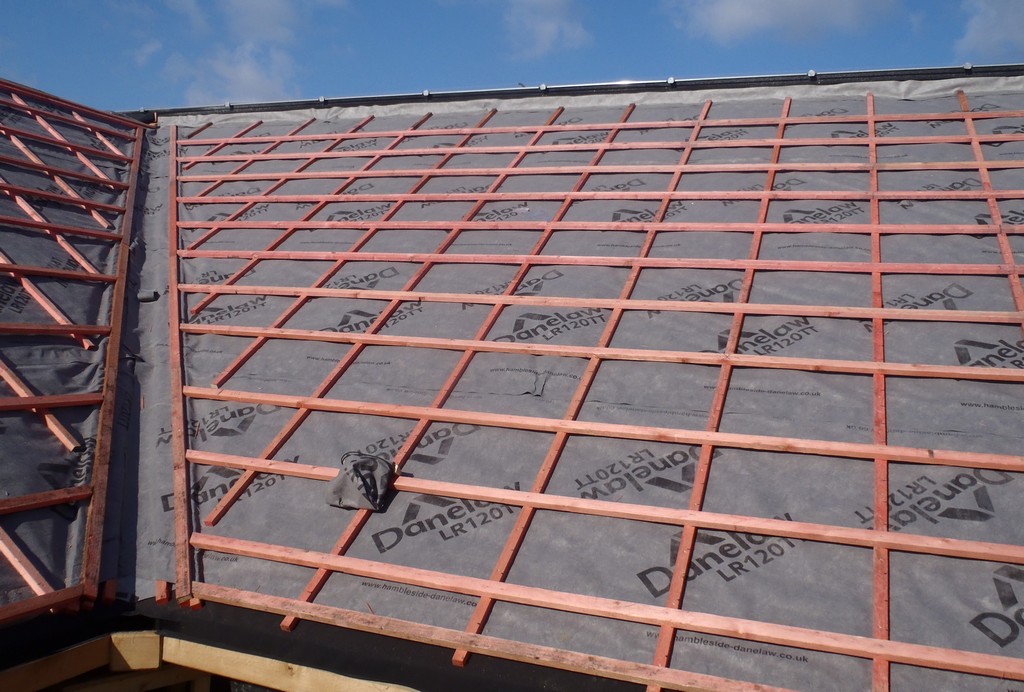
    The subsequent days were spent laying on the dark grey breathable plastic membrane, row by row, around the three roof surfaces, fixing each section with vertical counter battens and a few lines of tile battens to act as a ladder for us to climb up and down easily.

    One of the other jobs that had to be done was to finish off building up the hip and ridge layers of plywood strips to provide the fixings for the flashing slates, on the OP hip angle and the O Ridge line.

    Membrane-and-Hips-and-Ridge-Done-on-N

    Membrane-and-Hips-and-Ridge-Done-on-N


    Then we could complete the breathable membrane coverage on the N roof with a half width strip going over the ridge line and then doing the final strip of membrane on the M roof, a very long piece over 11metres (35feet) long and then a small 300mm wide strip to provide the complete protection up onto the kerb of the Skylight.
    End-of-week-13th-April-1

    End-of-week-13th-April-1

    End-of-week-13th-April-2

    End-of-week-13th-April-2


    End-of-week-13th-April-3

    End-of-week-13th-April-3

    End-of-week-13th-April-4

    End-of-week-13th-April-4


    This week sees the completion of fully waterproofing sections of the roof along the back the building that is served three downpipes, so we are now collecting approximately 130 square metres (about 1/3 of the total) of rain water from the roof when any rain falls out of the sky!! This amounts to 130litres of rainwater for every 1mm of rain fall recorded!
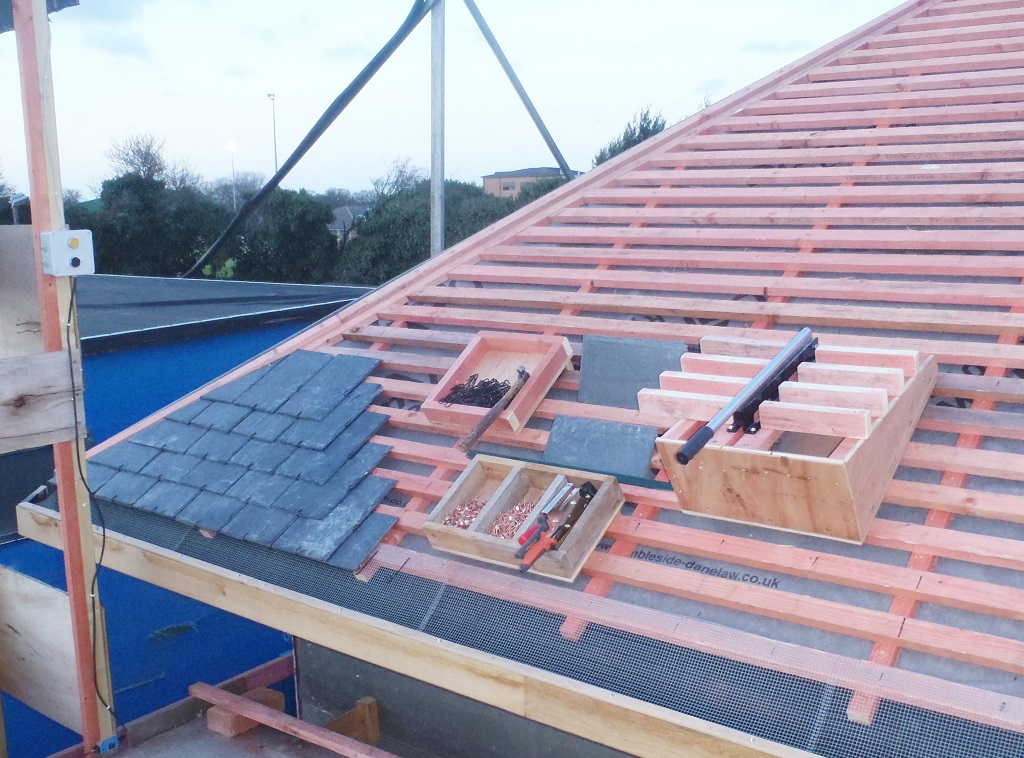
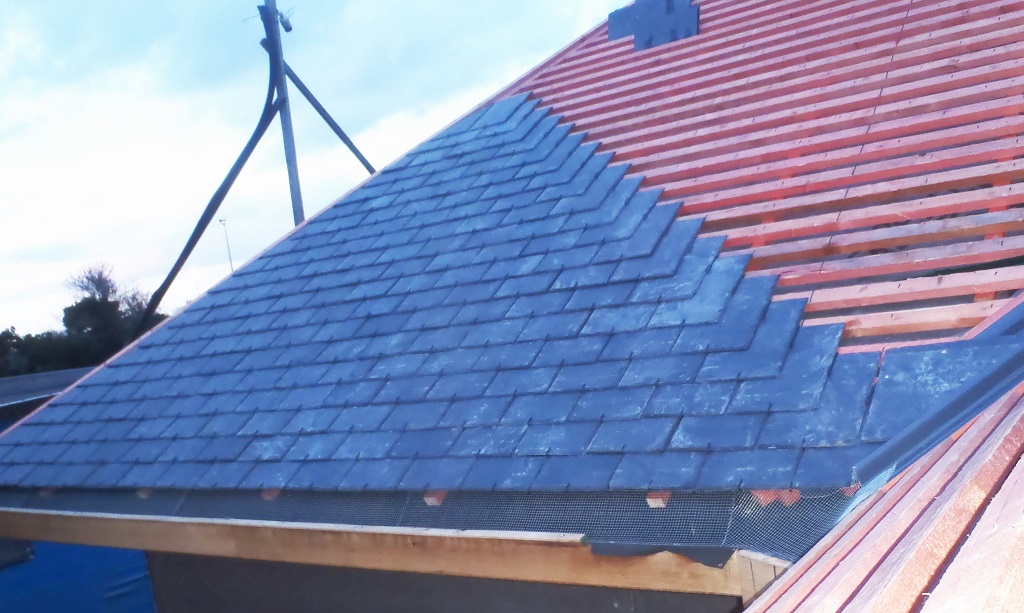
    Next week’s set of tasks is to finish off the stainless steel brackets for holding the ladder support wire (then we can clear up the tools in the workshop), make a flexible fibre-glass plastic hip and ridge “hat” strips and then carry on putting up more slates on the K section!

  • Section J Fully Covered in Slates, K All Battened Up and Guttering Complete Along Back of Building

    Another week is done, apart from two days of interruptions (due to a day of rain and two half days of other commitments), we had a good week of work. We completed our second section of roof, prepared the next one ready for the slates and finishing off the last stretch of Guttering.
    First job of the week was to put on the breathable membrane layers up on the K roof, overlapping the rubber strip already done from last week, putting down vertical counter battens every 610mm apart and then nail on all the horizontal tile battens at the usual spacing of 112mm up the slope. We did this job in two separate stages, the first one being just enough so we could climb up and get over to the J roof so we could complete the task of installing the slates.

    Menmbrane-and-battens-on-K

    Menmbrane-and-battens-on-K


    Thus, we duly did finish off putting on the slates on the J section of the roof, a total of about 400 of them. We had also put on the metal mesh over the gutter going around the corner (from J to K).
    End-of-April-4th

    End-of-April-4th

    End-of-April-5th

    End-of-April-5th


    The forecast was for more rain, light random showers, so we got on with putting up the second stage of tile battens on the K roof and got that done, including all the hip flashing battens too.
    K-completly-battened

    K-completly-battened


    The other job that was completed, earlier in the week, was completing the guttering along the O section and also a little bit on to the P section too, which now concludes all the roof elements along the back of the building.
    Gutter-started-on-P

    Gutter-started-on-P


    Next week, if the weather holds good, we may install more rubber and breathable membrane layers on the rest of the roof surfaces along the back, L, M and O, and put up the first set of counter battens and a few tile battens to act like a ladder. If the weather is bad, then we will be working in the workshop to make fibre-glass flexi-plastic objects to protect our Hips and Ridges against the rainwater when we put on the flashing slates.

    P.S. We have been asked to include a diagram to remind people of the position of where we are working…

    House

    House

  • Slates on J Roof and Progress on Gutters

    Another week is done and we are progressing on the roof putting Slates on the J roof segment and Guttering on the next four sections from L to O.
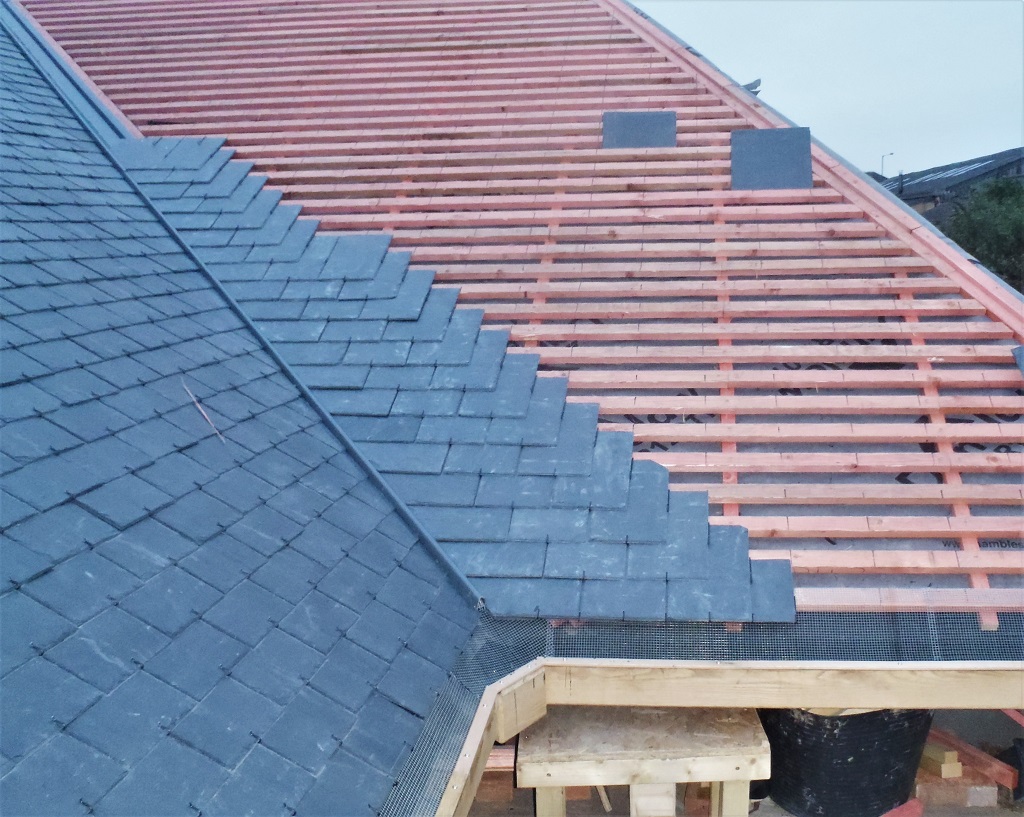
    We came back from our trip down south and resumed work on Tuesday by completing the valley line of slates and did a further three more lines up the diagonal before we got too close to the hip corner joining the L segment of the roof. We couldn’t continue because we wouldn’t been able to climb up over the hip to get to the higher rows of slates without having the next set of tile battens nailed up (to act as the ladder!).

    Slates on J Roof and Progress on Gutters

    End-of-26th-March


    So for the next couple of days, we got on with installing more of the Oak timber guttering, continuing from the corner of K and L, completing L and going around along M and N plus also the last section O we got along the back of the building (and have scaffolding platforms installed).
    Slates on J Roof and Progress on Gutters

    Gutters-L-M-N-Attached-1

    Slates on J Roof and Progress on Gutters

    Gutters-L-M-N-Attached-2

    Slates on J Roof and Progress on Gutters

    Gutter-O-attached


    We quickly put up more of the hip support layers of plywood strips on the N and O corner and cut off the overhanging pieces to make a neat squared off ends. The other corner K and L was also cut and made neat too. This means that the task of fibre-glassing with black resin was done on all four corners (two outside hip coroners and two inside downpipe channels valley corners) in one session.
    Slates on J Roof and Progress on Gutters

    Corners-and-Downpipe-channels-fibreglassed-1

    Slates on J Roof and Progress on Gutters

    Corners-and-Downpipe-channels-fibreglassed-2

    Slates on J Roof and Progress on Gutters

    Outside-corner-with-fibreglass-over-hip


    The last piece of work of the week, was starting to install the rubber liners inside the gutters whereas we laid in the 9 metre long rubber membrane for the K section. We decided to try a different order of doing things and this time, we applied the wet rubber latex solution on the base of the oak gutters first, laid the rubber down and then tackled each ends separately. The ends were also done differently, doing each flat surface in turn with the contact adhesive and getting a much better result with a very neat flat finish.
    Slates on J Roof and Progress on Gutters

    Rubber-lining-for-K-glued


    On the next week, we will continue putting in more rubber liners for the gutters for L, M, N and O (the O section, we will have to do the outside hip corner O P (we left it undone thinking we could do that later when we move around to do P) but we realised that we do need to have half of it installed so we can lay the rubber in the O segment and also have all the sections of the back of the building completed and be able to move all our scaffolding platforms in one go and move to tackle the next portion of the building’s roof) Then we will start laying down the breathable membrane all the way along and so on.

  • Ladder Support System Created, Roof Section I complete and Kerb Flashing Done

    We resumed work in new week by continuing slating the I section of the roof, Creating a roof ladder support system and getting the flashing line of slates onto the kerb underneath the overhang of the skylight done too.
    One of the first jobs was to make a heap of kerb flashing slates which were made from cutting a standard slate in half down the long direction (to make 100mm wide by 300mm long pieces) and we then made a jig to hold our slate nail hole puncher in a fixed position and align each half slate to have a nail hole put in exactly 75mm from each end and 50mm from one edge.

    Ladder Support System Created, Roof Section I complete and Kerb Flashing Done

    Jig-for-punching-holes-for-Kerb-Slates


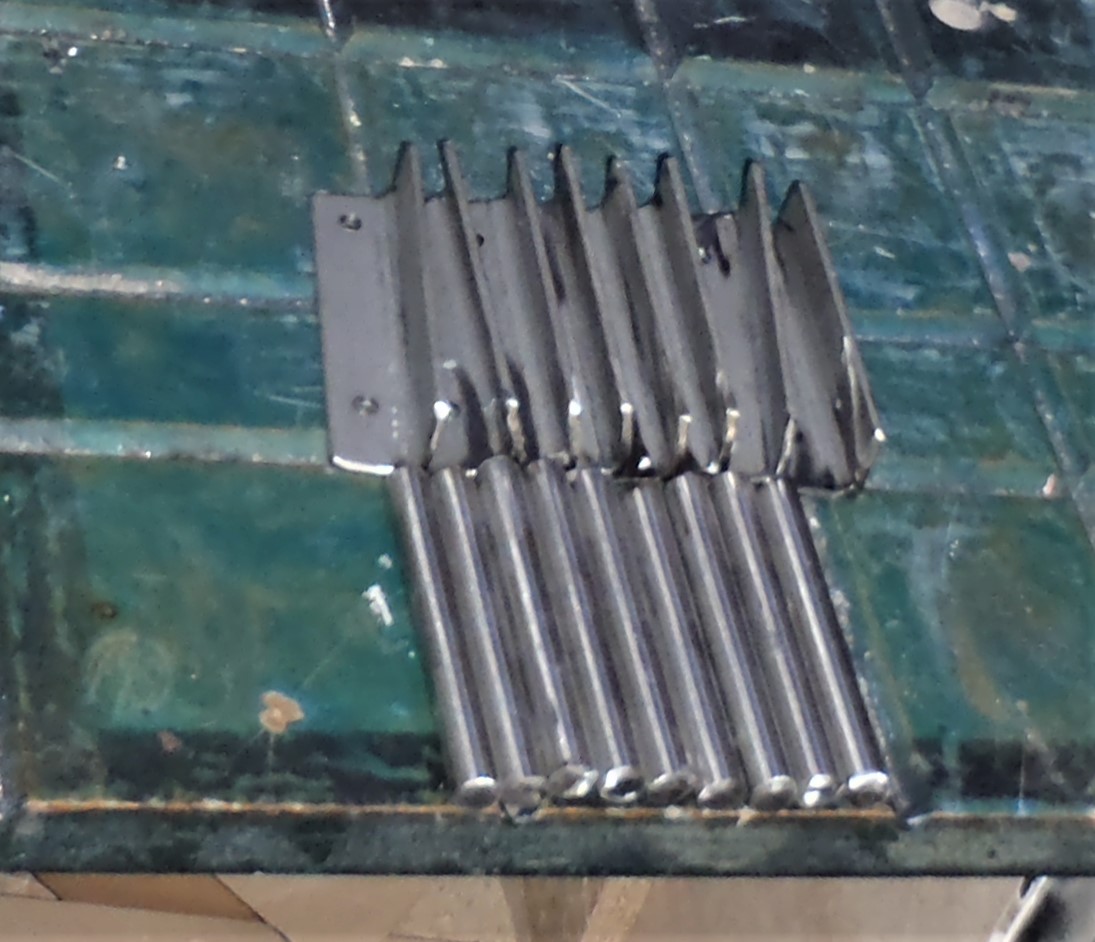
    But also before we could continue with the slating, the roofing ladder support suspension system (This will be a stainless steel cable attached around the skylight, to which we can hang a roof ladder if we need to access then skylight etc) needed to have various components created, namely the stainless steel brackets which are 100mm long (a right angle steel bar) with a 12mm rod sticking out which is also 100mm long.

    Ladder Support System Created, Roof Section I complete and Kerb Flashing Done

    Parts-for-Kerb-Wire-supports

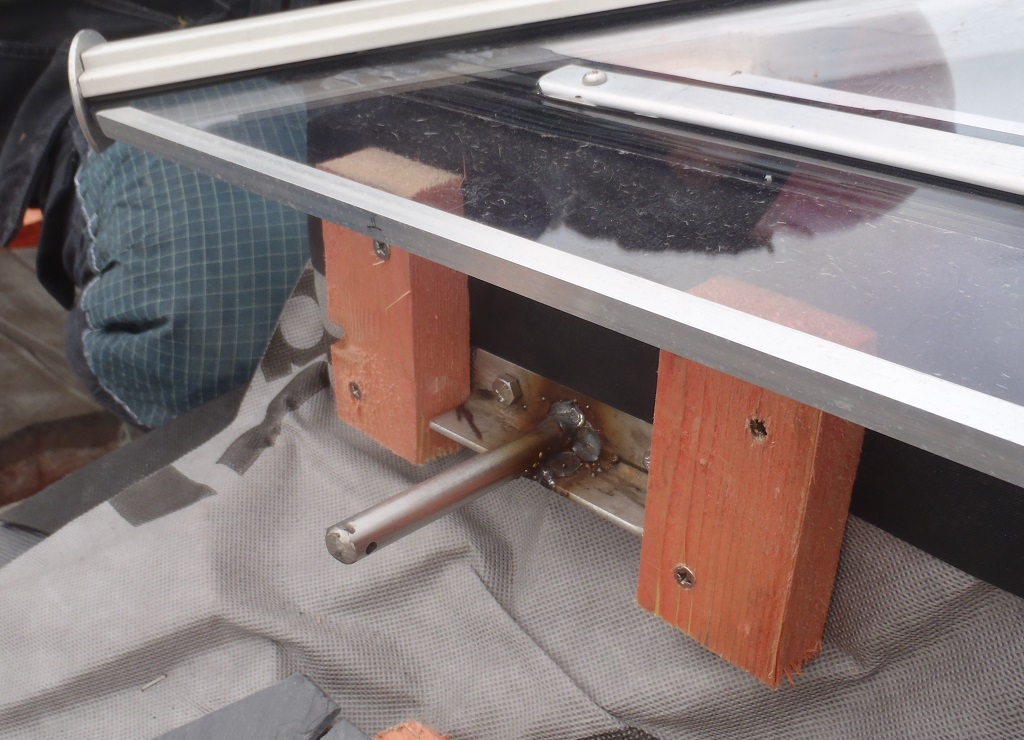
    The two pieces will be welded together (with stainless welds!). We got one finished so we could take it and mount it up onto the kerb at the start of the skylight. The angle iron piece had two screw holes and we used stainless steel hex head coach screws to fix it in place horizontally between the vertical battens.

    Ladder Support System Created, Roof Section I complete and Kerb Flashing Done

    Roof-Wire-support


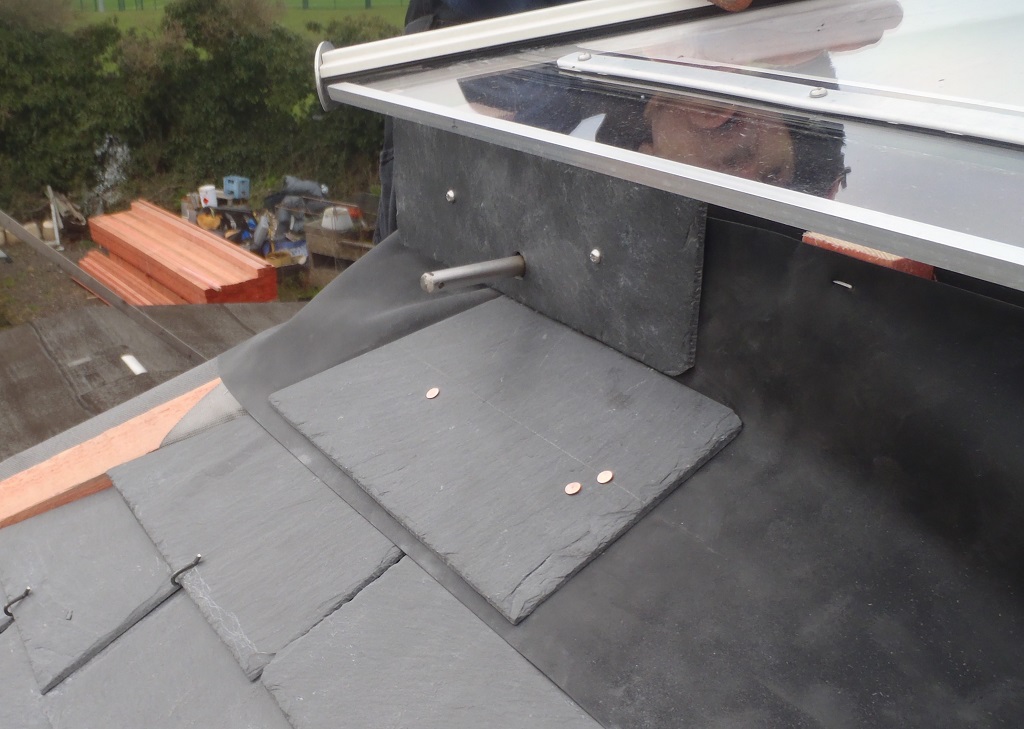
    We then got the rubber membrane which is 250mm wide and stapled it along the first section of the kerb to all the vertical battens so it is ready for the half height flashing slates to cover over it, with the dangling part of the membrane to go underneath the final row of tiles.
    Ladder Support System Created, Roof Section I complete and Kerb Flashing Done

    First-kerb-Slate-with-Wire-support-post


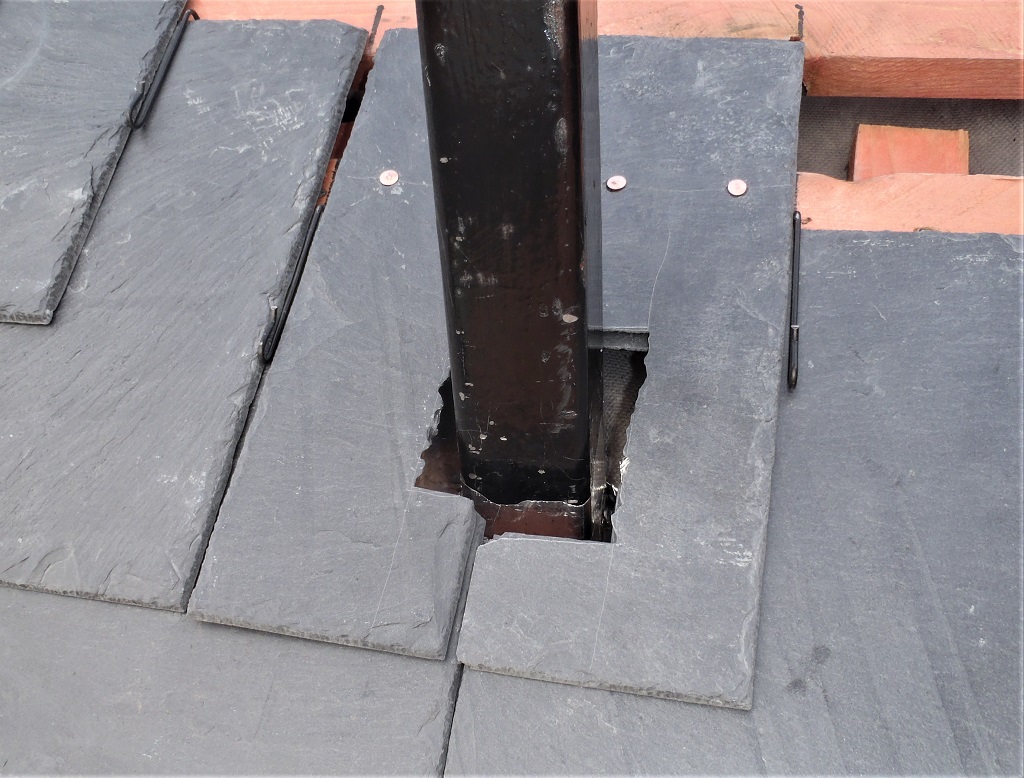
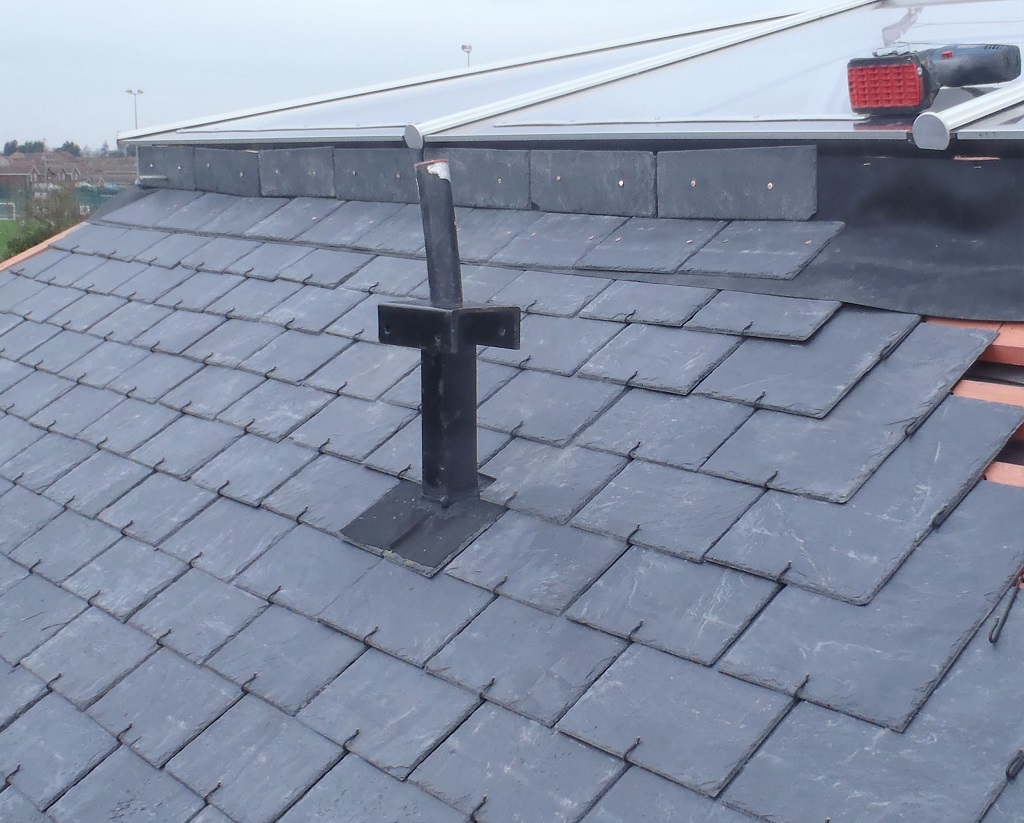
    The chimney bracket was the next challenge! The square metal pole (50mm across) sticks out of the slope of the roof and we had to cut and trim each layer of the slates to fit around it.
    Ladder Support System Created, Roof Section I complete and Kerb Flashing Done

    Slates-cut-around-bracket


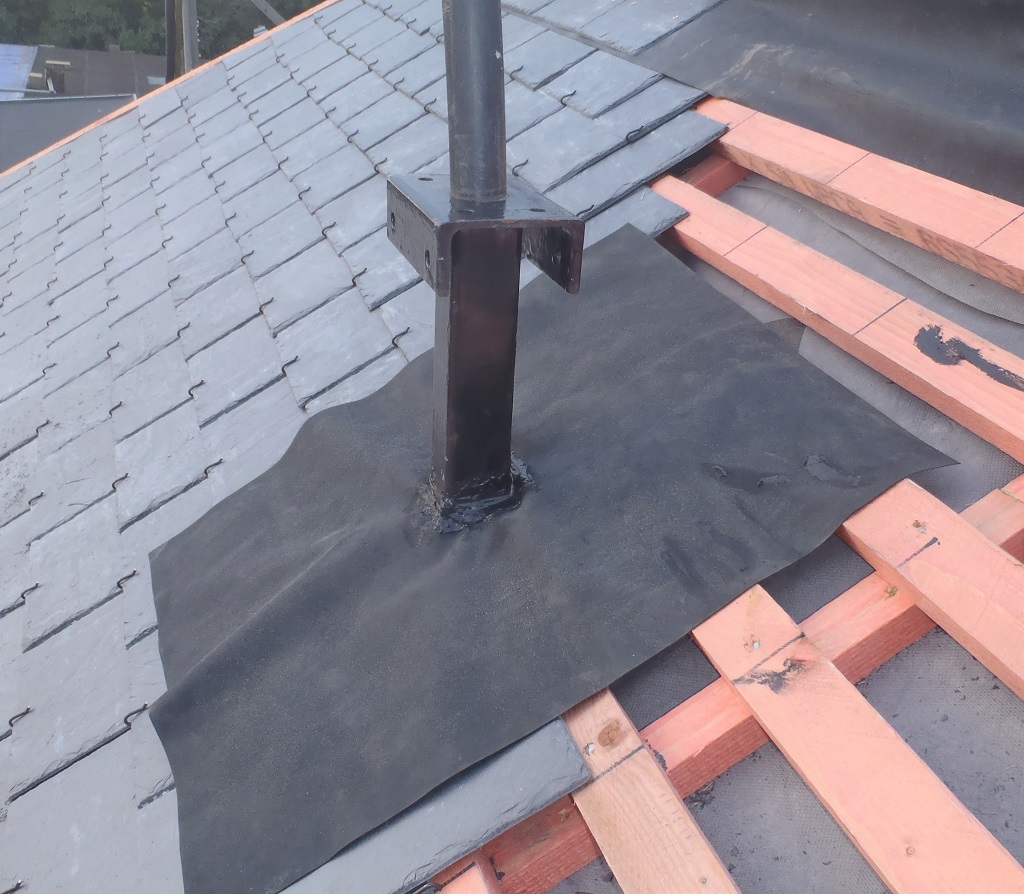
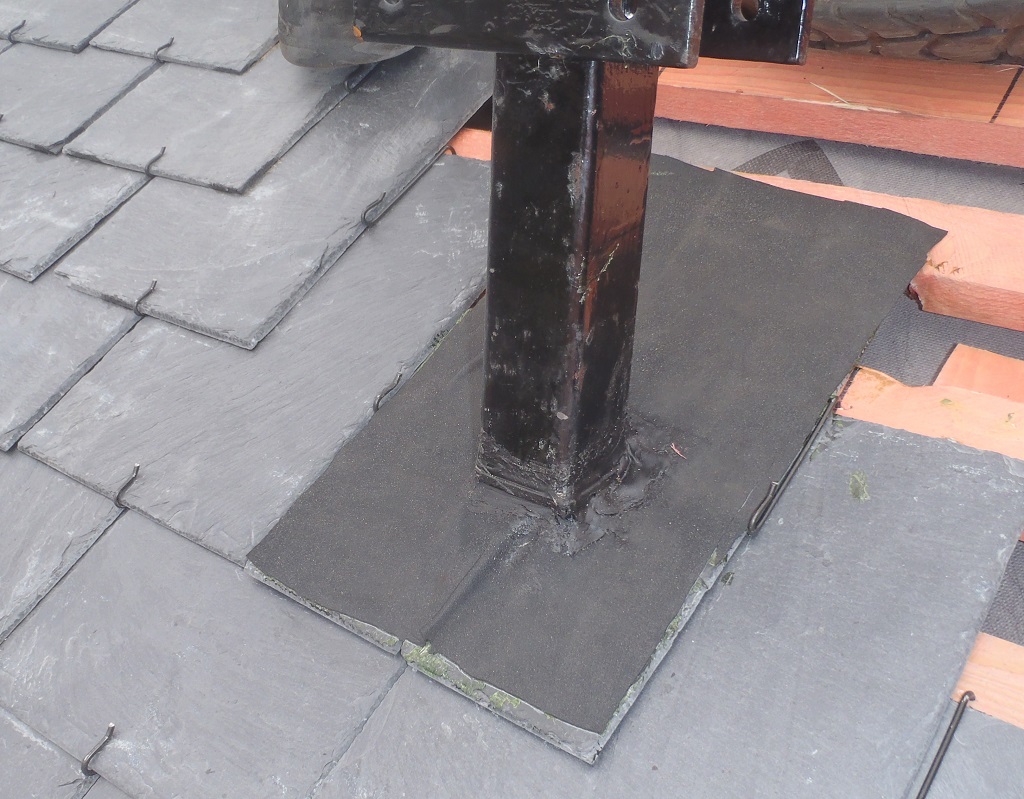
    The pole had a rubber membrane stretched over and pulled down the pole and laid flat on the top slate. It was sealed with proper rubber sealant between the rubber and the metal pole and clamped using a black cable tie to mechanically hold it in place while the sealant cured. Then the rest of the rubber membrane was glued to the slate itself with contact adhesive to stop it flapping in the wind and provide a good surface for the rain water to run off correctly.
    Ladder Support System Created, Roof Section I complete and Kerb Flashing Done

    Rubber-seal-glued-to-the-Bracket

    Ladder Support System Created, Roof Section I complete and Kerb Flashing Done

    Rubber-seal-complete-on-Bracket

    Ladder Support System Created, Roof Section I complete and Kerb Flashing Done

    Chimney-bracket-in-the-roof


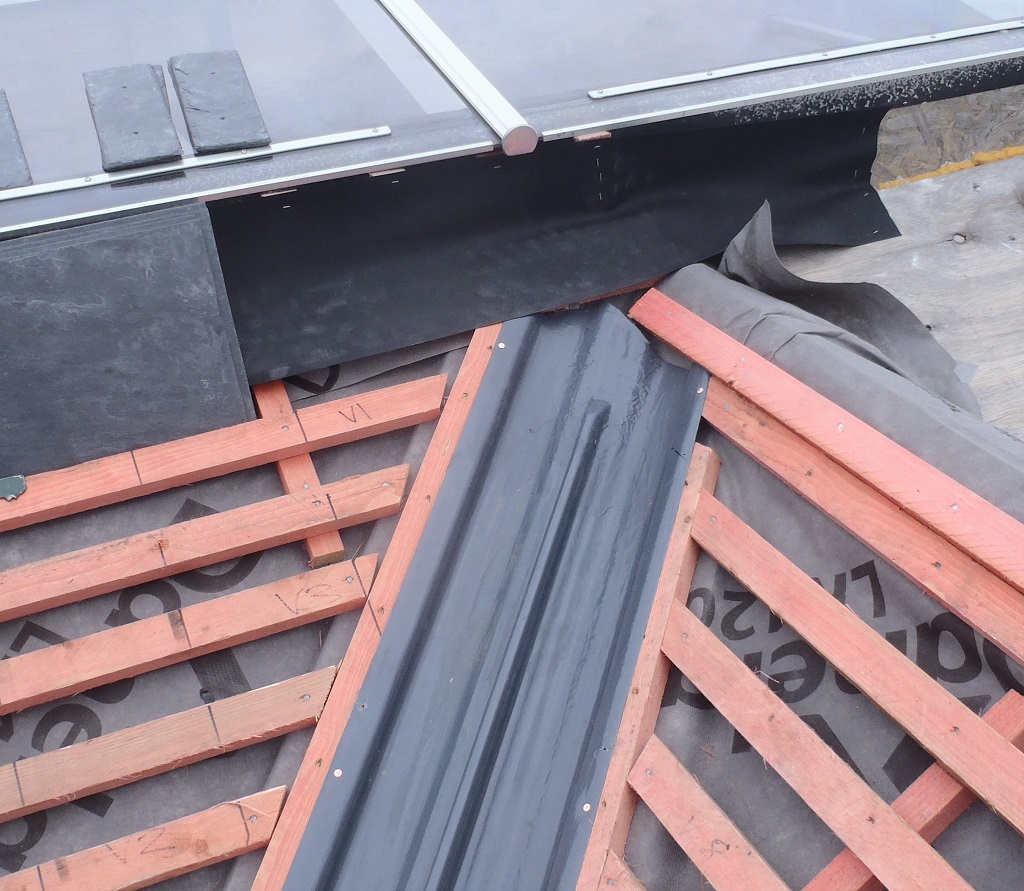
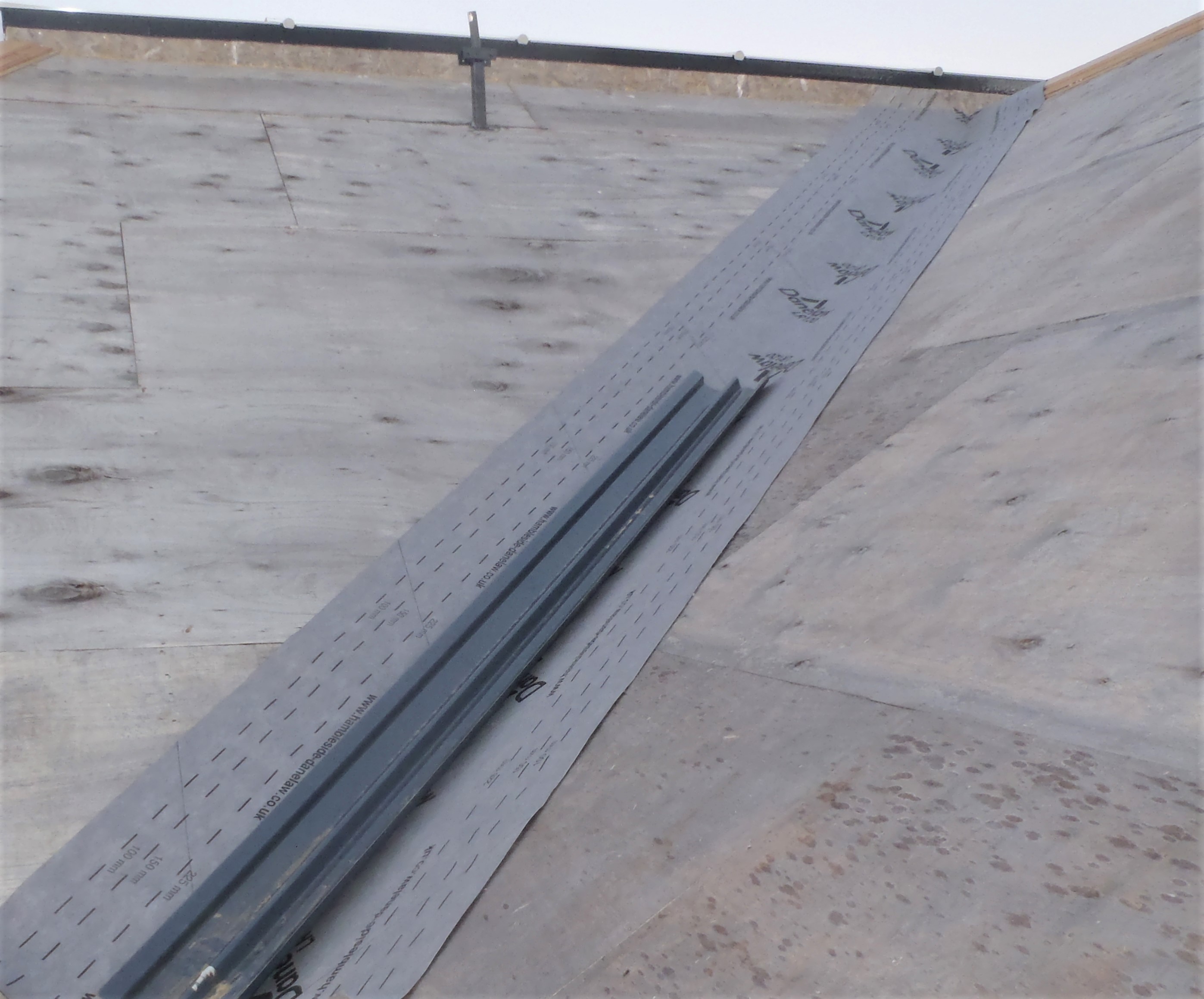
    We arrived at the point where we needed to sort out the last section of the valley trough. We had to analyse how the slates will be laying from the two slopes of the I and J sections of the roof and how the ridge comes into play as well. We made some adjustments to the fibre-glass trough to turn it into an arrow shaped and also trimmed off the “bull-nose” sticking up bit so we can lay down the flashing slate tiles protecting our ridge line. We mixed up some white resin with black dye until we got close enough to the mid grey colour and then sealed up the “hole” we created at the top of the trough and now we have a waterproof collector mechanism that goes right up to almost the kerb.
    Ladder Support System Created, Roof Section I complete and Kerb Flashing Done

    The-Modified-top-of-valley-trough


    We finally completed the I section of the roof, bar the last five slates which we can do from the other side of ridge when we are doing the L and M roofs, because we can organise the layers of the flashing rubber membrane pieces in such a way to ensure that rain water will always be collected and diverted down the valley trough.
    Ladder Support System Created, Roof Section I complete and Kerb Flashing Done

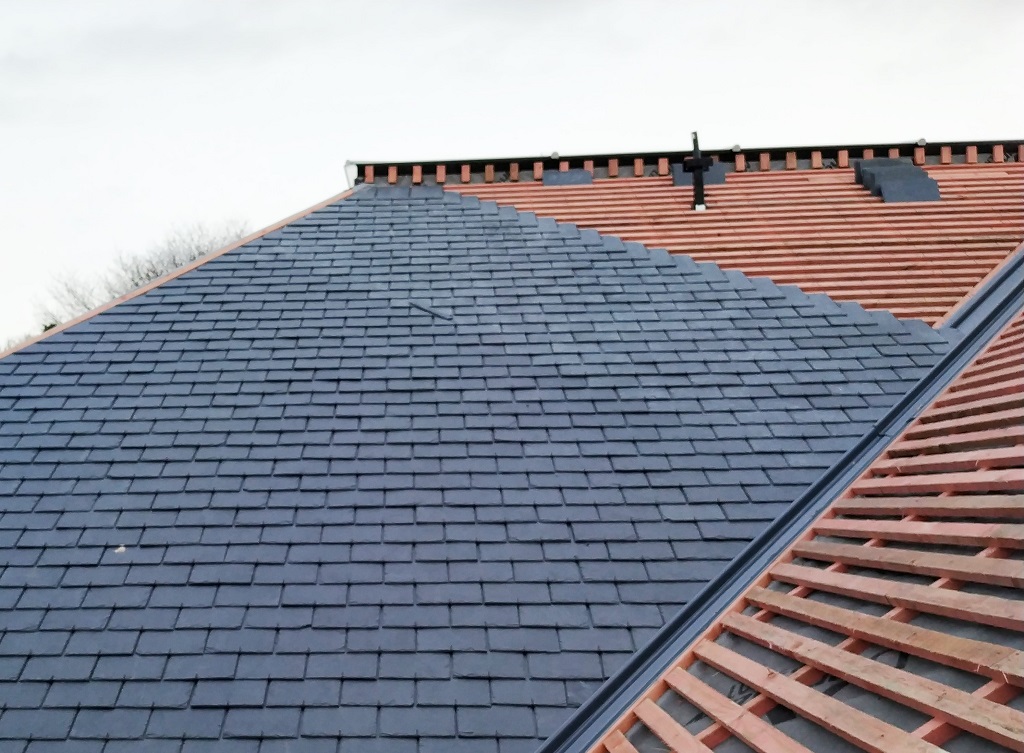
    Roof-I-fully-slated


    So we now have started the J roof and we have most of the markings drawn on the J roof with the regular 204mm spacings on the tile battens. Next job was the metal mesh inserted to cover up the guttering up to the outside corner and clamped down with the oak thin strips.
    And got on with the task of putting on more slates, starting back at the bottom over the gutters, at the valley end and working left to right as usual.
    Ladder Support System Created, Roof Section I complete and Kerb Flashing Done

    End-og-22nd-March


    We will have a small break (Saturday and Monday) as we need to go and visit family down in London but from Tuesday, we will carry on with the J roof, which hopefully won’t take so long because it doesn’t have chimneys or kerb complications to worry about!!

    Ladder Support System Created, Roof Section I complete and Kerb Flashing Done

    End-of-18th-March

    Ladder Support System Created, Roof Section I complete and Kerb Flashing Done

    End-of-19th-March-1

    Ladder Support System Created, Roof Section I complete and Kerb Flashing Done

    End-of-21st-March

    Ladder Support System Created, Roof Section I complete and Kerb Flashing Done

    Roof-I-fully-slated


  • Slates Start Going Up!

    For this week’s worth of work, with lots of weather interruptions along the way, we started the actual process of putting up our Slates! Using our new collection of tools and equipment, we projected a line up the roof at right angle from the Fascia to serve as the master reference line to work from. We started to use a blue chalk line to snap down lines from top to bottom but the rain nearly washed it away after doing the first 20 lines. So we reinforced the refernece line with a solid black marker pen and then marked each batten with 204mm spacings using a old metal tape which we prepared with marks so we don’t have to keep measuring the spacings each time.
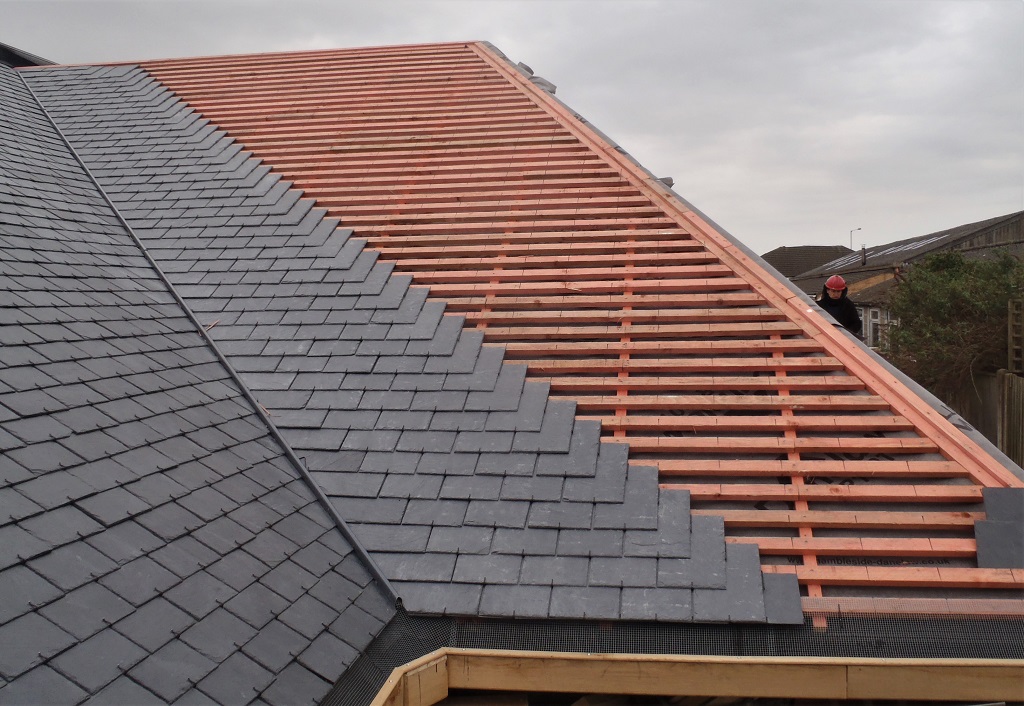
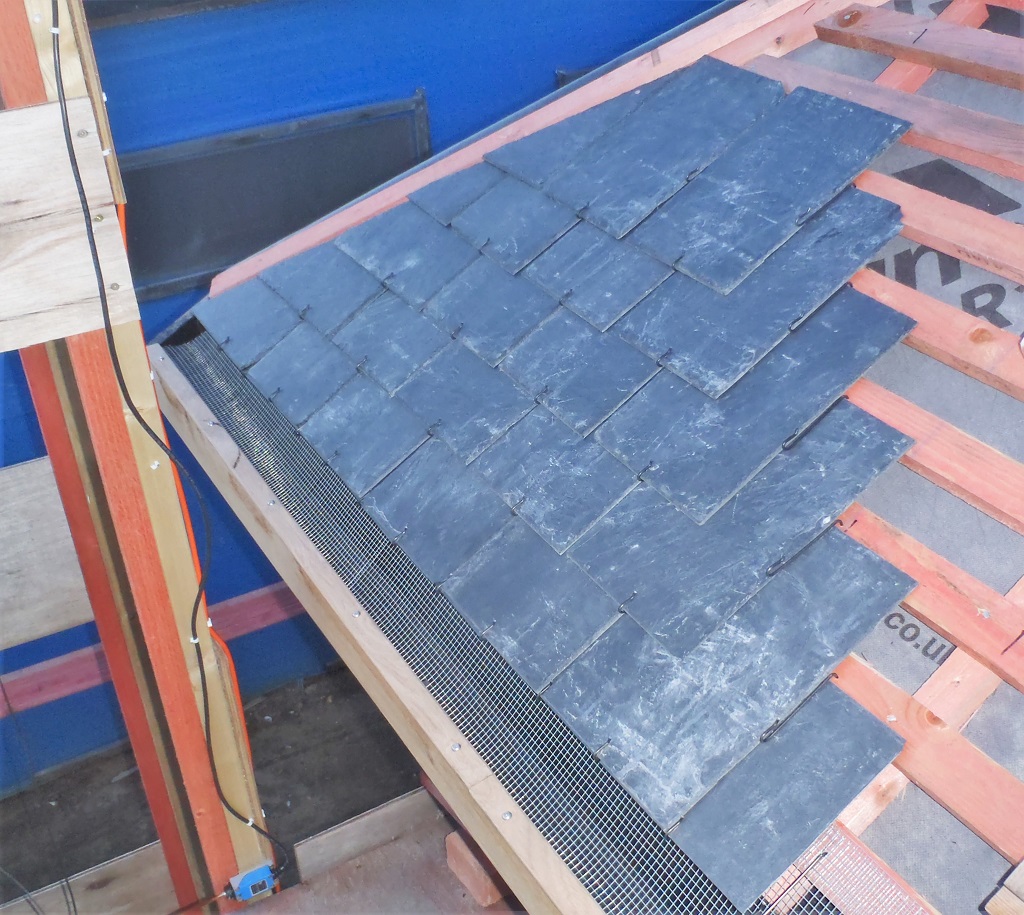
    After the marks were redone, the first job to do was to cover up the Gutters with our galvanised metal mesh (1 quarter inch spaced grid and holes) by aligning the bottom edge to the front of the gutter’s upright plank, stapling it down (on top of the rubber membrane already there) and then lifting the mesh up to the first line of the tile battens. Here we also stapled it down (using stainless steel staples) and then folded up the excess mesh backwards so we had a padding of this mesh to support the bottom line of slates hanging over the gutters (the padding acts like the missing third layer of slate). Finally, we screwed down a fixing cap of oak timber we had previously made, on top of the mesh and rubber, using stainless steel wood screws with nice large dome heads to clamp down everything. We trimmed off the excess rubber away and the whole thing now look neat and tidy.

    Slates Start Going Up!

    Gutter-mesh-and-capping-strips-installed-on-I


    After that, We started in the bottom outside corner (the join between H and I sections of the roof) and working left to right, started putting on the slates. But the first task was to slice a dozen slate tiles to remove 112mm off their lengths, because the first layer which is hanging over the gutters needed this amount removed to align up with the bottom edge of the second layer. This ensures that any rain water flowing down the roof is still captured by at least one layer of slate before reaching the guttering. We had to smile because we nearly got caught by the “rookie mistake” of not turning over these shortened tiles upside down so the bevelled edges are visible from below and the first and second slates sit flat together back to back!
    After that, it was a case of getting into the practice of nailing our nails in for each row before putting in the next slates (thus avoiding discovering afterwards that we missed some nails!!) and also remembering to turn the slates upside down when using the guillotine too, because the guillotine works downwards and causes the bevelling edge effect as the blade explodes through the slate.

    We are learning as we go along!
    The next thing for us to learn, is doing the diagonal shaped slates when we interface to the hip edge. After having sneaked a training video on the net, we had that one sorted too and we were able to complete 5 rows before the end of the day.

    Slates Start Going Up!

    The-first-slates-1

    Slates Start Going Up!

    The-first-slates-2


    We continued on the next two days and doing three slates at a time for each row, working diagonally back towards the hip, this being the best compromise between doing more at once against having to lean over to far sideways (and slightly above) to nail in the next hooks and slide in the slates.
    When we reached the inside corner, at the bottom of the valley between the I and J roof slopes and had to spend some time there to sort out the metal mesh, to shape it , cut it and bend it, to cover up the corner of the gutters and the end of the fibre-glass trough. We then completed a total of 9 stripes.
    Slates Start Going Up!

    The-next-9-stripes-of-slates


    Finally, on the last day, Saturday, we could work on installing the slates without pausing to cope with another challenge like a valley, we got about 300 slates up, we had to go and load up our three “boxes on wheels” (which hold about 110 slates each) with slates from the eleven crates waiting alongside our Loke.
    We finished the day by installing the second fibre-glass trough section to join on to the first one. We are getting quicker and completed 15 stripes!
    Slates Start Going Up!

    The-next-15-stripes-of-slates


    We are about half way up and we will resume on Monday, weather permitting, and hopefully get the rest of the roof done by Tuesday. At which point, we will start on the J section at the bottom again!

  • Slate Cutting tool, Nail Containers and Slate Spacing Guides

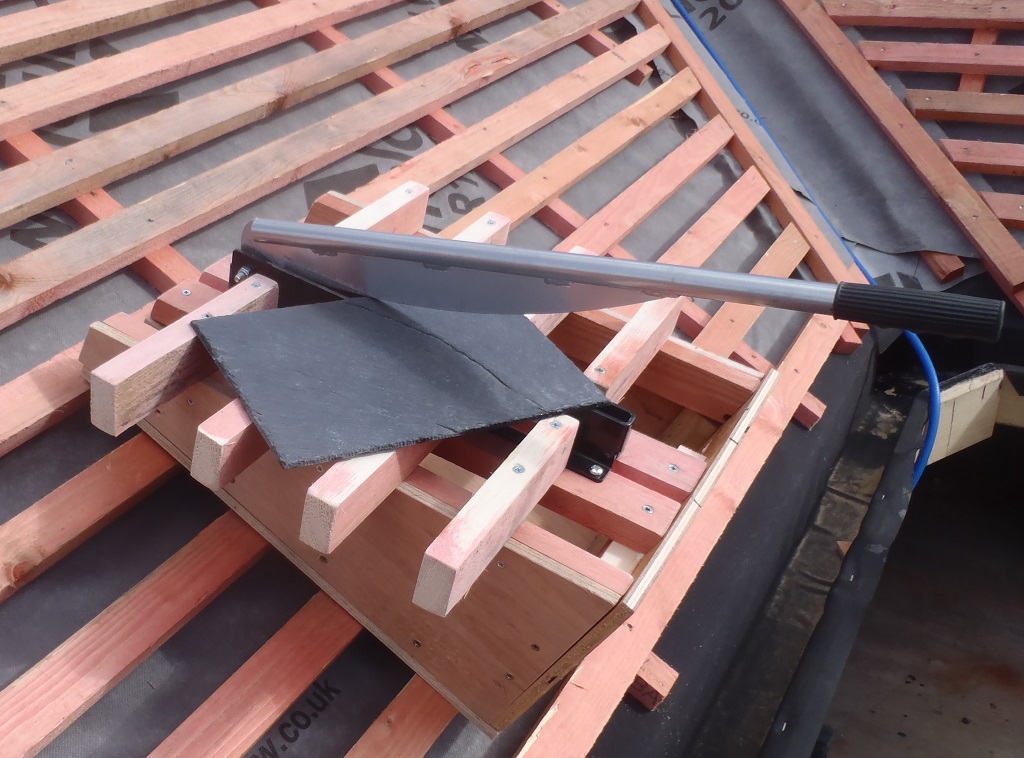
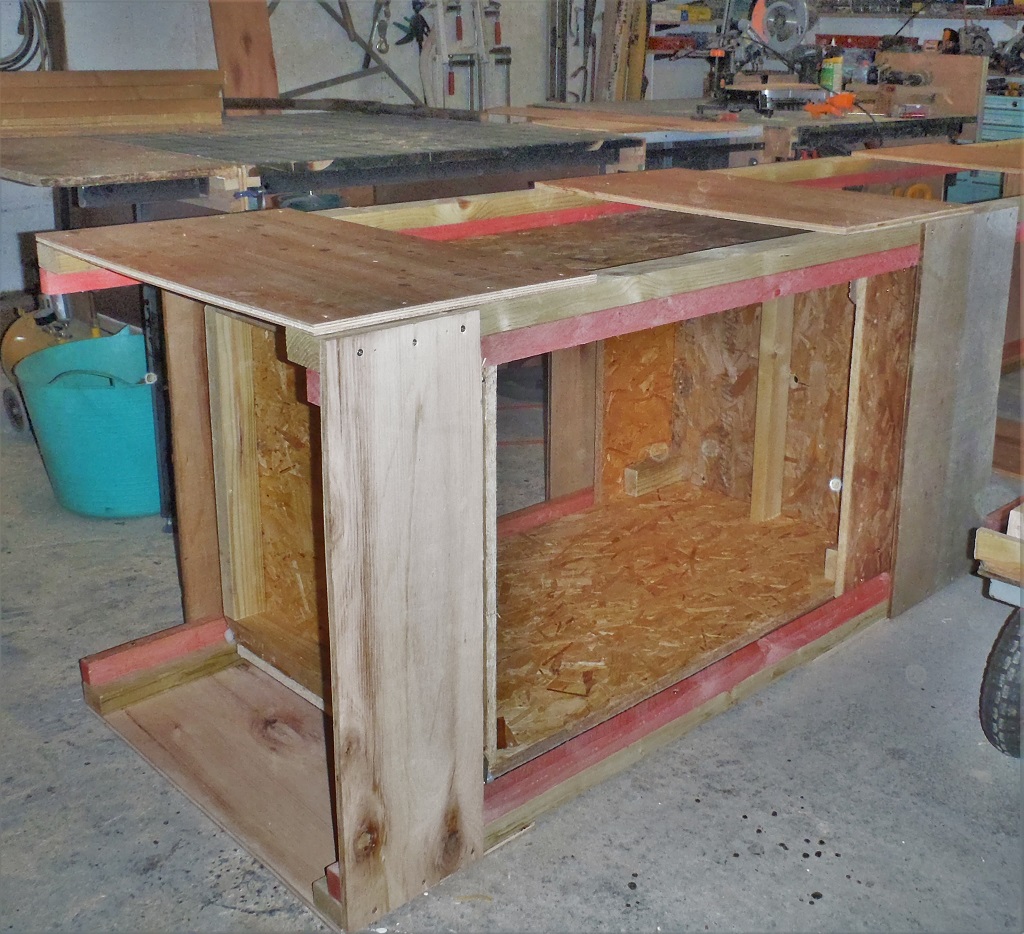
    Today, following on from Saturday’s work, we designed and built a slate cutting guillotine with supporting stand which has rubbish collection built in.

    Slate Cutting tool, Nail Containers and Slate Spacing Guides

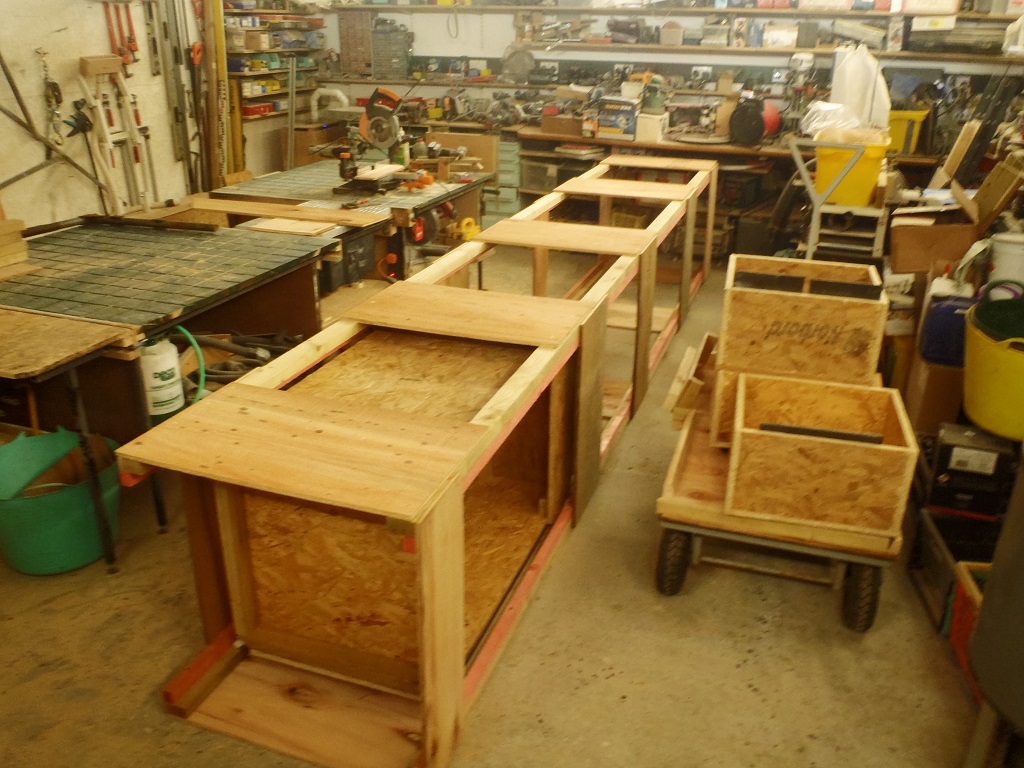
    Slate-cutting-guillotine-and-stand


    The guillotine sits on top of the box like container and there are standard measured marks to help us repeatedly slice certain slates at various required sizes.
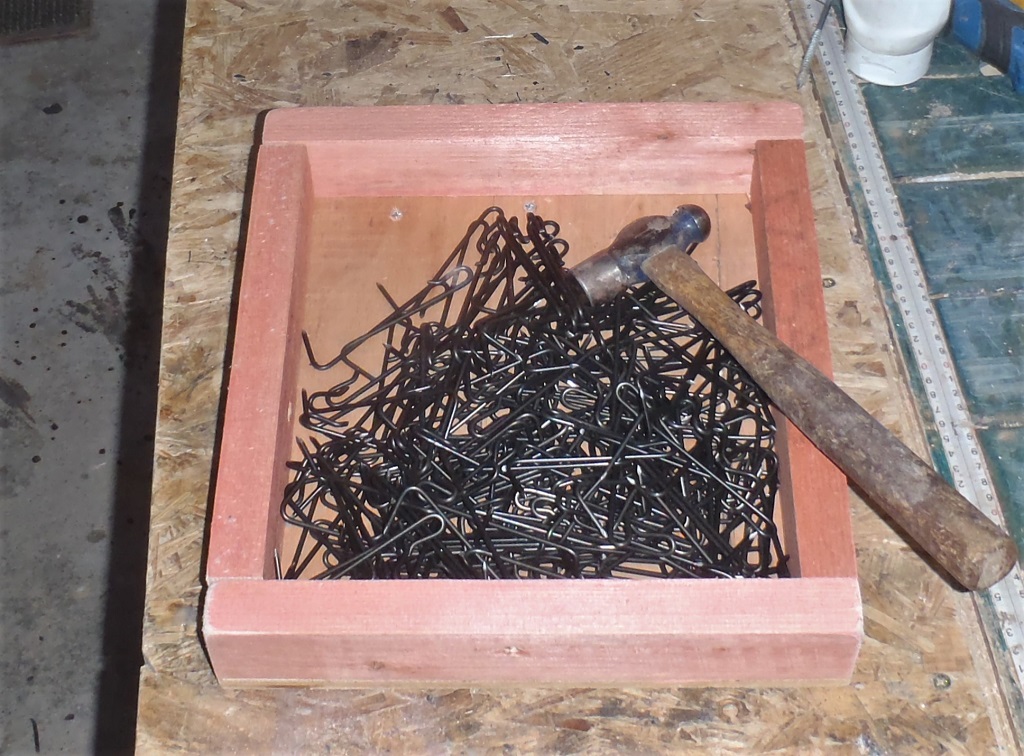
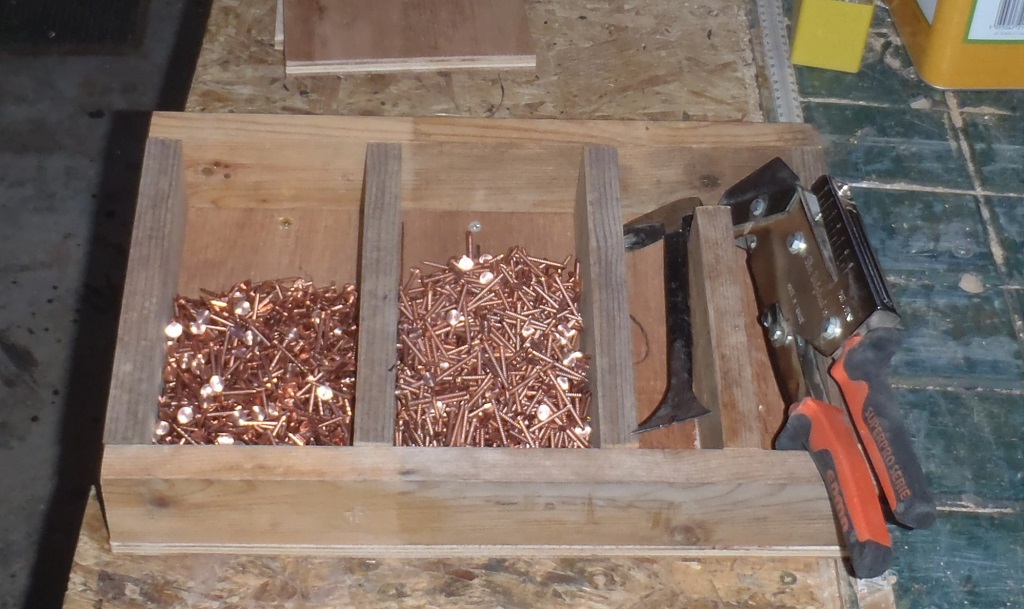
    The next piece of equipment we made, was a couple of containers to hold the various types of nails (the stainless steel slate hooks and two sizes of copper nails).
    Slate Cutting tool, Nail Containers and Slate Spacing Guides

    Box-of-slate-hooks

    Slate Cutting tool, Nail Containers and Slate Spacing Guides

    Box-of-copper-nails-with-tool-storage


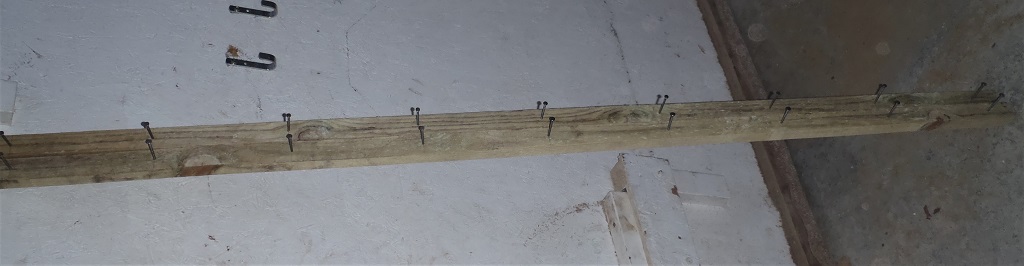
    Next item were two templates to guide us to align the slates at the required 204mm spacing, made using a 38mm wide batten with nails hammered in at the correct distances.
    Slate Cutting tool, Nail Containers and Slate Spacing Guides

    Slate-spacing-marking-sticks


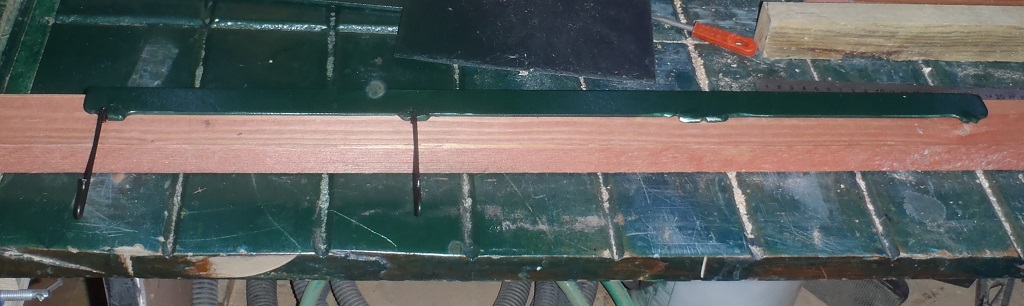
    Finally, the second guide template was a metal affair with notches at the nailing points, again at the 204mm spacing but also marked are the half way points (the 102mm distance) between the notches, to allow us to align to the chalk line on the tile battens.
    Slate Cutting tool, Nail Containers and Slate Spacing Guides

    SLate-hook-fixing-guide


    Hopefully these pieces of equipment will provide consistency, ease of getting the job done and achieve a neat finishing touch to our roof. We now need to have good weather!!

  • Rubber Liner Installed in Gutters and Tiling Battens Started

    Here is a summary of our work for the last 10 days ..
    Using glass fibre and black resin, we sealed the complex downpipe channel three way intersection plus the two outer corners too. We did this to avoid the complicated task of laying the rubber membrane lining the gutters to go around the odd shapes of the corners and joining together the two incoming gutters (off the I and J sections of the roof). Then we glued in two separate straight strips of the rubber membrane, along the bulk of the gutters and sealed the ends onto the glass-fibre surfaces with contact adhesive.

    Rubber Liner Installed in Gutters and Tiling Battens Started

    Fibreglass-and-rubber-on-inside-corner-IJ

    Rubber Liner Installed in Gutters and Tiling Battens Started

    Fibreglass-and-rubber-on-outside-corner-JK


    The first strip of the breathable membrane we put on the roof is for the valley as this is always the lowest point for any water to run downhill so we laid down a metre wide strip with stainless steel staples.
    Rubber Liner Installed in Gutters and Tiling Battens Started

    Membrane-in-the-valley

    Next things we had to analyse and test, was the valley trough (a moulded fibre-glass constructed object) that needs to fit underneath the slates, to catch all the rain water flowing down the slope into the valley. It is a deliberate method of allowing the water to “leak” pass the end of the slates and collect together and be diverted in a channel. For this reason, the battens needed to be spaced apart so it is fully supporting the trough on the bottom, and then supporting the two outer edges on the wider tile batten.
    We made a test assembly on another valley on the roof first and worked out that three 38mm wide battens can be placed together (with a gap of 38mm between the inner single batten and the two outer battens) on each side of the valley, with a gap measuring 130mm wide between them. Then a 50mm battens is placed on top of the 2 outer battens to hold the edge of the trough.

    Rubber Liner Installed in Gutters and Tiling Battens Started

    Test-fitting-valley-trough


    Using our research, we proceeded to screw full length battens (4.5metres long) into place, on top of the breathable membrane already there, going up the I-J valley and then we doubled back on ourselves putting 90mm nails into the underlying rafters to provide a strong secured fixing.
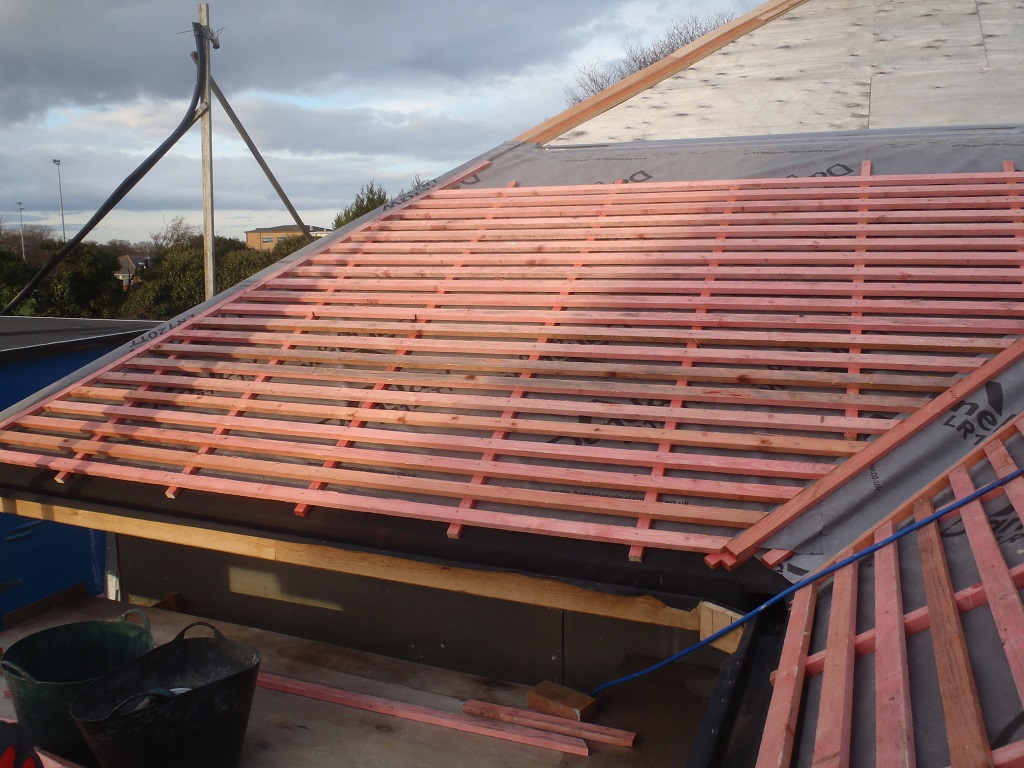
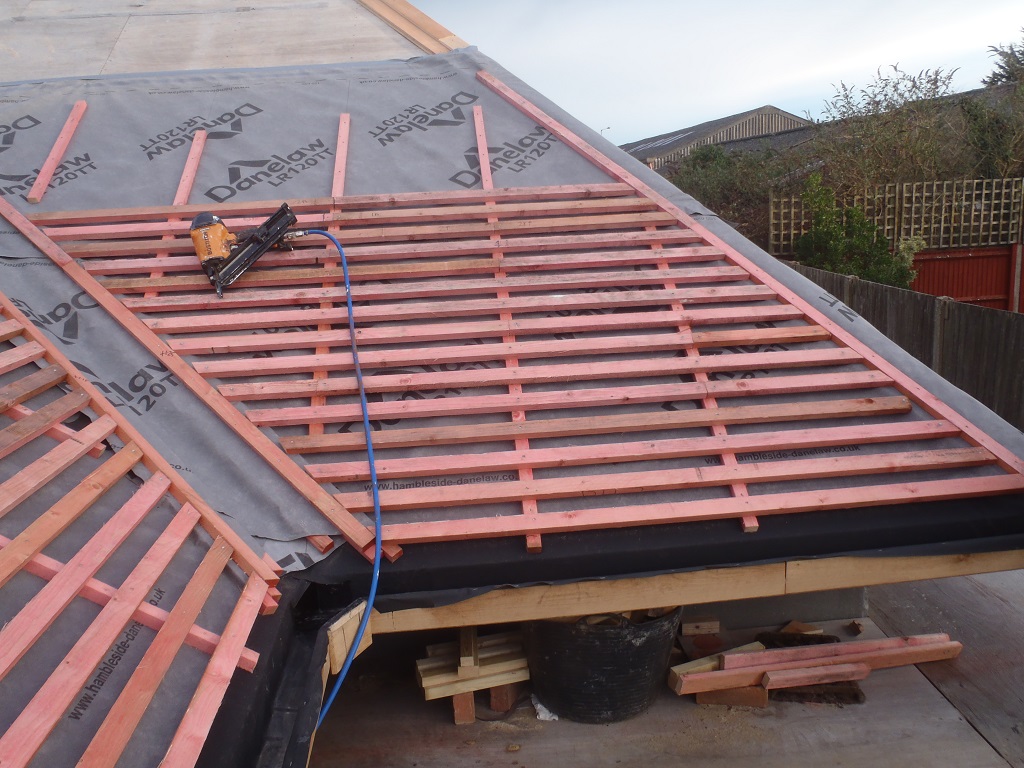
    It now follows that we can start on the task of mounting all the tile battens on to the roof. The breathable membrane goes on first, going flat on to the roof boards, starting the first line, overlapping the lower rubber membrane and running over the Hip and Valley ends. The membrane was held into place with the vertical lines of battens, in short segments that stop just before the top edge (To allow the next piece of membrane to overlap). Then the horizontal tile battens were nailed into place at regular spacing of 112mm apart, so that a slate will sit across three rows of battens and hook onto the hanging nail off the third line.
    Rubber Liner Installed in Gutters and Tiling Battens Started

    Slate-layers


    We managed to get about 20 rows on the I roof and about 16 rows on the J roof sections, just about half way up the slope.
    Rubber Liner Installed in Gutters and Tiling Battens Started

    Battening-started-on-I

    Rubber Liner Installed in Gutters and Tiling Battens Started

    Battening-started-on-J


    On Monday, in the afternoon, we will resume this task of more wooden battens and probably have it all complete by Tuesday.

    We are learning the techniques and methods needed on this section of roofing, and will be getting better and quicker at it as we progress!

  • Lift Shaft Installed and All Working

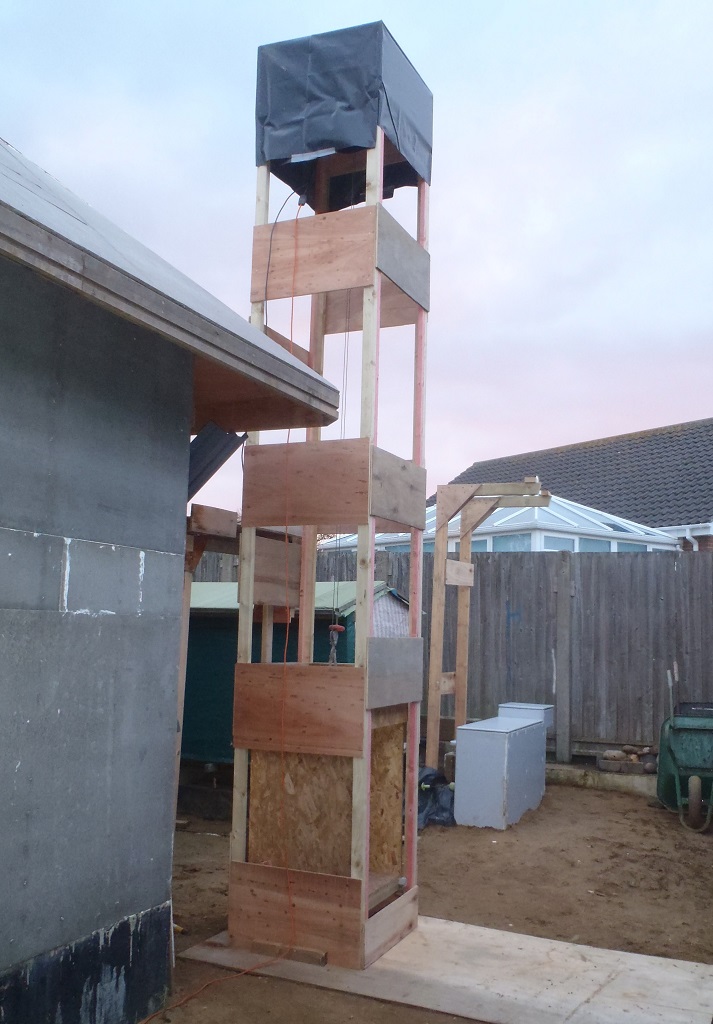
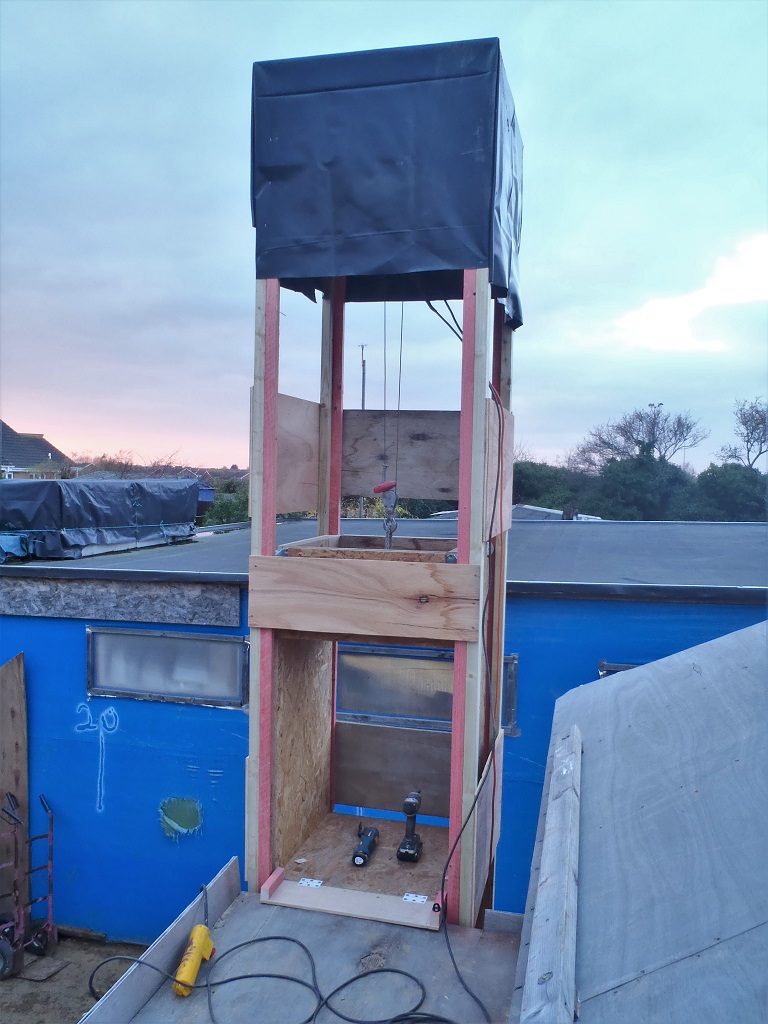
    Today, we took the opportunity of the fine sunny but cold weather to take our Lift Shaft outside and install it against the walkway platform running around the back of the building. It was positioned against the start of the “I” section of the roof, mounted on a 8feet by 4feet sheet plywood. We also anchored it up at the top of the nearest leg of the platform to ensure that it won’t get blown over in high winds or topple with heavy loads inside it.

    Lift Shaft Installed and All Working

    Complete-Slate-Lift

    Lift Shaft Installed and All Working

    Lift-at-the-Bottom

    Lift Shaft Installed and All Working

    Lift-at-the-top


    We had to slide the cargo cage up inside the Lift Shaft while it was lying on its back, entering from the bottom. Then push the whole thing upright by lifting at the other end (the top end) and slowly walk it gradually upright. It was also anchored at the bottom to the plywood base sheet too.
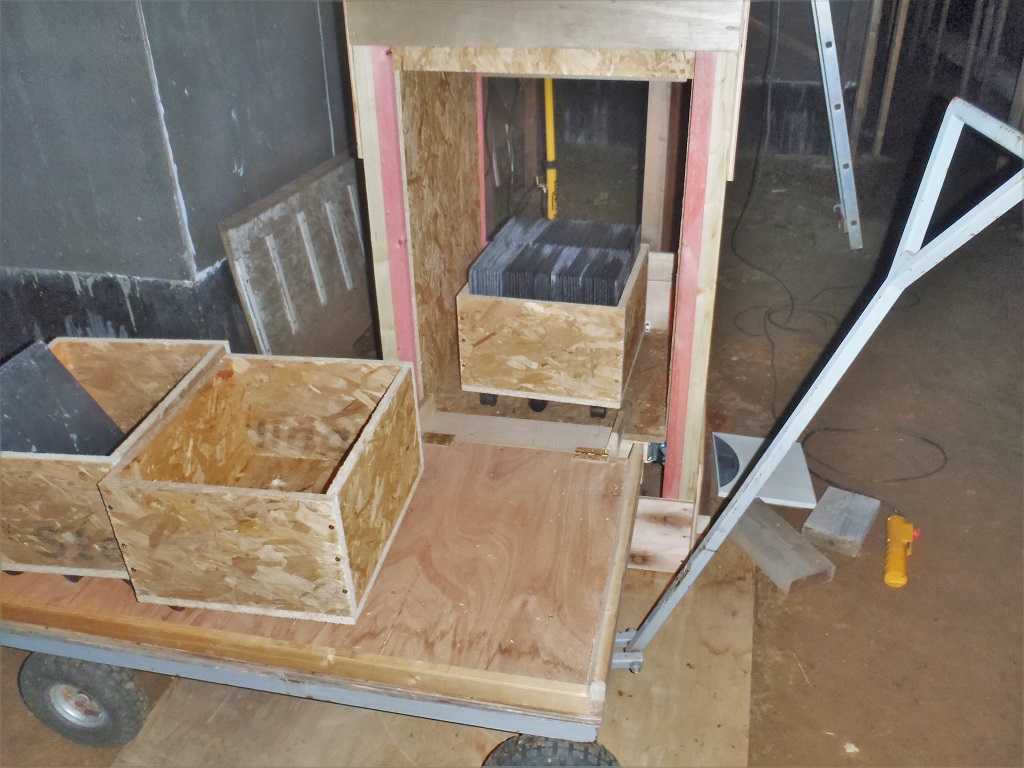
    We then hooked up the hoist motor at the top of the shaft using a metal pole and unwound the cable down to the cage. The final job was to mount on a second ramp on the other side of the cage, the side facing the platform walkway so we can trundle our dolly trolleys off. We tested the capabilities of the whole system by first loading several heavy concrete blocks into the cargo cage (about 75kg of load) and ran it up and down several times.
    Then we went to our slate storage area and loaded up one of our dolly trolleys full of slate tiles, we managed to put in two rows of 60 slates. We took that back again using our modified flat-bed trolley and loaded it into the cage. We weighed this and the cage on a bathroom scales and it came to just short of 150kg and the cage being about 40kg itself which leaves about 110kg for the box of slates. This latest load test was handled just fine!
    Lift Shaft Installed and All Working

    Loaded-dolley-in-lift

    That is the basic lifting system all done, mechanically speaking at least, but we have ordered some electrical switches, push buttons, limit switches (to detect the position of the cargo cage) and relays plus a micro-controller (tiny computer) chip to join all these pieces with some logic to achieve a much better system of having the ability to push a button to send it up and automatically stopping at the top, and do the same with another button at the top to send it down again. It will have other safety features like the ramp must be folded up and secured before the lift can start moving.

  • Lift Shaft Built

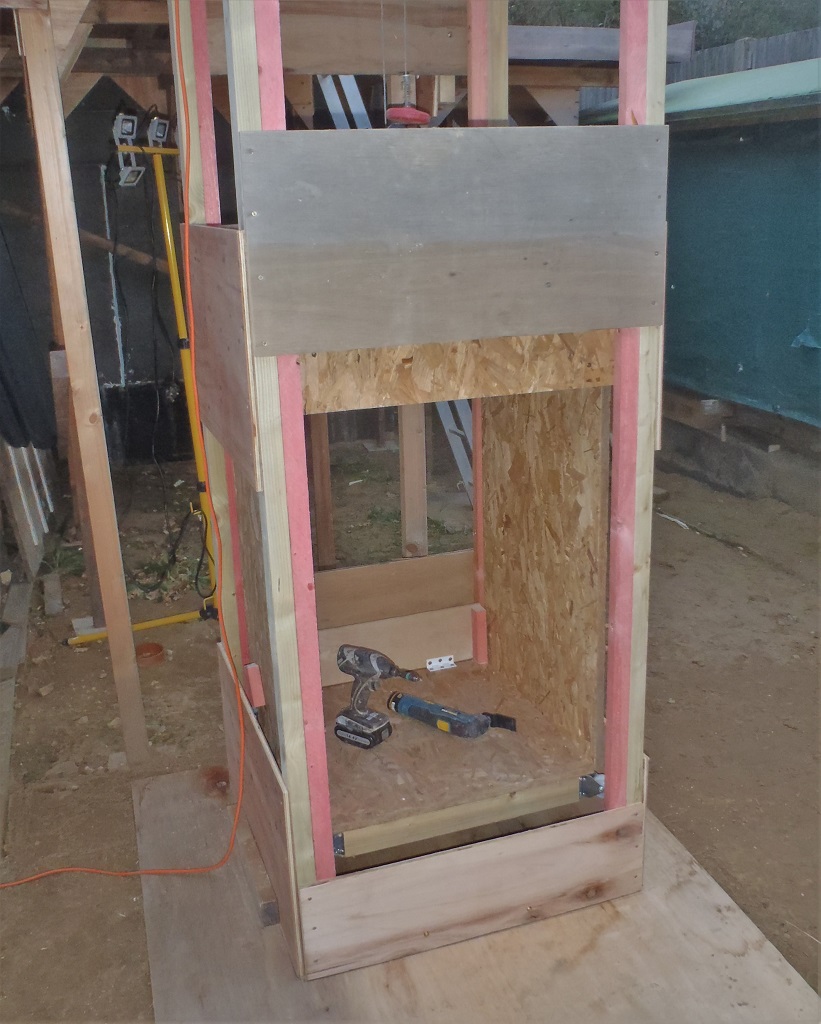
    Today, we created the Lift Shaft to take our box on wire up and down. It measures 730mm by 760mm (internal measurement of 680mm square, the size of the cargo cage) and it is nearly 5metres (16feet) long, or rather tall when it is standing up.

    Lift Shaft Built

    Lift-cage-in-Shaft

    Lift Shaft Built

    The-16-foot-lift-shaft


    We also created the support framework to hold the metal bar which in turn is holding in place the electric hoist.
    And finally, a little sloping roof installed at the top end and we will wrap some heavy duty plastic to protect the motor, electrical wiring and control boxes from rain water.
    Tomorrow, we will man-handle it outside and rotate it upright on to a flat base to anchor it, slide it against the platform walkway and make any final adjustments including putting on the second ramp at the top.