Category: Slates

Slate Tiles measuring 300mm by 200mm, 18600 in total, covering 360 square metres.

  • Building a Lift Mechanism to Raise our Slates

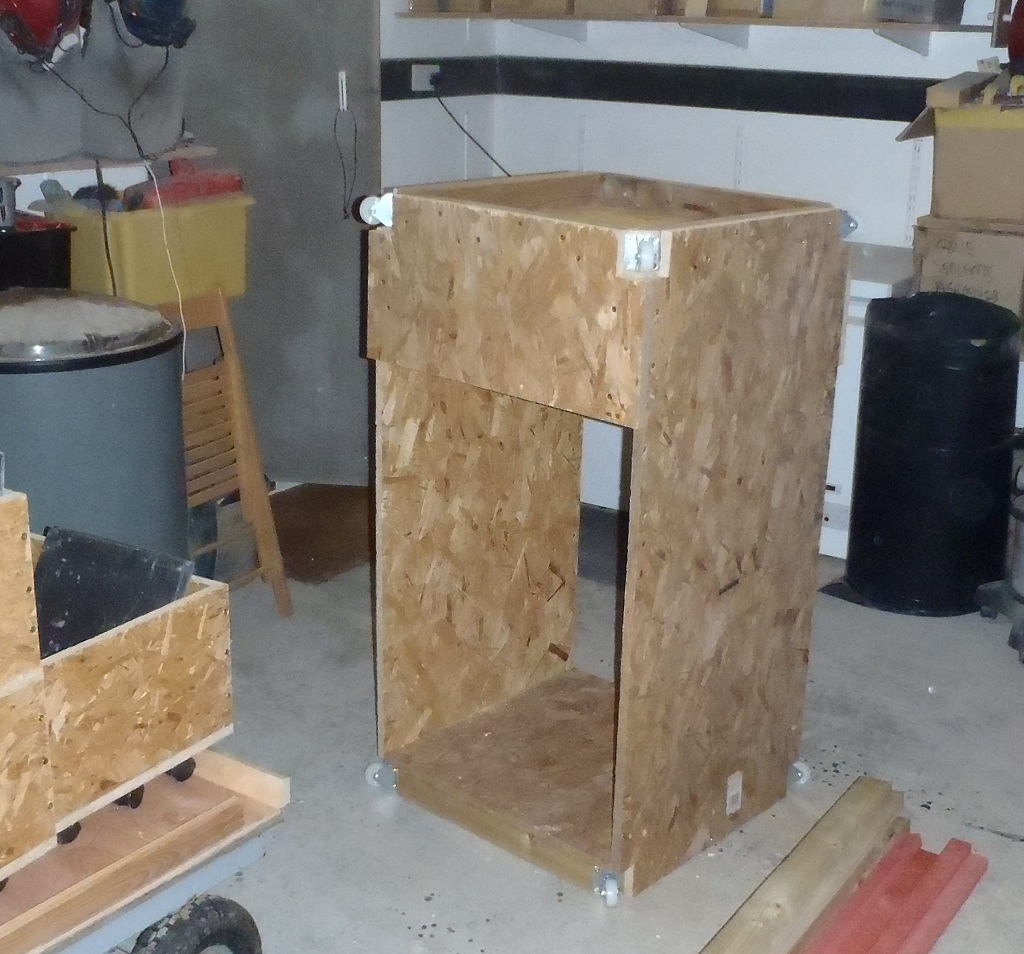
    Today, we started building various pieces of equipment to help us lift our Slate tiles up to our working platform. We need a lifting mechanism to raise our dolly trolley load of slates so we created a cage measuring 2feet square by 4feet tall, with castor wheels in each corner, both at the bottom and the top.

    Building a Lift Mechanism to Raise our Slates

    Slate-lift-cage


    The cage will be connected from the middle point, via a steel wire, to our electric hoist and controlled by several push buttons and the cage will move up and down inside a framework to keep the cage straight and stop it twisting around or jamming up.
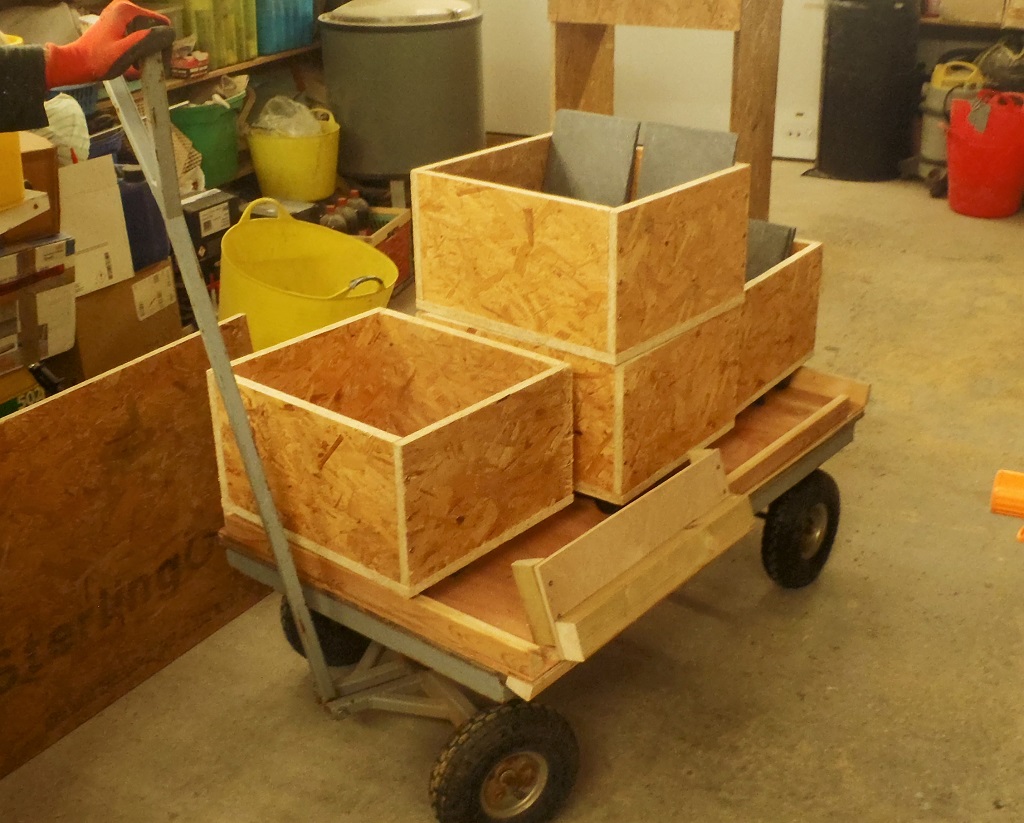
    The other task was to adapt our medium sized flatbed trolley so it can transport three of our dolly boxes to and from the crates of slates, including a little ramp that will bridge the gap to the cage in our lift mechanism.
    Building a Lift Mechanism to Raise our Slates

    Small-trolley-modified-to-carry-slate-dollys


    Tomorrow, we will build the lift shaft, all 16feet of it!!

  • Dolly’s Created to help transport our Slates

    After having a major tidy-up in the workshop (to clear away the tools and mess from building our filtration module), we started on making various pieces of equipment to help us in getting the Slates up onto the roof.
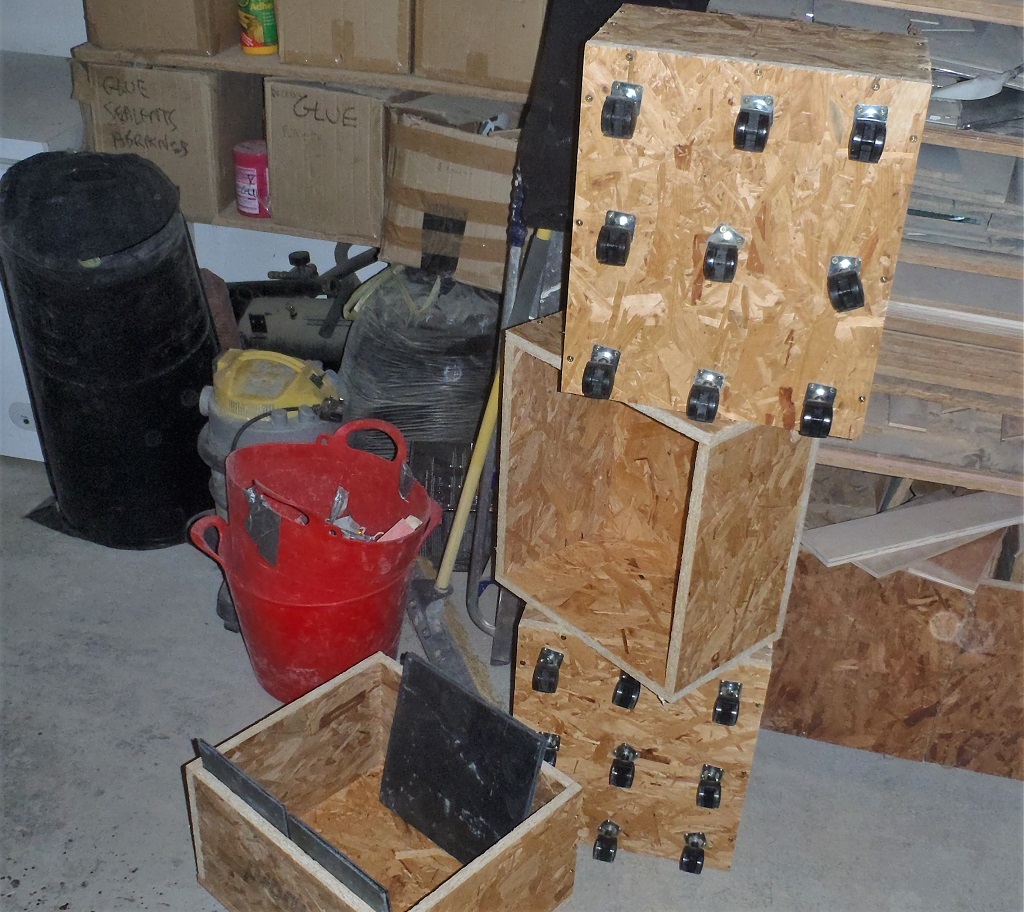
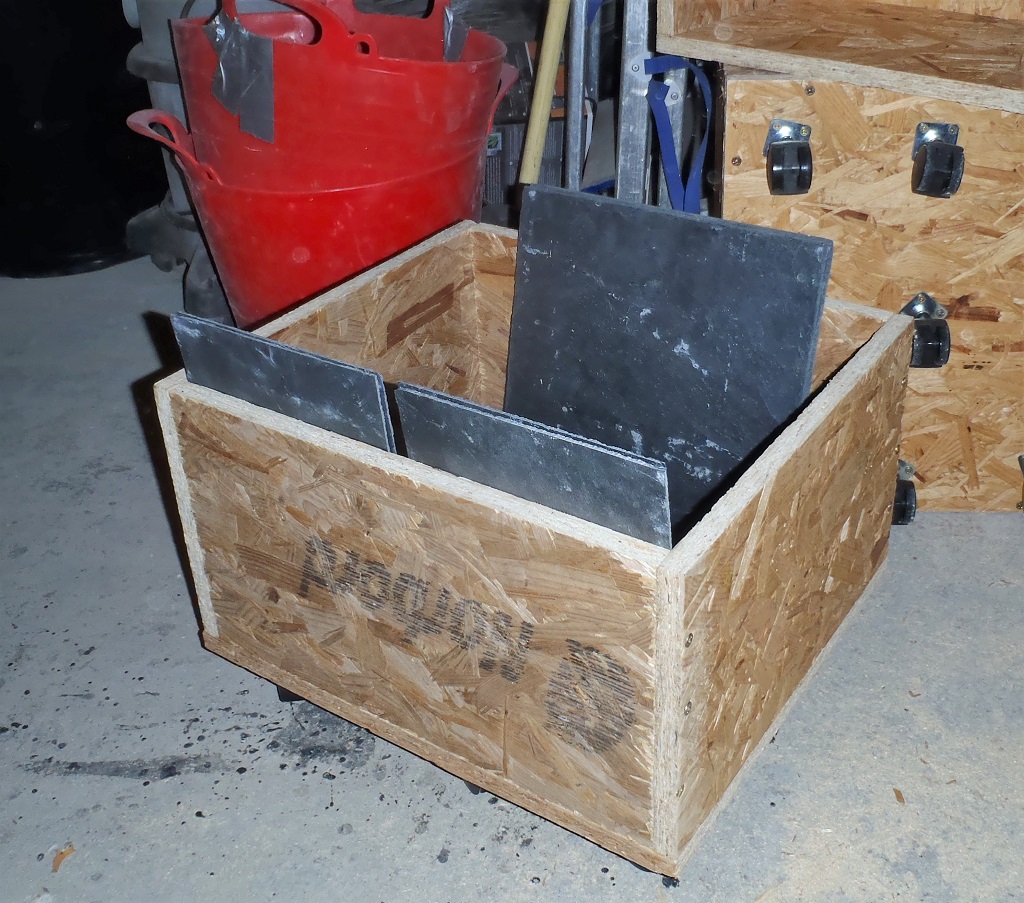
    Today, we created four dolly trolleys to help transport a heap of Slate tiles from our storage area alongside the Loke and get them to where we would be currently working on the roof. They are made out of 18mm OSB board, each dolly is 425mm wide by 400mm in the other dimension and 240mm high, big enough to allow us to pack about 150 slates, in two rows of 75, held vertically (They will weigh up to 150 Kg or 330 lbs i.e 23 stone!).

    Dolly's Created to help transport our Slates

    Slate-dolleys-1

    Dolly's Created to help transport our Slates

    Slate-dolleys-2


    We put on nine little office chair type of castor wheels on each and we tested them by crouching down in the box and get pushed along the floor!
    These will go onto a vertical lift mechanism to take each one up to the walk-way platform, we will design and make the lift next week.

  • Trial Run in Working with our Slate Tiles

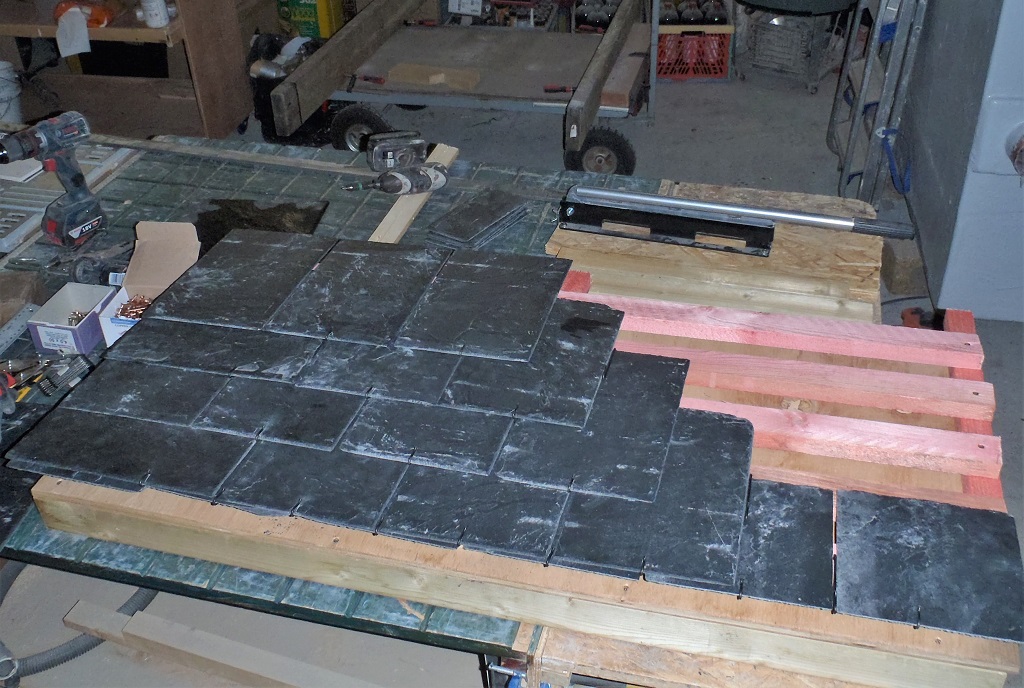
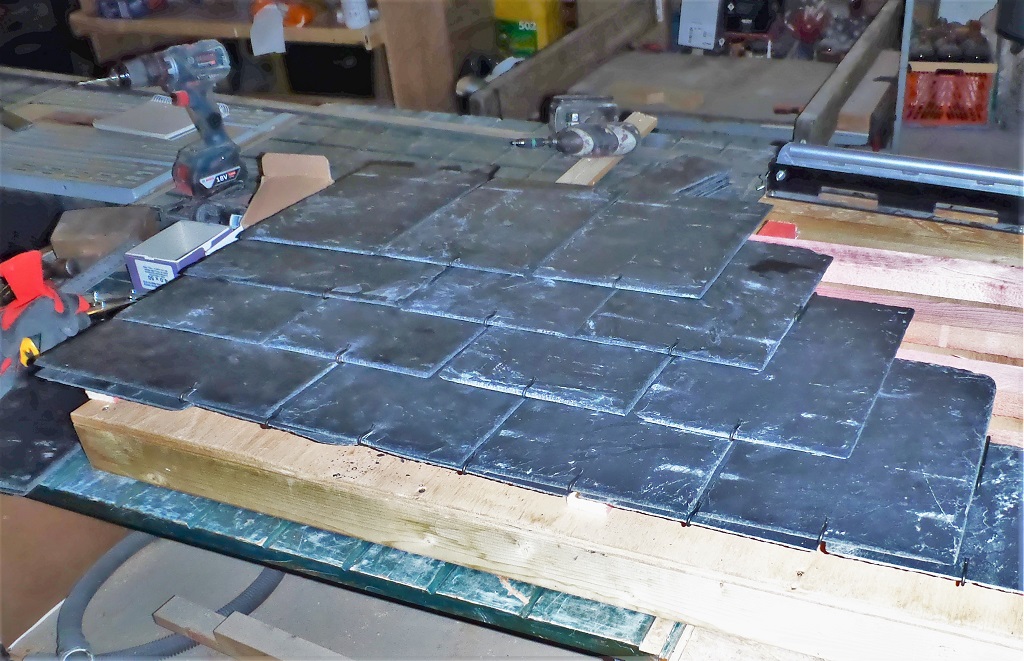
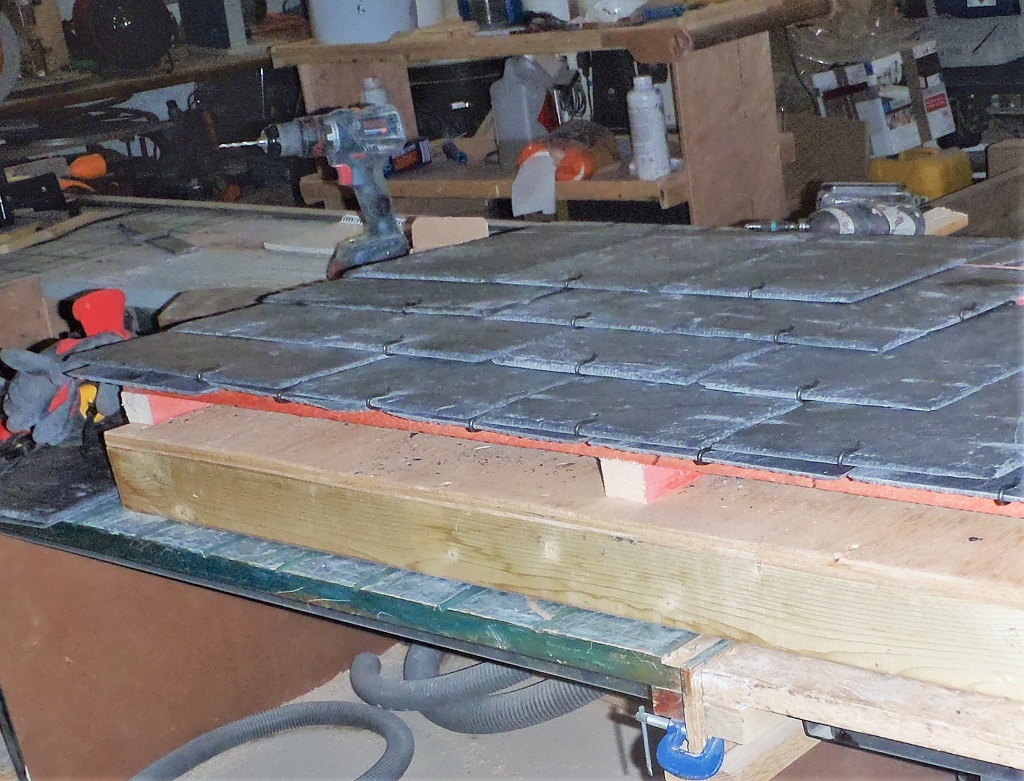
    We constructed a small test rig, to reflect the design and placement of the two layers of the wooden battens to be on our roof and then played with a dozen slate tiles.

    Trial Run in Working with our Slate Tiles

    Roof-slating-test-1

    Trial Run in Working with our Slate Tiles

    Roof-slating-test-2


    The first row of any roof has to have two tiles (the lower tile is cut down in height) to ensure that the rainwater will be directed down the slate and not drip through onto the battens and the breathable membrane. We tested using the copper nails (through two holes) to see how they work, and tested using the hook nails (a bent rod of metal running underneath and hooks on the bottom edge)
    Trial Run in Working with our Slate Tiles

    Roof-slating-test-3


    It is quite obvious that there is a need for a “filler” to be inserted on the first batten, to take the place of the missing third tile, so we will fold up our gutter metal mesh guard several times to the required thickness and when that is nailed on the first batten row, that will provide the extra height needed.
    The overhang distance of the bottom edge of the slate tiles will be about 55mm so we will position the first line of battens so that the tiles will hang over the gutters by 25mm, and the rainwater drips nicely in.

  • Slates on Section D and E Completed and Preparing the Guttering on Last Section At Last

    In these two weeks, there was a big disruption and stoppage to our work. The first week had only one successful day of work and that when we got the “D” section of the roof completed and got started on the “E” roof. The rest of that first week was spent recovering from the flooding we suffered during a very heavy rain storm, see Rain, Rain, Rain. for more details!
    The second week was more successful thank goodness .. ..
    First day, Monday, was spent in the workshop processing five more oak planks to make the remaining guttering pieces. We were short by three base pieces and two front ones. We had some of each type left over so we used those ones as our template to duplicate the extras. It was a 4 stage process to cut the various tongue & groove edges, bevelled angled edge and making the tongue to fit the fascia slot. We finished this task with a morning session on Wednesday.
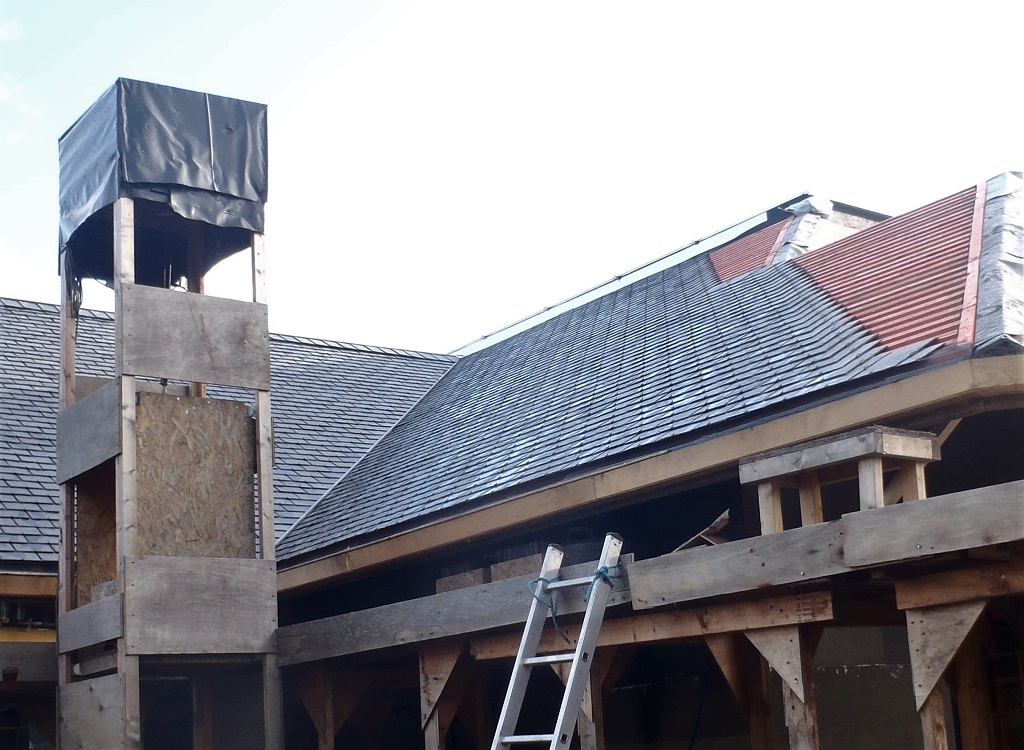
    Fortunately, we had some dry days remaining so we got on with putting up slates up on the “E” section of the roof and got most of it covered by Thursday. We couldn’t go any further as we don’t have any access (safe access) from the other roof surfaces to finish off the section.

    E-mostly-slated

    E-mostly-slated

    The-ABDE-Junction

    The-ABDE-Junction


    Friday was an alternative day of work doing a hand rail for a family member and fitting it to their stairs. We made it using a 3metre plank of 27mm thick oak timber and planed it down to about 80mm wide with a gentle horizontally curving profile. Also we made a 45mm square post with another oak piece we had left-over from a previous job (the window sill).
    And finally, on Saturday, we rearranged two platform modules to extend our walkway and working platform to reach the remaining “H” section of the roof and a bit of the original “I” section where we started this whole job.
    We had to move some empty slate crates and also coiled up two plastic conduit pipes that had been buried underground along the back of the house for various old functions in the past.
    The afternoon saw the base pieces of the guttering cut and test fitted (but not glued) to section “G” and “H”, to rejoin back to where we started all those months ago!
    What was quite odd and amusing is that this last section along “H” saw the most wobbliest stretch of our fascia we have had in the whole of the roof and we had to make some minor adaptions to our base boards to make them fit in a straight line. Nothing complicated.
    (no picture as it got dark!)
    So next week, we will get the gutters finished, fibre-glass and black resin the final three corners, put in the rubber liners and then put up the breathable membrane and wooden battens up the roof.

  • Covering of Section I and J Roof is Progressing

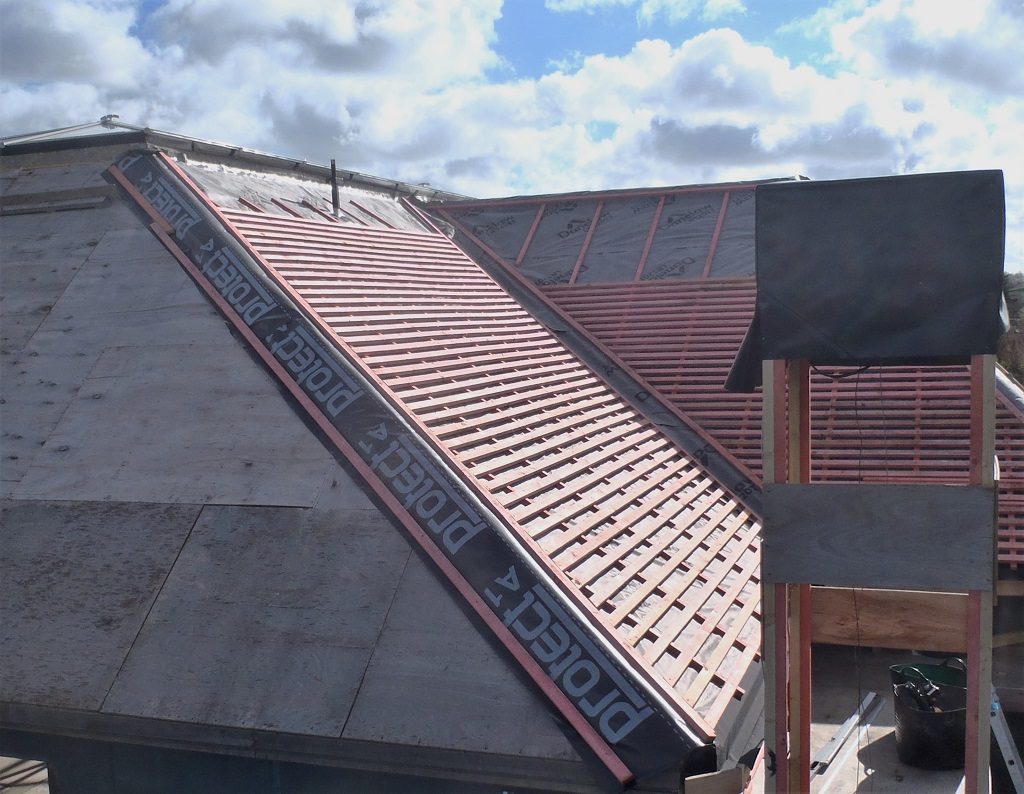
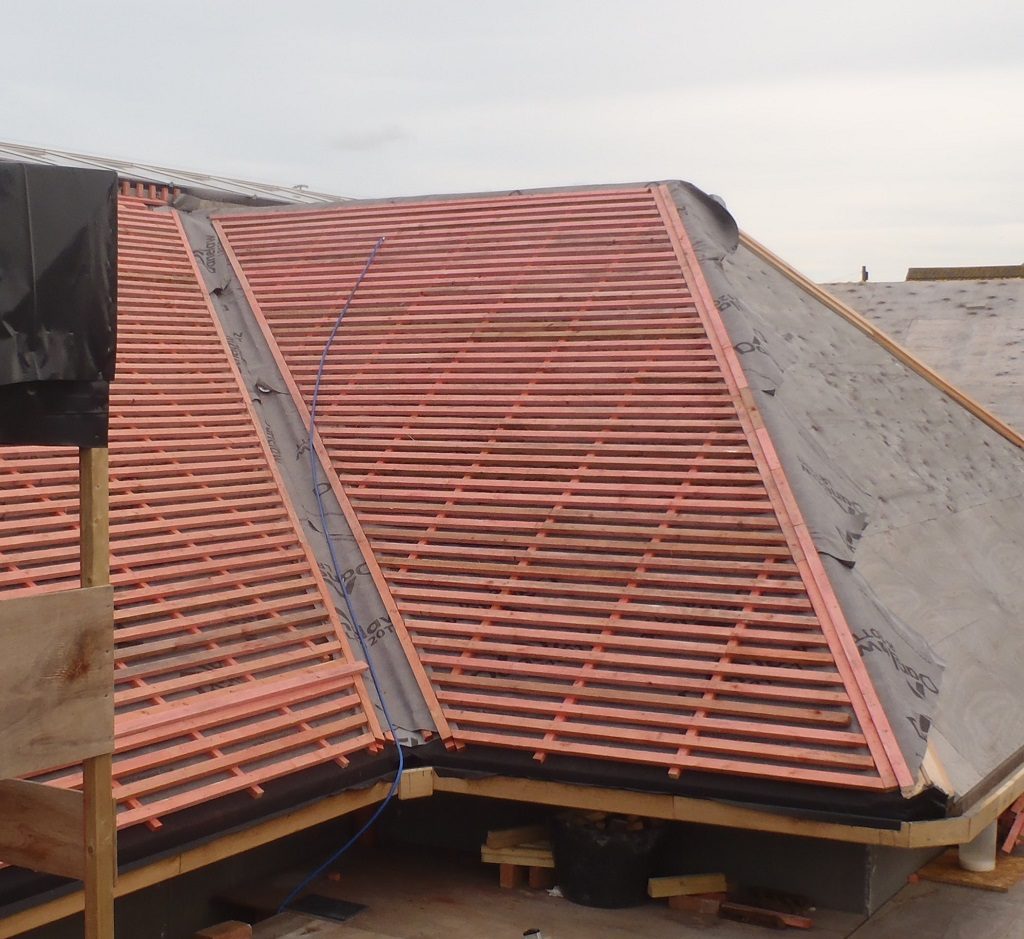
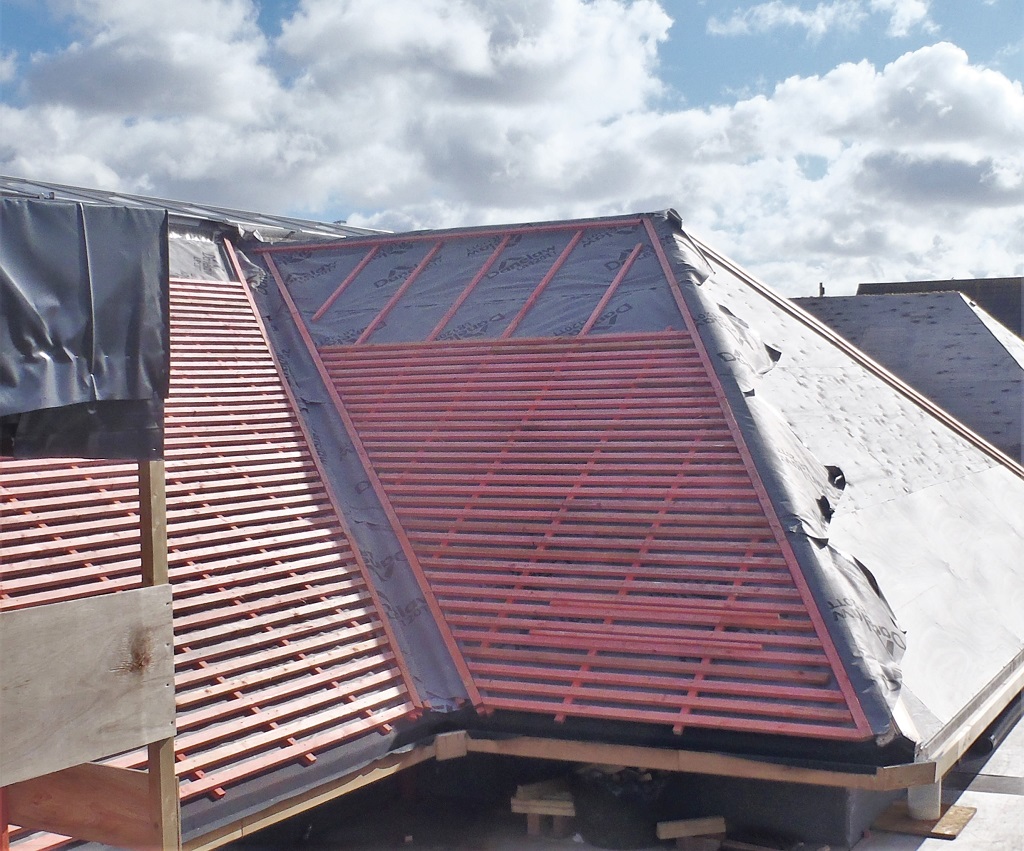
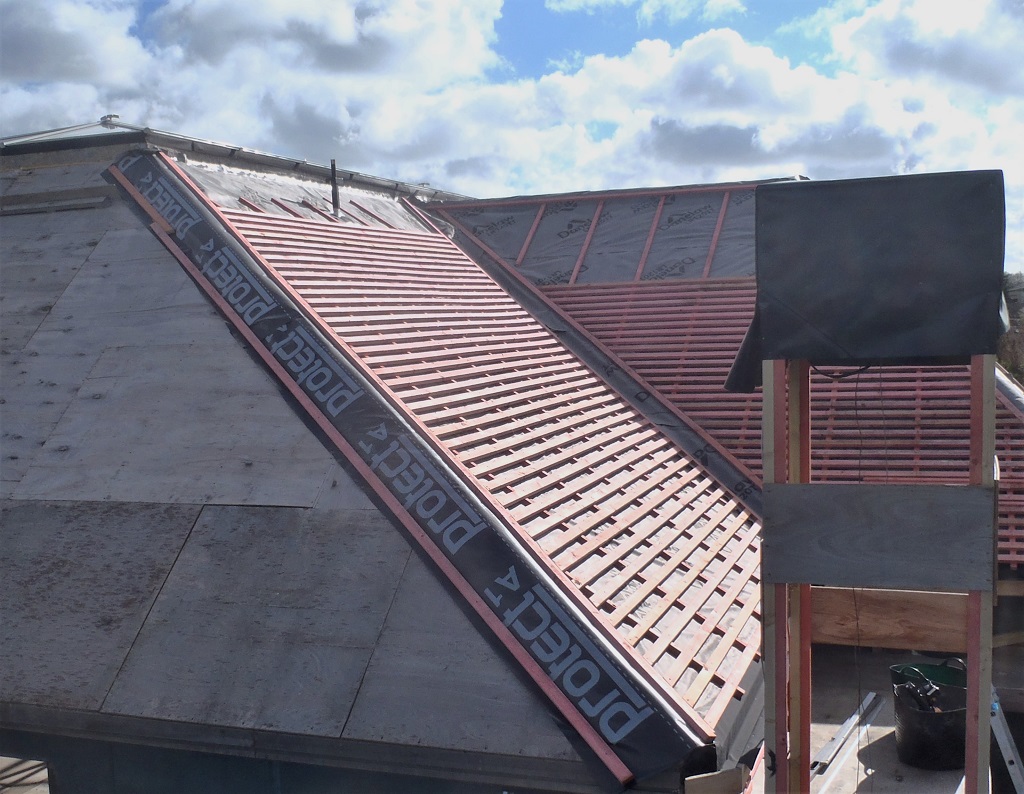
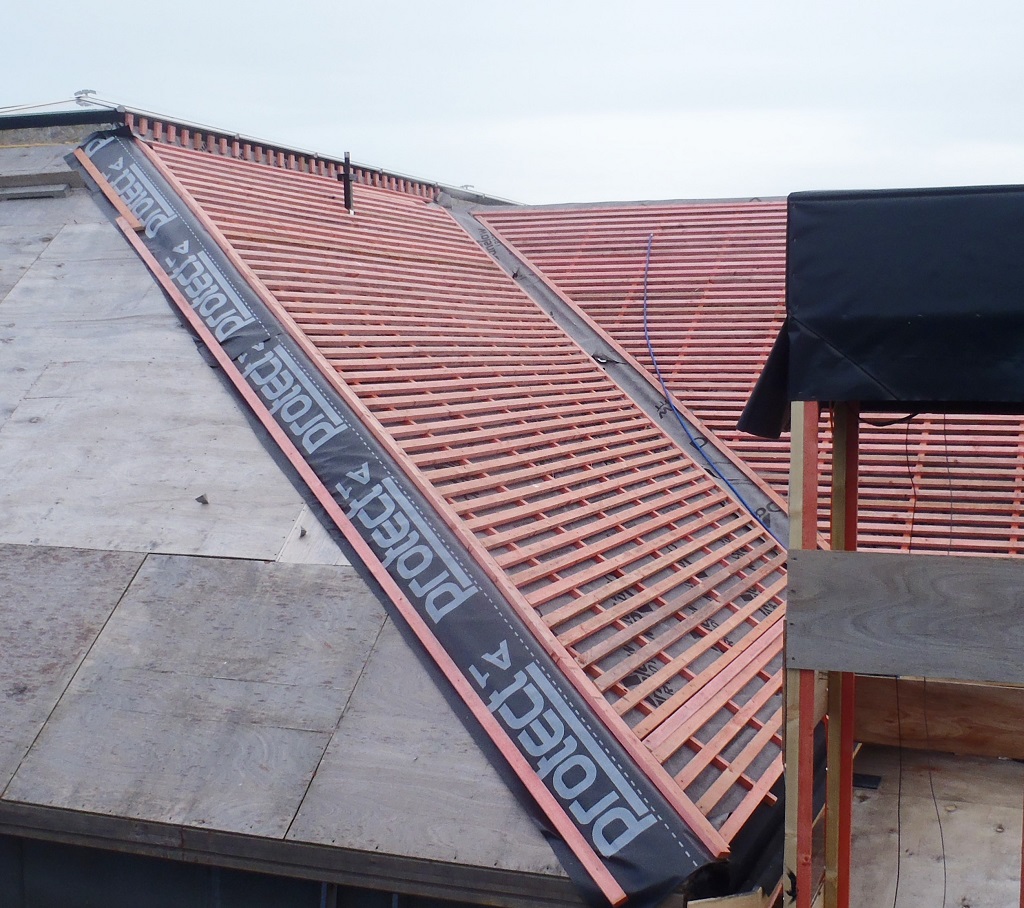
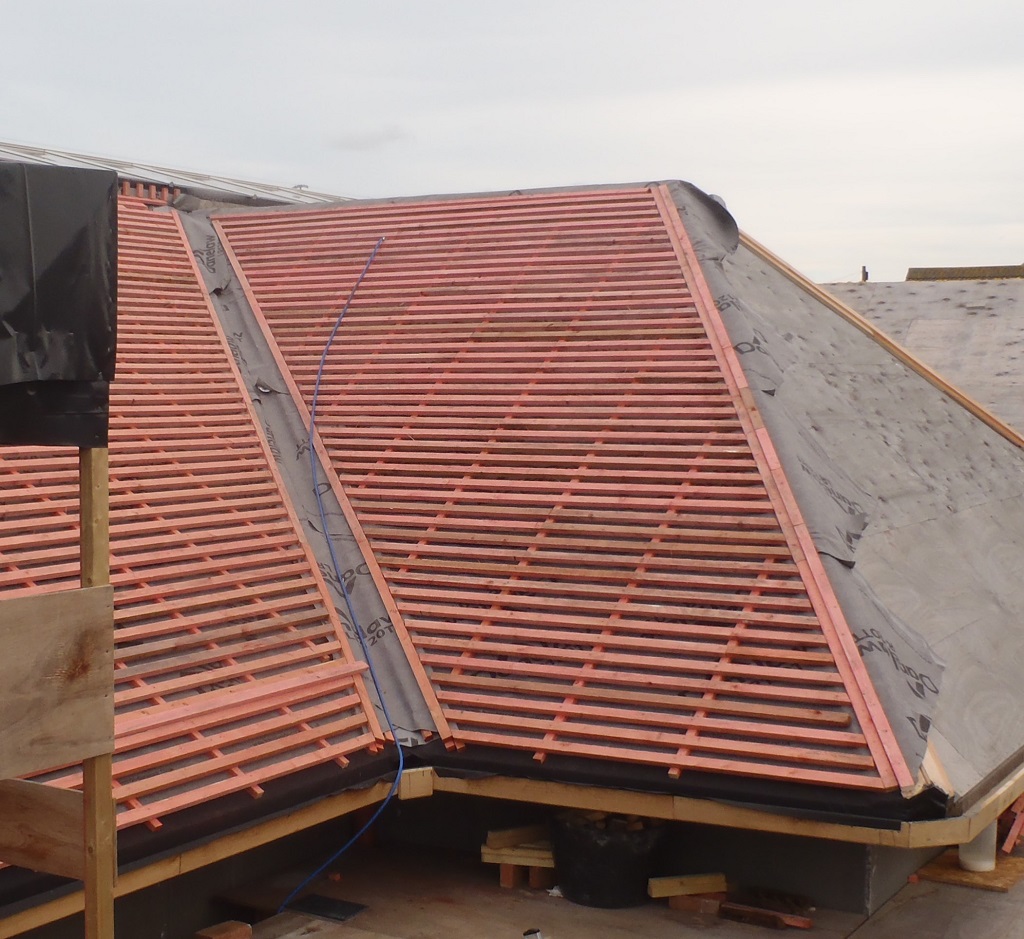
    This week, we continued with the task of nailing up rows and rows of battens on top of the breathable plastic membrane on the I and J section of the roof.
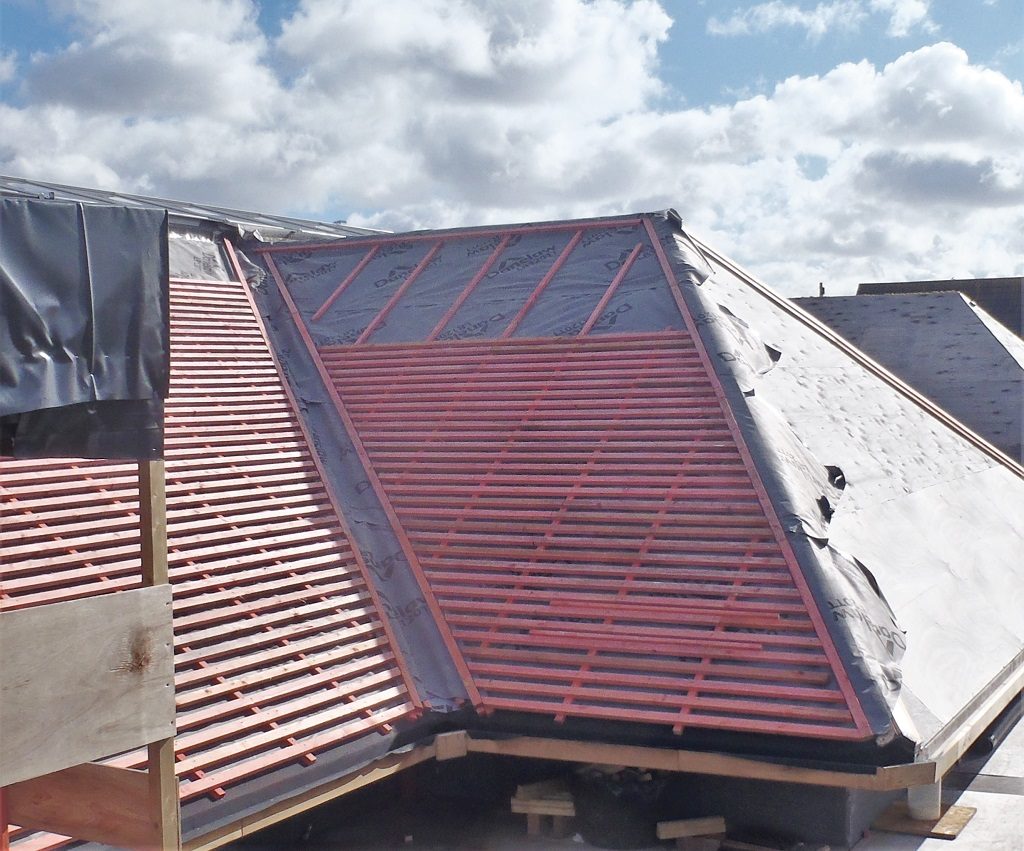
    Covering of Section I and J Roof is Progressing

    Battens-nearly-finished-on-J

    Covering of Section I and J Roof is Progressing

    Battens-nearly-finished-on-I


    We also had to do the chimney mounting pole where it came through the roof boards. The breathable membrane had to have a slit cut into it, to slide over the metal pole and then lay in a square rubber piece that had a small square hole cut in the middle and stretched over the square pole too. The rubber went under the membrane above the pole and over the top of the membrane below the pole, to ensure that any water that had slipped past the slates would run off without entering into the house.
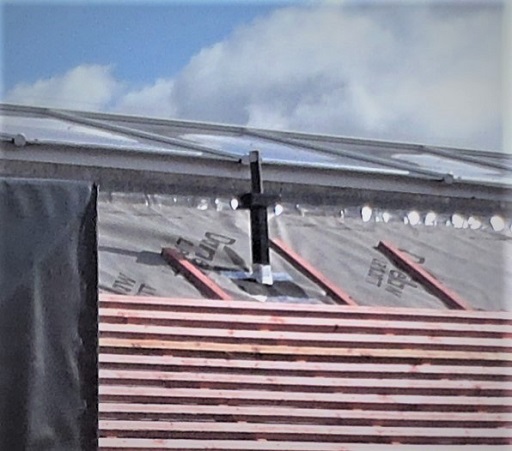
    Covering of Section I and J Roof is Progressing

    Sealing-base-of-chimney-support


    Some of our days were interrupted by rain and other commitments but we managed to get a long morning of work in, here and there, before the forecasted rain arrived, or around our other commitments.
    Both the I and J sections are both complete, all tile battens are up, all spaced apart 112mm and ready for the Slates to go on.
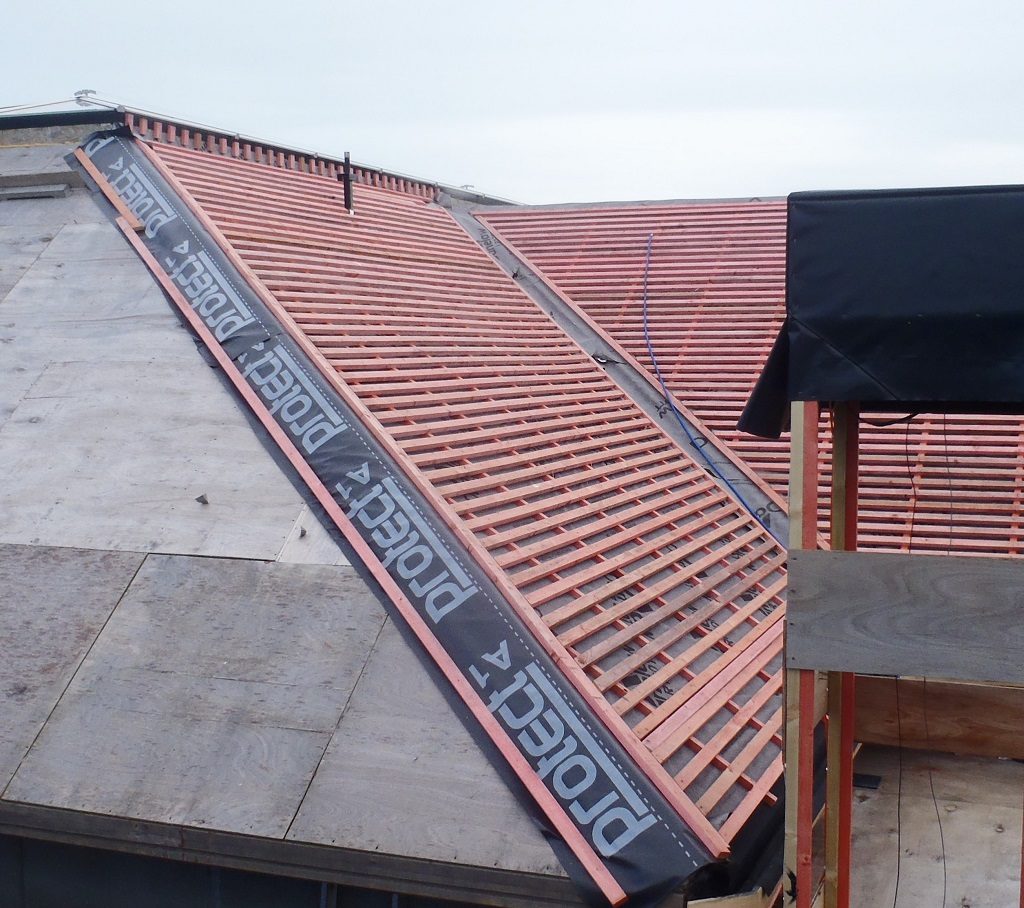
    Covering of Section I and J Roof is Progressing

    Battens-finished-on-I

    Covering of Section I and J Roof is Progressing

    Battens-finished-on-J


    But we had to fiddle with the valley trough modules to build up a 7 metre line up the inner corner of the roof, and interface the top end into the layers of rubber and breathable plastic membrane and slates so that any rainwater will be collected by the trough and not leak on to the roof boards (which of course is protected with another backup plastic membrane too).
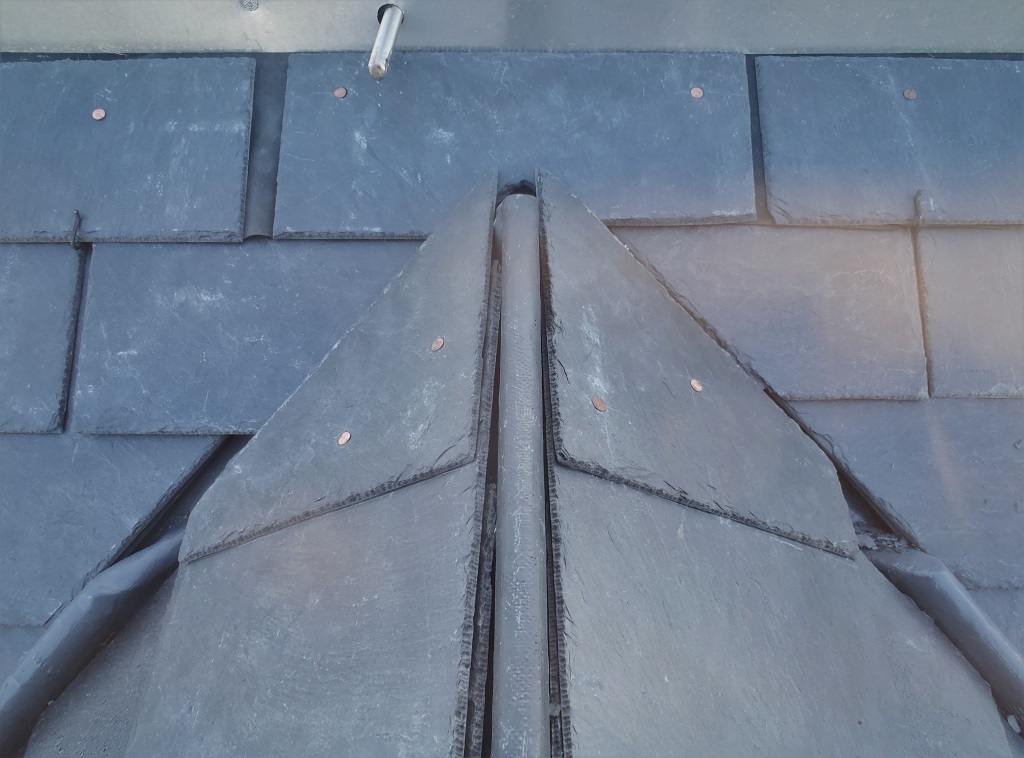
    We are also talking about using Lead sheets to provide a very malleable material to shape around the complex angles at these points on the roof, for example, the three way intersection of the K roof and the Ridge line coming out from the house.
    Finally, we put up the support battens on the kerb, 100mm high pieces, screwed with stainless steel screws, spaced apart 150mm (half a slate so each slate can have two nails in it), to hold the flashing rubber membrane to seal the junction between the slope of the roof and the kerb. These battens also reinforces the security of holding our breathable membrane into place and not get ripped during strong winds.

    The last job started on Saturday, was designing and making various tools to help with the process of shaping the slates, a box container underneath the guillotine tool, to hold the sharp pieces of rubbish (and not scatter across the roof surface and make a mess in among the wooden battens and membrane). We will finish that on Monday and also make a tool to make the task of placing alignment marks up the tile battens much easier. These marks are spaced apart 204mm, the width of a slate plus one hook .