Category: Equipment and Tools

The Tools we are using on this Project

  • Jig to Slice Concrete Blocks

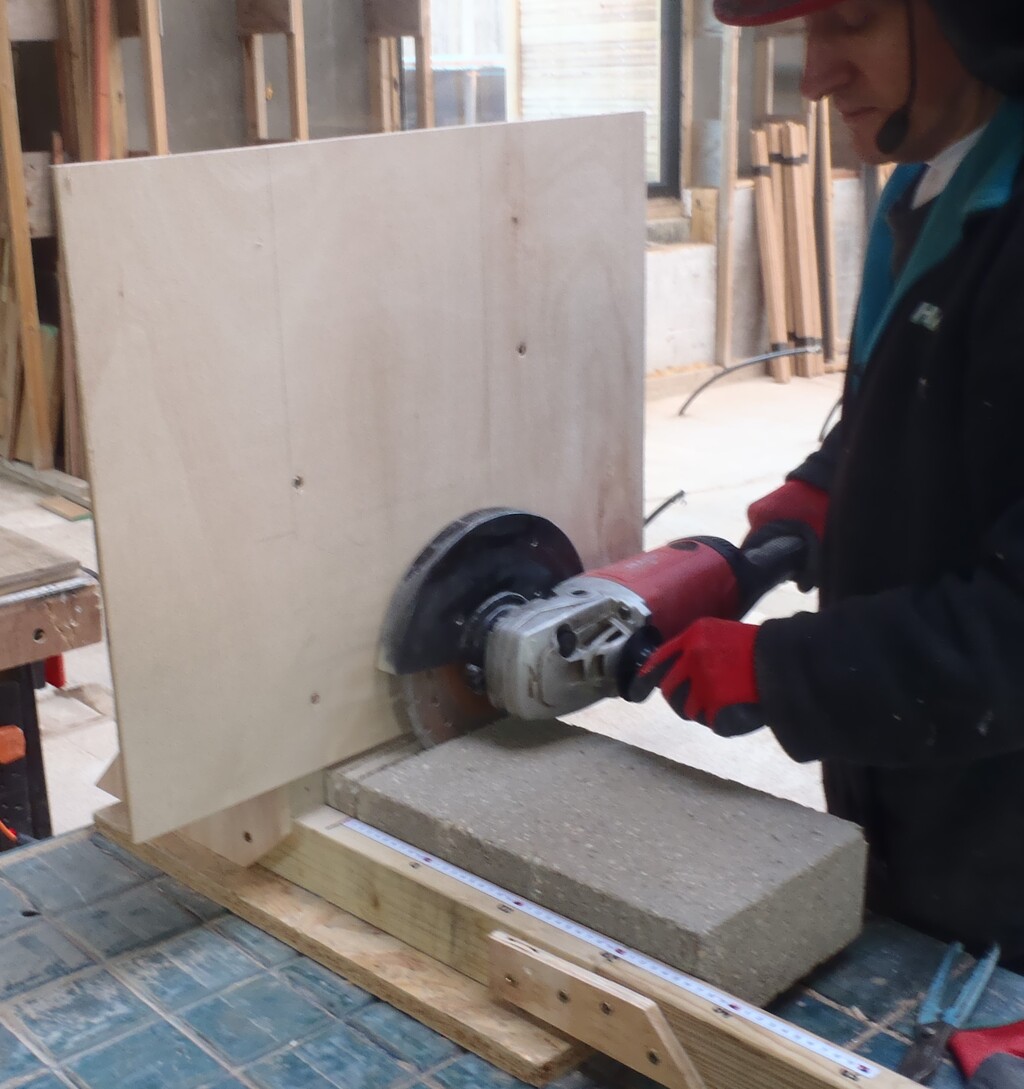
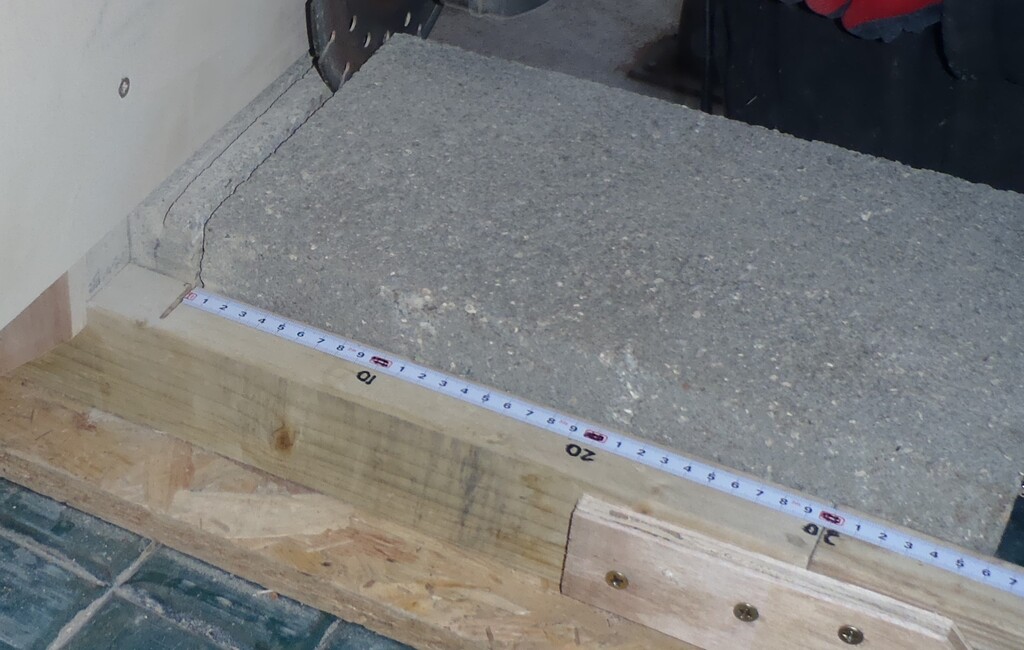
    This morning, we created a jig to help us slice up concrete blocks using our large mains powered angle grinder fitted with a diamond coated cutting blade. We put several chunks of timber and OSB pieces together, to form a fence with a ruler attached to it, plus a right-angle flat surface using a piece of plywood to guide the machine at close to 90degree as possible.

    Jig to Slice Concrete Blocks

    Block-cutting-jig-1

    Jig to Slice Concrete Blocks

    Block-cutting-jig-2


    The angle grinder and the blade was able to cut fairly easily through just over half way through the 100mm thick concrete block and just turning the block over, we could slice quite neatly a block to a given size.

  • Chop Saw Plank Slicing Station

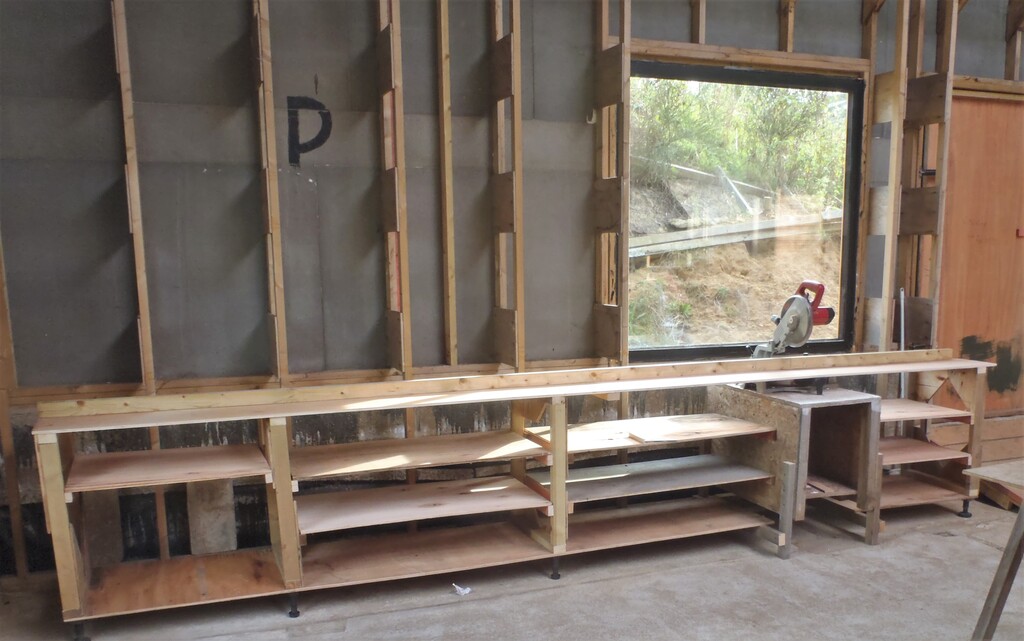
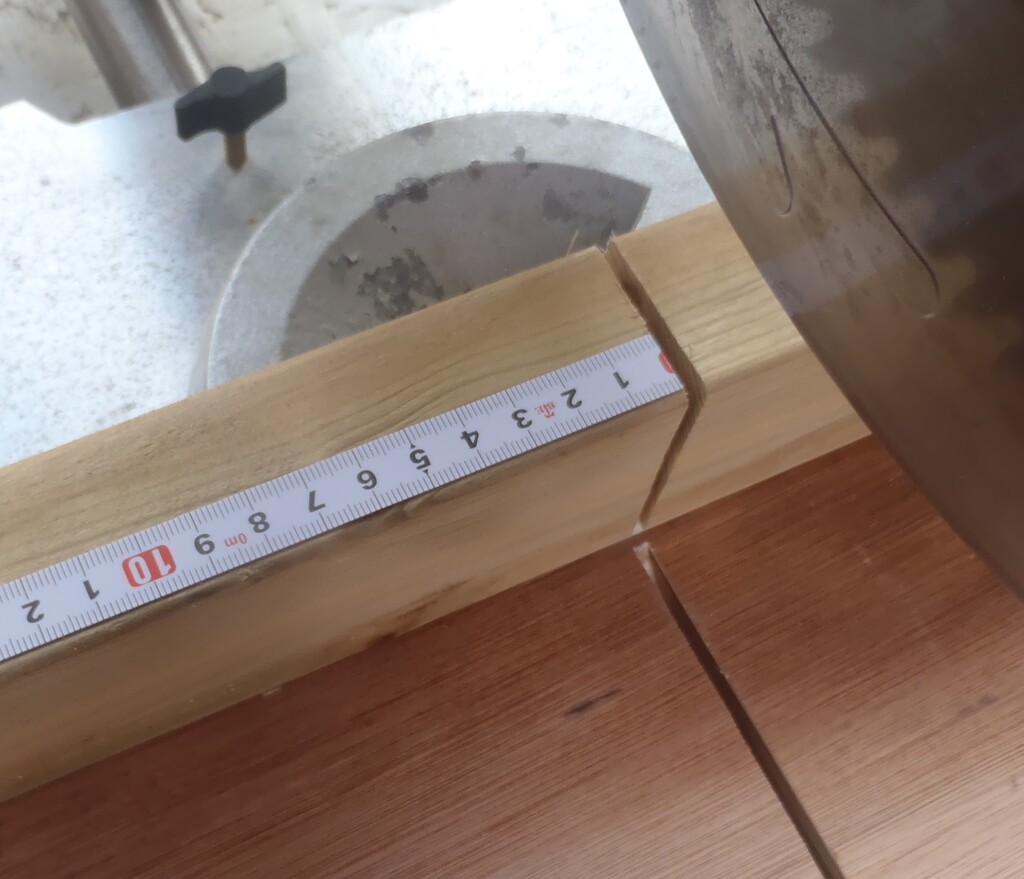
    We started the week by creating a new piece of equipment, this time, a plank slicing station down in our Great Room, using our large chop saw and a length of 63mm CLS timber and two pieces of plywood strips to build a long 4.8metre long straight channel. The chop saw was placed about three quarters the way along towards the right hand end so we can put a end block clamped to the CLS fence and we then can consistently chop up many planks into the same length. To aid in measuring planks we attached a 3m measuring tape to the top of the CLS.

    Chop Saw Plank Slicing Station

    Saw-Station

    Chop Saw Plank Slicing Station

    3m-Measure-along-the-Saw-station-fence


    We also sub-divided the space underneath into shelves so we had loads more storage space for various building materials and pieces of equipment.

  • Created Large Right Angle Framing Tool

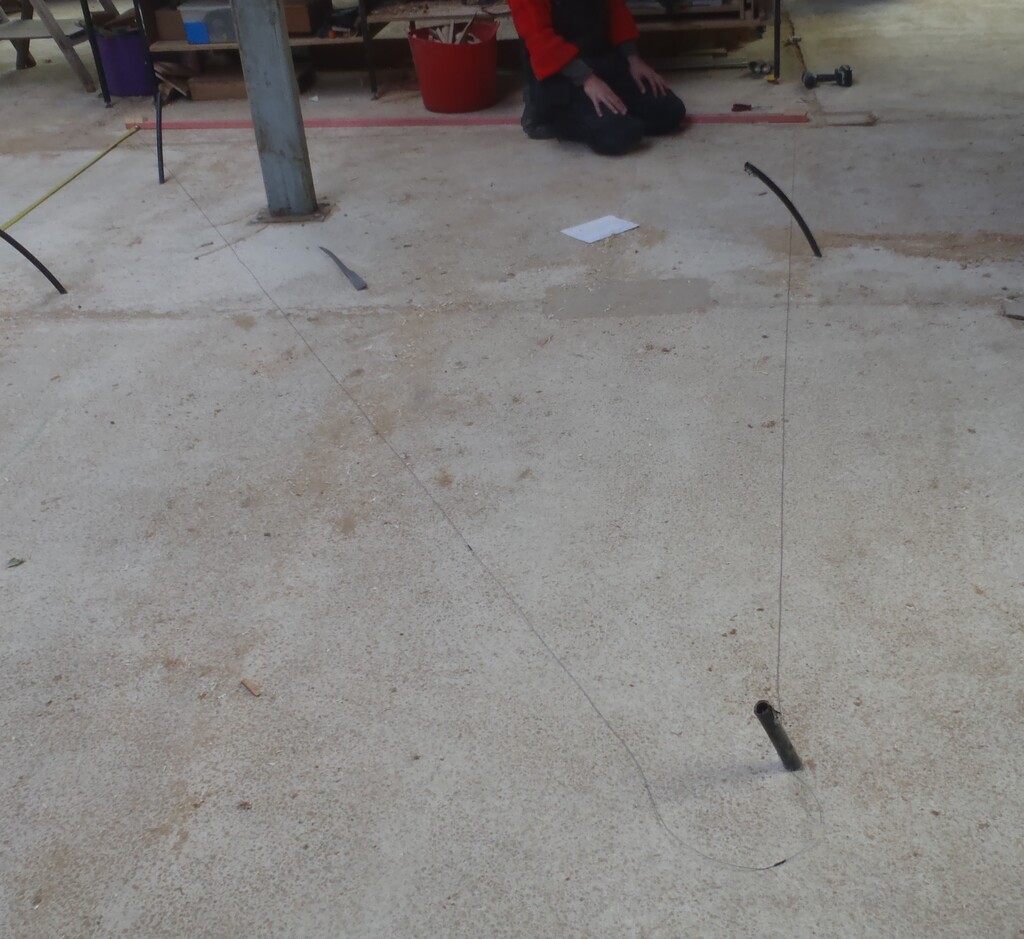
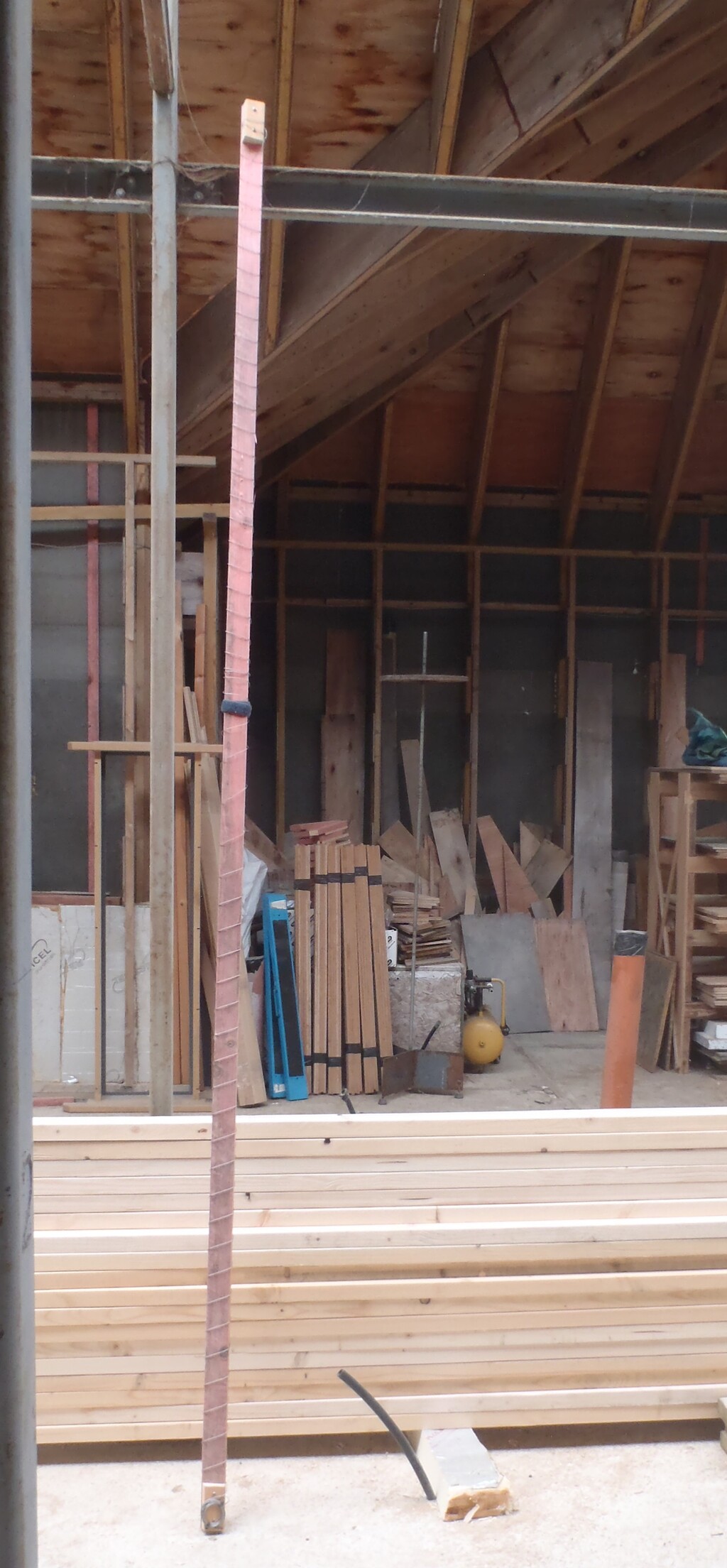
    We needed a tool to set out the rooms inside the house, as all the walls are right angled we needed something to get long right angled measurements. So we spent a few hours making a large framing square, using the mathematical and ancient truth that a right angle triangle measuring 3m by 4m always forms a 5m hypotenuse. So using a good quality and straight wooden batten, to form the base of the triangle, the 3metre side, we then took a flexible “cord” to stretch out to form the other two sides of the triangle.
    But we were struggling to find a “cord” that will serve the purpose and not stretch alarmingly when tensioned. Ordinary string was no good, even high strength highly woven cord didn’t work (it stretched 50mm over 4m) and we resorted in using a piece of 1mm stainless steel wire (left-over from our bird disruption system up on the Skylight), this only stretched 3mm! Luckily, we had enough to make a 9metre piece with two marks at 4metres and 5metres.

    Created Large Right Angle Framing Tool

    Large-Framing-Square


    So holding the wire out taut, at one of these marks, we can form either a left-handed or a right-handed triangle, which forms a good line perpendicular from the surface we placed the batten against.
    We can mark the floor at the beginning and end points and if necessary, can extend the line out to the required length of the stud wall we are mapping out, and once that task is done, we can wrap up the wire around the batten and put it away in a nice compact package.

    Created Large Right Angle Framing Tool

    All-rolled-up

    P.S. Can you spot our problem in the first photo?


    The wire is looped around the roof post!

  • Replaced Caterpillar Tracks on mini Digger

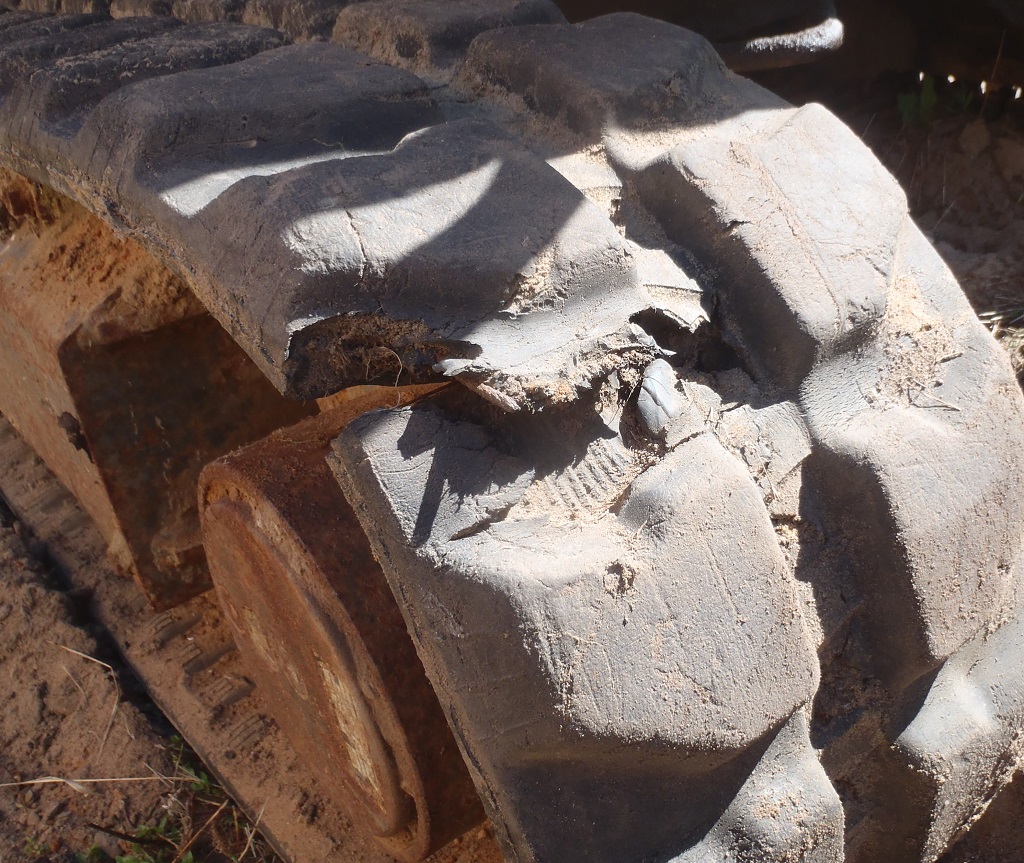
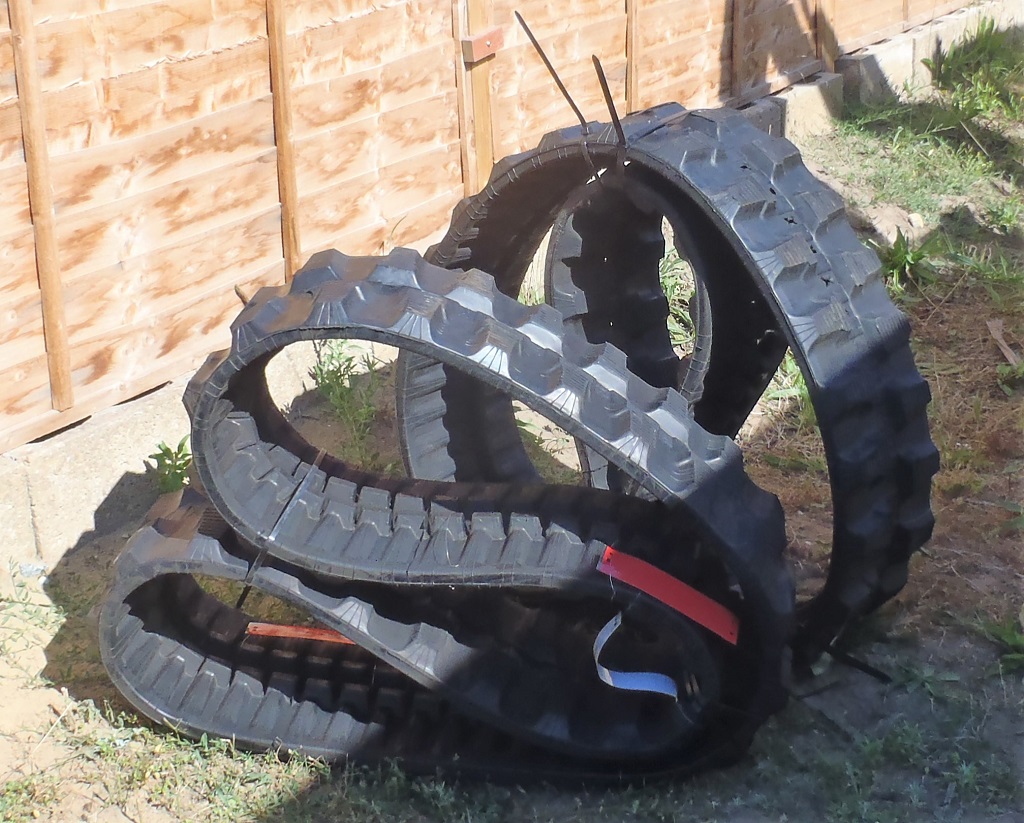
    We discovered a couple of days ago, at the weekend, that one of the caterpillar tracks had split and ripped half way across. We can see rusty steel wires sticking out of the rubber material.

    Replaced Caterpillar Tracks on mini Digger

    The-tear-in-the-old-track


    The mini digger has been idle for several years and we think the whole machine has been slowly sinking into the sandy dirty soil every time we had heavy rain showers. This probably meant that the tracks had been “under water” for longer periods of time and there must have been a initial split in the rubber material to allow the water access to the tensile steel wires that runs around the circumference of the track and converted the high carbon steel into iron oxide!
    So we ordered a pair of new rubber belts online and they came yesterday (Tuesday), amazing considering that we only placed the order at the beginning of the week!! Wow!
    All very clean, very black and smelling of strong rubber.
    Replaced Caterpillar Tracks on mini Digger

    The-new-tracks


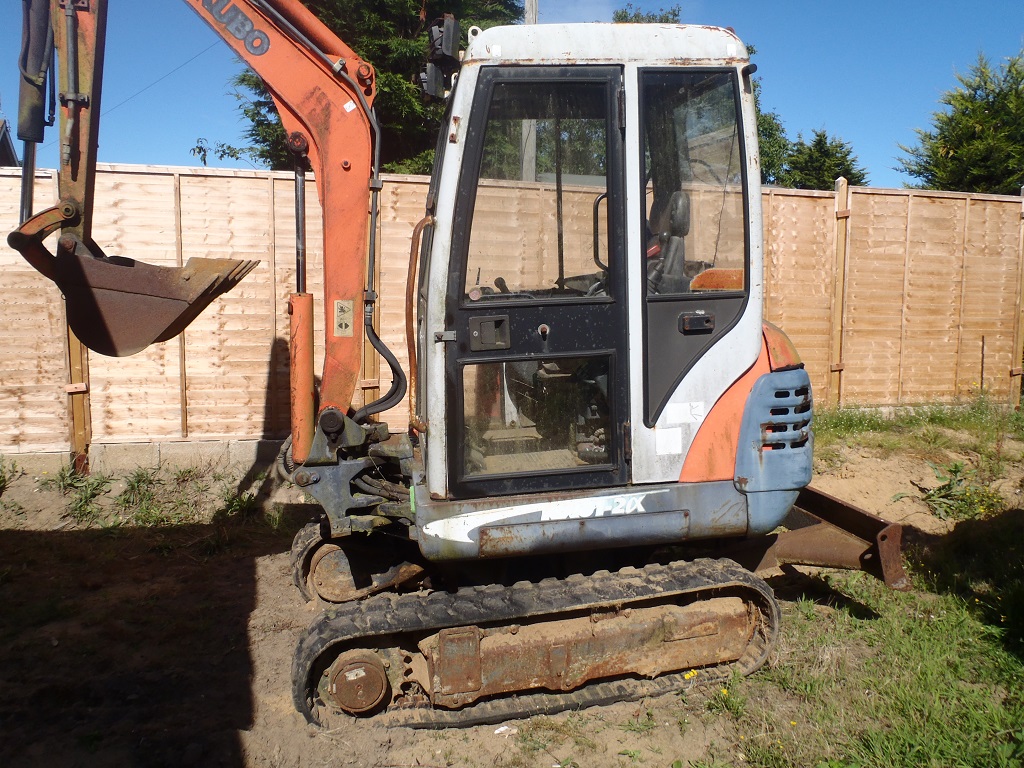
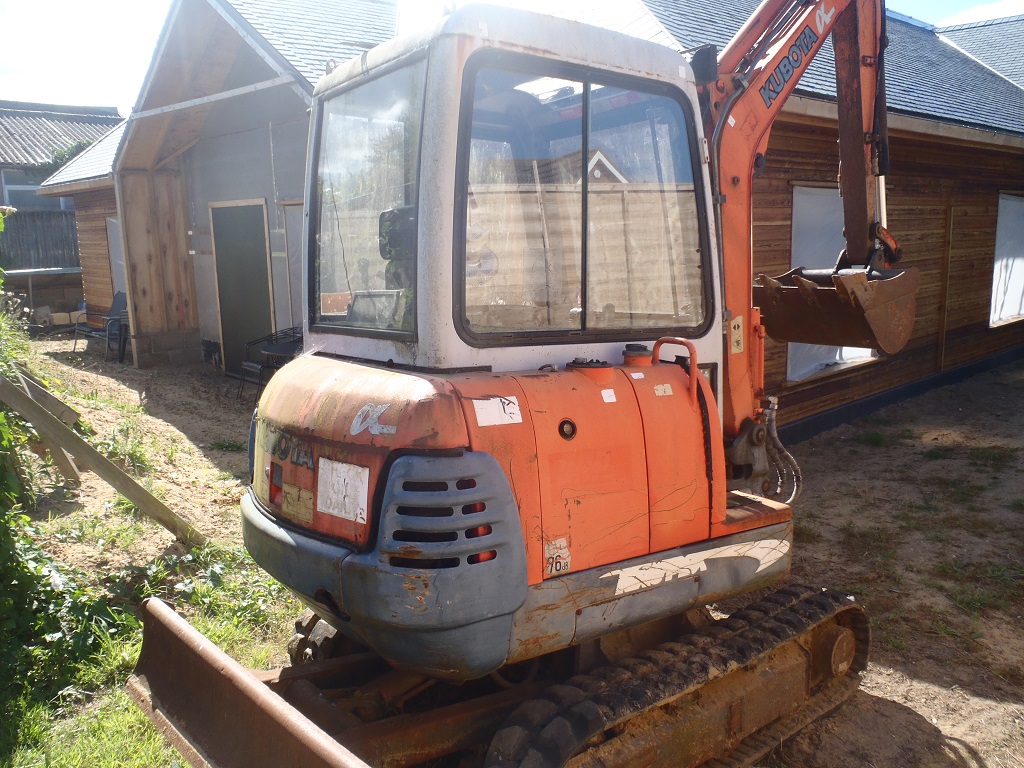
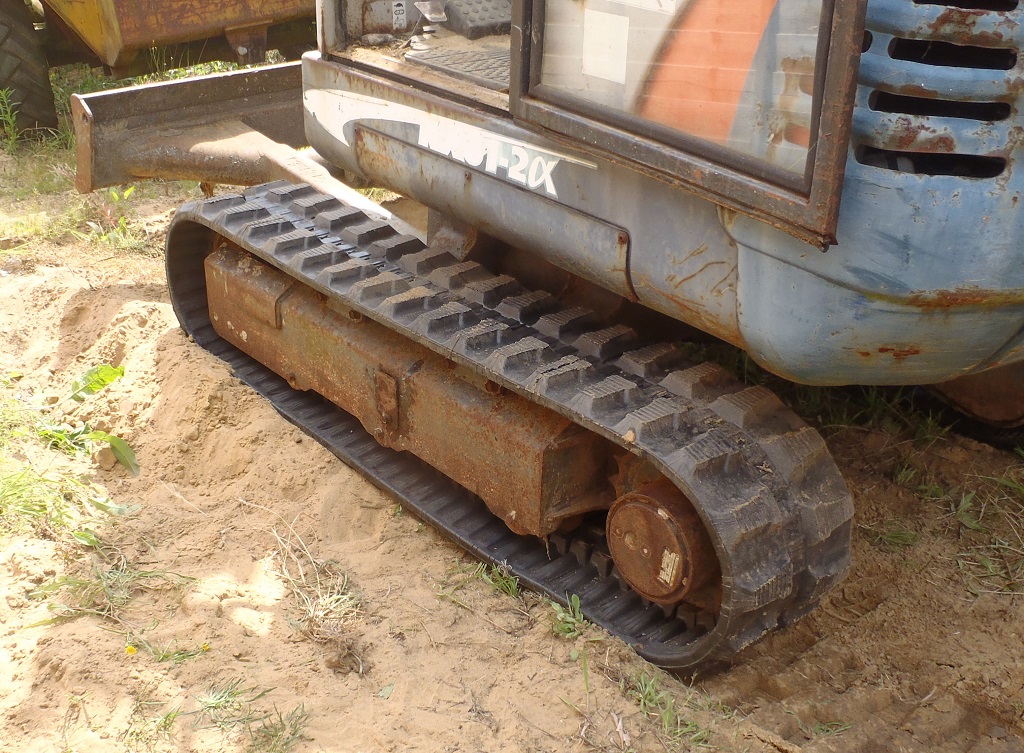
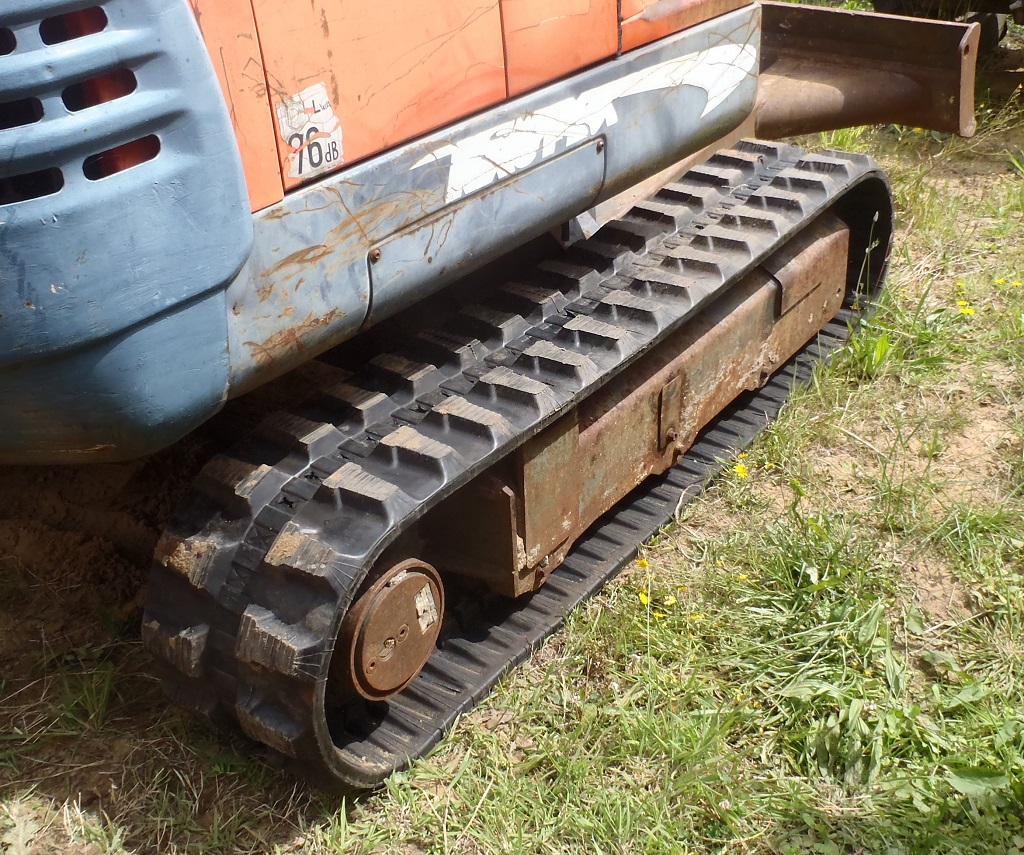
    After we had completed putting up the Larch cladding on the “I” section of the house, in the late afternoon of Tuesday, we came over with our pressure washer and jet blasted all the lower portion of the digger to remove as much as possible the sand and dirt in and around the caterpillar tracks and cog wheels. We also gave the cabin a quick blast to see if the dirt and green algae would come off and it does seem so. We were wondering whether to give it a fresh coat of paint!
    Replaced Caterpillar Tracks on mini Digger

    A-very-dirty-digger-1

    Replaced Caterpillar Tracks on mini Digger

    A-very-dirty-digger-2


    So on Wednesday, the big day, of taking off the old tracks and sliding on the new ones! These belts are very very heavy! There are 76 rubber coated heavy steel metal bars (one inch diameter with heavy flanges sticking up to ensure positive engagement with the drive cog wheel), spaced apart by 52.5mm, the track being 300mm wide and the tread depth of 20mm deep. We estimated that the weight of one of these track is about 100kg each!!

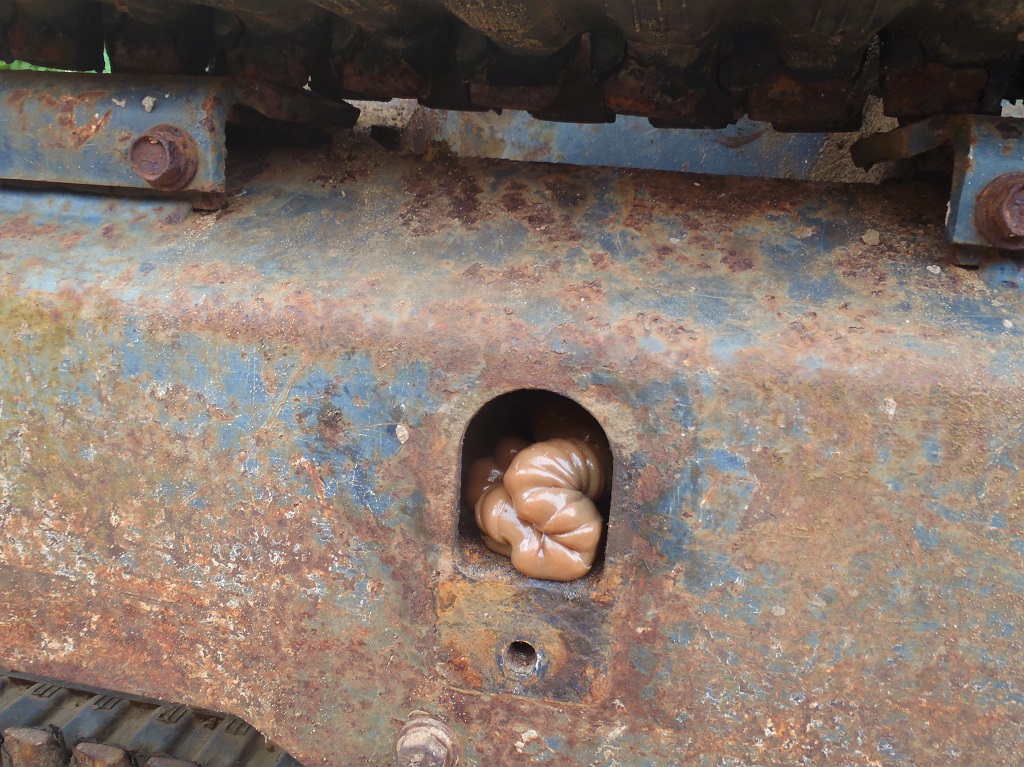
    The first job was to push the whole digger over to lift one track entirely off the ground and then open up the cover to access the static hydraulic ram that lies inside the structure that holds the caterpillar track. There is one screwed in plug that has a grease nipple point in the middle. We undid the plug to allow the grease to escape when we thump the end of the track in. we used a sledge hammer to knock the ram backwards, this in turn ejects a small blob of grease.

    Replaced Caterpillar Tracks on mini Digger

    Grease-comes-out-like-a-pile-of-


    The distance between the two internal “cog” wheels at each end, is shortened by about 25mm and that is enough for the rubber track to slip off (with a bit of an assistance by lowering the digger down to flatten the track and extend its length), to disengage off the front wheel (the non-drive non-sprocket wheel) and we could then drag the old track away.
    After inspecting the various parts, most especially the main front wheel and three smaller solid metal wheels, to make sure that they weren’t loose and still easy to move, which they were very nicely smooth and tight.

    Next, is to drag into place the new tracks and sort of hook it on the back cog wheel and lay the rubber track out alongside the digger and lowering down the digger again, to extend the length just enough to squeeze it over the front wheel using a crow bar. Then the hard work starts .. by pumping grease back into the static hydraulic ram to push the front wheel back out to its fully extended position to tighten the track up. The instructions says that the droop in the track underneath the middle small cog wheel should be about 2cm so it is not too tight and not too loose.
    Our grease gun is a manually operated device, using a pumping handle and it was awkward in trying to get the gun’s outlet to engage to the nipple on the digger and put  thousands of PSI pressure to force the ram outwards and tighten the track.

    Replaced Caterpillar Tracks on mini Digger

    All-new-and-shiny-1

    Replaced Caterpillar Tracks on mini Digger

    All-new-and-shiny-2


    We repeated the whole exercise for the other track and just before lunch time, we got both changed over and we now have a fully working mini-digger again.

    The final job after lunch was to make sure that all the joints all over the digger was fully charged with grease. The log book was updated with today’s work and the last entry was back in 2016!! The old tracks were folded in half and carted around to the back behind the temporary living quarters for storage and we will decide to what to do with them later on. We even may use them as a raised flower beds!!

  • Scorching Machine is Complete

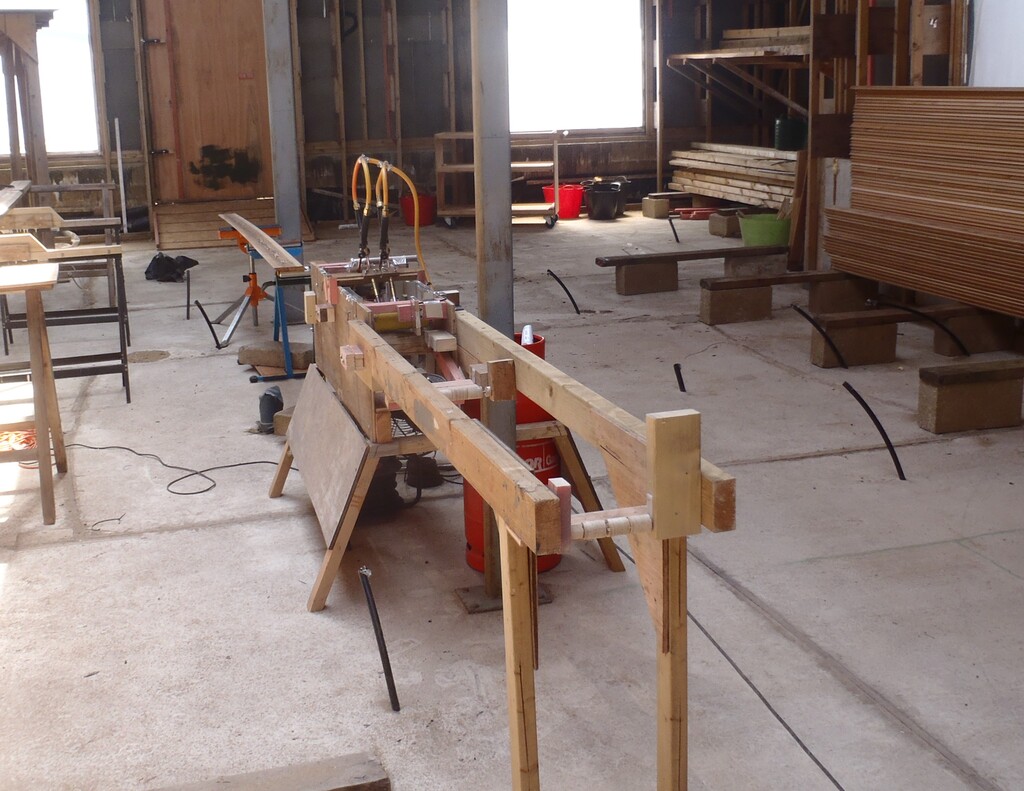
    It took another three weeks to finish off tweaking the design of the scorching machine, with many iterative changes as we test and adapt the machine (As usual things take much longer than you expect, but I have enjoyed the change of work).
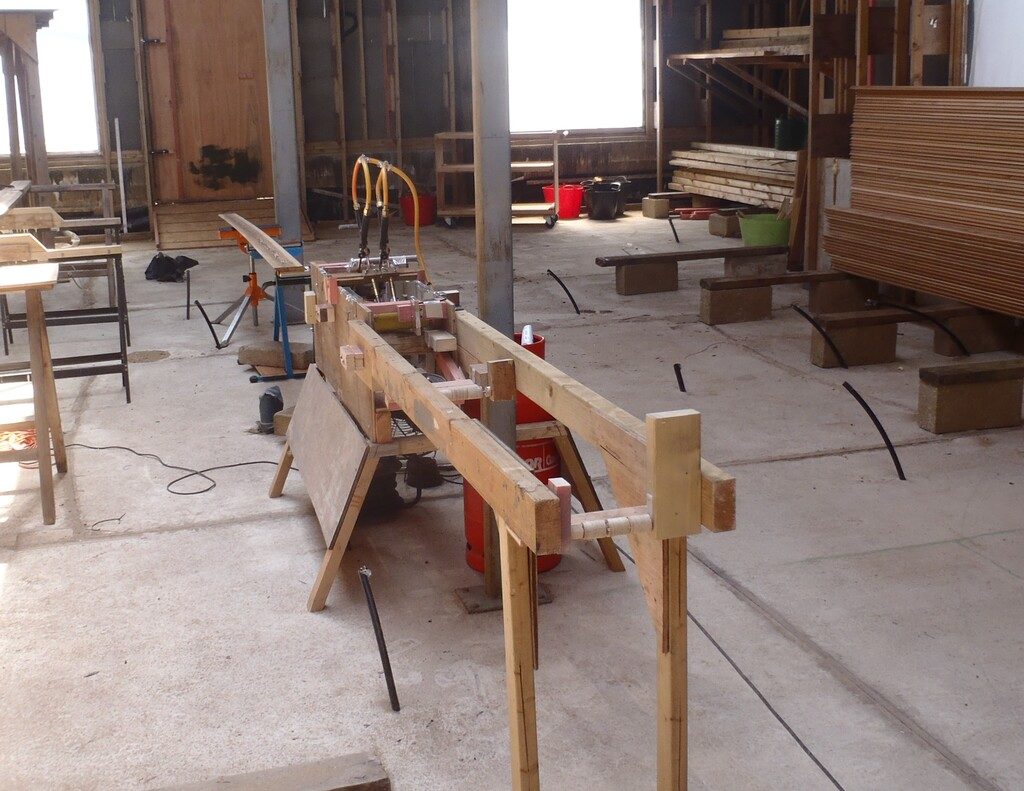
    We started by moving the machine into the house (after cleaning up a bit), we then made a extension to the input side to guide and support the plank entering the machine.
    Input-rollers-on-the-machine

    Input-rollers-on-the-machine


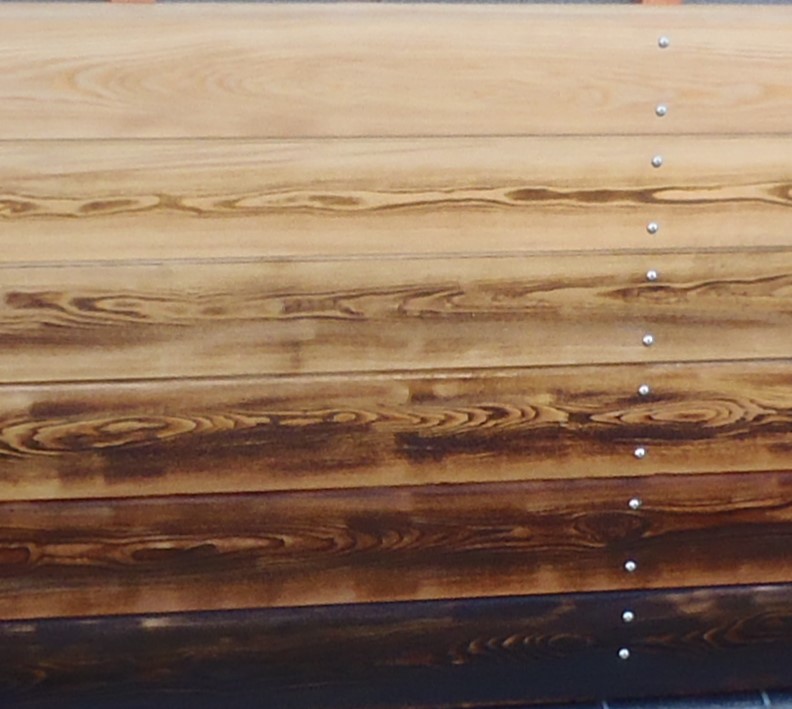
    We did some test runs, and we can vary the amount of “burn” from a black highly charred finished to a gentle pale scorching. We have selected 5 levels of speed, all the way from a very slow 10mm per second (very highly burnt) to a much quicker 40mm per second to produce the pale finish. We also have the option of no scorching at all and this being our sixth level.
    Our-six-scorch-levels

    Our-six-scorch-levels


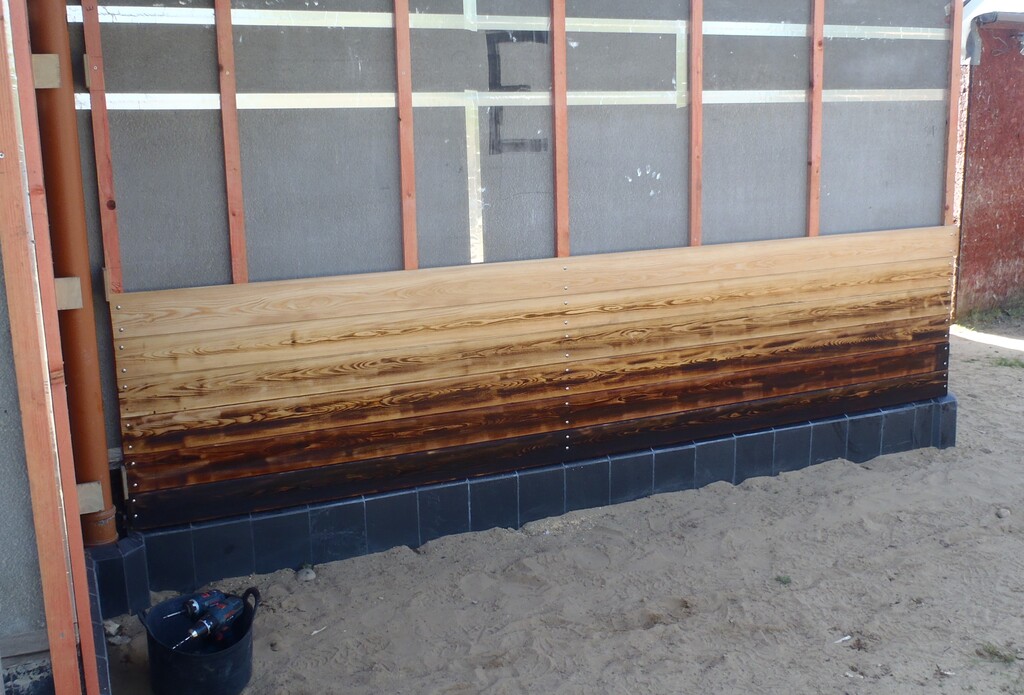
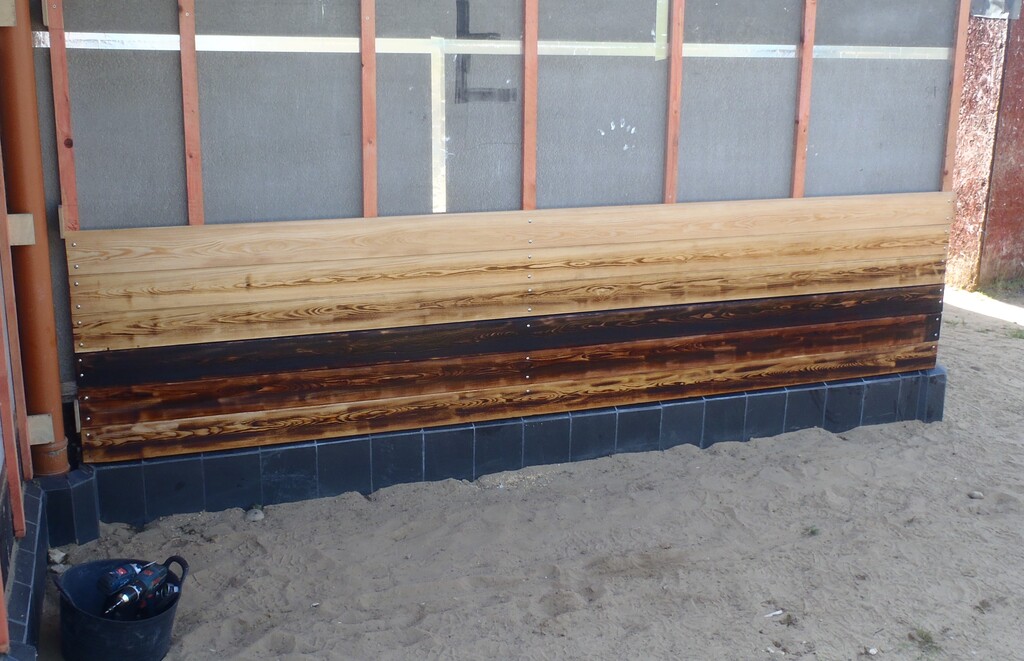
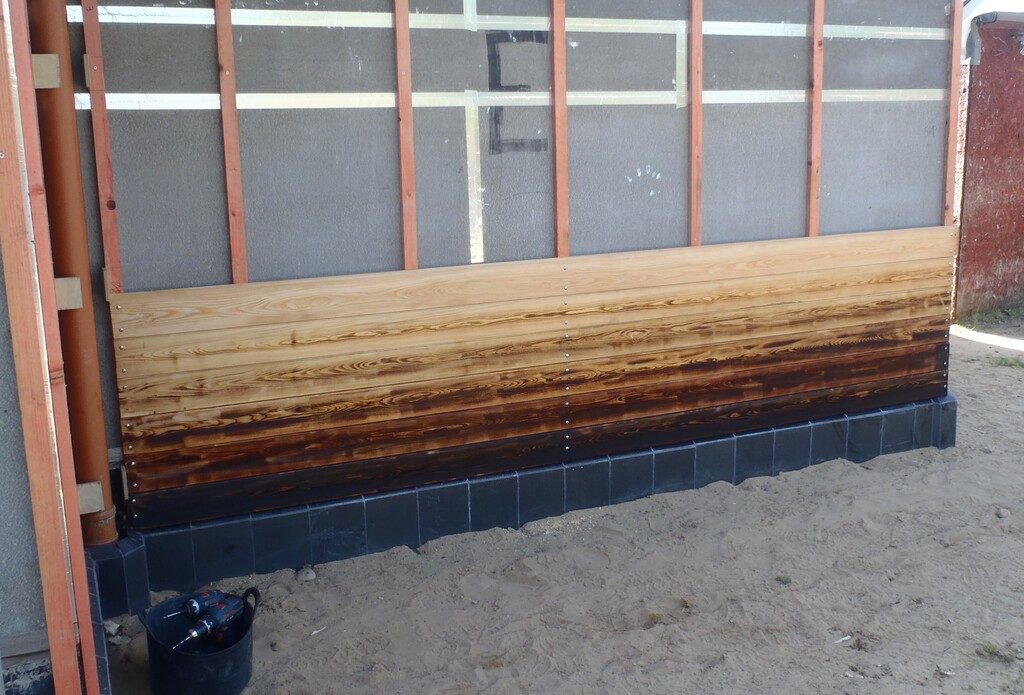
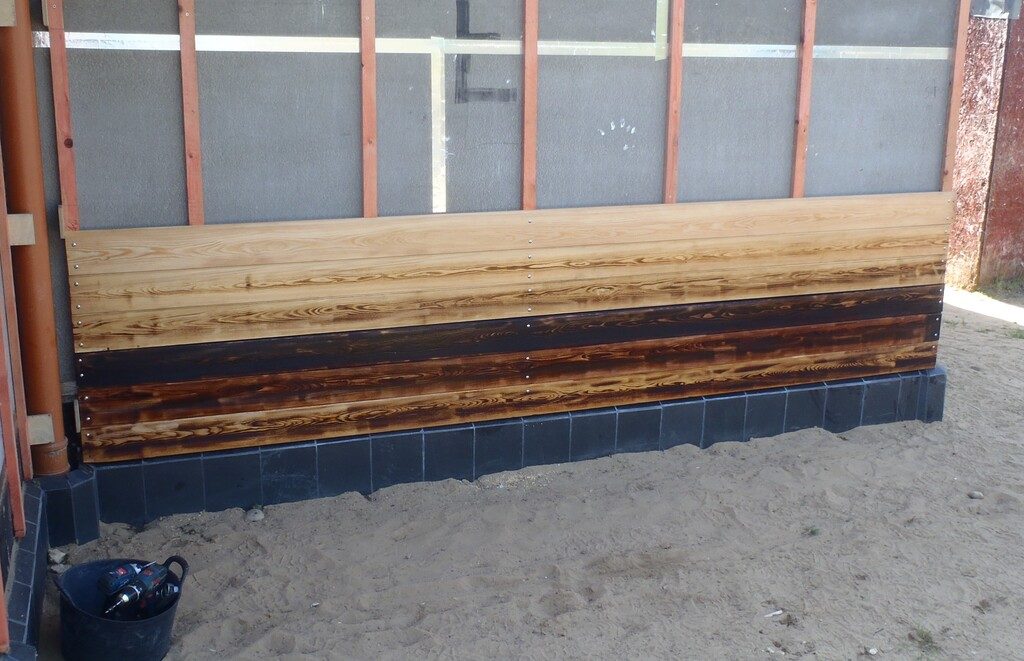
    We put up a block of different burnt timbers on our house wall in the full sunshine to examine it and decide on what patterns we might like on different walls, taking into account their compass orientations, the windows sills and headers etc.
    First-set-of-graduated-boards-on-a-wall
    First-set-of-graduated-boards-on-a-wall

    We-decided-to-flip-the-bottom-rows-

    We-decided-to-flip-the-bottom-rows-


    The next job was to build a spreadsheet of all our walls (fifteen of them), with their compass orientation, whether it is under a porch, then divide the wall up into three vertical sections (under the windows, beside the window itself and lastly above) to allocate what level of scorching is desired and then find solutions to the pattern of plank widths to fit into each section. This resulted in a table of quantity’s vs plank width and scorch level.

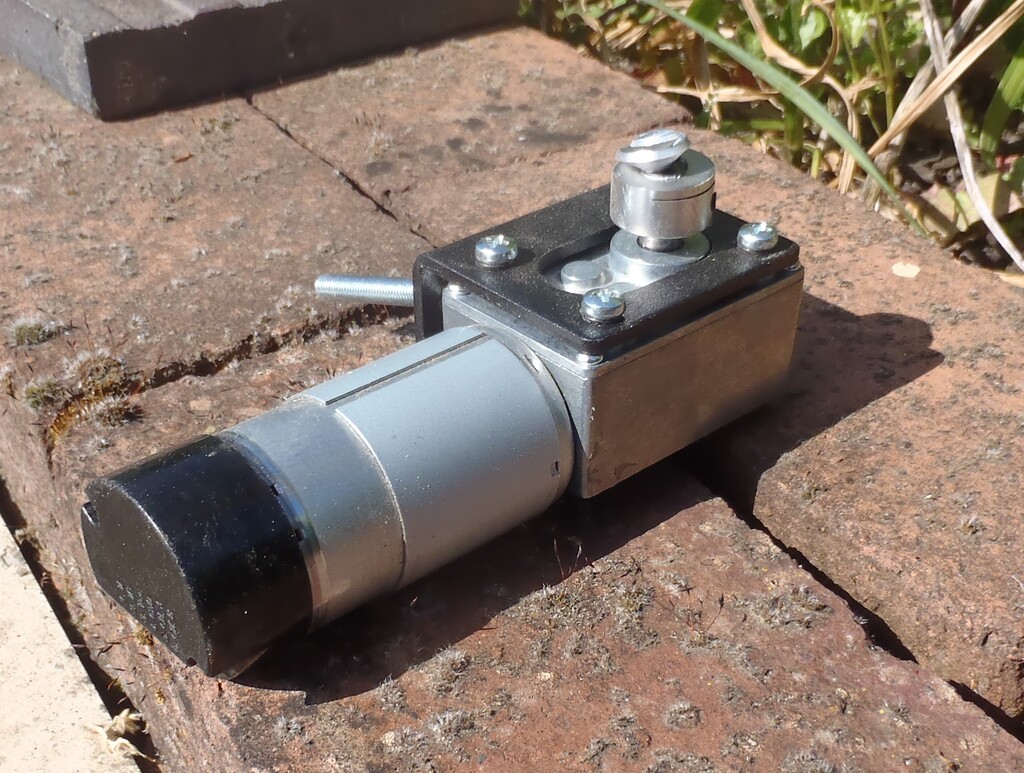
    We started to process the wide planks first (they are nearest) and we had lightly scorched (#1) some planks when a plank got stuck. Shaun was running the machine whilst Stephen was wire brushing the finished planks so We did not notice for a while until Stephen looked over and saw the smoke poring out! We shut off the burners and when we examined the machine we found one of the motors had sheared it’s flexible connector…
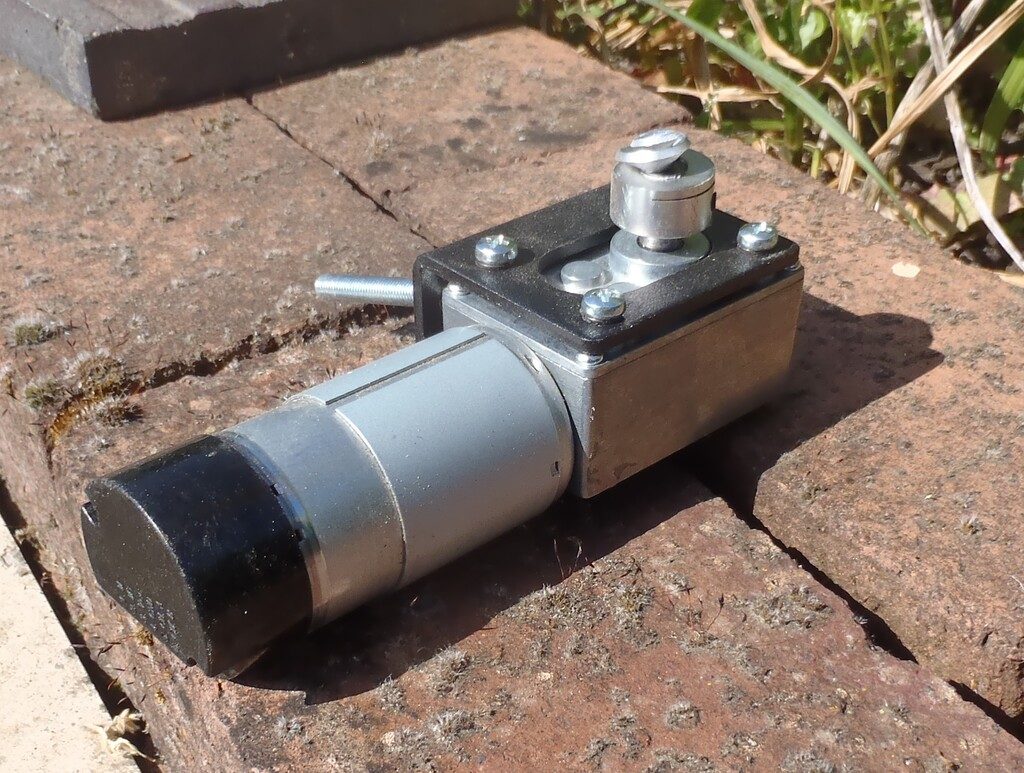
    Drive-adapter-sheared-off

    Drive-adapter-sheared-off


    We repaired the machine and carried on but a few planks later we had a jam again (the plank sometime wanders off or bends), we caught this one earlier and no damage was done. At this point we decided (being nerds and all) that we would add sensors to the machine to detect any stall and sound an alarm. In hind sight we should just have carried on whilst keeping a good eye on the machine as getting sensors to work reliably took 2 weeks (but that’s hindsight for you)!
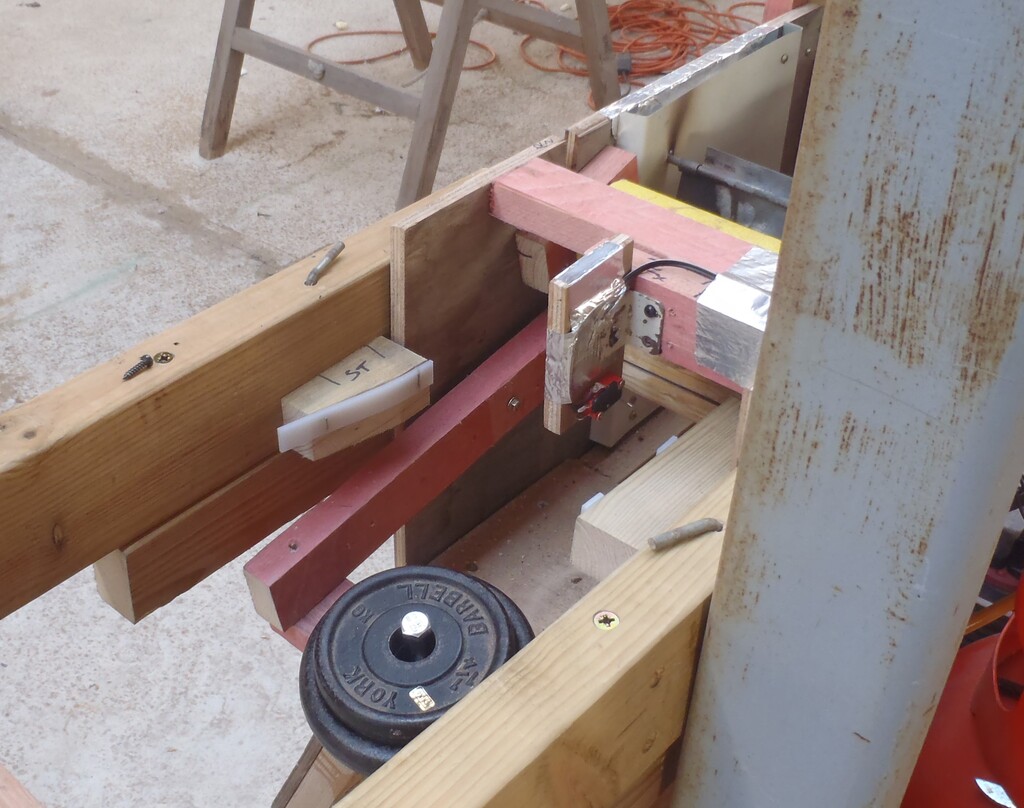
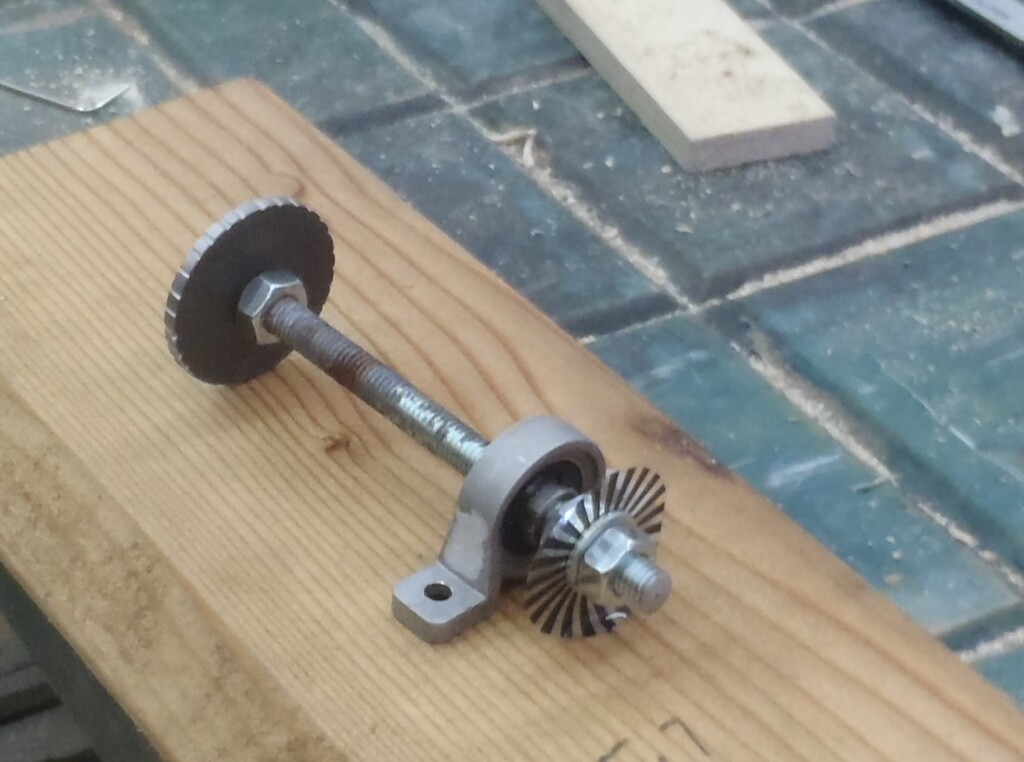
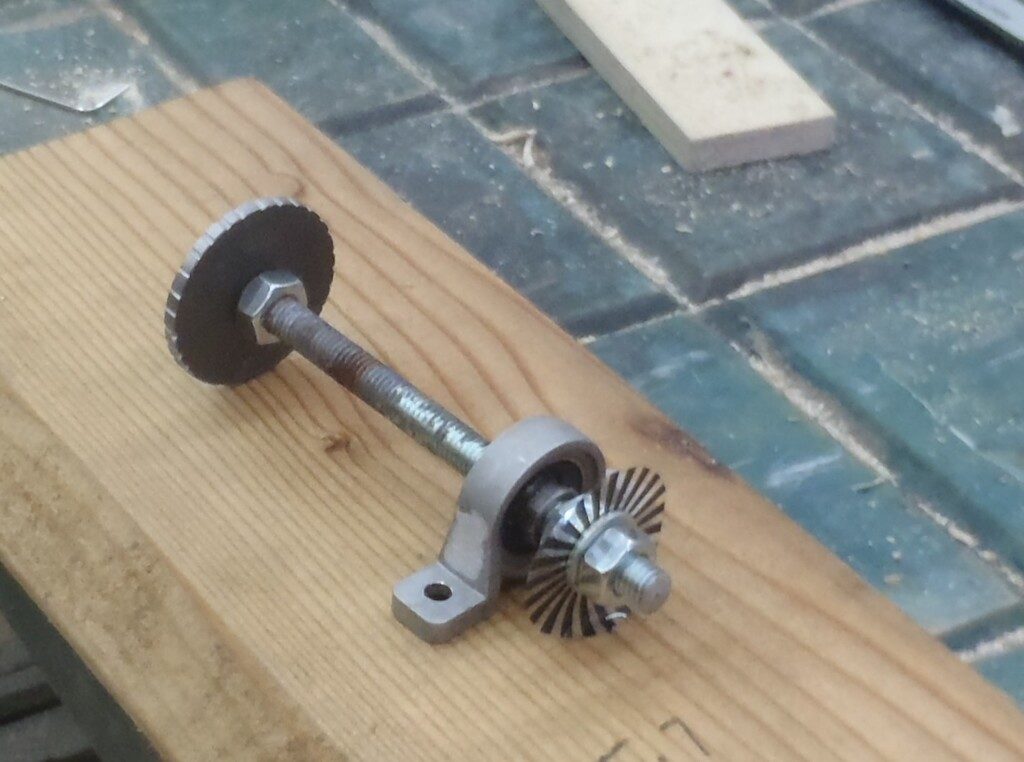
    The machine needed to know 3 things – When the plank enters, when it leaves and if its moving. The first two should be simple just put a switch near the plank to be pressed when the plank is in. The movement detector devised initially was a metal wheel on a shaft which had a sensor measuring the shaft rotation, the shaft being mounted on a pivot which kept the wheel in contact with the plank.
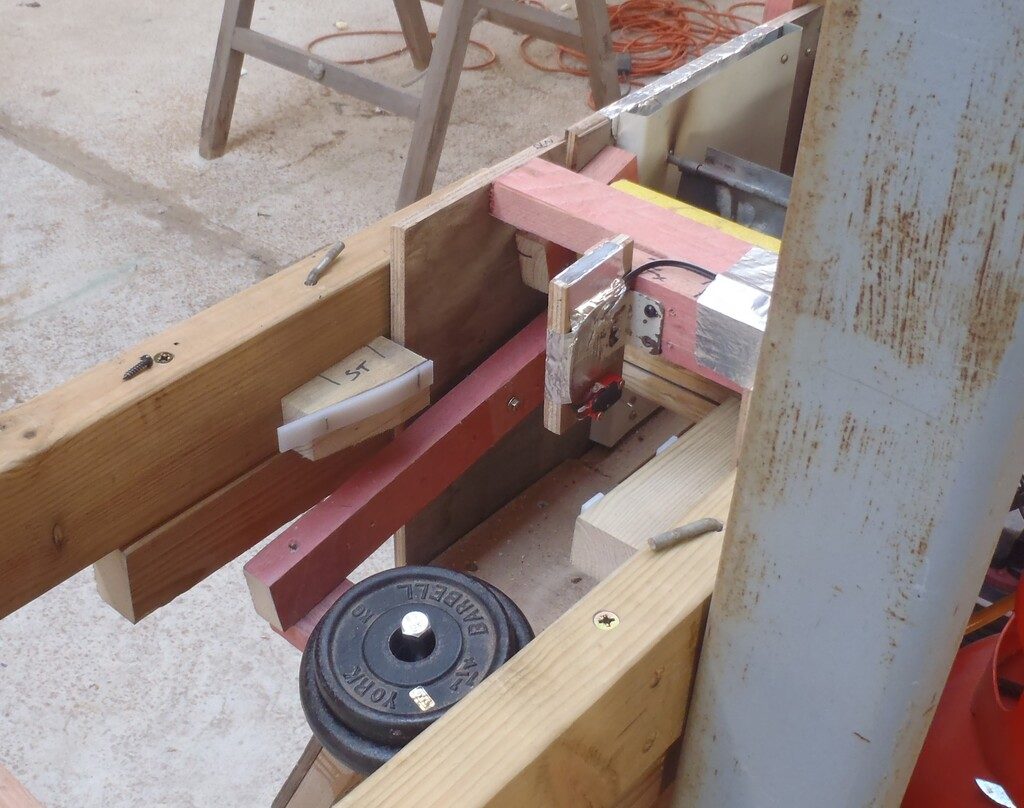
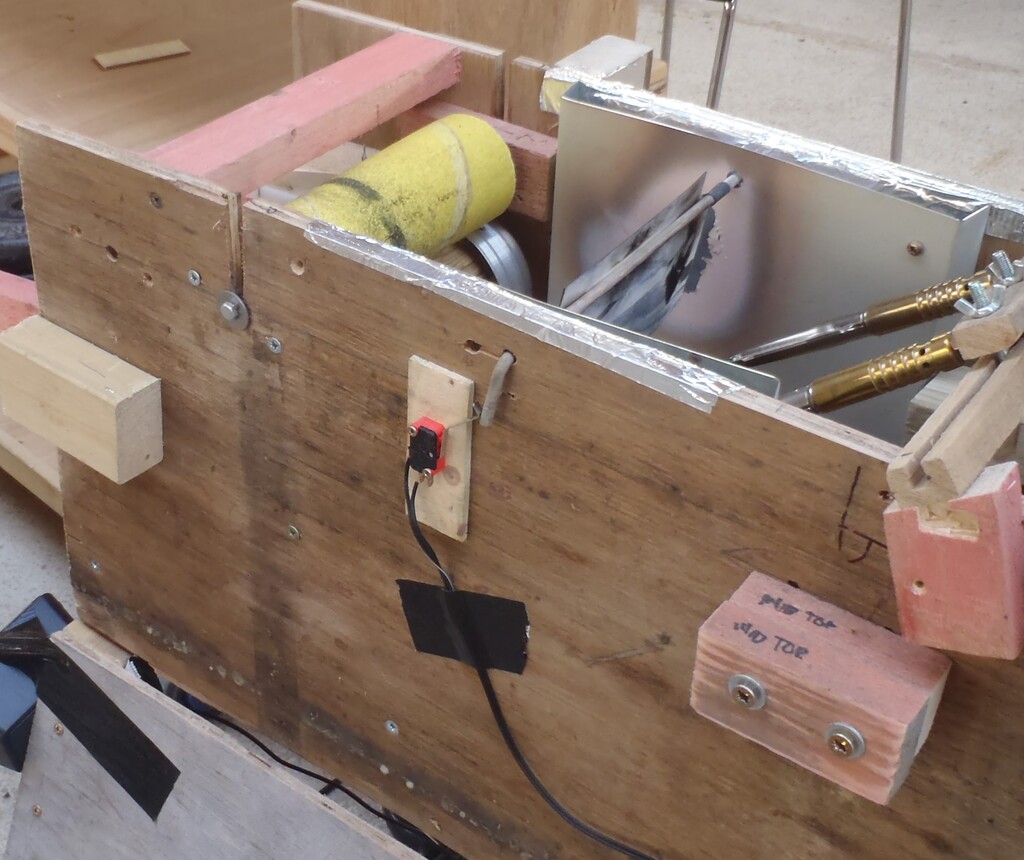
    Input-plank-sensor-switch
    Input-plank-sensor-switch

    Rolling-encoder-mechanism

    Rolling-encoder-mechanism


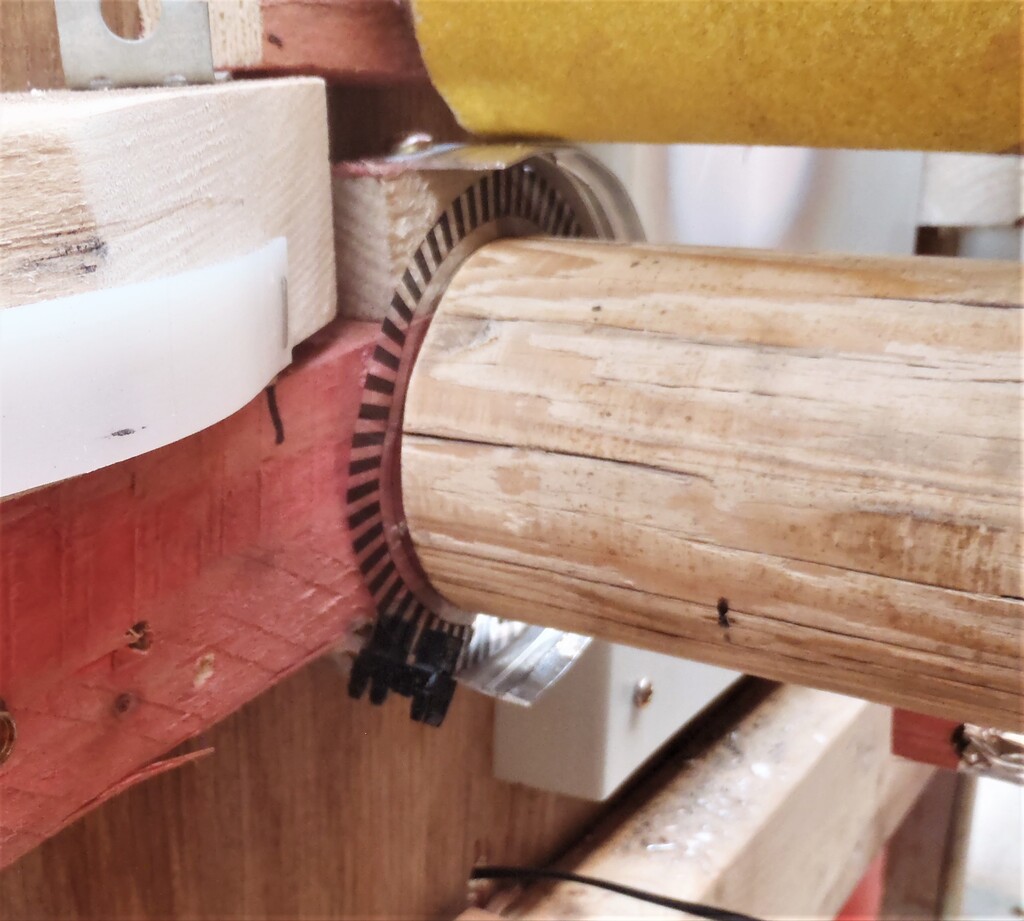
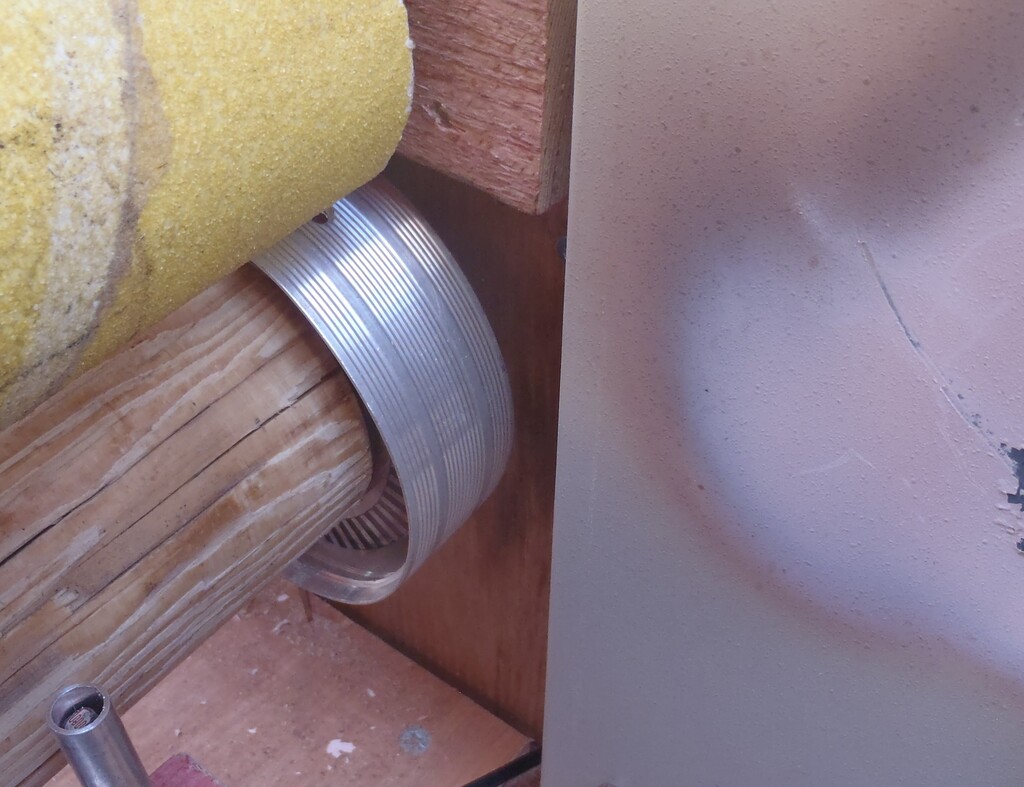
    So having built the sensors and fitted them it took a day to write the software to run the machine and start testing. The metal wheel did not run very consistently on the plank even after filing some ‘teeth’ on on it so after a while a new system was devised to put encoder disk and sensors on the pinch rollers which force the plank against the drive rollers (an all together better way but you don’t always think of the best way first). This was fabricated, installed and worked reliably.
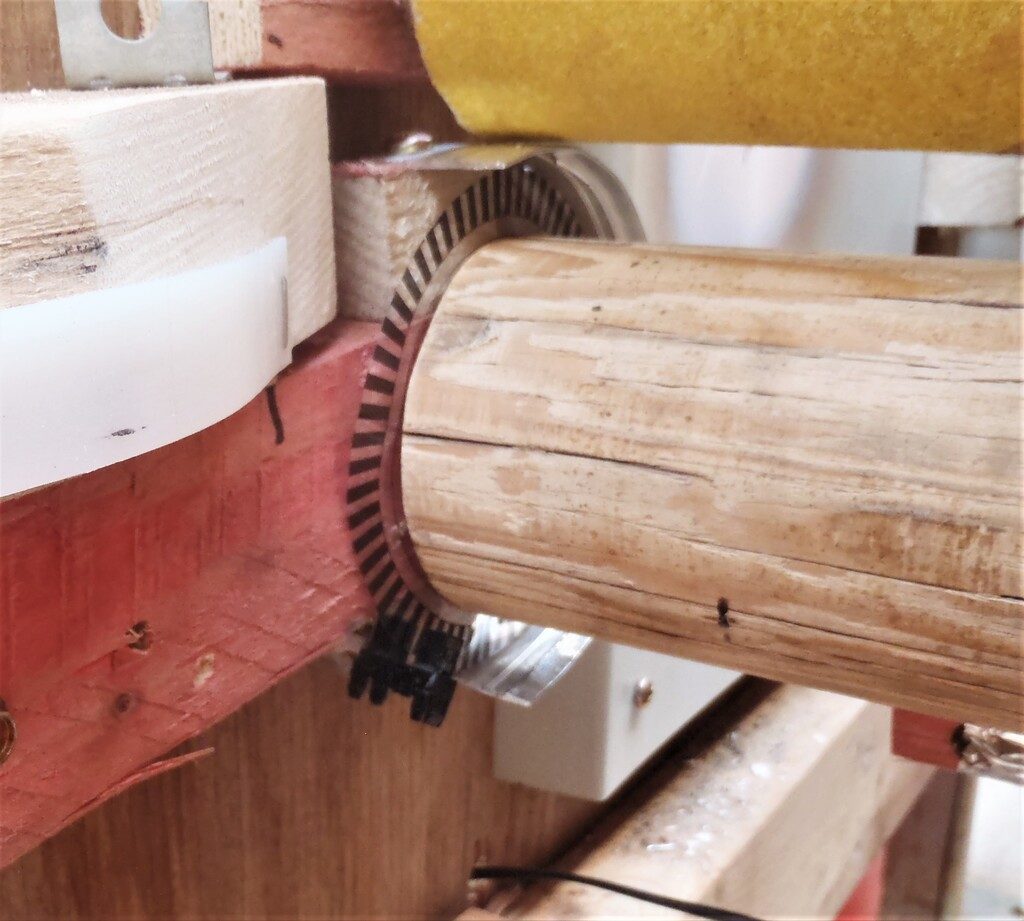
    Encoder-disk-and-sensor-on-a-pinch-roller
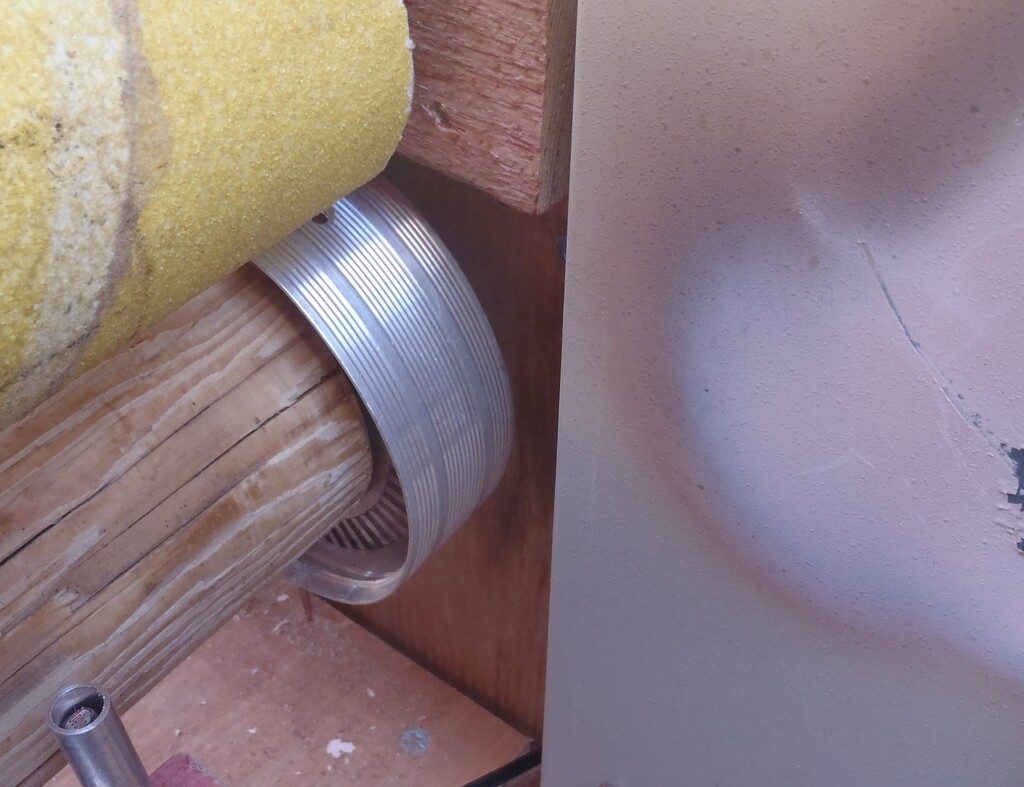
    Encoder-disk-and-sensor-on-a-pinch-roller

    Protecting-the-plastic-encoder-from-the-heat

    Protecting-the-plastic-encoder-from-the-heat


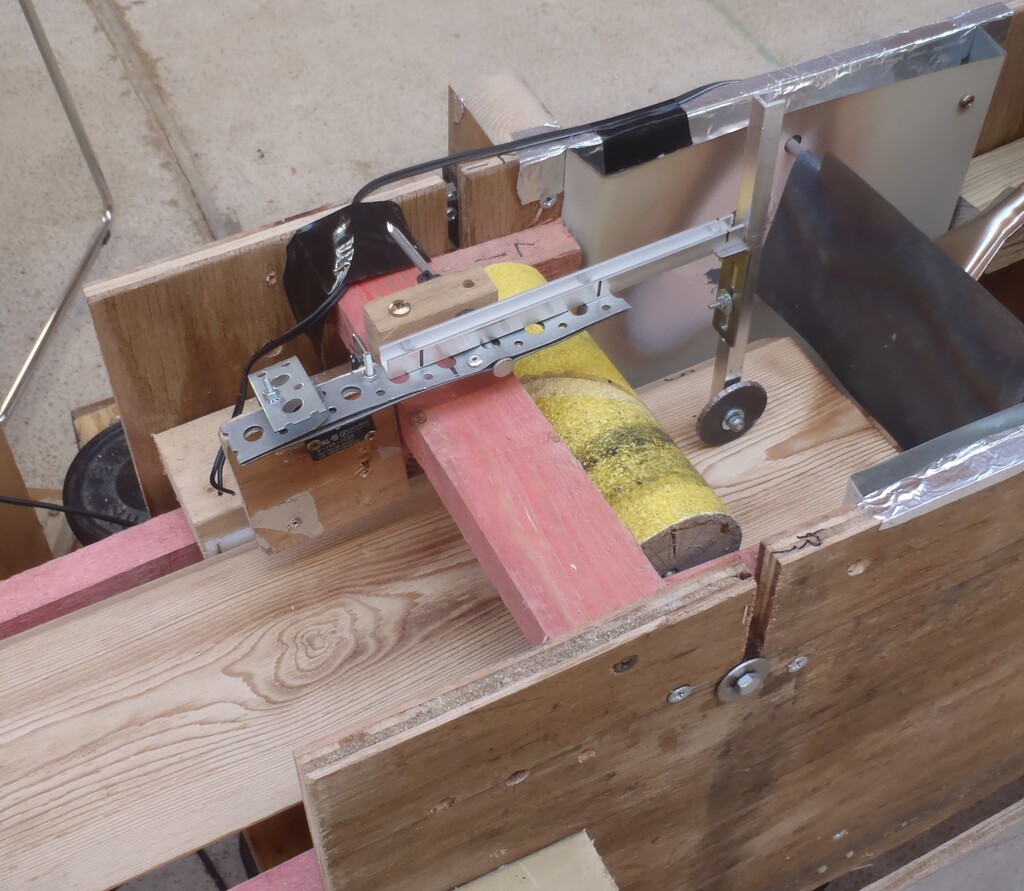
    The next problem was that when we turned on the burners the output switch got too hot! Again a different system was needed, we needed to get the switch away from the heat so various pivoted arms where fabricated, tried and modified. But after a long time trying to get them to work reliably we gave up on this idea as well.
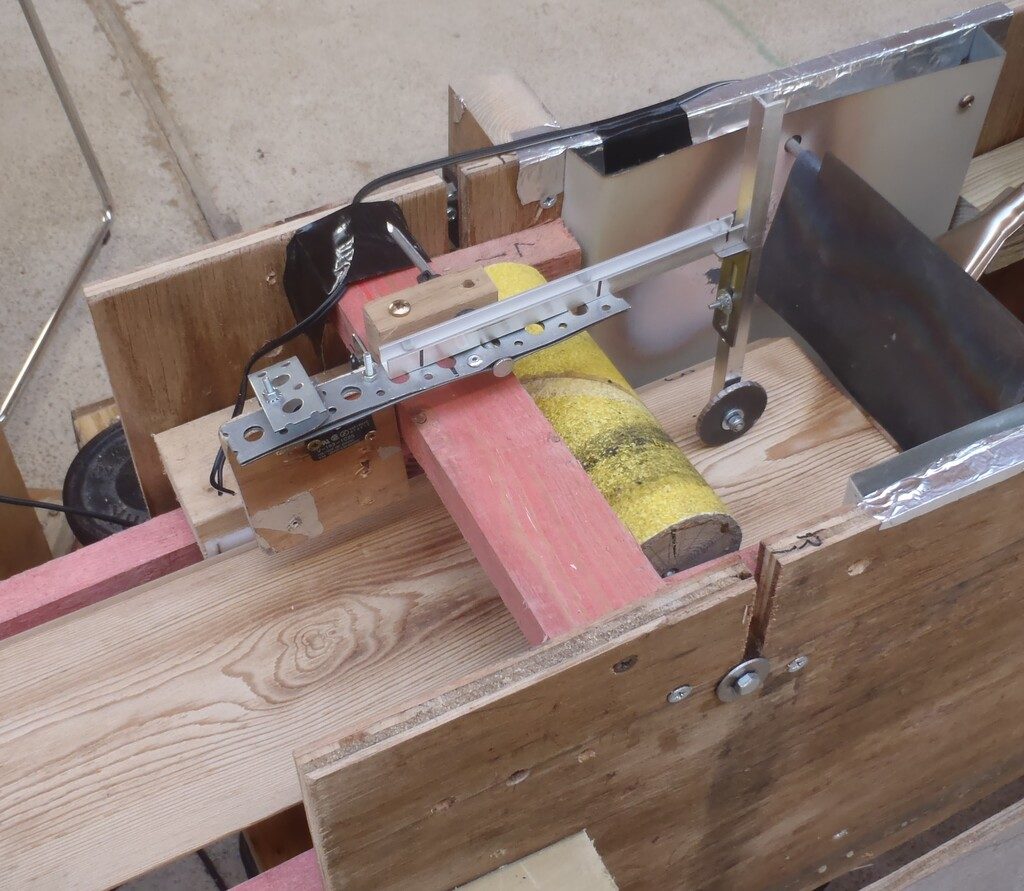
    Wheel-lever-output-switch

    Wheel-lever-output-switch


    A non contact sensor was needed and a light sensor placed just below the plank would give different readings to show when the plank was present or not. This was fabricated and fitted and worked! We finally had a working machine and just a bit of fine tuning of the software was done. On the last Saturday a revelation was had! in that there had always been a lever to activate a switch built in to the machine from the beginning. The output flame guard was hinged on a rod which come out the side of the machine and this rod was turned when the flame guard was pushed up by the plank. This rod happened to have a bent end which was ideal for pushing a switch so we fitted a switch so now we have two output sensors which work…
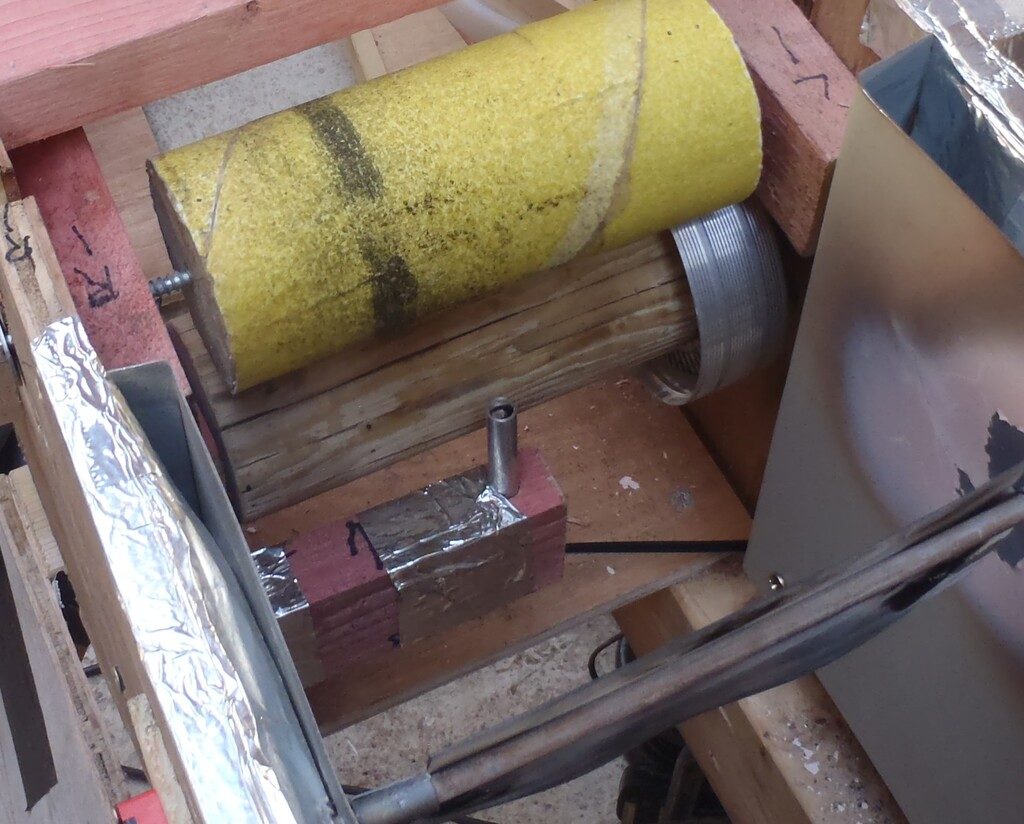
    Optical-output-plank-sensor
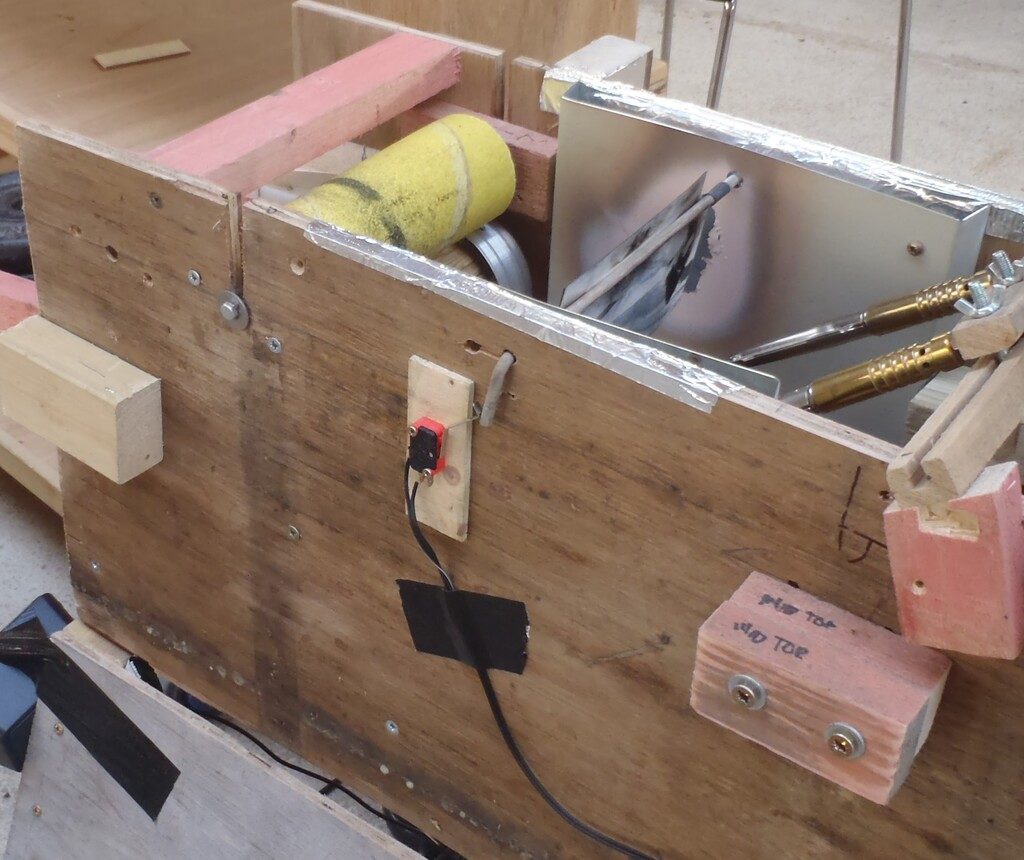
    Optical-output-plank-sensor

    Output-switch-using-the-flame-flap

    Output-switch-using-the-flame-flap


    So we finally have a machine for processing the planks, which will probably only take a week!
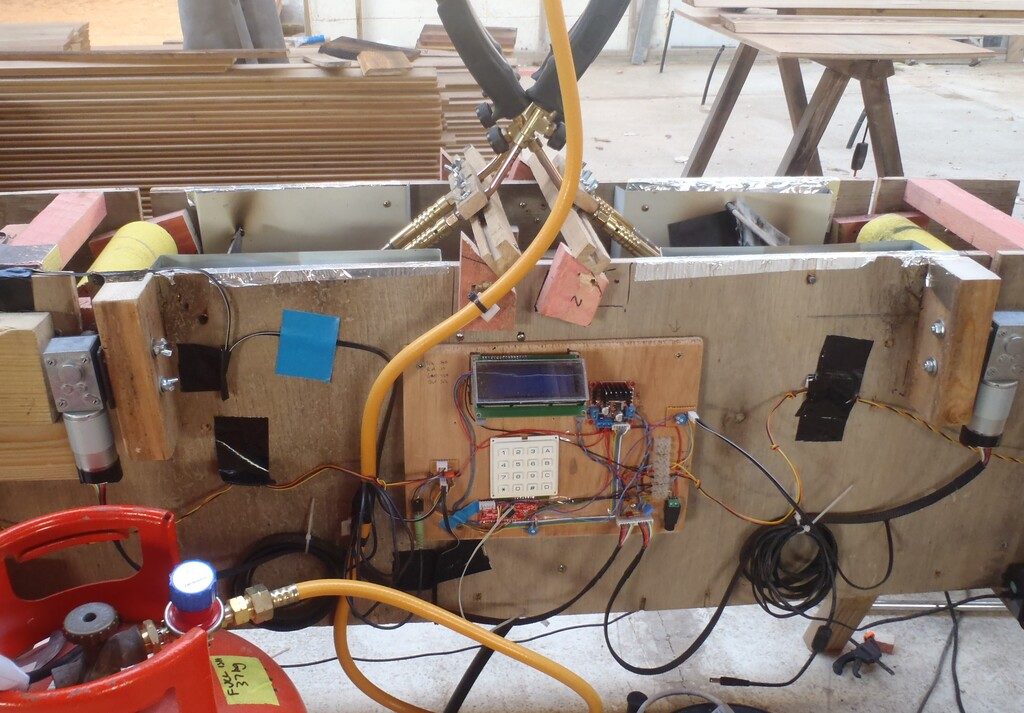
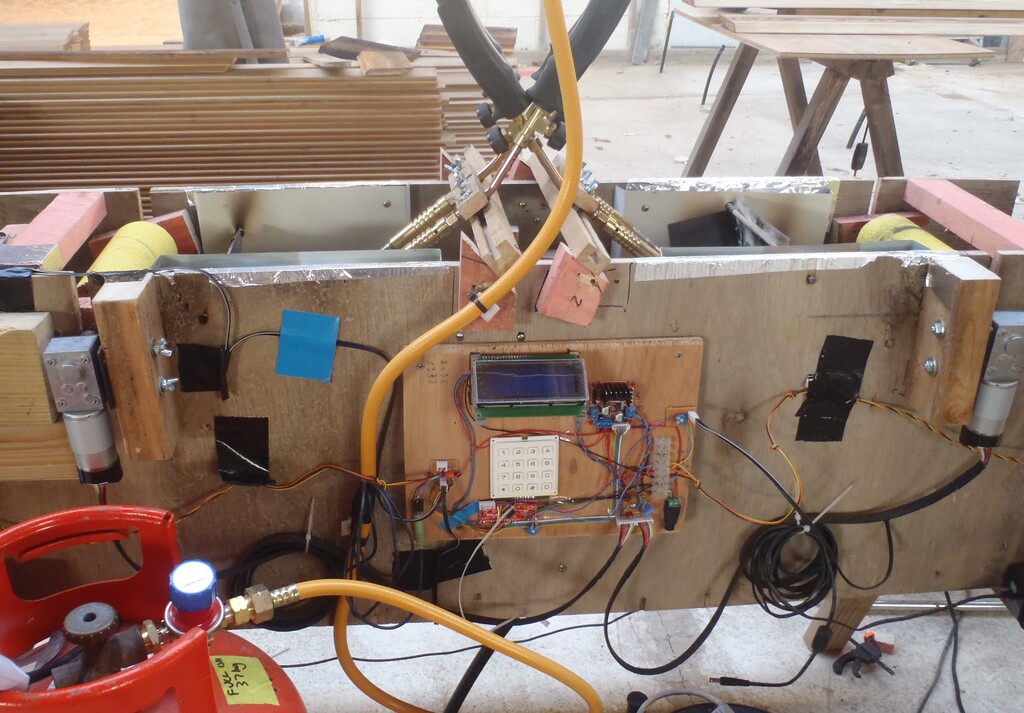
    Final-Control-board-and-wiring
    Final-Control-board-and-wiring
  • Foam Board Slicer Created and Started Putting Insulation into Walls around Entertainment Room

    This week, we created a machine to slice up our pile of random insulation sheets (which can be up to 150 mm thick) and started putting them into the walls surrounding the Entertainment Room. We needed to do this job now as we require access to the “I” section of the wall in Bedroom 3 so a new window hole can be created and this is being blocked by the stack of insulation.
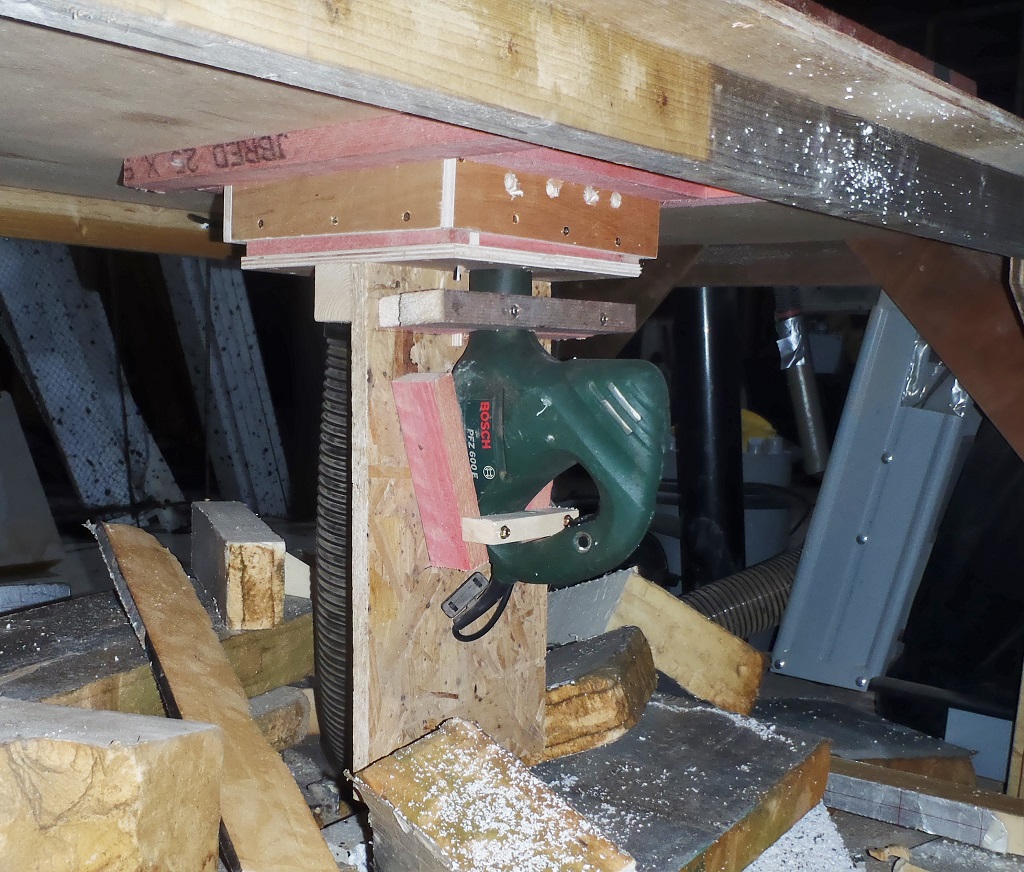
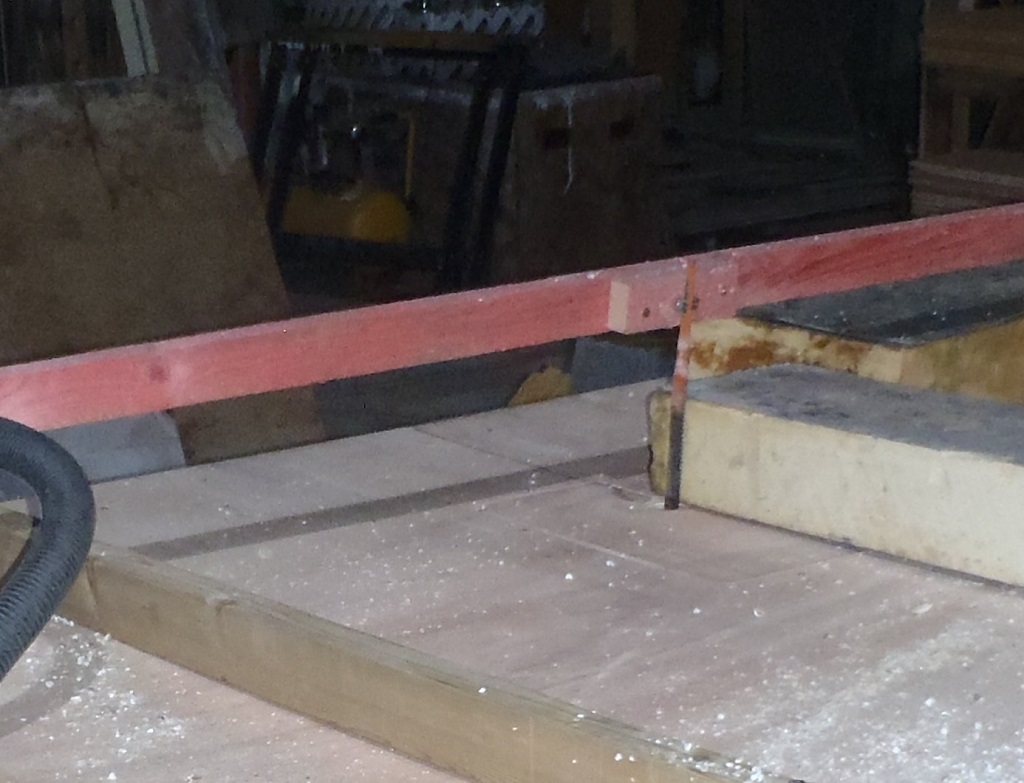
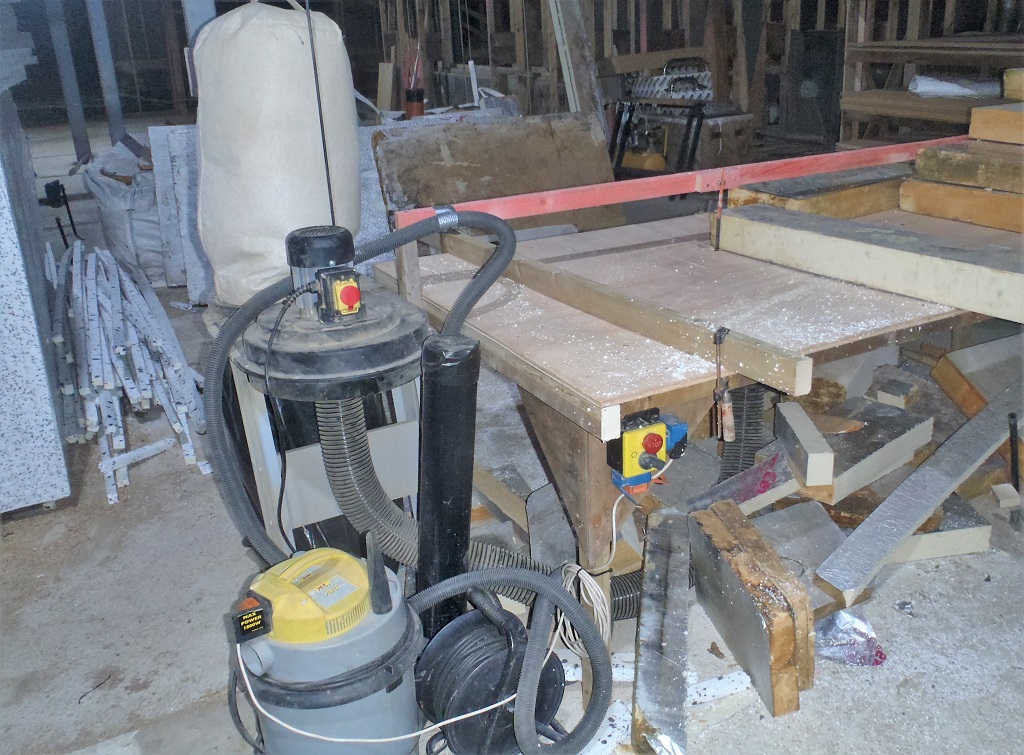
    So our slicing machine is constructed using a full 8foot by 4foot sheet of 12mm plywood, framing the edges and putting it on legs and then mounting a sabre saw into a wooden bracket and screwing it to the under side of the table. The table had a square section measuring 300mm cut out so we could gain access to the saw clamp to change blades. We also put together a boom arm over the blade and mounted a pair of ball races that grips the saw blade to stop it flexing sideways.
    Sabre-saw-in-Insulation-Saw-Table

    Sabre-saw-in-Insulation-Saw-Table

    Insulation-Saw-table-Blade-and-guide

    Insulation-Saw-table-Blade-and-guide


    We also made provision to have our large format vacuum machine to suck away the crumbs and dust of the insulation material as we push it through the slicing machine.
    Finally, we got a mobile adjustable fence with two clamps so we can set up a regularised width to guide the foam sheets through the machine.
    Insulation-Saw-table-and-extraction

    Insulation-Saw-table-and-extraction


    Then, first job was to slice some of the sheets from the random heap of thicknesses, widths and lengths to produce a regular 940mm size. This measure is the distance from the concrete floor and to the height of the concrete wall and its three lines of timber. This means that when the first section is filled in, then the upper section can be loaded with another set of regularly sized insulation boards.
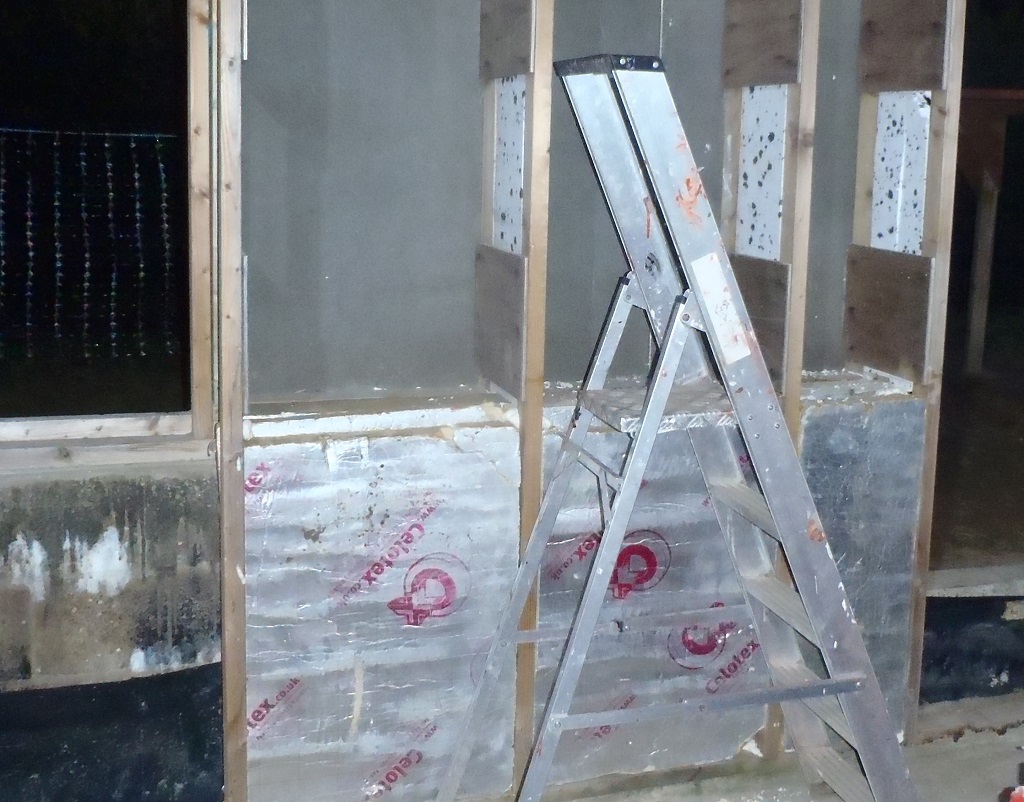
    So this is what we did and now the Entertainment Room has the lower section along the “d” and “c” of the wall all filled in, apart from the window section.
    Insulation-at-base-of-wall

    Insulation-at-base-of-wall


    Then we realised that we could use up the left-over pieces of the polystyrene foam sheets (they came from when we were making the rafters) and we could use them to fill in the gap within the leg themselves, as they were already 38mm thick and this is exactly what we need here to block a potential cold bridge through the legs.
    So all the pieces went through the slicing machine at 220mm wide and ready to be inserted when we need to.
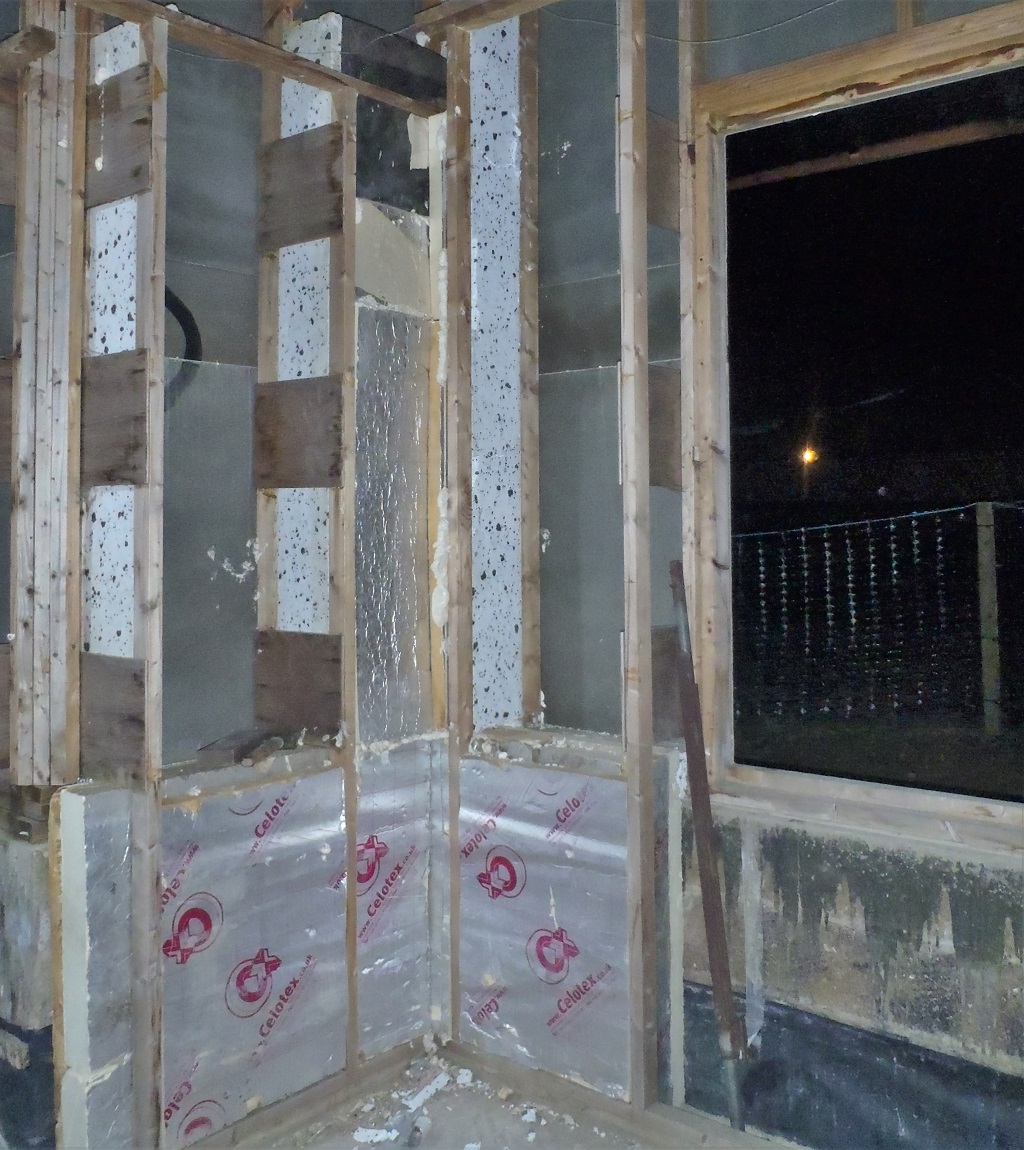
    Finally, we started the task of filling in the upper section of the walls and we decided that because of the random nature of the foam boards we got second hand, we would slice the pieces into a regular width and then stack them on top of each other and build it up layer by layer, with lots of PU spray foam to make sure that we don’t get any cold bridging. So we started right in the corner (the “C” – “D” corner) and sliced a set of 620mm wide pieces. We had found enough for two layers of 120mm thick boards and finished off the third layer using 100mm thick boards.
    Insulation-in-CD-corner

    Insulation-in-CD-corner


    It was rather fiddly but we are learning and some of the pieces were quite tight so next time, we will make it a little looser and use more spray PU foam to seal all the edges and joints. This would mean using a lot more spray foam but it is a small extra cost against the total cost of the insulation and it would help us move quicker in doing this job too.
    Next week, we resume filling the walls in around the Entertainment Room, the reason we are doing this area first is because we will be building the soundproofing concrete walls as one of the first jobs to do inside the house when we have finished all the exterior cladding and have installed the windows and we would lose access to get the insulation in!!

  • Proceeding with L to N Roof Sections

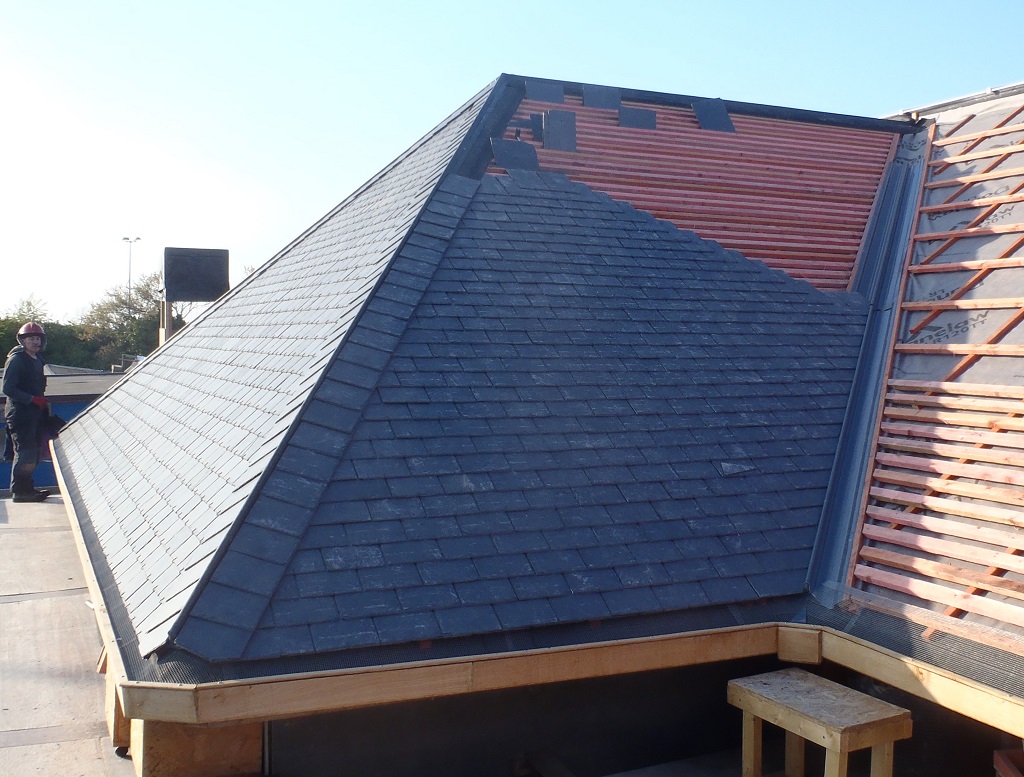
    For our week’s work, we got on with the next three sections, the L, M and N which forms a U shaped inset. We first got all the tile battens up on L section and then used up the remaining full length battens we had up on the platform to do the first eleven lines on the M roof, all by Monday lunch time.
    We then started putting up the slates on the L slope, to have a change of job as it can get painful on our muscles in our legs having to crouch down, especially doing the slates.

    N-End-of-Day-2

    N-End-of-Day-2


    Being such a short section of the roof, we are having to stop and start a new diagonal strip of slates quite often (starting at the valley and stopping at the hip), and that slows us down considerably. By the end of Tuesday, we estimated to have put up only about 280 slates for a day and a half of work.
    N-End-of-Day-3

    N-End-of-Day-3


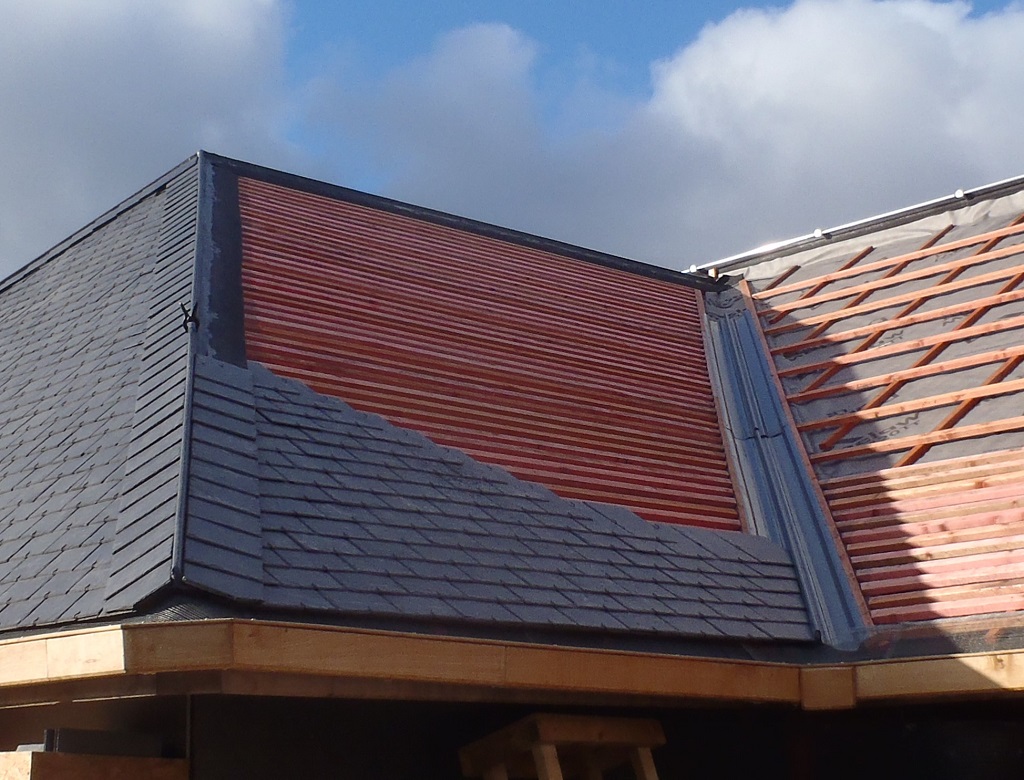
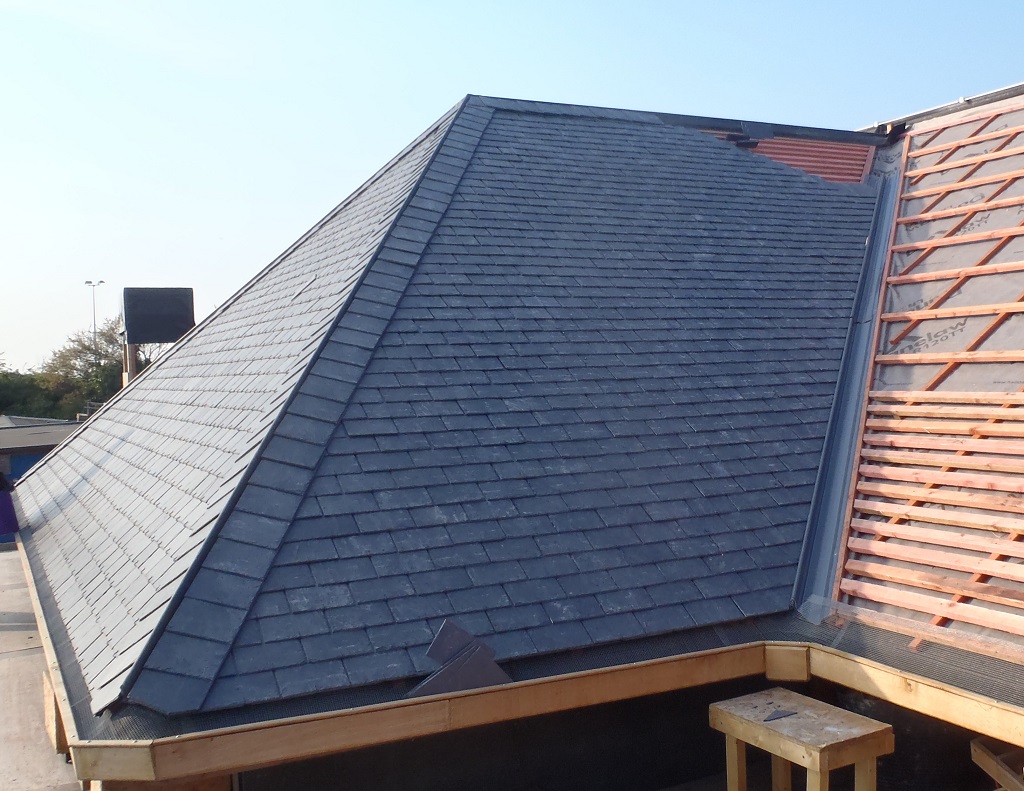
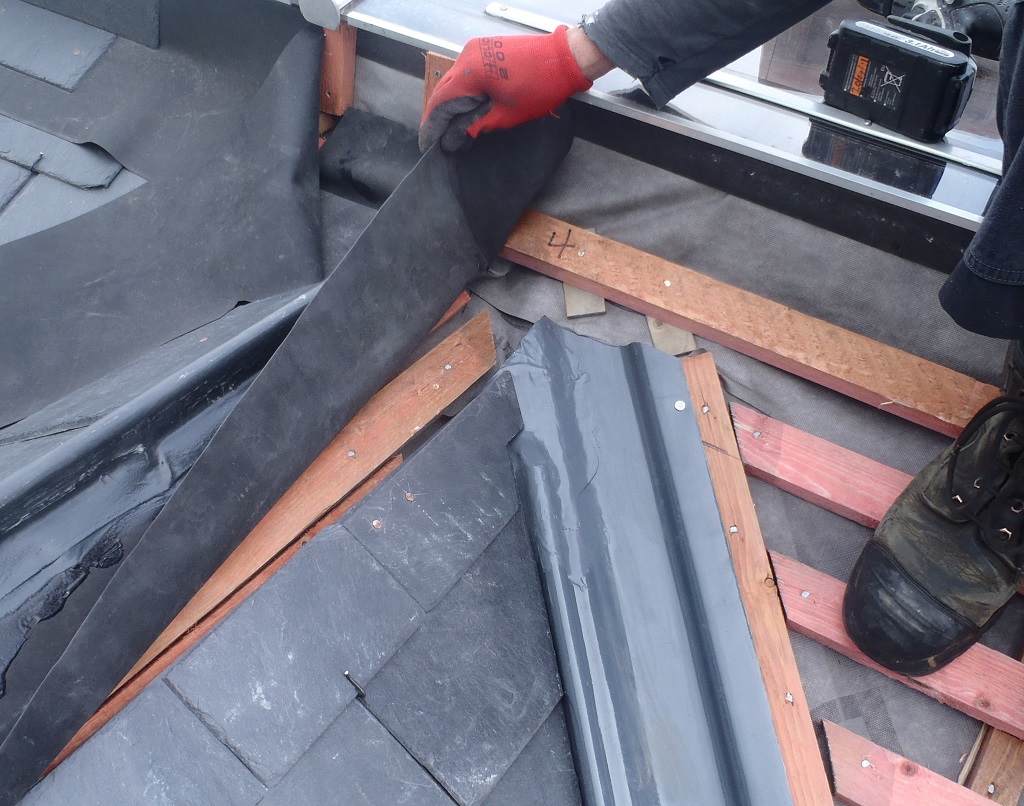
    Wednesday saw the “almost” completion, with another 300 slates, of the L strip of roof, only leaving a small triangular bit right up at the top of the valley. We needed to cut and trim the third small length of the fibre-glass trough to fit, modifying one batten to make sure the trough will go as high as possible to ensure capture of all the rain water.
    N-End-of-Day-4

    N-End-of-Day-4


    On the next morning, on Thursday, we trimmed off the bull nose middle part of the trough and reapplied a new layer of fibre glass woven mesh and dark grey resin to seal up and form a solid waterproof trough again.
    Top-of-N-M-Valley

    Top-of-N-M-Valley


    While the resin was hardening, we spent most of the day (running late into the afternoon because we thought there was going to be a heavy rain shower mid-afternoon plus also we had a meeting to attend) putting up lots and lots of tile battens up on the M section. We used thirty or so full length battens to cover almost the whole of this section and only has the left-over bits to fill in next week.
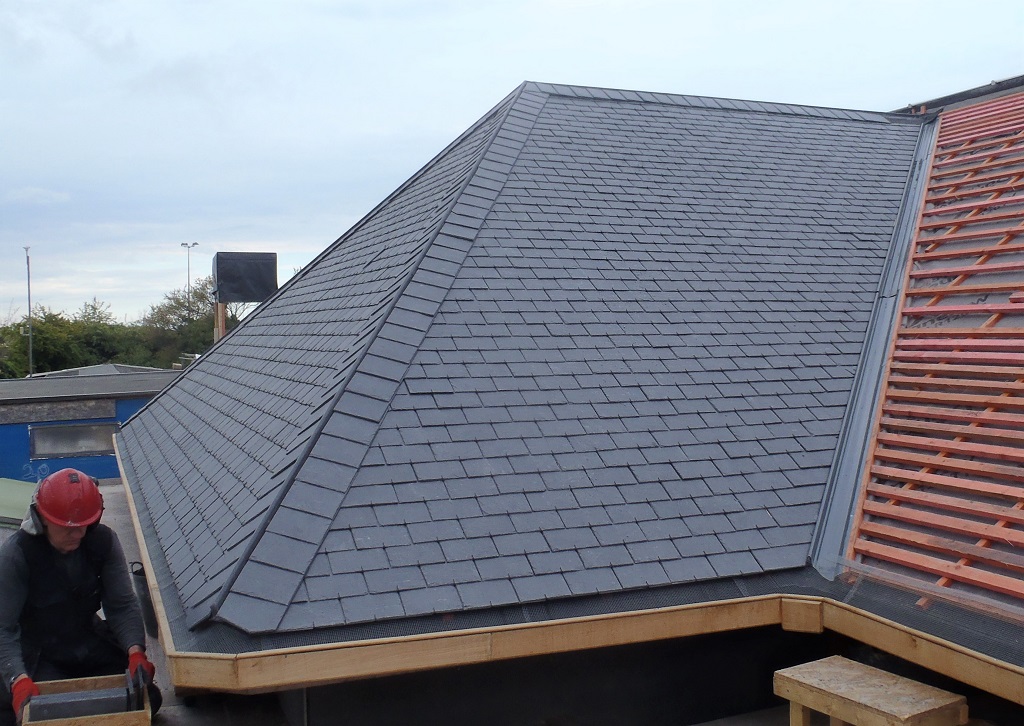
    After our late lunch, and no sign of the rain, we took out our new modified trough out and fixed it into place and then continued putting in the final fifty slates or so to completely finish the whole of the L section, including nearly all the flashing tiles too. The final part of the intersection of the four roof sections will be completed when we reach it with the slates on M next week, as we need to know exactly were the slates meet.
    N-Complete-Nearly

    N-Complete-Nearly


    The next two days (Friday and Saturday) were washed out so we didn’t fancy working in the wet and slipping on the battens. We will resume next week on Monday and finish putting the tile battens on M and then start slating that segment next. We have covered about twenty percent of the roof (4 segments) so far but it will jump to about thirty-three percent when we get both the M and N sections finished, which hopefully won’t be too long in coming.

    And we have resumed shooting daily videos of our work so here are the time lapse versions for you to watch…


  • Slate Cutting tool, Nail Containers and Slate Spacing Guides

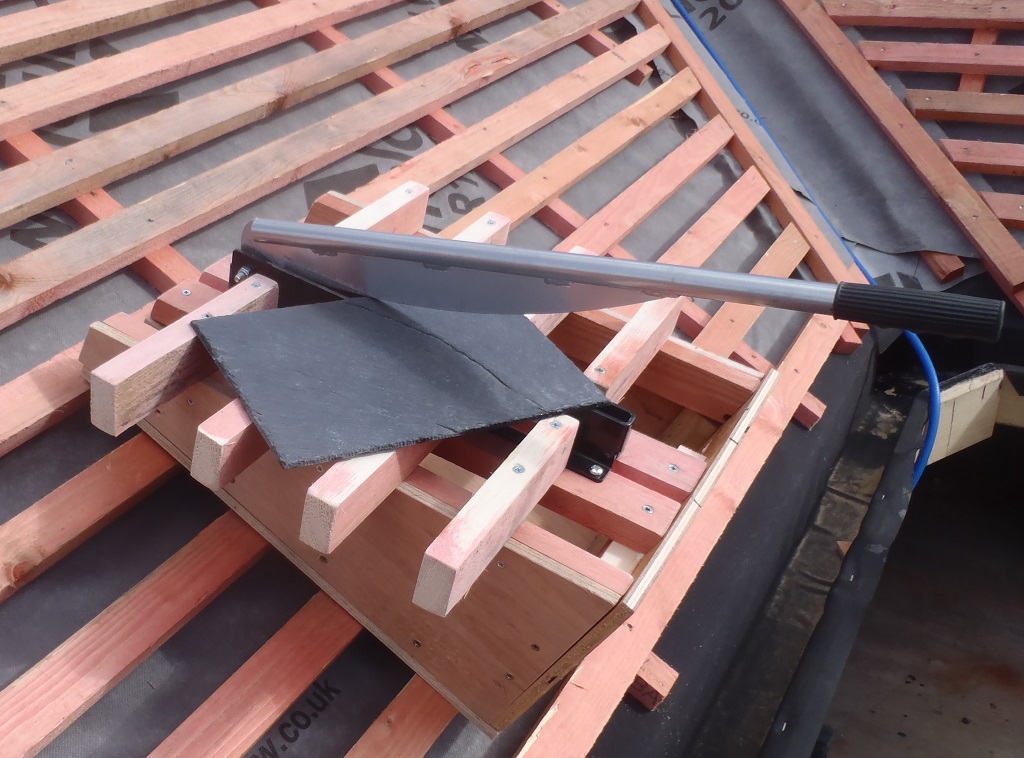
    Today, following on from Saturday’s work, we designed and built a slate cutting guillotine with supporting stand which has rubbish collection built in.

    Slate Cutting tool, Nail Containers and Slate Spacing Guides

    Slate-cutting-guillotine-and-stand


    The guillotine sits on top of the box like container and there are standard measured marks to help us repeatedly slice certain slates at various required sizes.
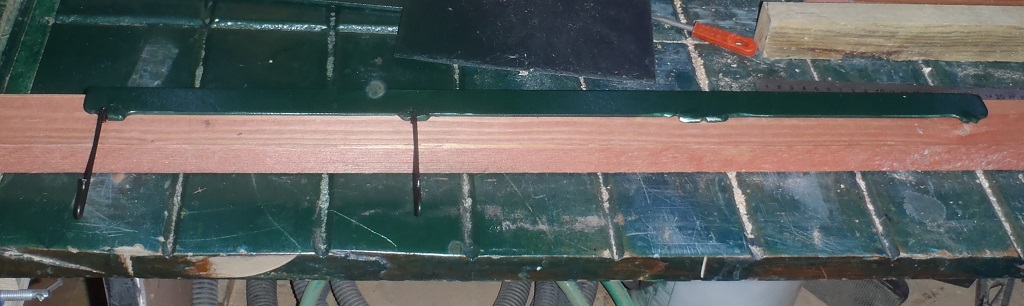
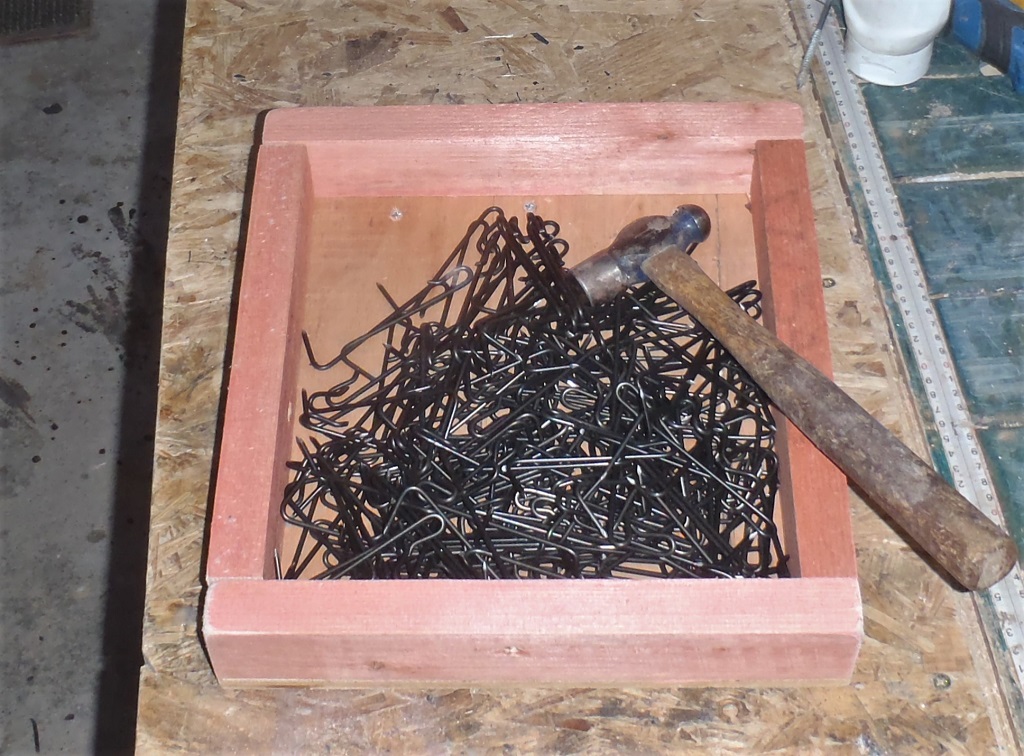
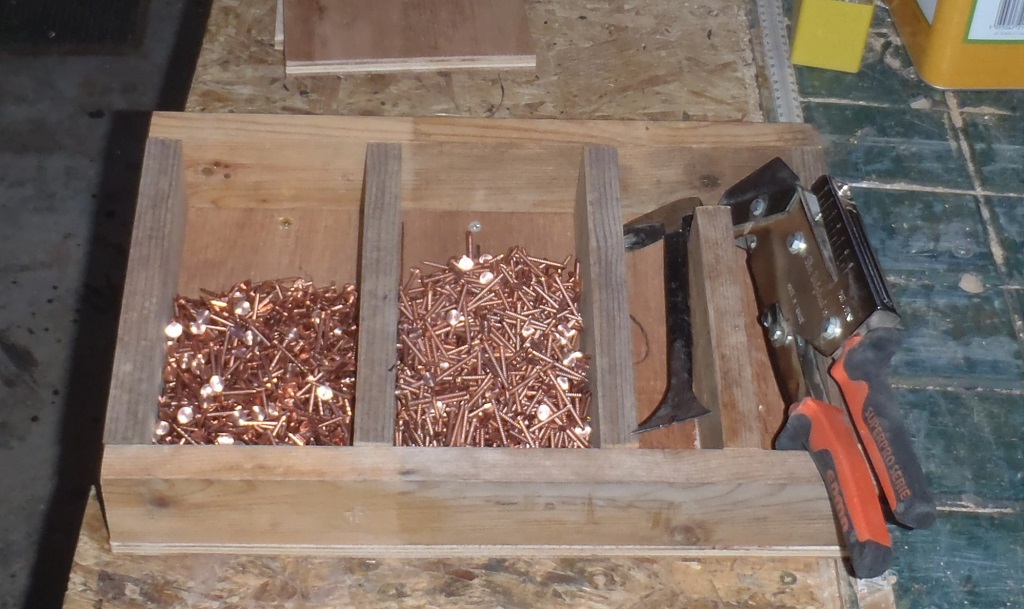
    The next piece of equipment we made, was a couple of containers to hold the various types of nails (the stainless steel slate hooks and two sizes of copper nails).
    Slate Cutting tool, Nail Containers and Slate Spacing Guides

    Box-of-slate-hooks

    Slate Cutting tool, Nail Containers and Slate Spacing Guides

    Box-of-copper-nails-with-tool-storage


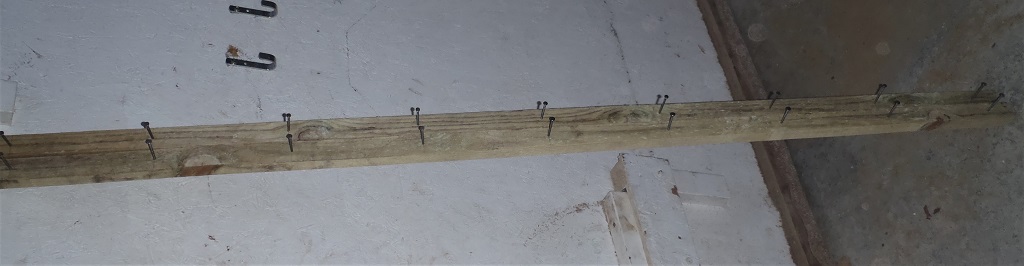
    Next item were two templates to guide us to align the slates at the required 204mm spacing, made using a 38mm wide batten with nails hammered in at the correct distances.
    Slate Cutting tool, Nail Containers and Slate Spacing Guides

    Slate-spacing-marking-sticks


    Finally, the second guide template was a metal affair with notches at the nailing points, again at the 204mm spacing but also marked are the half way points (the 102mm distance) between the notches, to allow us to align to the chalk line on the tile battens.
    Slate Cutting tool, Nail Containers and Slate Spacing Guides

    SLate-hook-fixing-guide


    Hopefully these pieces of equipment will provide consistency, ease of getting the job done and achieve a neat finishing touch to our roof. We now need to have good weather!!

  • Rubber Strips for Hips and Ridges Done and Metal Mesh Dispenser Coming Together

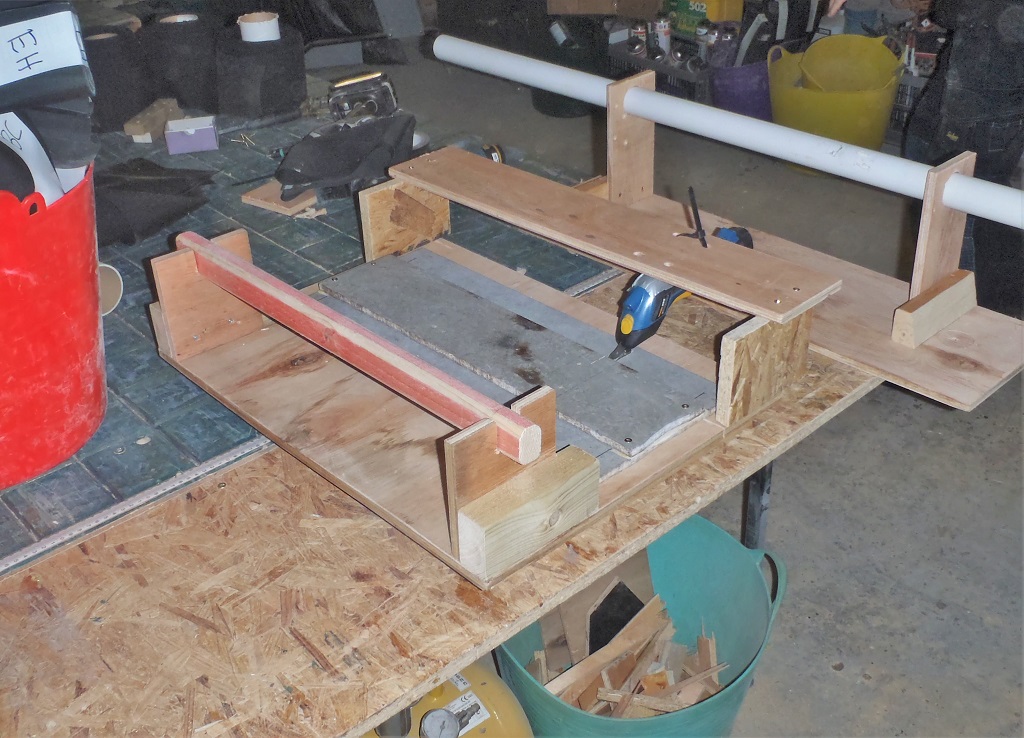
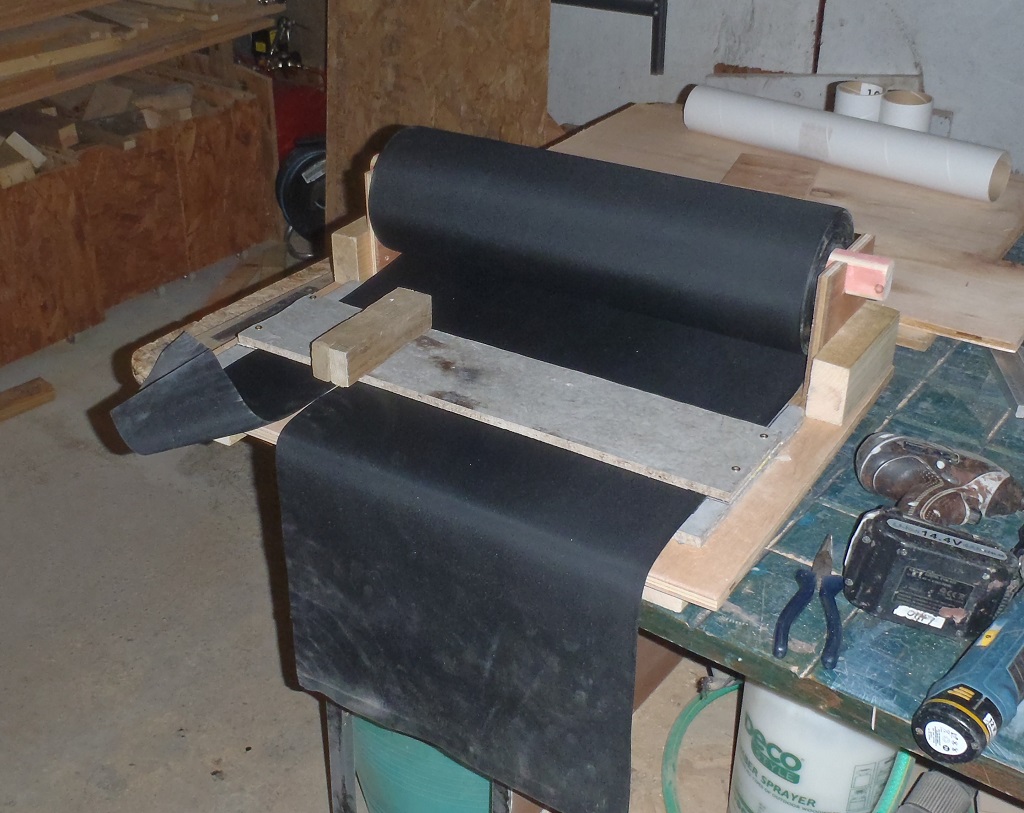
    We continued with the task of slicing up the wider rolls (four of them) into a little bit narrower width (380mm because we are using narrower slates than we envisaged months ago when we bought the rubber), using our dispenser with the razor blade as the cutting tool. But we discovered that the rubber material had too much flex in it to keep it straight and it wobbled side to side and made a ragged edge, especially after pulling out longer pieces. So we had a think .. and decided to replace the razor blade attachment with a battery powered scissors instead.

    Rubber Strips for Hips and Ridges Done and Metal Mesh Dispenser Coming Together

    Rubber-slicing-tool


    It worked much better but it was still awkward in trying to handle the rubber material and we ended up getting a third pair of hands to help to help roll up the cut rubber – we needed 1 person to unroll (the rubber is firmly ‘stuck’ on the roll) and 2 to re-roll (1 for each strip).
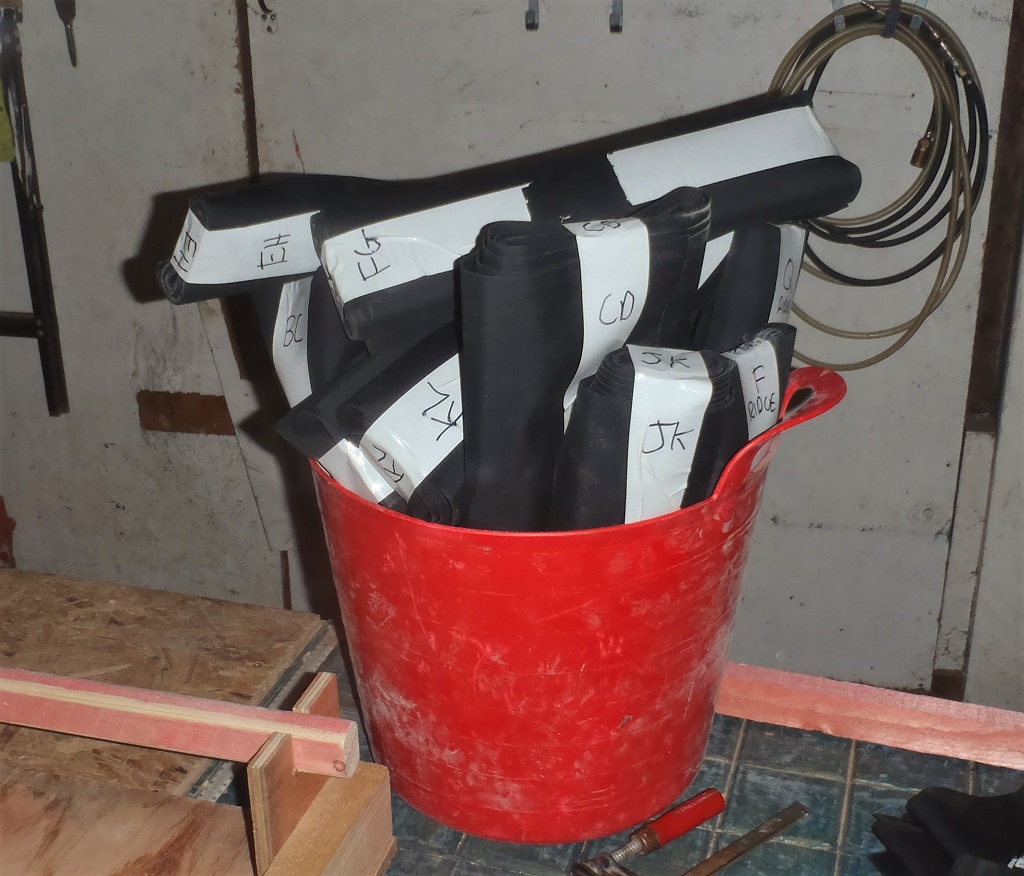
    We now have a trug full of 15 lengths of rubber strips, for the hips and ridges, alongside another 2 trugs of similar pieces but for the guttering.
    Rubber Strips for Hips and Ridges Done and Metal Mesh Dispenser Coming Together

    Trug-full-of-rubber-strips

    So that’s that job done so everything was dismantled and we started making the next dispenser, this time for the roll of the metal mesh. This metal mesh is for covering the gutters to keep out large items like leaves, moss and other rubbish blown on the wind.
    The mesh is a grid with 5mm spacings and the roll (being 920mm wide) will be chopped up into 300mm lengths and we are planning to use a guillotine like mechanism to cut the mesh. We will find out later on whether it will work or not .. time will tell!

  • Dispenser and Cutter for Rolls of Rubber membrane

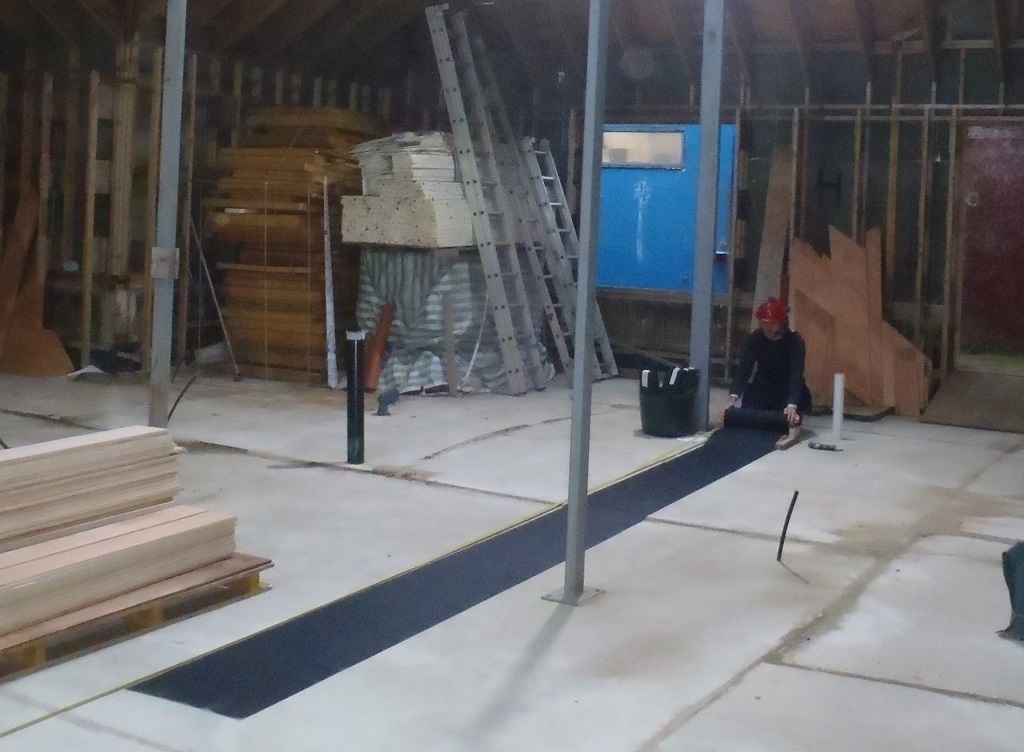
    Today, we made a dispenser to hold a roll of rubber membrane (20m long strips 500mm wide wrapped on a cardboard tube) so we could easily unroll each roll of rubber and cut them to the required lengths. We had a list of 16 numbers, optimised to minimise wastage off these 20m rolls.

    Cutting-the-Rubber-for-gutters-to-length

    Cutting-the-Rubber-for-gutters-to-length


    We now have a pile of cut pieces ranging from 1.4m to 10.2m long, ready to be inserted into the guttering when we get to assemble each section around the house.
    We then modified the dispenser by adding a cutting module, positioned at 380mm from one edge so we can produce a narrower strip of rubber for protecting the hip and ridge lines. The cutting module was made by sandwiching a classic razor blade in between two strip of battens and then screwed down to the upper layer of the cement board.
    Dispenser and Cutter for Rolls of Rubber membrane

    Rubber-slitting-machine


    Even a razor blade struggled to cut the rubber membrane when we tried to slide it through the thin slot. But we realised that if one manually cut a short distance first, it started slicing fairly easily afterwards.
    On Monday, we will slice the remaining four rolls and cut a further 15 lengths (10 hips, 5 ridges).