
So, what do we do?
Do we try to cover this mess up? Put a line of plastic over it to stop the moisture staining our finished plasterboards? Or, paint a thick layer of varnish on the back of the plasterboard?
But, this is not good at all. This means that the plywood will stay damp for years and years because the calcium chloride desiccant holds on to the water forever. Also, the calcium chloride liquid is slightly corrosive and we got our main heavy duty steel RSJ beams up there supporting the whole roof and Skylight.
No, we are going to play safe.
This means ripping off all the “infected” plywood and replacing it with fresh new material. We decided that we can use 11mm OSB boards instead of plywood, as it is not a structural element of the Skylight. We ordered 10 sheets and they will arrive soon.
In the meantime, we went along the Skylight, on our trusty platform, to pull off each piece. They were both screwed and glued on!! It was hard work yanking off each sheet! The glue was so strong that we were actually ripping a layer of ply off the back of the boards! We tidied up all these broken strips of ply, removed broken screws and generally got it cleaned up.
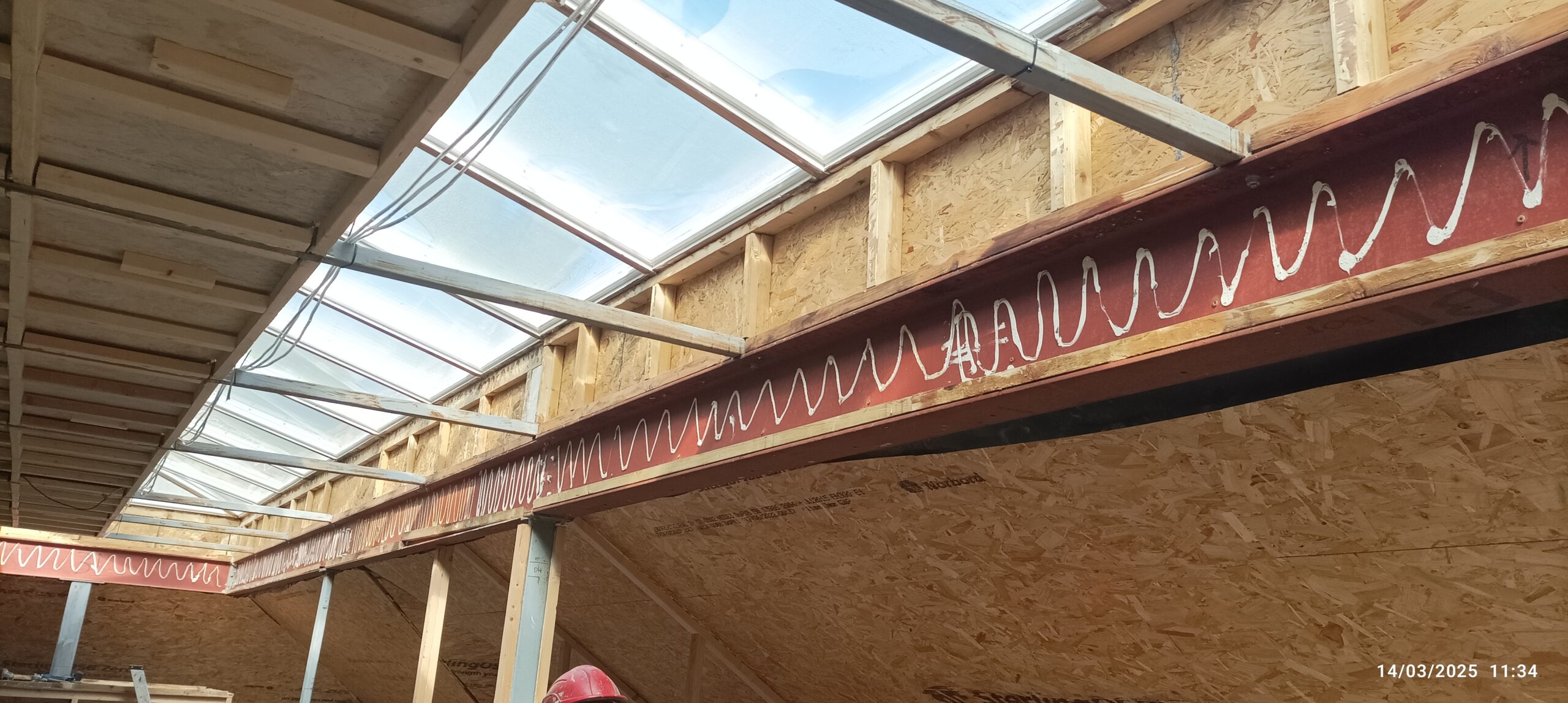
Lining stripped
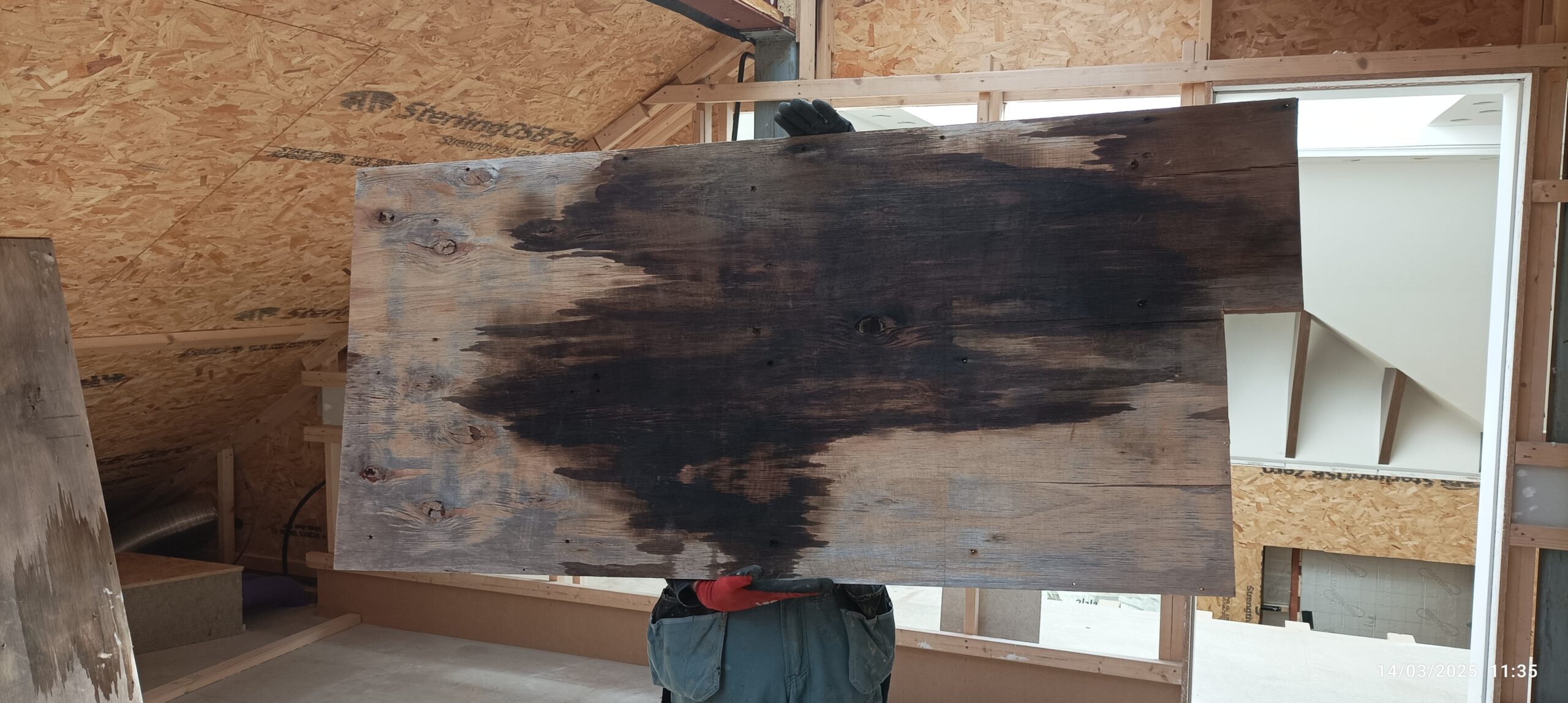
A contaminated board
Now that we have removed the plywood covers, we can see in some locations where the desiccant liquid has managed to get behind the plywood and soak the timber and the top of the steel RSJ itself.
So, we need to neutralise his liquid and the web says “use soda powder, which is sodium carbonate” or “use baking powder, which is sodium bicarbonate” and this converts the calcium chloride into calcium carbonate, which is limescale. It also produces table salt, Sodium Chloride and in the case of the bicarbonate powder, also produces carbon dioxide gas.
Nice and simple!
We had washing soda in our washing supplies so we mixed a good heap of the powder into hot water and dissolved it all. We then filled up a spray bottle and went around squirting on the damp patches and saw an instant reaction where it went white. This being the calcium carbonate. We also got a large sponge and literally soaked the surfaces of the plywood pieces that we had laid out flat on top of our Swimming Lane outside. This also caused the wet patches to go white too. Hopefully, that will solve that problem and once it is dried out, there will be just a mixture of calcium carbonate and sodium chloride salts sitting there and minding its own business.
We also liberally sprayed all the spots on the floorboard where the desiccant had dripped down from the Skylight. This includes the stair case as well. We deliberately soaked a good amount on the first three steps at the top of the stairs and also wiped the next three steps down too.
But, in the meantime, we have been attempting to dry out all the condensation that managed to freeze on the outer pane of plexiglass. We had made it worse ourselves because we kept running the air fan all night as well, and unfortunately, we hadn’t realised that the air that we pumped into the Skylight was getting more and more humid, and alas, the moisture froze on the plexiglass, especially during the icy cold weather we had been having.
So, we needed to get rid of all this moisture first, before we could continue doing the repair work up in our Skylight. to achieve this aim, we rigged up an air drying chamber, using a large rubble sack, put in a water proof plastic tray and put a folded up mesh situated above the tray. The mesh held a large pile of Calcium Chloride crystals, which will grab the moisture out of the air passing through the plastic rubble sack. We made a hole at the other end and connected our air fan, to continue pumping dryer air into our Skylight.
The results of this operation is that we are slowly winning the battle against all the moisture. The Skylight windows are slowly clearing away and soon we can resume work. We have already had to empty two loads of dissolved crystals and we have just ordered a couple more bags of the Calcium Chloride. We will continue with this operation for another couple of weeks.
While all this had been going on, We have been working on our Ventilation system downstairs!!