Category: Water

Cold and Hot water running around inside the house, Cold Header Tank and Hot water Tank, plus also all the connections under the floor.

  • Testing of Large Cold Water Header Tank

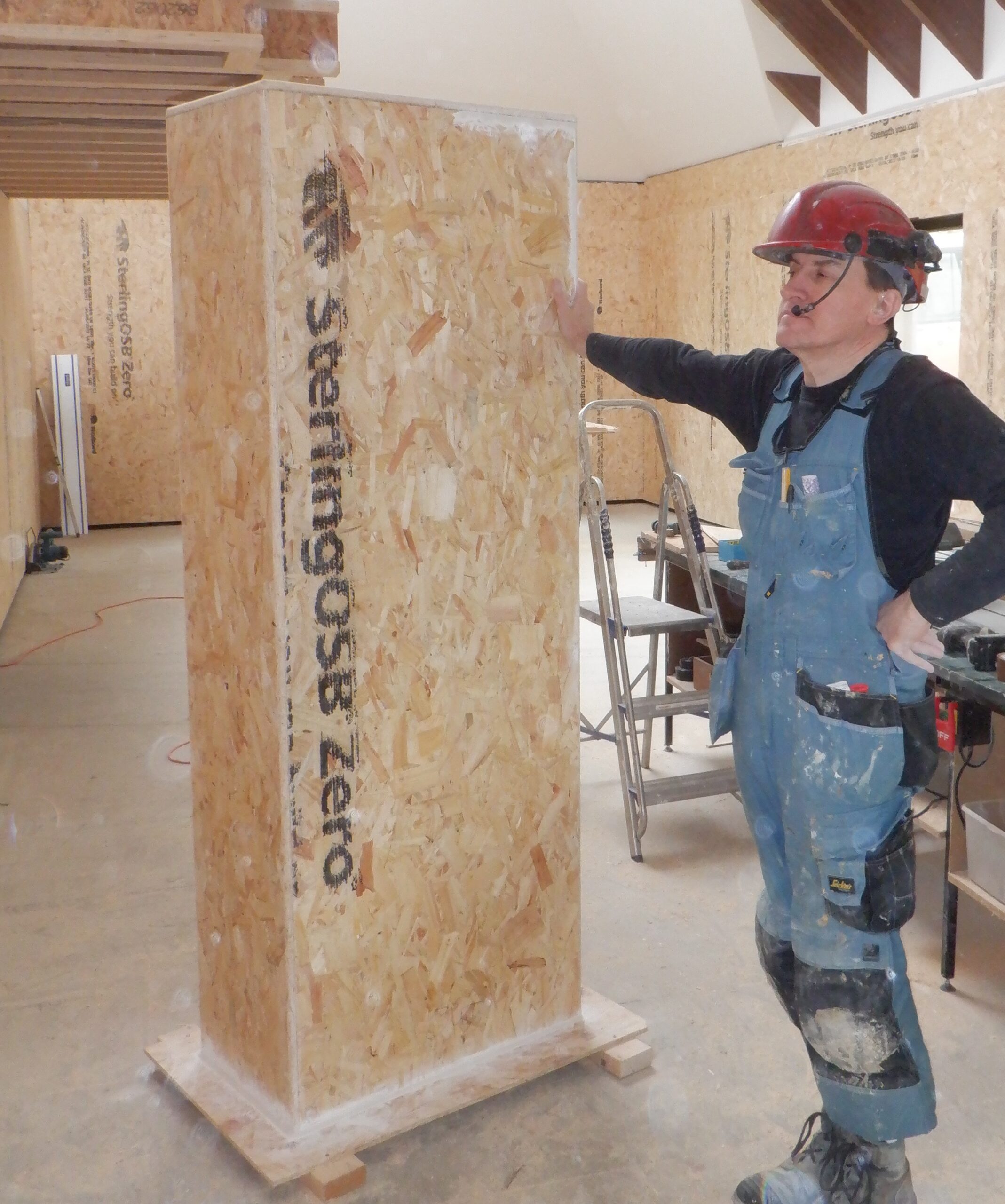
    Yesterday, we fitted our newly arrived tank connector and let the LSX sealant set overnight. today, we stood the tank upright and placed it on two small pieces of battens to lift it off the floor so that we can inspect the bottom surface for any leaks. Yes that is correct, we are testing for leaks! We used the garden hose to start filling it up ..

    And stopped when we were about an inch above the tank connector at the bottom. Then, we left it standing there while we went off to do other things in the house…
    We came back for lunch .. and found .. Nothing !!
    No Leaks !!
    Yippeee!

    So after lunch, we continued filling the tank, after moving the tank onto a layer PU foam matting because when it is full, it will be weighing 500kg, a half a ton !! And we wanted to make sure that the tank is not over-stressed on our bumpy garage floor so we put one of our exercise mats underneath to absorb any irregularities.

    ..

    We put in another foot of water in the tank .. and .. we got pin-prick leaks on the flat sides, not on an edge, but in random places on the flat sides !!
    OOOO Boy!
    It is very disappointing and it just shows you that making a water tank is an exercise in following a method. And, the part of the method we seemed to have skipped, was to put on a so-called “gel” coat first thing, straight on to the mould and allow it to harden to a gel like substance before continuing with the rest of the layers of matting and resin etc.

    So, we are going to have to give our cold water tank a coat of gel resin and then a final top coat, from inside the tank itself. We ordered the necessary containers of resin and brushes and rollers etc.
    Plus also some activated charcoal filters for our breathing masks because there is going to be a high concentration of solvent inside the tank, as we paint the inside surface. We will have the fan blowing fresh air in as well.

    We emptied the tank of the water and stuck the heater inside, to start drying out the whole thing, including driving out any trapped moisture within the strands in the walls, where the leaks were.
    It got to be bone dry because the resin does not like any moisture at all.

    That concludes our second water tank!! Our next one is our Hot Water tank so we had better do it right next time!!

  • Installed Green Rain Water Pipework Up To Header Tank

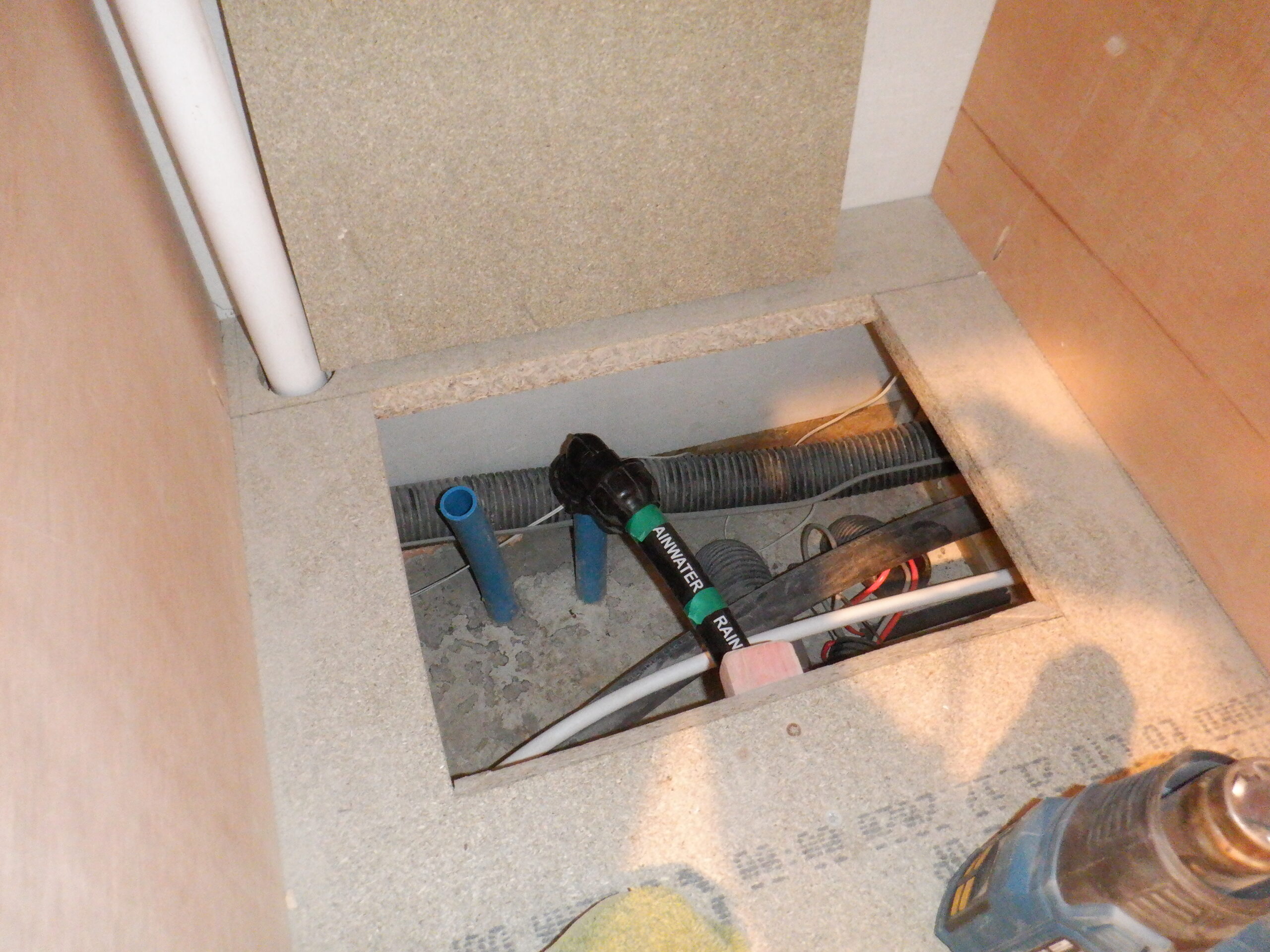
    While we waited for the leak test on our new cold water tank, we got on with the task of installing a 32mm water pipe, all the way from the Utility Room where there is a similar 32mm pipe coming up through the concrete floor, where the pipe is routed from the Garage and its buried rain water storage tank.
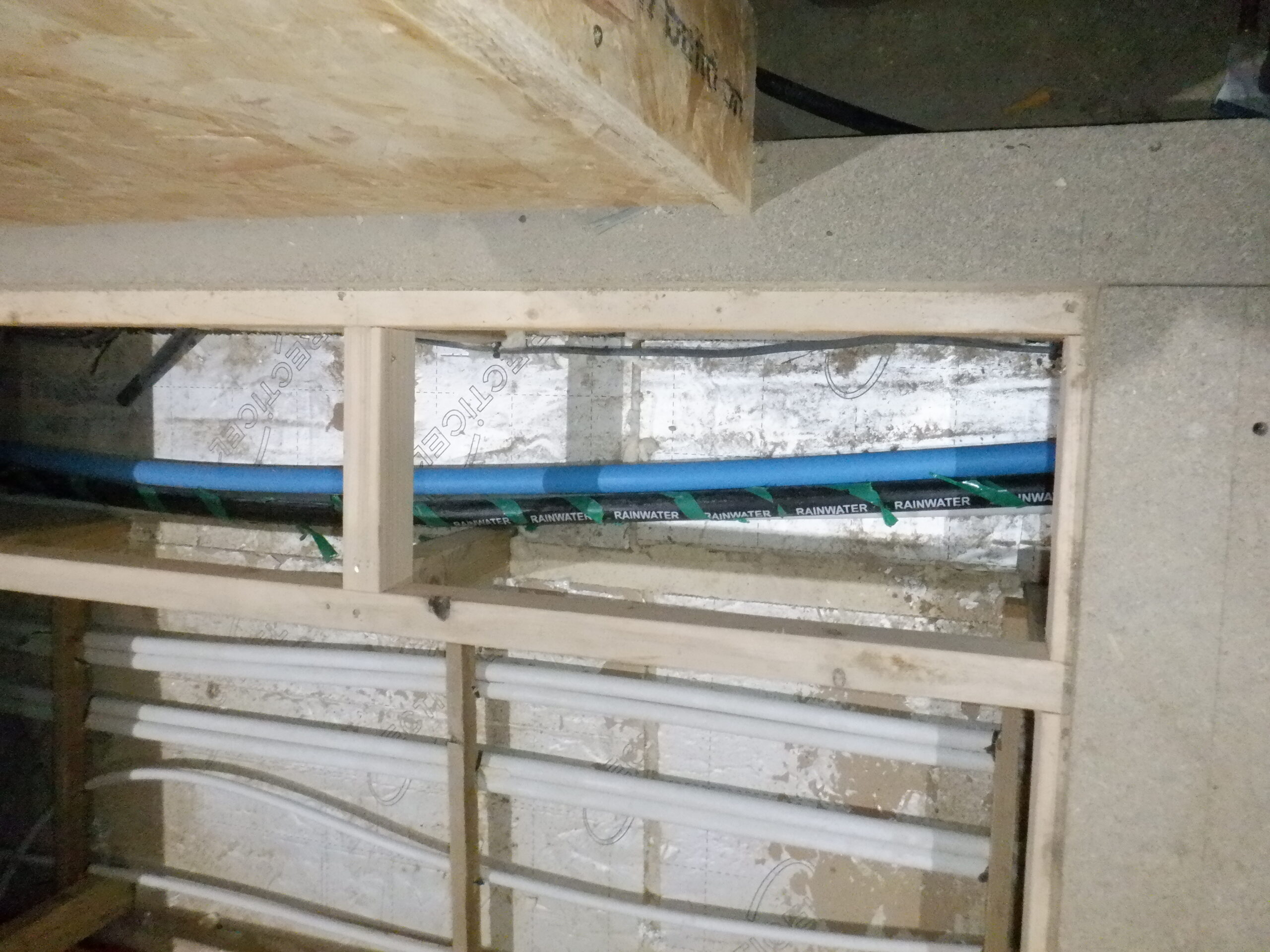
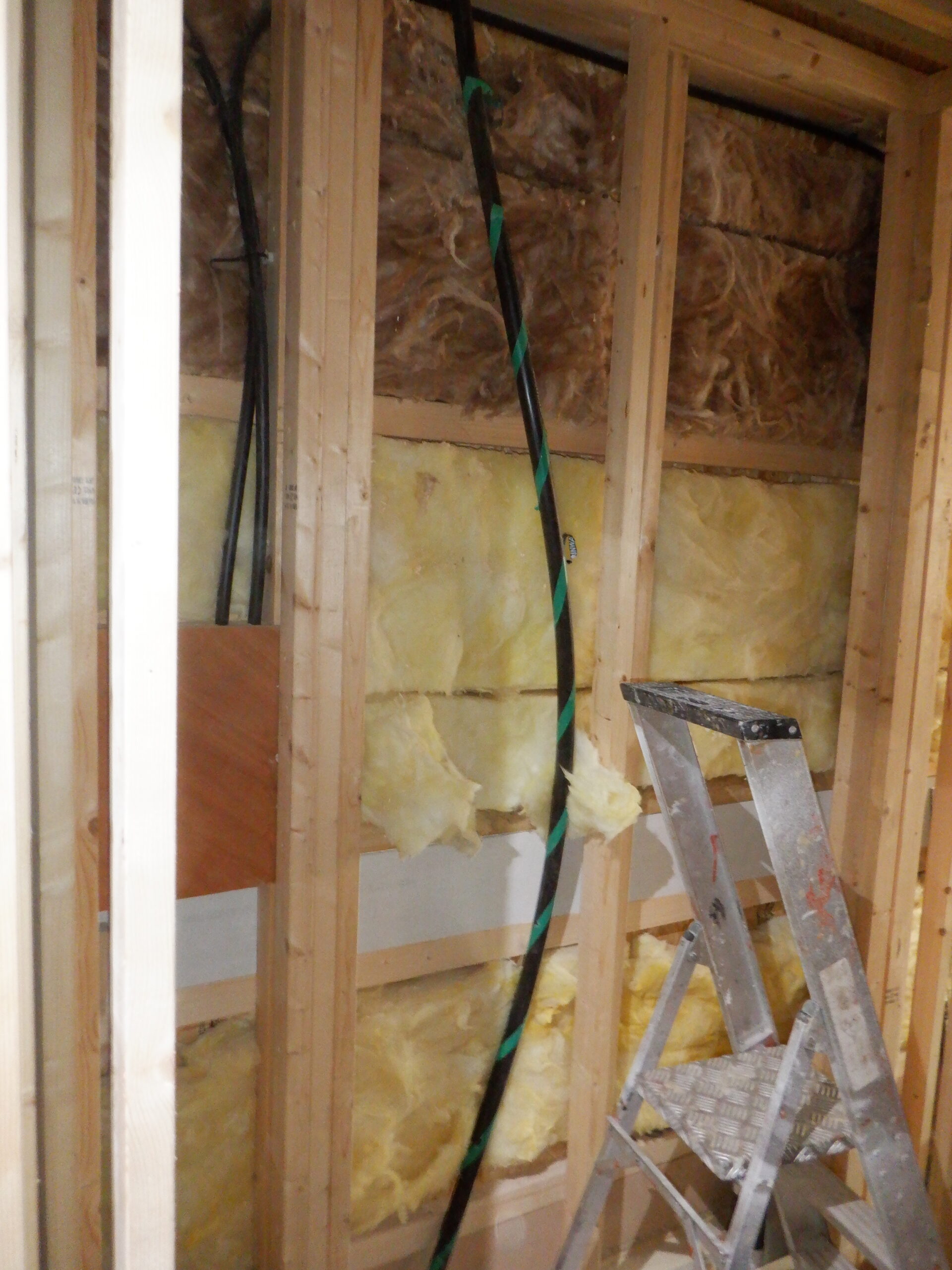
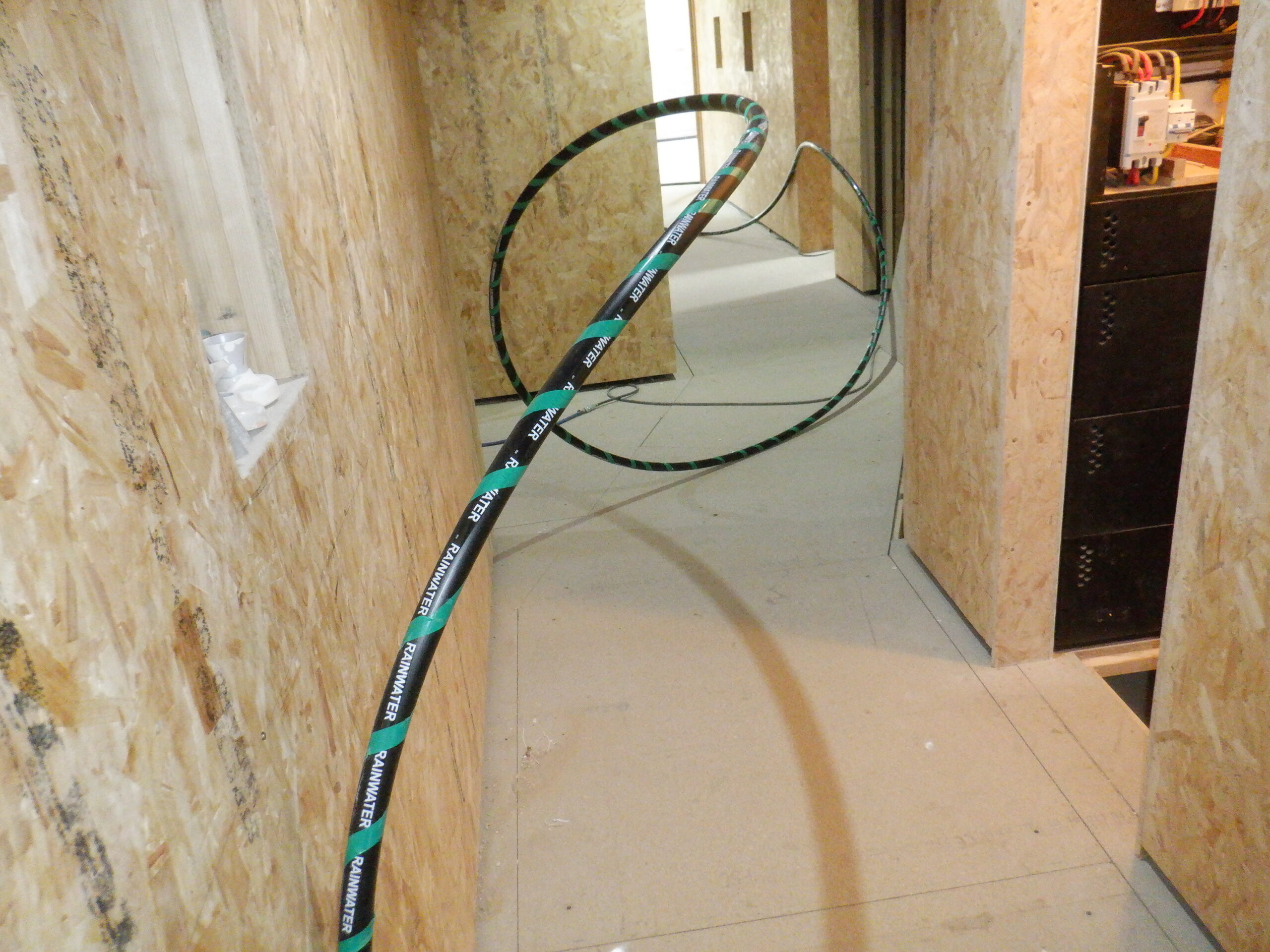
    By law, we have to label our water pipe to indicate that rain water is flowing down the pipe and the standards states that it got to be a black and green striped pipe. We didn’t want to have to pay stupid prices so we had some electrical 19mm wide green sticky tape and wound it around and around the pipe. We also printed two entire rolls of 8metres of white on black tape with the word “rain water” repeated all along the length of the pipe.
    Rainwater pipe being marked

    Rainwater pipe being marked


    We then lifted up the various floorboards in the Utility Room, along the two hallways, all the way to the Bathroom, so that we could aim up inside the wall that divides the Bathroom from Bedroom Two, through the wooden top plate and the floorboard itself.
    We started at the Utility Room end by laying out the pipe all the way outside the house, across the driveway so we could route the very stiff plastic pipe, down under the floorboards, weaving in and out of the legs, making sure that we went pass other pipes and future ducting without causing problems. It was hard work, especially when we needed to turn the corner, to go down the side hall to the Bathroom. The tight sharp bend made pulling the pipe quite difficult and we ripped our nicely stuck on sticky tape and labels in some places – Phew!
    But, we made it slowly and surely !! And We arrived in our bathroom!
    We needed to pull a little bit more through because we needed to thread the other end of the pipe under the flooring and get it routed over to the pipe coming up through the concrete, situated underneath the washing machine section, under the worktop and window in our Utility Room.
    There are two pipe to choose from but we selected the one that would be closer to our rain water connections in the Garage. We put on LSX sealant, put in the inserts and then push the right angle elbow joiner into place and tighten the two locking nuts down tight.

    So in our Bathroom, up the ladder, we drilled a hole through the double layers of the CLS timber that is part of our wall structure, and and through the floorboard as well, to come up just alongside the platform that will have the tall header tank sitting on.

    Rainwater pipe starts under utility floor

    Rainwater pipe starts under utility floor

    Rainwater pipe heads along the halls

    Rainwater pipe heads along the halls

    Rainwater pipe Heading upstairs

    Rainwater pipe Heading upstairs


    We also took this opportunity of laying in, on top of the rain water pipe, another 32mm water pipe, this time blue. It will come down from the header tank and go back into the Utility Room, to the Utility Cupboard, for connecting to the water pump and the pressure vessel. So, we put in the first length from the Utility Cupboard, under the floorboard like before, and reached the corner outside our Tech Cupboard where it will have a T-junction installed later on. This connection will allow for a supply of unpressurized cold water to be available for the fire suppression system and also to feed our downstairs WC so it doesn’t rely on electricity to fill the cistern and allow us to wash our hands. All the other basins and toilets will be fed via the pressurised system as we do not expect to have many interruptions, especially with our Solar Panels and Batteries providing a backup to the supply from the grid electricity. Mind you, the motor might go, or the controller, or even our computers that controls the pump!! So, we got our downstairs WC for emergencies!! Smile!

  • Cold Water Header Tank Created

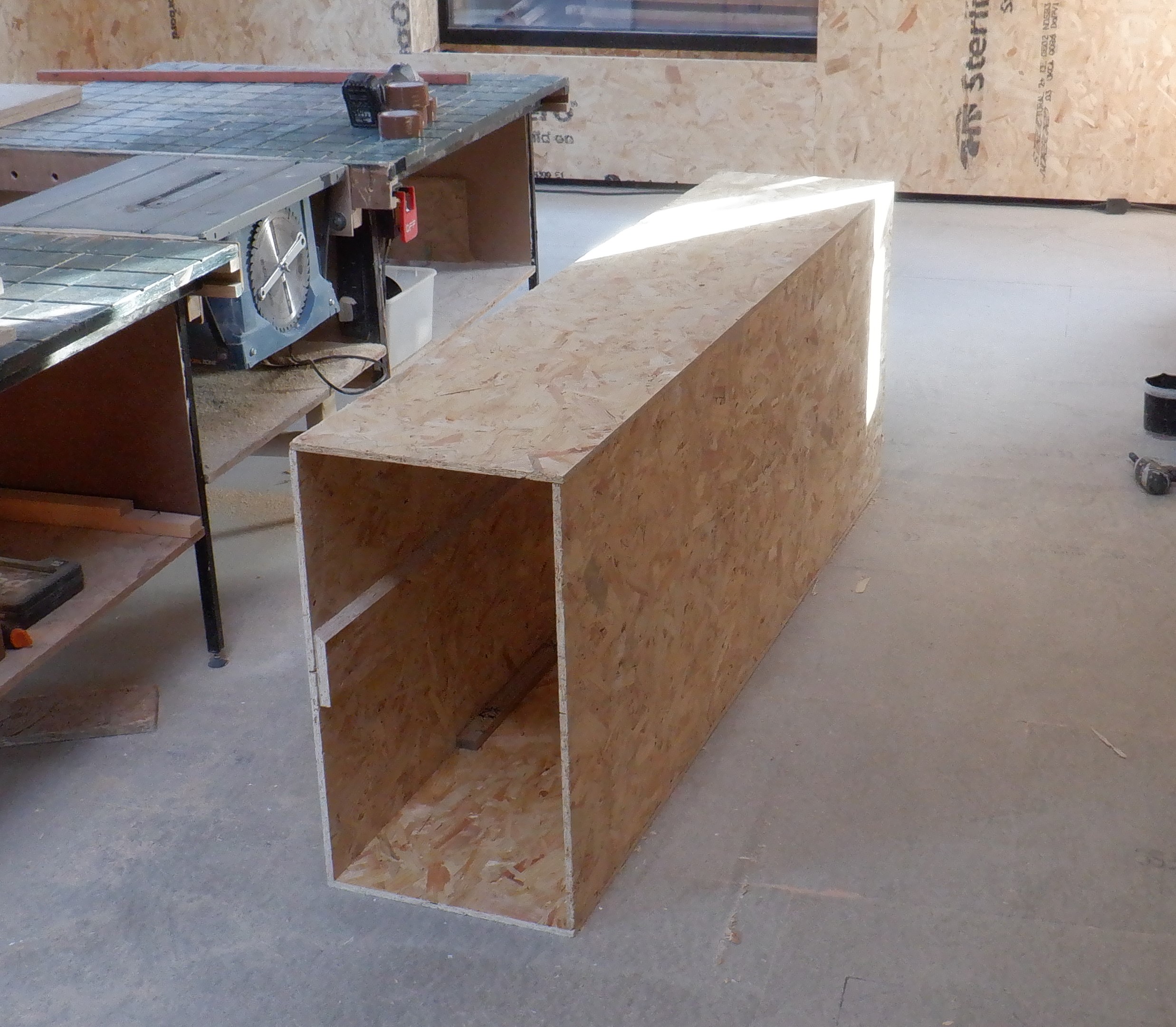
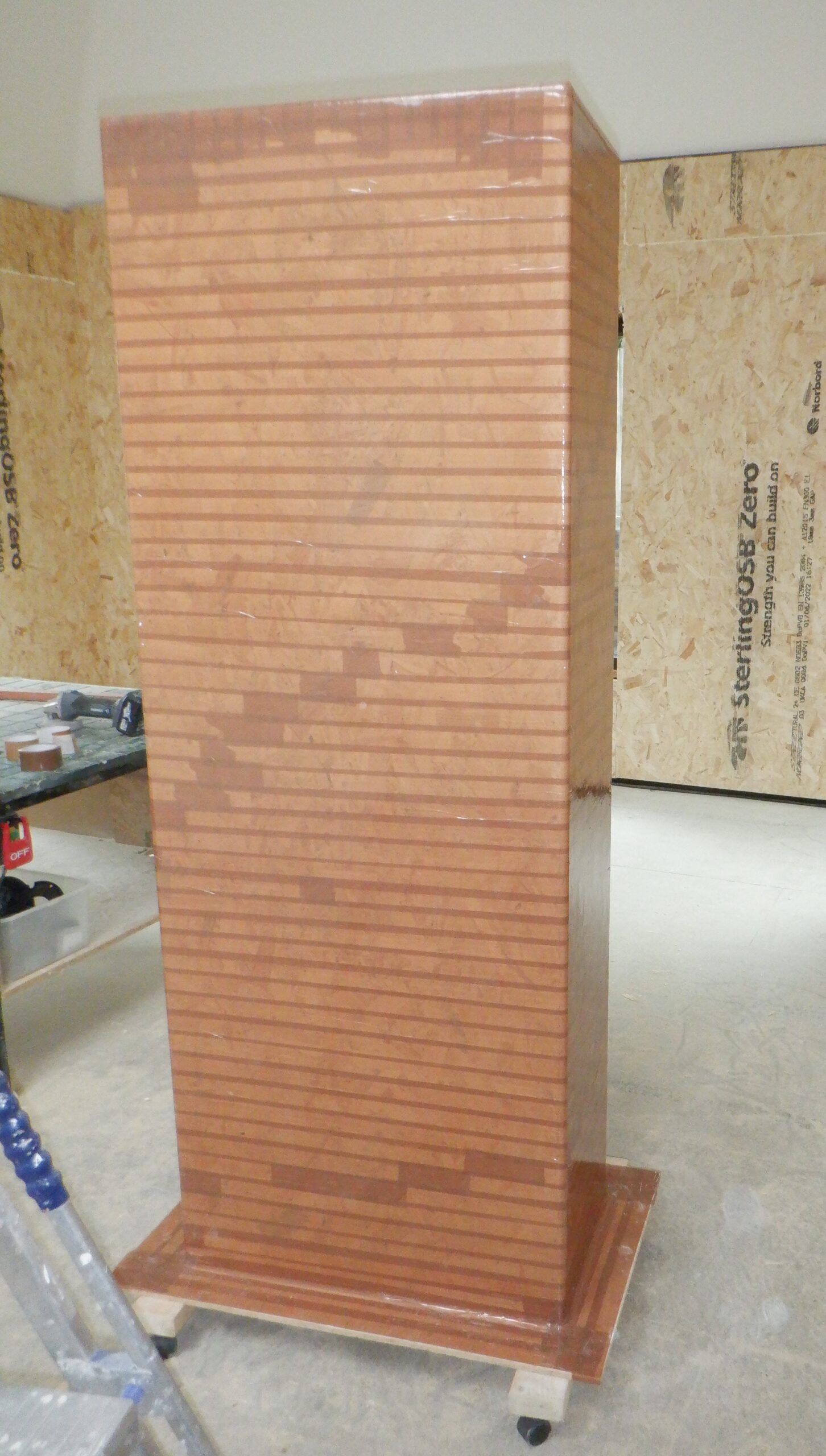
    While we waited for our Test Tank to dry out completely before we can initiate any repairs, we got on with building the mould for our next tank to make, this time the cold water header tank that sits upstairs behind the Shower Room. This tank measures 700mm wide and 400mm deep and 1900mm tall, it will sit on the reinforced platform we have already built and there will be about 150mm (6inches) clearance at the top to allow us to get the lid off and look inside.
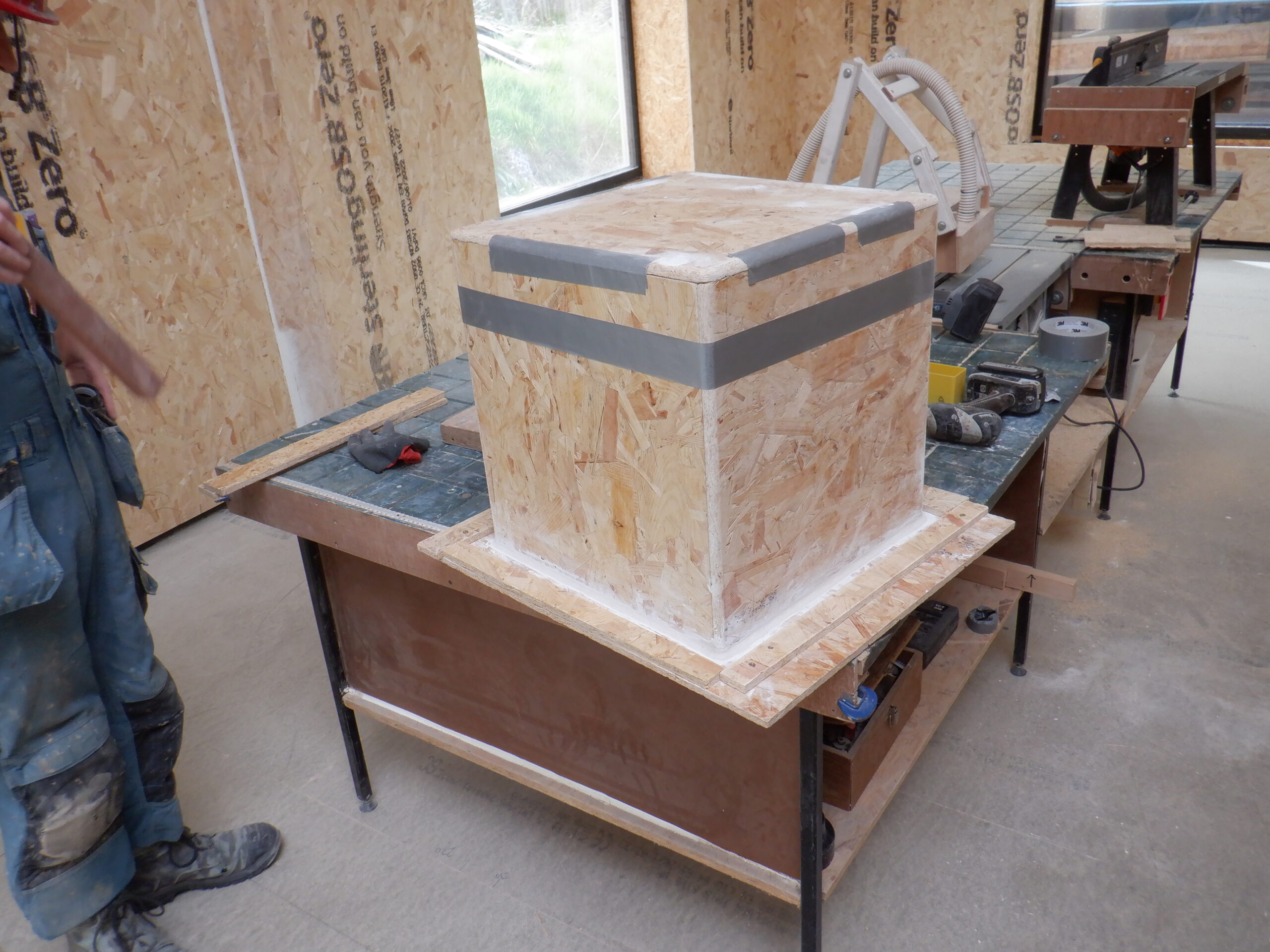
    So, we got two more sheets of our 11mm OSB off our rack of miscellaneous sheet materials and proceeded to build a similar designed mould like we did before. One of the major differences is that we need to be able to crawl inside the mould to reach the screws that holds wooden blocks around the edges. We decided that this mould needed more secured edges because it is larger, hence the reason for having more wooden blocks around the long edges. It was quite interesting crawling inside, flat on our stomachs and screwing the final screws in place to tighten the mould together!!
    We did the usual routing on all the edges, to put a nice curved and smooth edges for the glass fibres to bend gently around the flat surfaces.
    Cold Tank Mould being made

    Cold Tank Mould being made

    Mould ready for tape

    Mould ready for tape


    And then, covered the entire mould in our new brown parcel tape, using two complete 66metres rolls!!
    Covered in release tape

    Covered in release tape


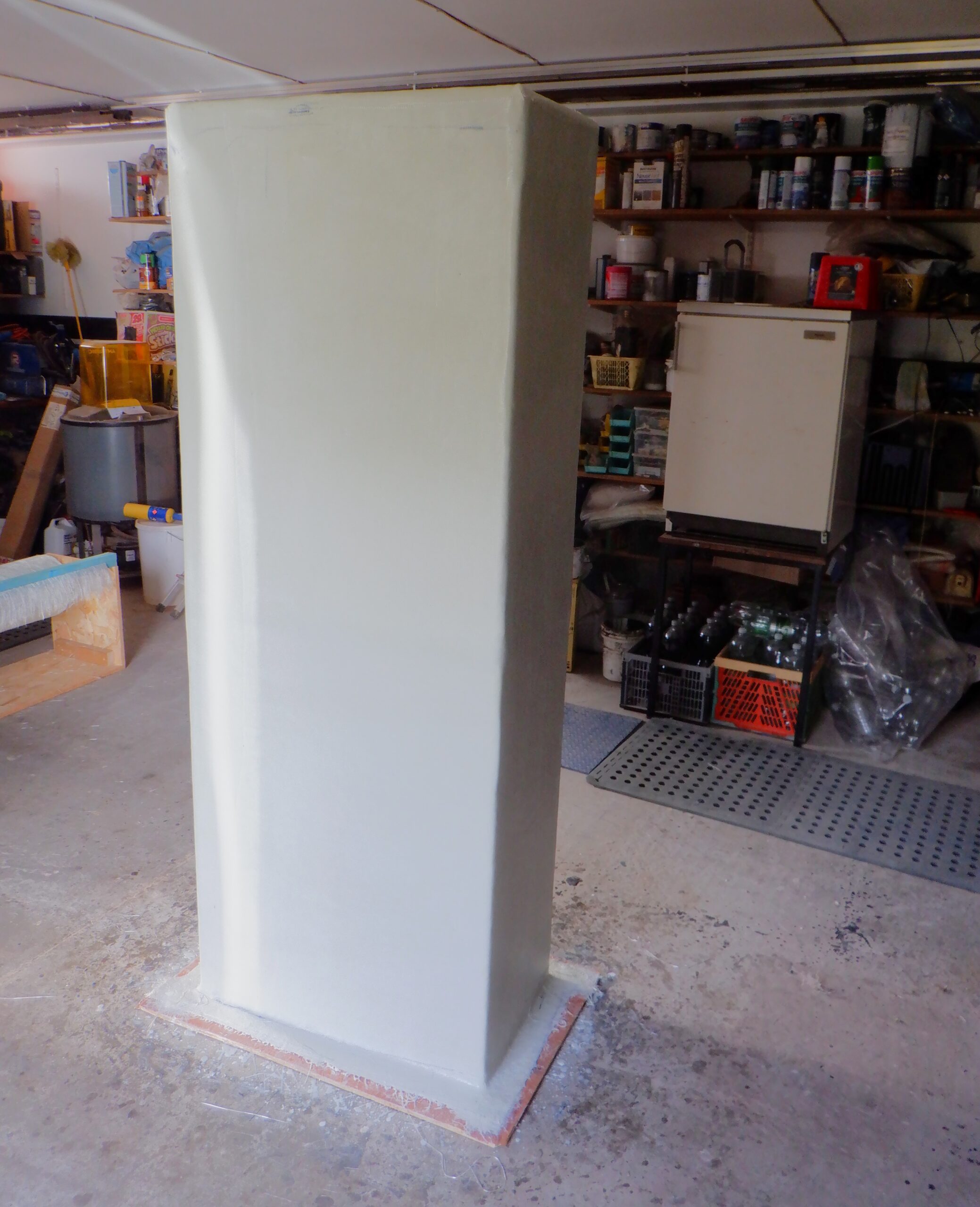
    Next, we cut all the glass fibre material into 12 pieces of 2.3metres lengths (this is being the circumference of the tank in a horizontal direction, measuring two sides of 700mm and two sides of 400mm, giving a total of 2200mm so we added an extra 100mm to be on the safe side), then we created six rectangular pieces for the base of the tank measuring 500mm wide strips off the roll, enough to cover the 400mm width of the base, but deliberately used the whole roll width of 990mm to cover the 700mm in the other direction and send the excess around the corner to reinforce the bottom 140mm of the side walls so we can install plumbing connectors and not overly stress the material too much with the very stiff plastic 32mm diameter pipes. Next, we tore off 120mm wide strips and then slice it in half down the middle and these narrow strips will go around the flange at the bottom of the mould.
    Finally, we cut a length off our woven cloth roll, ending up with two pieces measuring 1900mm long and 1550mm wide (the original cloth width). That isn’t quite enough to wrap around the tank so we then sliced off a further 1900mm piece again, but this time, we sliced the width in half to make two 750mm wide strips, to join with the other piece and make a complete loop. The last couple of pieces is for the base and we sliced a 500mm wide length off the roll and also sliced this one again in half, to make the final two pieces.We had originally put our mould on two planks of timber that had four office chair castor wheels so we could spin the mould around when we are working on it. It worked well when we were wrapping the brown parcel tapes onto the mould, but discovered that just standing up in the Garage, on the concrete floor, we actually didn’t want to keep moving it around, and instead, we would walk ourselves around the mould!! So we could off the wheels and those two planks!!

    The next job was to prepare the resin and we are going to use 25kg of the stuff, it comes in a very large bottle! But, we had our tin that had our dark brown resin in, so we poured off the small amount of that left-over resin into a small pot (we will use this resin to attempt to repair our Test Tank). We then tipped the large bottle and filled up the metal tin which holds 5kg, making it much easier to mix in the white colour we want and easier to pour small batches of resin, ready for the hardener catalyst liquid to be added and stirred in. Our white colour, which is titanium oxide powder, needed to be sieve through a old tea stainer, to knock out all the lumps and then have a small amount of resin dropped in the powder, to make a smooth paste. This vastly improves the white colour to be completely mixed into each tin load of resin, by adding several teaspoons of the white resin and thoroughly mixed in.
    Now, we can get started, fresh at the start of a new day, even starting an hour early at 9am and keep going until we have completely finished. We put on the first cloth layer by coating the whole mould with the resin and then putting on the first large piece of cloth, repainting it over again. we decided that we would try and turn it inside out so that we can maximise the amount of resin this very first layer should get. But, it proved rather difficult so we didn’t do it again to the second piece of cloth and just thoroughly coated it with lots of resin. We wanted to make sure that we had a decent starting layer of water tight glass fibre saturated in resin, especially on all the corners. We don’t want a repeat of the tiny little leak we had in our Test Tank!!
    We then started laying on the 2.3metres length of matting, doing the lower half first, and then putting on the upper half afterwards, and making sure that we put on two coats of resin every time. We repeated this twice more so we had done three layers and half way there, at which point, we consolidated all the layers and resins by using our aluminium textured roller, which is designed to pressurised the individual glass fibre strands and mix the resin completely together, going carefully around each of the corners and edges.
    We put on the last three layers of matting and finally, put on the second layer of the woven cloth to finish off.
    We were working for nearly 7 hours non-stop !!

    Header Tank All made

    Header Tank All made


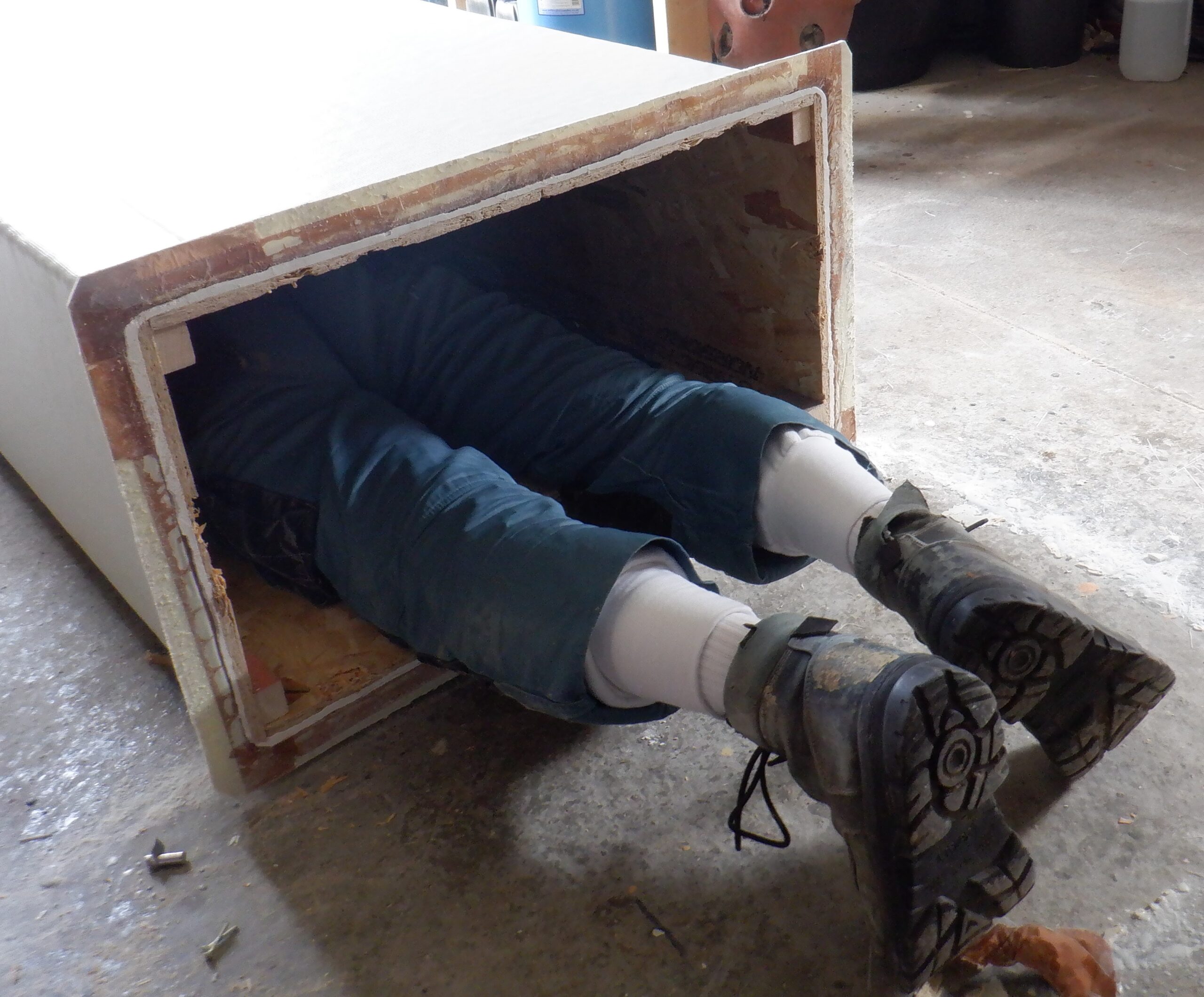
    We left it overnight, to allow it to cure and harden the resin as much as possible, before we tackled the next task of removing the wooden mould from inside the freshly made tank. The first job was to carefully trim the flange so that it is an even amount all the way around the whole tank, by using our wiggle saw and a chunk of CLS timber to act as a spacer guide. Then we carefully lay the tank on its side and prop it up on a couple of wooden planks so the weight wasn’t resting on our new flange after we had removed the first part of the mould. The “lid” came off and we needed to crawl inside to undo all the screws, to release the four sides from each other and make it easier to bend each side inwards and then remove.
    Shaun undoing mould fixings

    Shaun undoing mould fixings


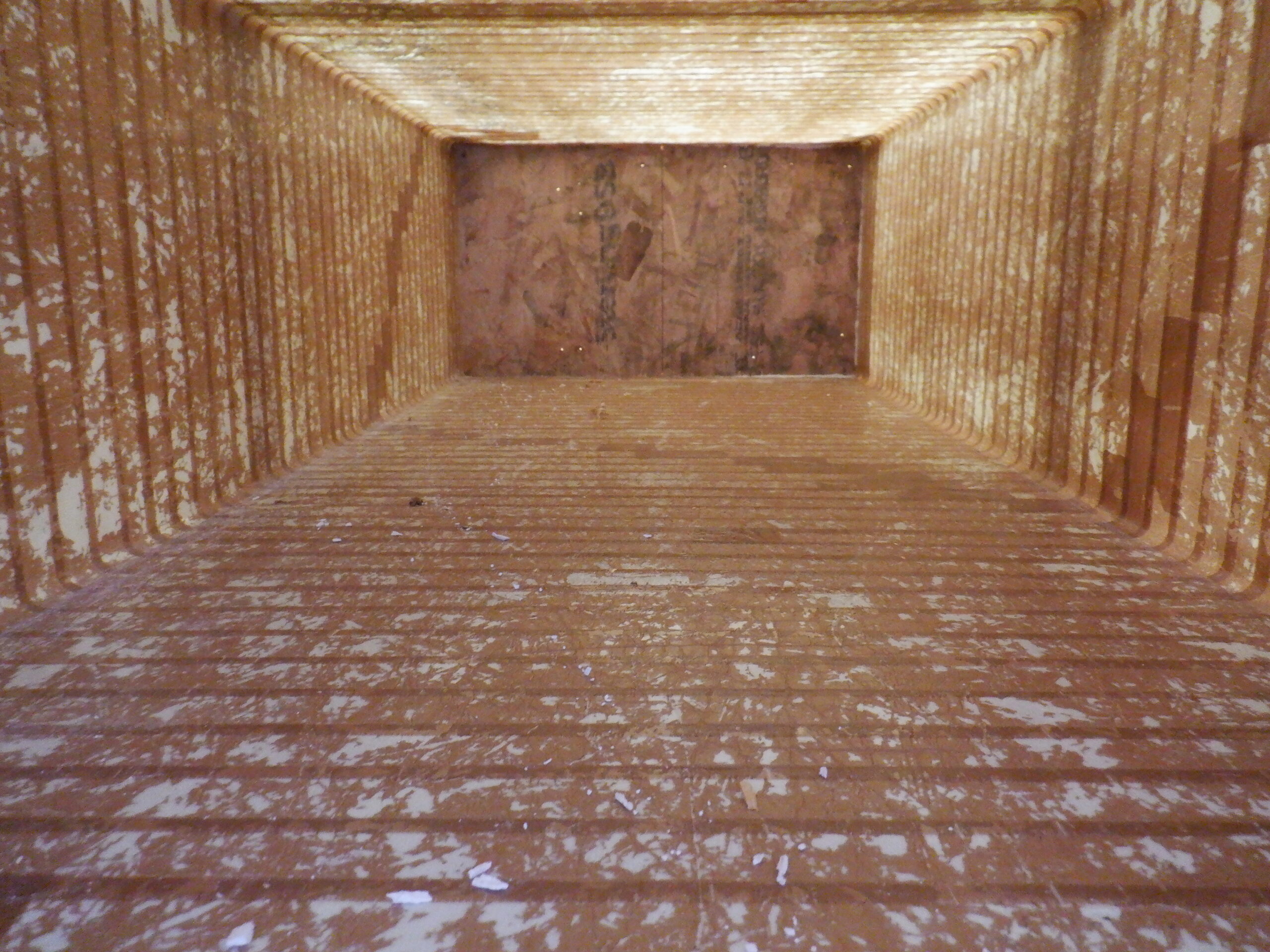
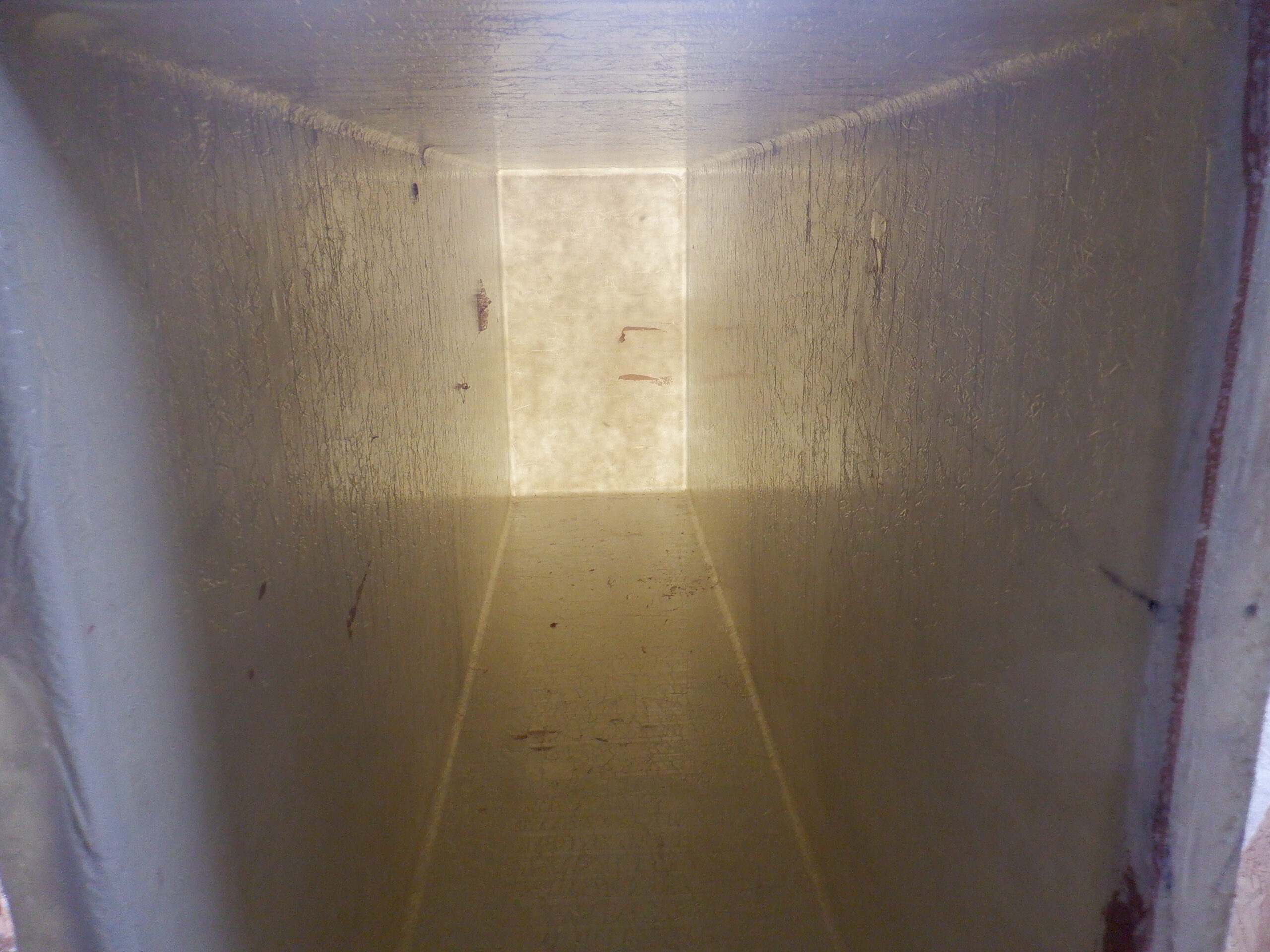
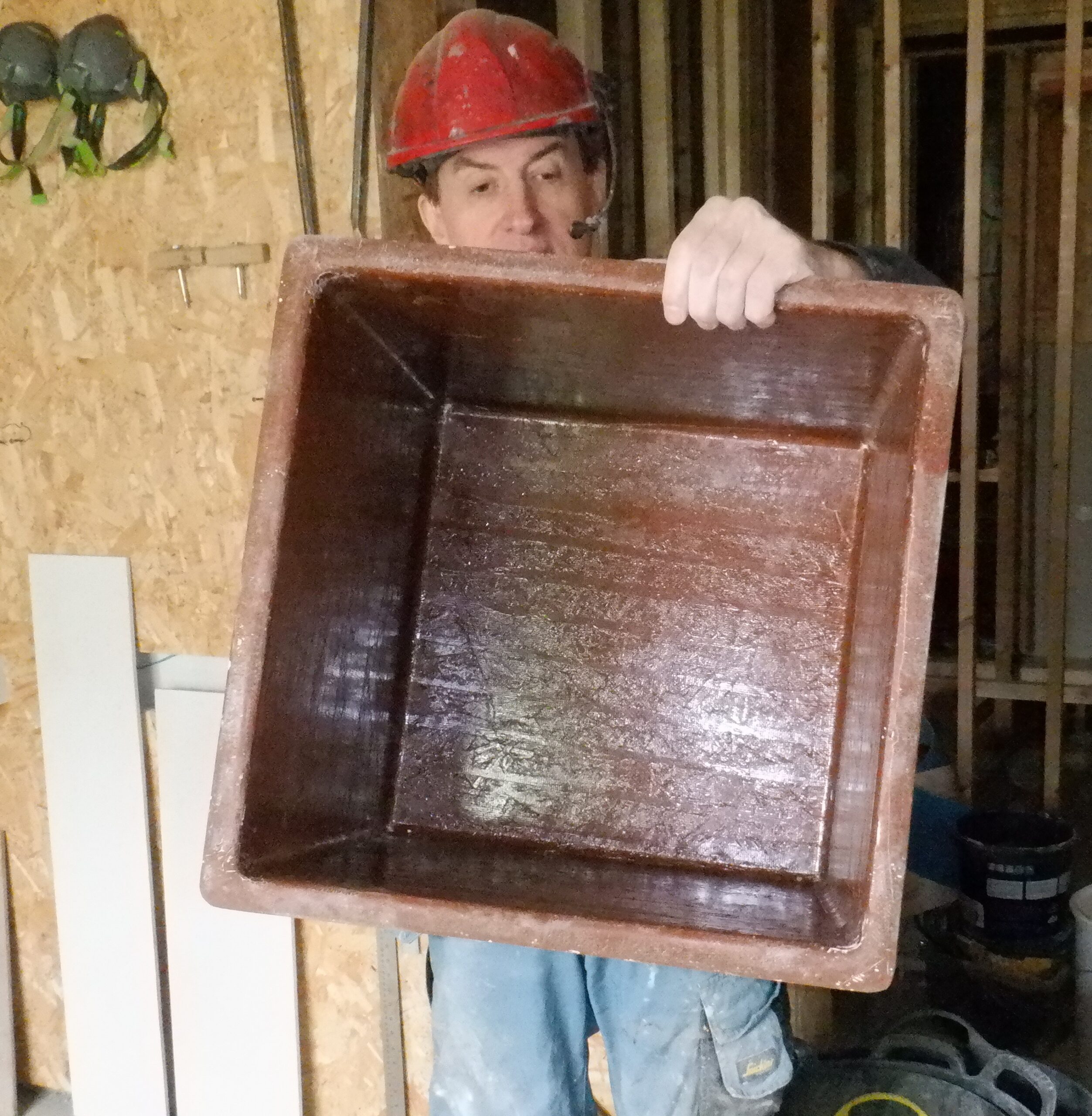
    We managed to get the four long sides out fairly easily but we discovered that the sticky parcel tape has gone extra sticky for some reason. This meant that we had to crawl across this yukky tacky surface to get to the bottom final piece of the mould and dig it out. Mind you, we had to wait five minutes first, to blow away all the fumes of the solvent. We used a fan. This perhaps gives us a clue to why the sticky tape has gone extra sticky because the solvent was able to migrate through the thin plastic film of the parcel tape. Anyway, we managed to dig out the bottom section of the mould and were able to peal the majority of the stick tape off, by starting at the bottom of the tank and pulling it out like a sleeve. We discovered that our tank is translucence and it glowed in the sunshine !!
    Tape stuck to the inside

    Tape stuck to the inside

    But it came off fairly easyly

    But it came off fairly easyly


    The problem with the extra stickiness was extended to the resin finish as well and we needed to leave it open, with fresh air blowing on it, for three or four days over the weekend, before most of the sticky tackiness had disappeared.

    The whole tank got a bit of a rub with sandpaper, to take off any sharp edges and glass fibres that didn’t settle down during the last coat of resin. The flange got its four corners rounded and the sharp edge smoothed over as well.

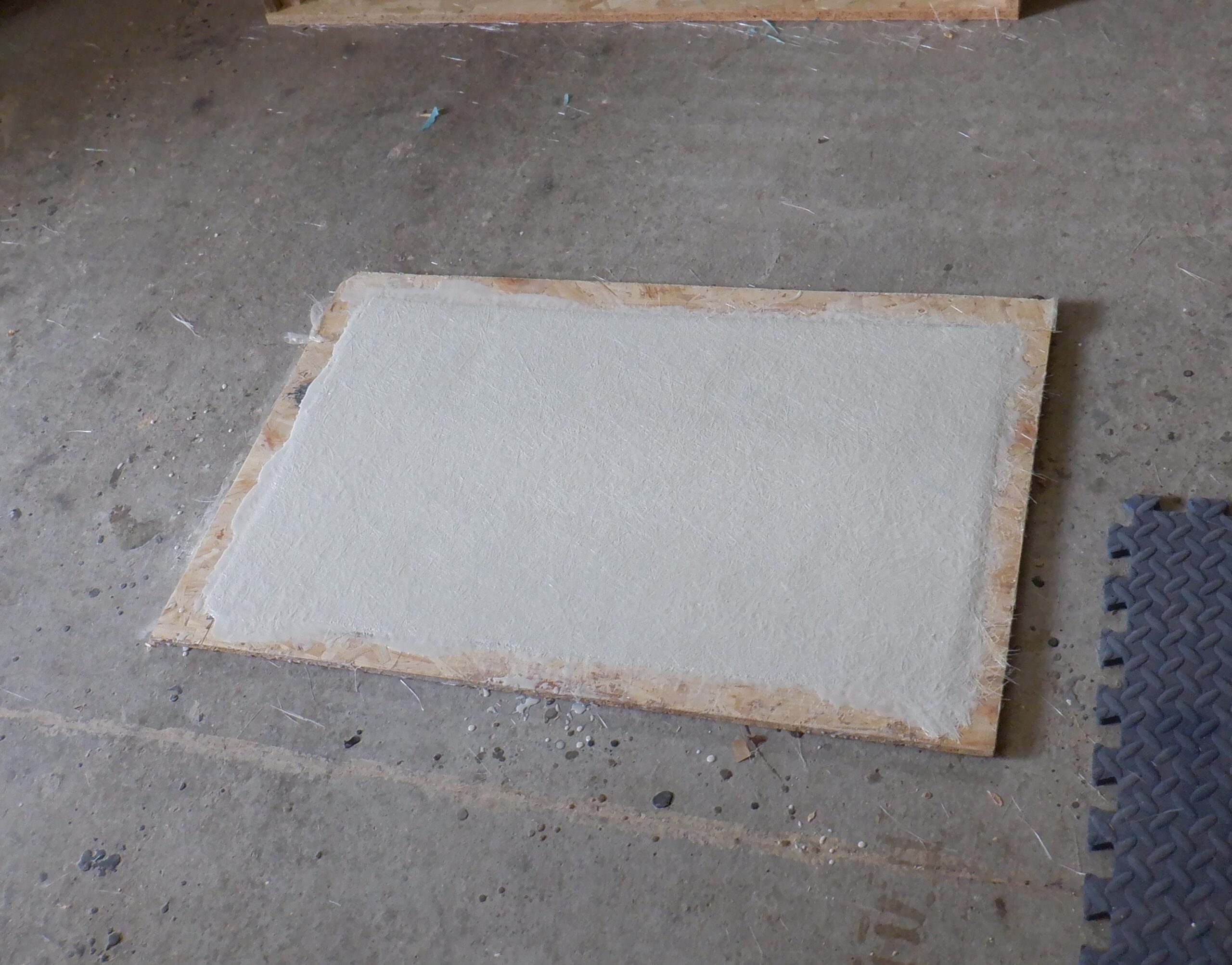
    In the meantime, we took the original base that the mould sat on, reapplied more sticky tape but this time using the clear parcel tape instead for a comparison test and made a four layer matting with the same white resin flat across the board. It came off much easier, without leaving behind this sticky stuff so it looks like that the parcel tape is too thin to give the best results. So we have made our lid for this Header Tank, so that we can keep out the dust and dirt. It will be clamped down using wing nuts, on a sandwich of rubber draught excluder strips, to provide that seal.

    Cold Water tank lid laminated

    Cold Water tank lid laminated


    That concludes the construction of the Header Tank, we are waiting for plumbing bits and pieces to arrive before we can perform a soak test and find out if we got any leaks. This tank will hold a maximum of 500litres and that weighs half a ton !! So we WILL not be tipping it over, out of our garage door to empty it!! We Do Not want a tidal wave gushing across our driveway!! Hence why we have been waiting for our plumbing order to arrive, with a tank connector and a shut-off valve so we can empty it the old fashion way! In fact, we will take the opportunity to try out our water pump motor and see how it performs and how noisy it is as well.

  • Creation of Test Tank

    We are at the stage of designing and building our water tanks, one cold and one hot. Because, we have a limited target volume to locate these tanks, we decided to make our own tanks, using glass fibre and polyester resin. We have used this kind of construction material a number of times before so we calculated the amount of material we would have to buy, in order to build the three tanks we are wanting. But first, we needed to make sure that it works out properly so we are doing a Test Tank first. Actually, it will become a plant pot for a tree that came at Christmas time!
    It will also be part of a boiling water test as well because we need to make sure that our hot water tank will hold the hot water without softening the walls.
    So we ordered 33kg of glass fibre matting, 35kg of ‘normal’ resin and 30kg of ‘special’ heat and chemical resistant resin, plus also 20metres of woven glass cloth as well.
    The Test Tank measures 450mm on a side, making a cube. We want to have a lip around the top so we can see how well it forms, ready for a lid to seal down on it, on our larger tank later on. The Test Tank won’t have a lid.
    So we need a mould, to take the eight layers of matting and two layers of cloth, to make a wall thickness in the order of 5mm thick.
    This mould will have to be constructed in such a way, that it can be disassembled afterwards, as the completed tank will be solid and sticking to the mould.
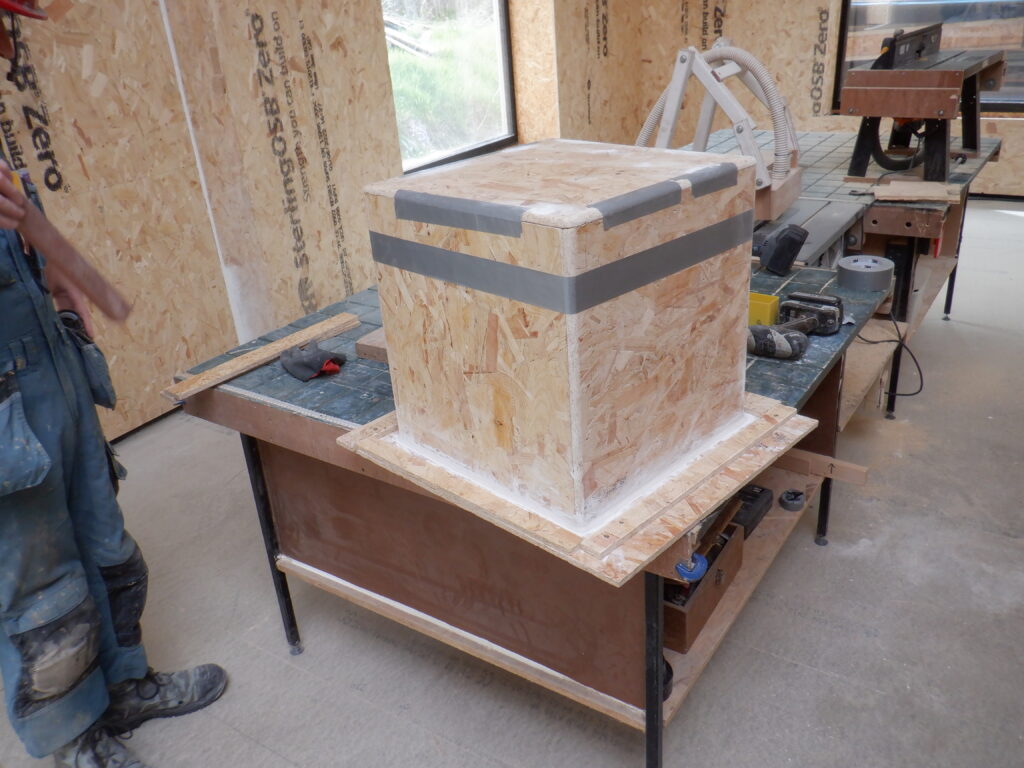
    So we used sheets of 11mm OSB boards, sliced it up into four sides and one base. Two of the sides were slightly narrower so that the overall dimensions came out the same on all four sides. Also, these two narrow sides had a saw cut sliced almost all the way through the 11mm thickness, to make it much easier to drive a crowbar into the gap between the finish tank and the mould and be able to bend the sides inwards. We did the same for the base as well. We then screwed little battens around the edges to hold the corner edges together, but done in such a way so that the pre-cut sides can move inwards. It was a careful process of making sure that we could ?undo? the mould, in the correct order.
    Finally, we put on a larger ?lid? on the mould so, when the mould was turned over to sit on this so-called lid, we had a space to form the lip of the tank as well. We rounded all the edges using a 12mm quarter turn shaped router and also applied a little bit of plaster to provide a gentle bend for the lip too.
    Box mould constructed

    Box mould constructed


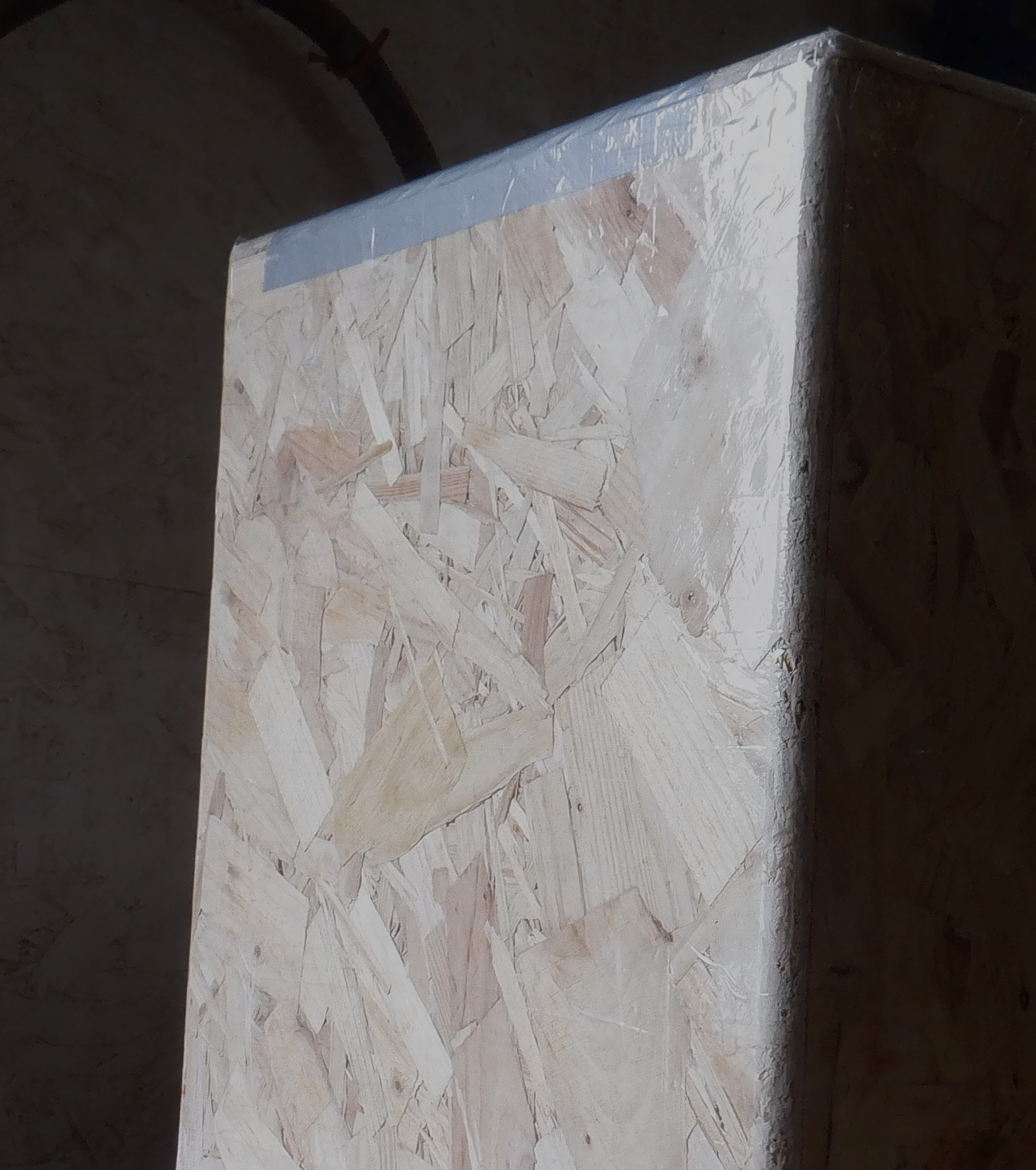
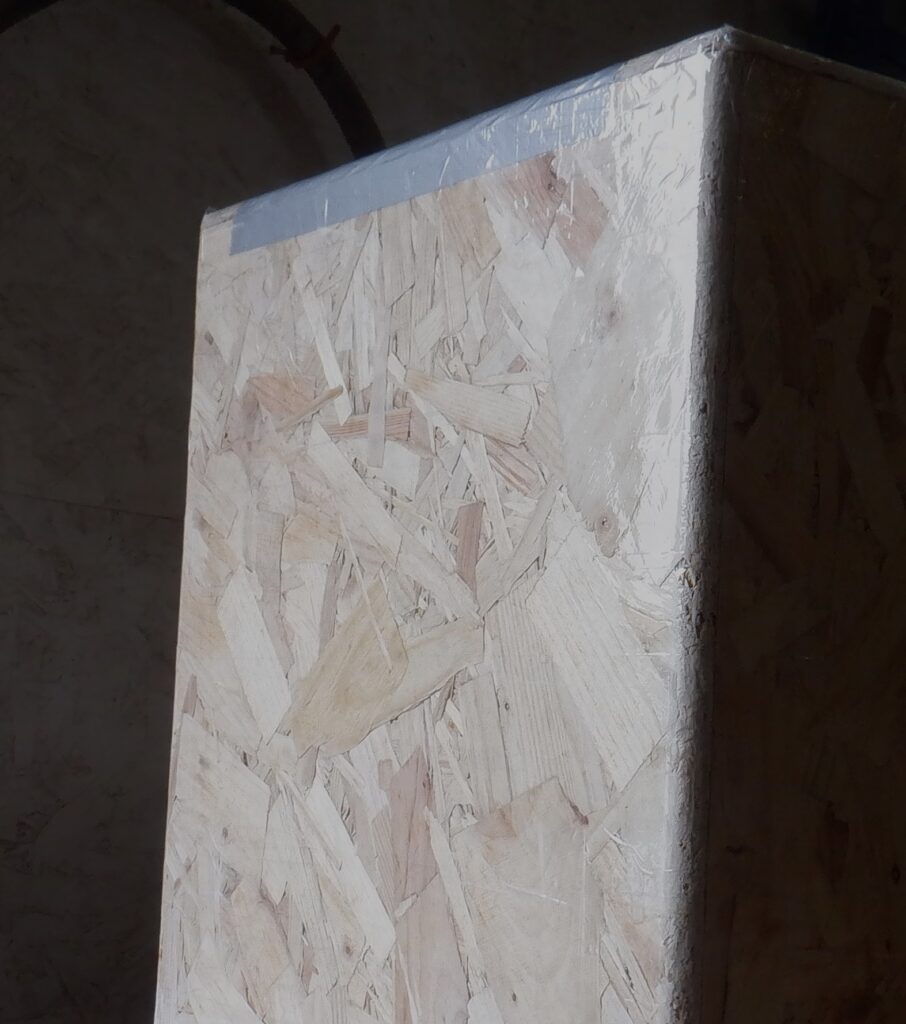
    Now, we wrapped all over the mould a complete layer of parcel sticky tape because we discovered that the parcel tape offers a very very non-stick surface against the polyester resin. We did some quick test using various grades of sticky tapes, as well as some very thin plastic film material and this is how we discovered that standard parcel tapes works the best.
    So this is what we did with our Test Tank, wrapped it up in this sticky tape. Mind you, we only had the ‘clear’ sticky tape and it was quite difficult to see where we have been or not. So, we ordered the brown stuff !!
    Covered in tape

    Covered in tape


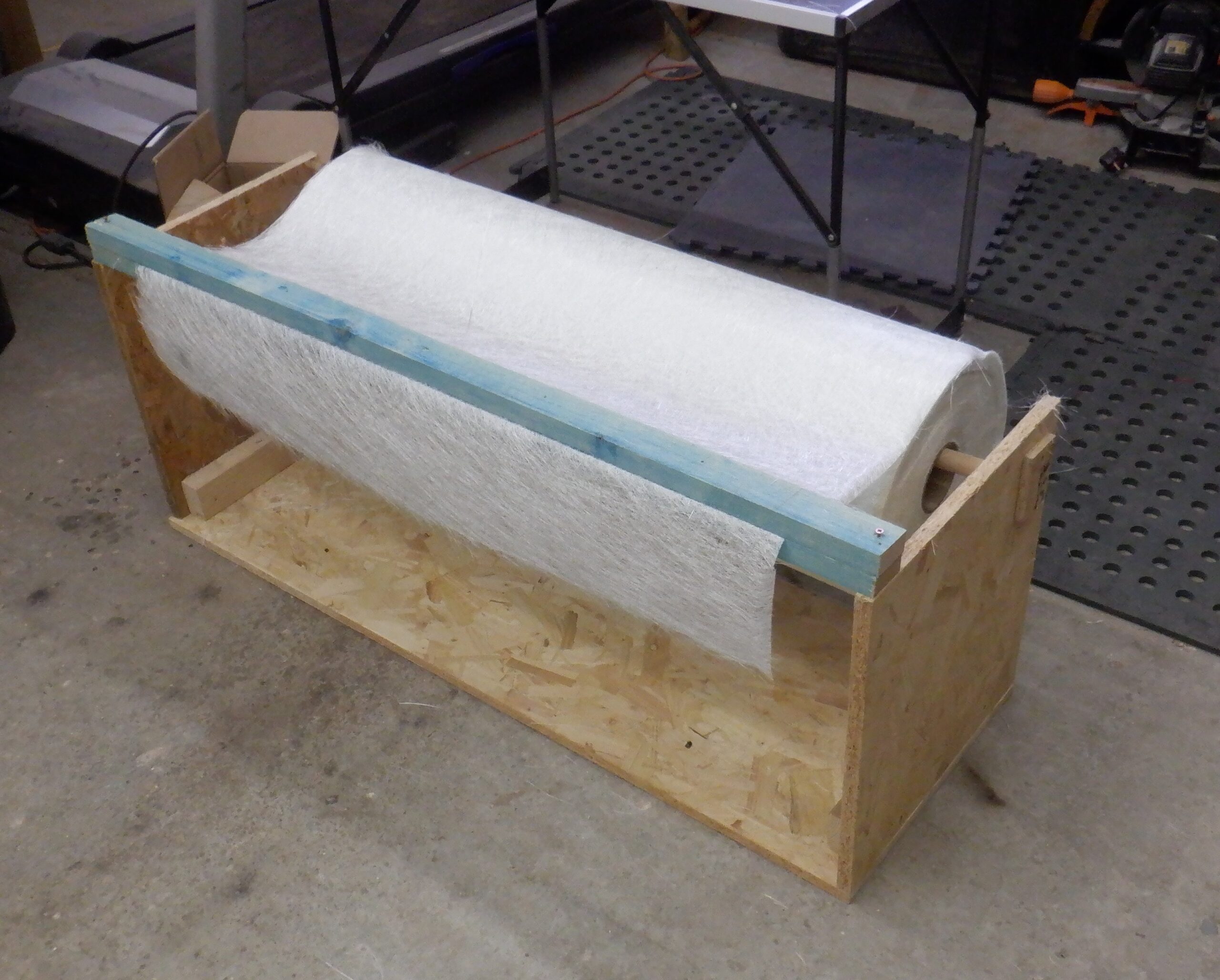
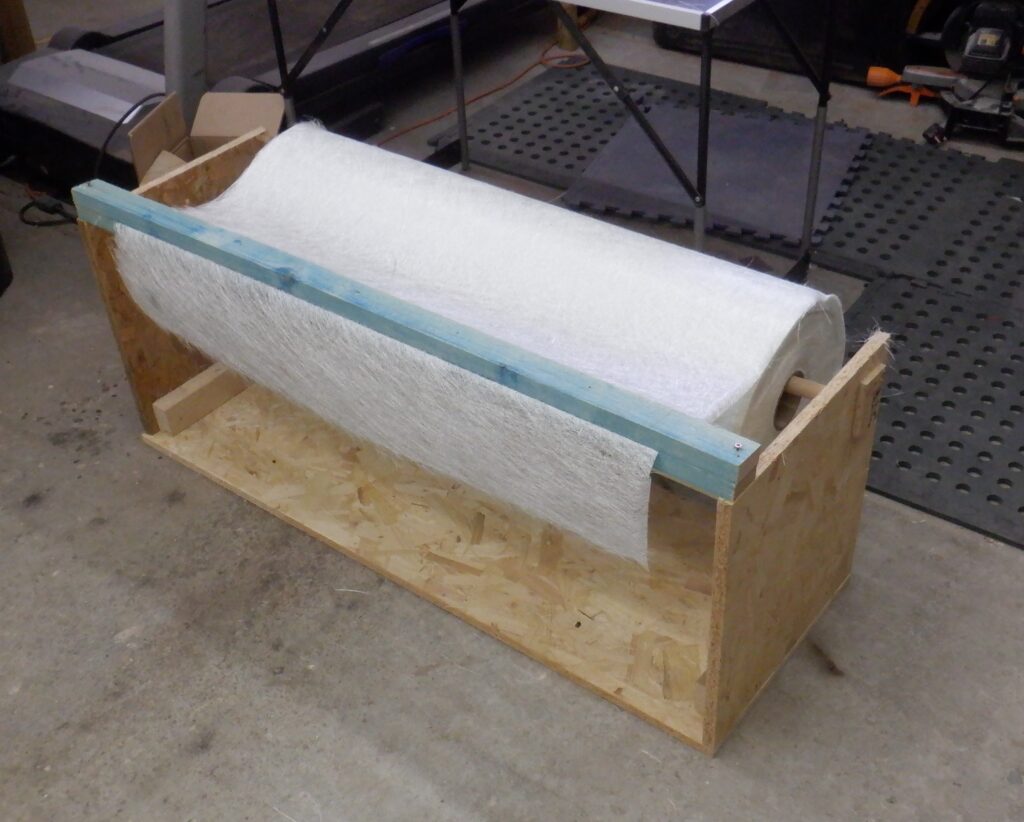
    Next, is to prepare the glass fibre and have them ready, in a pile of torn pieces. But, before that, the 33kg roll of matting needed a carrier so we could pull off the roll the required length. We quickly assembled a wooden carrier using left-over OSB 18mm pieces and a length of broom handle (we had some left-over of those too from a previous project, so we didn’t have to use a domestic broom!)
    The roll is a metre wide so the carrier is 1200mm wide, with a two battens loosely sandwiched together at the top, for the glass fibre matting to slide in between. This allows us to press down on the upper batten and grip the glass fibre and tear pieces off.
    33Kg of Glass fibre Mat

    33Kg of Glass fibre Mat


    So we tore off twelve pieces measuring 450mm long, and four pieces of 900mm long. These form the bulk of the walls but we wanted to put an initial layer of the woven cloth on the mould first so that this offers the maximum strength bending around the corners of the tank. We unrolled the cloth and cut a single piece 1350mm by 1000mm long. Then, we draped it over the mould and carefully cut the overlapping folds, to remove the triangles so the cloth would lay down flat.
    We did a second one so we could put that cloth piece on as the final layer, to encapsulate all the strands of glass fibre that comes in each matting sheet. These matting sheets are made up of a random sprinkling of 50mm long glass fibre strands, held together with a very light glue that will instantly dissolve when the resin is applied.At this stage, we decided to put in colouring dye into the resin so we went for a muddy brown colour by mixing four teaspoons of red powder and four teaspoons of blue powder dye and this made a muddy brown colour, suitable for being a flower pot !
    The final steps of preparations, was to get several pots of acetone ready for cleaning our rollers and other tools, a pile of paper wipes and a collection of mixing trays etc.
    So, we started at 11:25am and mixed our first batch of resin with the hardener, using 1% ratio of hardener so we had plenty of time to apply the mixture before it started setting. The garage temperature was about 15°C so 1% will give us a good 30 to 40 minutes of handling time.
    We coated the mould with the brown resin, using a fluffy roller to transfer the liquid over, and then draped the cloth over. We slid the cloth around and made sure that it went from edge to edge and that the two sides folded in and overlapped properly. Then, we rolled on more resin liquid until the cloth was entirely coated in resin. Then, we got our four larger pieces of matting, and one by one, laid each over the mould, tearing one edge so that it can rotate around the mould and the loose flap goes over the top. We put plenty of resin all over the surfaces. We used the aluminium roller to work the resin liquid into the individual strands of glass fibre, and also, to force out any trapped air.
    Next, we took the narrower strips and went horizontally around the mould, repeating the process of loading lots of resin on each piece of matting and eventually, we put on a total of eight layers. We also put on the second woven cloth material near the end of the process.
    It took us two hours to do this Test Tank.
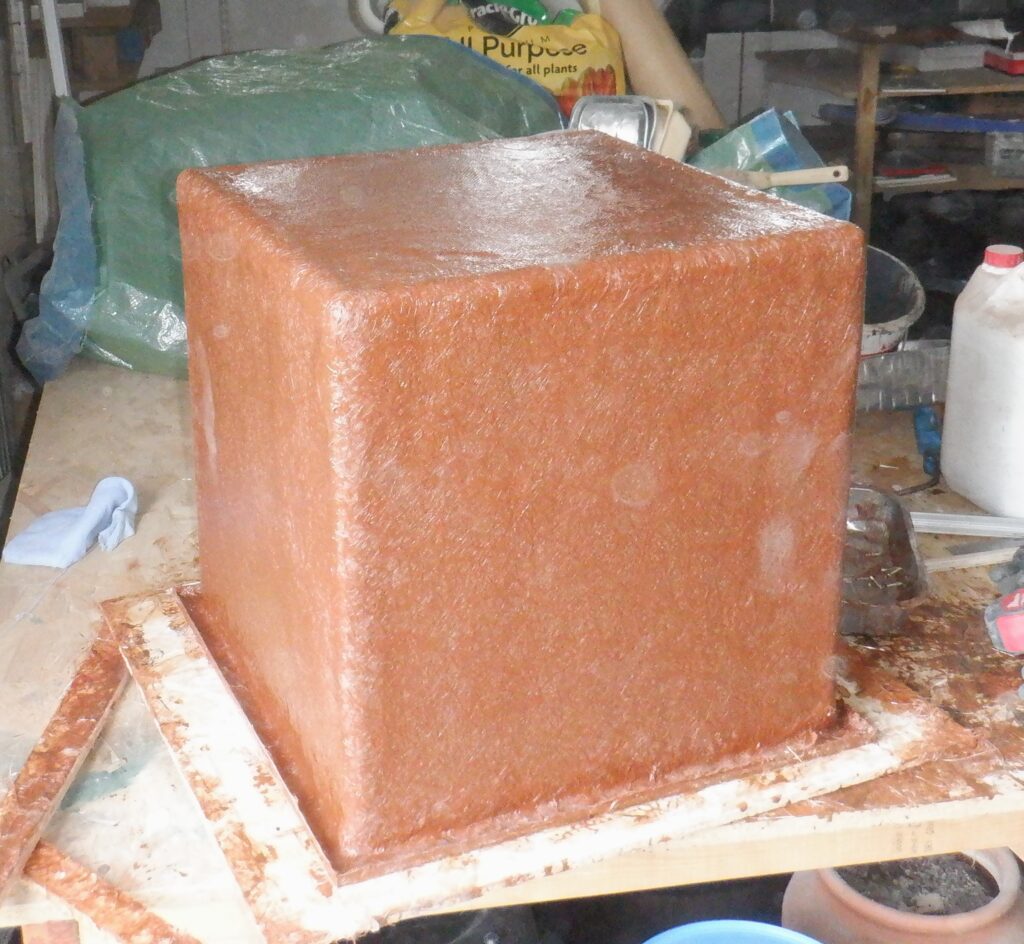
    Test box fibreglassed

    Test box fibreglassed


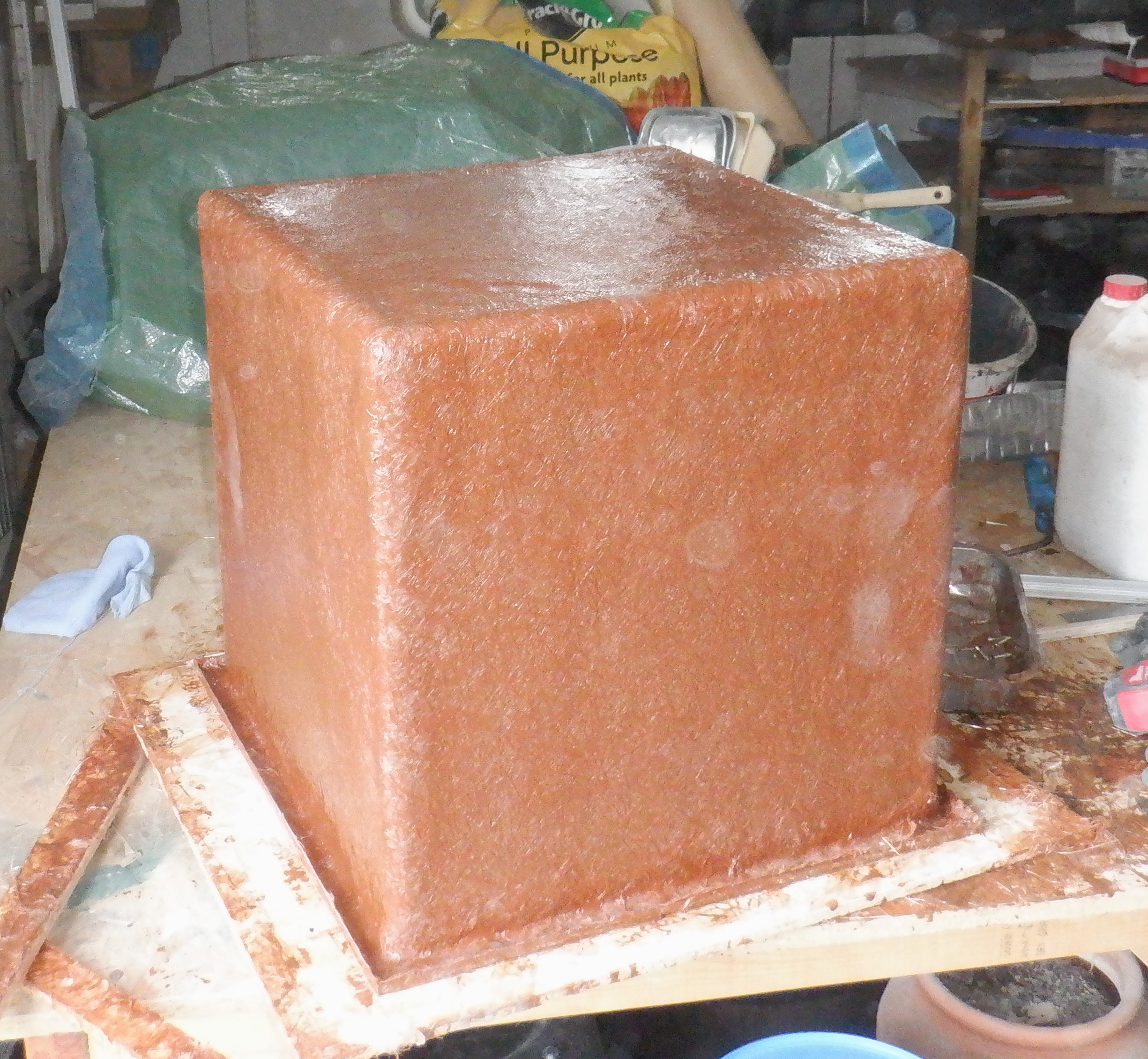
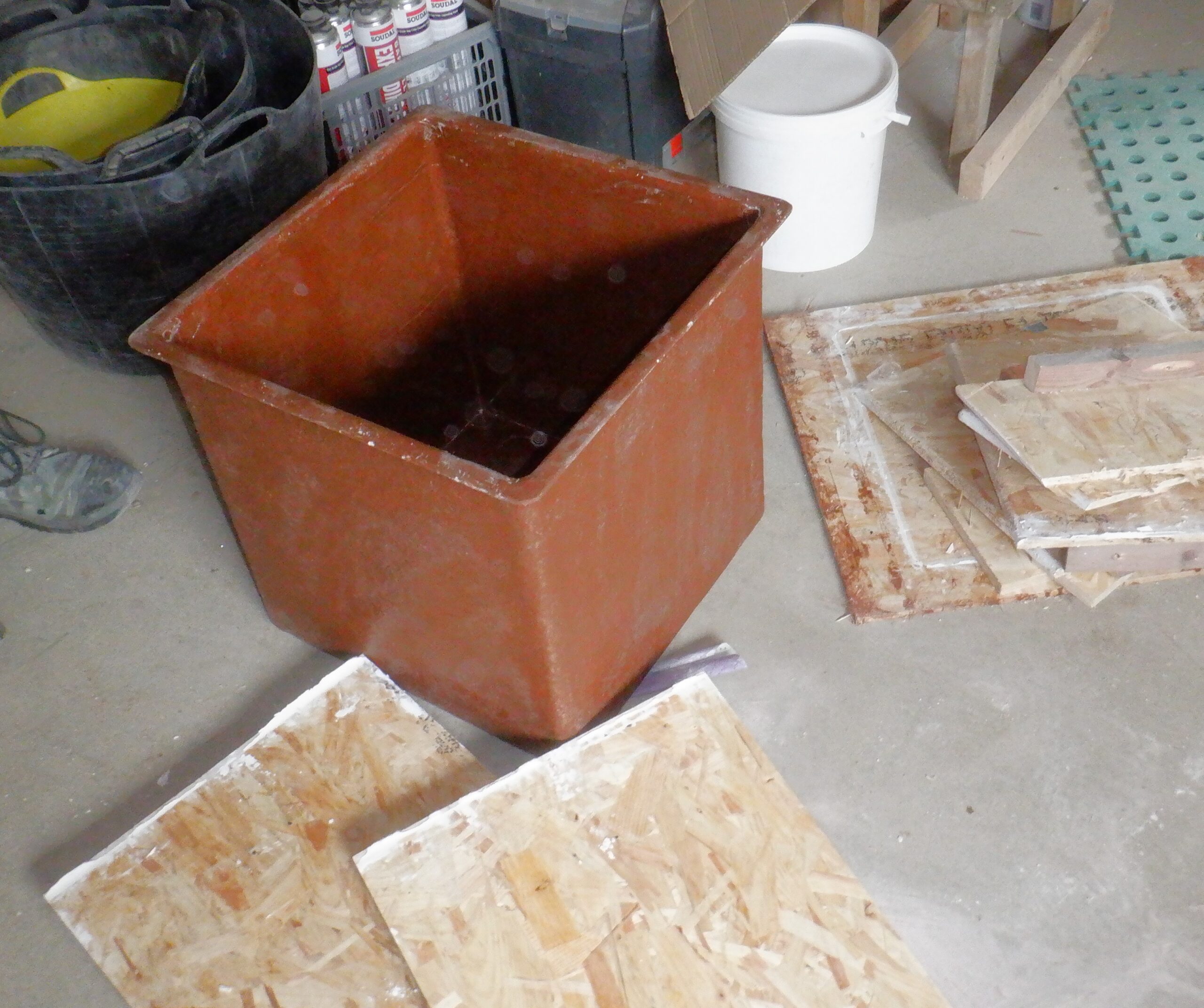
    We gave it a couple of days (over the weekend) for the resin to cure and harden before we tackled the task of dismantling the internal mould and generally, it was not too difficult. We unscrewed various screws and then used a crowbar to lever the two side walls that had the ?almost? cuts in them and this then allowed the other two walls to come out and finally, we got the crowbar into the cut line in the base and managed to lever each half out. Then, we pulled off the parcel sticky tape which got left behind on the inside of the finished tank, it looks like that the resin had quite an attraction to the glossy side of the parcel tapes, more than the sticky attraction to the wooden surfaces anyway. It wasn’t a problem as we could peel off the tape fairly easily, leaving behind a brown cubic reinforced glass fibre plastic tank. It needed a bit of trimming around the lip because we had a ‘dam’ to make the lip flange, but it ended up with too much glass fibre and resin. So, we just laid down a small piece of 6mm thick MDF board on the floor and, positioned up to the edge of the flange (the tank is upside down) and used our wiggle saw to slice off the lumpy bits.
    We also ran the sand paper over the surfaces, to rub down little spikes of resin and fibre and also rubbed the edge to round the corners and the square edge.
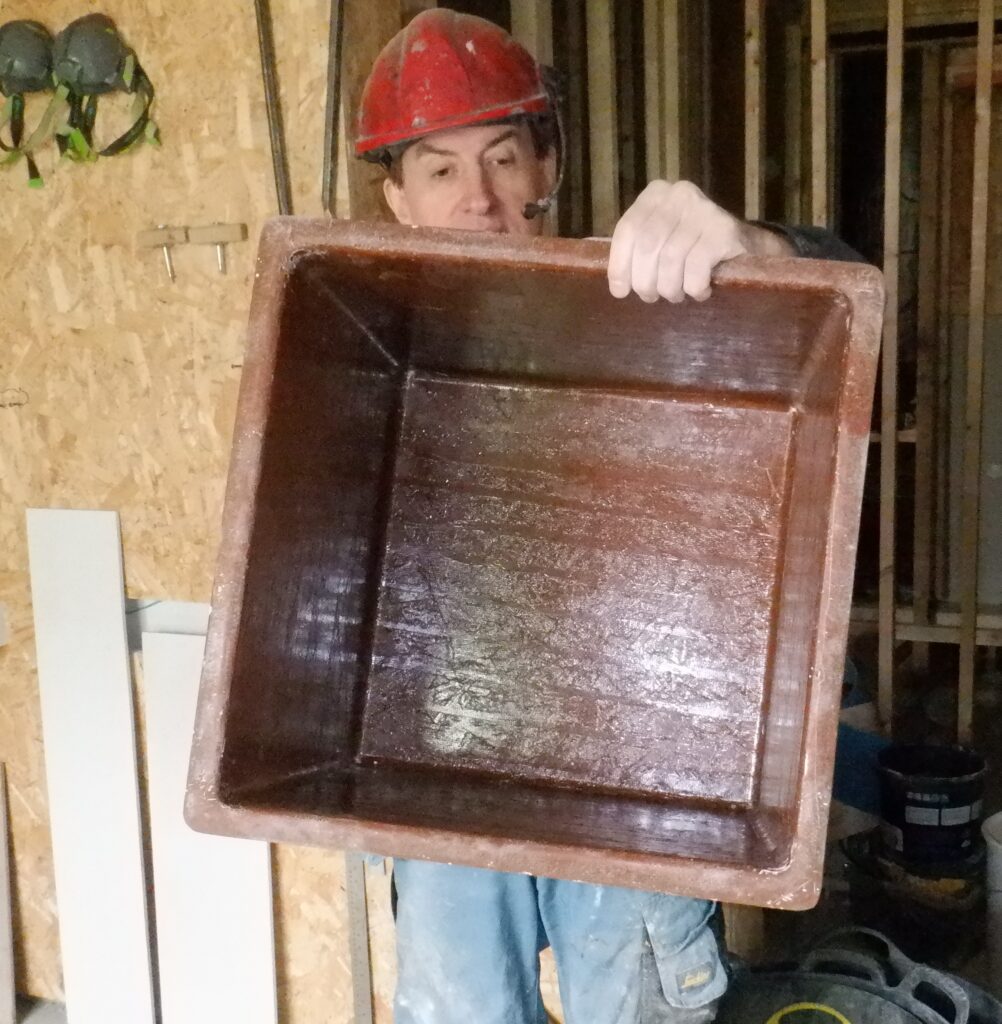
    Test tank demoulded
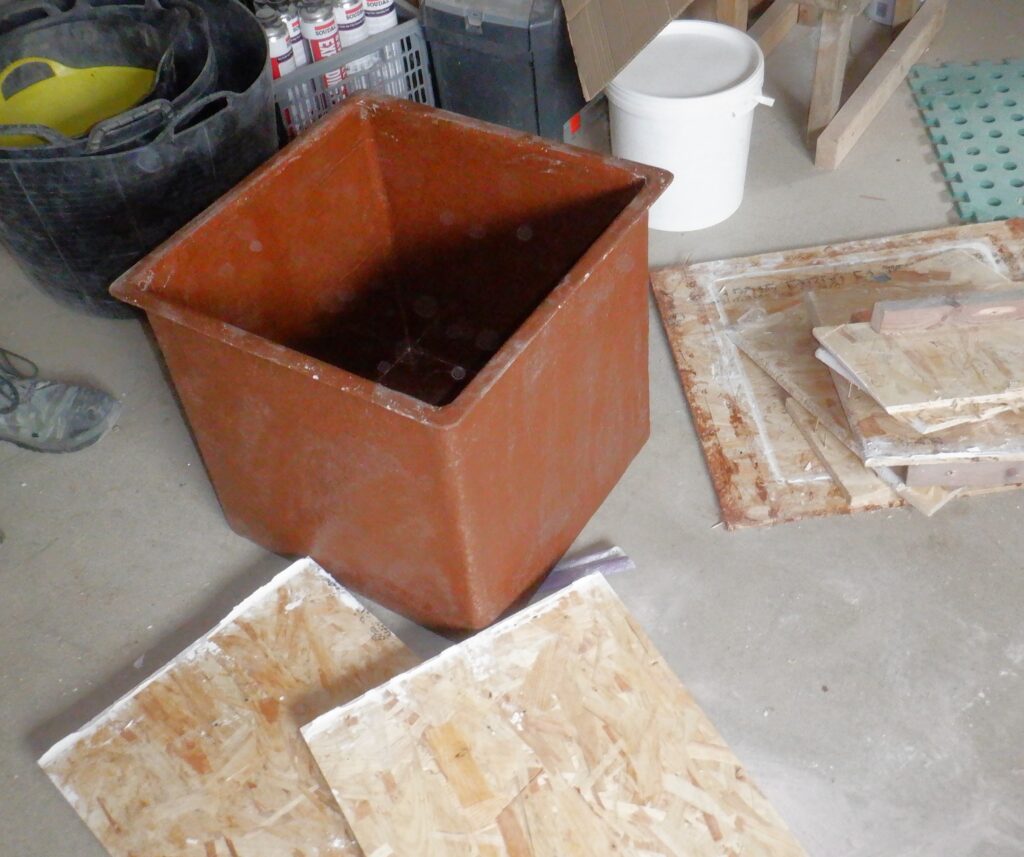
    Test tank demoulded

    Test Tank

    Test Tank


    The final stage of this test, is to put in water, both cold and hot water, and see if it holds it without leaking.
    This Test Tank holds about 90 litres so we got the garden hose and filled it almost to the top and sat it in our Garage and left it for a few hours while we got on in making the next mould for the larger header tank.
    Unfortunately, we had a leak!!
    A very very small one! But still a leak!
    It is amazing to how water can get through 10 layers of glass fibre and resin. The leak is actually on one of the rounded bottom edges and we believe that we were not careful enough in making sure that these rounded edges were carefully loaded with extra resin, to make sure even those fibres are saturated.
    We learnt a valuable lesson and this is what this Test Tank revealed to us!
    We will have to patch the leak before we can perform the hot water test and we will do that later on.
  • Service trench completed

    Service trench completed

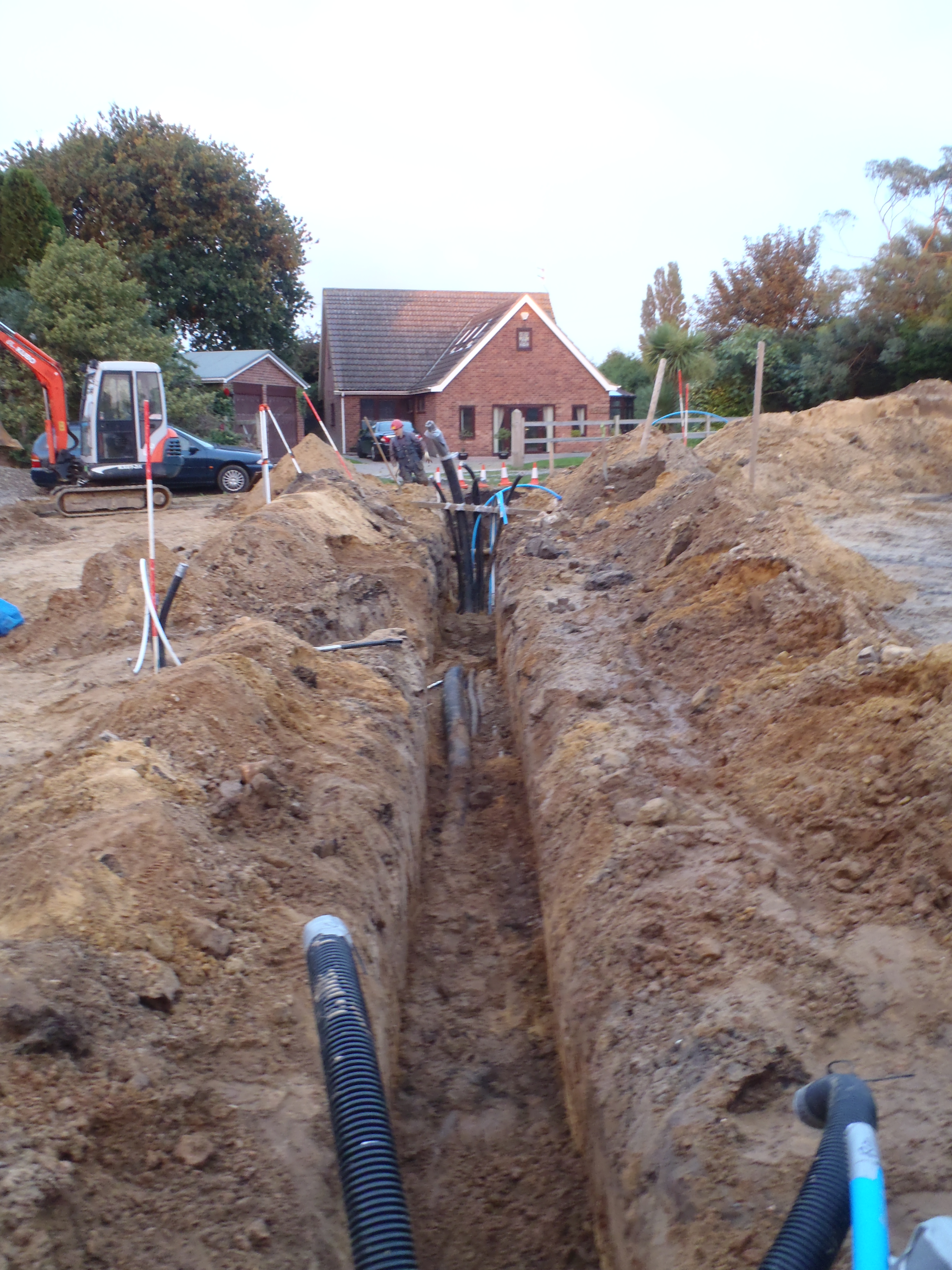
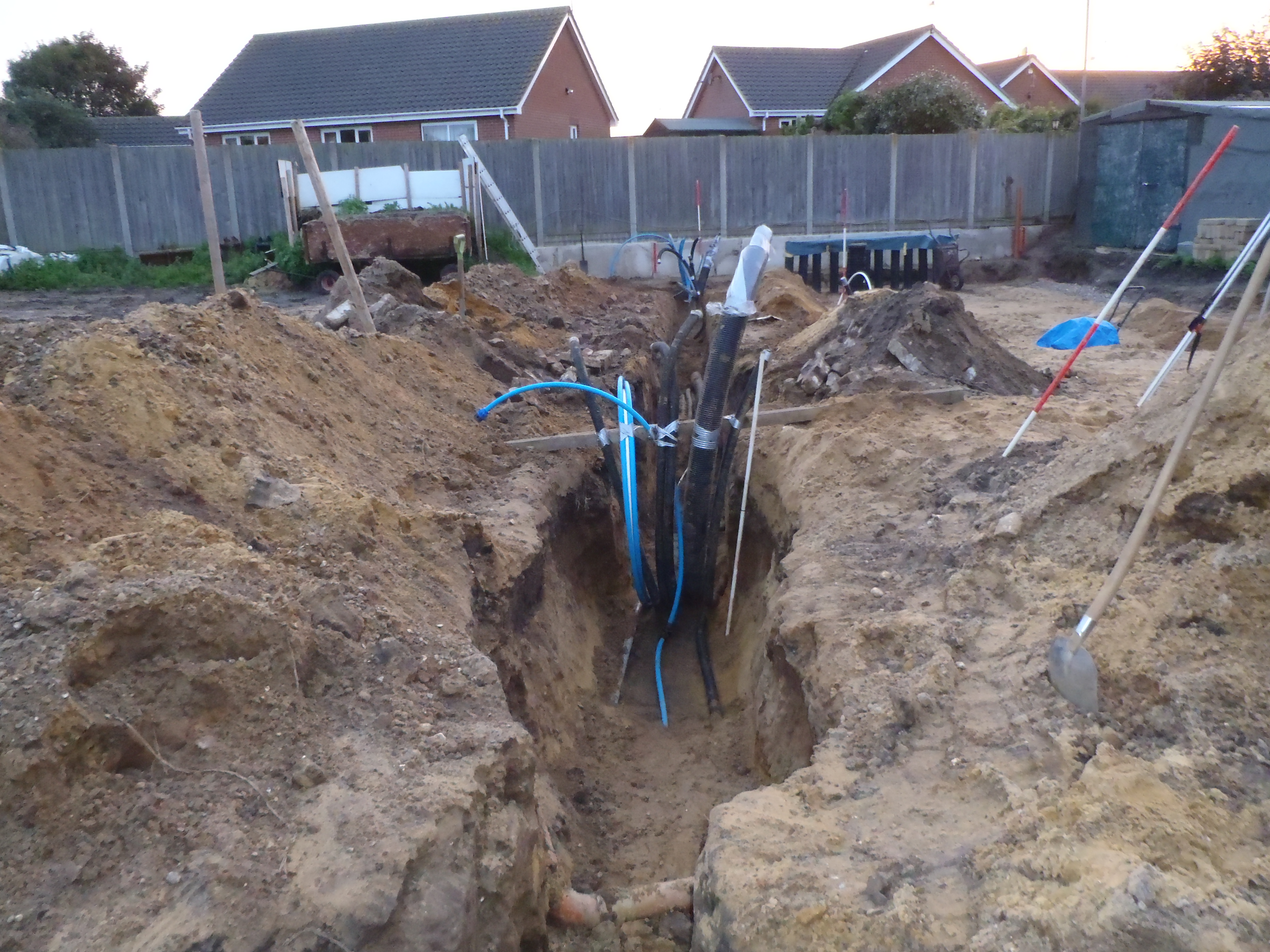
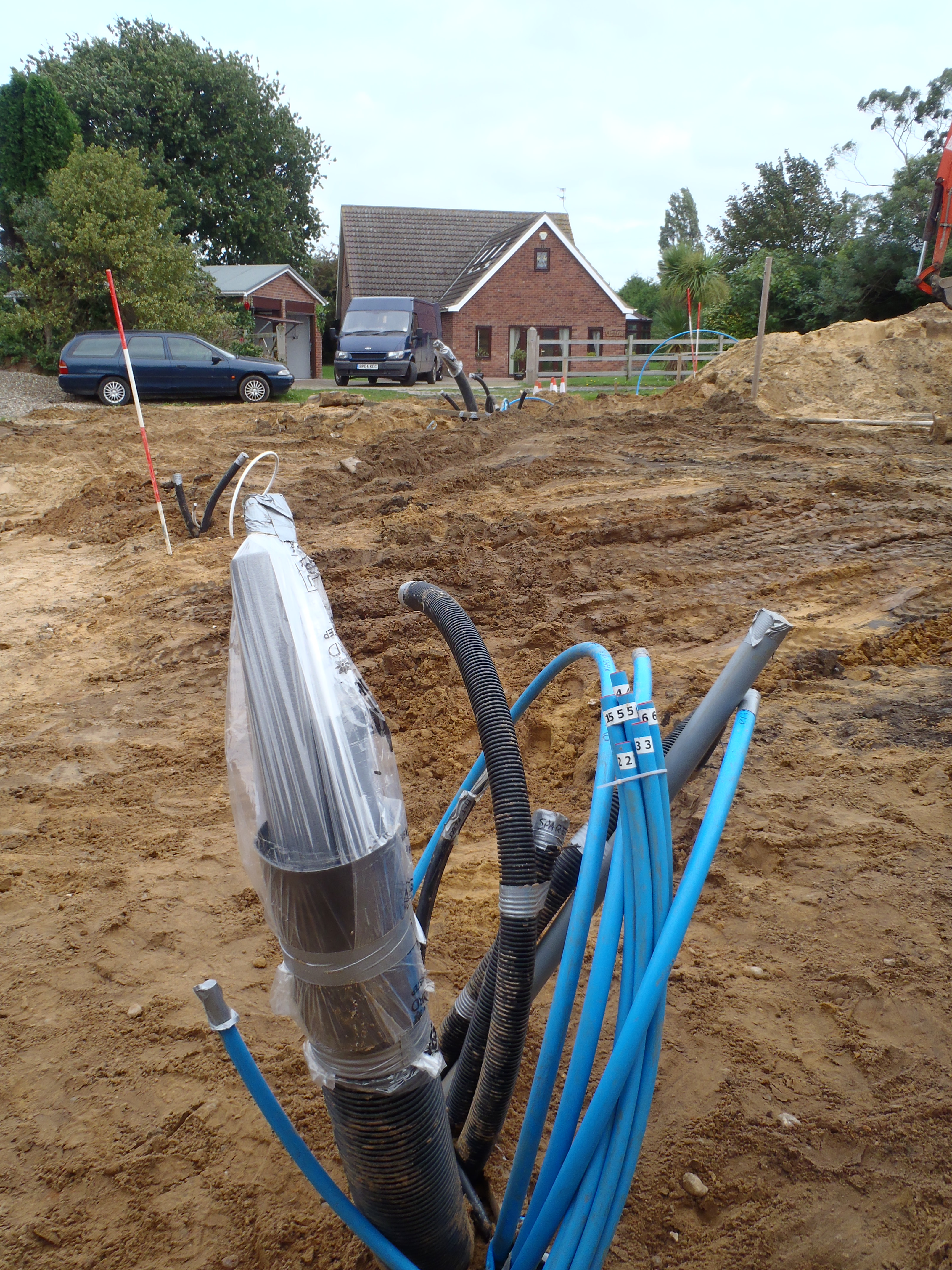
    Thursday 30th

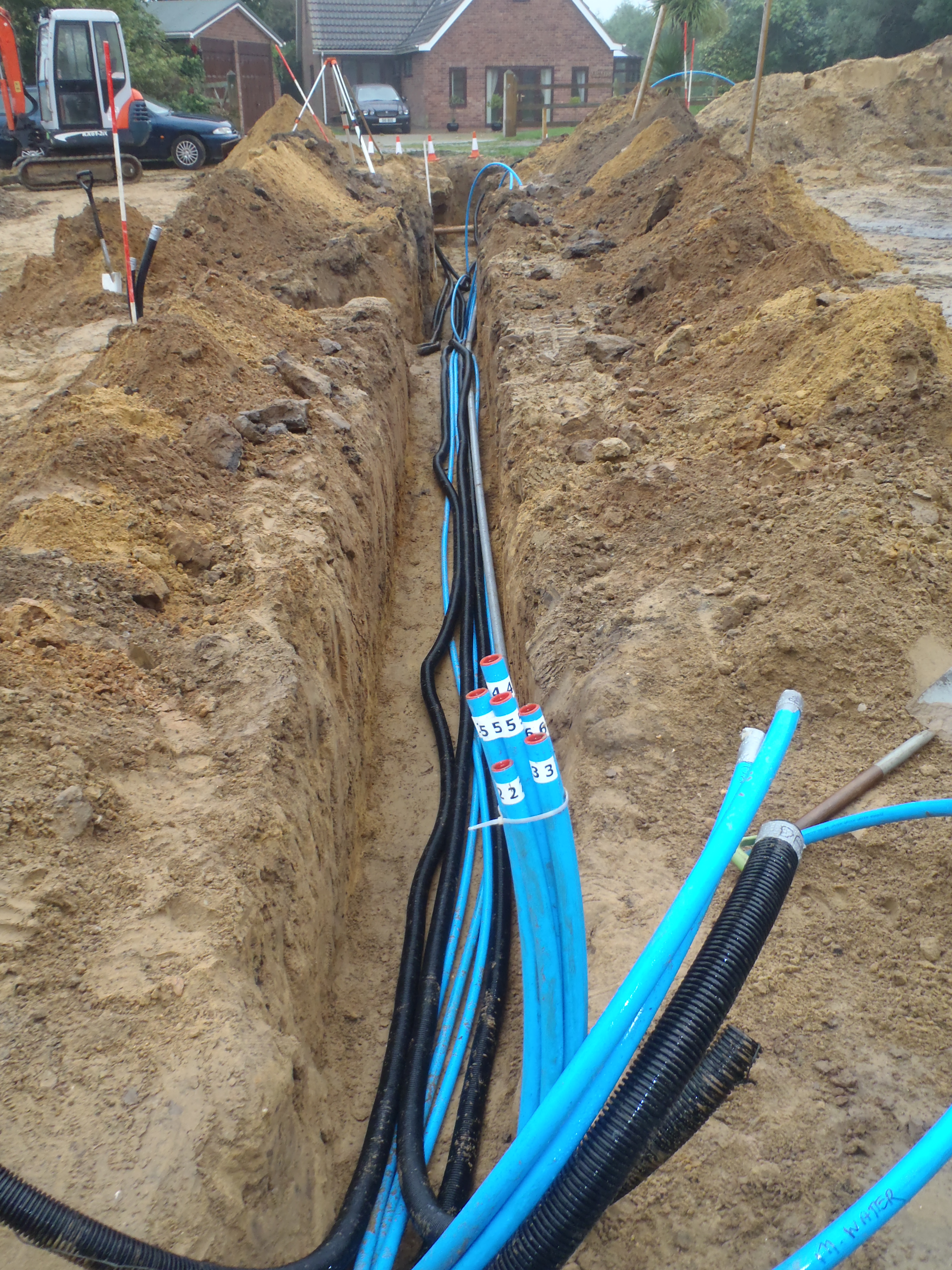
    Installed all the pipes and conduits into the trench after sliding 2 x 22mm plastic plumbing pipe with foam insulation (25mm on flow and 19mm on return) into the large conduit (tried insulating with rockwool and gave it up as a bad job!).

    Service Trench All conduits in place

    They are from left to right :- Data, rainwater1, compressed air, rainwater2, mains water, central vac, spare, solar water & electricity.

    Friday 1st Oct

    Started by filling trench to approx 300mm above conduits then placed warning tapes (100mm wide polythene printed with warning messages about water & electricity below) along the trench. We then filled the trench to the top.

    Service Trench Filled

  • Service trench

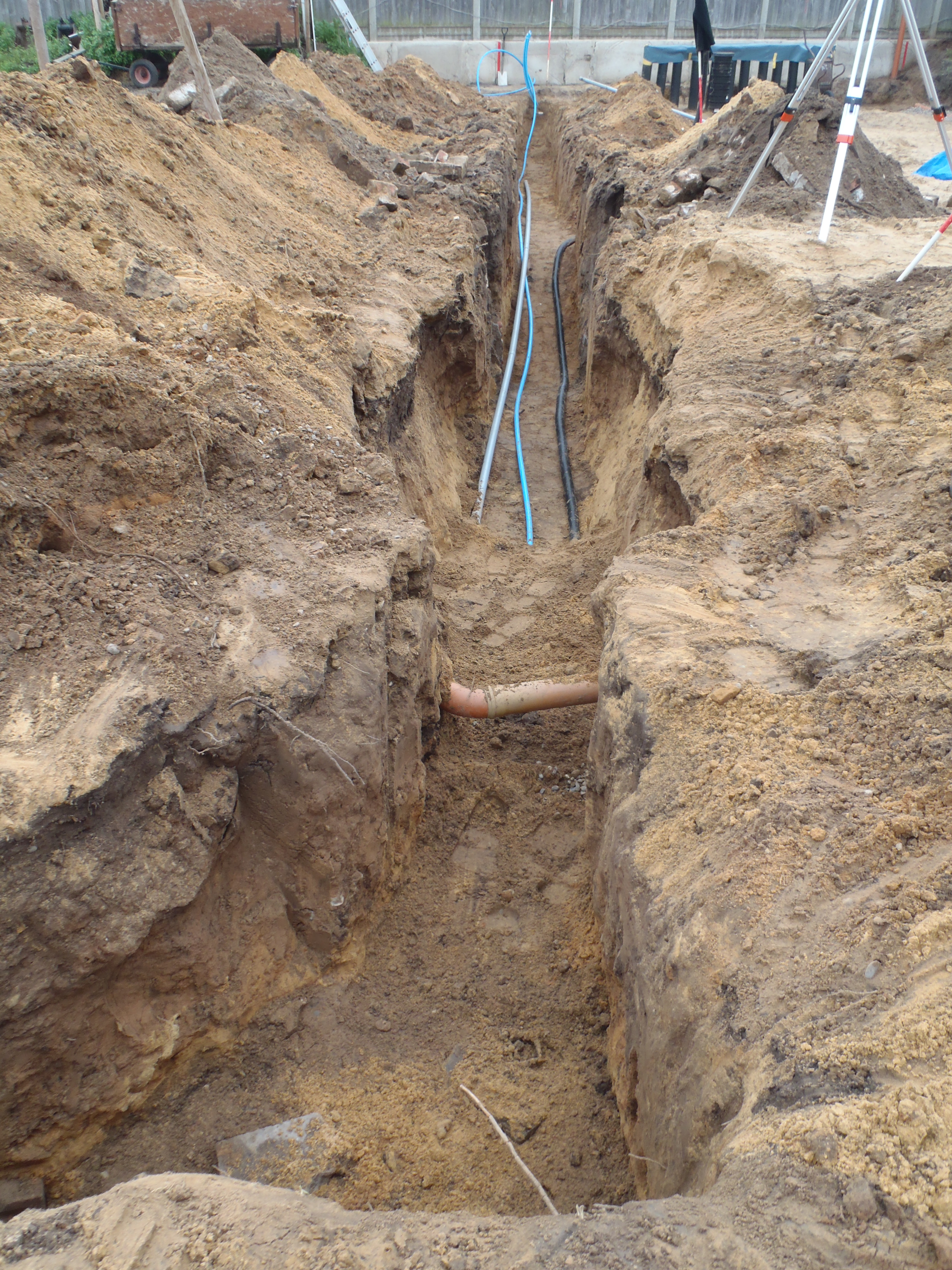
    Digging initial trench from the garage to the loke and along the loke a few meters. On Tuesday we dug most of it and finished it off Wednesday morning. The trench is mostly about 1.5m deep (gets shallower towards the garage).

    Installed the power & telephone ducts and the water pipe from the garage to the loke and round the corner, leaving the rest of the coils wating for the trench to be extended.

    service trench with main utilities in

    We then ran most of the connections from garage to house.

    trench with most pipes and conduits in