Category: Water

Cold and Hot water running around inside the house, Cold Header Tank and Hot water Tank, plus also all the connections under the floor.

  • Plumbed in the Hot Water Tank and the Pump into Hot Water System

    We got on in tackling the next task of connecting up the Hot Water tank and the Pump to the pipework that is running around the house. This high capacity 28mm pipes forms a circulation system to supply constantly hot water to all our rooms. We started at the Hot Water tank and we have six connections to do. They are as follows:
    • Overflow
    • 28mm High and Low
    • 22mm to internal heat exchanger coils
    • 15mm Filling
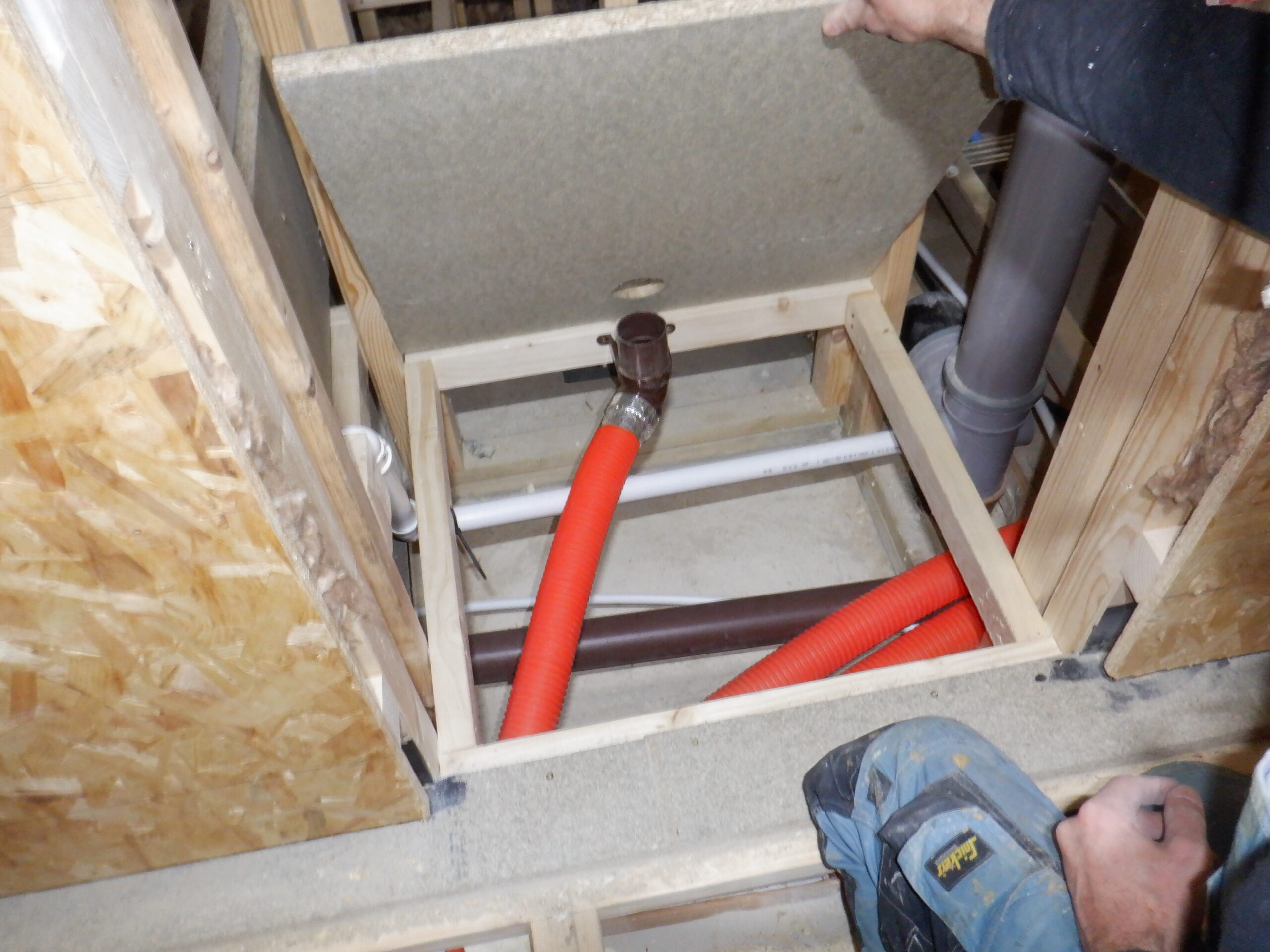
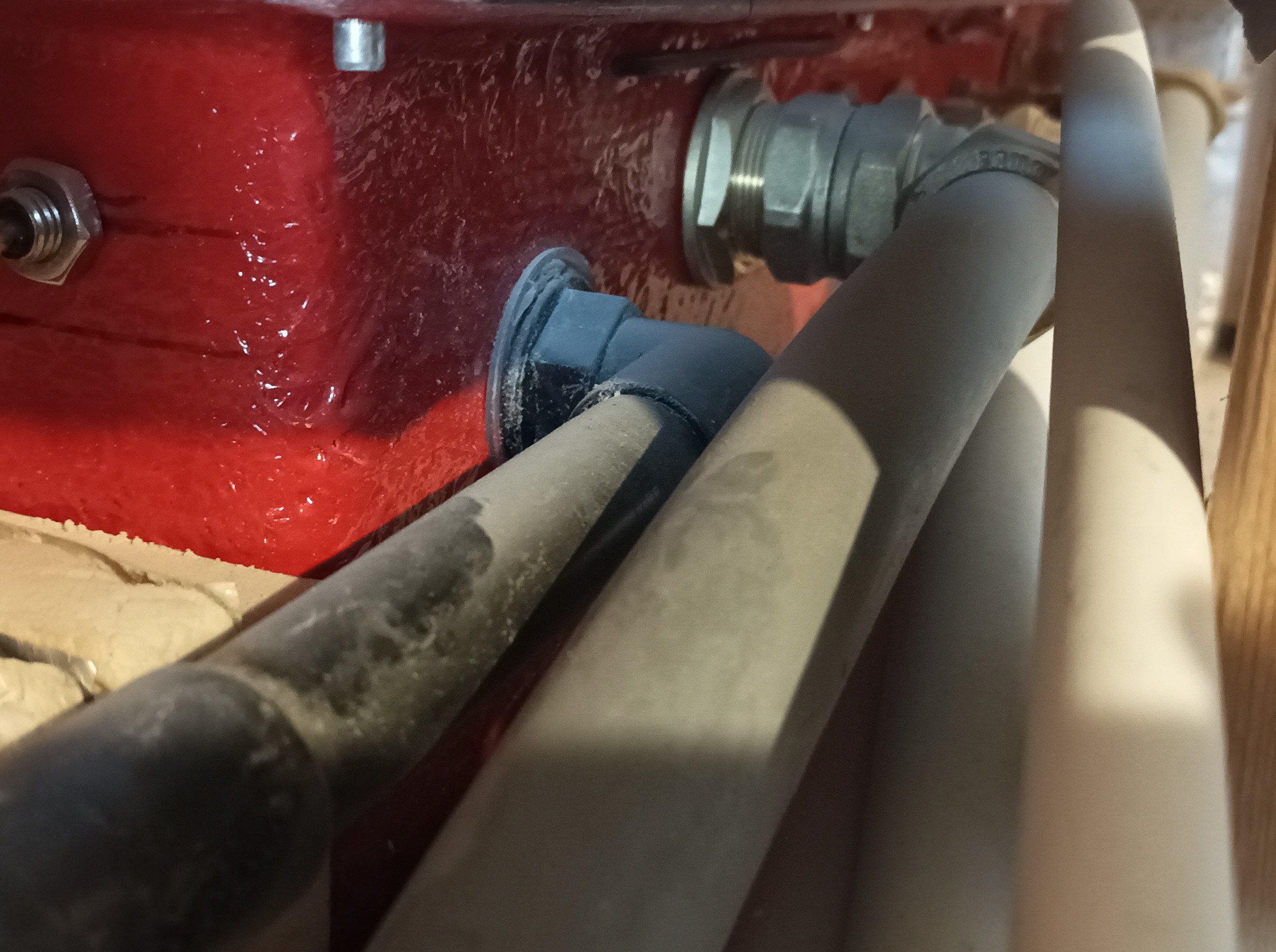
    We needed to get these pipes out from the Hot Water tank, over the other side of the vertical air duct, to bend down towards the concrete floor of the Utility Cupboard. We needed to avoid the various removable hatches and modules on the air duct itself so we screwed on a couple of horizontal battens on the side of the air duct to help guide and anchor the pipes into place. That copes with the five water pipes but the Overflow pipe is different. This emergency piece of pipework needed to get down pass everything and then run horizontally off towards a U-bend trap, ready to go further into the waste pipework. We dealt with this pipe first because it will get covered up by all the other pipes. So we routed it out horizontally for a few inches from the tank and then immediately turned 90degrees down against the insulation until it reached the air duct that disappears under the floorboards. We then turned 90degrees, plus a little 45degrees horizontally so that we could run the overflow pipe horizontally along just inside the wooden framework of the cupboard, making sure that it constantly is travelling on a downwards slope. All the joints were solvent welded together so it is now permanent.
    Hot Tank Overflow

    Hot Tank Overflow

    The next pipe connection to do on the tank is the 28mm diameter pipe that sends the water deep inside the tank. This is our Low filling point and the water will always flow down this pipe and push water down at the bottom of the tank. This means that the circulating hot water coming back from the rest of the house, will immediately connect to this pipe. The hot water return comes into the cupboard, goes through a T-junction with a 15mm side connection that has a shutoff valve and a garden hose connection point (for allowing drainage of the pipework). The other side of the T-junction immediately has a right angle compression brass piece which connects to a length of 28mm plastic pipe to go up and bends around to connect to the tank we mentioned already.

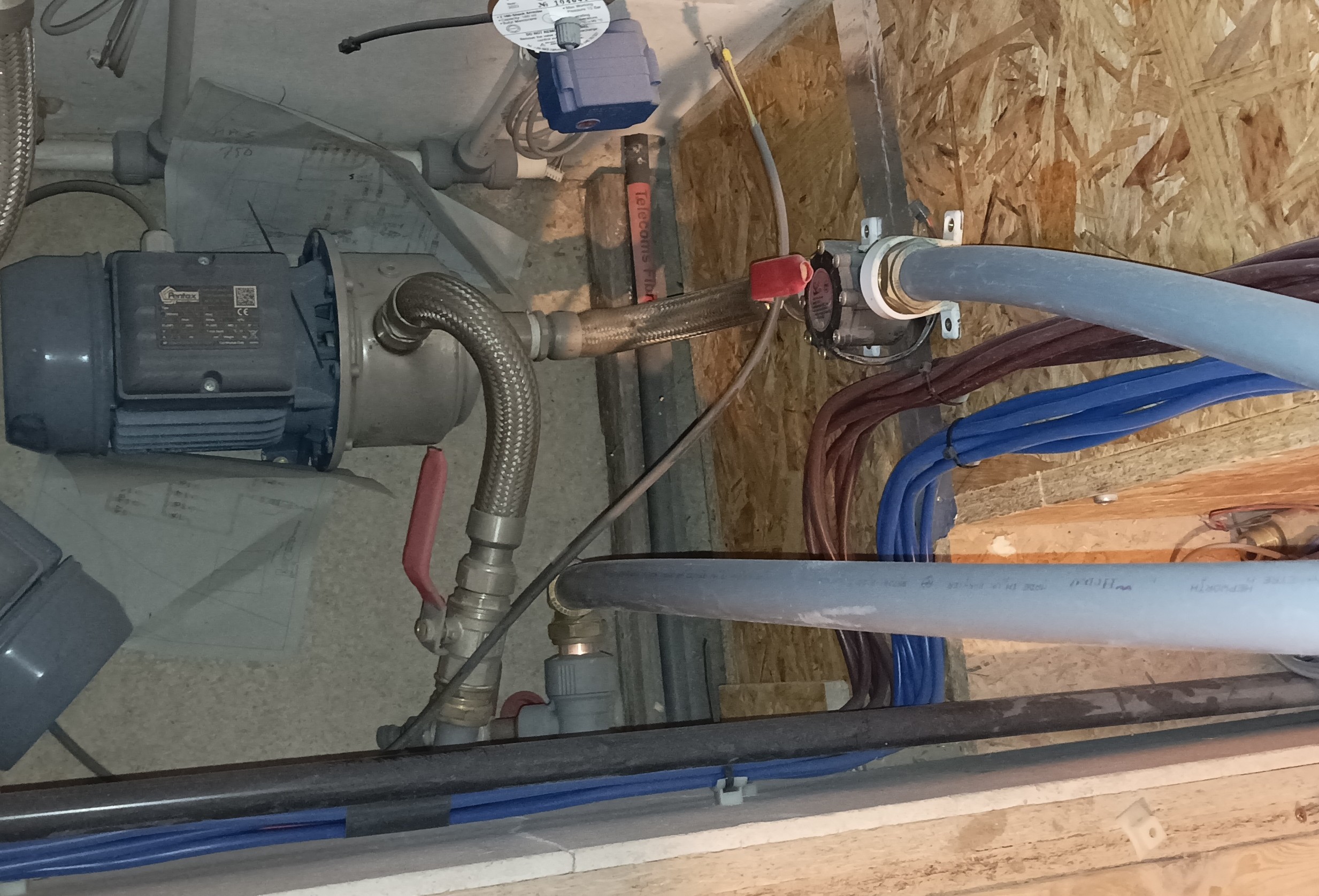
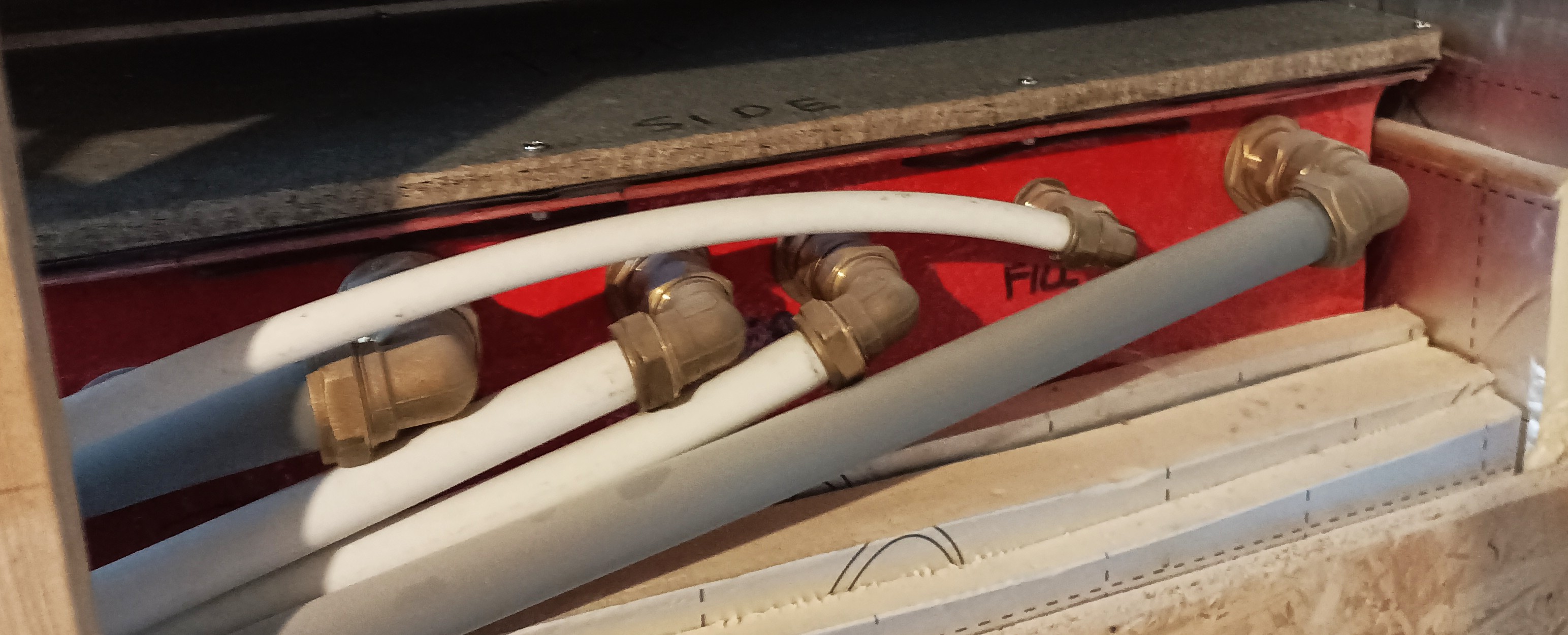
    The next connection on the tank is the first of the 22mm to the heat exchanger coils and that came out and also followed around in a gentle curve but diverted back towards the wall once it is across the air duct, ready to be connected to all the Water Management System. We repeated this with another 22mm pipe to connect to the second tank connection. The next point along the side of the tank is the 15mm filling point and again, that came out and also followed the route of the other 22mm pipes, back to the Water Management System. And finally, the last connection, is the second 28mm pipe for extracting hot water and sending it around the house. This pipe came out just like the other ones, and it curved around but, this time, goes slightly backwards so that it can connect to another isolating manually operated valve and a flow rate sensor, before going through a flexible rubber pipe to join to the pump. The other side of the pump then bends around in a tight sweep to go down to the second isolating valve and then connected to the main 28mm circulation system running around the house.

    Hot Tank Connections

    Hot Tank Connections

    Hot Tank Pump

    Hot Tank Pump


    The next task to do, before we can test the circuit and all our connections, is to go around installing a pair of isolating valves at each tap-off point at each of the Bedrooms, Bathroom, Great Room and the end of the circuit in the Kitchen. In the Kitchen, we installed a short length of 15mm plastic pipe to join the two ends together, so that we can test the circuit for any leaks.

    We then tested the plumbing by sticking the garden hose into the hot water tank and shoving the hose up the second 28mm extracting pipe inside the tank, to fill up the entire pipe circuit running around the house. We had to do that because the pump needed priming (filling it up with water) so that it has something liquid to suck upon. These kinds of pump do not run dry and cannot suck air, hence the need to prime the circuit with water and remove the trapped air inside. While the water was going in, we went to each tap-off point and check for leaks.
    None so far ..

    Once the pump is primed and connected to the electronic controller, we ran the pump at various speeds and pressures, to thoroughly test the entire system and make sure we don’t have any leaks. AND, We didn’t !!

    The flow rate sensor was sending a pulse every litre that is flowing through the pump every second and at the highest power setting, we managed to get a 47litres per minute rate. And that is with a little 15mm pipe acting as the temporary bypass in the Kitchen. If we had a full size bypass, then the rate could be quite a bit faster!! And this is deliberately what we want to see, so that when there are sudden demands of hot water in two or three different locations, the pump can adjust itself to supply even more hot water and the human won’t notice the change, especially something like the shower.

    This concludes getting the Hot Water circulating system commissioned and not having any leaks!

  • Hot Water Tested

    Over the last couple of weeks, at various spare opportunities during our work around the house, is to deal with our Hot Water tank. We wanted to test it for leaks, run the water right up to maximum temperature and see how long the heat stays in.

    One of the first steps to do before we proceeded to test the tank, is to put on our cement lid on to a rim of silicone, to create a seal. We put a line of parcel tape on the underside of the cement board so it didn’t stick to the wet silicone sealant, and just patted and laid the heavy lid down on top.
    We did put on four layers of PU foam board on top, creating a insulation layer of 160mm thick.

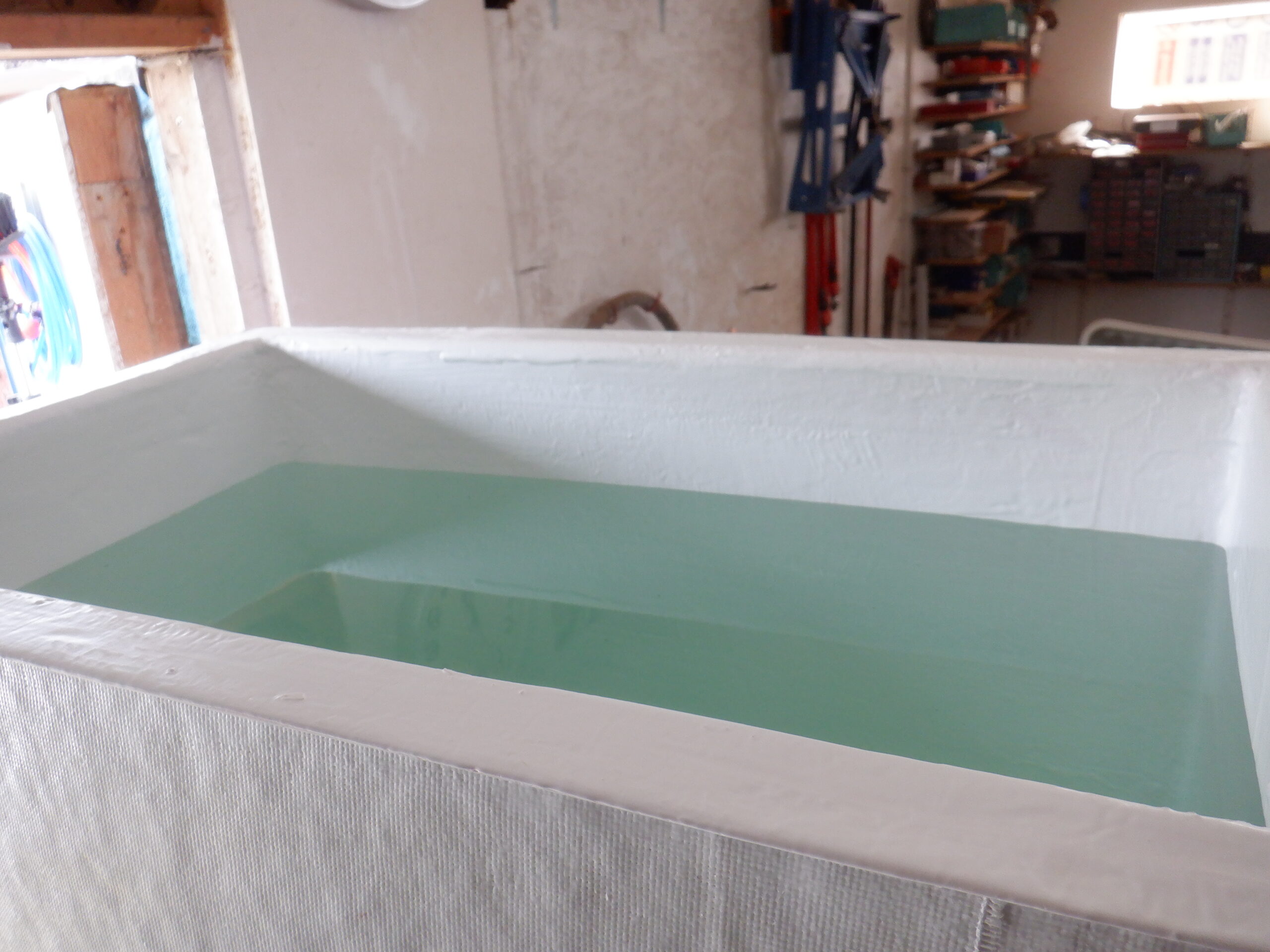
    We filled up the Hot Water tank that we previously installed a few weeks ago. Then, using spare solar energy from our roof panels, we heated up the water a few hours each day (when it was bright with sun) and eventually, got to 80°C. There were no leaks! Yippee!

    We also tested the tank for any hot spots by using our Infra-Red camera sensor that gives a calibrated picture, showing actual temperatures and everything. We noticed that the back edge had a bloom of rising heat drifting up and we realised that it seems to be hot water vapour that is escaping the lid and the seal.

    The temperature seems to be dropping at about an 1°C per hour, which is mostly because we still have two large uninsulated sections where the pipes and electric cables comes out the tank. Our calculations suggest that if we had a solid insulation of at least 100mm thickness, without any missing chunks, the temperature should last much longer at about 6hours for each 1°C drop.

    Once the hot water cooled down to ambient surrounding levels, we inspected the lid and internals. We noticed that the lid has very slightly coiled up in the heat, and also the under side (exposed to the steam), had sprouted some limescale deposits of some kind. We hadn’t sealed the cement material against water so it looks like that the steam had managed to penetrate the substance and caused this side-effect. We cleaned it off using a piece of sand paper and decided to find some roofing rubber membrane we had left-over from doing the Garage roof. This will withstand the steam and protect the lid. We also installed ten captive nuts and bolts around the edge of the lid so we could flatten the lid back down on to the silicone seal again.

    We will do another test soon, but after we had constructed the air ventilation that is situated next to the tank.

  • Hot Water Tank Kitted Out and Installed Into Utility Cupboard

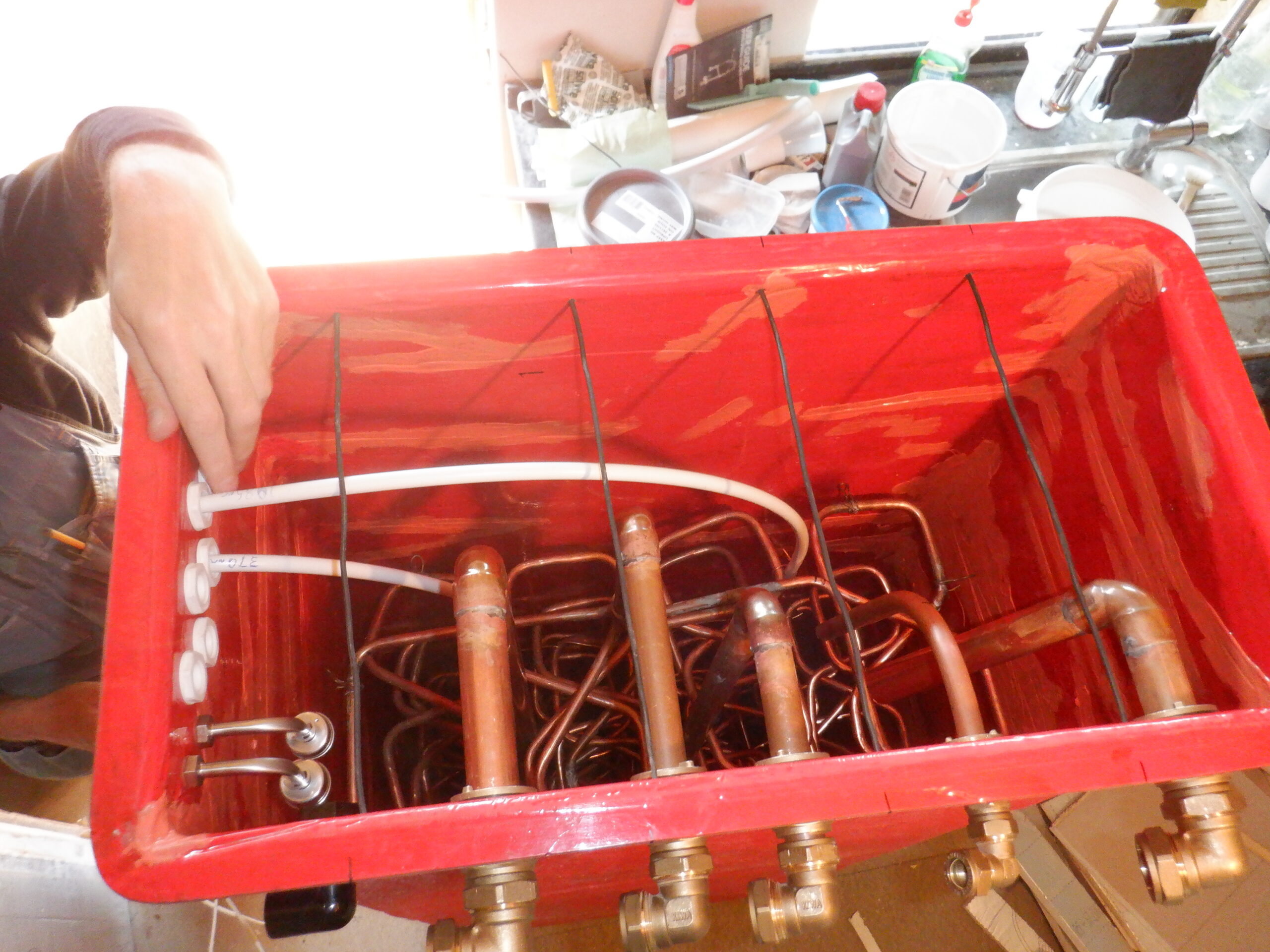
    One of the jobs we have been working on now and again, in between other jobs, is putting together all the internal bits and pieces for our Hot Water Tank. The heat exchanger is now ready and we slid it into the tank. Then, we aligned the three pipes inside, with their elbow bends on top, and drilled clearance holes for a series of tank connectors, one for the 28mm pipe and two for the 22mm pipes. Plus also another 28mm one for a short piece of pipe, to pair up with the other 28mm pipe that goes down to the bottom of the tank. That covers the two main types of water flowing in and out of the tank. All four needed their elbow bends to be soldered into place.
    But, that is not the end of these tank connectors, we then did another one for a 15mm pipe, a piece of copper pipe which we put a 90degrees bend on it and that will be a cold water feed to top up the hot tank if necessary. The final water type tank connector we inserted, is for the overflow relief pipe, just in case the filling mechanism didn’t halt the filling when it should have done so.
    All those connectors were mounted just under the flange at the top of the tank, on the long side, and they all have external right angle bends, ready for plastic pipes to be inserted in.So, on the short side of the tank, we then drilled a series of holes, this time, for the electrical types of connections going in and out of the tank. The first two were float switches, for controlling the cold water filling system. They are positioned so one will detect the water level dropping below the 100mm mark which will cause more cold water to be fed in. The second float switch is positioned just underneath the overflow outlet so we can detect a failure to halt the filling process and cut off the electric supply to the pump or valve etc.
    Then, the next holes to drill out, were seven holes, to allow nylon glands to be fitted, which has a screw cap that tightens down on electrical wires (two of them actually have 10mm plastic microbore water pipes coming through as these are conduits for two temperature sensors to be inserted into the water). The other five glands will have a bunch of electrical wires going to a mixture of 50V DC heating elements and a couple of 230V AC Mains heating elements, to dangle down inside the tank near the bottom.

    Hot tank with everything plumbed in

    Hot tank with everything plumbed in

    Now having fitted everything that will go inside the Hot Water Tank, we moved it into the Utility Cupboard, to end up in the corner, tucked out of the way.

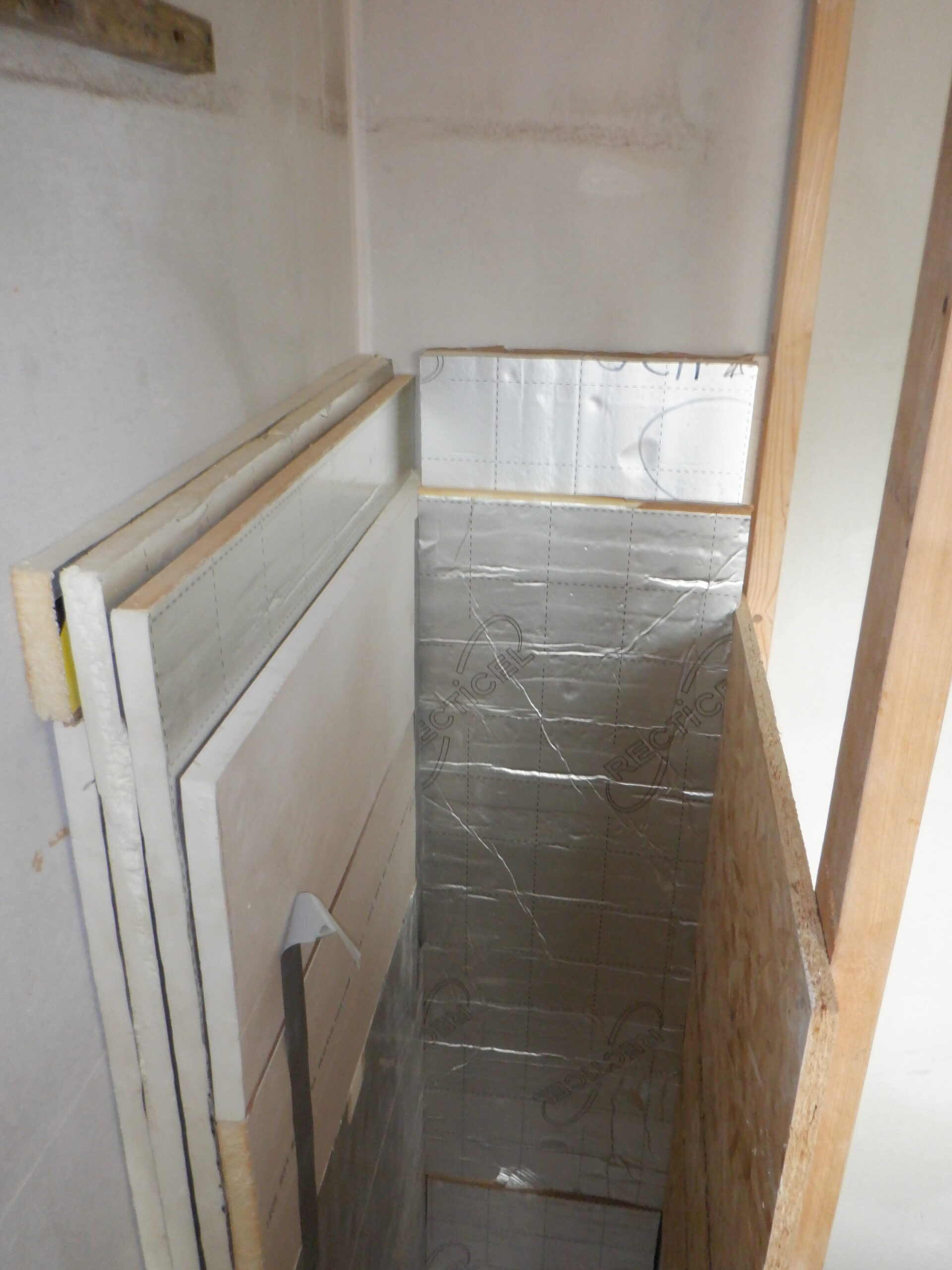
    But first, we need to put in a solid block of PU insulation foam boards, to surround the tank, to insulate the tank, with a thickness of 100mm all around. We had a collection of 25mm thick sheets that were left-over from other jobs so we put in four layers on the bottom, measuring 800mm deep and 500mm wide. Then, we put in a piece of DPM plastic across the whole area, sandwiched between the third and fourth layers, to act as a captive water tight barrier, so we can detect any future leaks, using an electronic sensor. This is a last ditch detection system so that we are made aware that the tank is leaking somewhere and that we have to rescue the situation.
    Next, we put in four more layers of the PU sheets, this time, the left-hand side of the tank. They are 800mm wide and went to a height of 1800mm for the first three layers and a slightly shorter 1700mm high piece for the final layer that is next to the tank and fits just under the flange.

    The third block of insulation is the back wall, this time measuring 400mm wide and a similar height as the previous load. We jammed them in so it keeps the left side layers nice and tight.

    Start of hot water tank insulation

    Start of hot water tank insulation

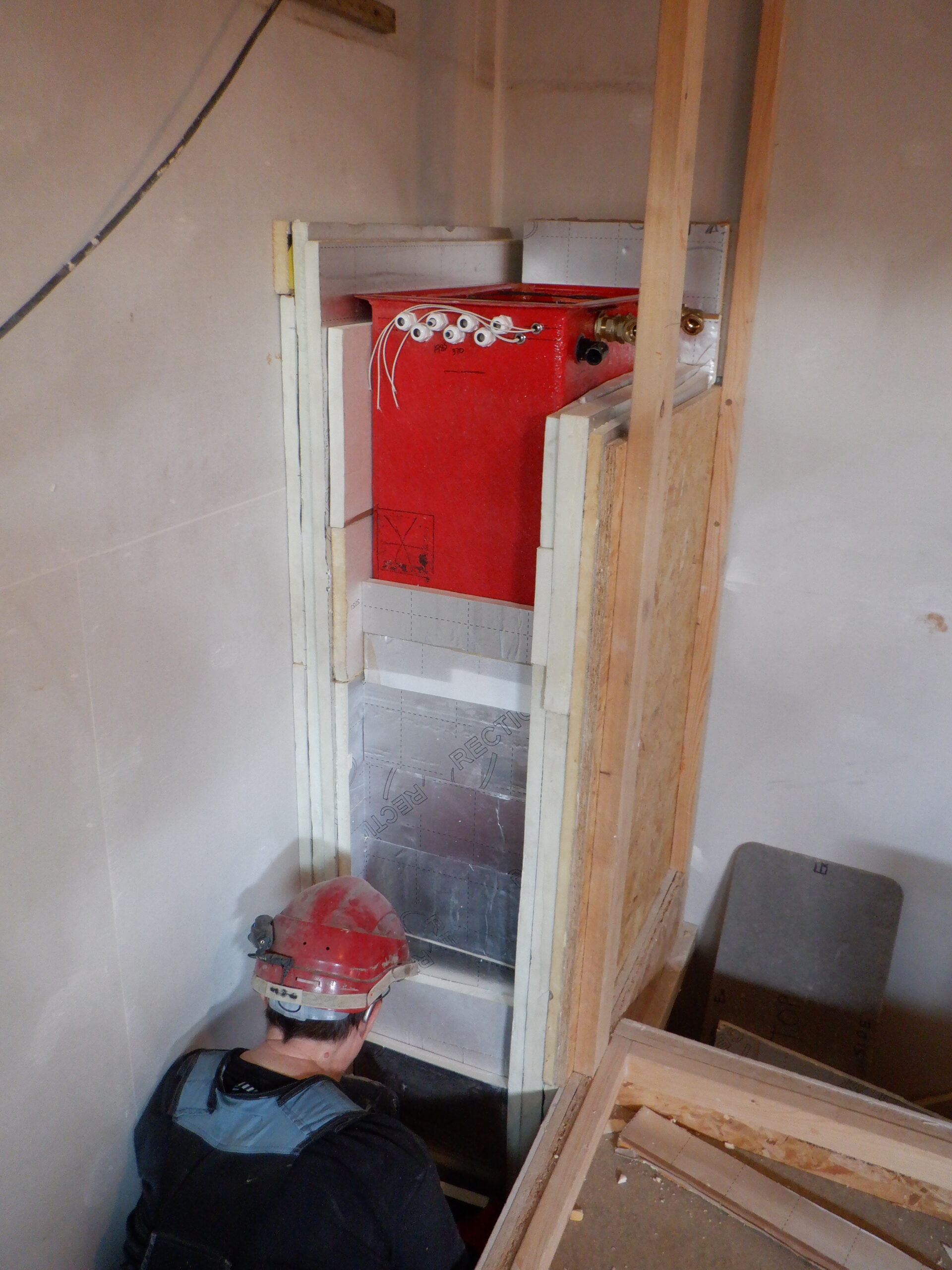
    We can now man-handle the tank into position, sitting on the block of insulation and shoved over so it is tight next the left block. We then resumed sliding in more sheets, this time, only measuring 700mm wide but we could only get 90mm of foam boards into the available gap, which we achieved by putting two layers of 25mm sheets and a single 40mm thick sheet. Also, we reduced the height by 100mm as well, because all the pipe connections are in this location. We will probably fill in this gap with glass wool insulation later on once we have fitted the various pipes into place. We are also likely to slide in an additional 40mm PU board that will fit in between two CLS wooden legs that are part of the cupboard framework. That will provide some extra insulation as well.

    The final step in covering up the tank is the front and we put in two layers of 25mm sheets measuring just 300mm wide and 1600mm high, and a final 40mm thick one to finish off.

    Fitting last of the insulation to the hot tank

    Fitting last of the insulation to the hot tank

    The final piece for the tank, the lid. We got a small left-over piece of 12mm cement board and cut it down to fit on the full dimension of the tank plus the flange around the top, and cut it to fit. We stuck a couple of layers of 40mm foam board on top as well.

    That concludes the assembling of the Hot Water Tank and fitting it into the Utility Cupboard, with its insulation completely surrounding it. We will do another soak test and this time, rig up an electrical circuit and heat up the water to a good 90°C to test everything. This is a good time to do that as the electricity prices are very cheap during the night, plus also, we are getting lots of solar at the moment, which will help reduce the cost of heating up 288litres of water and then letting it cool down by natural means so we can find out how long it takes with the amount of insulation we have put on.

  • Repair the Hot Water Tank

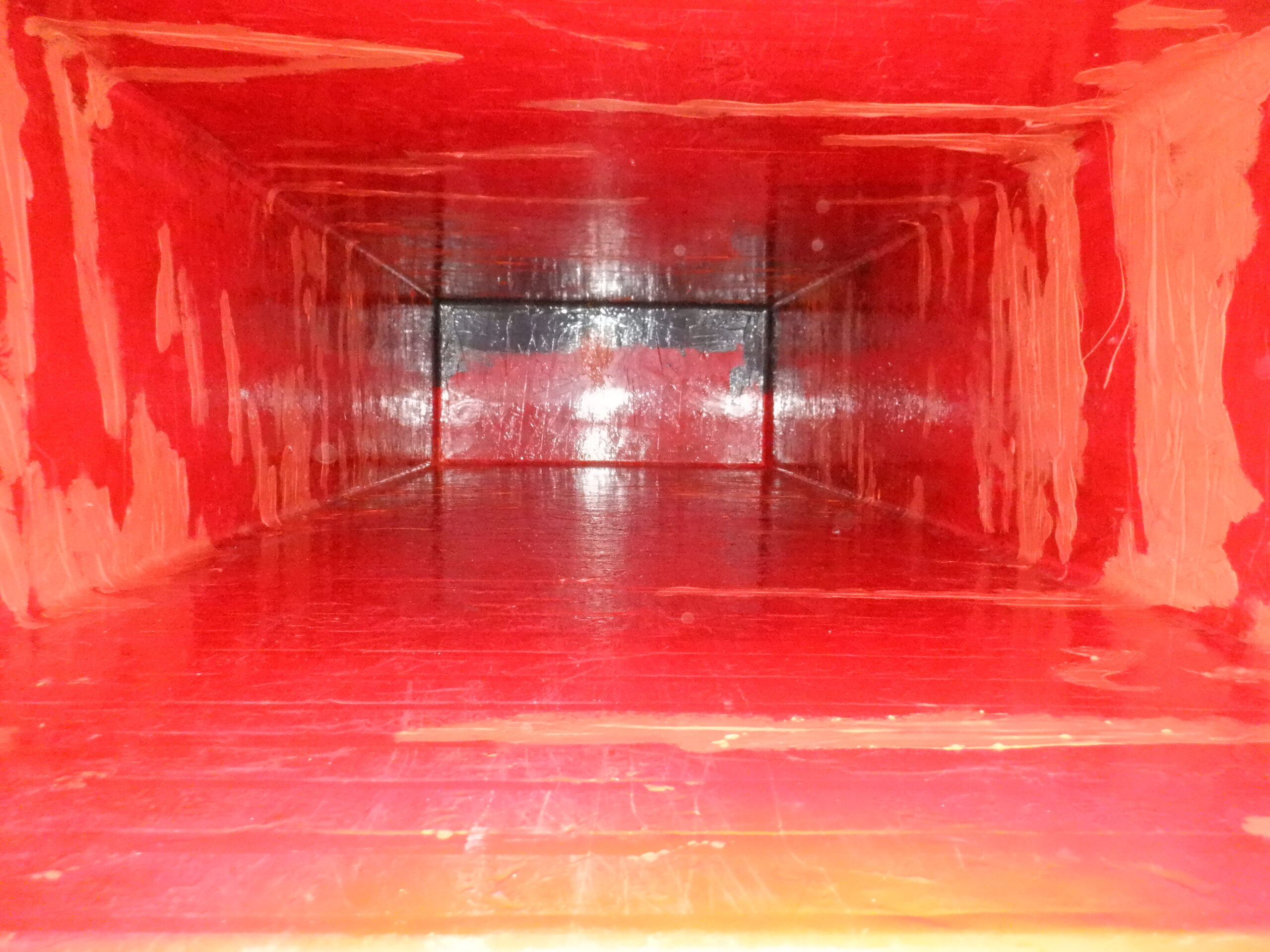
    At last, we tackled the annoying problem of fixing a leak in our new Hot Water Tank we constructed a few weeks ago. Just to recap the situation, we discovered that our mould we had made to shape the fibre glass resin on to, had little ripples in the release tape we had stuck on. These little ripples has create little grooves in the finished resin surface. One of these grooves was deep enough to breach the inner skin and this allowed the water to escape. That is the situation .. O Boy!
    So, we tackled this problem by having to climb, or rather, crawl inside the tank which is lying on its side. We vacuumed the inside and then rigged up a fan to blow forced air into the tank, to make absolutely sure that we are getting fresh oxygen and removing the chemical vapours. We went through the whole tank and scrubbed all these grooves with acetone, to clean out them and prepare the surfaces ready for a fresh application of more resin. We have to do this work in two stages because we cannot turn ourselves over to work upwards, so, we had to rotate the tank over.
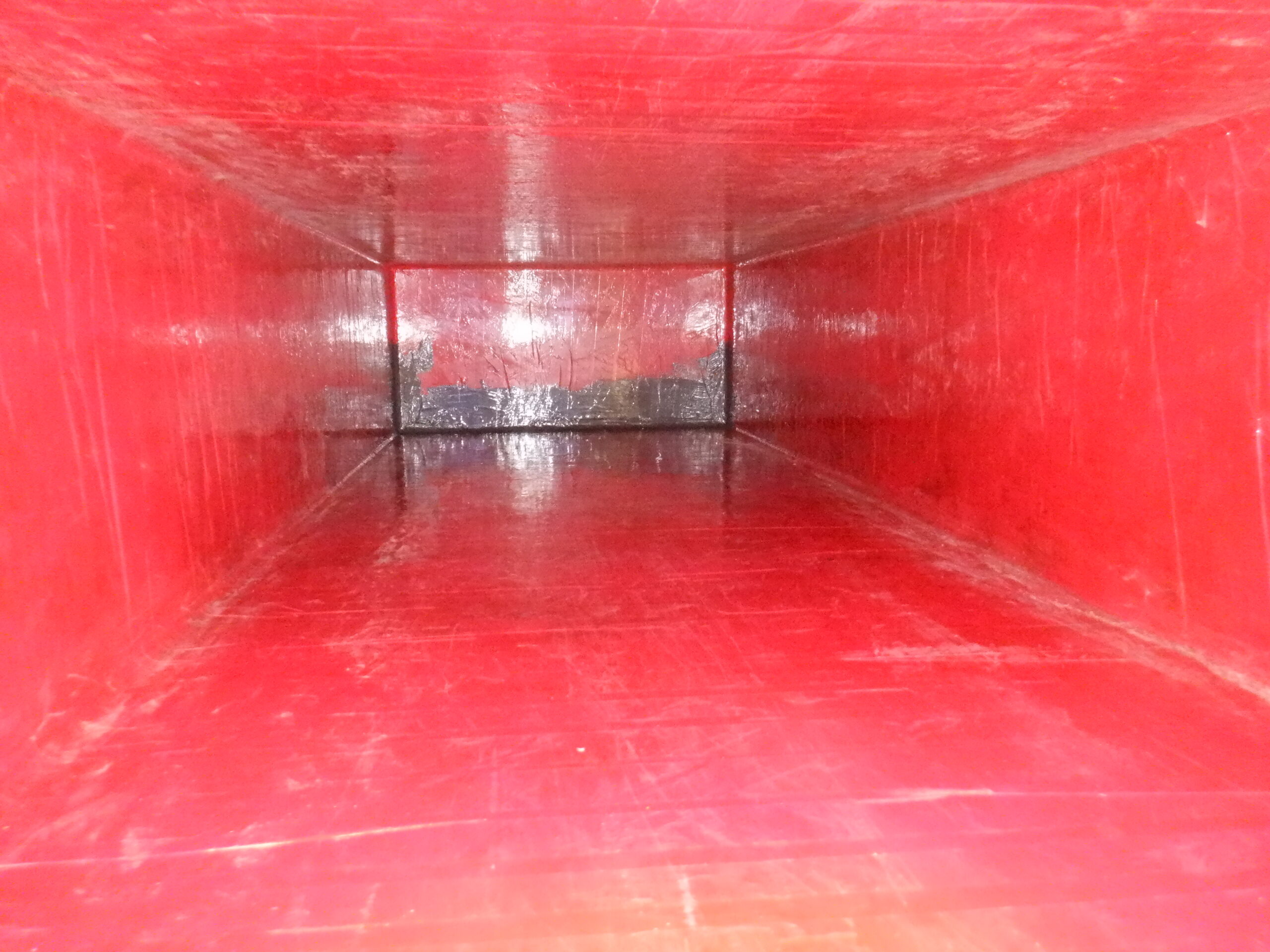
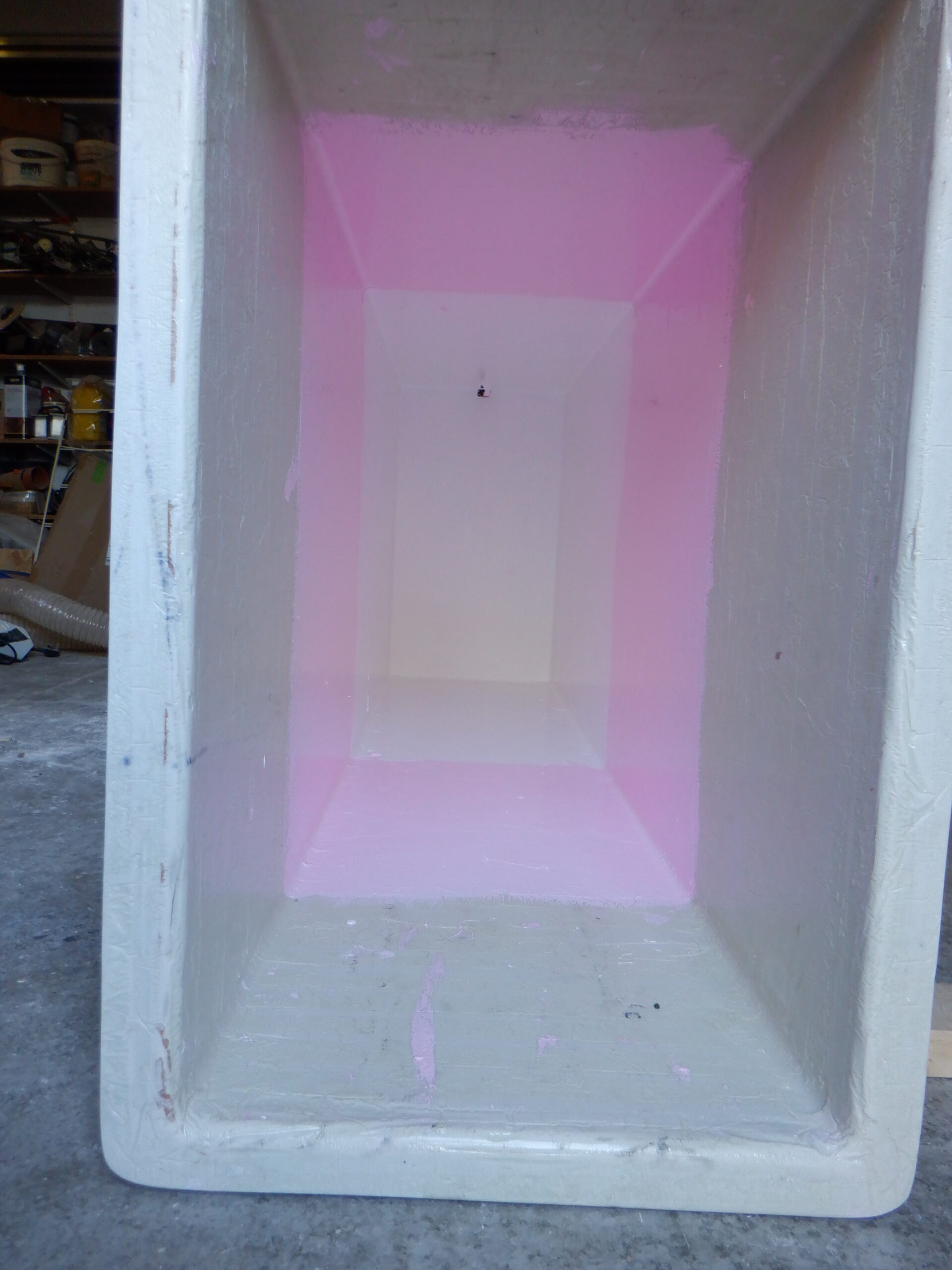
    We mixed a small quantity of resin and added some yellow dye, which turned the red colour to an orange shade. This will give us a feedback to where we had applied the resin. While wearing our mask with the activated carbon filters, we proceeded to dab each of these grooves. We turned the tank over and did the other half as well.

    Sealed up the defects in Hopt Tank

    Sealed up the defects in Hopt Tank

    We left it to cure and harden overnight.
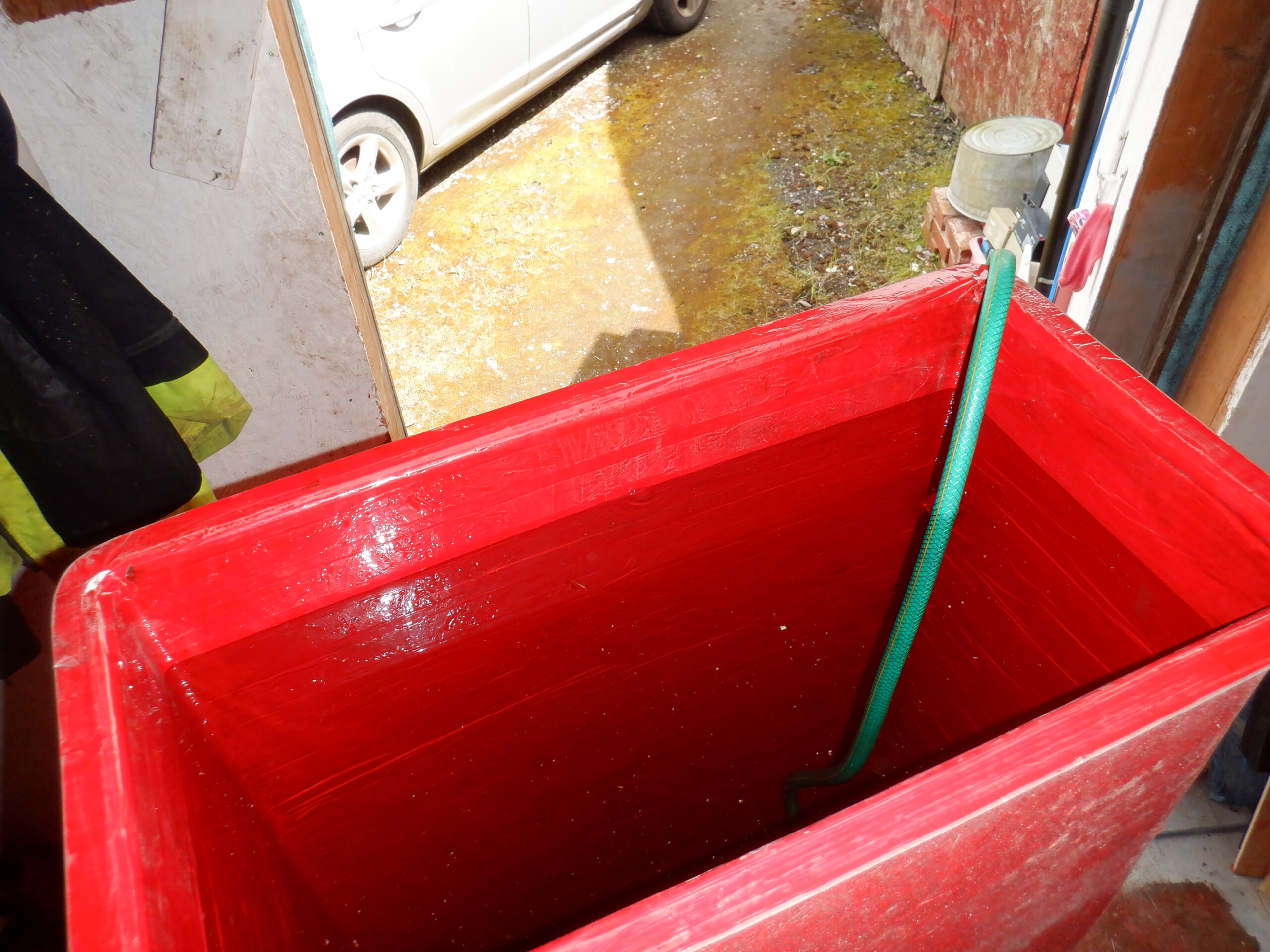
    Now, it is time to give it another leak test, we got out our garden hose again and started filling. .. In the meantime, while it was filling, we went to find a piece of 12mm cement board, traced the outline of the top of the tank and sliced it into a lid. This will sit on top, on a ring of rubber around the edge and keep the steam and hot air in the tank.
    Oh No !! !!
    We still have the same leak as last time !
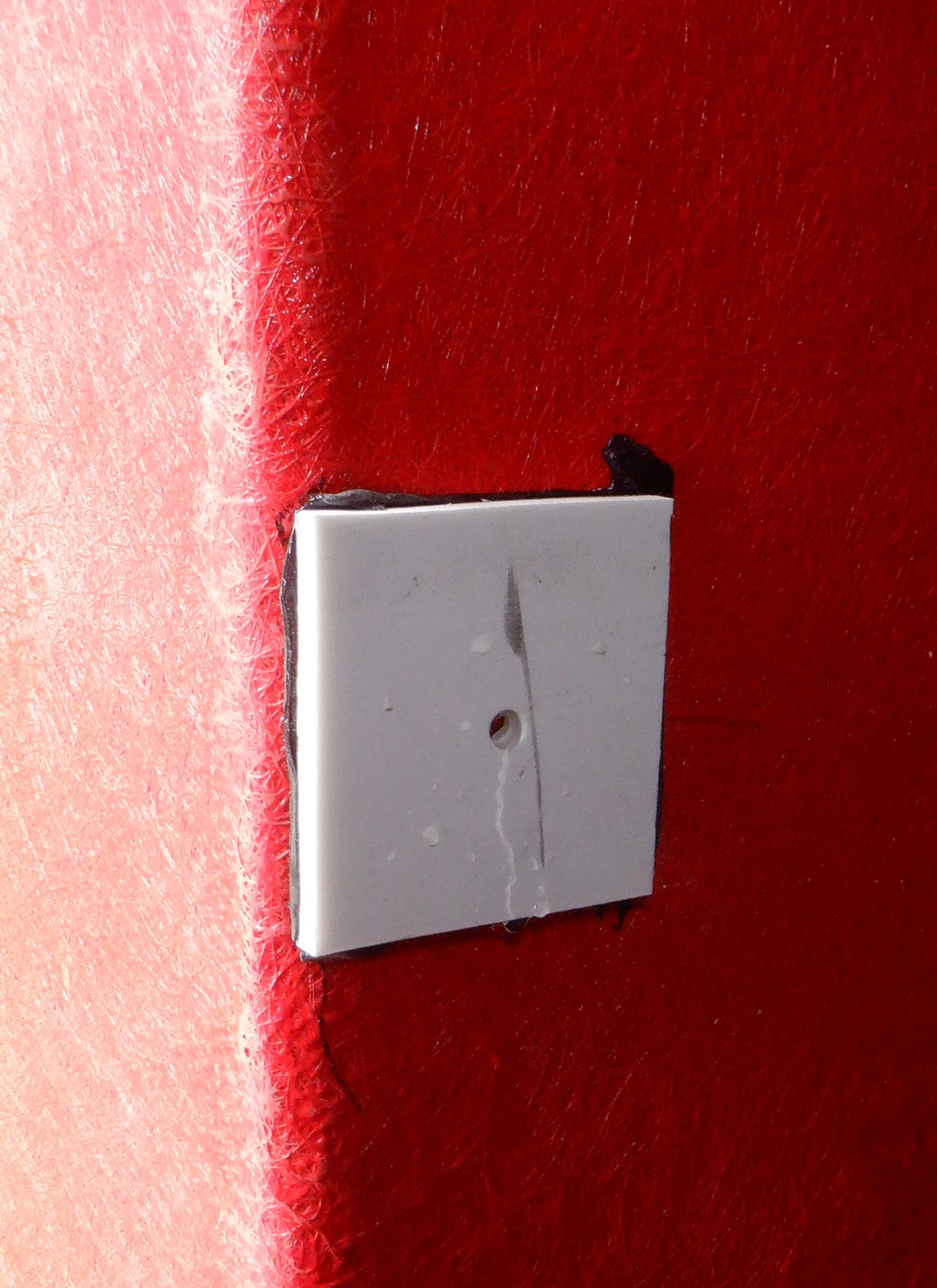
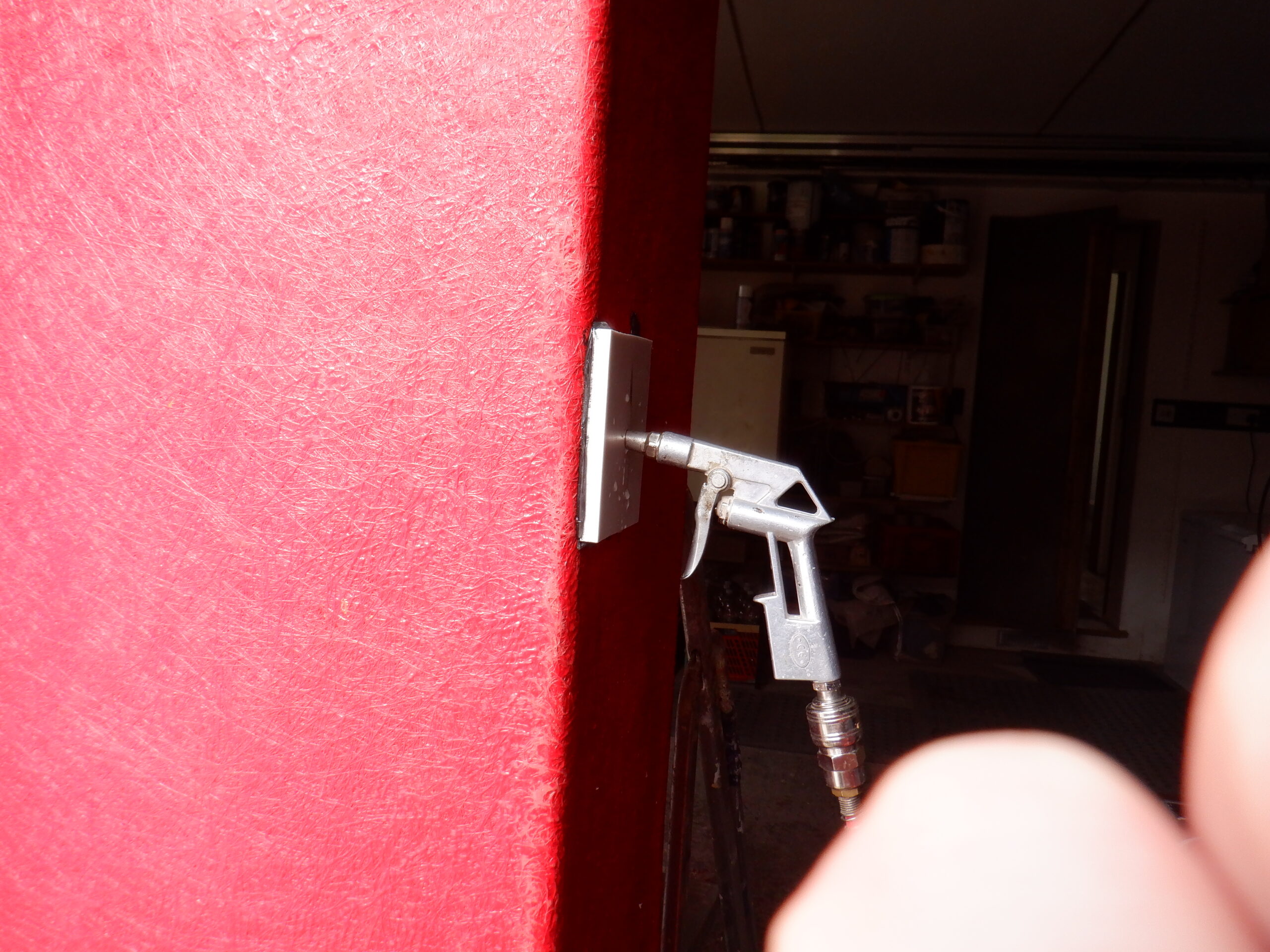
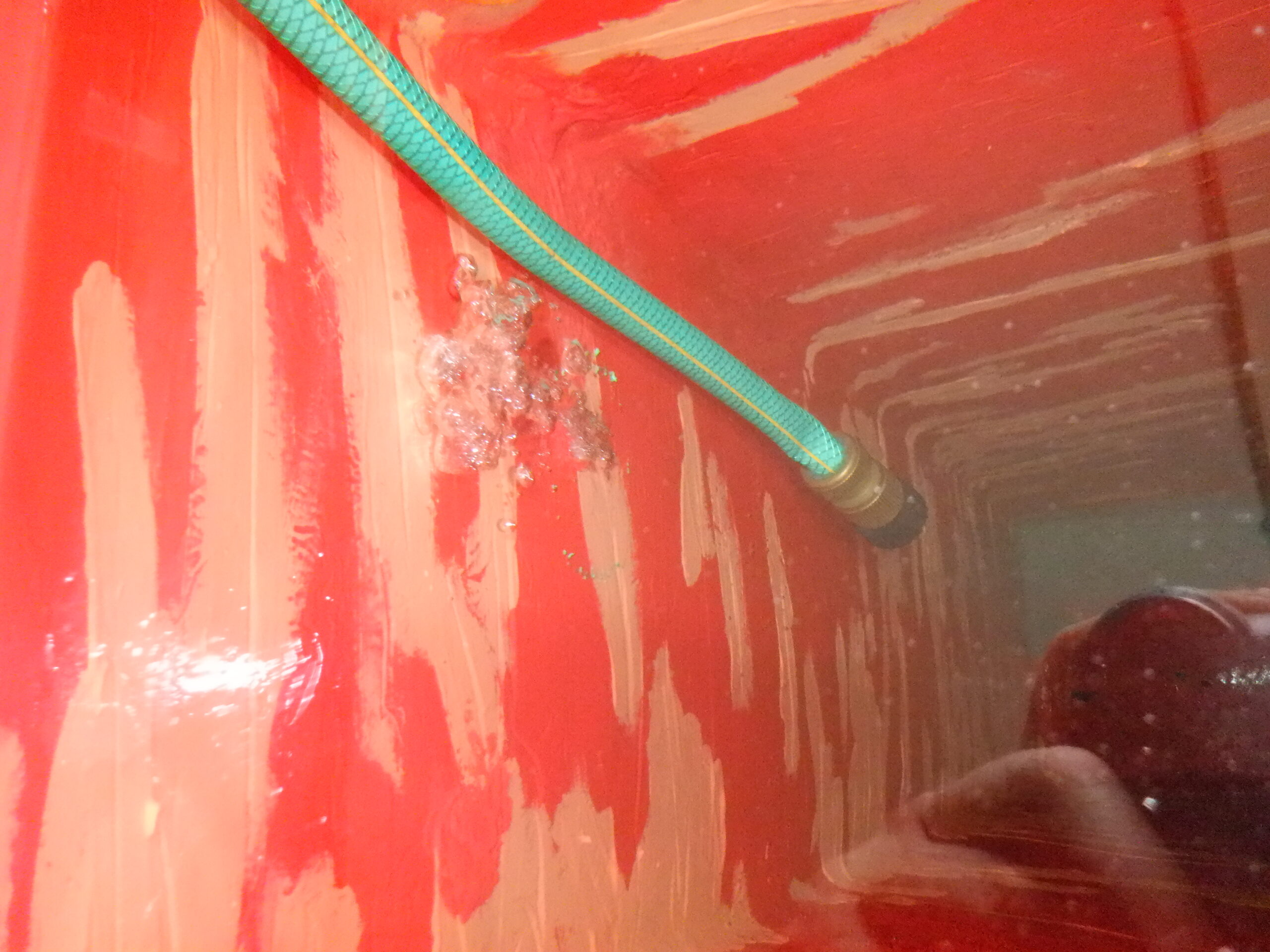
    After trying to see where the hole is, on the inside of the tank, we had the idea of using compressed air to blow backwards from the spot where the water is steeping out and force air through the skin and hopefully make air bubbles appear on the inside. We eventually stuck on a 4inch square piece of thick plastic, with a ring of butyl thick glue around a circle and then clamped it on over the site. We carefully sent small burst of air into the white plastic pad, through a hole in the middle and .. we had a stream of air bubbles blowing into the water!
    Plate attached to allow air injection

    Plate attached to allow air injection

    Injecting air to find the leak

    Injecting air to find the leak

    Bubbles showing where leak is

    Bubbles showing where leak is


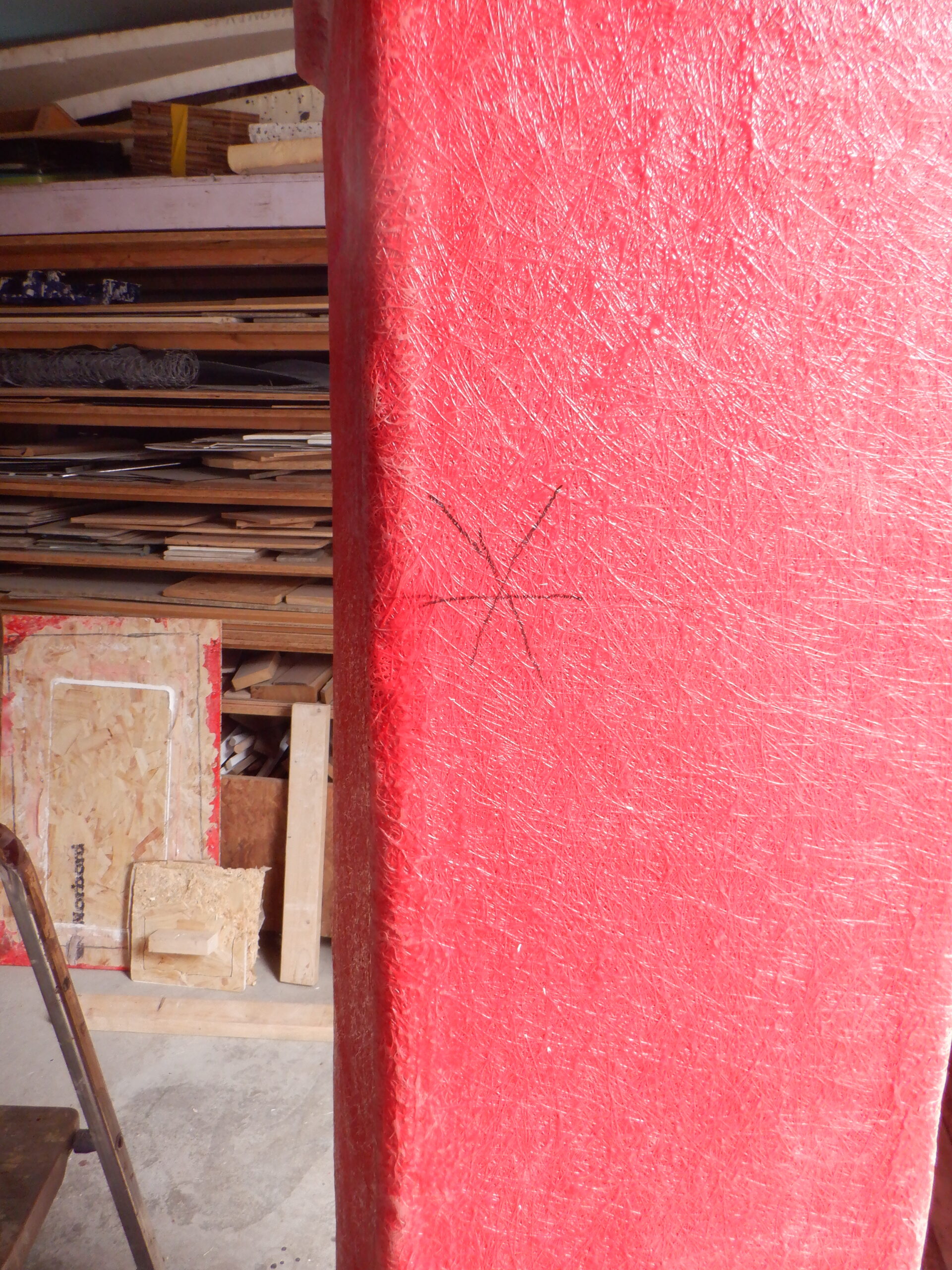
    We got a dark wax crayons and drew a small circle around the site where the bubbles came out. It had to work underwater!!
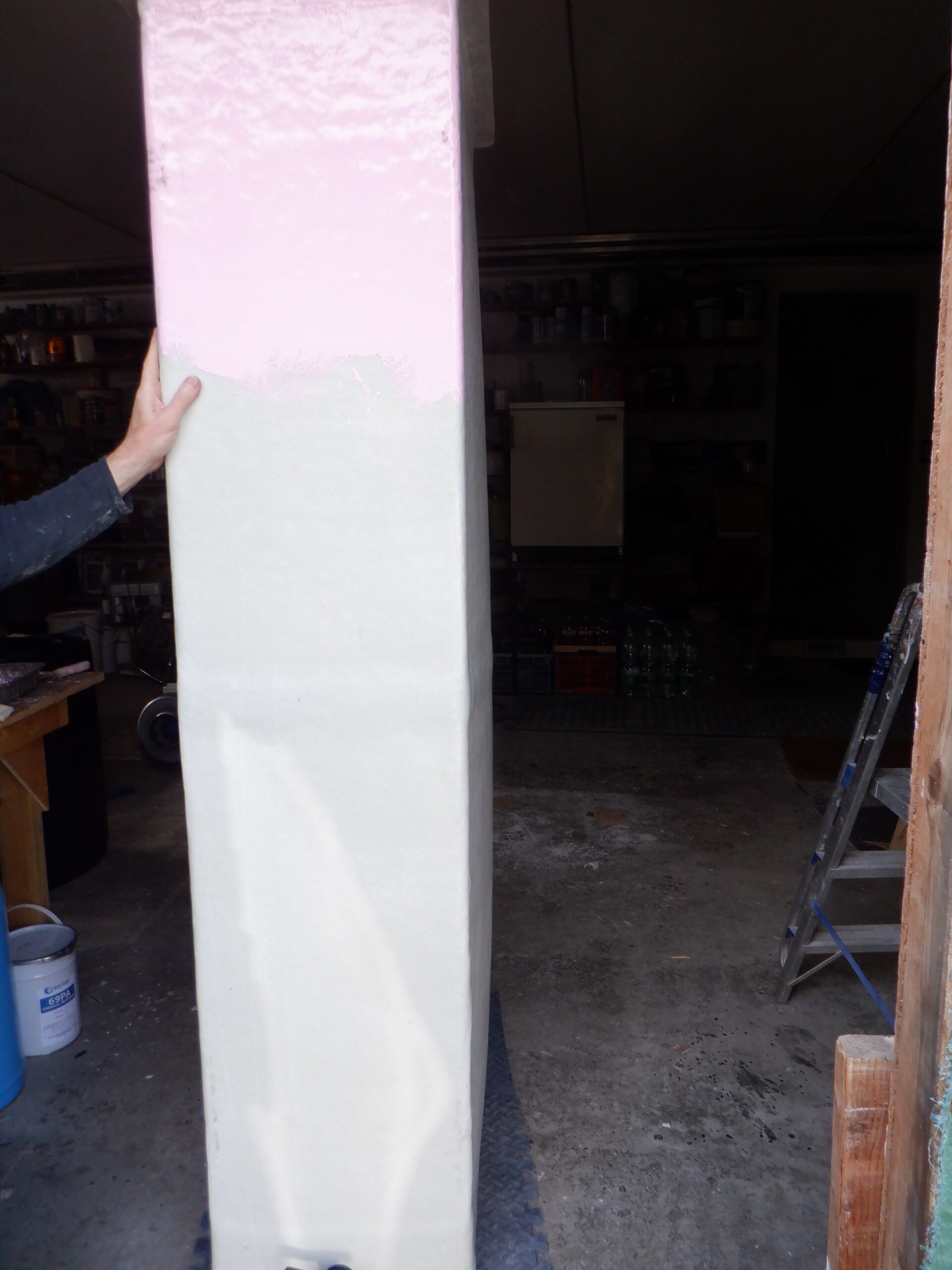
    Then, we drained the tank so that the level of the water was 6inches below the “hole” and then drew a wider circle using our marker pen. We sanded heavily this zone, to make sure that the surface is well “roughened”, to help stick the new layer of resin over that spot. We also heated up both sides with a hot air gun, set to 100°C maximum, to thoroughly dry the fibre glass and drive out any moisture trapped within the fibre glass itself. It needed to be as dry as possible so that the new resin will stick properly. We rubbed the entire zone with more acetone, to soften the resin and make it more attractive for the new liquid resin to stick better as well. We mixed a small amount and then applied it to the 4inch zone inside the tank. We had left-over so we painted the wall near the top of the tank, where we are planning to have various connections made to pipes etc.
    Again, we left it overnight to allow the resin to cure fully, before refilling the tank back up to normal levels again. To see whether we have fixed the leak .. or not!!
    ..
    No Leaks!! Hurray! Yippeeeee!
    At last!
    We left it full of water all day and it is looking good.
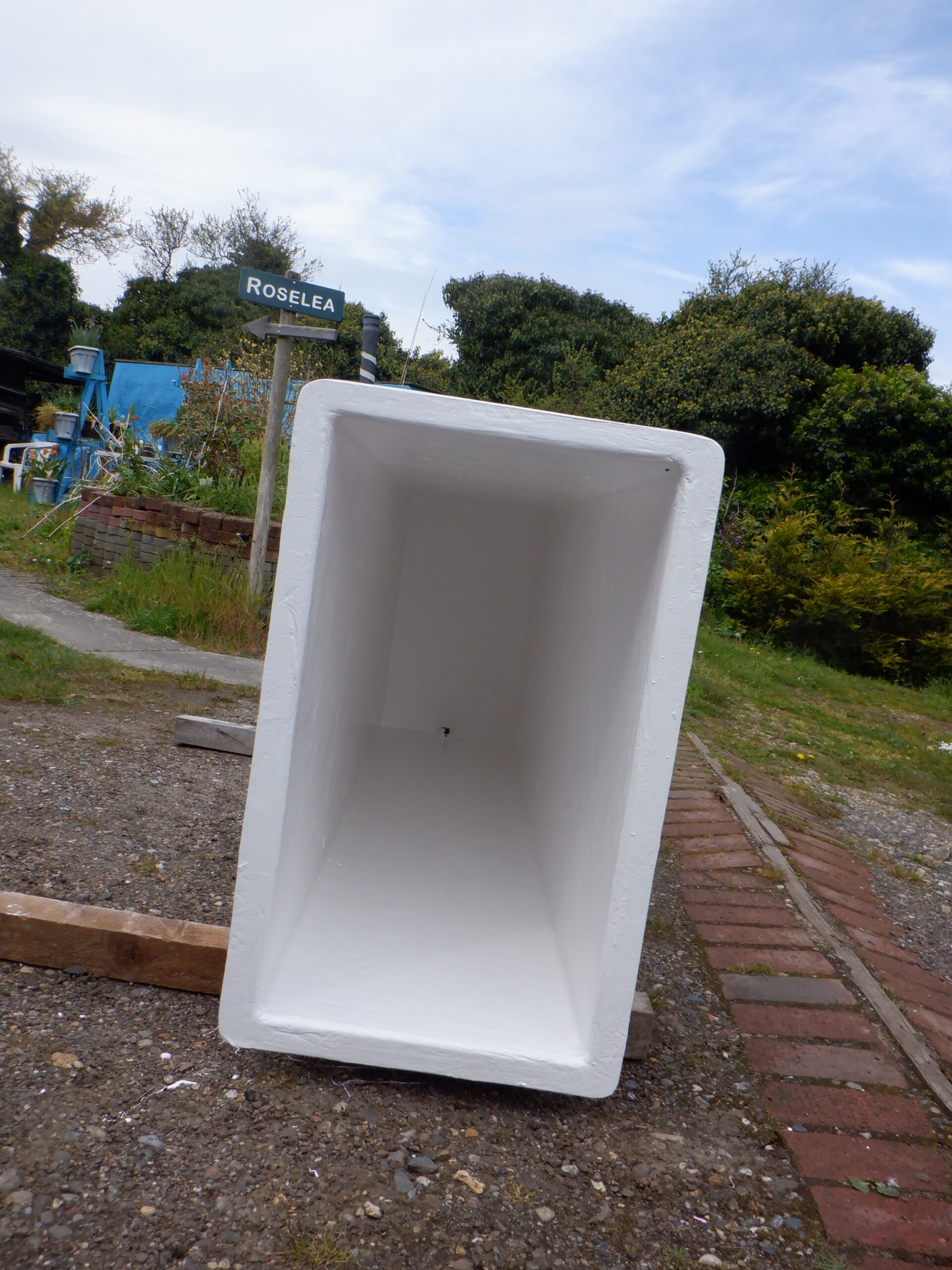
    We now have a repaired Hot Water Tank! Ready for the next stage of fitting the connectors and the heat exchanger coils ..

  • Constructed Hot Water Heat Exchanger Coils Plus Other Pipes and Sensors

    We have been spending a day here, a day there, whenever we were waiting for glue to set, paint to dry etc. etc. and got on with the task of designing and building a heat exchanger coils for our Hot Water tank sitting in our Utility Cupboard. We wanted to have a system where we could run in various hot water, or indeed cooler water sometimes, to transfer energy into, or out of, the tank. We are going to use lots of copper pipes, narrow 10mm wide copper pipes, and bend it into a coil, to form a tall rectangular spread out maze of pipe bending this way and that way, to form a column. We want to make four of these, so that they stand in a line, inside our Hot Water tank. They will be connected to a 22mm copper pipe and a tiny little manifold which will allow four 10mm pipes to join into the 22mm pipe. The 22mm would then go up to the top of the tank and exit to the outside world.

    So we were thinking of doing a series of “figure-of-eight” loops, wrapping the copper pipe around two 110mm waste pipes, set apart very slightly, making sure the overall dimensions kept within 150mm by 300mm. In fact, we made sure that the longer length didn’t exceed 270mm so that there was room to slide the finished article into our tank. We found some left-over waste pipe, made two equal length, measuring 250mm and then cut little slots at one end, all the way around, to form little bendable tabs. We heated up the plastic to bend these tabs out and then we screwed the two pipes onto a block of wood.

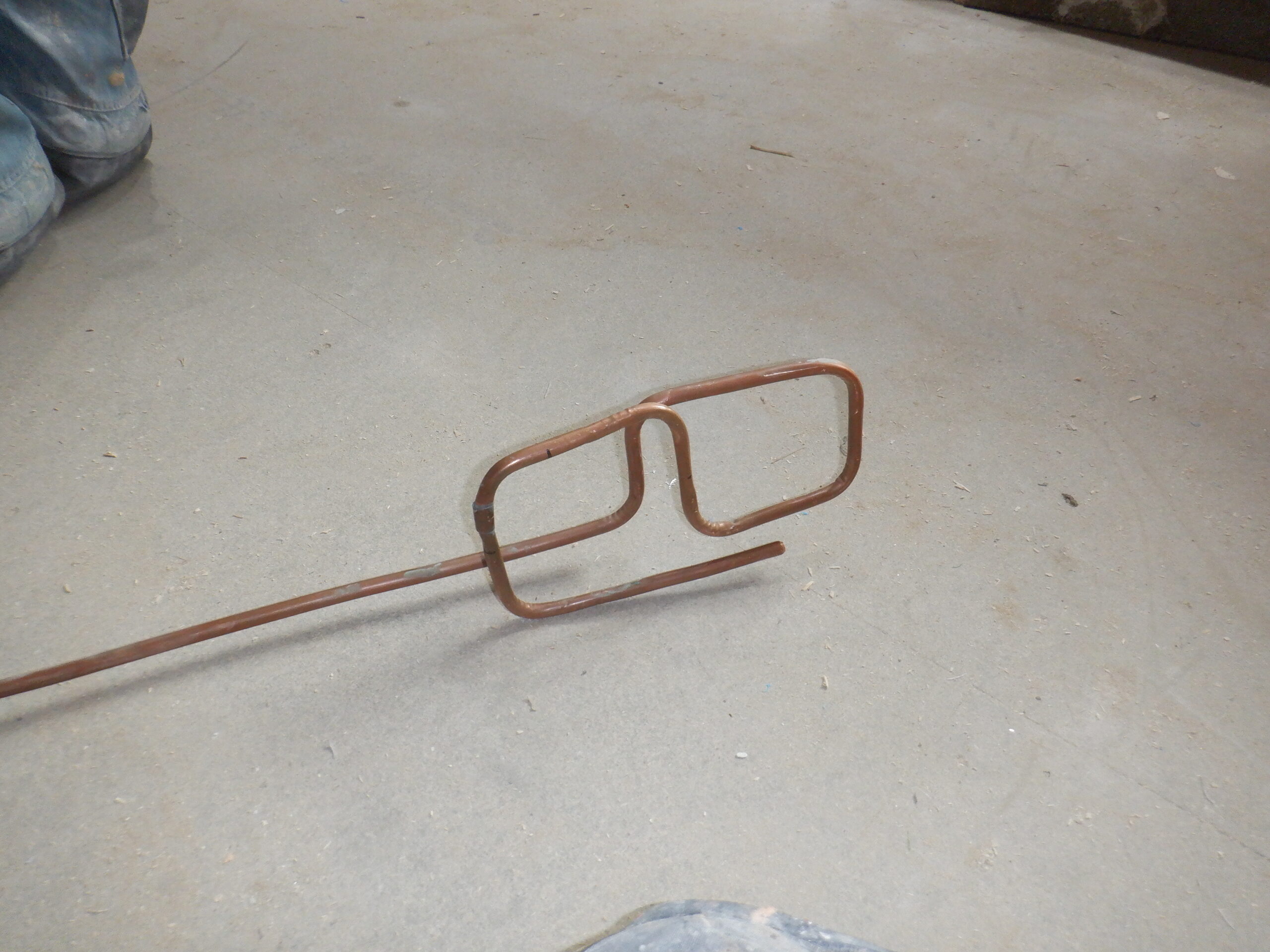
    We then started trying to bend the copper pipe around these template, but discovered straight away that the thin walled copper pipe kept on buckling and didn’t want to bend smoothly around. Oh Dear!

    So for Plan B! We decided to use our miniature pipe bender tool, designed to cleanly bend these microbore pipes but at a much tighter radius, of around 20mm, forming a bend that would be only 40mm across for a full circle. We still tried to use our existing template, to bend the copper pipe with right angle corners, and 60degree in the middle when we wanted to make the “figure-of-eight” shape but it was proofing very difficult. It was a matter of getting precise distances from one bend to the start of the next bend, to apply the bending tool in that precise location, to end up having the copper pipe going around the two upright plastic waste pipes. We had a little chaotic set of coils.

    Trying out pipe bending

    Trying out pipe bending


    By the way, we were using old copper pipe we had from a previous project some 15 years ago, so we were not losing material here with our experiments!!

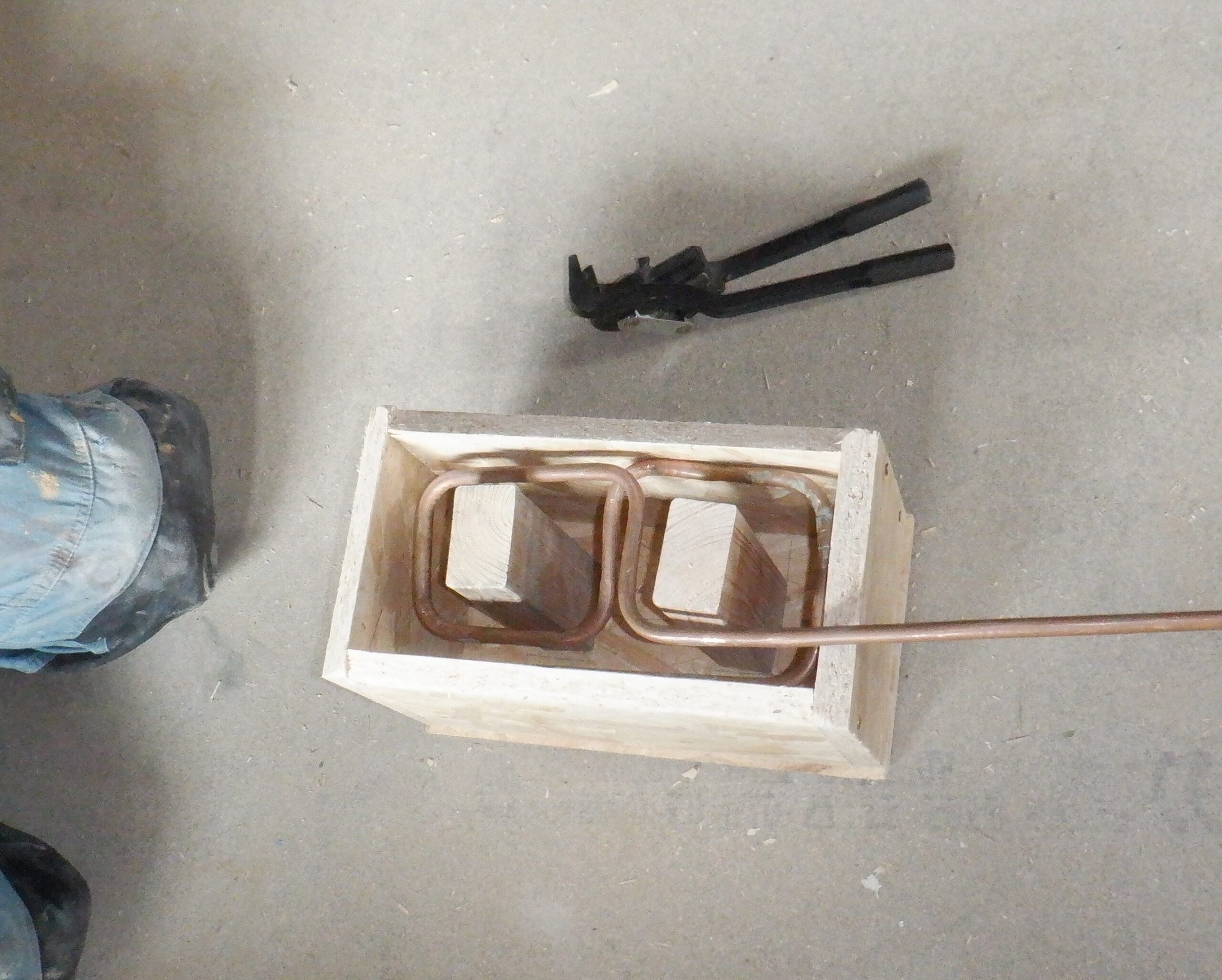
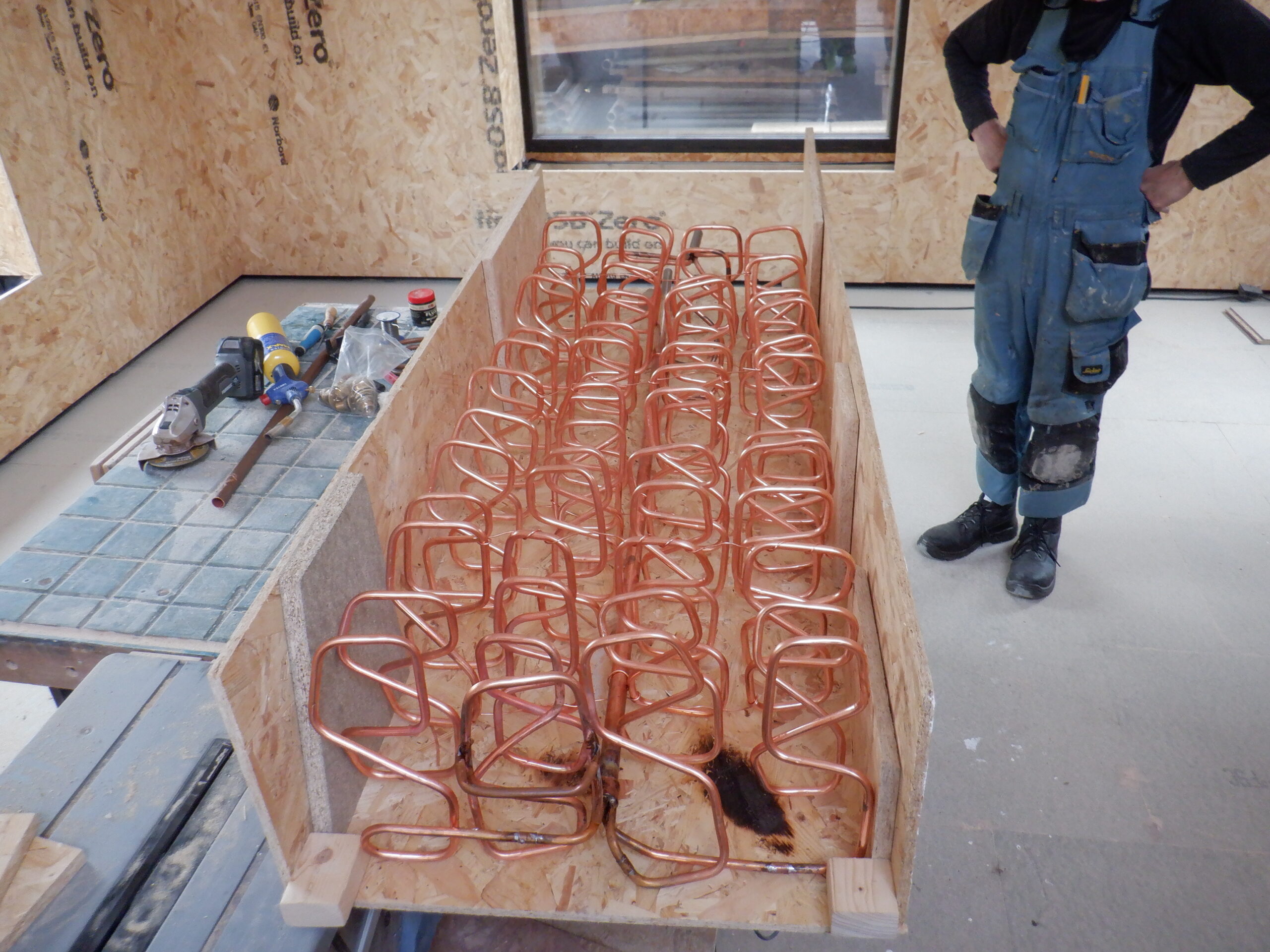
    What we ended up, as you can see in the photo above, is a random collection of lengths and gaps, which gave us the idea that if we change our approach slightly, like for example, if we build a rectangular box and, instead of the two plastic tubes, we mounted two wooden pillars using 63mm CLS timber, to ensure that we had maintained a cleared section to allow the insertion of the immersed electrical heaters as well. This box measures 270mm long by 130mm wide.

    Frame to constrain tube bending

    Frame to constrain tube bending


    We did another test run and it was much easier to randomly bend the copper pipe at various points, so long as it obeyed the basic requirement of going around each pillar in a figure of 8 movement, it doesn’t matter where or what path the copper pipe takes. It looks quite reasonable.

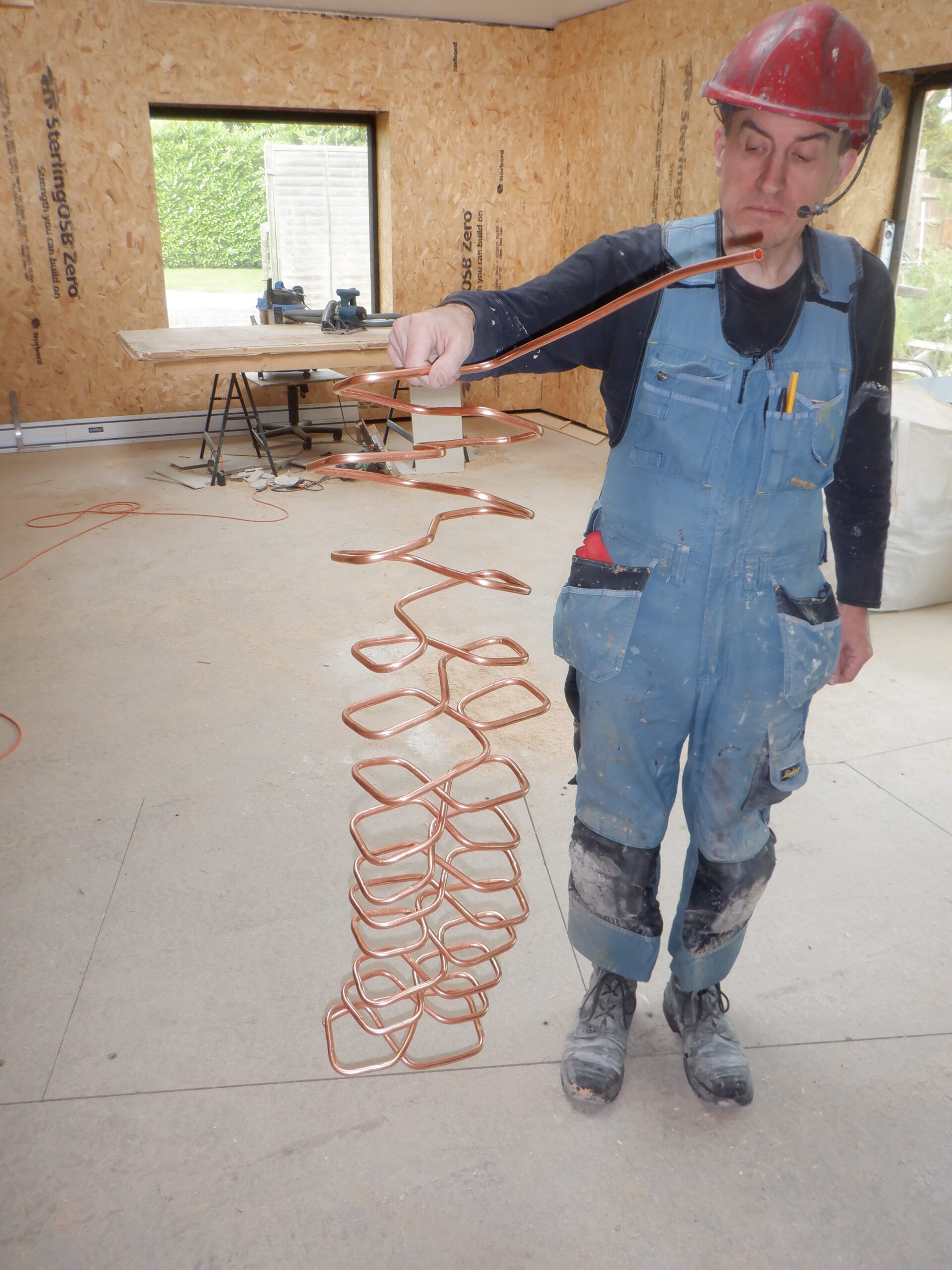
    So, we committed ourselves to using our freshly bought boxes of 10mm copper pipes, and proceeded to bend one column of random lengths and angles, to bend the entire 10 metres of the copper pipe, all into that limiting rectangular requirements. It took a couple of hours to do the job, but we ended up with a column, vaguely rectangular in shape. We pulled the approximately thirteen loops out, stretching it out to about 1metre tall.

    First heat exhanger formed

    First heat exhanger formed

    On another day, while waiting for the Cloakroom paint to dry, made two more “coils”, this time only taking about an hour to do all the bends. The third one had a slight crumpling up of one of the bends so we had to chop that out and replace it with a new bend and soldered the replacement back into that location.

    Then we did the fourth and final one the other day. We now have four of them, ready to be assembled together later on.

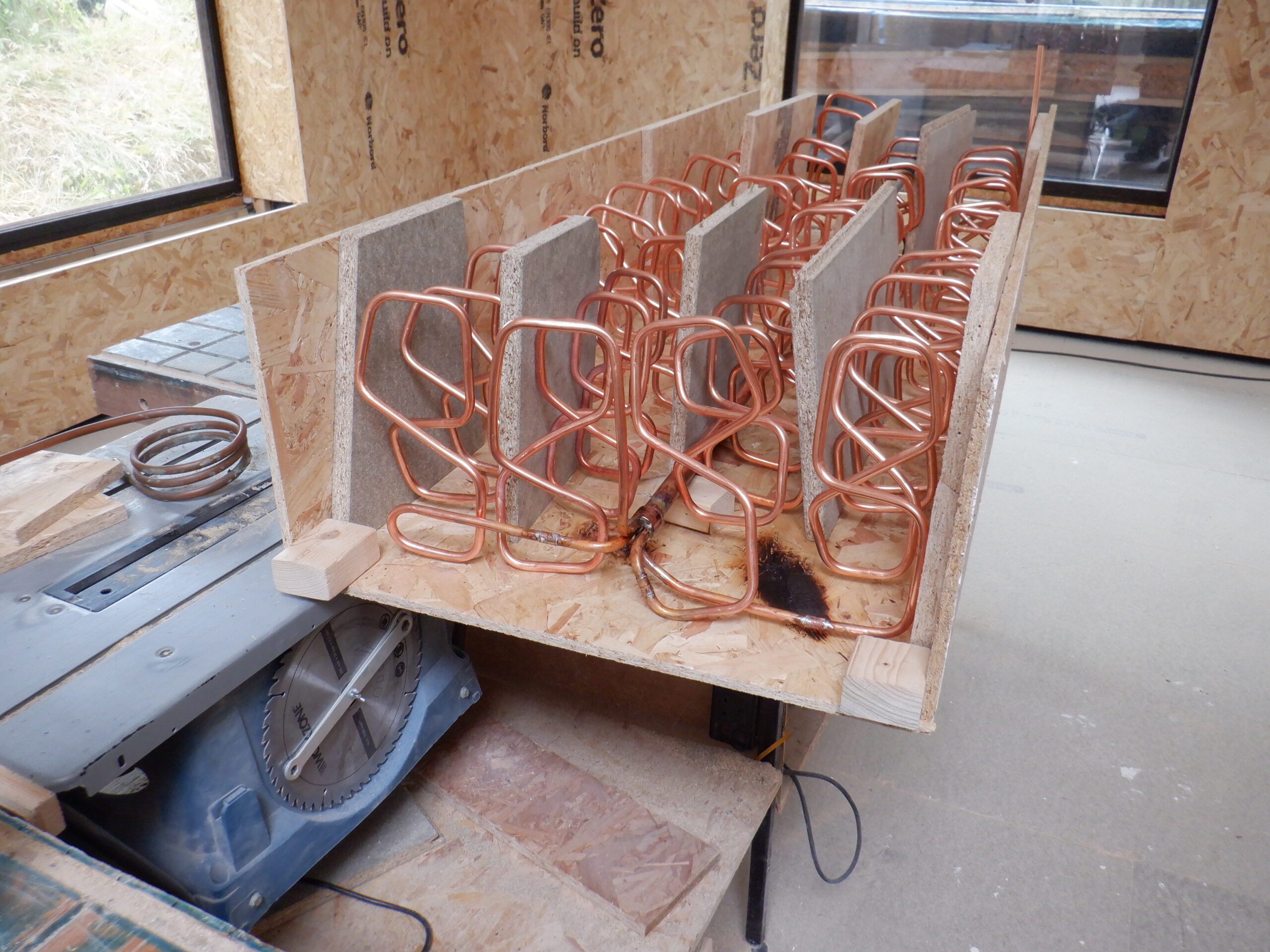
    On another occasion, while we were waiting for a new tin of acrylic varnish to arrive, we got on with the job of assembling our four coils, to form a single module, ready to be slid into the Hot Water Tank. So, towards this aim, we put together a rough and ready simple template of our hot tank, just the back and two sides, measuring 600mm wide and 300mm high, and 1700mm long, emulating the shape and size of our tank. Then, we put in 100mm wooden blocks at the top, to make sure that the copper coils do not occupy too far up the tank and we did a similar thing at the bottom, but this time, only a 50mm blocks so we can guarantee a buffer of water underneath the coils.
    We then stretched out all four coils, to fill the majority of the space. We noted that we could, and did, slide in pieces of 18mm and 22mm thick boards in between the coils, including on the outside too and that helped keep them much neater and separated from each other.

    Now these four separate coils needs to be connected together. I mean the actual copper pipes at each end, so that the water coming in, and out, of the tank, via a 22mm copper pipe, can be split up and flowing around the four group of coils, transferring the energy in one direction or another.
    We got a very neat brass adapter that fits to a 22mm size copper pipe and four 10mm holes, arranged in a two by two grid, on the other side. We managed to carefully bend each separate coil “tails”, sometimes with an extension piece, and connect each tail into this adapter. Then, we cleaned all the joints, put on flux and then got our gas torch to heat up all the joints and melt solder in the joints.

    Heat Exchangers Base

    Heat Exchangers Base

    Heat Exchangers base manifold

    Heat Exchangers base manifold


    The 22mm copper pipe went up the middle and pokes out the top end.

    We then repeated the process to the other end of the coils, and soldered the adapter and joints in a similar manner. This time, we put on a little short piece of the 22mm pipe. Both of these pipes will have elbow right angle bends but we will do that later on when we got the whole thing inserted into our tank.

    We then bend a small piece of 10mm pipe, into a “U”, to make a “foot” to take the weight of the heat exchanger and also maintain a 50mm gap at the bottom of the tank. That was also soldered into place too.

    Then we slid in a length of 28mm copper pipe down through the coils and anchored that into place by twisting some thick copper wire we found in our left-over cable scrap box. We also threaded some more of the thick electrical wire (we stripped off the plastic coating) and anchored the coils together as well, to stop it wiggling around.

    Heat Exchangers in place

    Heat Exchangers in place


    Another additional little task we did, was to twist little pieces of wire on the outside of the coils, between it and the walls of the tank, to provide a simple way to make sure that the coily module will sit nice and centred in the tank and keep away from the wall surfaces. We had to solder these pieces into place, to stop them twisting out of alignment.

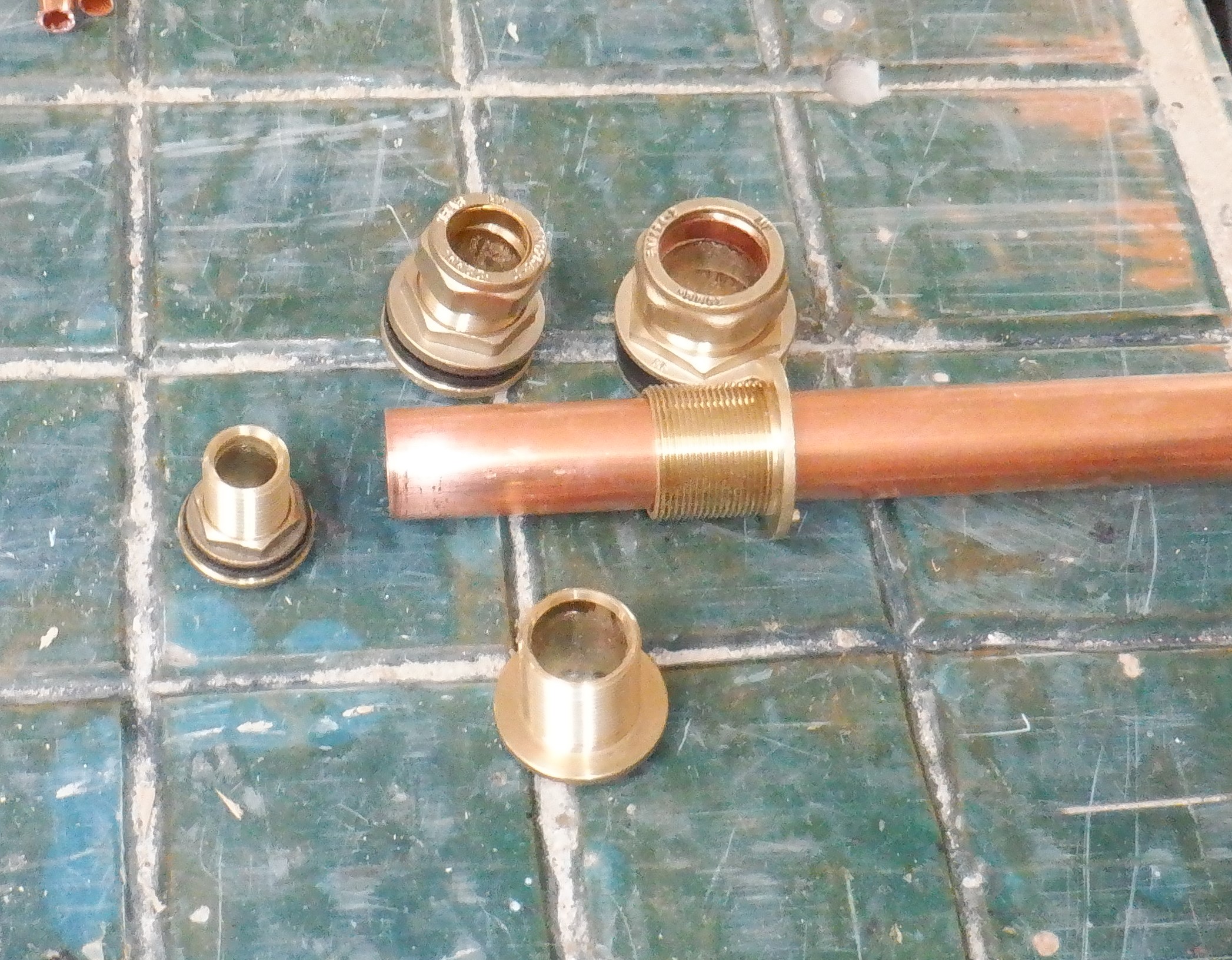
    All these pipes (the two 22mm ones plus also two 28mm ones) and also a 15mm filling pipe that we haven’t mentioned yet, will all need a tank connector mounted at the top of the tank, to allow the copper pipe to gain access to the outside world. But, we want to slide the copper pipe right through these connectors, but that can’t happen until we have grinded an internal flange away. We used a 16mm HSS drill to ream out the 15mm tank connector, and used a tungsten carbide grinder to do the job in the four larger connectors.

    Tank Connectors reamed out

    Tank Connectors reamed out

    finally, we could do a “leak” test at last! We connected up our compressed air adapter which we had previously assembled, using various plumbing bits and pieces, joined to our tyre adaptor. We push it on the 22mm pipe, blasted air down inside the long coily pipes, to remove any rubbish. Then, we put on an end stop on the other 22mm pipe and built up the air pressure inside the pipe. We had a hissing sound!! We squirted some soapy water on everything, to track down the source of the hissing noise and eventually located it to a repaired section where one of the inline joints was leaking. It took us two goes to plug the gap in the joint with melted solder. We then tested everything again and this time, we held tight! Our testing adaptor has a digital pressure gauge and we put in 3.90bars of air and it stayed steady for a couple of hours, only very slightly dropping to 3.88bars, which is probably as a result of temperature change. We had squirted more soapy water on all the joints and see if bubbles formed like a little miniature volcano .. but none developed. Yippee!

    The last thing we did, was to slide a length of plastic 10mm pipe down in among the coils, to serve as an temperature probe. We sealed the bottom end with a brass end cap compression fitting, to make it water proof, but also, to provide a good metal heat sink to help warm up the thermometer sensor that we will slide down inside the 10mm plastic pipe. We even put in a blob of thermal transfer paste, to help improve the connection between the thermometer sensor and the hot water that it will be measuring near the bottom of the tank. We did another one, but a much shorter one, to measure the top of the tank.
    That concludes making the Heat Exchanger module !!

    The next job is to patch up the tank itself and then we can install the heat exchanger in for real, and connect all the pipes through those tank connectors to the outside world!!

  • Installing Utilities underneath the Cloakroom and Beyond

    We started putting in the Utility pipes and ducting underneath our downstairs toilet, which we are calling by its traditional name of a “Cloakroom”, which is a very odd name as there is no evidence of cloaks or hats or sticks at all!
    We wanted to make progress on implementing an actual toilet, fully flushing and everything, including having a working hand basin as well. So to achieve this goal, we needed to make sure that we have installed all the necessary pipework, and air ducting, that goes under the floor, to the other Ensuites behind, including going upstairs too.
    Our downstairs Hallway have various Utilities travelling down its length, the major Air Duct travelling down the middle of the house and both hot and cold water in the side branch. So this is where we need to “tap-off” several feeds to each of our surrounding smaller wet rooms, like the Ensuites, toilets and shower room upstairs.
    So, we started by putting in two manifold “distributors” in a line, and connected to our pressurised cold water. Each of these manifold units comes with three 15mm side branches so we have six in all. Four of them will be heated up by the hot water and fed to the following destinations; the Shower Room upstairs, the Toilet’s basin upstairs, Work Room Three’s Sink upstairs and the Cloakroom’s basin.

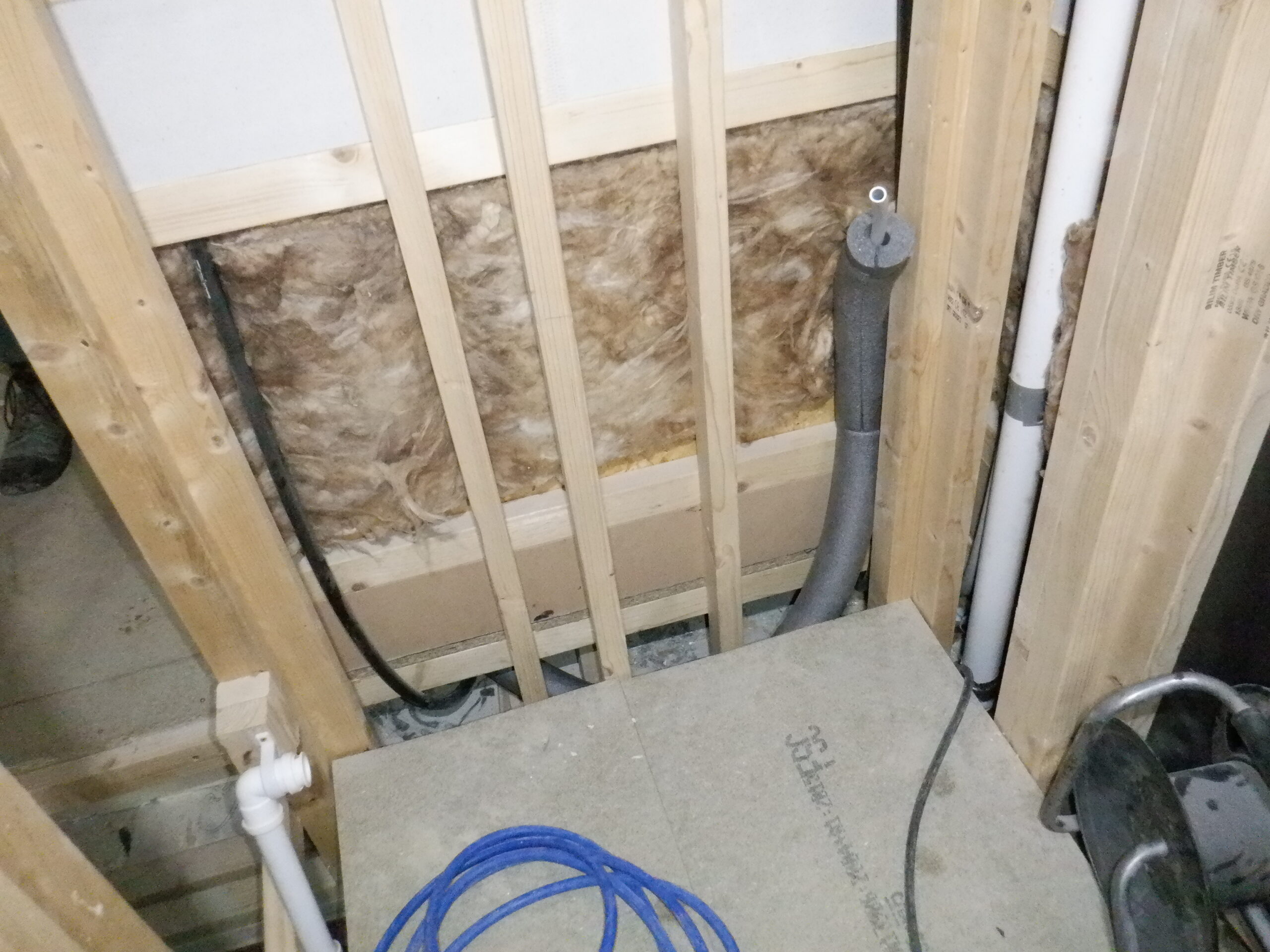
    We installed a length of 15mm plastic water pipe, insulated in 75mm thick tubular foam for our cloakroom downstairs and left it sticking out of the wall, ready to be fed through holes in the wall boards when we get that far. The other end will be connected to our hot water mixer / heat exchanger unit which is located in the hall, along with a motorised valve so the computer can control the flow of water going into the basin. Then we did a second hot water 15mm pipe wrapped in more of that 75mm foam insulation material, went up inside the wall space to the First Floor joist and then sideways to head to the back of the upstairs toilet and then turned upwards and be ready for plumbing into that basin. There are two more hot water connections, the shower and workroom sink, to be done later on as these don’t cross our Cloakroom.
    The other two 15mm connections are straight direct cold water feeds to the cistern for the upstairs toilet and the cloakroom downstairs. They were threaded through the walls from under the floor and is now waiting for the equipment to be installed.
    Then we put in a 32mm wide waste pipe that connects to our main waste stack, drilling out a side connector and inserting a rubber bung that has a 32mm hole to take the waste pipe coming from the basin. We terminated this pipe 6inches off the floor, sticking out of the wall that separate the cloakroom from the Linen cupboard. Again, we will have to drill a clearance hole through the wall boards when we come to fit them up.

    Cloakroom Water supply

    Cloakroom Water supply


    Now it is the turn of the air ducting.
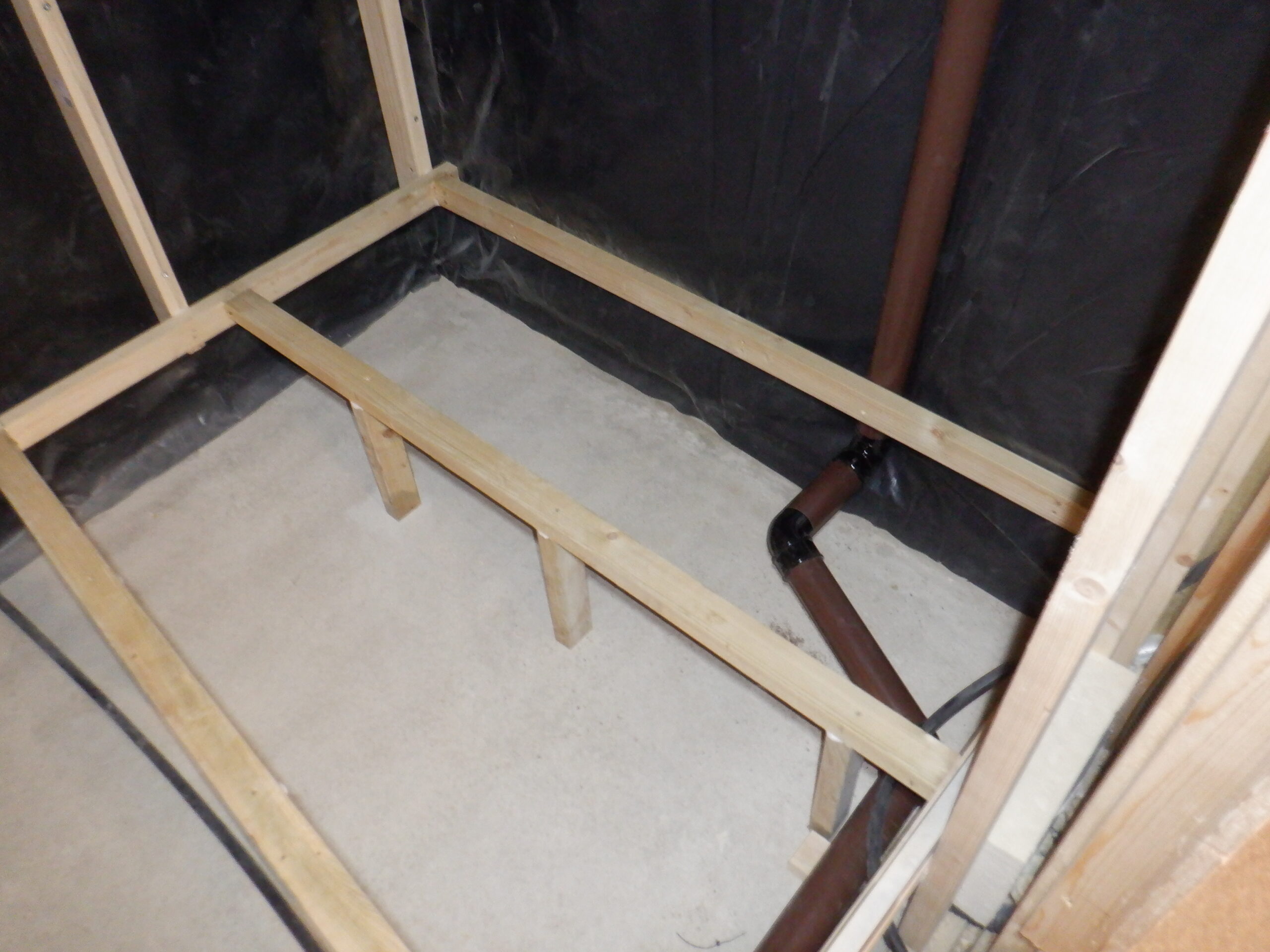
    The air ducts needs to travel all the way to the far Ensuite (number Two) and we decided that we needed to build the framework for both Ensuites flooring so we had legs to attach these tubes to. See Ensuite 2 floor framing (2)

    Ensuite 2 floor framing (2)

    The following air tubes to install, were the orange flexible 50mm diameter conduits. Another long one to take fresh warm air to Ensuite Two, to approximately half way on the back wall, ready to plug into a left, and right, distributor, one for the Vanity Unit, and the second one in the Shower area. These are much slower and are used to provide a constant room temperature gentle air flow to keep the room fresh and dry. Of course, this utility will slow right down, or even stop, when one is having a shower. Anyone would feel a draught when one’s body is wet all over, one would feel the chilly breeze!!
    A similar air conduit is installed for Ensuite One, to swing around and terminate about half way in the middle of the back wall, opposite the entrance way.

    The next orange conduit is for the Cloakroom and then the Linen Cupboard, needing only short lengths but this time, we connected a right angle bend on the ends and carefully positioned it so it points into the room. The Cloakroom will have this fresh air come underneath the Vanity unit, again slowing right down when the room is occupied. The Linen Cupboard had the 90degree bend pointing upwards near the back of the floor and this will provide lovely fresh warm air constantly inside the cupboard and keep our linen dry and fresh.

    Air supply for linen cupboard

    Air supply for linen cupboard

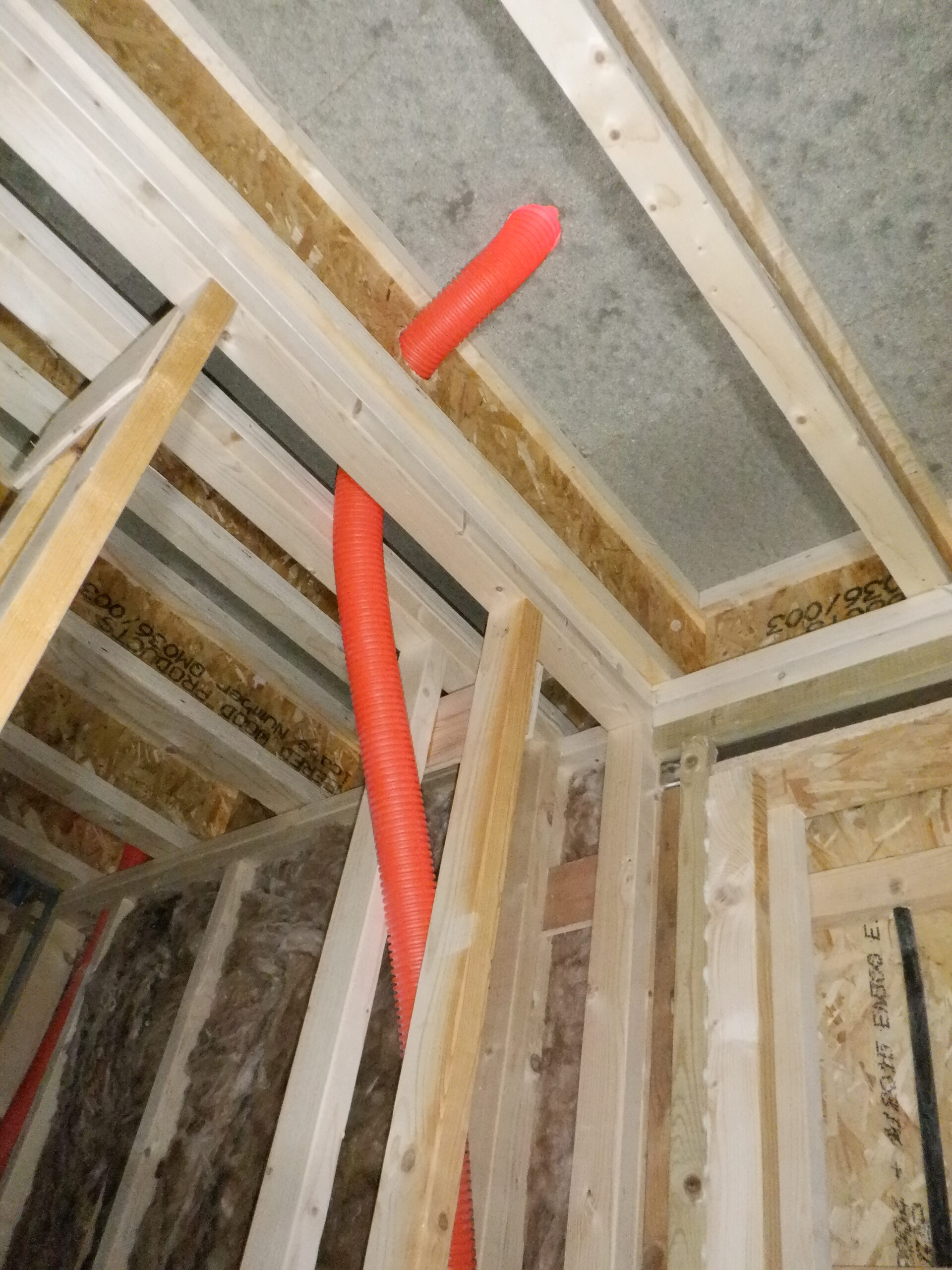
    The final orange one is being another 50mm flexible conduit to supply fresh air to the upstairs toilet, so it has to travel across the Cloakroom and then bend up inside the wall body (the wall that separate the Cloakroom from the Ensuite One) and then travel sideways inside the First Floor Joist space, to reach beyond the boundary of the Toilet, at which point, it will turn upwards and plug into another right angle bend, to poke out just underneath the Vanity unit like this cloakroom.

    Air supply for upstairs WC

    Air supply for upstairs WC

    The final piece of air ducting to do, is another rigid 68mm brown pipe, for another high-speed hot blast, going to Ensuite One, just the other side of the dividing wall from the Cloakroom. This will also turn up inside the wall space and pop out around chest height too.

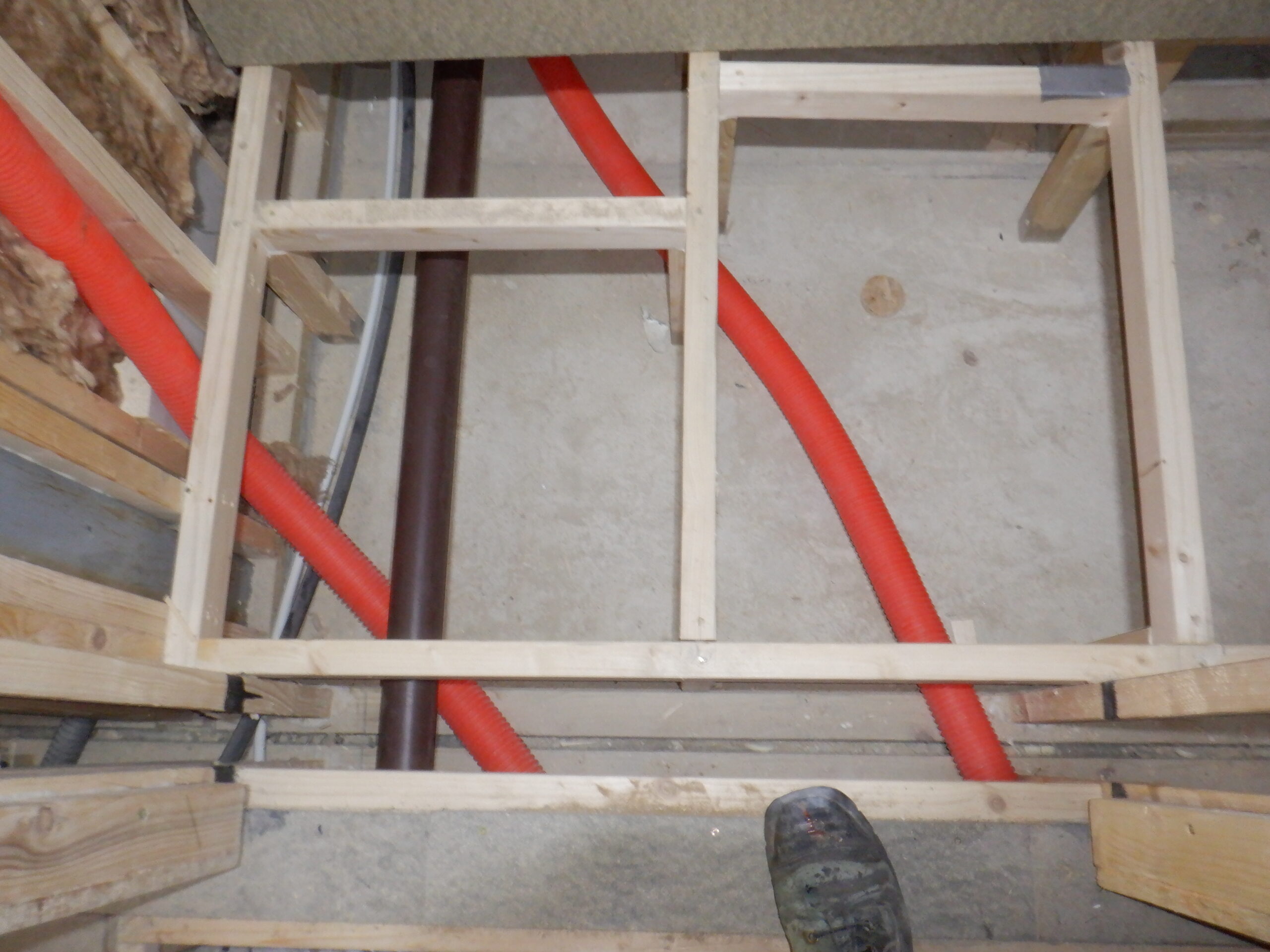
    Air ducts under cloakroom

    Air ducts under cloakroom

    All these air ducts will be connected to our main Air Duct, using specially design “collectors” that draws a controlled amount of fresh air out of the air stream, concentrates it down to a smaller diameter, passes through either a water based radiator, or an electrical heater, plus also an air flow rate sensor and a temperature sensor too and then further reduce in diameter to fit either these 68mm pipes, or the 50mm diameter conduits.

    This concludes this piece of work, putting everything we need underneath the flooring, in the Cloakroom, and we can now glue and screw down the floorboards at long last. We then can start building up the walls!

  • Hot Water Tank Constructed, And Tested!

    It is time to start making the mould for our Hot Water Tank this week. We took the material we used for the Cold Water tank and managed to reused most of the pieces. Only one was deemed to be too far gone.
    We had a slight delay because our track circular saw machine had suffered an accident (it fell off the table!) and twisted some of the mechanisms. It is an old ALDI product of many years ago but we were very lucky to find a eBay seller that had collected up returned units (somehow!) and just for £50, we bought a replacement machine. It looks and feels brand new, with an original saw blade and everything.

    While we were waiting for that to arrive, we switched over to doing work on the Cloakroom instead. We resumed the construction of the new smaller mould, measuring 600mm by 300mm and only 1700mm tall. We decided that we would follow the same design and method of assembly, because one of us (the thin one!) still can slide inside and screw .. and unscrew .. the various fixing points around the base of the mould and up both sides as well. We screwed on a chunk of CLS piece to the bottom board and tied a rope to it so we could pull off the final piece when the tank is constructed and we were disassembling the mould.
    We routed all the edges to make them smooth and rounded, just like last time, to provide a gentle change of direction so the fibre glass has maximum strength going around corners. We put it on a large base and then filled the bottom edge with polyfilla to round that final edge that will form the flange of the tank.
    The whole thing then got wrapped up in parcel tape, to act as a mould release. We switched back to using the clear sticky tape because we discovered that the brown parcel tape was too thin and it allowed a lot of the sticky to ‘leak’ through the plastic film and deposit it on the fibre glass resin. Our test tank didn’t suffer this fate and that used this clear tape. We had one whole roll left and a little bit on another roll. We almost made it! We had to use some of the brown tape but from a different roll which we hope is of a higher grade and not cause too much trouble. Fingers crossed!

    We transferred the mould back to the Garage and put it back on the same spot as the previous tank! It really makes a mess on the garage floor and we will definitely will need to come along and grind off all these splash marks etc.!

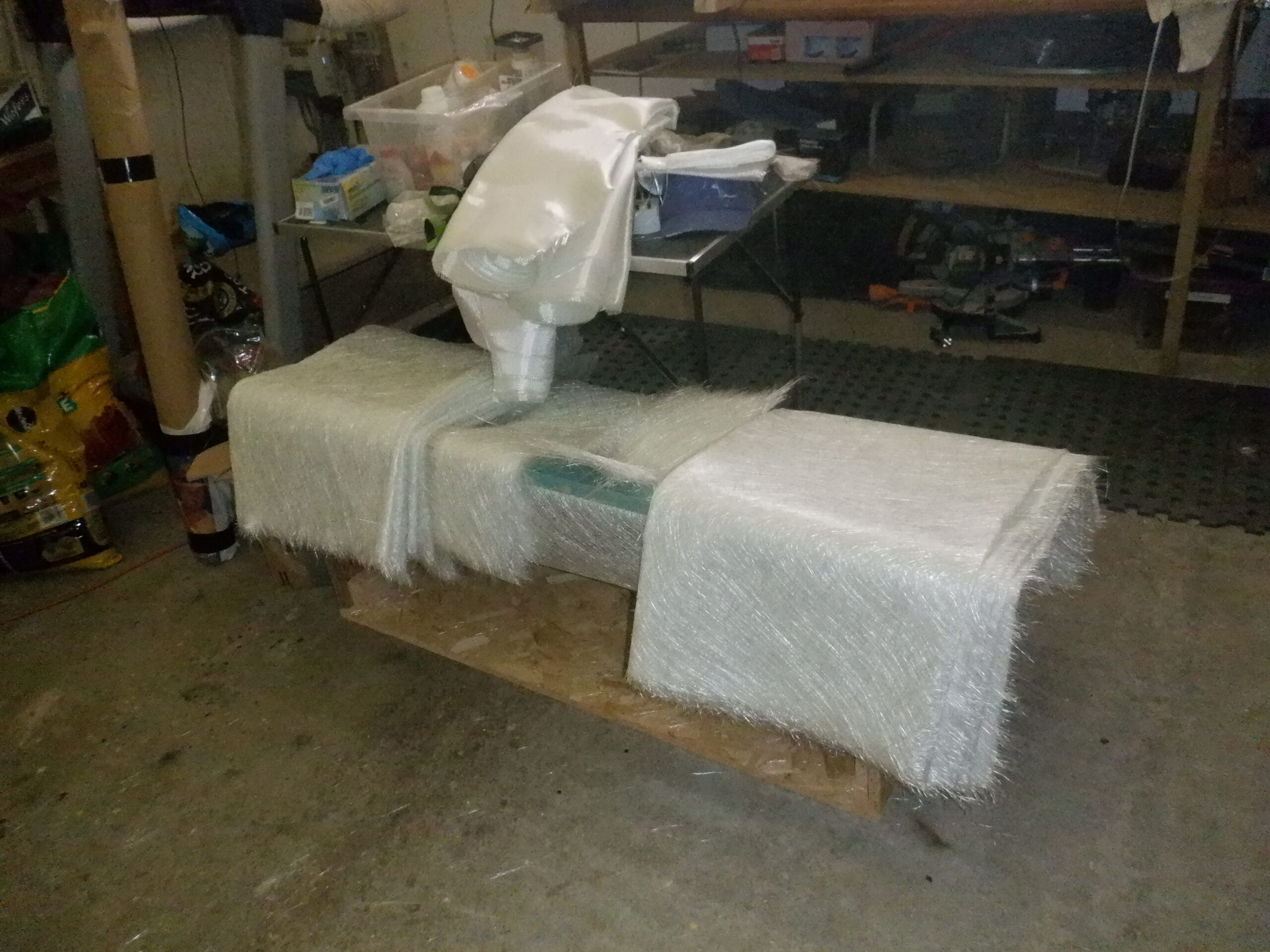
    We then cut off our giant roll of glass fibre matting sixteen pieces measuring 1850mm each, for which eight of them were folded up into a pile, and the other eight was torn at 165mm from one end. The larger pieces were folded up and put into a pile too. the 165mm cut-off pieces were then torn into eight 700mm lengths and sixteen lengths of 400mm, all in their piles as well. These pieces are the base of the tank, to make eight layers of matting in total. The other longer pieces will wrap around the tank itself, hence the 1850mm number, the circumference of the tank. The final piece of preparation was to cut off our woven glass fibre cloth a piece of 450mm length and cut the width in half, making two pieces of 450mm by 775mm. These will go on the base. Then, two longer pieces of 1900mm to form two pieces of 1900mm by 1550mm which will wrap around the tank, and almost reach the bottom of the mould (the height is 1700mm) but the flange will provide enough structural strength by itself. These woven cloth pieces are very good internal structural elements because they are made using a single fibre of glass filament and therefore, will provide more tensile strength, at the 90°C temperatures that this tank is going to have.

    Materials staged for hot tank

    Materials staged for hot tank

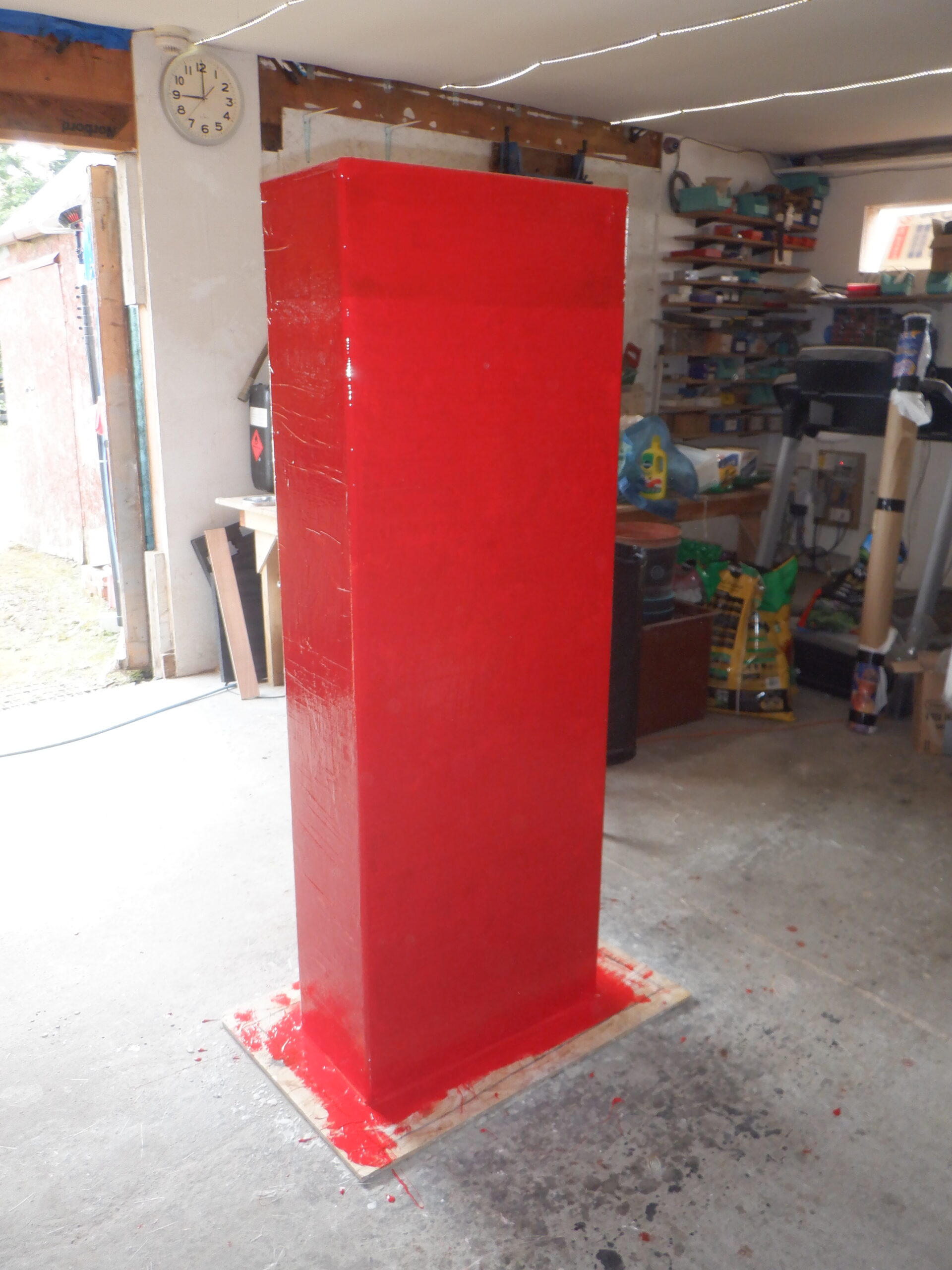
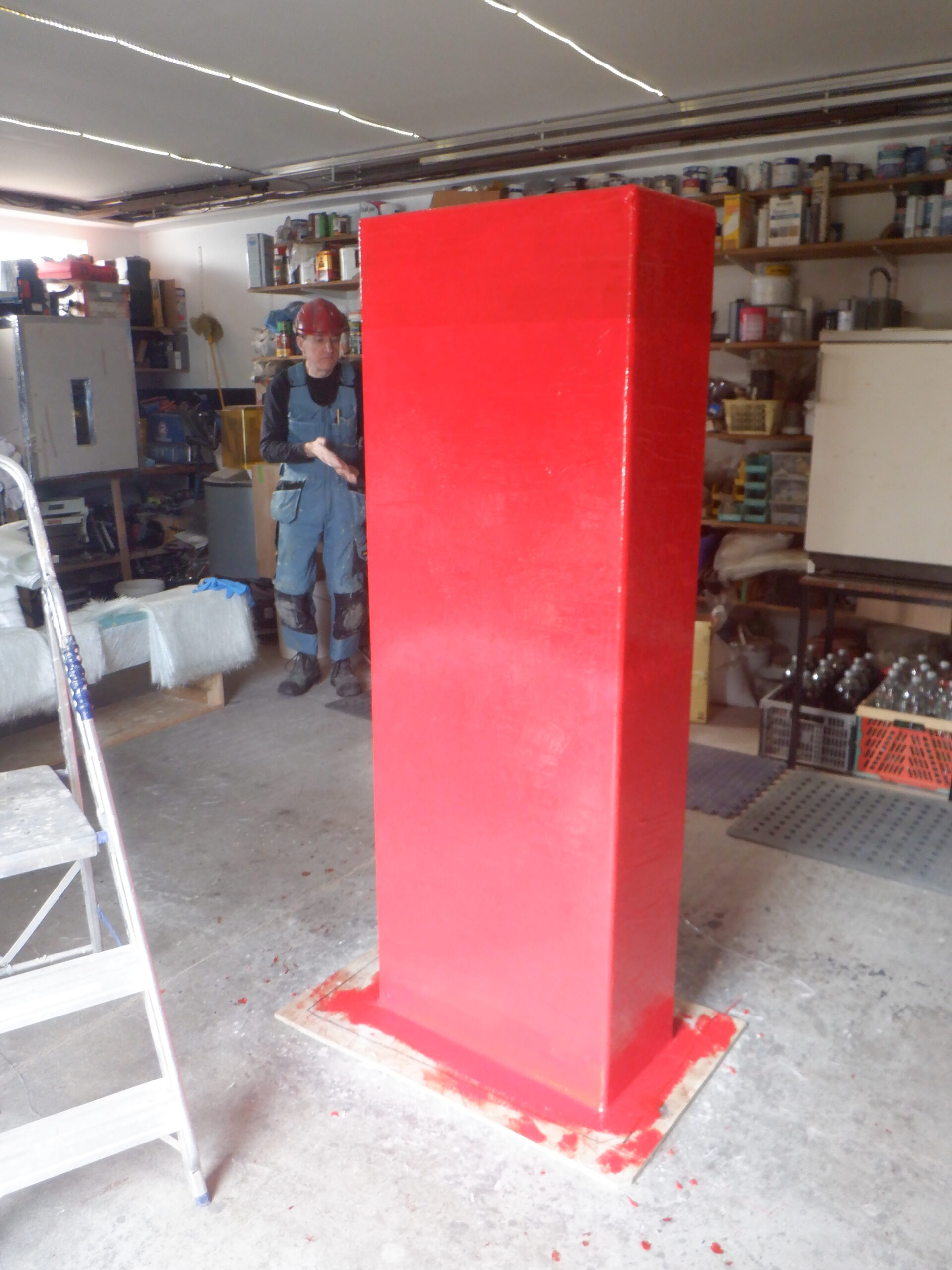
    We started really early the next day at just after 8am because we needed to put on two layers of what is called ‘Gel Coat’ which are extra thick resin which provides a solid layer of resin without any glass fibre in it at all. The problem is that we have to wait for this Gel Coat to solidify which can take an hour, before we can put on the second layer. Hence why we started so early!! We mixed in a lot of red pigment into our 5kg tin of special resin so we can see how well it gets painted on .. or not. The first layer went on directly onto the prepared mould and left to cure.

    First Gel coat applied (1)

    First Gel coat applied (1)

    First Gel coat applied (2)

    First Gel coat applied (2)


    we then went off to have breakfast and do some of our morning chores while we waited.

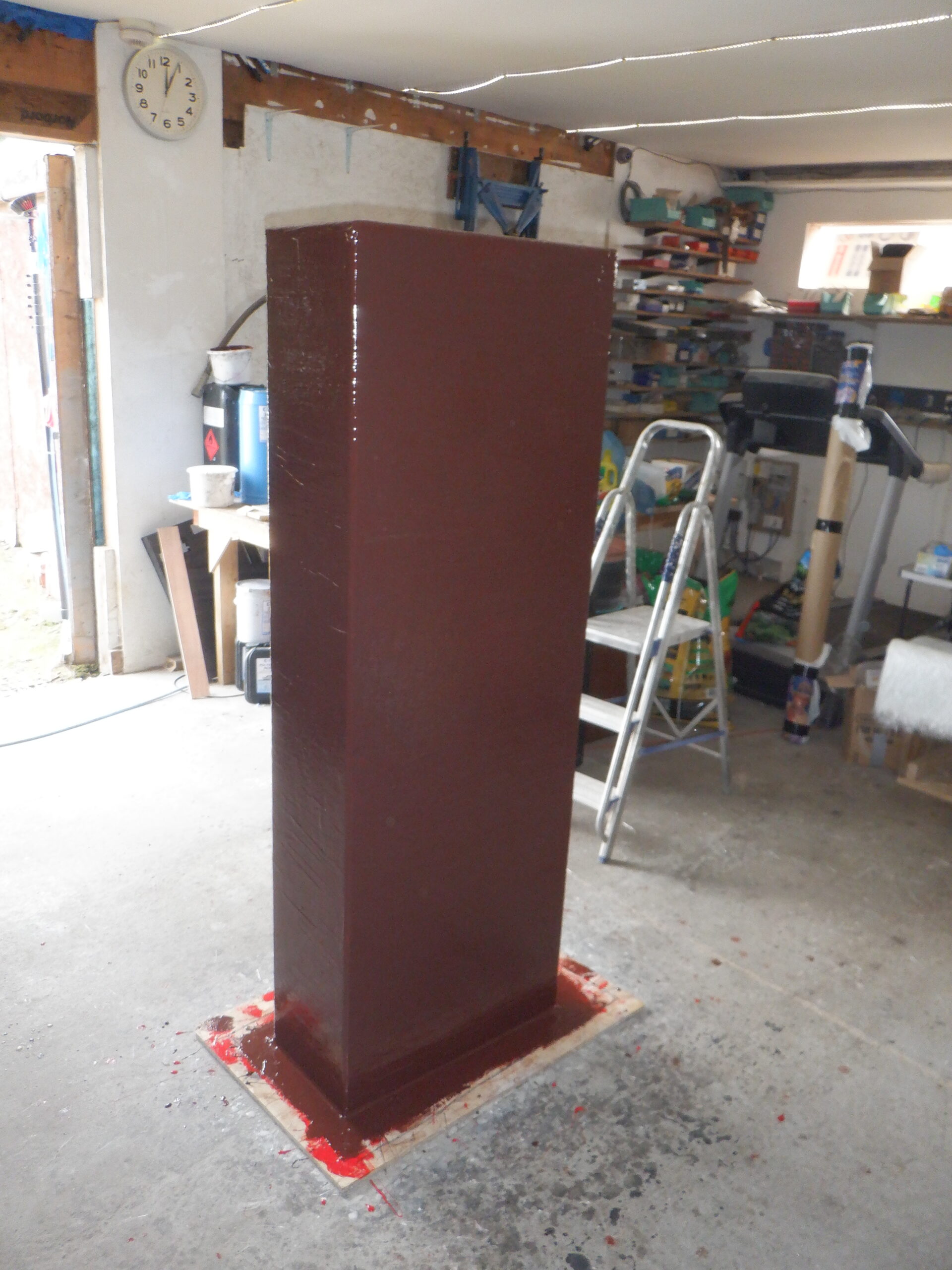
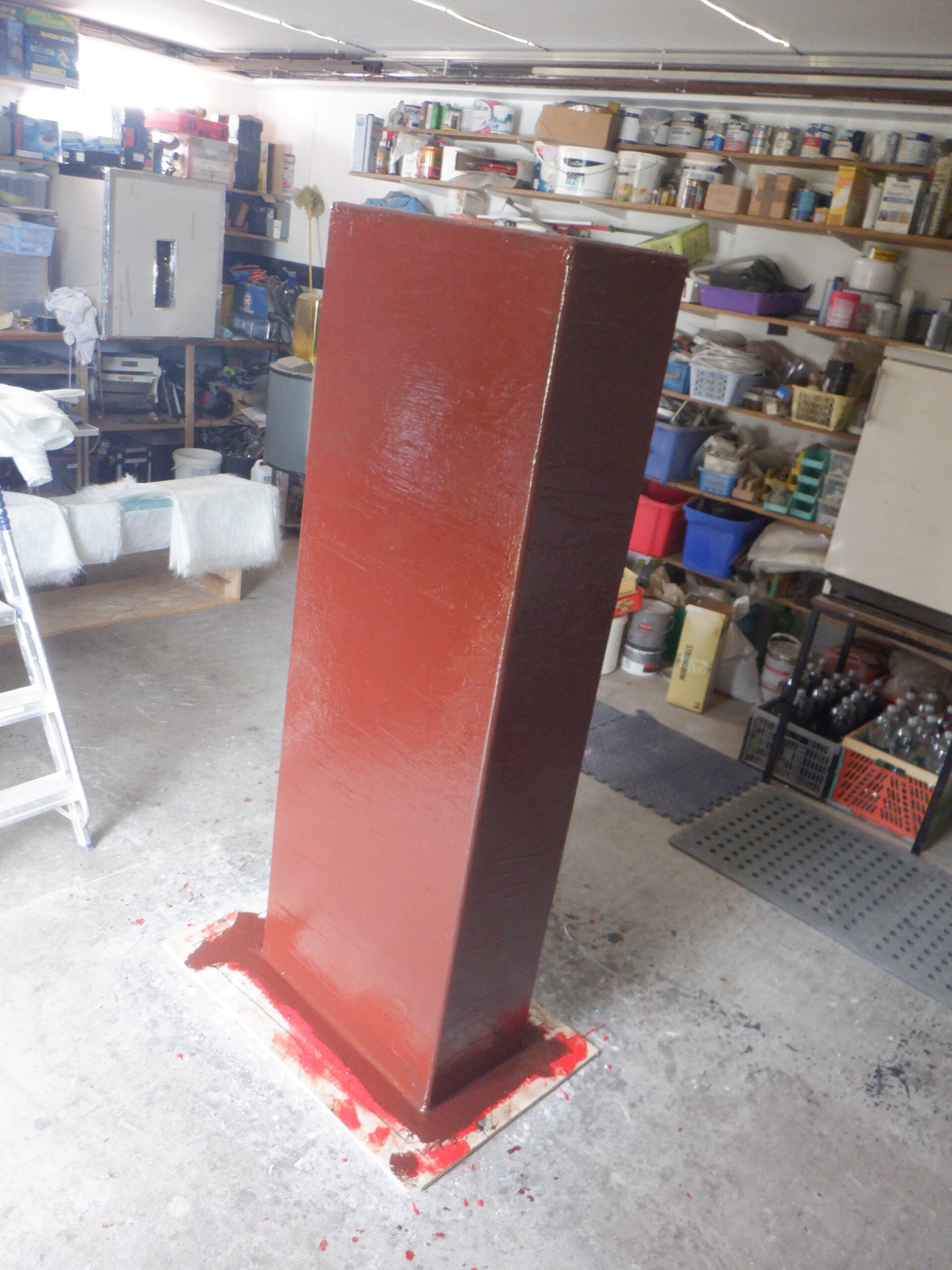
    About one and an half hours later, it was firm enough to allow us to put on the second layer. We mixed in a little bit of cyan colouring dye and it turned to a muddy brown colour !!
    That is fine as we can see a contrasting colour so we can see where we painted etc.

    Second gel coat (1)

    Second gel coat (1)

    Second gel coat (2)

    Second gel coat (2)


    This brought us up to approximately 12noon so we decided to have an early lunch and resume work at 1pm, instead of our usual 2pm.

    The next stage is putting on the glass fibre matting and coating it with regular resin this time. We first coated the whole mould with naked resin to wet the surface and helps hold the matting material on. We started at the top of the mould and put on two narrow strips and rolled more resin on top. Then, wrapped horizontally our wide matting strip and wetted that down, followed by the second horizontal but slightly narrower strip, to the bottom half of the mould and down onto the flange as well. Then, we proceeded to do this again, alternating with the horizontally strips so that the join is always well covered. We did the same at the top of mould too, alternating between two narrow long strips and four shorter ones but rotated 90degrees, so, again, the overlapping joints are thoroughly covered and reinforced every time.
    We did three layers of matting before we put on one of the two woven cloth layers. We then put on a fourth matting layer on top of that, before we stopped for the day. We were getting tired.

    So on the next morning, again slightly earlier than normal, at 9am instead of 10am, we resumed our work of building up layers of glass fibres. We put on two more layers of matting (which are random short pieces of glass fibres) before we put on our second woven cloth. And then we finished off putting on the final two matting layers. We rolled the surfaces all over using an metal aluminium textured roller which is designed to colligate the various layers of glass fibre and the resin together and also make sure that any trapped air bubbles are forced out of the mixture as well. We have been doing this several times over during the whole job.

    All layers applied (1)

    All layers applied (1)

    All layers applied (2)

    All layers applied (2)


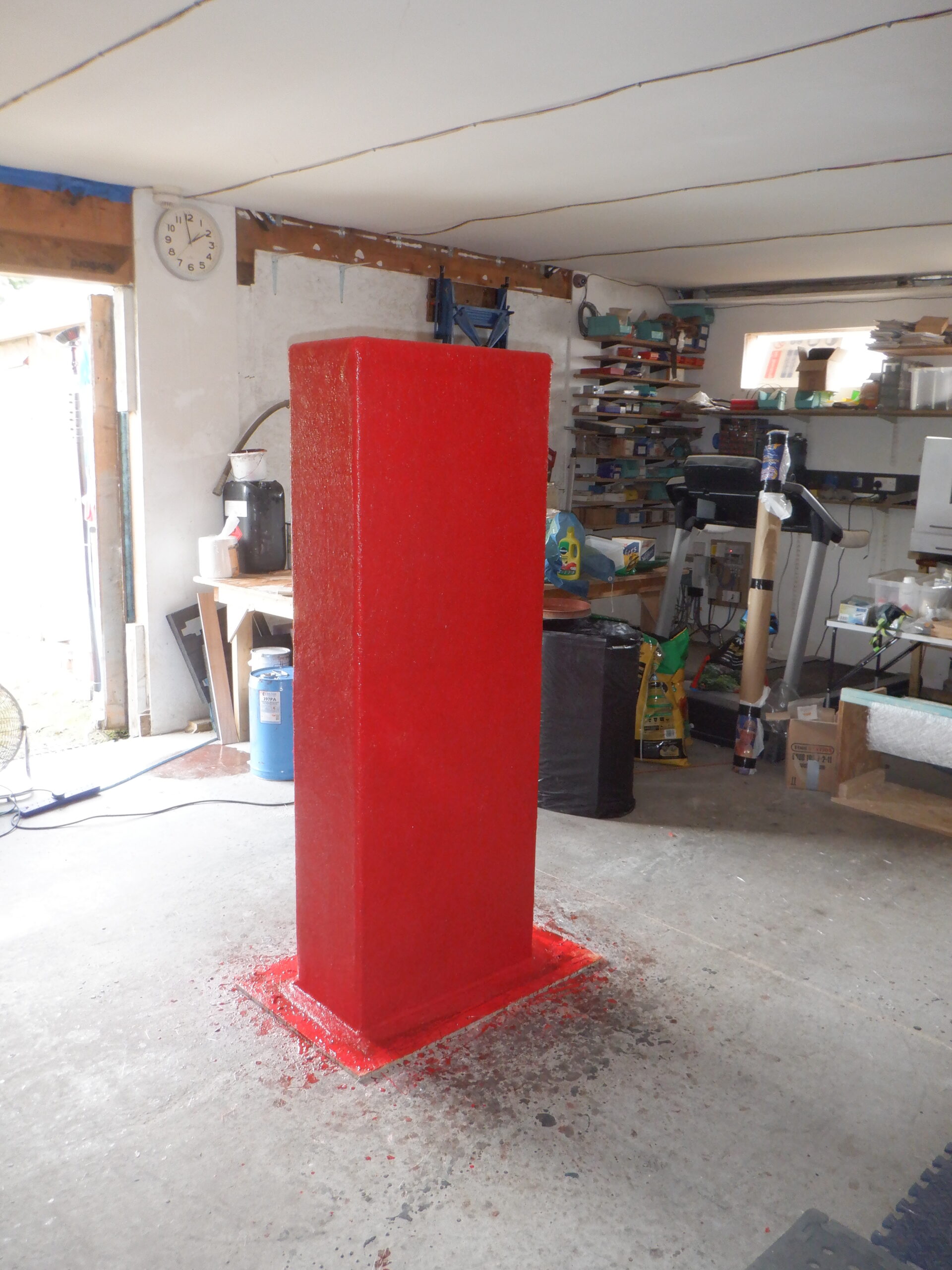
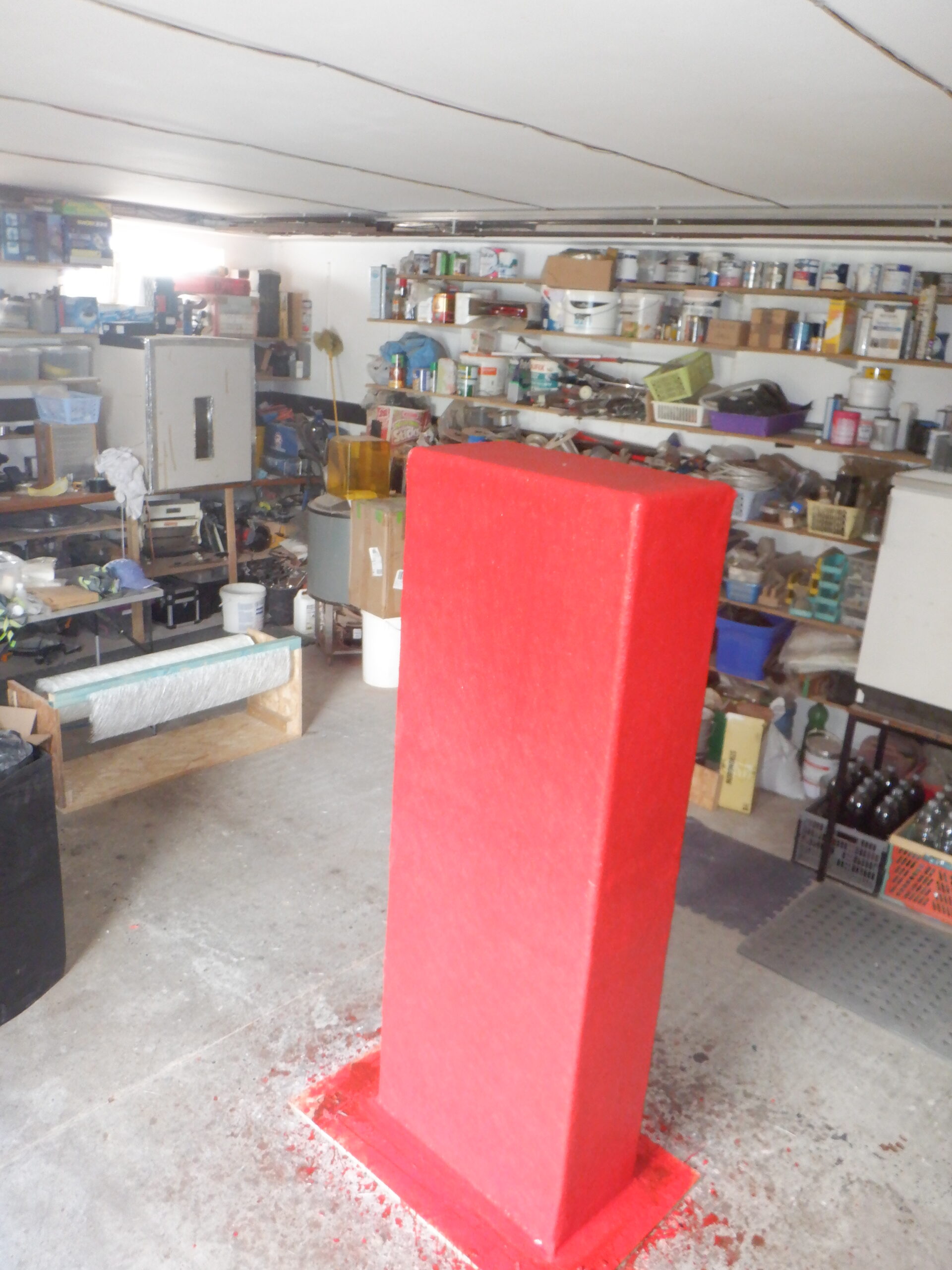
    We left it in the middle of our Garage for a few days, to cure and harden, before the next job of removing the mould.

    After a couple of days of curing and hardening, we tackled the job of removing the wooden mould. The first job was to trim the flange all the way around, using our wiggle saw and a piece of 25mm thick piece of wood as a guide. This will provide a flat surface for our lid to sit on when we have finished installing the various elements that will be dangling inside the tank.
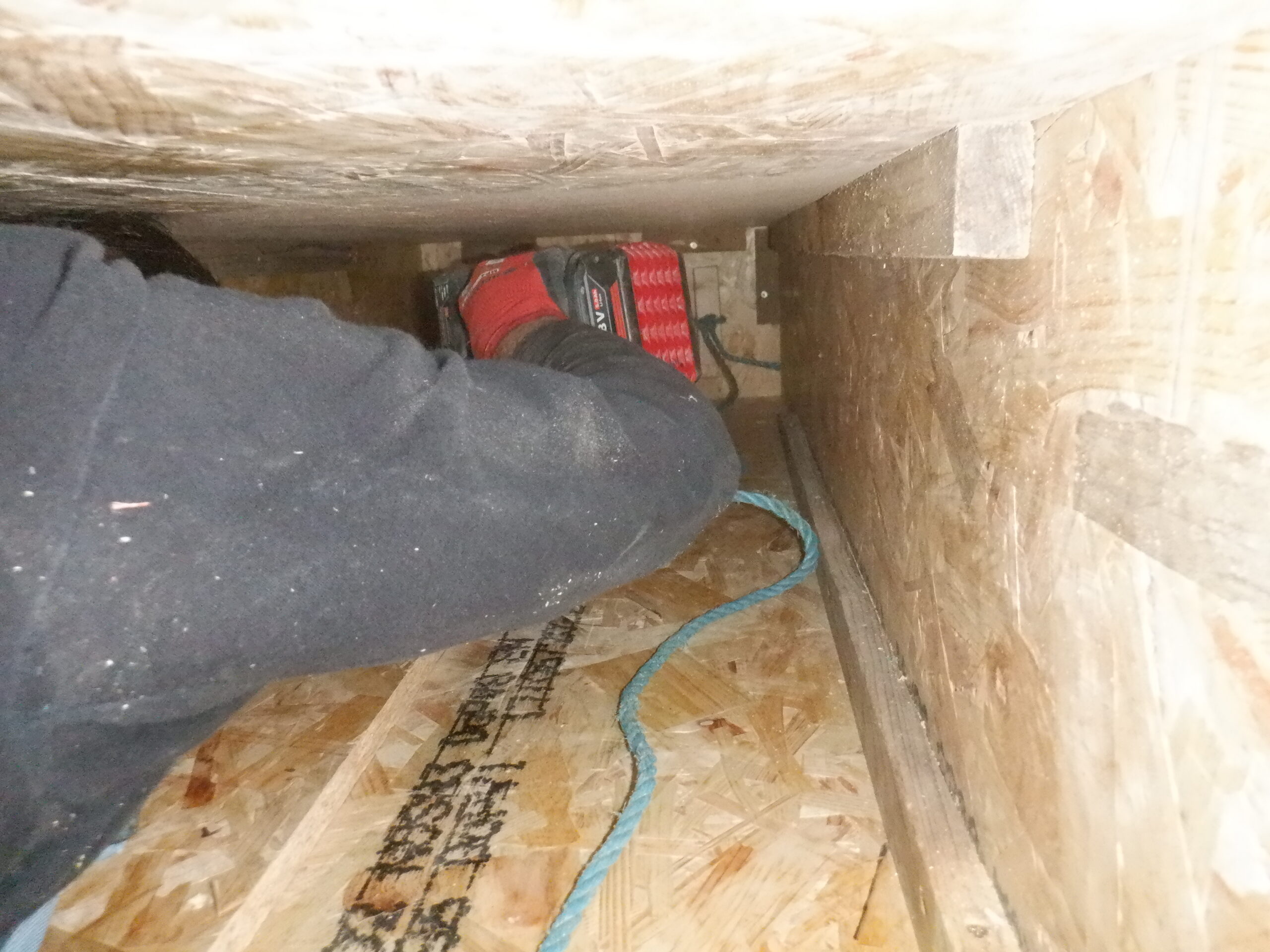
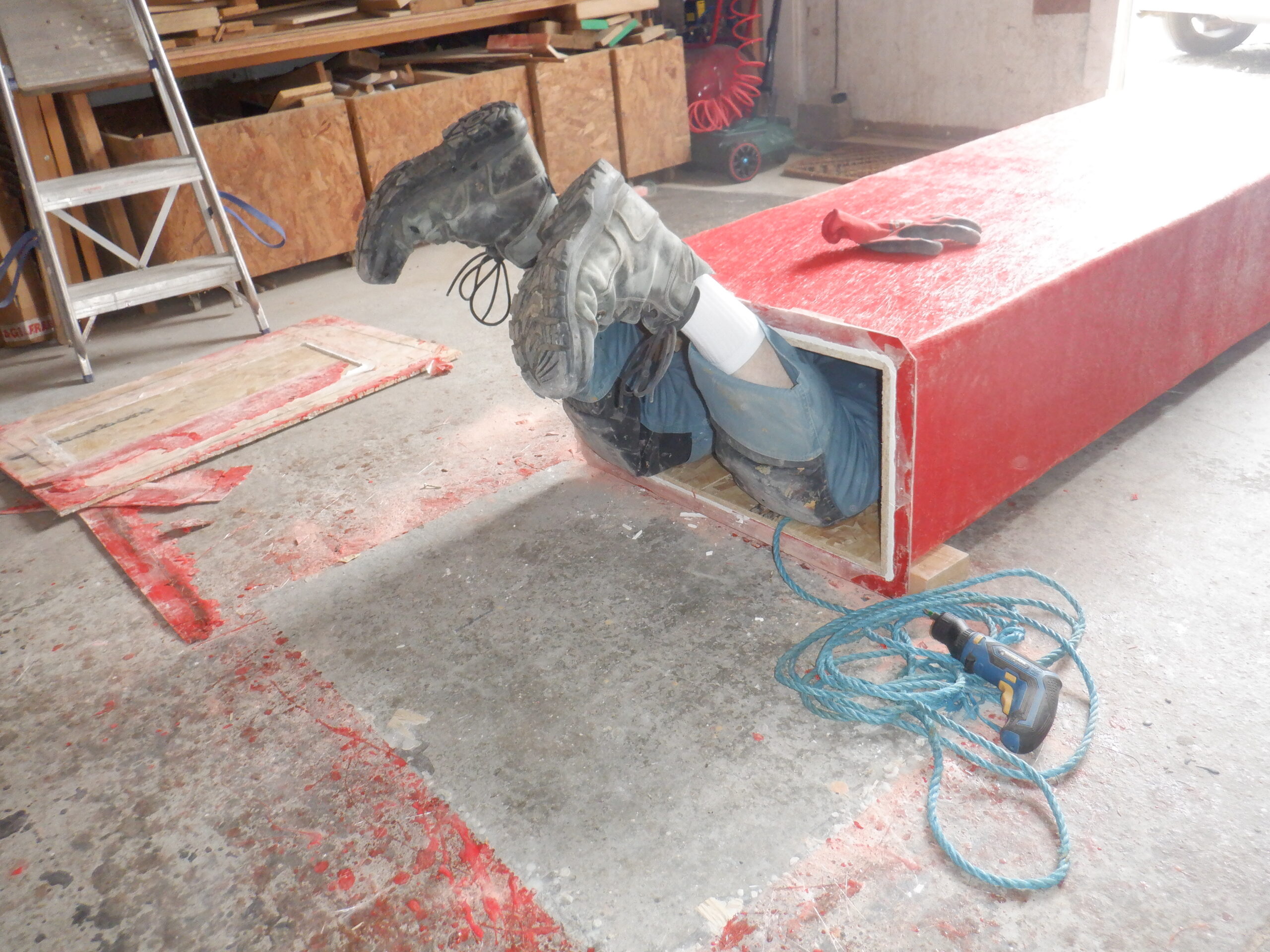
    The next step in removing the mould, is to unscrew the base off, which then gives us access to all the screws that holds the four long pieces in place. we had to crawl inside with the screw driver, to reach those screws!!

    Undoing mould fasteners

    Undoing mould fasteners

    All the way in...

    All the way in…


    Then, we could lever off each side in turn, taking out the wider ones first, and then the two narrow ones last. This left the bottom piece, the base. It is an 18mm thick OSB board and we tried .. and tried .. and tried .. to tug on the rope to yank this final piece out. But, it refused to move!

    In our wisdom, we thought that we had given the bottom piece enough freedom to rotate out when it was pulled via the rope, but it seems to be well and truly stuck.

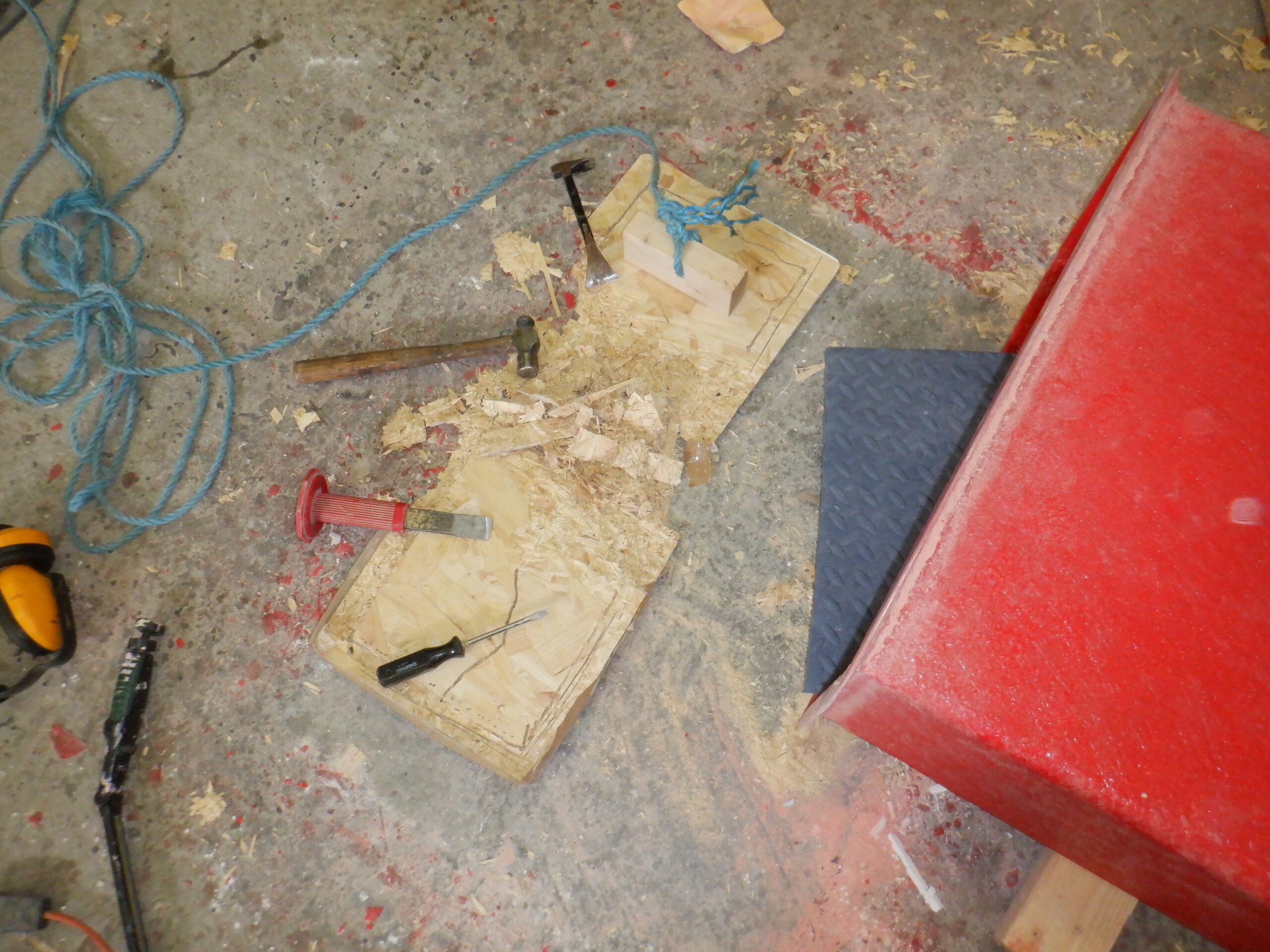
    This means that we had to crawl up inside and use various machine tools to the board .. but it was very nervous because we didn’t want to damage the fibre glass and its waterproof coating. So, we slowly hacked our way through the layers of the OSB board, pulling off small strands and eventually, we manage to reach through and get a crowbar in to lever one larger piece off, which then allowed the crowbar to reach in and lever the second half off!! O Boy !

    The destroyed Top of Mould

    The destroyed Top of Mould

    But .. ..

    We had after all scratched in several places, and gouged one spot deeply, plus also one of the corners seems to have lost a piece when this stubborn board finally popped out.

    This means that we have to do some repair work so we cleaned everything, sanded the surfaces to roughen it up for the new coat of resin, blasted it with our compressed air and then give it a thorough wipe with Acetone to also help ?key? the surface, ready for the resin. We mixed 65mg of our red resin, dropped some cyan into it, to turn it brown so we could see where we had painted it and then mixed in 2ml of hardener to make it set in a quicker time, but also, to make sure that this resin will cure thoroughly and not leave a sticky surface at all.
    We then crawled in with a light strip, and dabbed the affected areas.

    Damage repaired

    Damage repaired

    Now it is time to test it. We left it alone for the weekend and then poured in water to find out if we had got any leaks!!

    Testing the hot Tank

    Testing the hot Tank


    But alas !!!!
    We still had a single leak, near the top, about 300mm down. How frustrating that is !! Because, it is a learning process each time we step forward with the next version, but, the trouble is, this hot water tank, is our final version and we are not planning to make any more!! We have analysed the surface inside the tank and we got lots of horizontal grooves of varying lengths all over the place and we realised that these grooves were caused by the sticky tape we wrapped around the mould and it buckled up occasionally, especially when we were going around the corner from one face of the mould to the next one. in hindsight (how awful is that?!), we should have cut off these buckled up tape and stuck on a short piece over the top to make it all smooth again. As we say, it is no good knowing that NOW .. we are not making any more tanks !!
    Phew!
    Oh Dear! We have a leak

    Oh Dear! We have a leak


    As you can see, we are going to have to crawl inside and carefully paint each of these grooves whenever we find one. It will be difficult but just about possible. O Boy!!

  • Sealing of Test Tank and Running a Hot Test

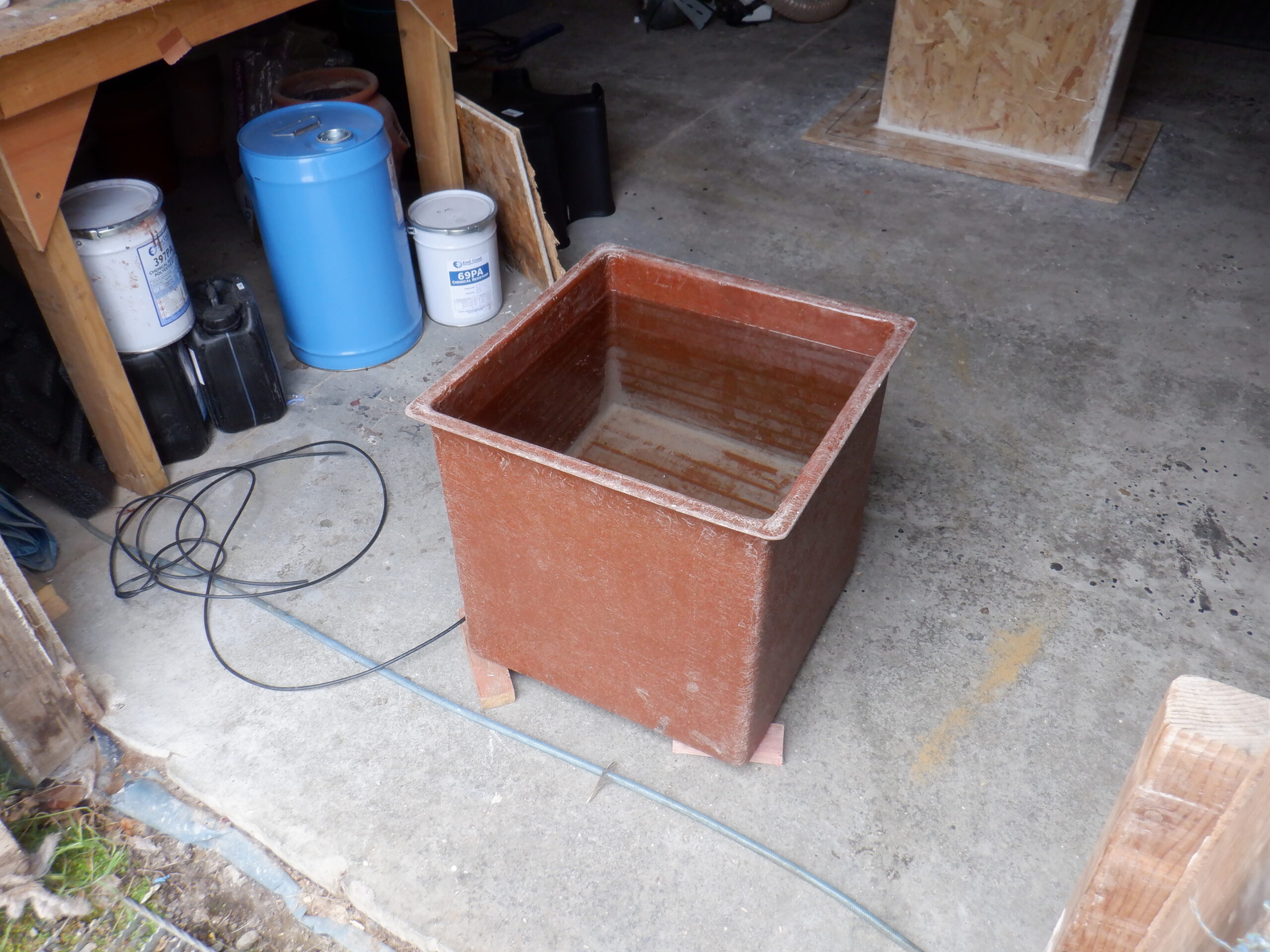
    One of the things we needed to do and finally got around to doing it this week, is to seal the tiny little leaks we had in our test tank we made a couple of weeks ago. We had a little bit of the brown resin left over from last time so we dropped some hardener into it, and together with some glass fibre tissue, we coated the area, the inside surface, where we had the leak. It took hours for the resin to cure and dry, but it got there eventually. We underestimated the amount of hardener!Next, we put the tub up on wooden battens and then filled the entire thing with water and left it all day, in fact, for several days. There is no sign of any leaks!! Hurray!
    Test tank full of water

    Test tank full of water


    There is nearly ninety litres of water sitting there, minding it own business !

    One of the reasons for building this test tank, was to see what happens when we put in very hot water in. Normally, this style of construction, using ‘standard’ polyester resin with glass fibre, is not dissimilar to other types of plastics and some of those cannot cope with very hot water and start deforming. What we wanted to know is whether our much larger Hot Water Tank will survive having very hot water in it, for years and years. So, towards this aim, we bought specially formulated polyester resin which have been certified to stay good and solid all the way up to 120°C and built this test tank. So the next step is this test run, is to put in several electrical heaters in this tub of water and bring it up to the boil. If it survives actual boiling water, then it will survive the hot water, up to 90°C, for years.
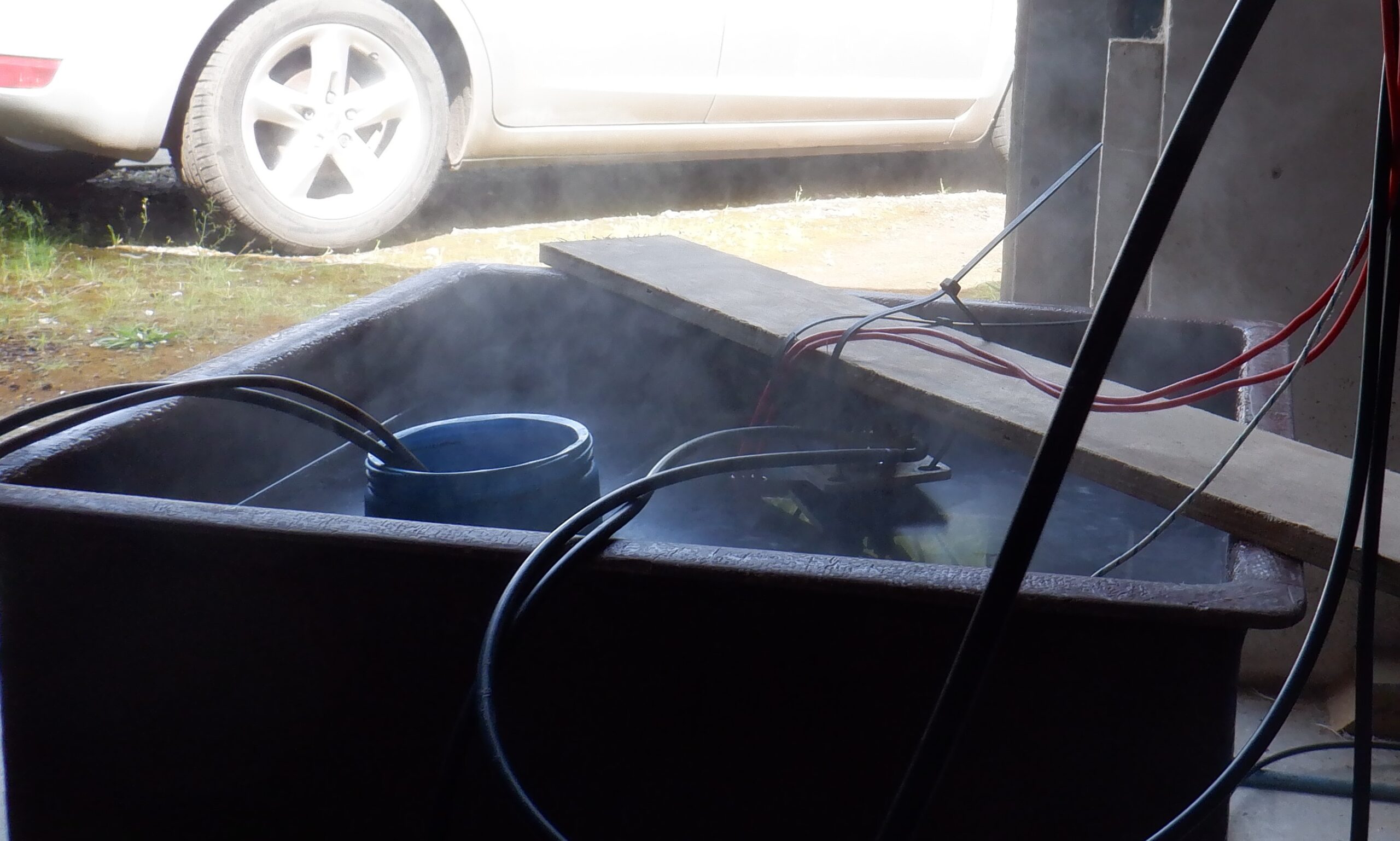
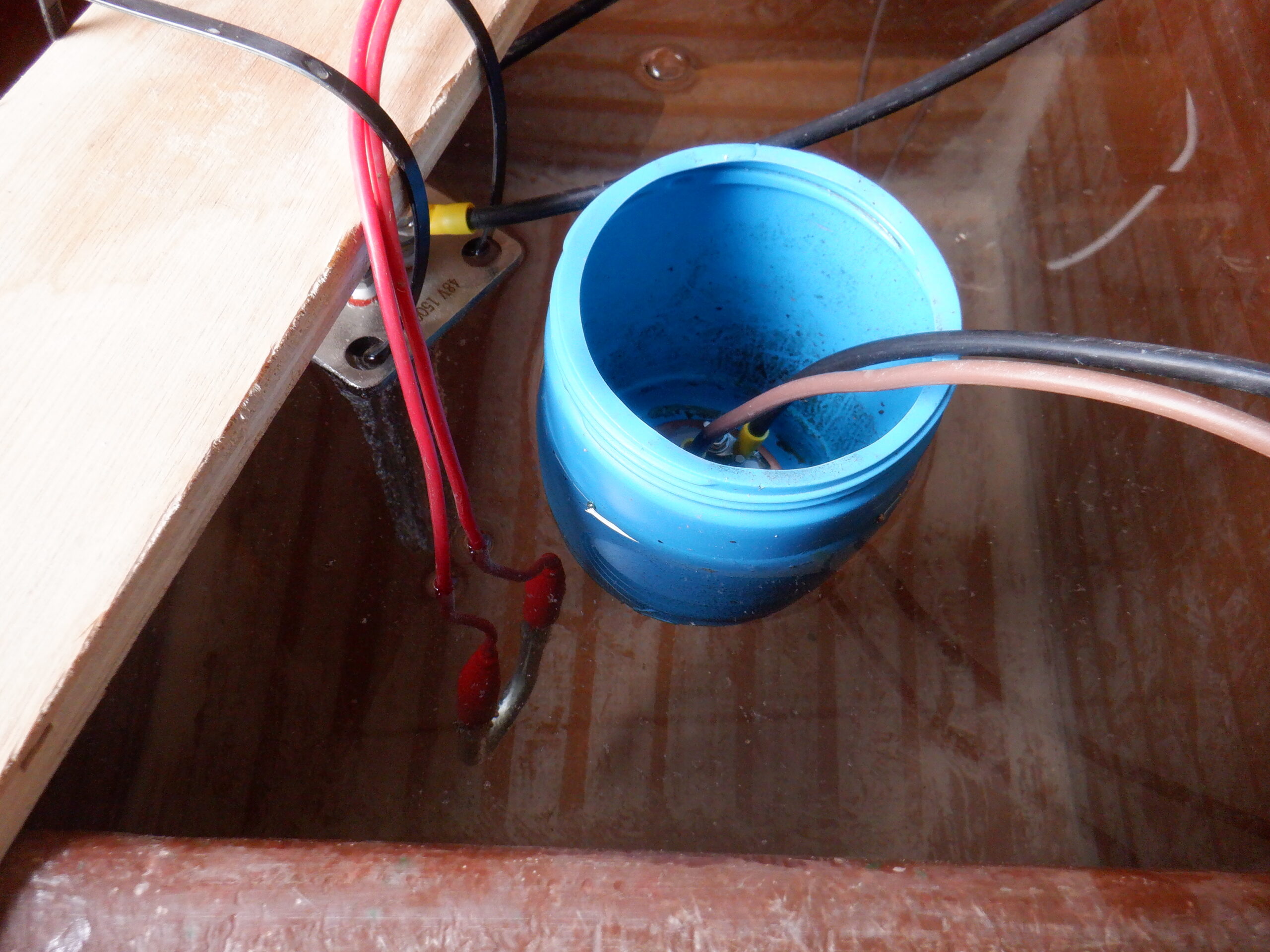
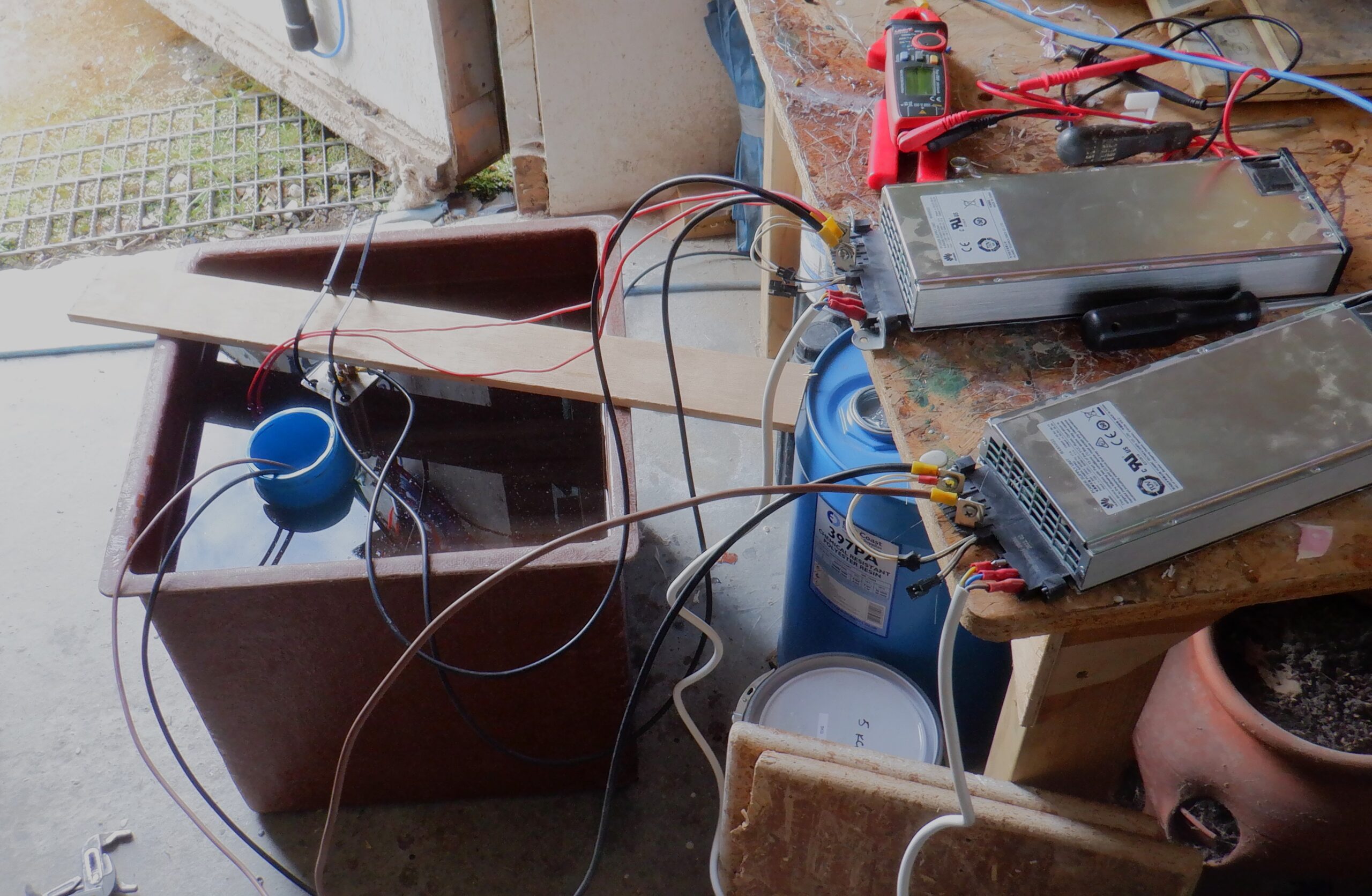
    We used two of our 50V power supplies and plugged them into the mains electricity. We wired up three separate heating elements, two 1.5kW capacity and the third one being 750W rated, so we joined one of the 1.5kW and the 750W to one power supply and the second 1.5kW element to the second power supply. We had to carefully dangle the bigger elements so the contacts didn’t get submerged into the water because there was enough voltage to start splitting the water molecule into their separate components; hydrogen and oxygen!! We didn’t want to have that happening, dangerous stuff having hydrogen and oxygen mixing together in their naked forms and with high quantities, and a spark, would cause a rather large explosion!! So, we stopped immediately and solved this issue by carefully lowering one of the element so it just had the heating rods buried in the water and the second element, we found a plastic old pot and put on a tank connector which allowed us to screw the heating element down through the bottom of the pot and it floated on top like a little boat. The smaller 750W element was already waterproof so that could submerge straight away.

    Heating Elements (1)

    Heating Elements (1)

    Heating Elements (2)

    Heating Elements (2)

    Heating the Test Tank

    Heating the Test Tank


    We started at about 12:50pm and we were collecting 4.2kW of energy directly from the Sun! In fact, we were collecting a new record of 6.96kW of energy from our solar panels and we realised that the inverter substation was able to convert more of the sunshine as the battery still needed charging and the left-over, some 1.2kW, was sent to the battery as well as powering our testing setup.
    Marvellous !!

    Without stirring the water in our Test Tank, it was already reaching 90°C by the end of lunch at around 2:15pm so we decided that was enough of a test. We switched everything off, pulled out the elements and then see if the tank was still solid ..
    In among the twirling steam ..
    And It Was .. nice and solid !!

    Hot Water

    Hot Water


    The temperature of the water was in layers as all the heating elements were nearer the top, which is why it only took an hour and a half to get 90°C water, because it was only at the top half that got really hot. We stirred the entire tank and it settled down to 60°C on average. This was good because it is much less dangerous now!!

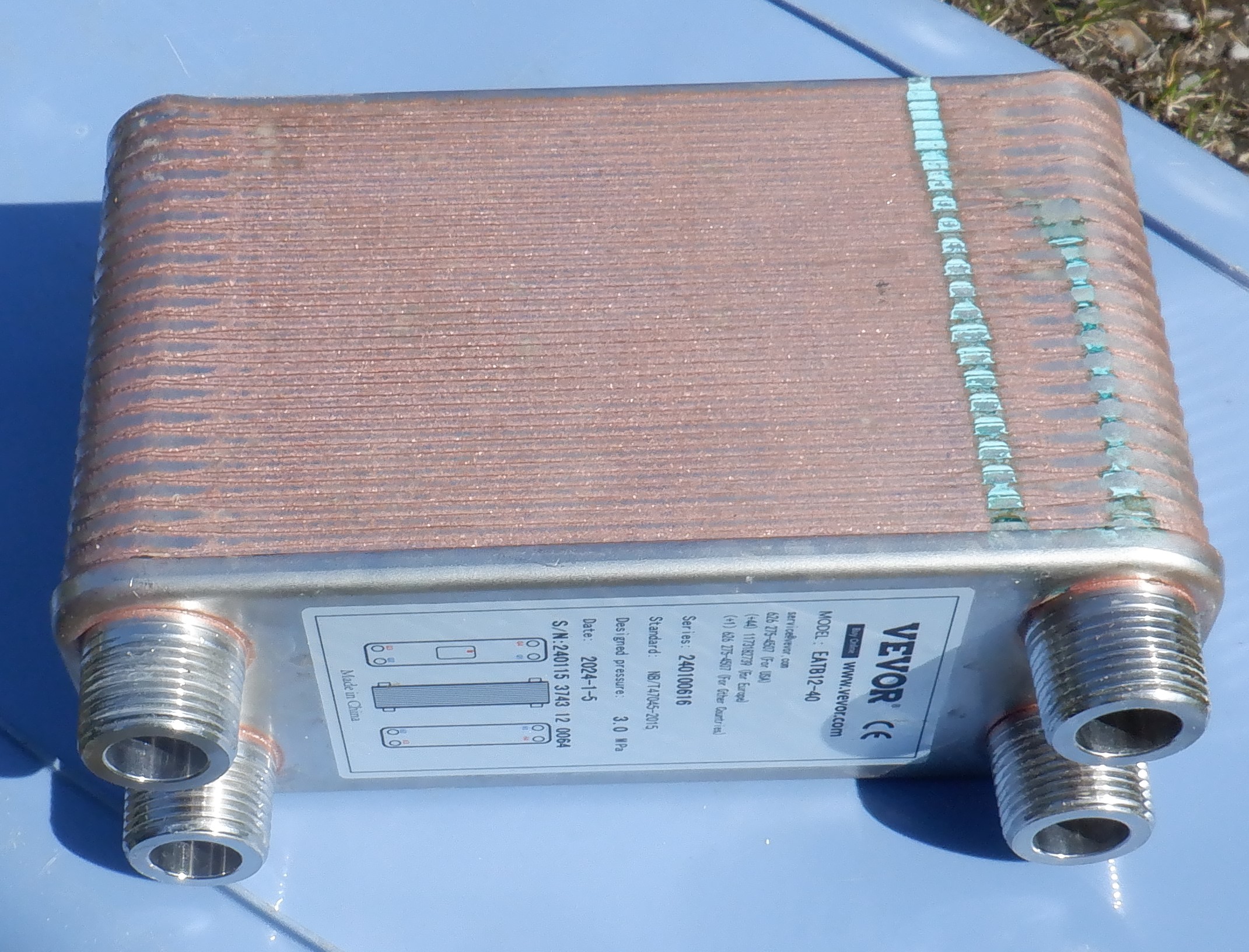
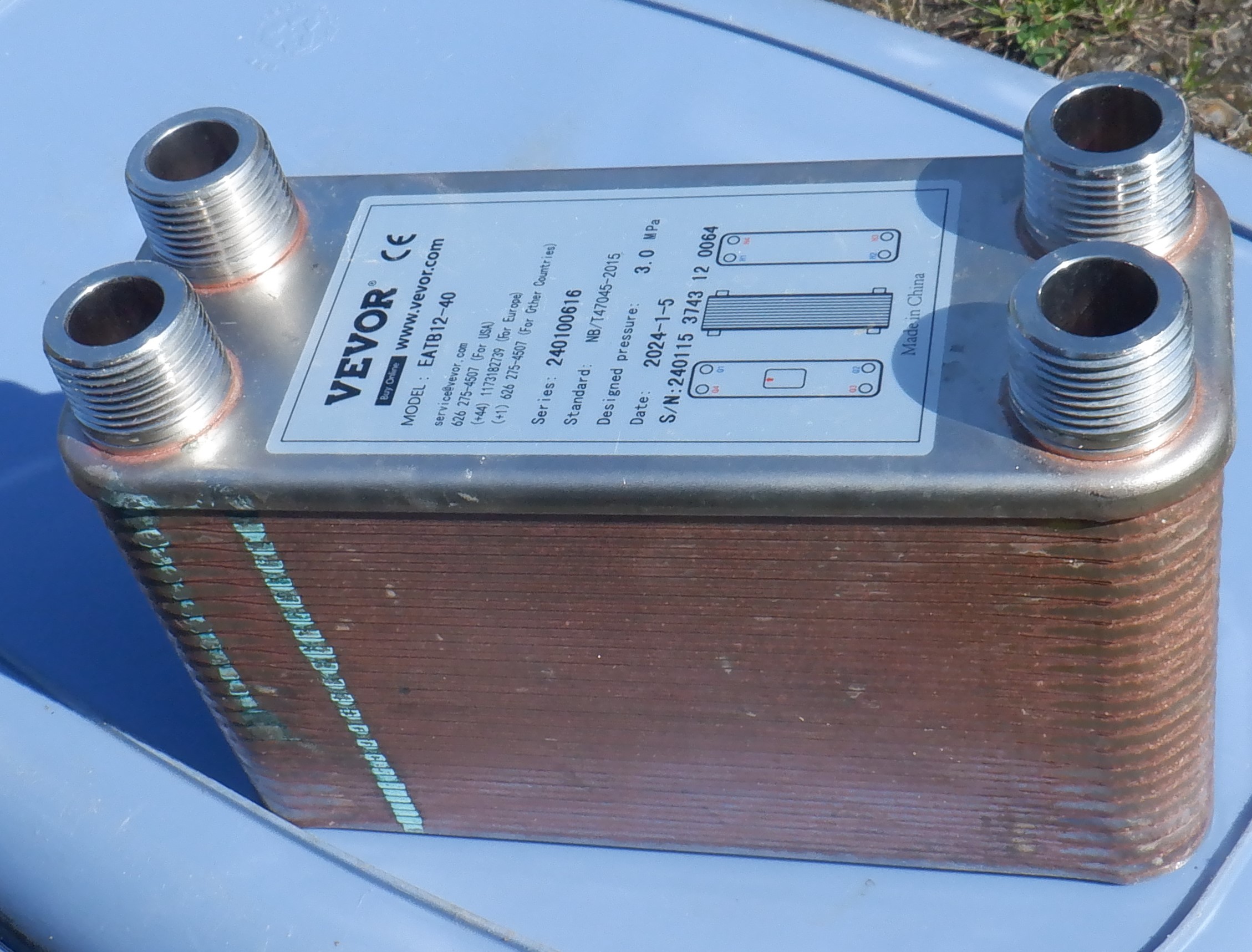
    We then spent the rest of the afternoon, experimenting in using our new 40 layer heat exchanger.

    Heat Exchanger (1)

    Heat Exchanger (1)

    Heat Exchanger (2)

    Heat Exchanger (2)


    These units will be used to heat cold fresh water from the header tank up to a comfortable temperature to wash hands and shower yourself. They work by have a stack thin metal plates which are connected on alternating layers to either the hot or cold water supply. Then when the water flows heat moves from the hot to the cold water. We bought this unit as a example and will buy more direct from china.
    We connected up a hose to our garden tap for fresh mains water in one end, a small pump and pipework to stuck the hot water from the test tank in the other end of the heat exchanger. The outputs from both of these ‘sources’ were just sent out of the Garage door and splashed out on to our driveway.
    We put on four temperature probes to monitor the four connections to the heat exchanger and had two flow rate meters so we could control and match the flow rate for both the cold water and the hot water side of the system. We played around with different flow rates, to see how quickly we could cool down the exchanger when we stopped the hot water flowing, plus to what happens if we went at maximum speed etc.
    Very interesting! We ran out of hot water but we learnt quite a bit!

    That concludes our Testing phase, for constructing a Hot Water vessel and we are now confident and ready to make a start on building our third water tank next week, the Hot Water Tank. This is our final water tank for the time being.

  • Assembly of the Cold Water System and Installation of Header Tank

    When we had a spare moment or two, between doing other tasks, we explored the Cold Water System and looking at building it. We did an order for plumbing bits and pieces a couple of weeks ago, getting a collection of parts to allow us to convert our main 32mm water pipe coming down from the Header Tank and joining it to our mains powered pump, and then back out to our domestic water supply that is going around the house to bathrooms and shower rooms etc.
    All the equipment is going inside our sound dampening Utility cupboard and it will be installed near the Air Ducting that is coming up out of the floor. We want to try and arrange the bits and pieces to minimised space because we have two more water pumps to be installed in our Utility Cupboard!!
    So we spent an hour or so fiddling with T-junctions, adapters, shut-off valves etc.
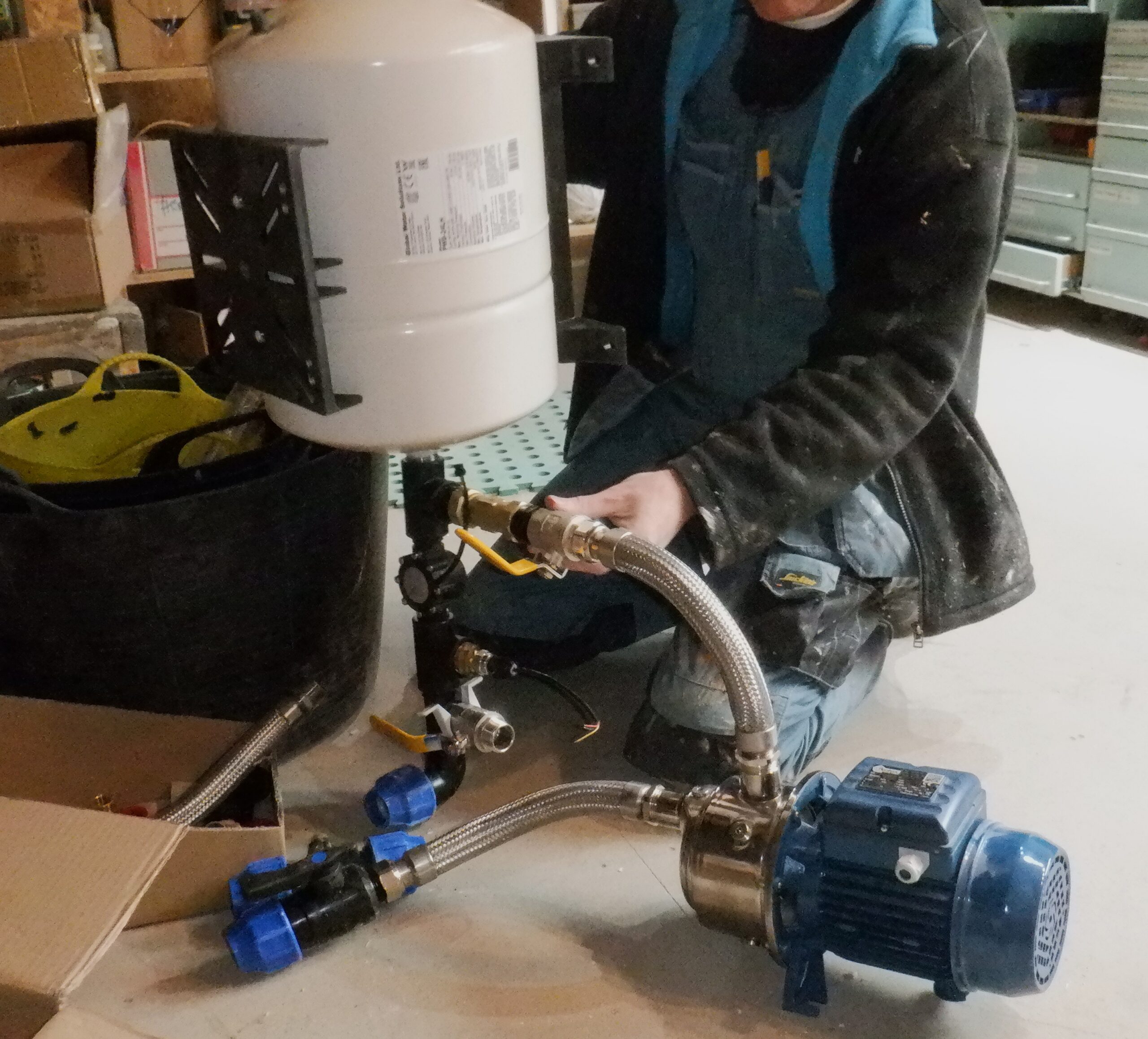
    Here is the exact mapping of the Cold Water System:
    • Header Tank feed (Blue 32mm pipe coming along under the floorboards)
    • A adapter with a 32mm compression joint, converts down to 1inch BS Male Thread, with built-in shut-off valve
    • Flexi-pipe, female to male 1inch threads
    • Water pump, both input and output are female 1inch thread (provides up to 3bars of pressure)
    • Flexi-pipe with male to female 1inch thread (allows the motor to be removed)
    • Shut-off valve with 1inch male and 1inch female threads (these valves allows isolation and removing of pump for servicing)
    • A nipple, all male 1inch threads
    • Non-return valve with double ended female 1inch threads (maintains the pressure in the system)
    • A Nipple, all male 1inch threads
    • T-junction, all female 1inch threads, connected to the sideway middle branch
    • Upwards is the Pressure Vessel with its 1inch male Thread
    • Downwards is digital flow sensor with double ended 1inch male threads
    • T-junction, all female 1inch threads, connected to upper branch
    • Sideways is the Digital Pressure Sensor to provide feedback to the controllers, with adapter
    • Downwards another T-junction, all male 1inch threads, connected in upper branch
    • Sideways to a shut-off valve with an 1inch female threads, which the other end being an 1inch male thread and has an adapter to convert to 22mm compression joints for domestic plumbing pipes
    • Downwards connects to right angle adapter with female 1inch thread to a 32mm compression joint (to go horizontally at the bottom of the cupboard)
    • Short length of blue 32mm pipe
    • T-junction with straight two 32mm compression joints horizontally and side branch a female ¾inch thread
    • Sideways to adapter(s) to connect a drainage stop-cock.
    • Onwards to blue 32mm pipe and starts its journey around the house!

    And here is a picture of our first play in arranging all those parts !!
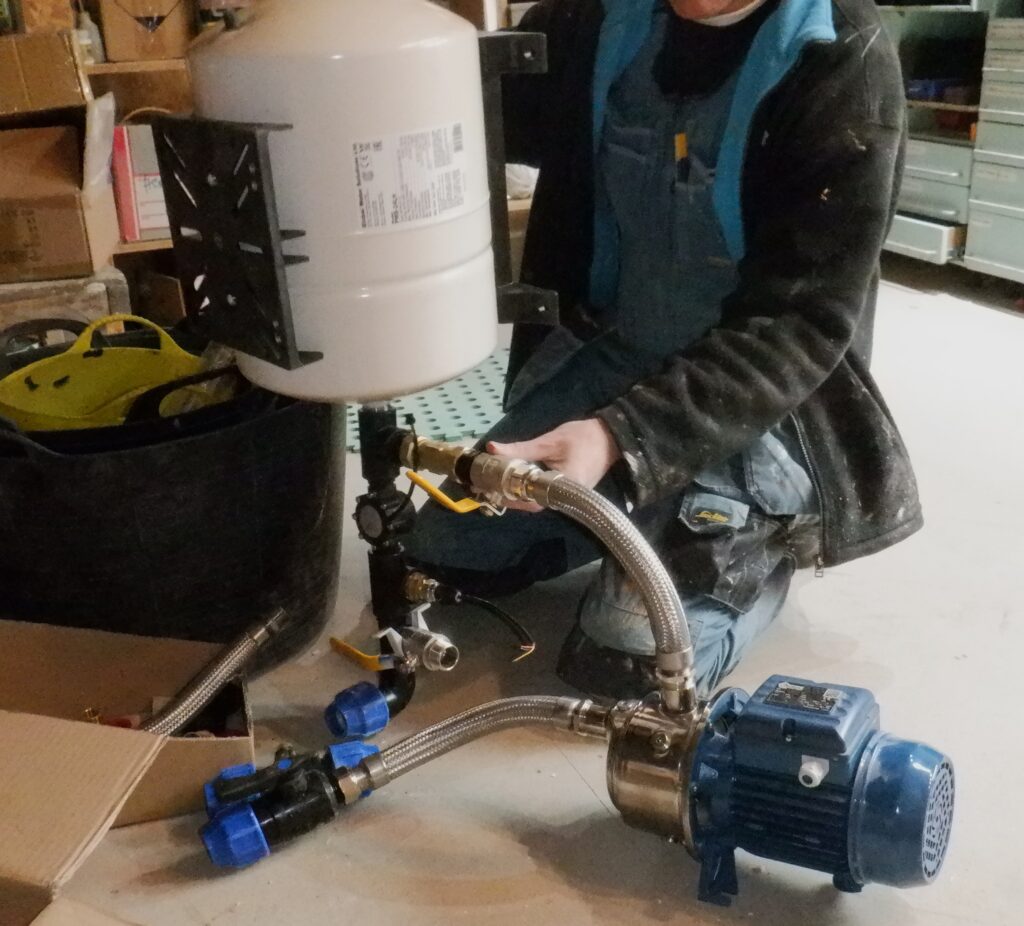
    Trying out cold water pressurisation parts

    Trying out cold water pressurisation parts

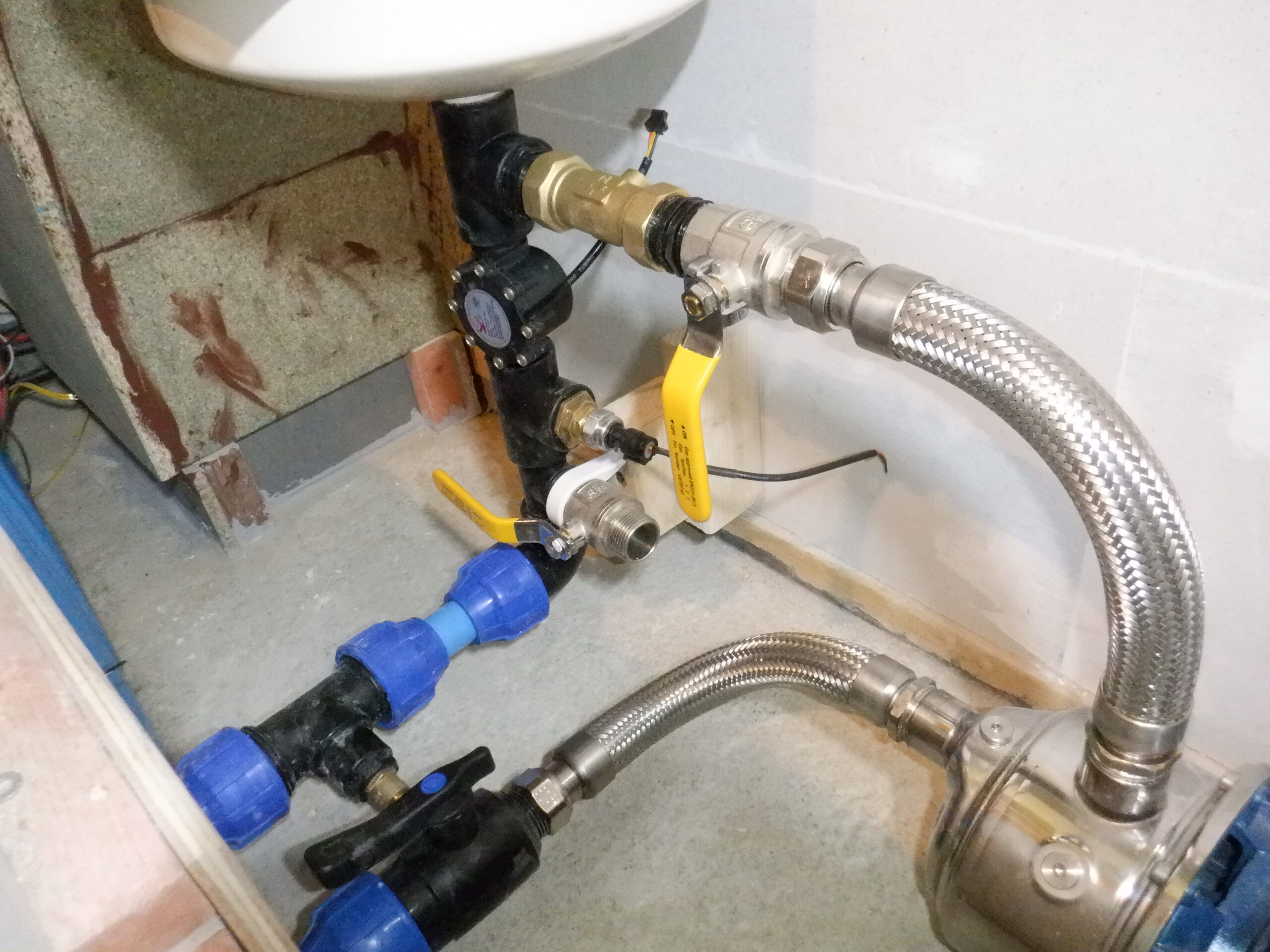
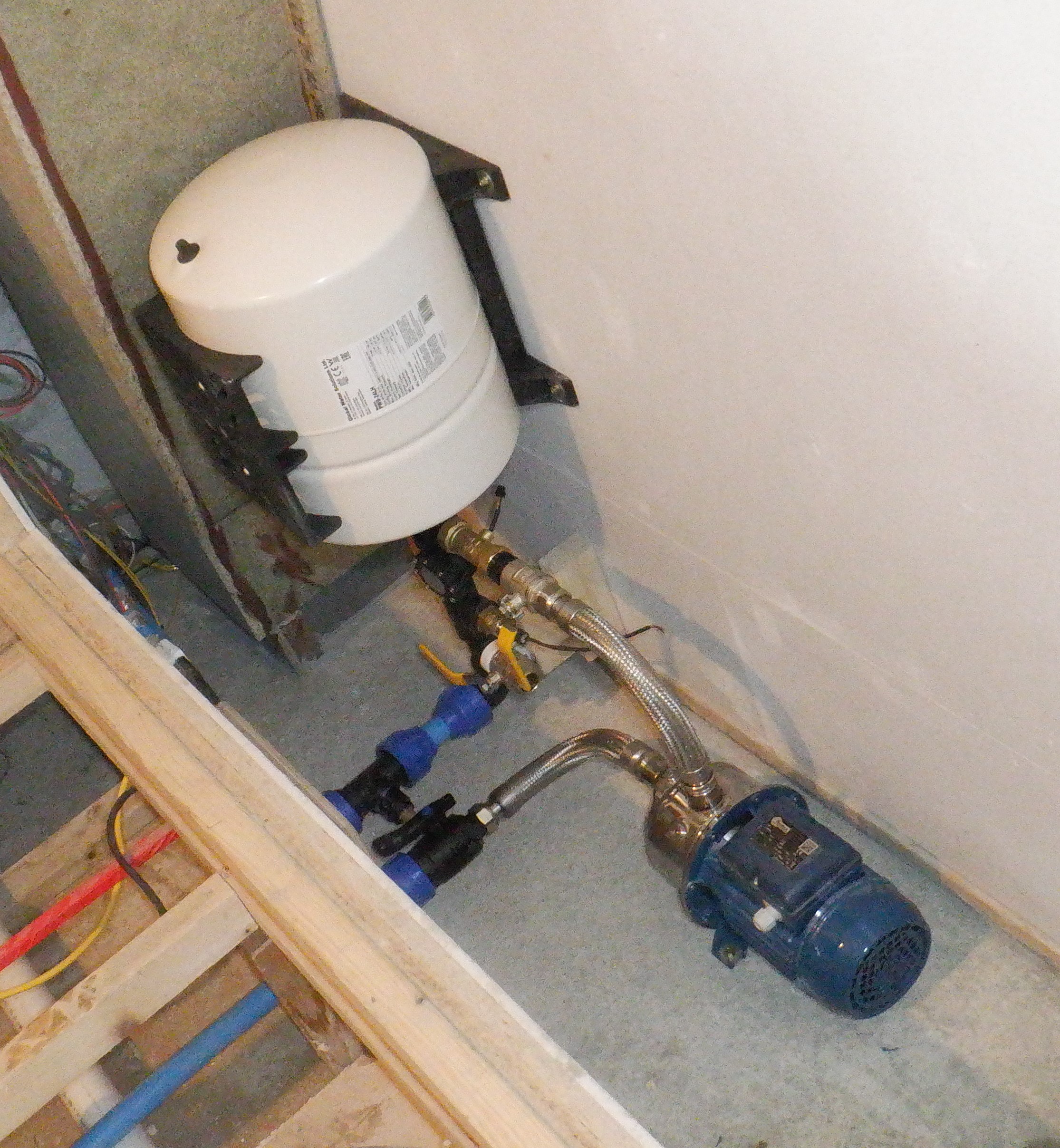
    After getting the Header Tank sealed against those leaks, plus also completed the first stage of building the ventilation ducting inside the Utility Cupboard, we implemented our plumbing matrix as stated above and physically installed the various parts next to the new ventilation duct. We screwed on the expansion vessel first and then used LSX thread sealing liquid on each joint on each part as we went through the design, including the electric pump which was bolted down to the solid concrete floor. The input from the header tank was joined in this network, the 32mm wide blue plastic pipe coming through the cupboard wall beneath the floor level, and then the output pipe which is also blue and 32mm diameter, came out the cupboard in a similar position but went off to the space underneath the sink, to join up with the existing water pipe that is travelling around our house, going from room to room.
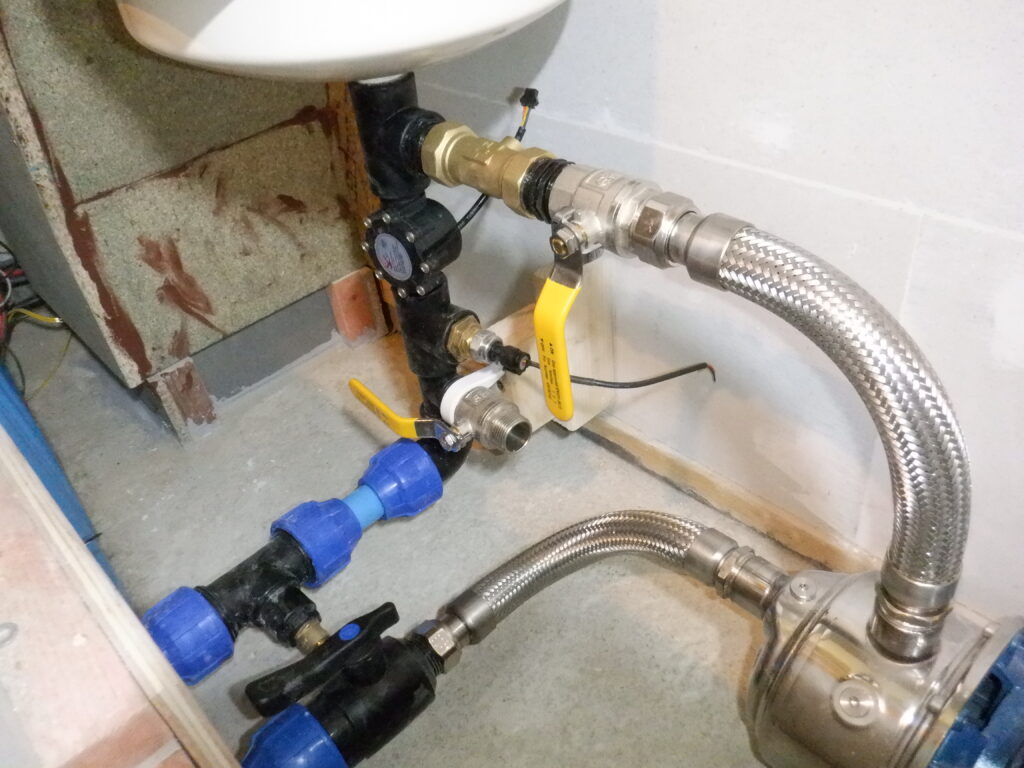
    Cold water pressurisation system 1
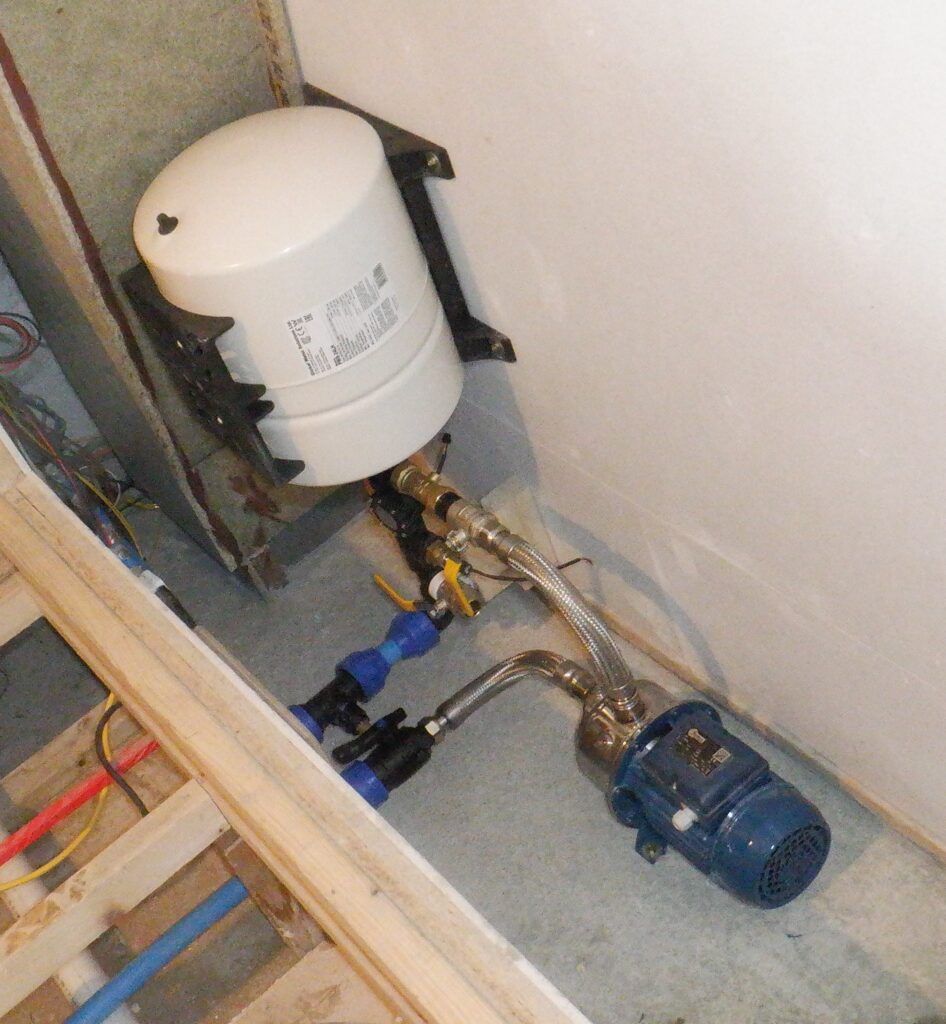
    Cold water pressurisation system 1

    Cold water pressurisation system 2

    Cold water pressurisation system 2


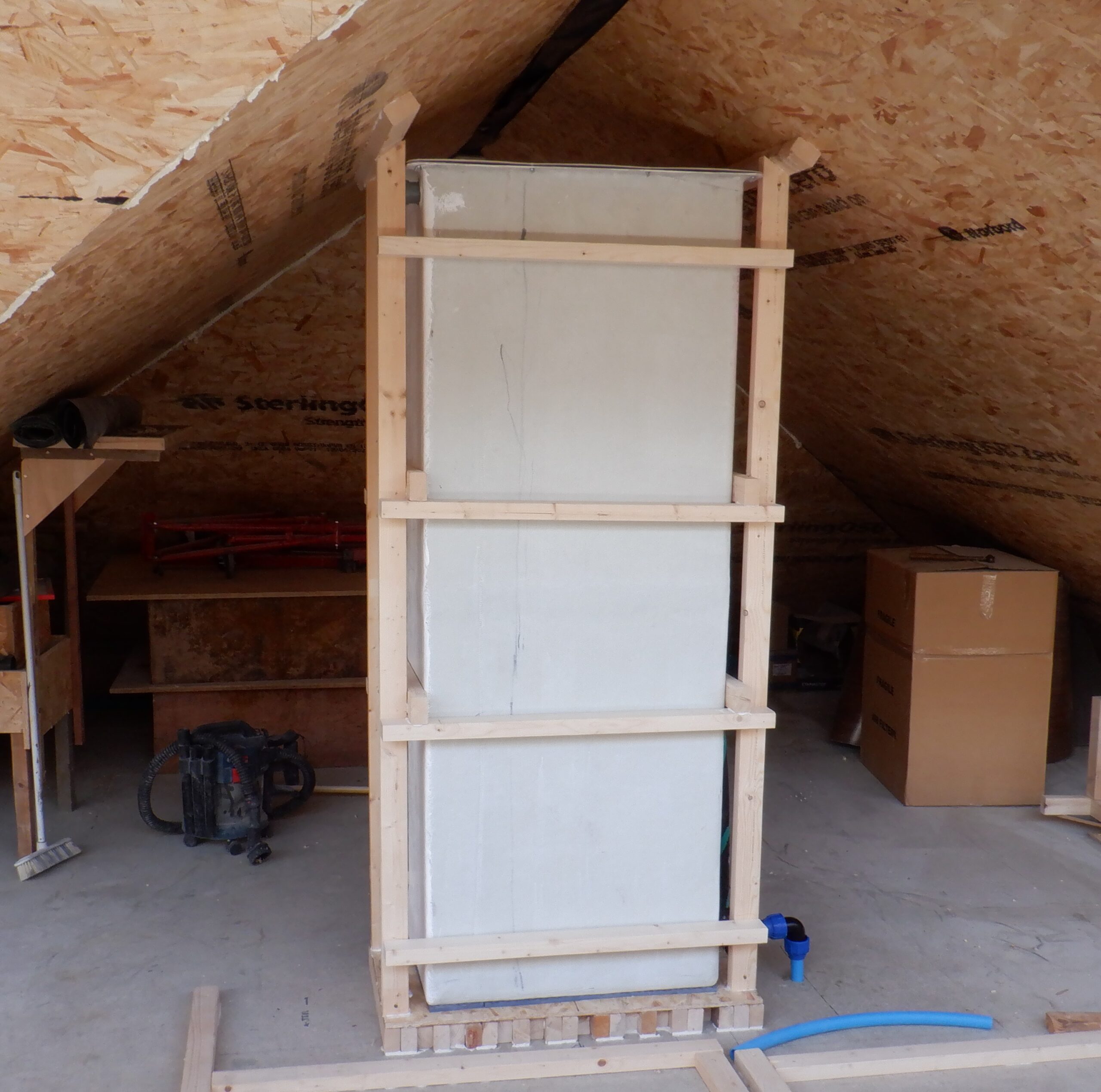
    The next job was to install our new Cold Water Header Tank upstairs, placing it on the prepared platform and then proceeded to build a wooden framework around the entire tank, putting four legs in each corner, attached at the both the bottom and top, glued and screwed into place. Then, putting four horizontal 63mm CLS wooden bars across the wider faces, evenly distributed and doing the same on the other wider face as well. Finally, we slid in two connecting pieces of timber, to join the front and back frameworks together, to help stiffen up the entire cage surrounding the tank.
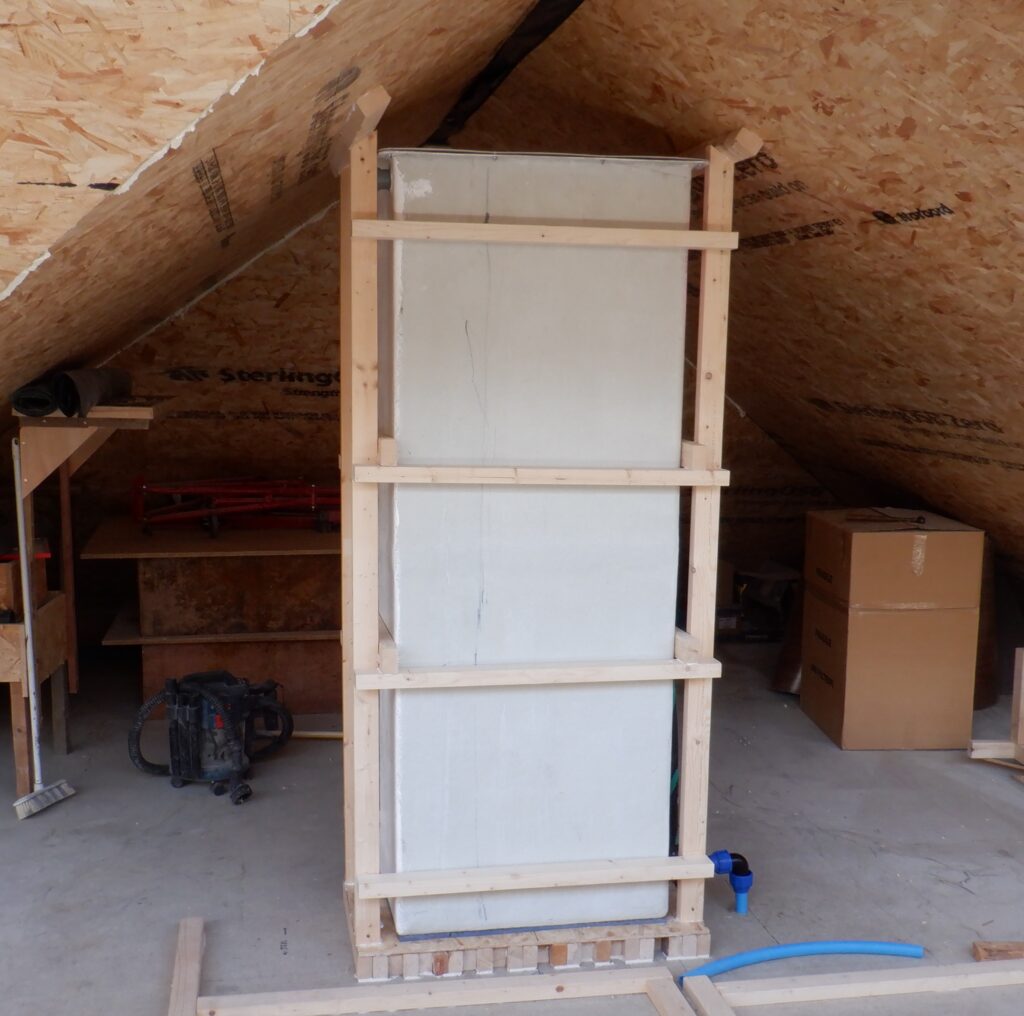
    Header tank in place and Framed

    Header tank in place and Framed

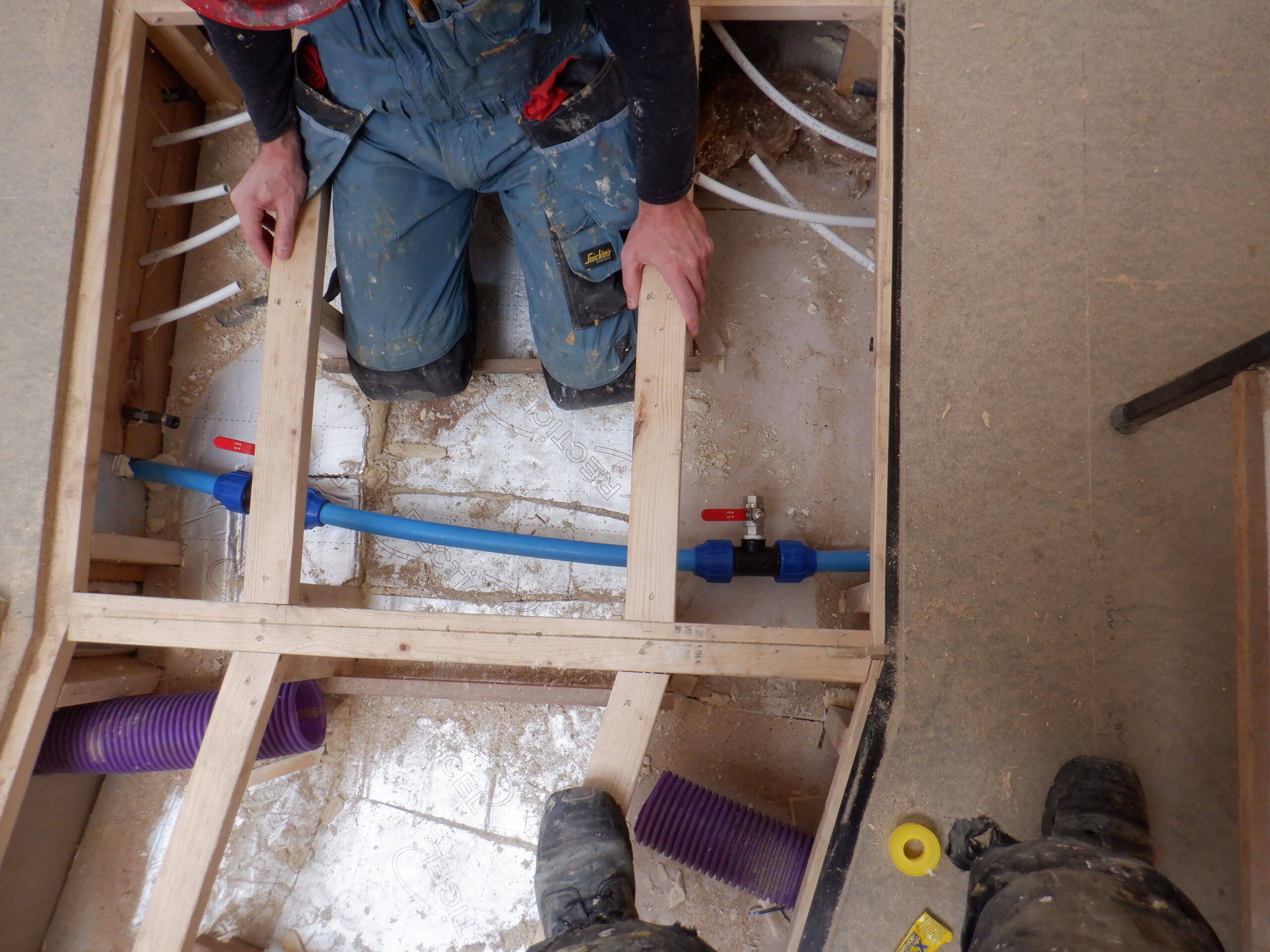
    We then connected the blue pipe to the tank connector we had already installed at the base of the tank, including a shut-off valve too. This pipe is the gravity feed that goes down to the space under the hallways, turning the corner and heads to the Utility Room and our assembled motor and associated equipment. This also included a T-junction half way along this pipe, under the flooring, just located at the crossroads in our Hallways, this branch will go off to our ground floor WC and also distributed to all our fire suppression system. We wanted to make sure that these services still work, even when we had lost power or control over our motorised valves and pumps. It is purely based on the good old reliable gravity feed from the header tank. It might be slow but it will still provide a toilet that will flush and the spray nozzles will still inject fine droplets of water during a fire breakout.

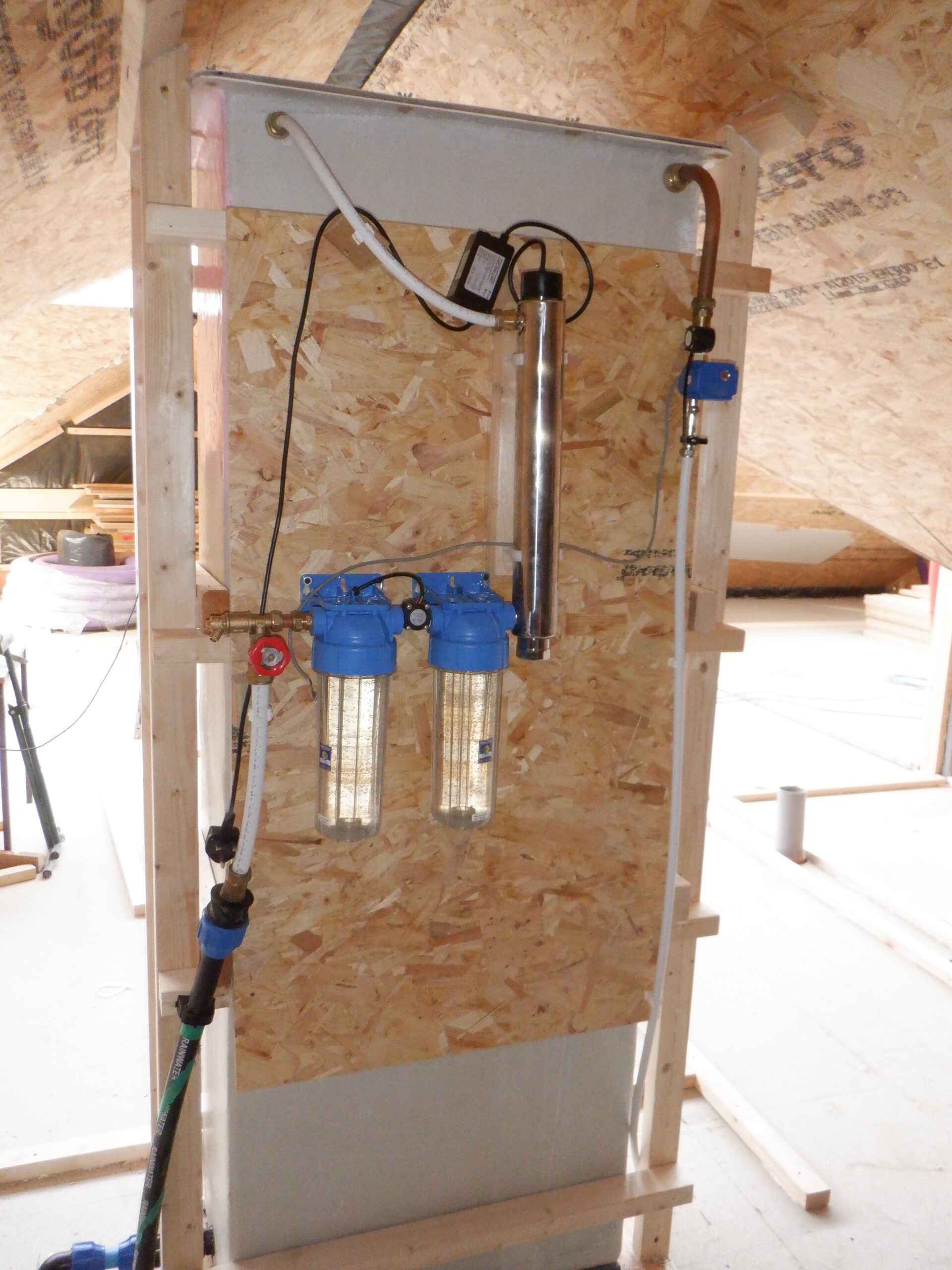
    Another job is to connect the “Green and Black” rainwater pipe to the Header Tank, via the filtration and sterilising units, which we mounted on a piece of 18mm thick OSB board that in turned is mounted to the framework around the tank. The 32mm Green pipe is converted to a 22mm plumbing pipe, which in turn goes into a flow-control valve, a drainage valve, enters a particle filter that removes solid bits down to 1micron across and then through a second filter, this time, an activated charcoal filter to remove chemical substances like the chemicals that the farmers used on their fields in our local district, which is blown up and carried by the winds to our slates on our roof, which is then washed off into our rain storage tank underneath the Garage. The third and final unit that this water passes through, is the sterilising that will kill viruses, bacteria and fundi, by bathing the water, and these floating invaders, with strong Ultra-Violet radiation. A similar system is also used for fish tanks and fish ponds.
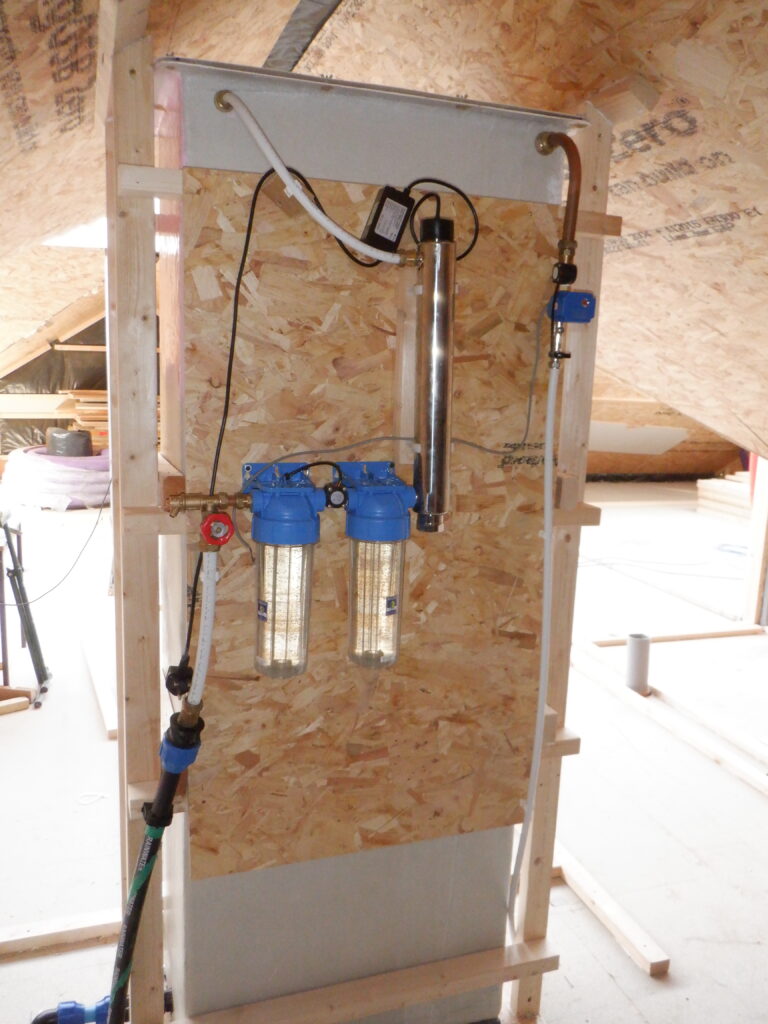
    Header Tank plumbing

    Header Tank plumbing

    We then connected up the pipework inside our Garage from the underground rainwater tank, to the 32mm black pipe that goes through the concrete floor slab and underground to the main house. It appears up through the concrete slab inside the Utility Room, under the sink and washing machine sections. We already had a pump sitting submerged at the bottom of the rainwater tank so we plugged it into a nearby mains socket and proceeded to run the pump and see how fast the water was flowing after travelling all the way from the Garage and right up to our header tank. We put on our test meter on the flow measuring sensor and it settled down to about 7Hz, which according to the standard formula for these types of flow meters, represents a flow rate of less than 1litre per minute. O Crikey, that is slow!! It would take ages to refill the Header Tank, after we had a shower, or ran a bath!! AND .. This is Before we had inserted the two filter modules themselves! So, after examining the specifications of our existing pump, we are buying a replacement submerged pump, the next model up, going from 250Watts to 500Watts in electrical power. This is probably a overkill but we had no choice. But, we will see later on when we have changed over the pump, inserted the two filters and then measure the flow rate again.

    So while waiting for the pump to arrive, plus also other bits and pieces of plumbing parts, we got on with another task. This time, we went around putting shut-off valves on each T-junction on the blue 32mm Cold water pipe that is going from room to room. We lifted up each hatch that allow access to the plumbing valves and other pieces of equipment, and connected a 22mm inline shut-off quarter turn valve. We carried on doing that from location to location, moving around the house. We did Bedroom Three, Bathroom, Bedroom Two (after having to move the entire stack of sheet material first – Phew!), Bedroom One, then the Great Room (where we had to install two T-junctions on either side of the air duct) and finally, terminating in the Kitchen (where we had to slice into our floorboard to make two little hatches that hadn’t been done yet).
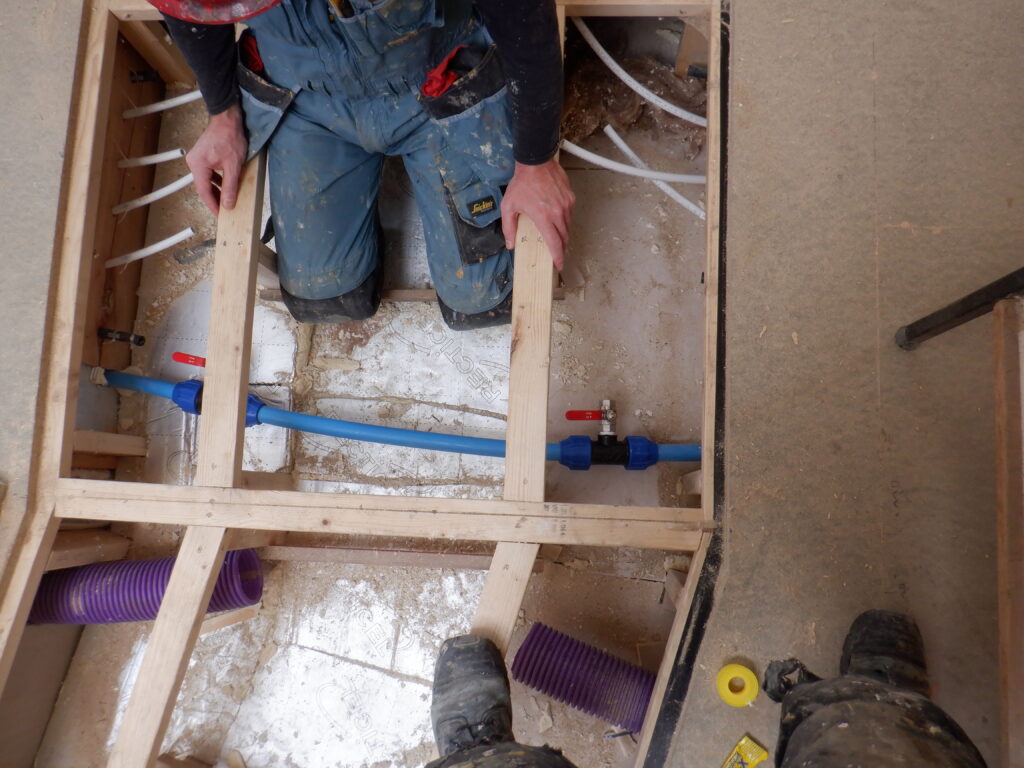
    Cold water outlets in Great Room

    Cold water outlets in Great Room

    Another plumbing job was to take a tap off the mains water 15mm pipe that is running down the hallway (which is going off to the Kitchen) and this branch line goes up inside the wall and pokes up beside our new Header Tank and connected into a series of items, as follows, a shut-off valve, a non-return valve, motorised valve and a flow rate sensor, before a final 22mm diameter copper pipe is bent and enters the Header Tank. This connection will provide a backup method of putting water into our Header Tank, against those times that we have ran out of rainwater. The computer will monitor the level inside our rainwater tank, and automatically switch over to using the mains water supply. Hopefully, this would only happen during very long droughts in the Summer months.

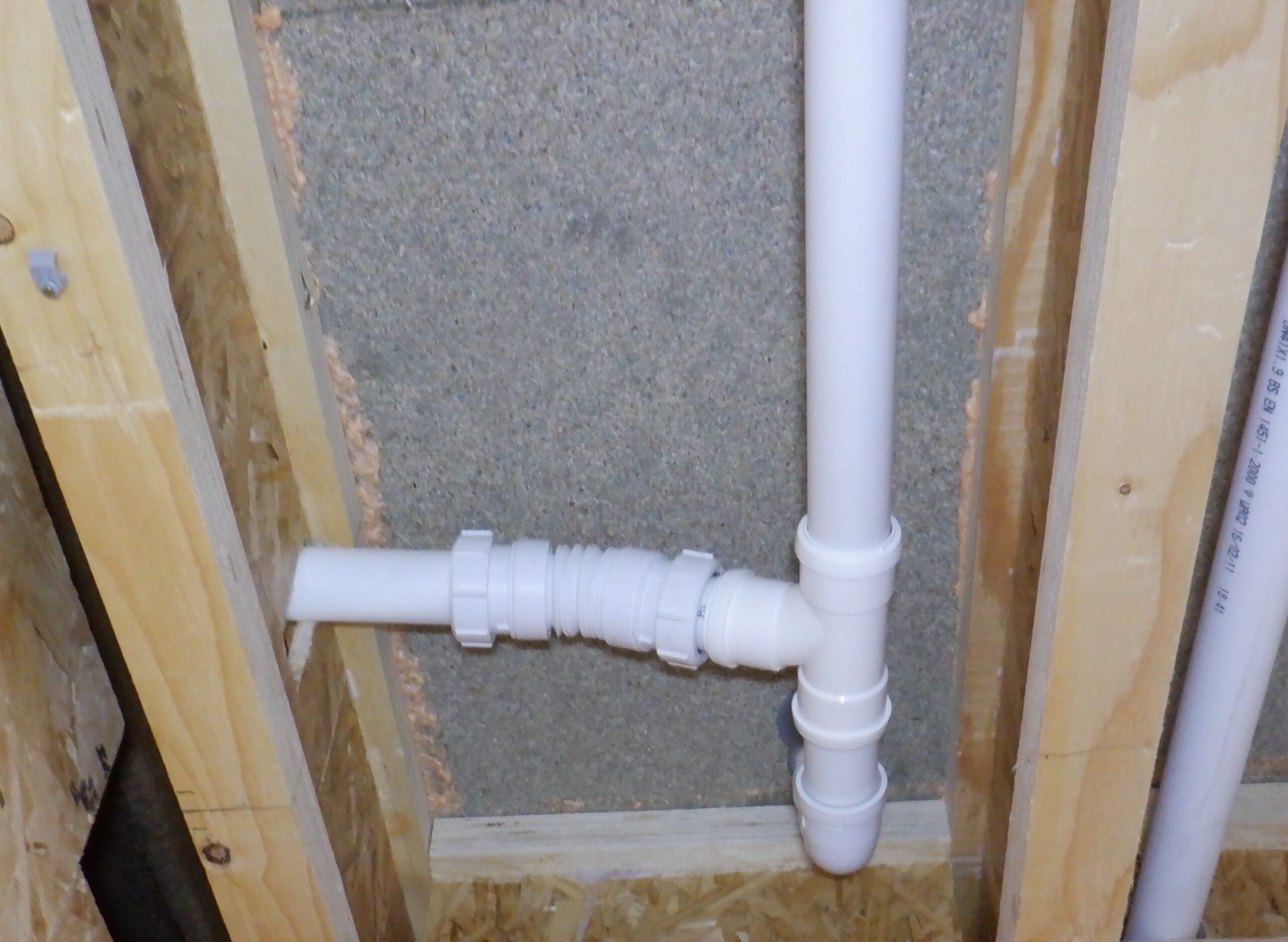
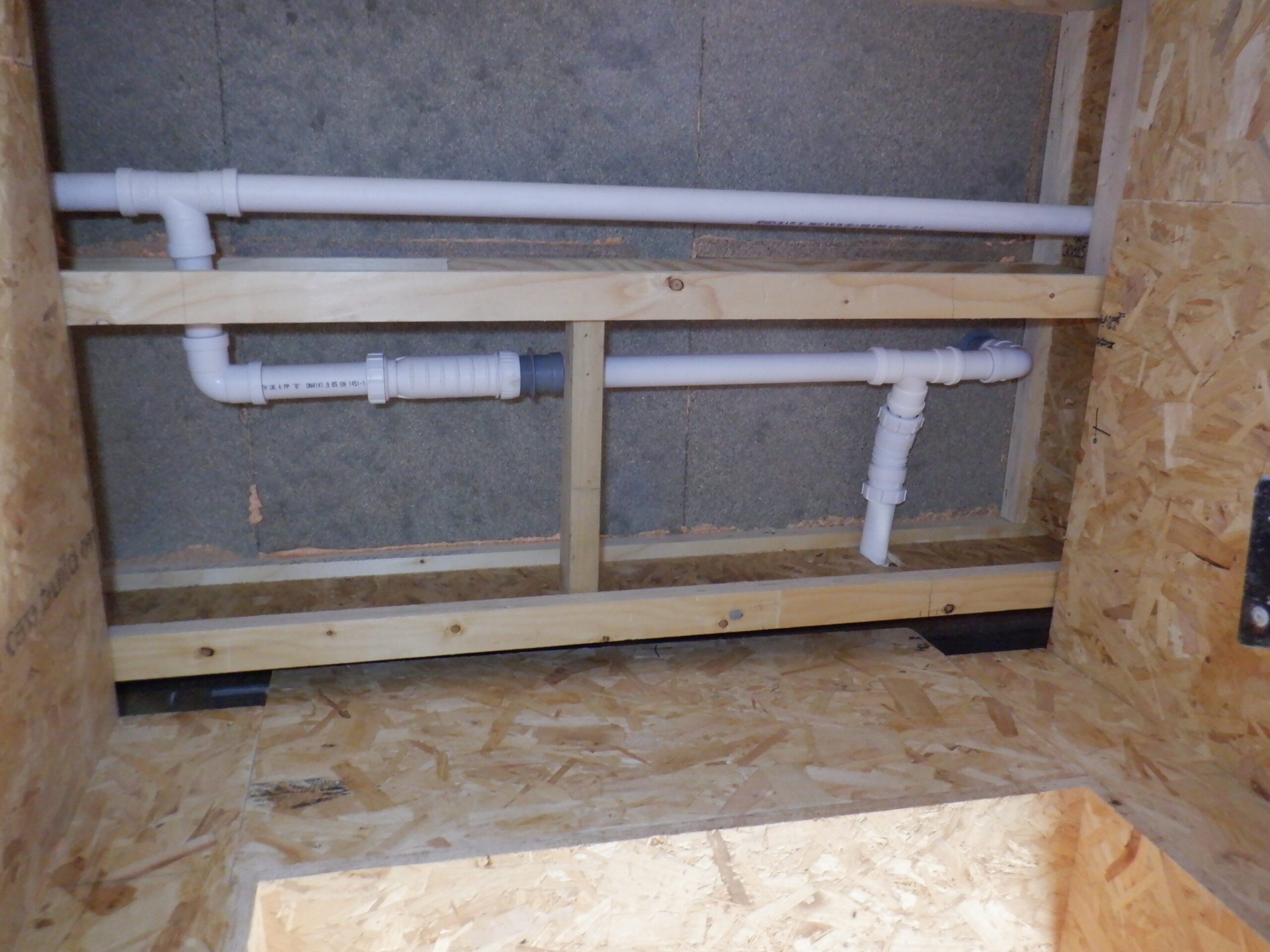
    Also on this Header Tank, is an overflow emergency drain point, right at the top, to make sure that if something goes wrong with the automatic mechanisms, the water will have somewhere to escape and not flood the the upstairs flooring, and drip downstairs into the Bathroom and Bedroom Two. This 40mm diameter “push-fit” white plastic pipework goes down from the tank connection at the back right hand corner, through the floorboard and then turns at an angle to pass through the webbing of the First Floor Joist, to arrive at the drain line that is coming from the Shower Room. We had to use a “flexible fan-folded” pipe to achieve the awkward angle but we managed to join into the pipe, which then goes into a Hepworth Valve (these are non-return rubber valve designed for waste water from bathroom basins and showers, these valves are to stop the horrible smells coming up the septic processing pipes) and this line of 40mm pipe then turns the corner and goes through another webbing of the joist and connects to another branch line that is coming from the sink that will be in the upstairs work room.
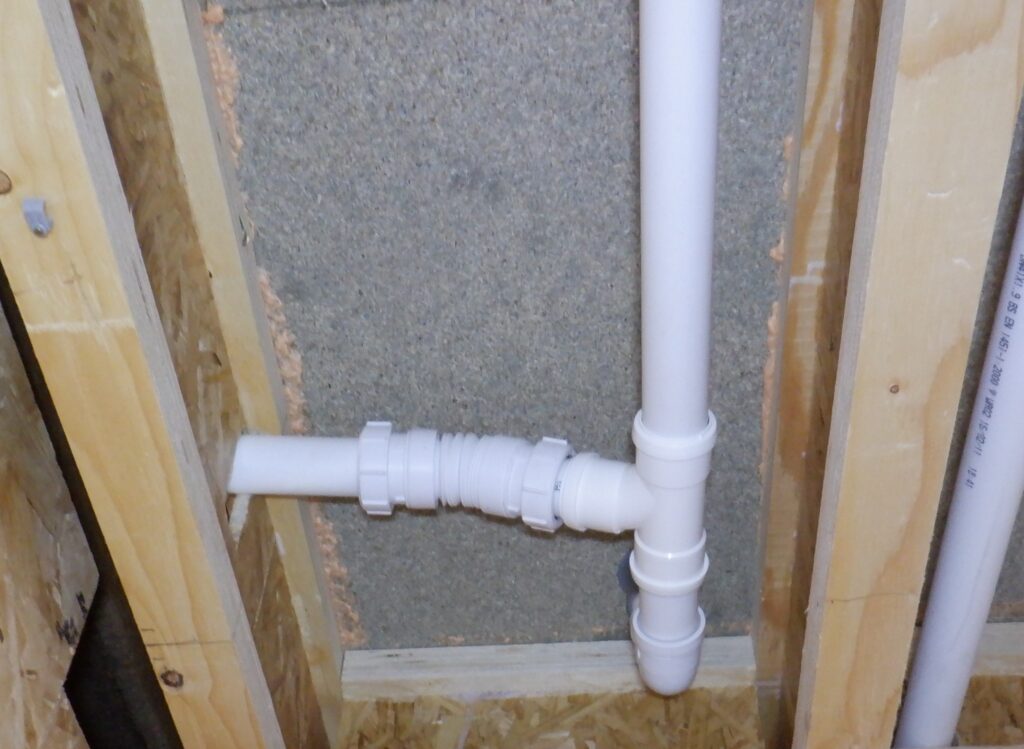
    Header tank overflow
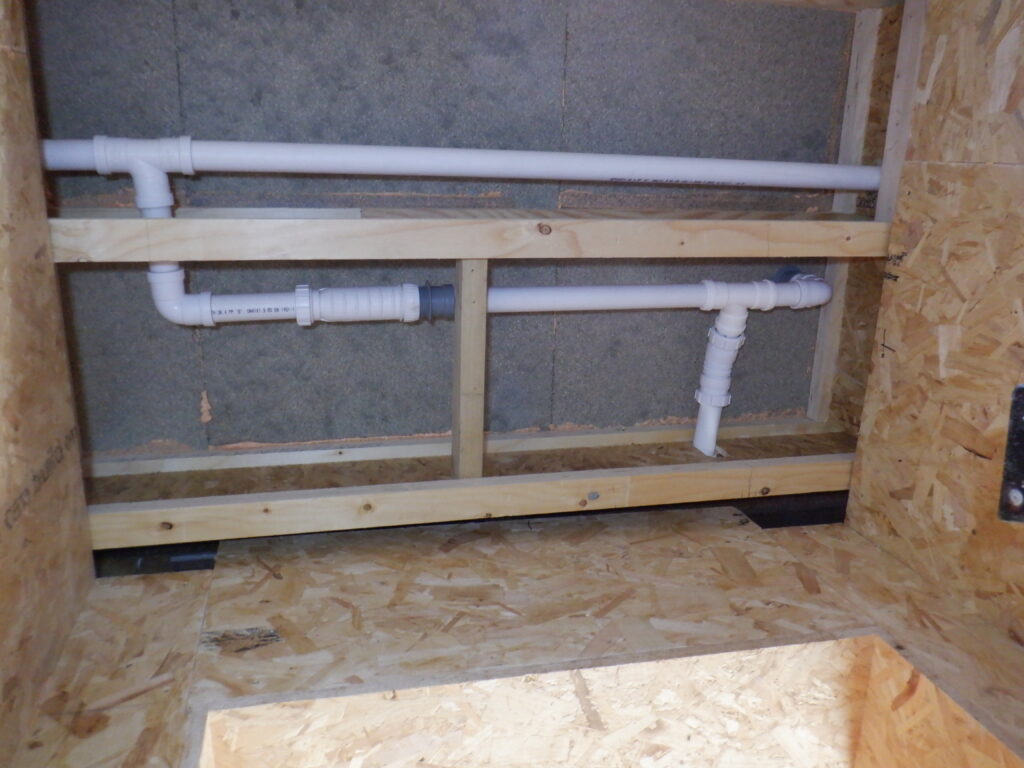
    Header tank overflow

    Header tank Overflow and Shower connections

    Header tank Overflow and Shower connections


    The new rainwater pump came today and we swopped over the two pumps. We discovered that the older pump wasn’t sitting as deep inside the rainwater tank, due to the automatic cut-off float switch that is attached on the side of the pump and it made the pump a bit wider and it was jamming at the bottom of the manhole column. So, when we lowered the new pump, it went further down and we discovered that the semi-flexible pipe, the vertical pipe that takes the output of the pump up to the top, was not long enough to reach the right angle connector. We had to extend this vertical part by another 200mm! Fortunately, we could use a spare piece of our 32mm blue pipe and replace the right angle connector with a full sized 32mm version instead, which made it more reliable and neater. We got it all sealed and tightened down and connected up the electricity again, and reran the tests we did earlier. So, the results of upgrading the pump, we achieved a thirteen fold increase in flow rate. The flow sensor went from 6.5Hz to 85Hz! This is so much better and we were pleased. Now, putting in the two filters this time, and the water flow rates came down a little bit, to a meter reading of 65Hz, which translates to around 8litres per minute. Interestingly the fine filter started getting brown almost immediately showing that the ‘clear’ water was anything but. We can live with that and one of the reasons for having such a large Header Tank, was that we could serve people having several showers, lasting 15 to 20 minutes each, which an estimated uses of about 100litres per person, assuming two or three short blast of water, at a rate of 15litres per minute and lasting a couple of minutes or so. With the tank holding 500litres of water, it doesn’t matter that we can only refill at 6litres per minutes and besides, it probably be able to catch up between those short blasts!!

    The final job to do, is to do a leak test on all our fittings. We did this by putting in a reasonable amount of water into the Header Tank and connect up the controller to the new Cold Water pump and pressurise the whole system. But, before we switched on the pump, we discovered that the head pressure was efficient enough to open the non-return valve so we could fill the whole circuit up with water, all the way to the end point in the Kitchen. We attached a short length of 22mm pipe to our manual shut-off valve in the Kitchen and direct the other end in a large trug. Once we had water coming through, we turn the shut-off valve to isolate the flow again, and went around looking and feeling for any leaks. At this point, we estimate that these fittings are being stressed at a gentle half an atmosphere of pressure, just from the height of the water in our Header Tank alone. We discovered one leak in our Utility Cupboard end, the flexible pipe coming from the pump to the shut-off valve so we redid the joint again and make sure it was nice and tight this time. this delay then allow us to discover that all our shut-off valve that hang off all T-junctions were weeping a tiny amount of water, including the last one in the Kitchen. There are eight of these side branches in total and only one of them, the one under the sink in the Utility Room had no signs of moisture. This meant that we had to drain the entire pipework of its water, by connecting a length of garden hose (running it out the door to our garden) to our specially installed drain tap. We ought to had used a pump to suck out the water, but we had the good idea of using our compressed air to push the water out quick, by putting the air nozzle into the Kitchen pipe. The only problem was that it was too FAST and the garden hose flew off the little barbed connector and we had a blast of water and air sizzling out! We hastily turned off the drain tap and began mopping up about two litres of water in the bottom of our Utility Cupboard. Fortunately, we had designed the cupboard to be water tight as possible, using bitumen sealant under the CLS footplate of the cupboard walls and also used preservative treated timber as well. After we tidied up, and finish emptying the rest of the water, we went around the seven locations; Bedroom Three, Hallway outside Bathroom, Bedroom Two, Bedroom One, two of them in the Great Room and the last one in the Kitchen. We had originally put on PTFE tape plus LSX but it wasn’t quite enough so we undid the joint and wound on a couple more turns of the PFE tape and extra LSX sealant and screwed it back on. We left them to cure and dry overnight before resuming testing again on the following morning.

    The following morning revealed that we had fixed those leaks, and under maximum pressure, when the pump is running, we solved those leaks for sure. BUT .. we had another very slight leak at the side branch inside the Utility Cupboard. It is a similar connection combination so we had to drain the pipework again, which turns out not to be very satisfactory. The drain valve is a clumsy design and when we undo the valve, it leaks all over the place. we shrugged our shoulders as it is not going to be often, to be draining the system and doing maintenance work. We fixed the leak in our tap-off branch (to supply water to various destinations inside our Utility Cupboard) and got it back up and pressurised again. We did have to run our rainwater pump, to put more water into our Header Tank so we could carry on with our testing work.

    We also brought out our electronic measuring devices and hooked it up to both the pressure meter and the flow rate meter sensors, they produce an electrical signal and we used two multi-meters to take a reading in tandem. The Pressure sensor produces a voltage between 0.5V and 4.5V, representing 0pascals and 500,000pascals respectively. That is approximately Zero atmosphere of pressure (just open to the air) and Five times the atmosphere of pressure. Our pump can manage three atmosphere of pressure, i.e. 3bars so our sensor can cope just fine.
    The flow rate is similar to the one we have used for the Header Tank upstairs, but it is a bigger affair so the formula is slightly difference. We measure the pulses it generates and then we divide that numerical value by the “adjustor value” which is 1.08 this time, and this calculation gives us litres per minute. So, what are the readings I hear you ask? Well, without turning on the pump, the pressure sensor gives a value of 1V which works out to be just over half a bar of pressure, which is what we would expect considering that the header tank and its water level (the tank is only half full) is about 5metres above ground level and that means half an atmosphere of pressure. The flow rate values that were recorded on the multi-meter was 14Hz so after putting that through the formula, we get a value of 13litres per minutes. That is not bad at all, just for a Header Tank by itself!
    So, after switching on the pump, we got a different set of readings, naturally enough. They were 2.8V for the pressure, which translates to 2.8bars of pressure (a bit of a coincidence) and a flow pulse rate of 35Hz, which translates to 32.5litres per minutes. The pressure is looking good but the flow rate is a bit slow. That is odd (Is the pump running backwards?).

    Now, we can turn off the Kitchen shut-off valve and build up the pressure in our expansion vessel, which takes a few seconds and then we turned off the motor. At this point, we go around and check all our connections everywhere again, now that we have pressurised the Cold Water system. The Great Room is ok, Kitchen is OK, Bedroom One & Two & Three are ok, the Bathroom is ok and the Utility Room is ok too. BUT .. we got another leak! This time, our pesky “bless-its-heart” drain cock is weeping drops of water! O Boy!

    This is the last straw for that poor drain point!! It had to go! So, We found another shut-off valve with a three quarter inch male thread so it could screw directly into the T-junction and on the other half, put an adapter to allow for a quick fitting hose connector so we could just plug in the garden hose and drain it outside somewhere. Perhaps later on, we may provide a drain standing pipe inside the Utility Cupboard, with a U bend trap (to stop the smells) so if we need to drain any water in any of our other pipework, we only have a short distance to stick the hose down and release the water.

    So, off we go again .. we filled up the pipework up (we had a very large trug in the kitchen to allow us to clear the whole pipework of any air etc. .. we had to be very careful to haul this trug of water outside! Twice!) and pressurised the system again. We took a reading off the pressure sensor (measuring 2.775Volts) and leave it for a while to see if the pressure holds .. or not!

    Barring any further leaks .. from our pressure test .. this concludes this particular job! We now have a Cold Water system to serve the House, the Garage and the Garden (eventually) – Phew!!
  • Sealing the Large Cold Water Header Tank, Tested It and Adding Final Plumbing Bits

    For this task, we ordered another batch of polyester resin from our suppliers, this time, specially formulated to be much thicker and jelly like so that we could paint it on without the need for any glass fibre matting or tissue. In the meantime, for the last couple of nights, we have been heating up the Garage during our Economy 7 cheap electricity period so that we had a working temperature around 20°C as recommended when painting on these Gel and Top coats type of resin.
    So on the Monday, we positioned the tank on its side and first of all, when all over the inside surfaces with a sandpaper to scratch the surface, to help stick the resin in better, and vacuumed it out too. We realised straight away that we couldn’t possibly coat a layer of Gel coat all over the surface in one go, for several reasons, not at least, it would take too long before the 15minutes working time we had would ran out, but also, we didn’t want to kneel on the tacky surface when we came to apply the Top coat afterwards. So divided the job up into four sections, starting at the bottom. So for the first section, the bottom area which has five surfaces to do, we went around wiping all the surfaces with acetone, to chemically loosen and unlock the old resin, to maximise the chance of this new coat to stick on good and hard. Therefore, the first Gel coat, mixing 1kg of resin and 20ml of hardener, and also adding some magenta dye colouring too. The darker colour makes it so much easier to see where one has painted and also you can see patches where light is shining through because it is too thin.
    It is very smelly indeed and we were very glad to be wearing our new activated charcoal breathing masks. We also rigged up one of our 150mm fans to funnel fresh air down into the tank as well.
    It was quite tricky to paint all the surfaces, especially the surface above one’s head. It took a bit longer to apply all the 1kg mixture and we had to abandon the last 250grams because it started to go hard. That is the trouble of working in a warmer environment and mixing that amount of hardener (which we had no choice over). So, it dawned on us that it would make better sense to paint the surfaces that are downwards and half way up the two sides first, and then rotate the whole tank over 180degrees and finish painting the other surfaces downwards as well. We also realised that it was a lovely sunny day so we took the tank outside and had it positioned in the sunshine, which helped to double check for those thinner patches too.
    We then applied the Top coat on top of the Gel coat, to seal everything in and provide a very smooth finishing surface.
    Recoating the Cold Tank

    Recoating the Cold Tank


    We carried on doing each section at a time, rotating the tank over for each half and by lunch on the following day, got it all done.
    Cold Tank recoated

    Cold Tank recoated

    We left it to harden for a good 36 hours before we proceeded to test it again. We put in 6inches of water to see if there were any leaks. Like last time, there were none. Then we carried on filling the tank right to the top.
    Header tank full of water

    Header tank full of water

    and bulging a bit

    and bulging a bit


    One thing we discovered was that the two larger sides were bulging quite a bit, due to the heavy volume of water. It is getting up to 500kg of weight! But, it seems to be just fine.
    Oh yes, just to let you know ..
    No Leaks !

    We then needed to empty this tank with its 500litres of water so we inserted a short length of the blue 32mm wide plastic pipe and opened the shut-off valve. The water came gushing out and shot a small stream across our driveway. We thought that it would be a nice chance to try out our new electric pump so we got that connected up, with its electronic controller and created an even larger stream shooting across our driveway!!
    It also meant that we were able to empty our tank in about 5minutes, which means that the pump was pushing the water out at about 100litres per minute!! That is very very fast !! Of course, we are not expecting that kind of flow rate when we have a shower, for example, a modest 15 litres per minute would be perfectly adequate for most people, which means that we could have four or five people having showers all at once, without over staining the pump and just about empty our Large Cold Water Header Tank! Hence why we have such a large tank in the first place!
    The final task to do on the tank is to install the two plumbing filling connectors at the top of the tank, and an overflow pipe around on the side. We put in a 15mm diameter connector for the mains water supply, the second one with a larger 22mm diameter connector, for the filtered and sterilised rainwater and finally, a 40mm diameter overflow connector which will take any excess water away, without flooding the floor and the bedroom downstairs.

    And finally, the last thing to do, was to trim our lid we made a week ago. We trimmed it to the size of the flange and then put in ten small stainless steel bolts and wing-nuts so we can clamp the lid down onto a line of rubber ‘P’ strip that was stuck down all the way around.
    That concludes the manufacturing of our Cold Water Header Tank, which now can be moved upstairs and installed into it place.