Month: July 2024

  • Hall Hatches Improved and Ready for Bolts

    While we waited for our latest modification we have done to our basin bowl mould, we decided to do one of the tasks that have been outstanding for quite a while now, which is to do two things. One was to glue in the captive nuts in the lid. We noticed that sometimes, they would pop out when we push in our special hatch keys, to screw the handle and then lift the hatch up, but instead, would pop the nut out. So, we went around all twenty-three of them and glued all these captive nuts back into place using construction glue. We also populated missing ones as well.
    The second task we did to these hatch lids, is to drill out a clearance embedded hollows, to take a 14mm washer and hide the head of a bolt so that both are below the surface. Then, we drilled a 6mm hole through the rest of the material which will allow a 35mm length bolt to poke through and will connect to another captive nut that will be screwed into the framework of the floor joists. We have positioned four of these “fixing down” points around the four corners of the hatches, 60mm in from each edge. We will have to glue a block of wood into each of the corners of the framework, but, we can do that later on.

    We had selected two of these hatches, to test out this technique last week and glued in a 63mm square block of wood in each of the four corners, and so we could see that when the 6mm hole was drilled, it went into the block underneath which was widened out to a 8mm hole, to allow for the captive nut to be itself screwed in as well. Then, the lid was bolted down nice and tight, to stop the various clunking noises when walking up and down the hallways.
    It worked very well.

    Right, that is another job done .. well half done .. we still have to glue in those wooden corner blocks .. but that it another time .. while we are waiting for glue or paint to dry somewhere!!

  • Hot Water Tank Kitted Out and Installed Into Utility Cupboard

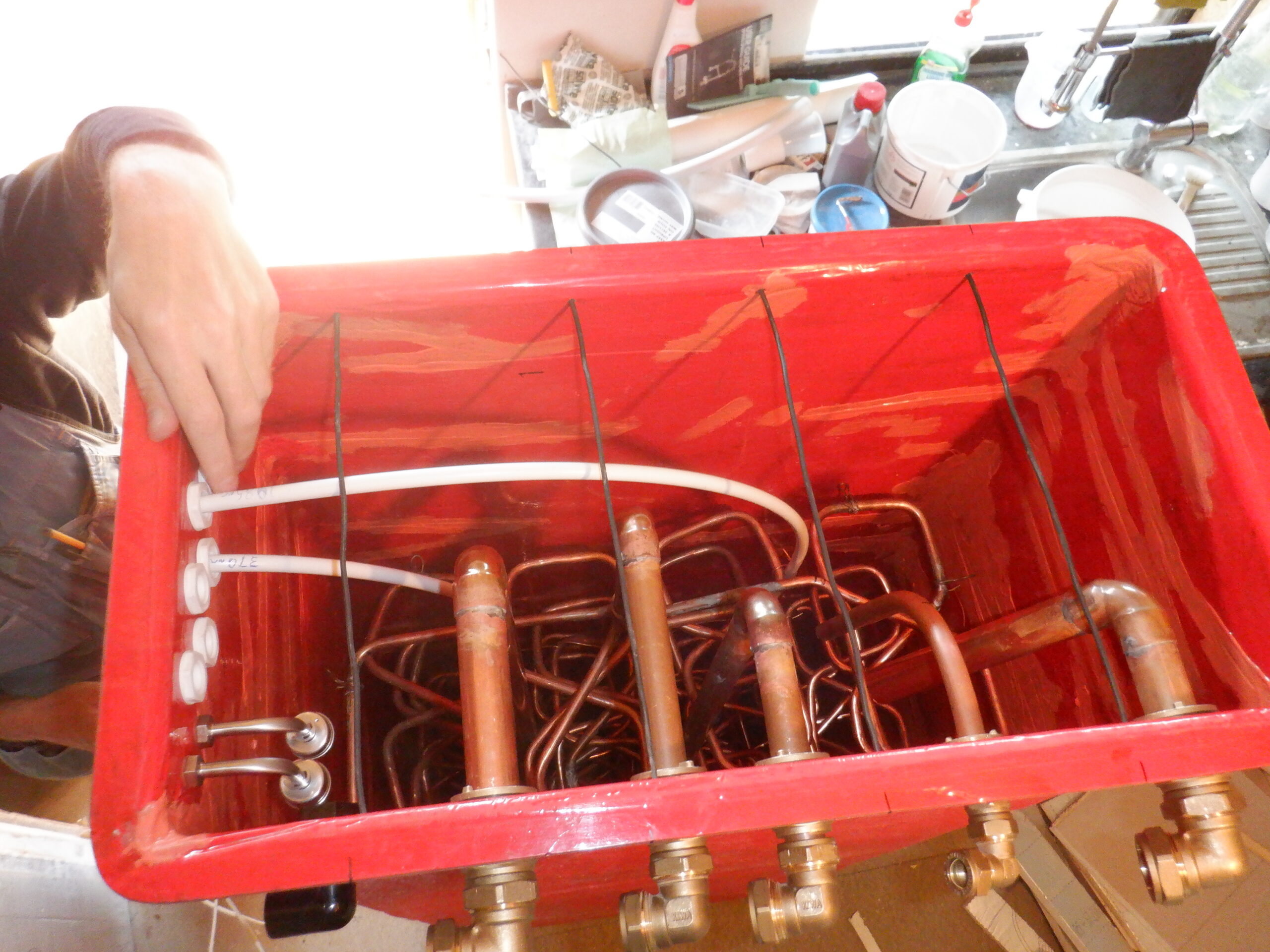
    One of the jobs we have been working on now and again, in between other jobs, is putting together all the internal bits and pieces for our Hot Water Tank. The heat exchanger is now ready and we slid it into the tank. Then, we aligned the three pipes inside, with their elbow bends on top, and drilled clearance holes for a series of tank connectors, one for the 28mm pipe and two for the 22mm pipes. Plus also another 28mm one for a short piece of pipe, to pair up with the other 28mm pipe that goes down to the bottom of the tank. That covers the two main types of water flowing in and out of the tank. All four needed their elbow bends to be soldered into place.
    But, that is not the end of these tank connectors, we then did another one for a 15mm pipe, a piece of copper pipe which we put a 90degrees bend on it and that will be a cold water feed to top up the hot tank if necessary. The final water type tank connector we inserted, is for the overflow relief pipe, just in case the filling mechanism didn’t halt the filling when it should have done so.
    All those connectors were mounted just under the flange at the top of the tank, on the long side, and they all have external right angle bends, ready for plastic pipes to be inserted in.So, on the short side of the tank, we then drilled a series of holes, this time, for the electrical types of connections going in and out of the tank. The first two were float switches, for controlling the cold water filling system. They are positioned so one will detect the water level dropping below the 100mm mark which will cause more cold water to be fed in. The second float switch is positioned just underneath the overflow outlet so we can detect a failure to halt the filling process and cut off the electric supply to the pump or valve etc.
    Then, the next holes to drill out, were seven holes, to allow nylon glands to be fitted, which has a screw cap that tightens down on electrical wires (two of them actually have 10mm plastic microbore water pipes coming through as these are conduits for two temperature sensors to be inserted into the water). The other five glands will have a bunch of electrical wires going to a mixture of 50V DC heating elements and a couple of 230V AC Mains heating elements, to dangle down inside the tank near the bottom.

    Hot tank with everything plumbed in

    Hot tank with everything plumbed in

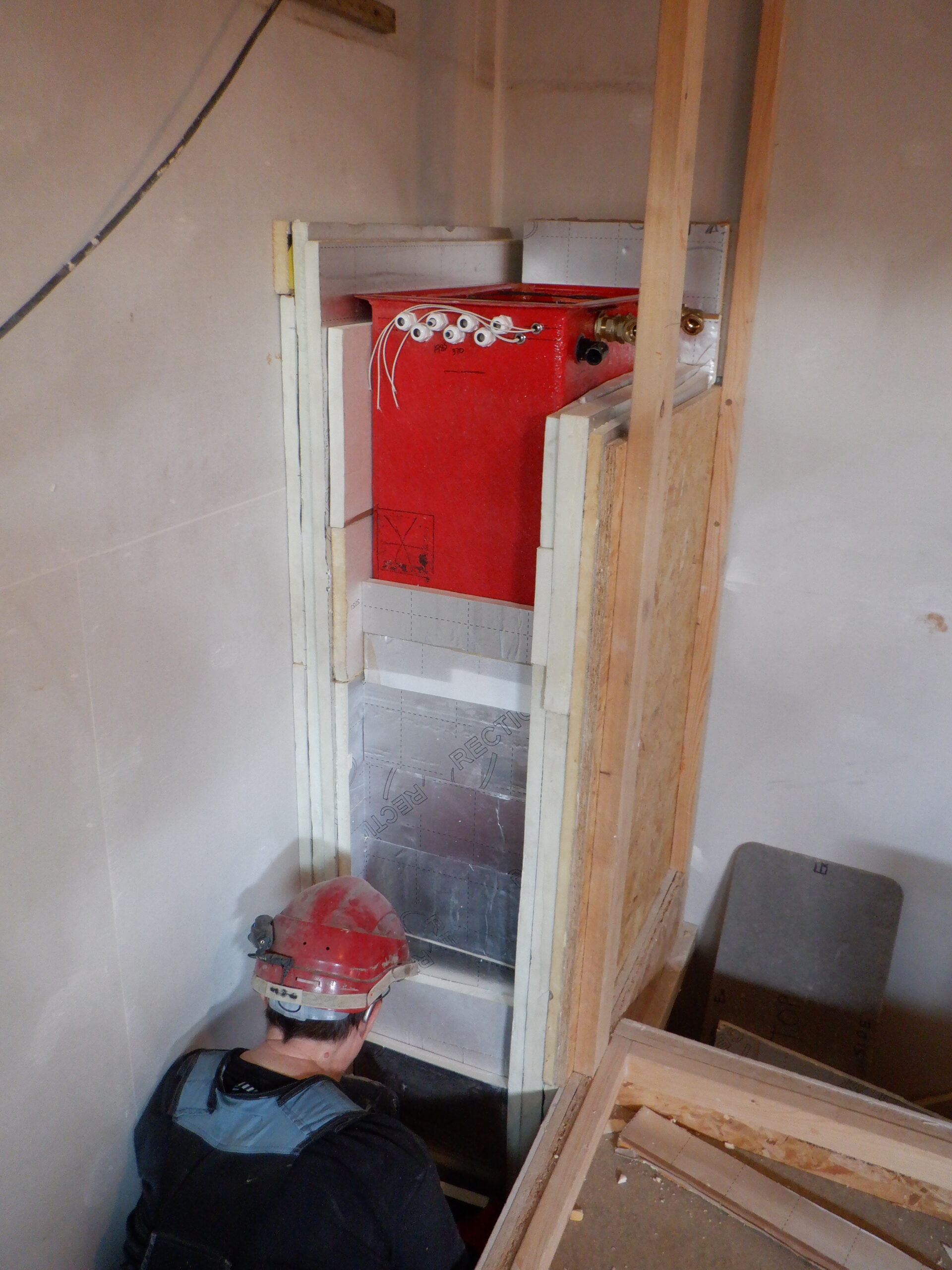
    Now having fitted everything that will go inside the Hot Water Tank, we moved it into the Utility Cupboard, to end up in the corner, tucked out of the way.

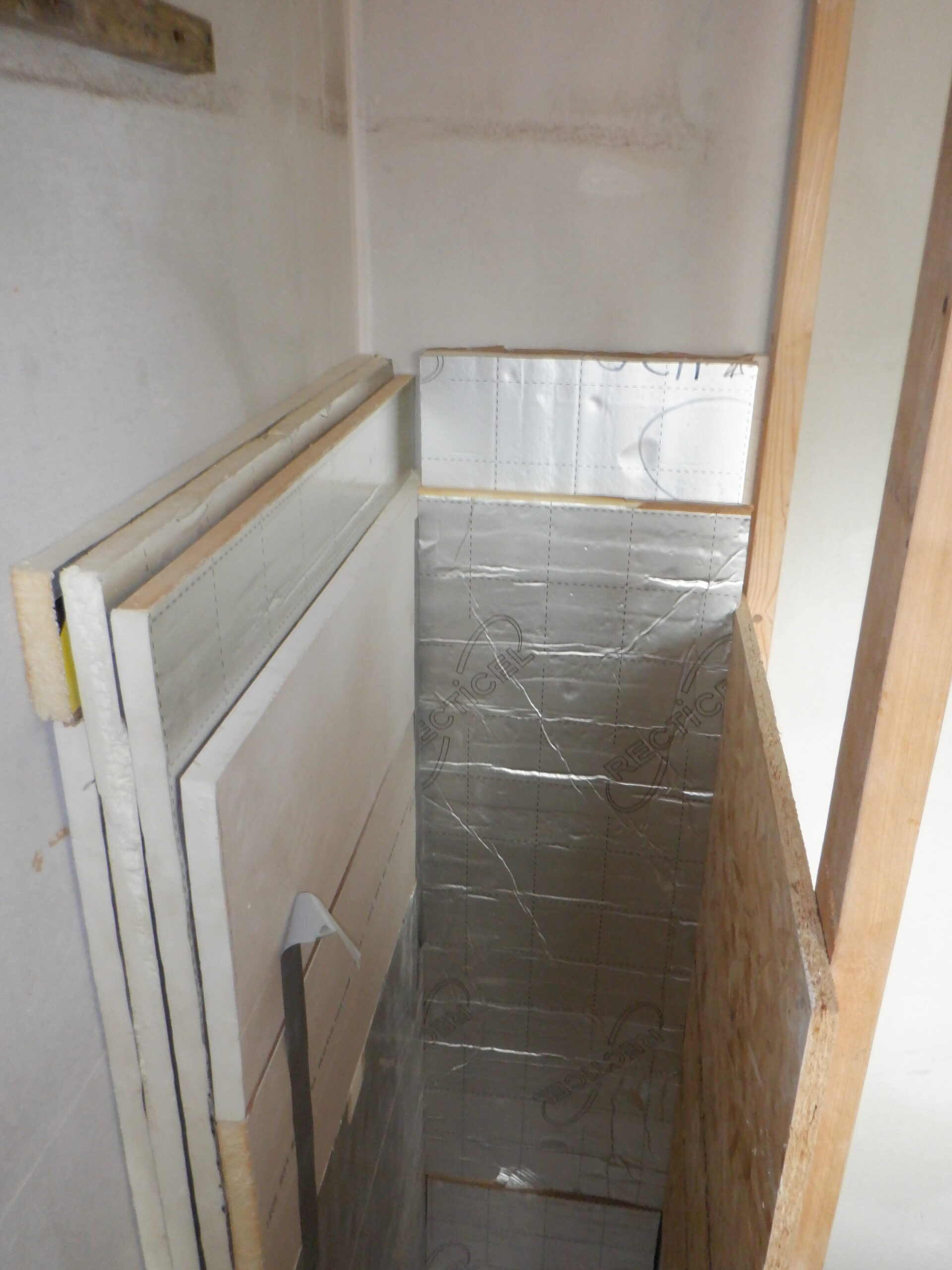
    But first, we need to put in a solid block of PU insulation foam boards, to surround the tank, to insulate the tank, with a thickness of 100mm all around. We had a collection of 25mm thick sheets that were left-over from other jobs so we put in four layers on the bottom, measuring 800mm deep and 500mm wide. Then, we put in a piece of DPM plastic across the whole area, sandwiched between the third and fourth layers, to act as a captive water tight barrier, so we can detect any future leaks, using an electronic sensor. This is a last ditch detection system so that we are made aware that the tank is leaking somewhere and that we have to rescue the situation.
    Next, we put in four more layers of the PU sheets, this time, the left-hand side of the tank. They are 800mm wide and went to a height of 1800mm for the first three layers and a slightly shorter 1700mm high piece for the final layer that is next to the tank and fits just under the flange.

    The third block of insulation is the back wall, this time measuring 400mm wide and a similar height as the previous load. We jammed them in so it keeps the left side layers nice and tight.

    Start of hot water tank insulation

    Start of hot water tank insulation

    We can now man-handle the tank into position, sitting on the block of insulation and shoved over so it is tight next the left block. We then resumed sliding in more sheets, this time, only measuring 700mm wide but we could only get 90mm of foam boards into the available gap, which we achieved by putting two layers of 25mm sheets and a single 40mm thick sheet. Also, we reduced the height by 100mm as well, because all the pipe connections are in this location. We will probably fill in this gap with glass wool insulation later on once we have fitted the various pipes into place. We are also likely to slide in an additional 40mm PU board that will fit in between two CLS wooden legs that are part of the cupboard framework. That will provide some extra insulation as well.

    The final step in covering up the tank is the front and we put in two layers of 25mm sheets measuring just 300mm wide and 1600mm high, and a final 40mm thick one to finish off.

    Fitting last of the insulation to the hot tank

    Fitting last of the insulation to the hot tank

    The final piece for the tank, the lid. We got a small left-over piece of 12mm cement board and cut it down to fit on the full dimension of the tank plus the flange around the top, and cut it to fit. We stuck a couple of layers of 40mm foam board on top as well.

    That concludes the assembling of the Hot Water Tank and fitting it into the Utility Cupboard, with its insulation completely surrounding it. We will do another soak test and this time, rig up an electrical circuit and heat up the water to a good 90°C to test everything. This is a good time to do that as the electricity prices are very cheap during the night, plus also, we are getting lots of solar at the moment, which will help reduce the cost of heating up 288litres of water and then letting it cool down by natural means so we can find out how long it takes with the amount of insulation we have put on.

  • Repair the Hot Water Tank

    At last, we tackled the annoying problem of fixing a leak in our new Hot Water Tank we constructed a few weeks ago. Just to recap the situation, we discovered that our mould we had made to shape the fibre glass resin on to, had little ripples in the release tape we had stuck on. These little ripples has create little grooves in the finished resin surface. One of these grooves was deep enough to breach the inner skin and this allowed the water to escape. That is the situation .. O Boy!
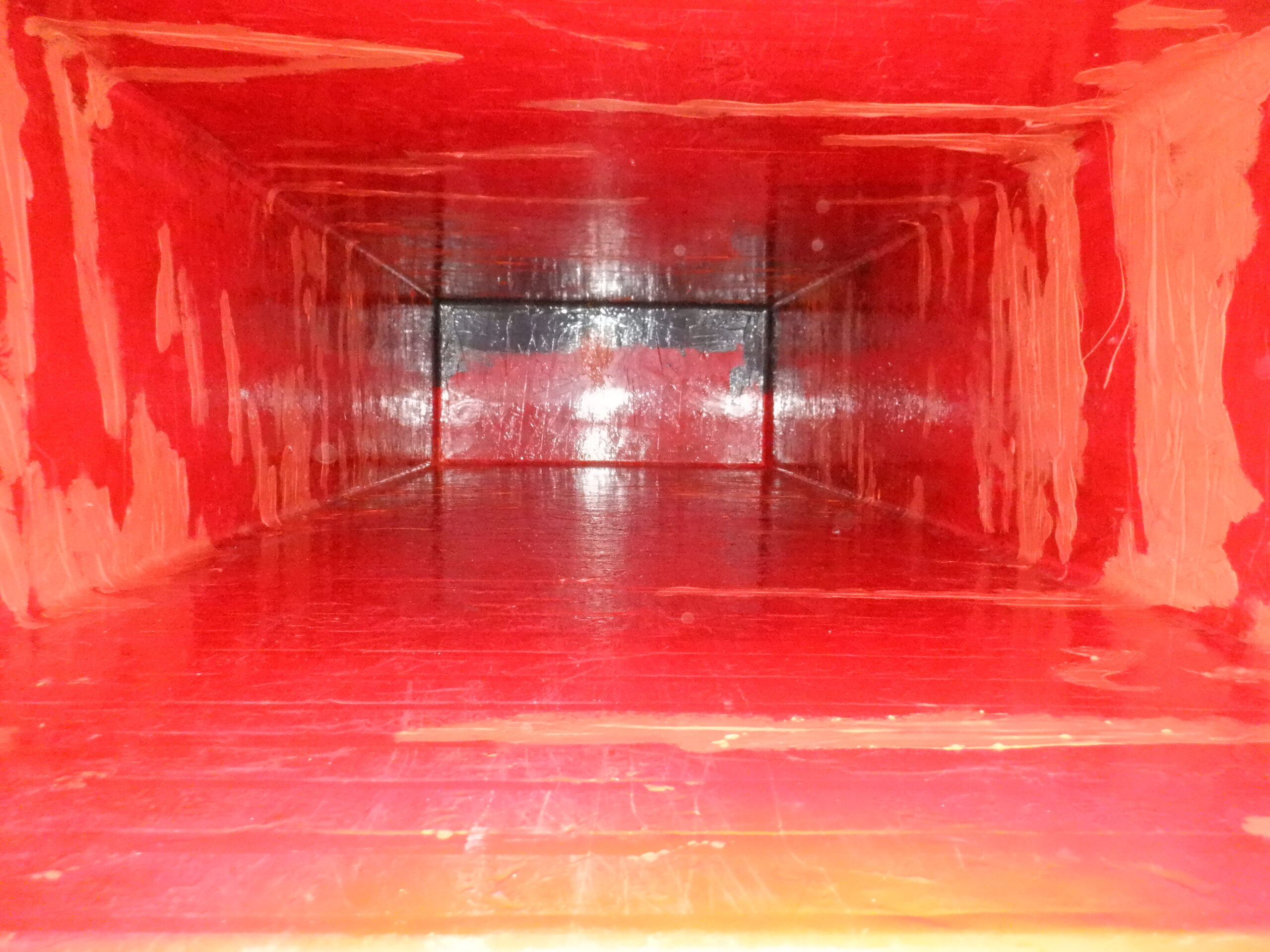
    So, we tackled this problem by having to climb, or rather, crawl inside the tank which is lying on its side. We vacuumed the inside and then rigged up a fan to blow forced air into the tank, to make absolutely sure that we are getting fresh oxygen and removing the chemical vapours. We went through the whole tank and scrubbed all these grooves with acetone, to clean out them and prepare the surfaces ready for a fresh application of more resin. We have to do this work in two stages because we cannot turn ourselves over to work upwards, so, we had to rotate the tank over.
    We mixed a small quantity of resin and added some yellow dye, which turned the red colour to an orange shade. This will give us a feedback to where we had applied the resin. While wearing our mask with the activated carbon filters, we proceeded to dab each of these grooves. We turned the tank over and did the other half as well.

    Sealed up the defects in Hopt Tank

    Sealed up the defects in Hopt Tank

    We left it to cure and harden overnight.
    Now, it is time to give it another leak test, we got out our garden hose again and started filling. .. In the meantime, while it was filling, we went to find a piece of 12mm cement board, traced the outline of the top of the tank and sliced it into a lid. This will sit on top, on a ring of rubber around the edge and keep the steam and hot air in the tank.
    Oh No !! !!
    We still have the same leak as last time !
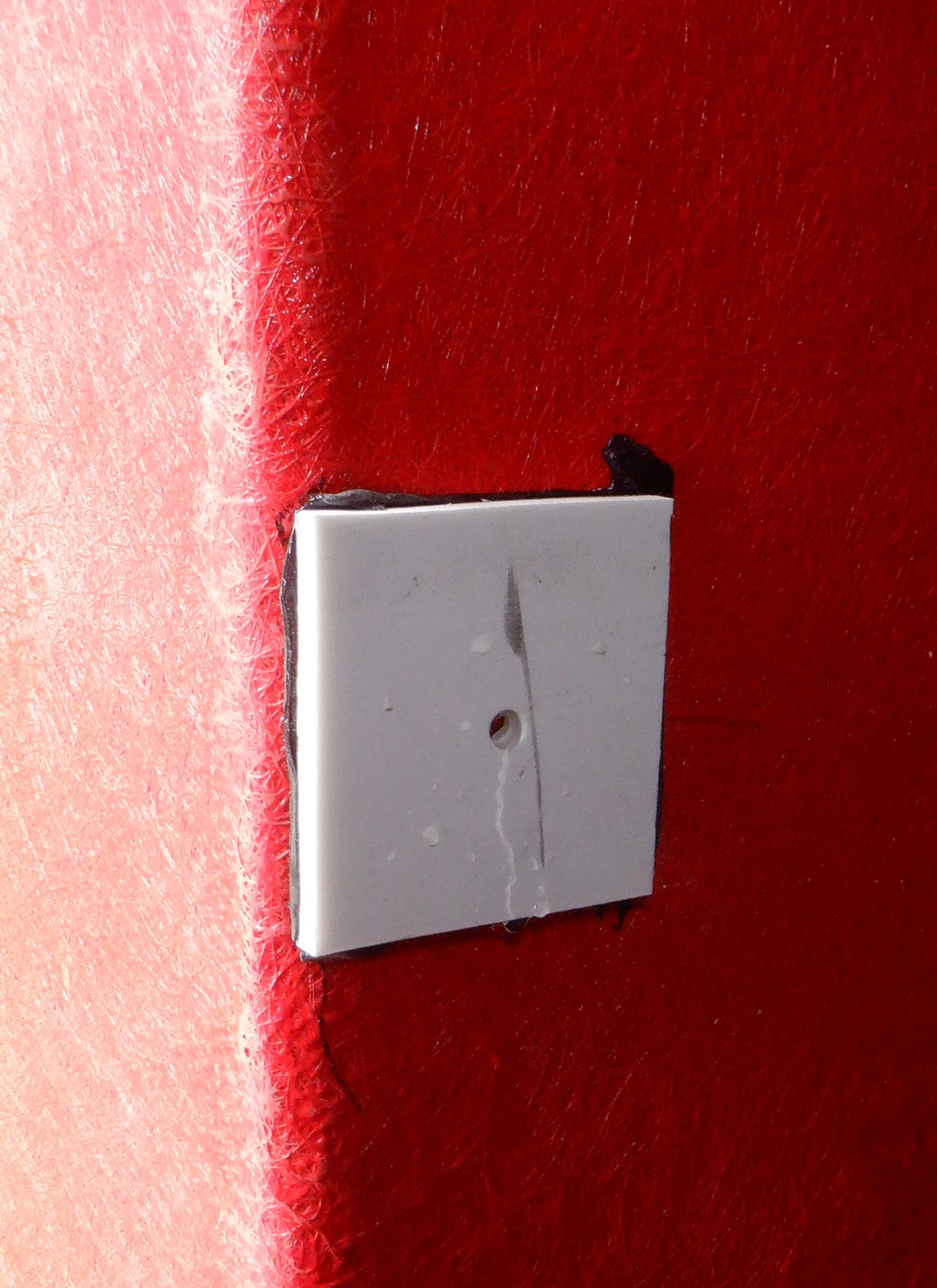
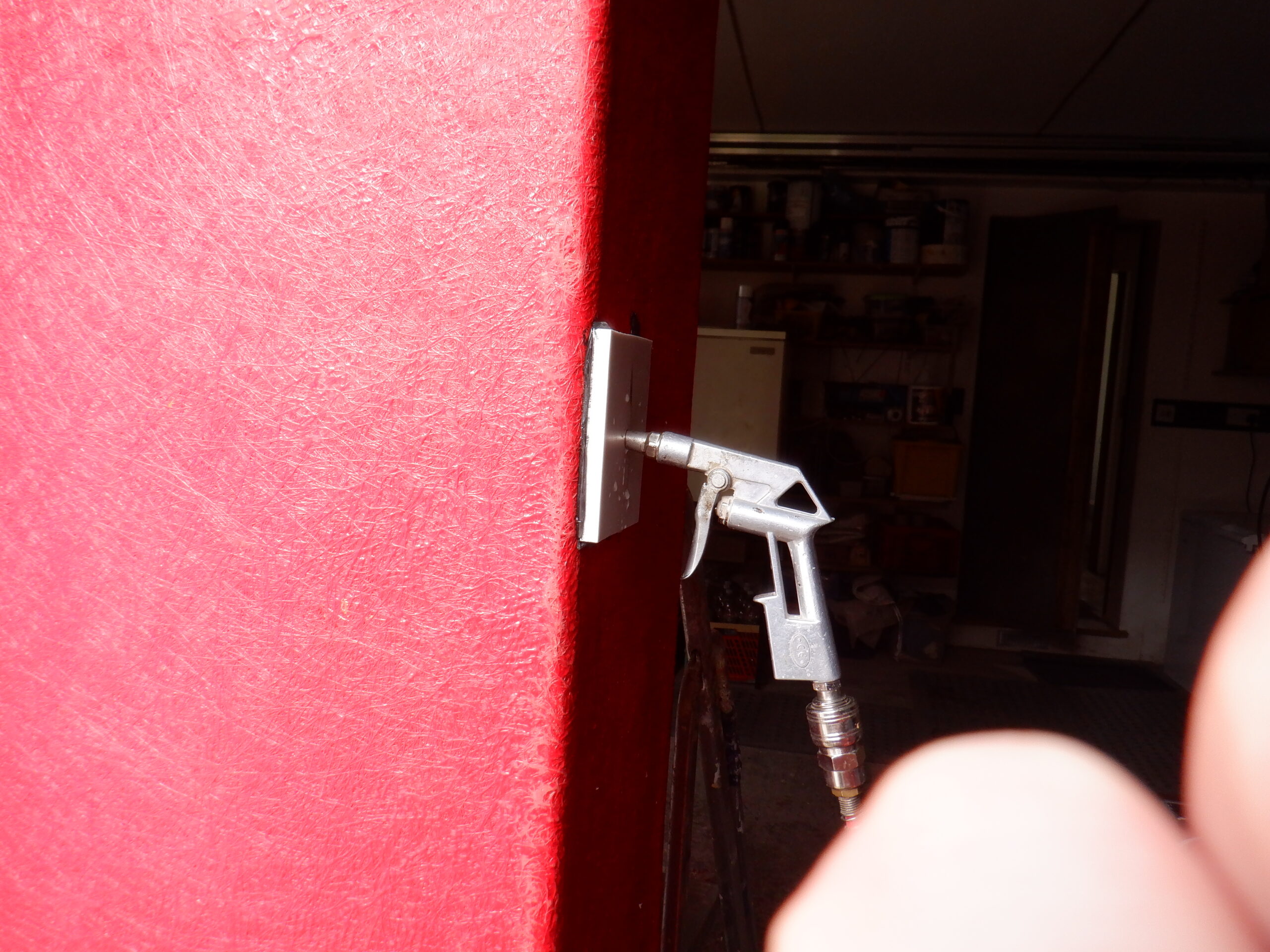
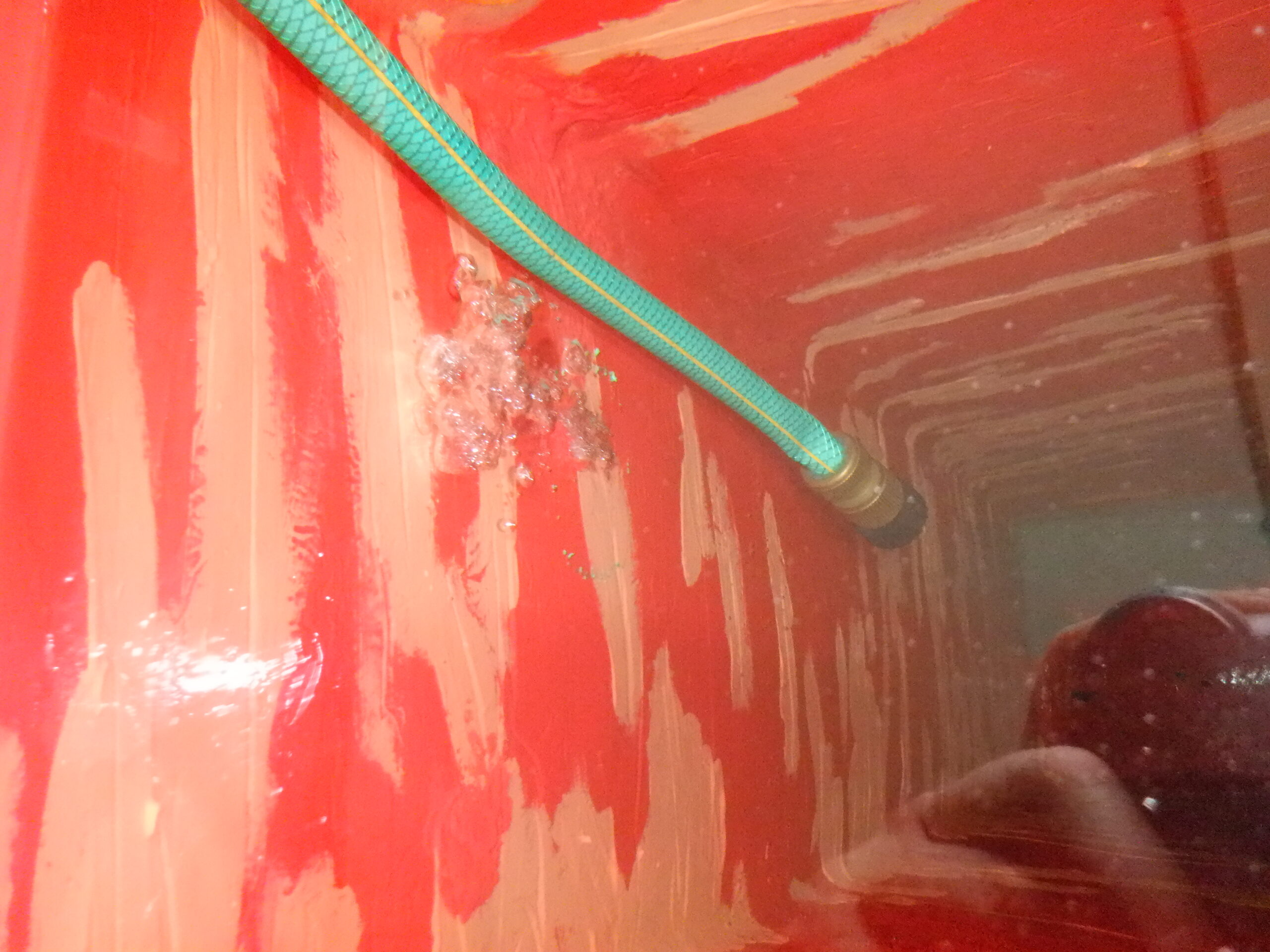
    After trying to see where the hole is, on the inside of the tank, we had the idea of using compressed air to blow backwards from the spot where the water is steeping out and force air through the skin and hopefully make air bubbles appear on the inside. We eventually stuck on a 4inch square piece of thick plastic, with a ring of butyl thick glue around a circle and then clamped it on over the site. We carefully sent small burst of air into the white plastic pad, through a hole in the middle and .. we had a stream of air bubbles blowing into the water!
    Plate attached to allow air injection

    Plate attached to allow air injection

    Injecting air to find the leak

    Injecting air to find the leak

    Bubbles showing where leak is

    Bubbles showing where leak is


    We got a dark wax crayons and drew a small circle around the site where the bubbles came out. It had to work underwater!!
    Then, we drained the tank so that the level of the water was 6inches below the “hole” and then drew a wider circle using our marker pen. We sanded heavily this zone, to make sure that the surface is well “roughened”, to help stick the new layer of resin over that spot. We also heated up both sides with a hot air gun, set to 100°C maximum, to thoroughly dry the fibre glass and drive out any moisture trapped within the fibre glass itself. It needed to be as dry as possible so that the new resin will stick properly. We rubbed the entire zone with more acetone, to soften the resin and make it more attractive for the new liquid resin to stick better as well. We mixed a small amount and then applied it to the 4inch zone inside the tank. We had left-over so we painted the wall near the top of the tank, where we are planning to have various connections made to pipes etc.
    Again, we left it overnight to allow the resin to cure fully, before refilling the tank back up to normal levels again. To see whether we have fixed the leak .. or not!!
    ..
    No Leaks!! Hurray! Yippeeeee!
    At last!
    We left it full of water all day and it is looking good.
    We now have a repaired Hot Water Tank! Ready for the next stage of fitting the connectors and the heat exchanger coils ..

  • Constructed Hot Water Heat Exchanger Coils Plus Other Pipes and Sensors

    We have been spending a day here, a day there, whenever we were waiting for glue to set, paint to dry etc. etc. and got on with the task of designing and building a heat exchanger coils for our Hot Water tank sitting in our Utility Cupboard. We wanted to have a system where we could run in various hot water, or indeed cooler water sometimes, to transfer energy into, or out of, the tank. We are going to use lots of copper pipes, narrow 10mm wide copper pipes, and bend it into a coil, to form a tall rectangular spread out maze of pipe bending this way and that way, to form a column. We want to make four of these, so that they stand in a line, inside our Hot Water tank. They will be connected to a 22mm copper pipe and a tiny little manifold which will allow four 10mm pipes to join into the 22mm pipe. The 22mm would then go up to the top of the tank and exit to the outside world.

    So we were thinking of doing a series of “figure-of-eight” loops, wrapping the copper pipe around two 110mm waste pipes, set apart very slightly, making sure the overall dimensions kept within 150mm by 300mm. In fact, we made sure that the longer length didn’t exceed 270mm so that there was room to slide the finished article into our tank. We found some left-over waste pipe, made two equal length, measuring 250mm and then cut little slots at one end, all the way around, to form little bendable tabs. We heated up the plastic to bend these tabs out and then we screwed the two pipes onto a block of wood.

    We then started trying to bend the copper pipe around these template, but discovered straight away that the thin walled copper pipe kept on buckling and didn’t want to bend smoothly around. Oh Dear!

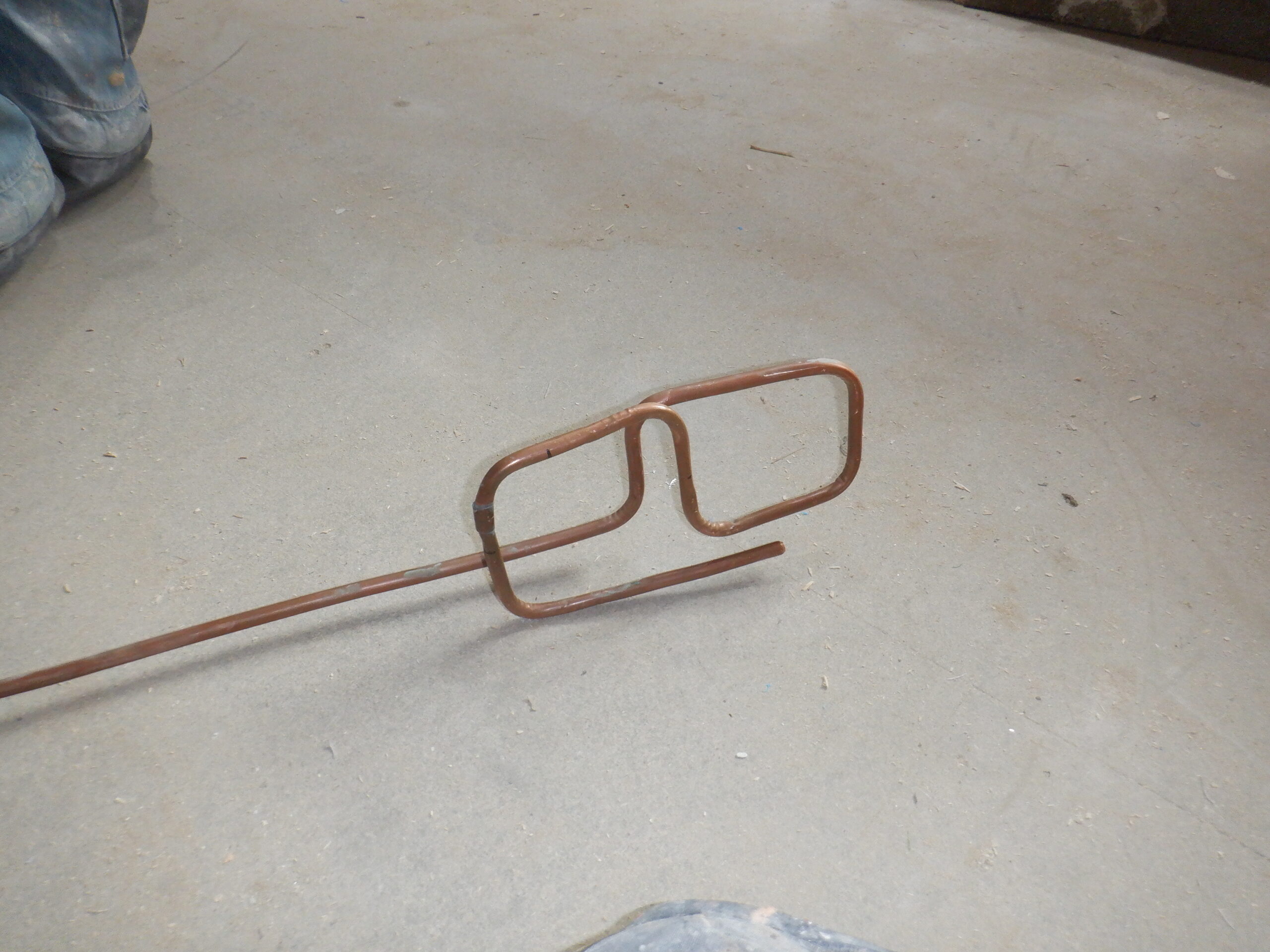
    So for Plan B! We decided to use our miniature pipe bender tool, designed to cleanly bend these microbore pipes but at a much tighter radius, of around 20mm, forming a bend that would be only 40mm across for a full circle. We still tried to use our existing template, to bend the copper pipe with right angle corners, and 60degree in the middle when we wanted to make the “figure-of-eight” shape but it was proofing very difficult. It was a matter of getting precise distances from one bend to the start of the next bend, to apply the bending tool in that precise location, to end up having the copper pipe going around the two upright plastic waste pipes. We had a little chaotic set of coils.
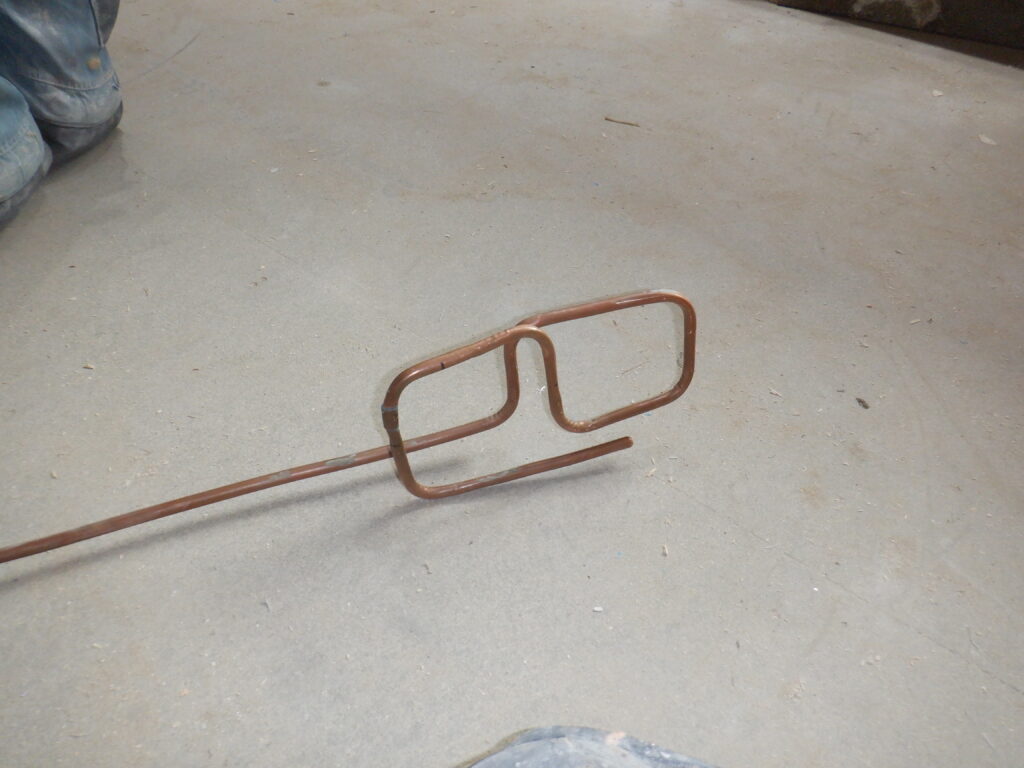
    Trying out pipe bending

    Trying out pipe bending


    By the way, we were using old copper pipe we had from a previous project some 15 years ago, so we were not losing material here with our experiments!!

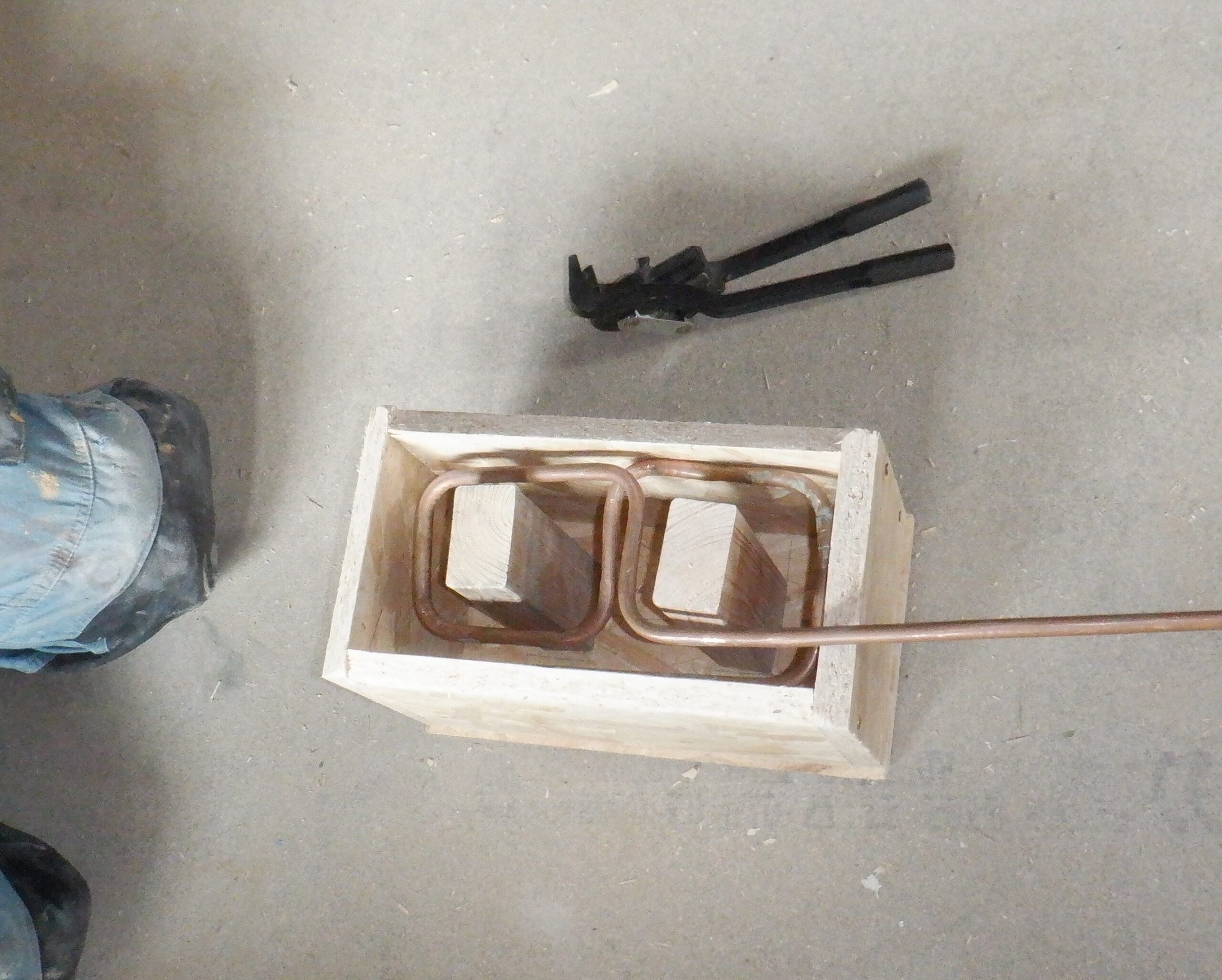
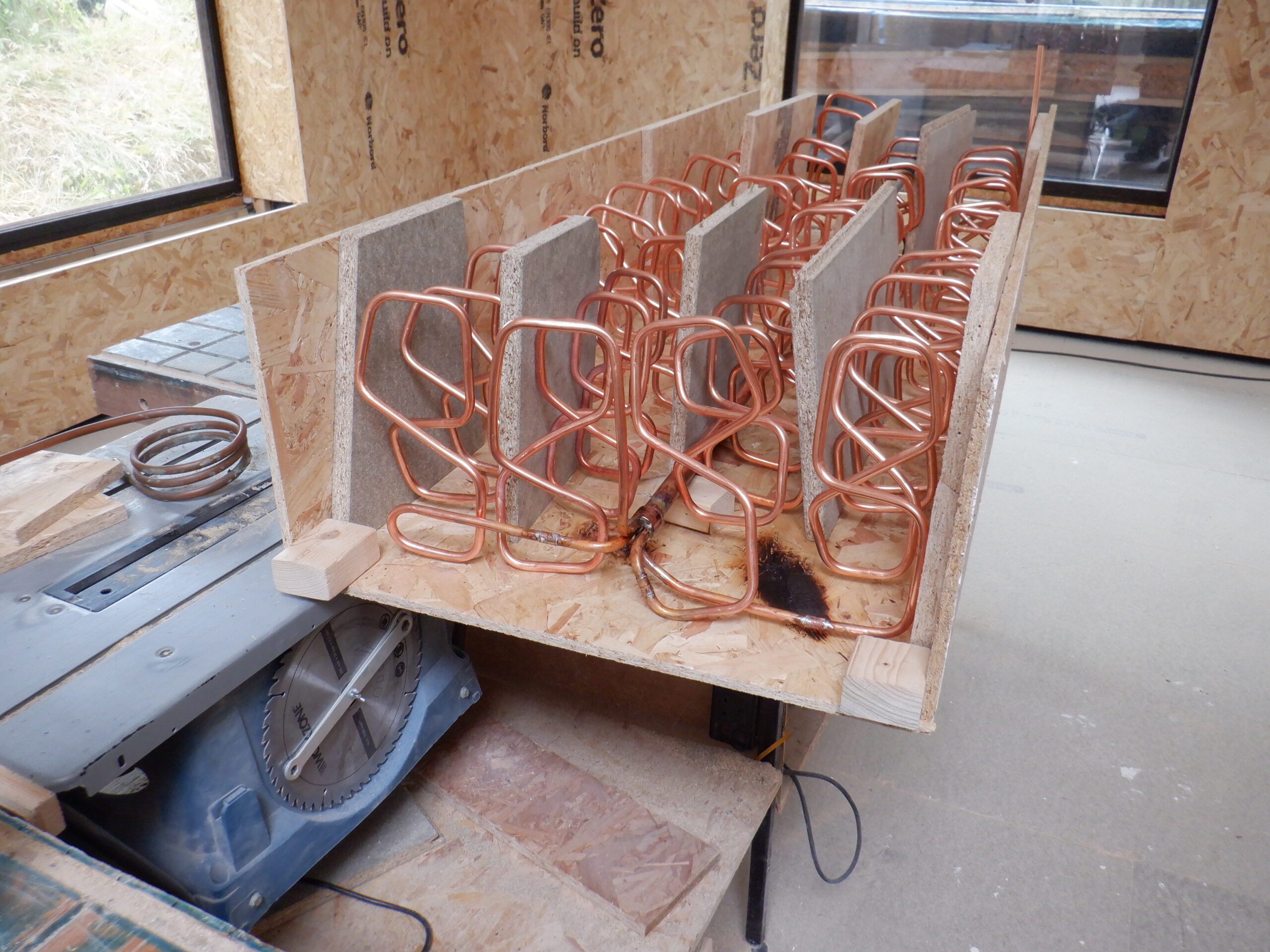
    What we ended up, as you can see in the photo above, is a random collection of lengths and gaps, which gave us the idea that if we change our approach slightly, like for example, if we build a rectangular box and, instead of the two plastic tubes, we mounted two wooden pillars using 63mm CLS timber, to ensure that we had maintained a cleared section to allow the insertion of the immersed electrical heaters as well. This box measures 270mm long by 130mm wide.
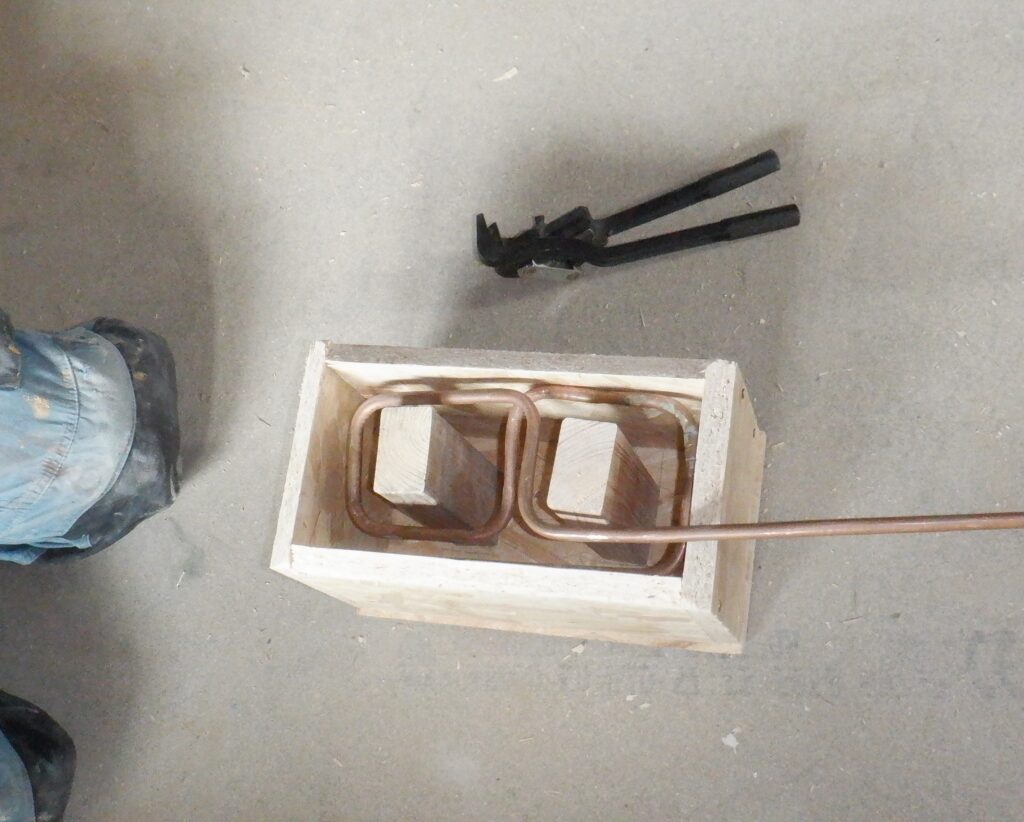
    Frame to constrain tube bending

    Frame to constrain tube bending


    We did another test run and it was much easier to randomly bend the copper pipe at various points, so long as it obeyed the basic requirement of going around each pillar in a figure of 8 movement, it doesn’t matter where or what path the copper pipe takes. It looks quite reasonable.

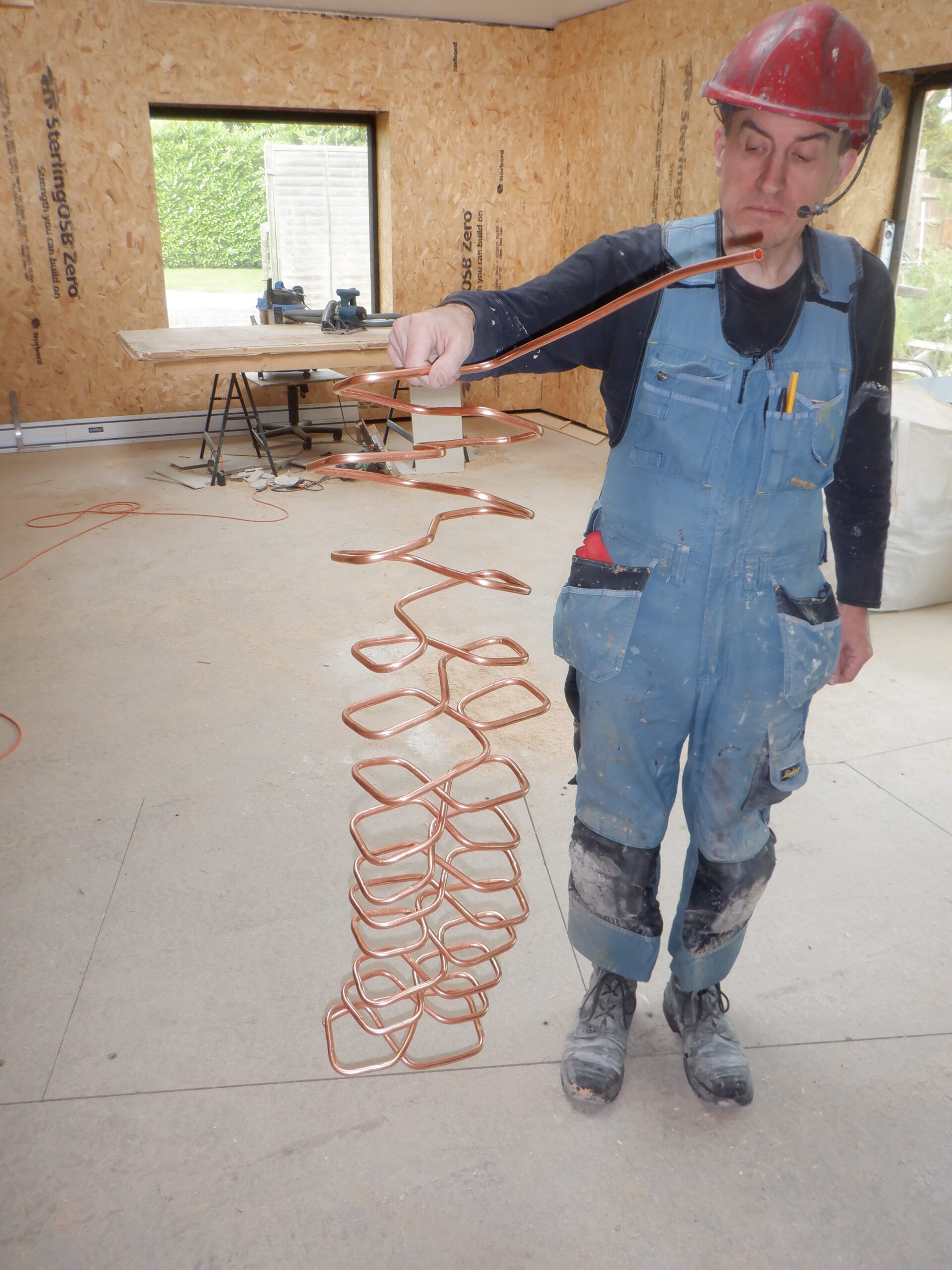
    So, we committed ourselves to using our freshly bought boxes of 10mm copper pipes, and proceeded to bend one column of random lengths and angles, to bend the entire 10 metres of the copper pipe, all into that limiting rectangular requirements. It took a couple of hours to do the job, but we ended up with a column, vaguely rectangular in shape. We pulled the approximately thirteen loops out, stretching it out to about 1metre tall.
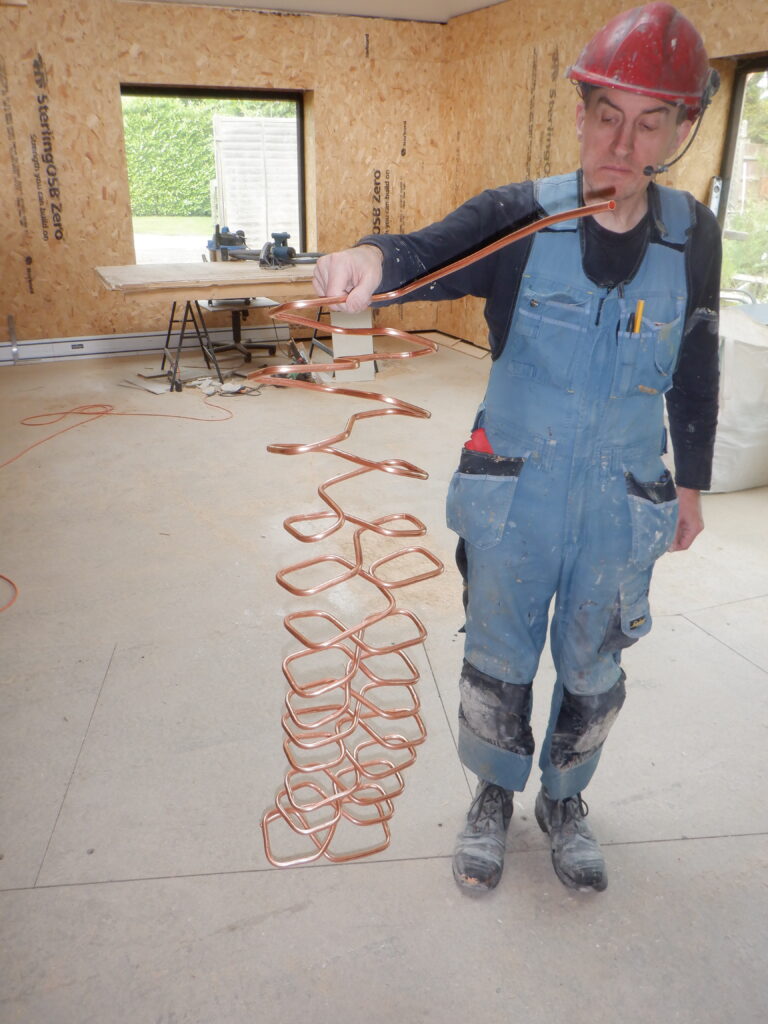
    First heat exhanger formed

    First heat exhanger formed

    On another day, while waiting for the Cloakroom paint to dry, made two more “coils”, this time only taking about an hour to do all the bends. The third one had a slight crumpling up of one of the bends so we had to chop that out and replace it with a new bend and soldered the replacement back into that location.

    Then we did the fourth and final one the other day. We now have four of them, ready to be assembled together later on.

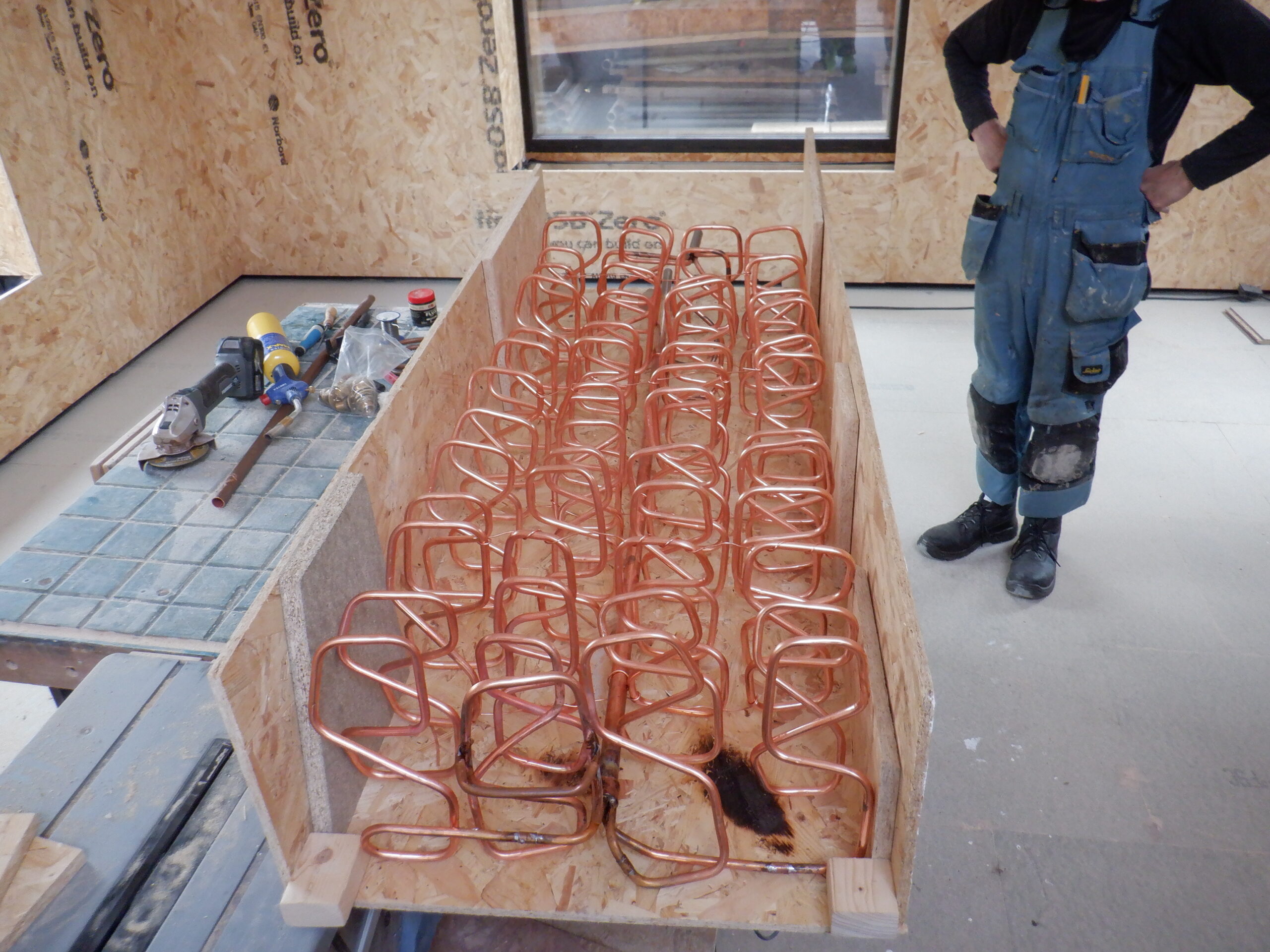
    On another occasion, while we were waiting for a new tin of acrylic varnish to arrive, we got on with the job of assembling our four coils, to form a single module, ready to be slid into the Hot Water Tank. So, towards this aim, we put together a rough and ready simple template of our hot tank, just the back and two sides, measuring 600mm wide and 300mm high, and 1700mm long, emulating the shape and size of our tank. Then, we put in 100mm wooden blocks at the top, to make sure that the copper coils do not occupy too far up the tank and we did a similar thing at the bottom, but this time, only a 50mm blocks so we can guarantee a buffer of water underneath the coils.
    We then stretched out all four coils, to fill the majority of the space. We noted that we could, and did, slide in pieces of 18mm and 22mm thick boards in between the coils, including on the outside too and that helped keep them much neater and separated from each other.

    Now these four separate coils needs to be connected together. I mean the actual copper pipes at each end, so that the water coming in, and out, of the tank, via a 22mm copper pipe, can be split up and flowing around the four group of coils, transferring the energy in one direction or another.
    We got a very neat brass adapter that fits to a 22mm size copper pipe and four 10mm holes, arranged in a two by two grid, on the other side. We managed to carefully bend each separate coil “tails”, sometimes with an extension piece, and connect each tail into this adapter. Then, we cleaned all the joints, put on flux and then got our gas torch to heat up all the joints and melt solder in the joints.
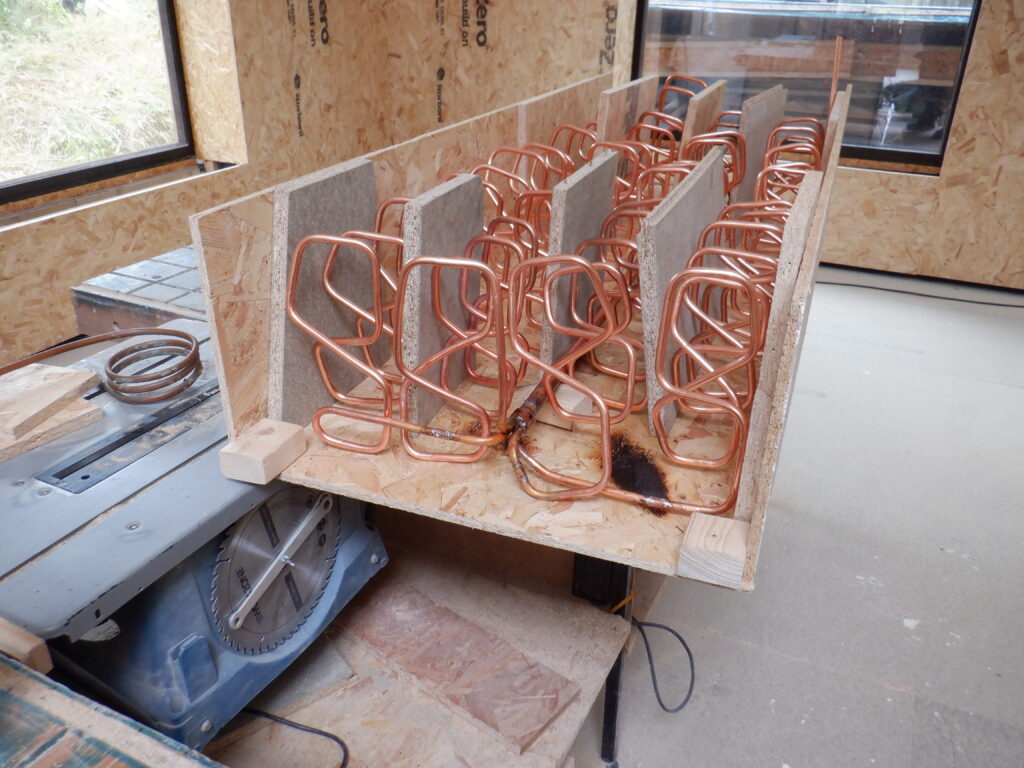
    Heat Exchangers Base
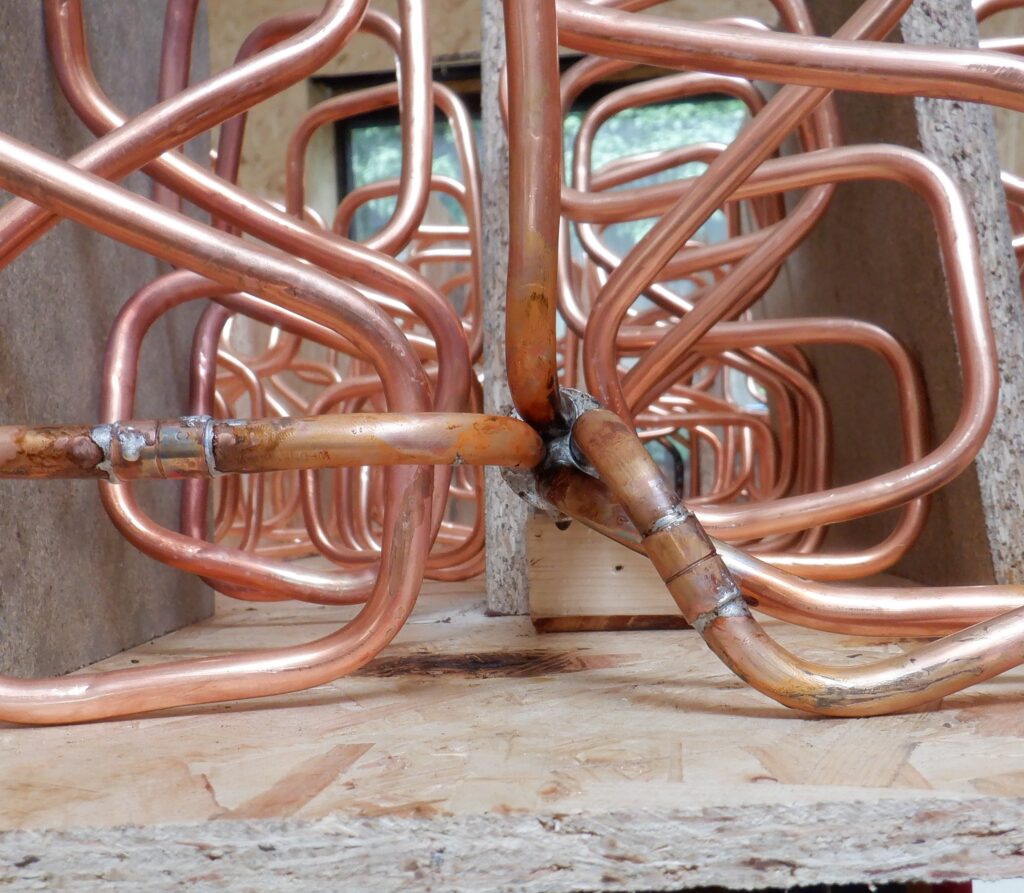
    Heat Exchangers Base

    Heat Exchangers base manifold

    Heat Exchangers base manifold


    The 22mm copper pipe went up the middle and pokes out the top end.

    We then repeated the process to the other end of the coils, and soldered the adapter and joints in a similar manner. This time, we put on a little short piece of the 22mm pipe. Both of these pipes will have elbow right angle bends but we will do that later on when we got the whole thing inserted into our tank.

    We then bend a small piece of 10mm pipe, into a “U”, to make a “foot” to take the weight of the heat exchanger and also maintain a 50mm gap at the bottom of the tank. That was also soldered into place too.

    Then we slid in a length of 28mm copper pipe down through the coils and anchored that into place by twisting some thick copper wire we found in our left-over cable scrap box. We also threaded some more of the thick electrical wire (we stripped off the plastic coating) and anchored the coils together as well, to stop it wiggling around.
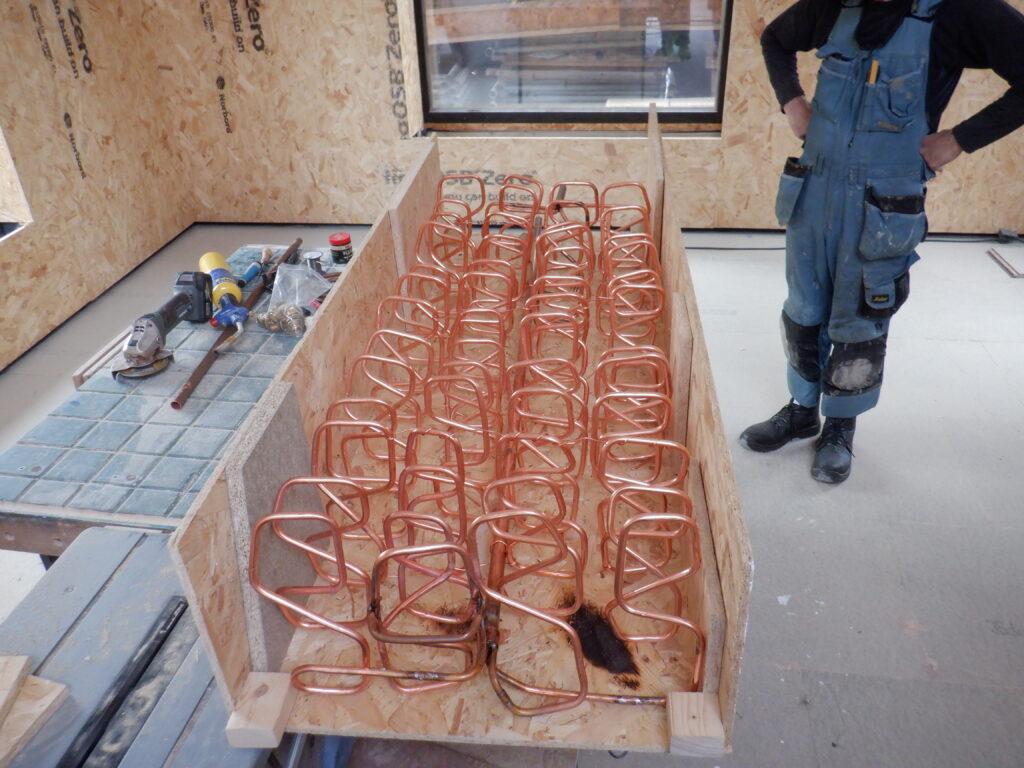
    Heat Exchangers in place

    Heat Exchangers in place


    Another additional little task we did, was to twist little pieces of wire on the outside of the coils, between it and the walls of the tank, to provide a simple way to make sure that the coily module will sit nice and centred in the tank and keep away from the wall surfaces. We had to solder these pieces into place, to stop them twisting out of alignment.

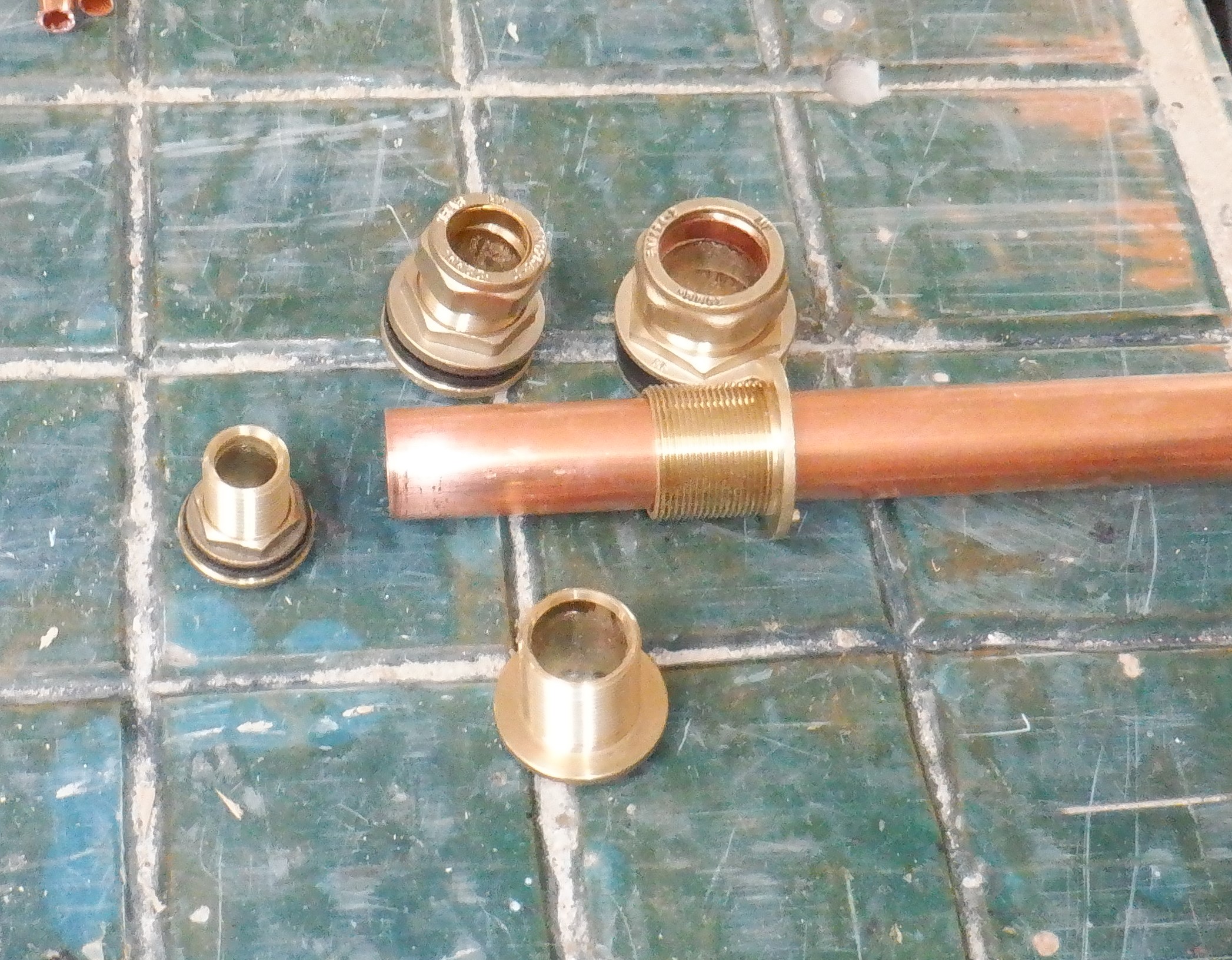
    All these pipes (the two 22mm ones plus also two 28mm ones) and also a 15mm filling pipe that we haven’t mentioned yet, will all need a tank connector mounted at the top of the tank, to allow the copper pipe to gain access to the outside world. But, we want to slide the copper pipe right through these connectors, but that can’t happen until we have grinded an internal flange away. We used a 16mm HSS drill to ream out the 15mm tank connector, and used a tungsten carbide grinder to do the job in the four larger connectors.
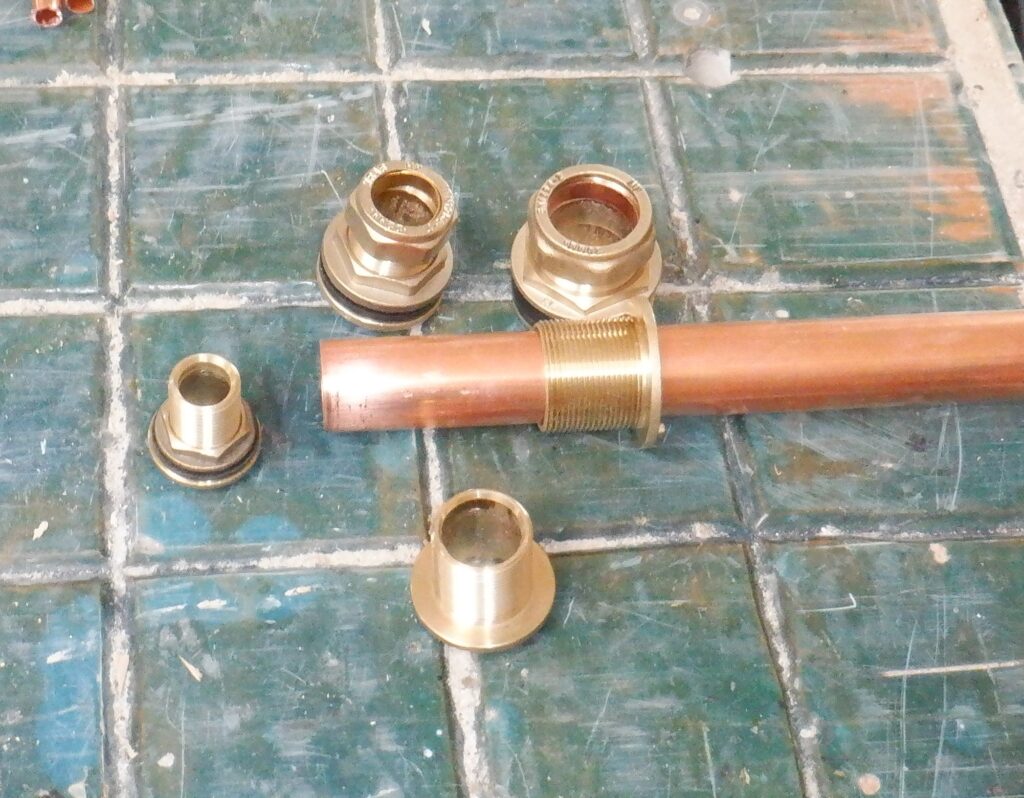
    Tank Connectors reamed out

    Tank Connectors reamed out

    finally, we could do a “leak” test at last! We connected up our compressed air adapter which we had previously assembled, using various plumbing bits and pieces, joined to our tyre adaptor. We push it on the 22mm pipe, blasted air down inside the long coily pipes, to remove any rubbish. Then, we put on an end stop on the other 22mm pipe and built up the air pressure inside the pipe. We had a hissing sound!! We squirted some soapy water on everything, to track down the source of the hissing noise and eventually located it to a repaired section where one of the inline joints was leaking. It took us two goes to plug the gap in the joint with melted solder. We then tested everything again and this time, we held tight! Our testing adaptor has a digital pressure gauge and we put in 3.90bars of air and it stayed steady for a couple of hours, only very slightly dropping to 3.88bars, which is probably as a result of temperature change. We had squirted more soapy water on all the joints and see if bubbles formed like a little miniature volcano .. but none developed. Yippee!

    The last thing we did, was to slide a length of plastic 10mm pipe down in among the coils, to serve as an temperature probe. We sealed the bottom end with a brass end cap compression fitting, to make it water proof, but also, to provide a good metal heat sink to help warm up the thermometer sensor that we will slide down inside the 10mm plastic pipe. We even put in a blob of thermal transfer paste, to help improve the connection between the thermometer sensor and the hot water that it will be measuring near the bottom of the tank. We did another one, but a much shorter one, to measure the top of the tank.
    That concludes making the Heat Exchanger module !!

    The next job is to patch up the tank itself and then we can install the heat exchanger in for real, and connect all the pipes through those tank connectors to the outside world!!
  • Exterior Larch Cladding and Oak Frames Cleaned and Oiled

    In the glorious sunshine, while it was far too hot indoors, we decided to start one of our Summer job now. We needed to do some serious maintenance to our exterior cladding of our house, giving it a thorough clean, and give it a good treatment of oil, and perhaps a touch of colour dye as well.
    So, the first part of this task, is to clean the larch cladding and the oak guttering and the oak surrounds at each window.
    We got our pressure washer out, pulled the hose off the reel, all 50 metres of it and only just got to the far end of the house! And started washing down the walls, using the rotating nozzle that seems to do the trick of shifting the dust and dirt out of the grain of the wood. Some of the larch has fungi growing on them as well, especially in those locations that don’t have a lot of sunshine on them, and gets wet from the rain. We are planning to apply some anti-fungi treatment, mixed in with the timber oil solution as well and give the wood some protection against further fungi growth.
    But, right now, we slowly worked our way around the whole house, doing each section by section. We even blasted the gutters as well, they are starting to turn silver and the pressure washer seems to give them a new leaf of life and colour again.

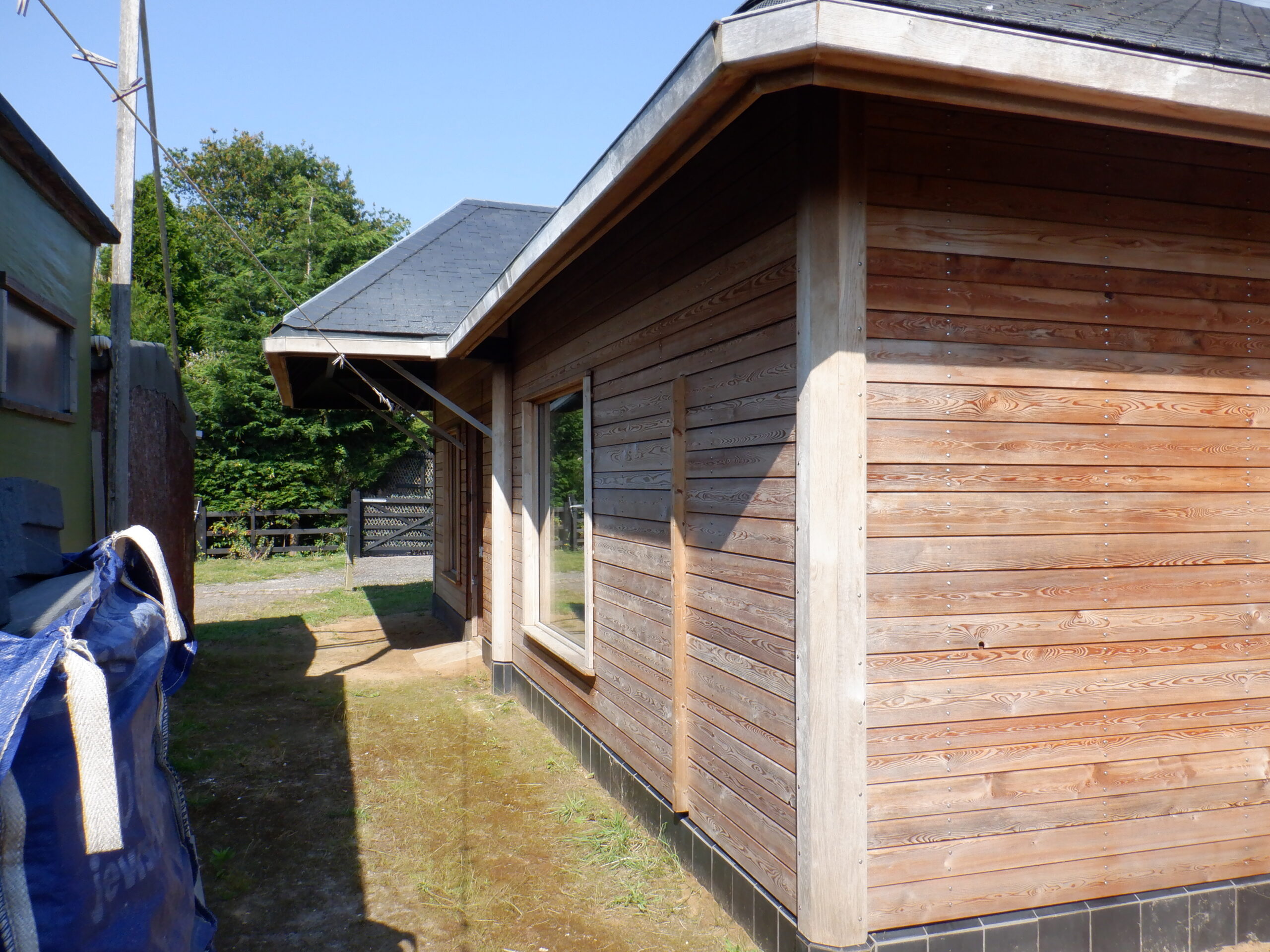
    P1 Wall before cleaning

    P1 Wall before cleaning

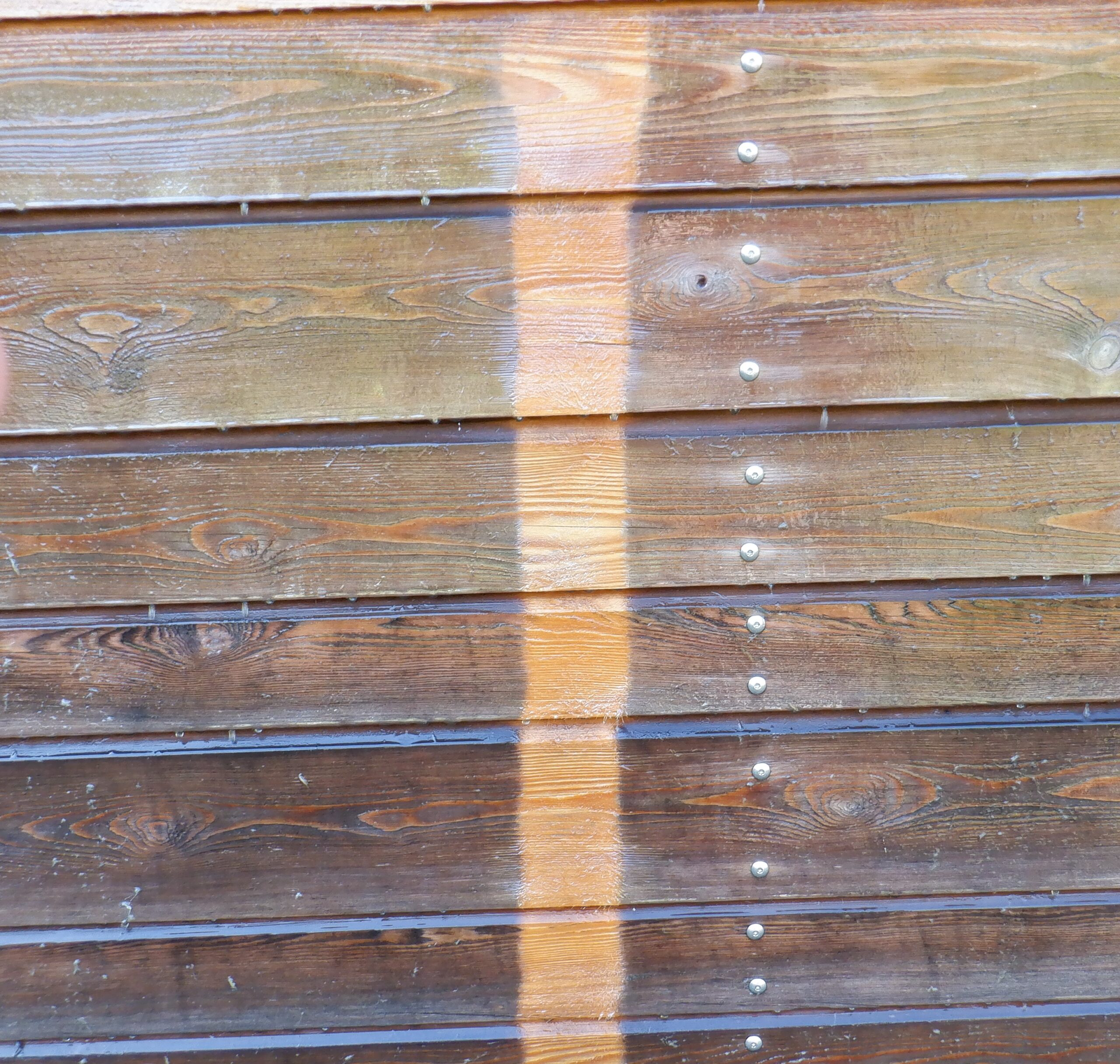
    Clean a Stripe

    Clean a Stripe


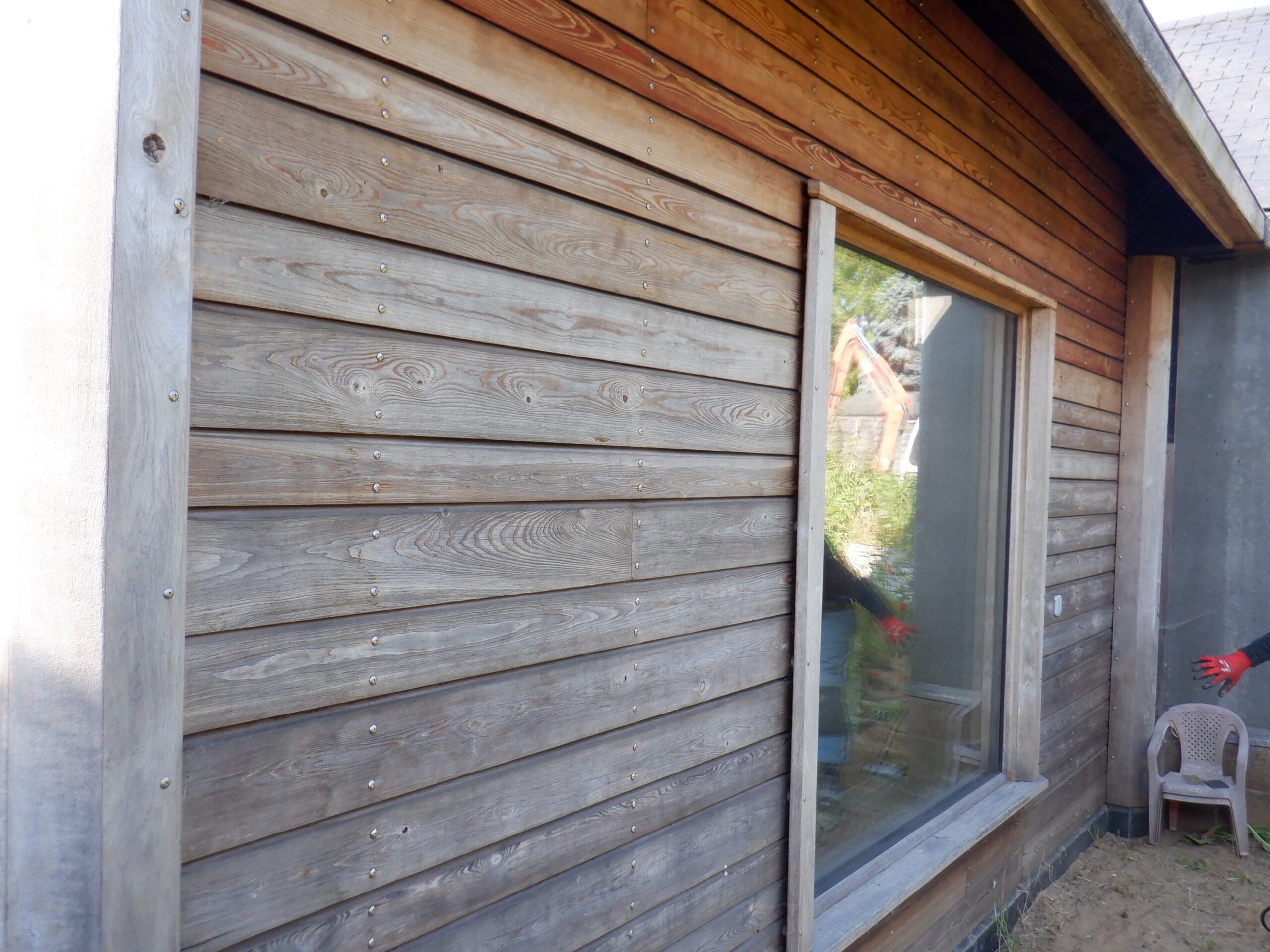
    As you can see from the photo, the walls were definitely grimy, and also, much of the original “burnt” colouring has disappeared as well. It is amazing that the Sun was able to bleach even the burnt colouring. O Boy!

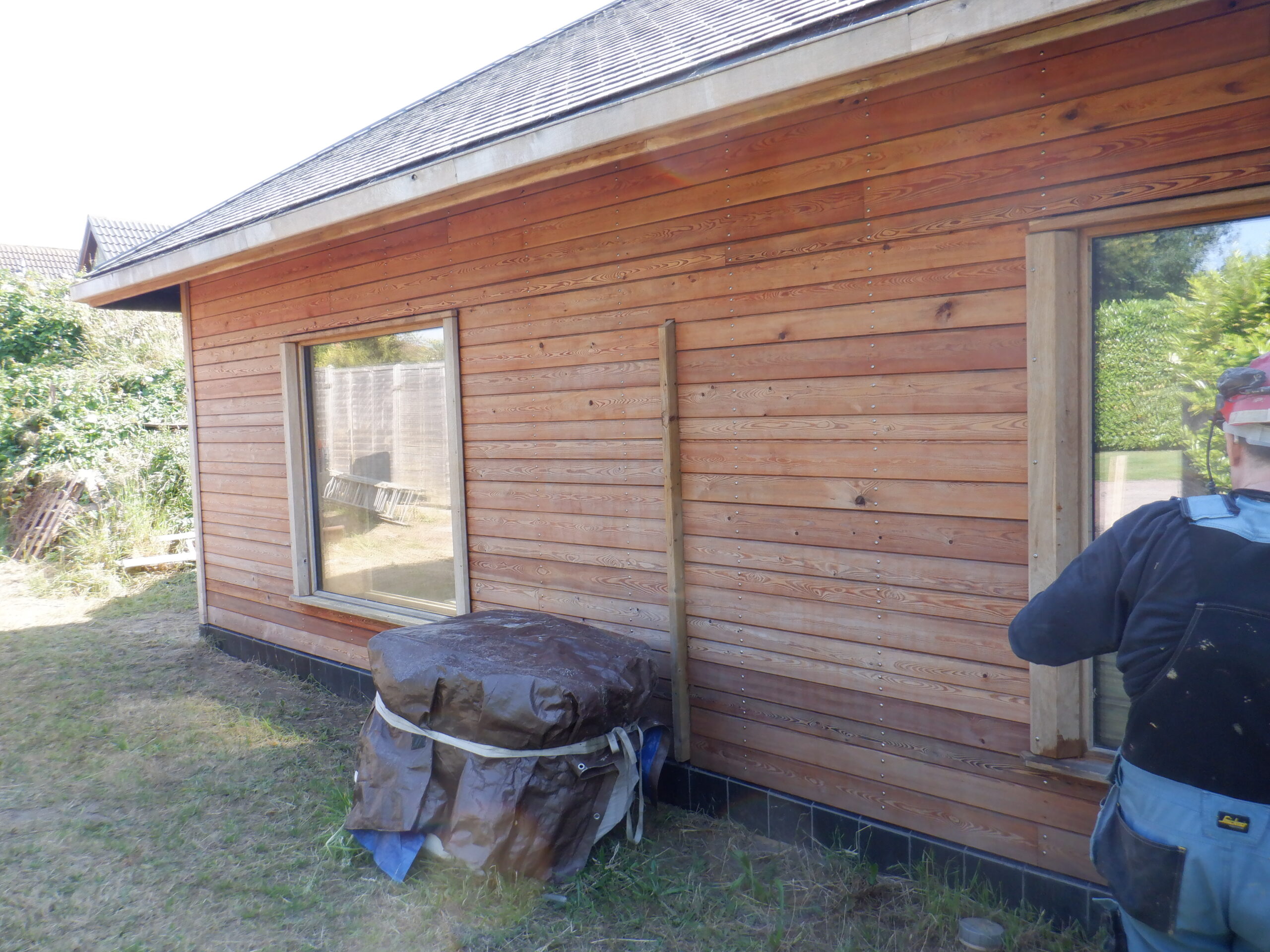
    So we now have a fresh looking house again!

    Walls all Cleaned up (1)

    Walls all Cleaned up (1)

    Walls all Cleaned up (2)

    Walls all Cleaned up (2)

    Walls all Cleaned up (3)

    Walls all Cleaned up (3)


    We have decided that the Larch Cladding had come out much better than we thought so we are not going to add any colouring dyes to the timber oil and just leave it natural.

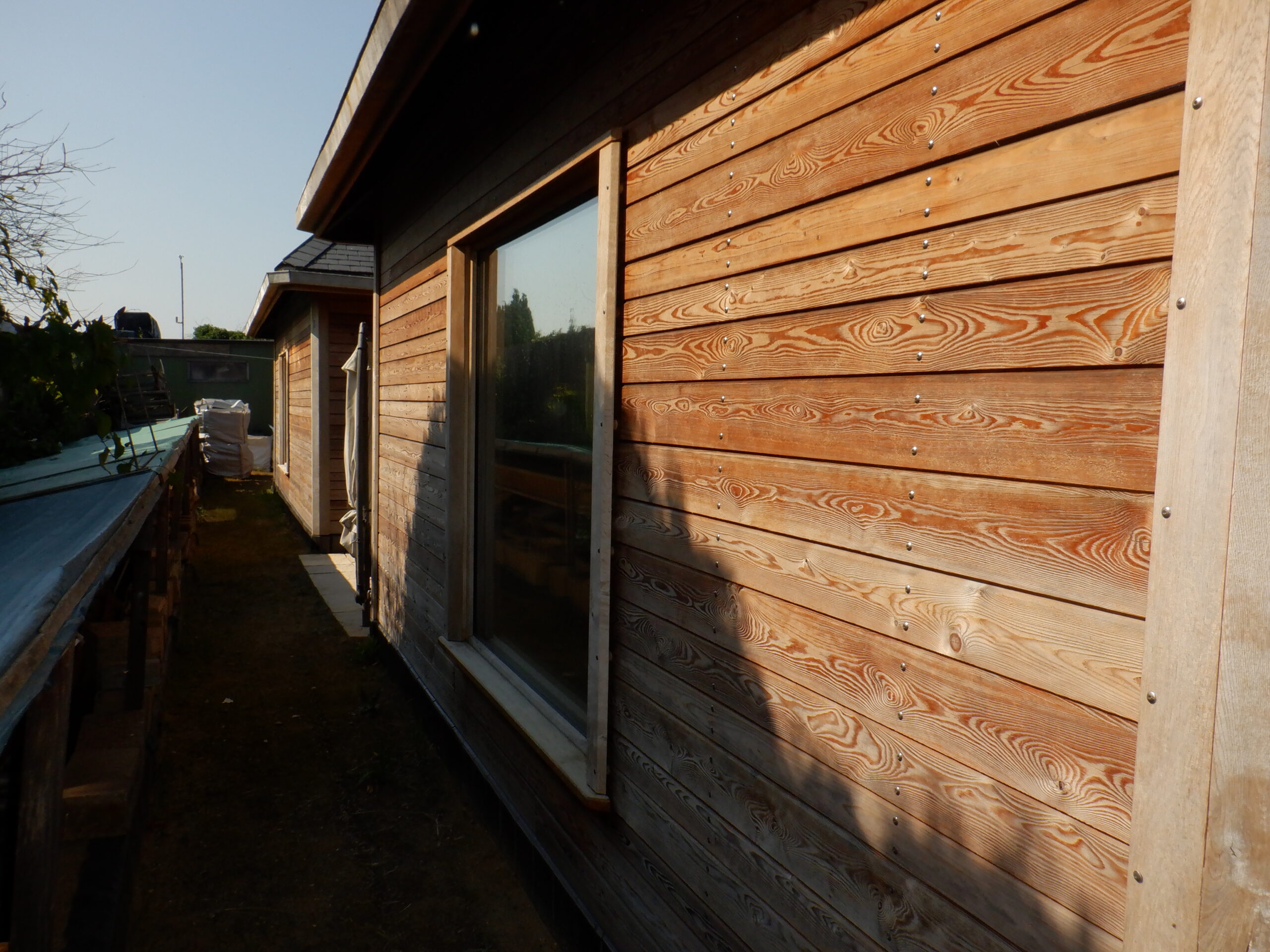
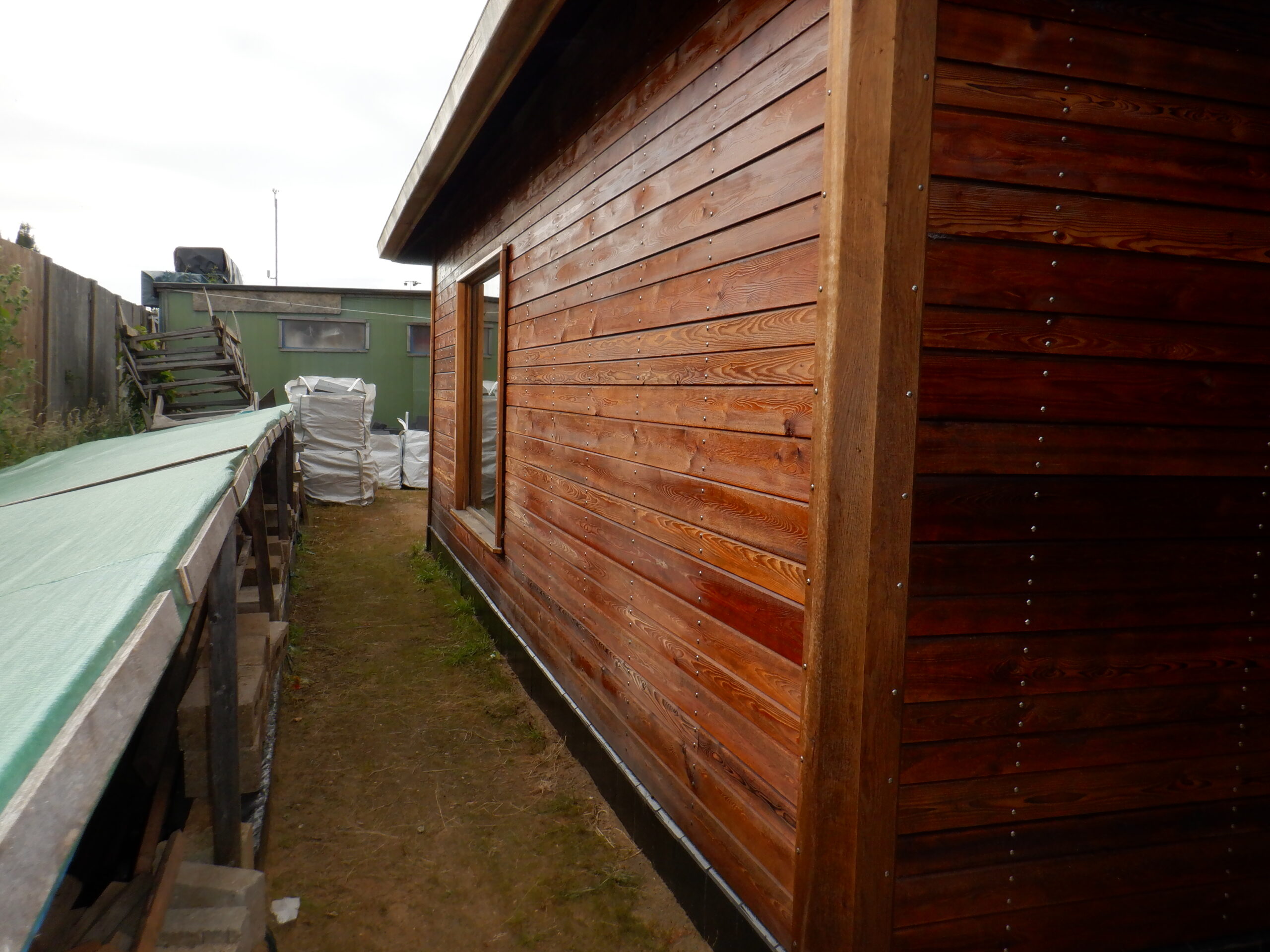
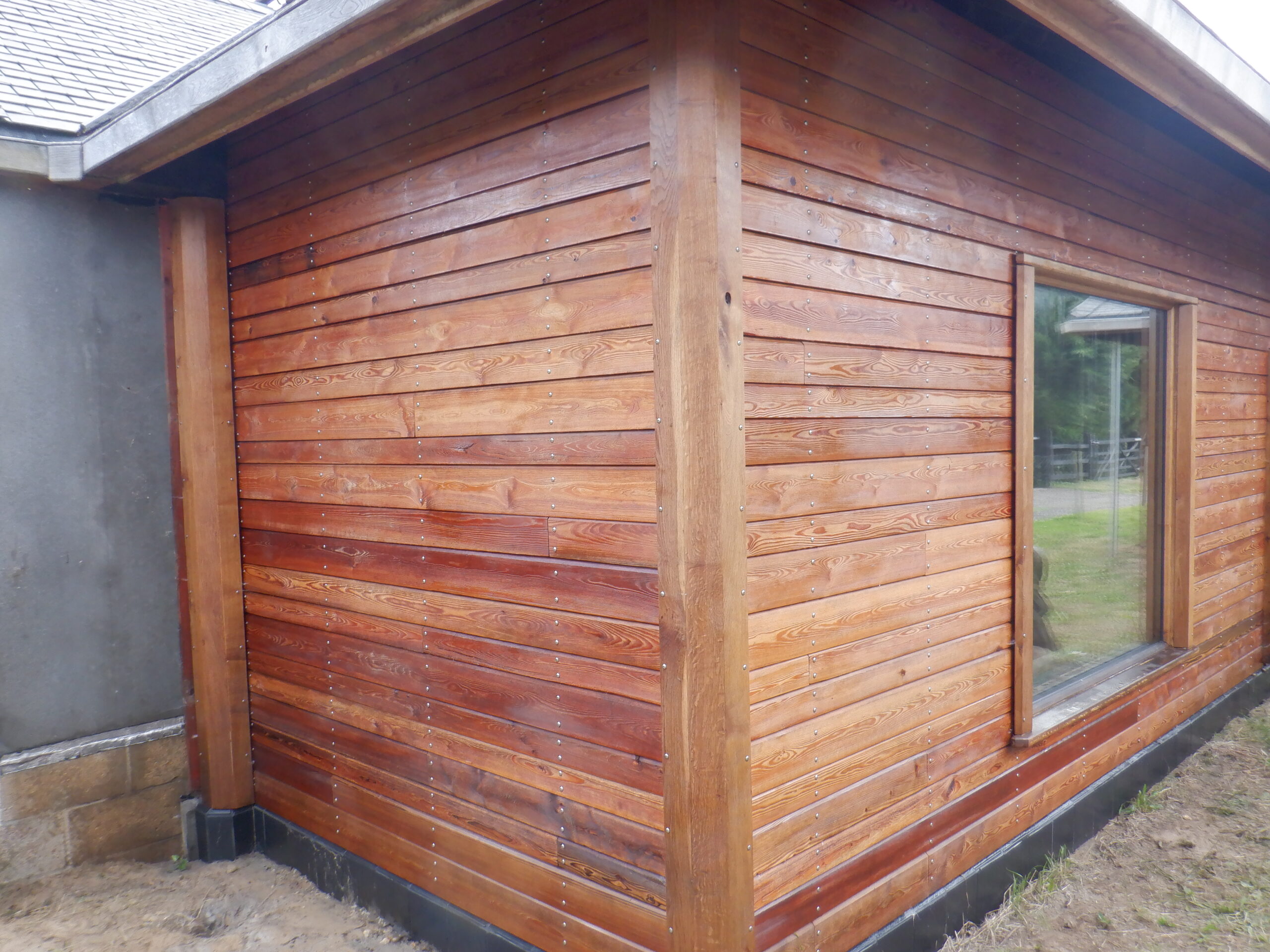
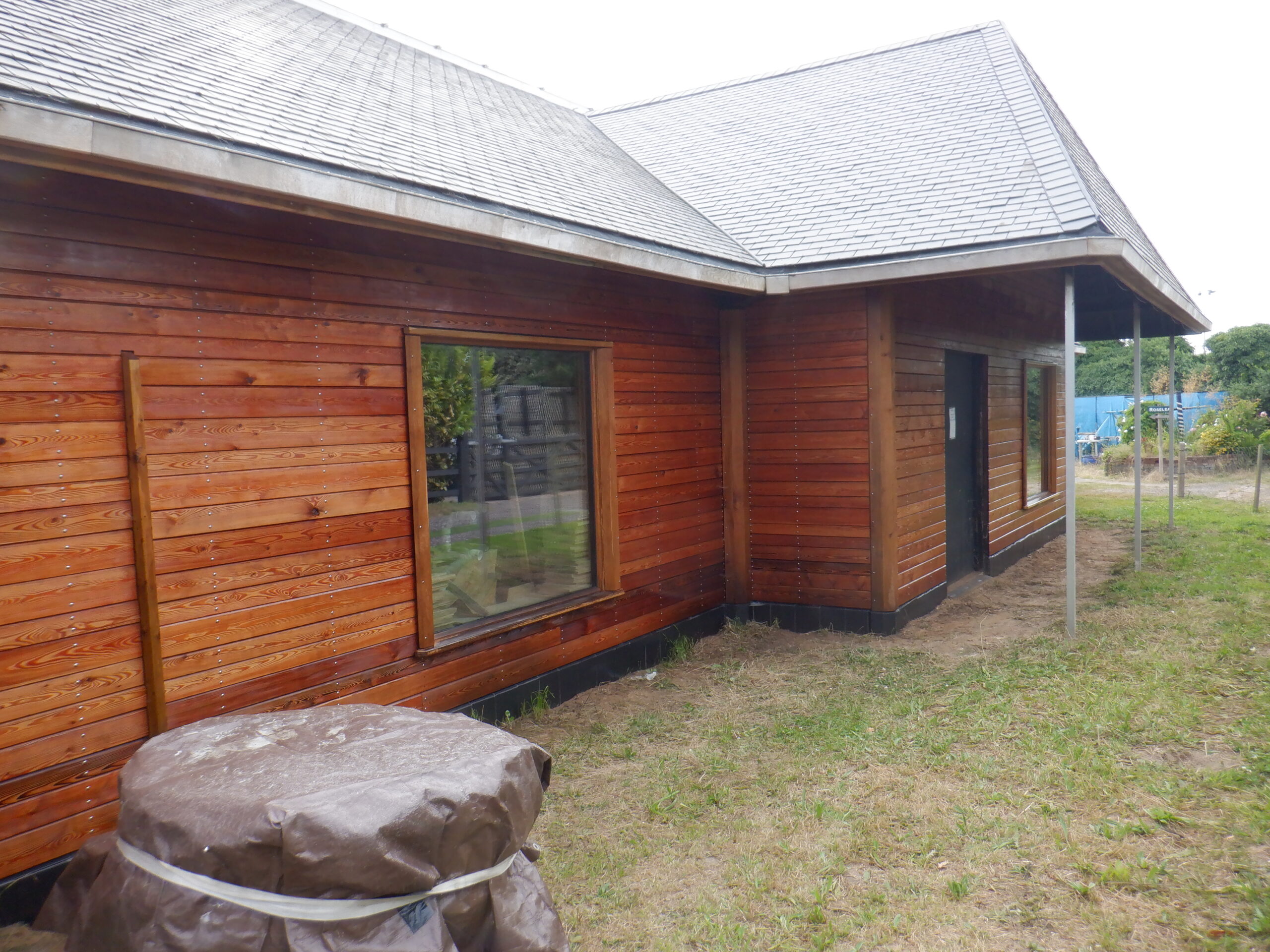
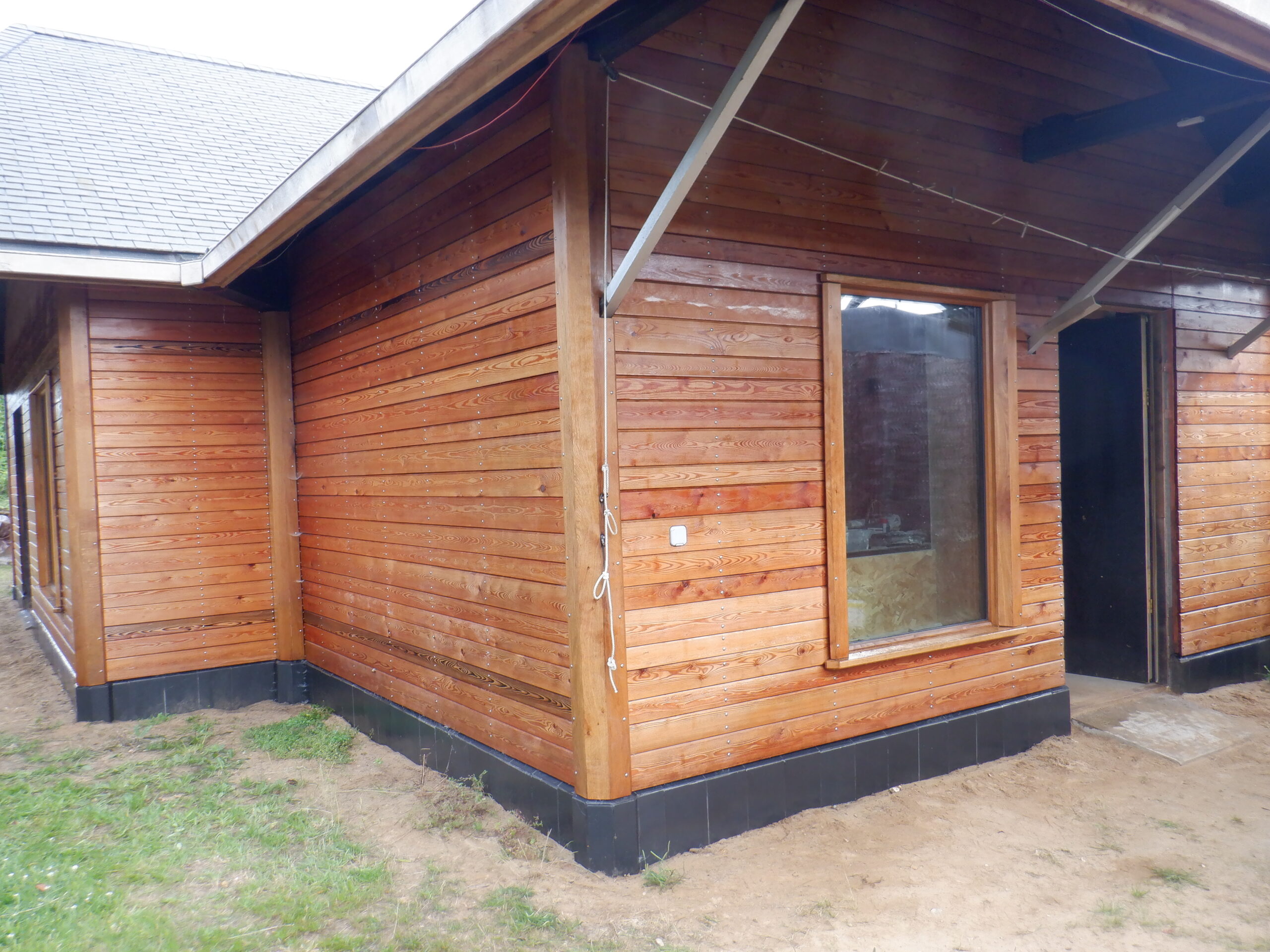
    We pulled out a spray machine that we required from somewhere in the past but discovered that the old Lead Acid battery was dead. After replacing that with a 12V mains supply adapter, we got lovely pumping noises .. but no liquid coming out the nozzle! Upon opening up the little pump, we discovered that the rubber membranes had stiffen up and were no longer flexible anymore. So, we ordered a replacement 12V pump, trying to match the specifications, like size and shape and wattage, as much as possible. Our new one is only slightly more powerful but otherwise the same. We swopped the two pumps around and we now have a lovely sprayer. We poured in our timber oil we still had from our original application and poured in about 25litres into the tank. We started on the O section, at the back of the house, and worked our way clockwise around the house. We even sprayed all the Oak framework around each window, plus also the Oak covers on the corners of the building.

    Cladding all re oiled (1)

    Cladding all re oiled (1)

    Cladding all re oiled (4)

    Cladding all re oiled (4)

    Cladding all re oiled (6)

    Cladding all re oiled (6)

    Cladding all re oiled (8)

    Cladding all re oiled (8)


    We then had to wash all of our twelve windows, to remove the oil that had splattered onto the glass. We used a handy little vacuum wiper that sucks off the soapy water after the glass has been scrubbed.

    And, because we had washed the windows, we went around and painting more oil onto the sills. Some of them needed three coats of the oil before it stopped soaking in.

    Finally, we spent an afternoon, rubbing down the Oak timber, to reduce the “fur” texture that had lifted off the surface after we had blasted the timber with our pressure washer. We used a soft sanding pads to knock off most of the white furry surface, also rubbing the sills as well. Some of the windows needed a bit more energetic scrubbing using courser sandpaper.