Category: Slates

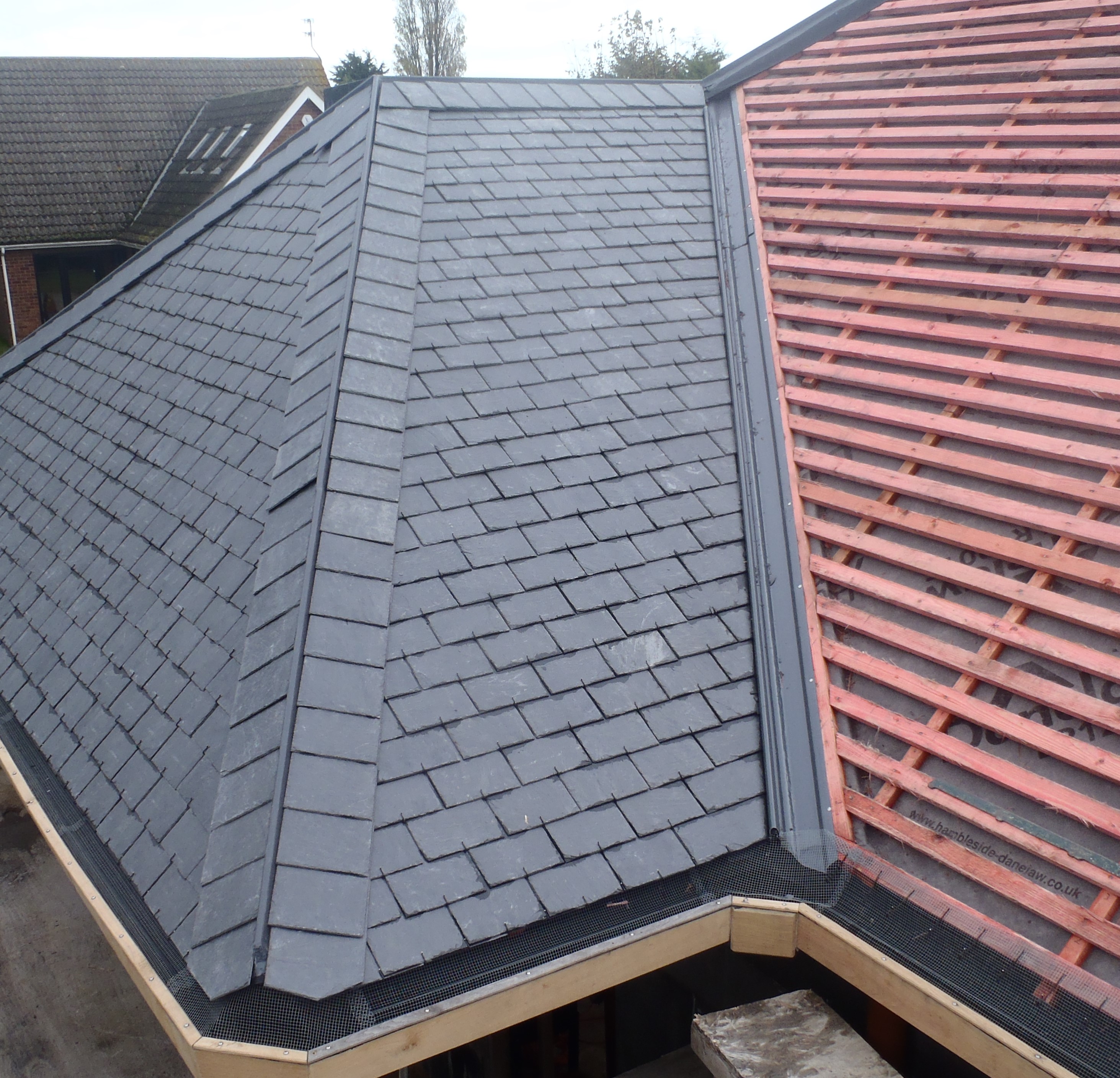
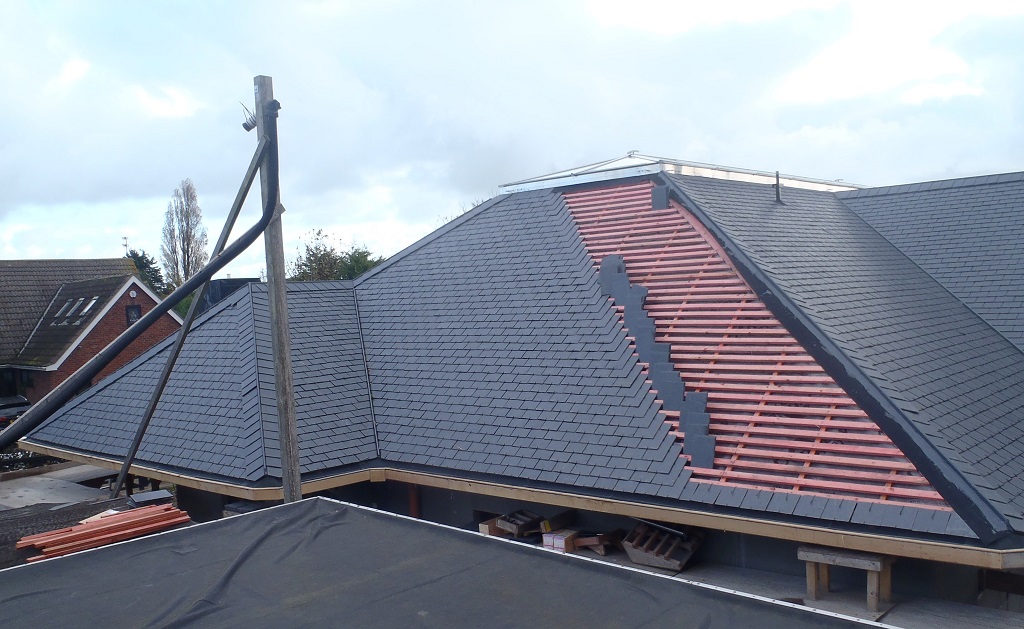
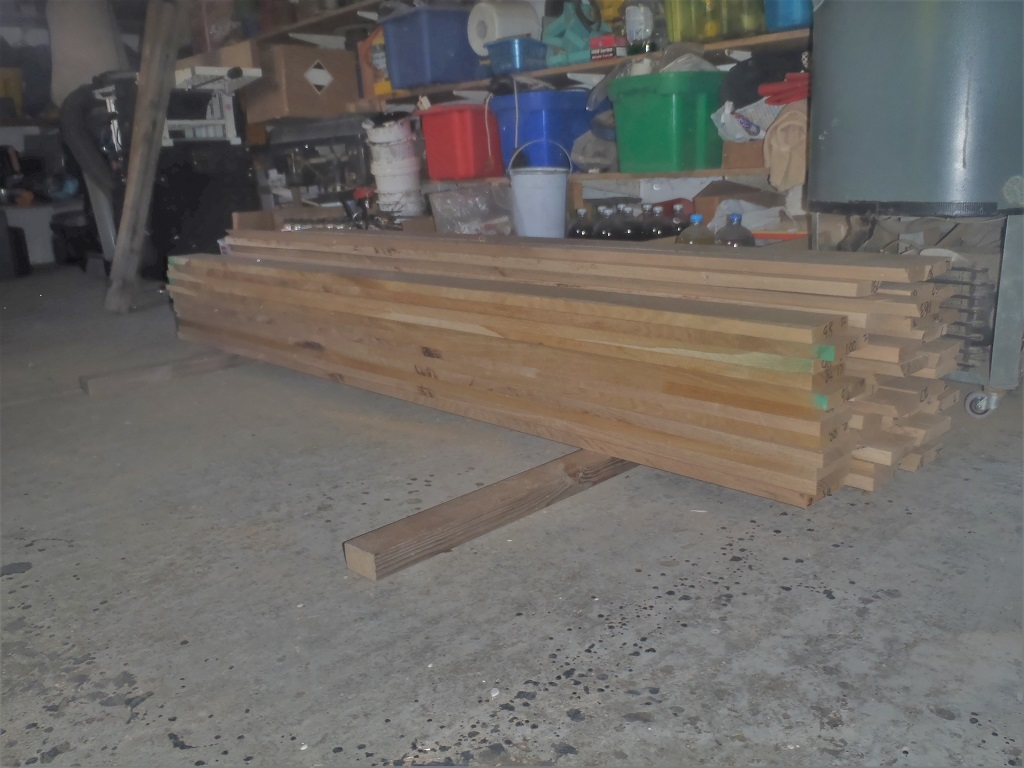
Slate Tiles measuring 300mm by 200mm, 18600 in total, covering 360 square metres.

  • Roof Section C Complete

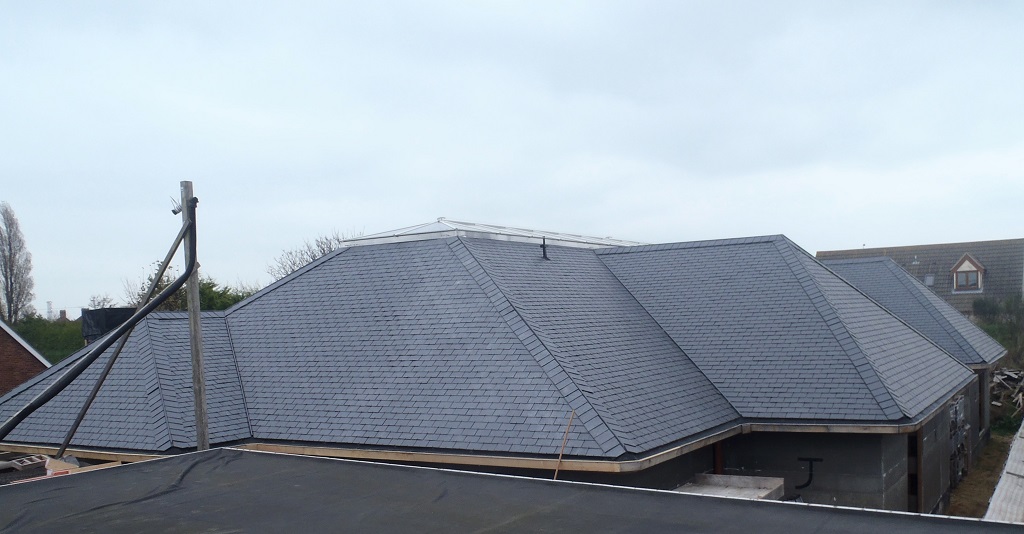
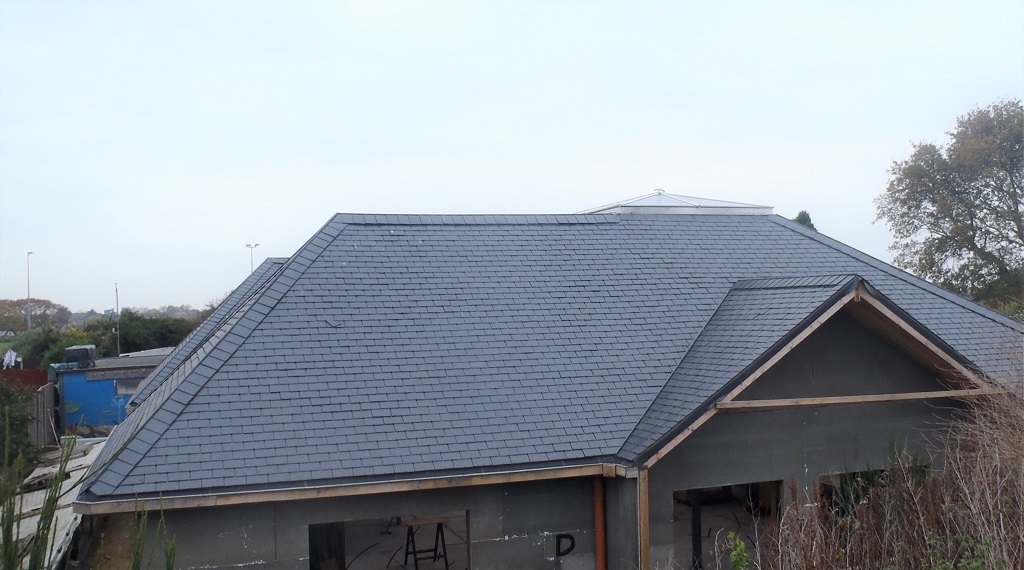
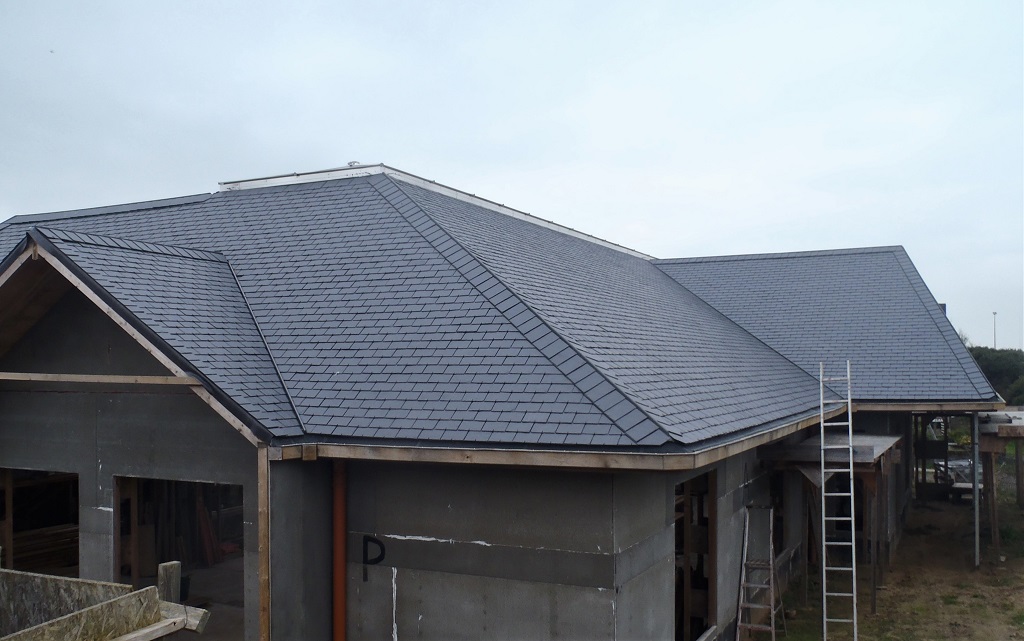
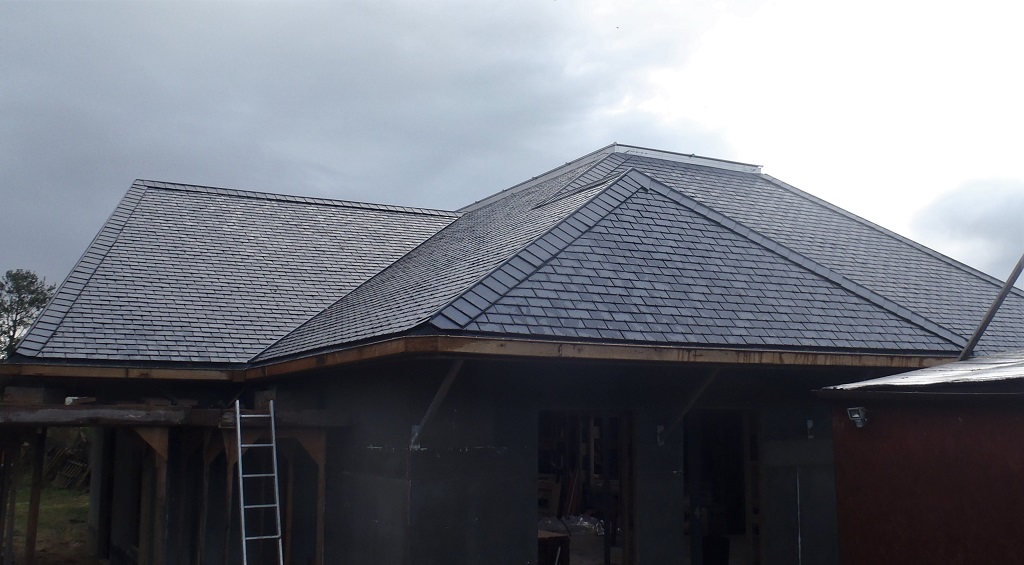
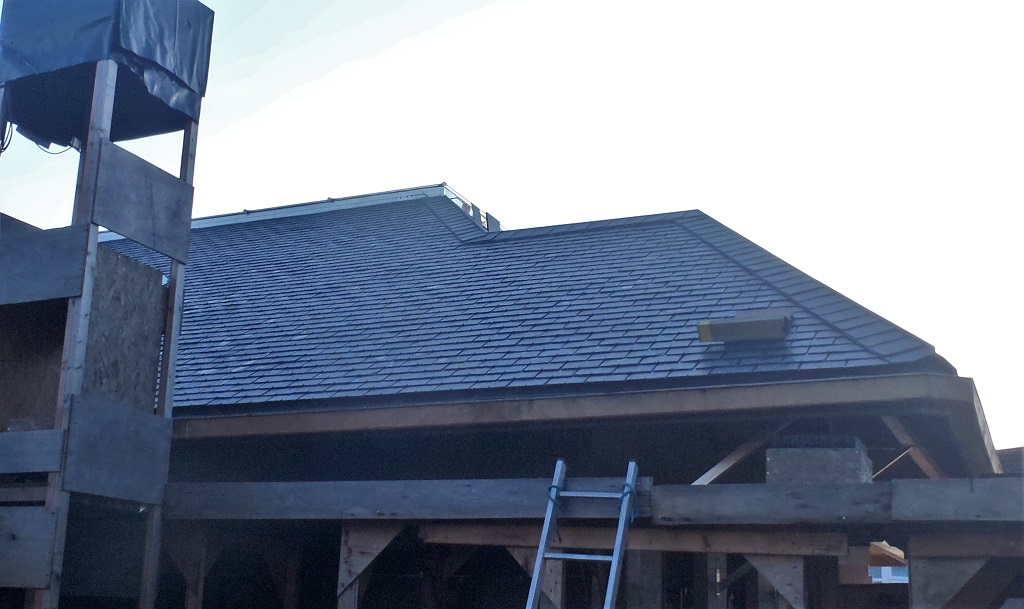
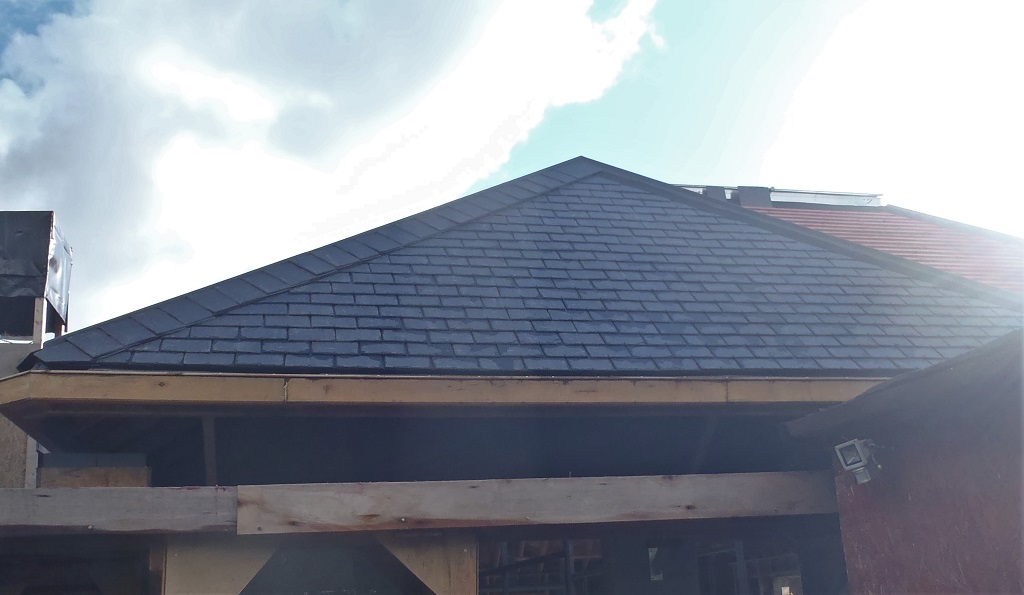
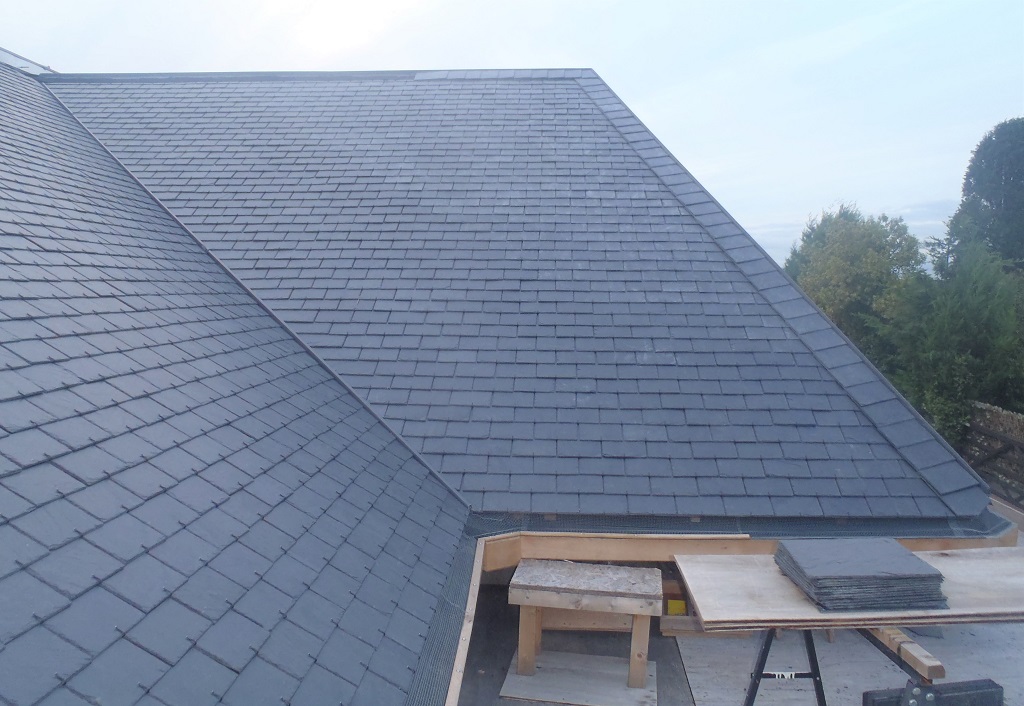
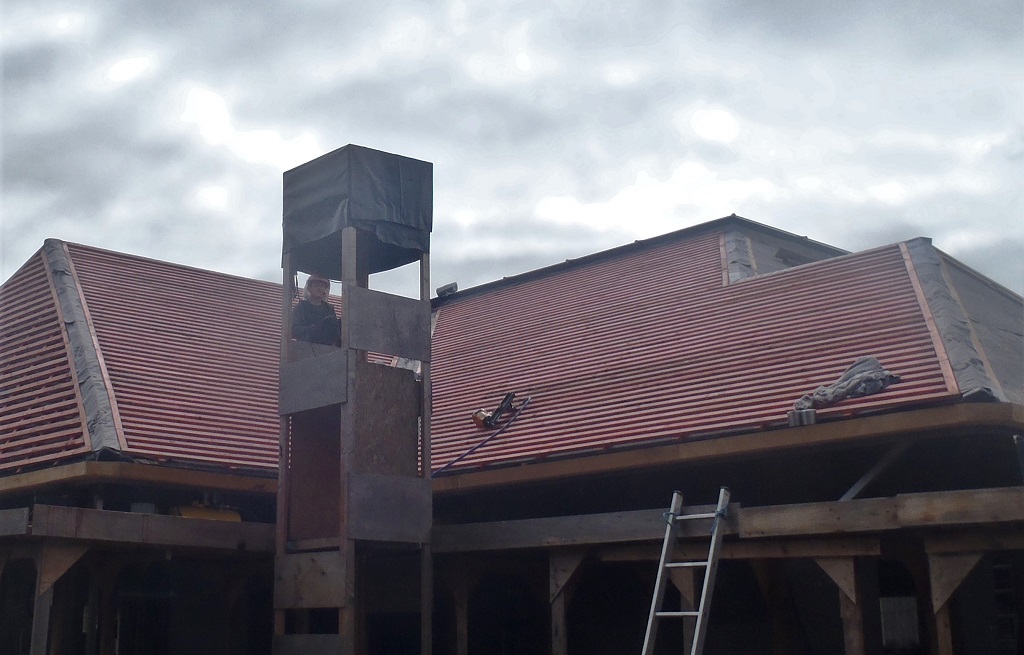
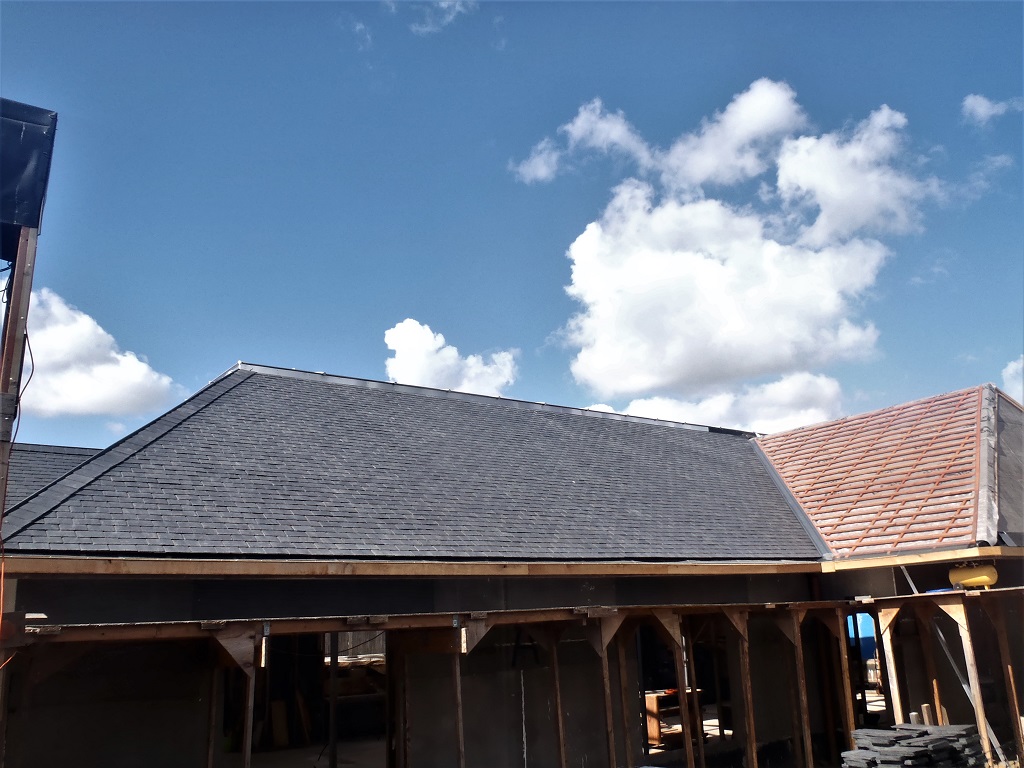
    On this very chilly Monday morning, and a bit of the afternoon too, we finished off putting slates on the last section of roof, the “C” section which is our front porch roof facing our Loke. Another 100 slates went up, followed by about 80 slates for the flashing up the two hips.

    C-roof-complete

    C-roof-complete

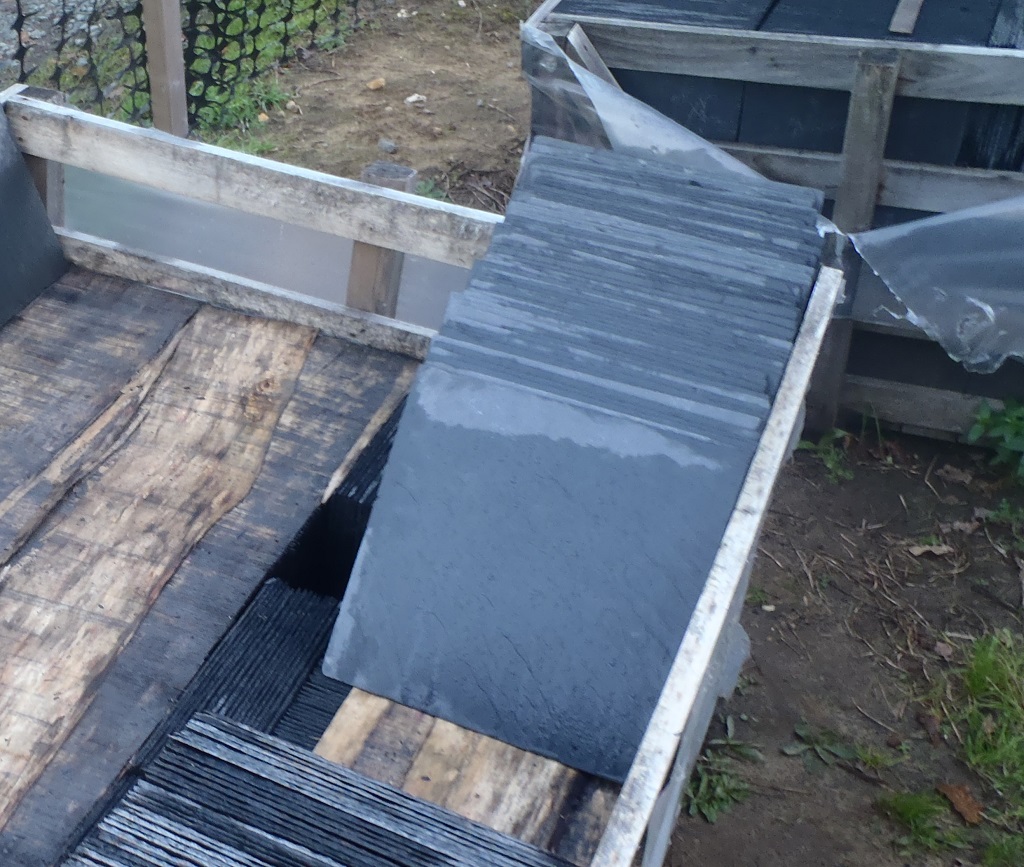
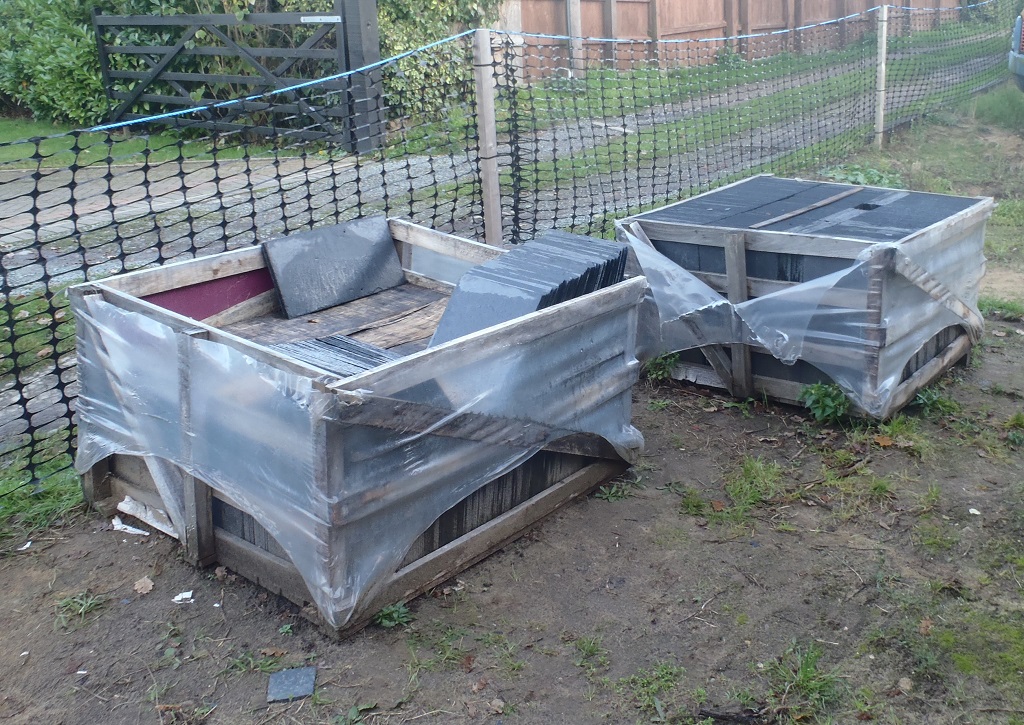
    This concludes the task of putting the roof on. We had a quick count of the remaining slates we got left which turns out to be about 3000 slates and 70 wide slates.

    The-3000-slates-left-over

    The-3000-slates-left-over

    and-the-70-left-over-large-slates

    and-the-70-left-over-large-slates


    We received 18360 slates last October so that means we have put up over 15000 slates, including 640 wide slates, stretched over an area of 360 square metres.

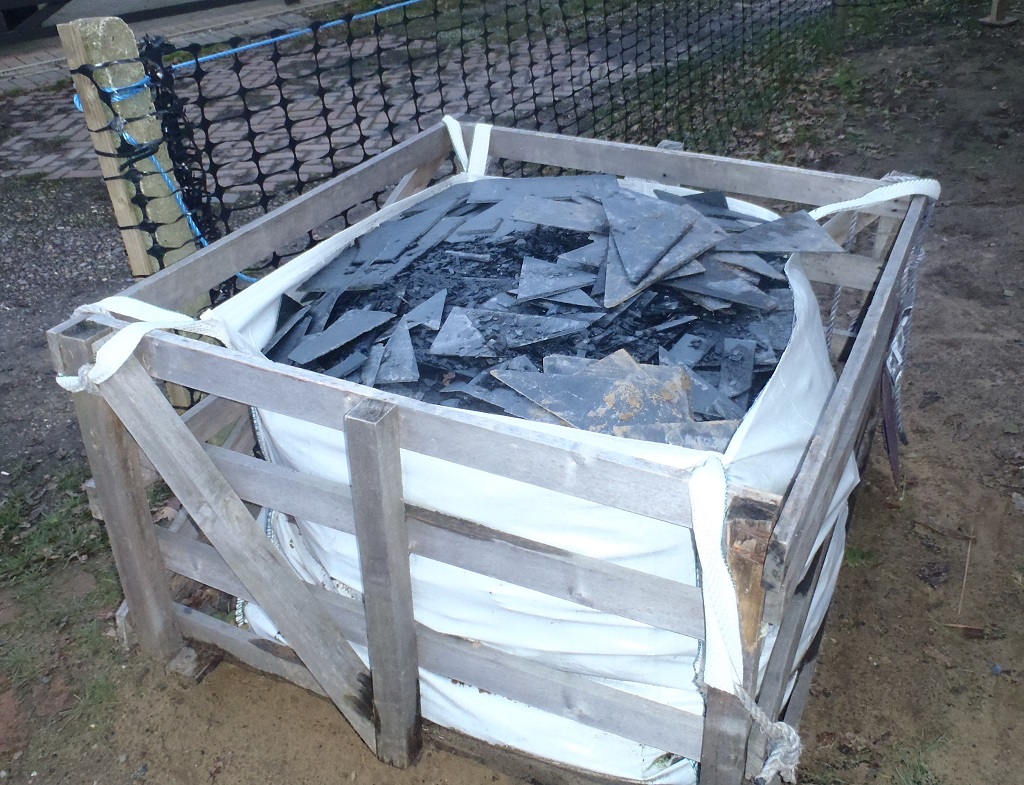
    We generated a full ton bag of waste pieces

    The-waste-slate

    The-waste-slate


    So that needs to be processed somewhere and somehow. We may phone around to see if anyone wants bits of slates for garden paths or something.

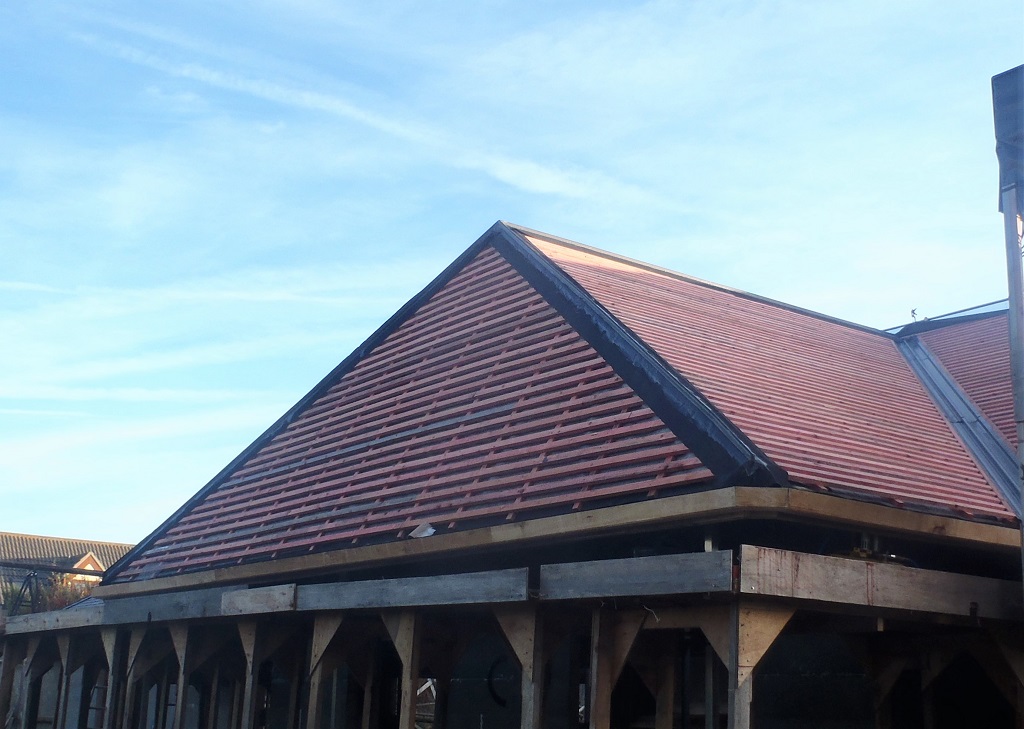
    This means that the whole roof is now complete at the beginning of December 2019. We started the job of constructing the roof way back in July 2017! with putting up the kerb and rafter support blocks. Then getting on with the job of creating each and every single rafter.
    It is by far the most complicated part of the building project we had to do and hopefully, the rest of the build will be just a tad bit easier!! (and quicker!!!!)

  • Roof Section H Complete!

    We start the week with the left-over task of moving the Larch Timber inside our house to get it under cover. It was two and a half tons of wood to shift!! See Larch Timber Arrives.

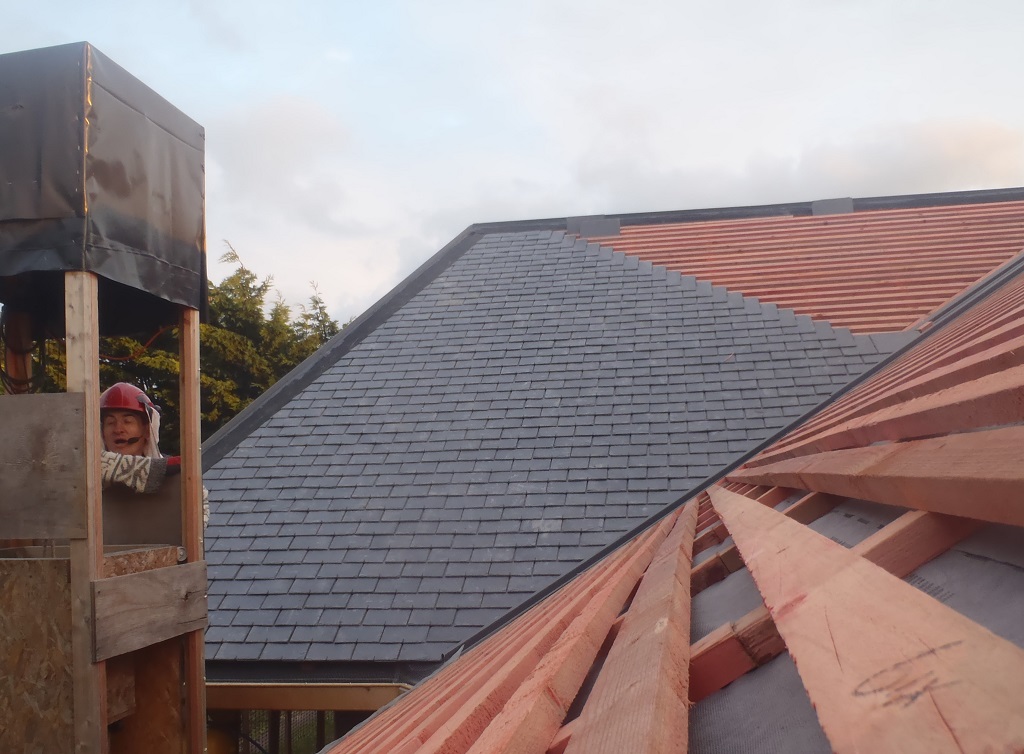
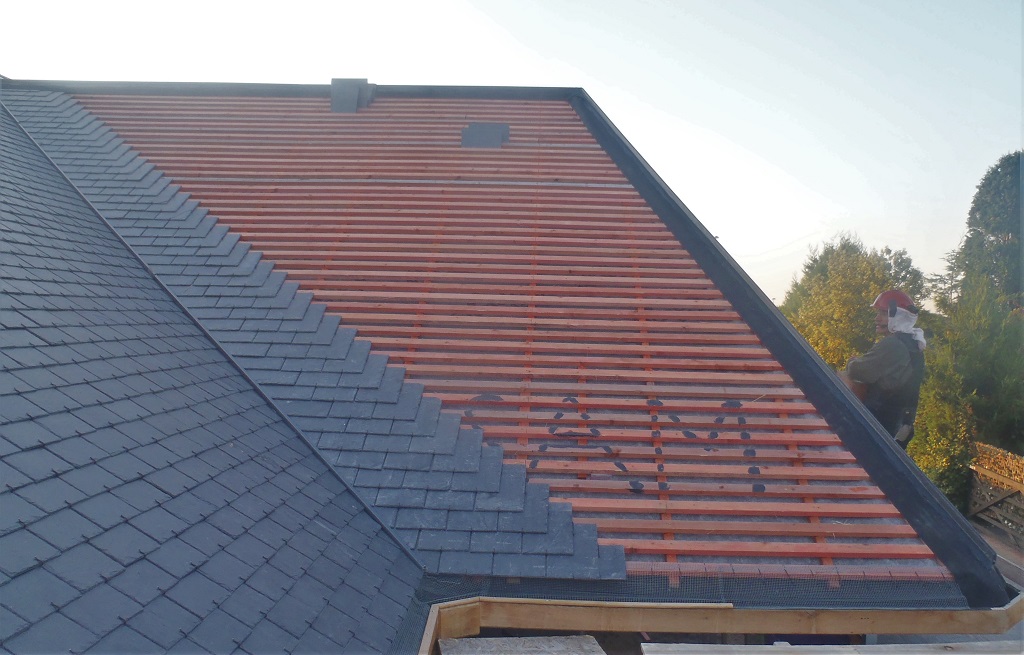
    But over the next couple of half day sessions, two afternoons (Monday and Tuesday) and one morning (Thursday) we got the remaining two hundred slates up on the “H” section of the roof, including doing the hip where we had to use our long extension ladder to climb up the roof to reach each slate meeting the hip edge. It was very fiddly because of the ladder, having to lean out and having to cut every slate with an angled shape. This also includes putting up the flashing slates as we went along.

    That concludes the “H” roof.

    Roof-slating-Rear-Right

    Roof-slating-Rear-Right

    Roof-slating-Rear-left

    Roof-slating-Rear-left

    Roof-slating-Front-left

    Roof-slating-Front-left

    Roof-slating-Front-Right

    Roof-slating-Front-Right


    We have finally reached right back to where we started eight months ago. The only small section left to do is over the front porch where we are designing a logo banner that will be cut into the slate surface itself and filled in with various coloured epoxy resins. This is the very last section of the whole roof, a further 500 slates.

  • Sections F, G Finished and H Nearly done !

    We resumed work on our roof, continuing with the task of putting up the flashing slates up the “F” Porch roof section and then started doing the “G” little section on the side of the porch section. This narrow strip is very very fiddly, having to work on both the valley and the hip and only four standard slates in between. It took well over a day to complete it, most of Monday and Tuesday morning.

    G-Slating-complete

    G-Slating-complete


    On Wednesday, we eagerly got started on the last section of roof, the “H” section, and got the valley done, which was slow because of having to cut on every row special slates to fill in the angle. But once that was finished, we then could speed up putting slates in strips of three slate wide and we got about 350 slates done in total.

    Thursday was a very wet day so we were going to work in the workshop but we had a sudden phone call from the delivery driver to say, “I’m ten minutes away with your Larch timber” and we weren’t expecting it! See Larch Timber Arrives.

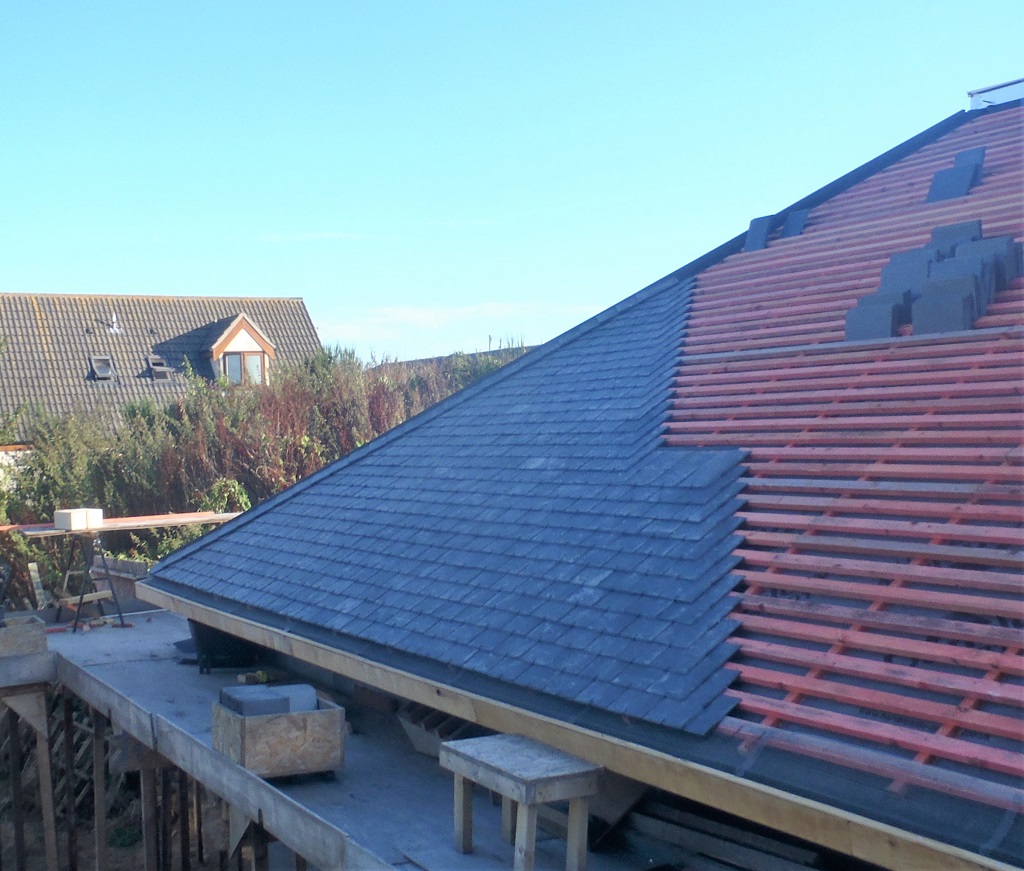
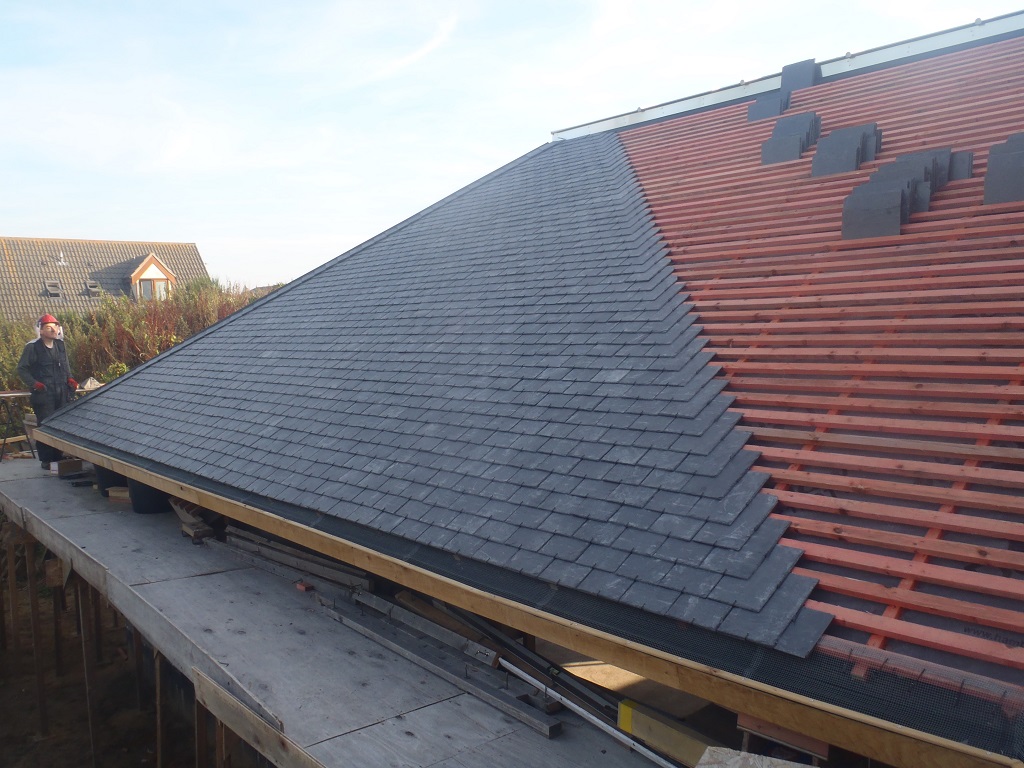
    We didn’t get back to our roof until Saturday. We managed to do another 300 slates and we are now about two thirds done on the very last bit of roof, the “H” section.

    Slating-at-the-end-of-the-week

    Slating-at-the-end-of-the-week


    We should get the last bit done on the new week including the tricky bit of scaling up and down the ladder to reach the last few slates!

  • Section F, G and H Gets Attention – At Last!

    Monday saw the start of a new period in our work, the clock had gone back at the weekend and we have lost an hour of work in the afternoon so we decided to shift our work day to start at 9am instead of 10am and finish at 5pm when it gets dark instead of 6pm.
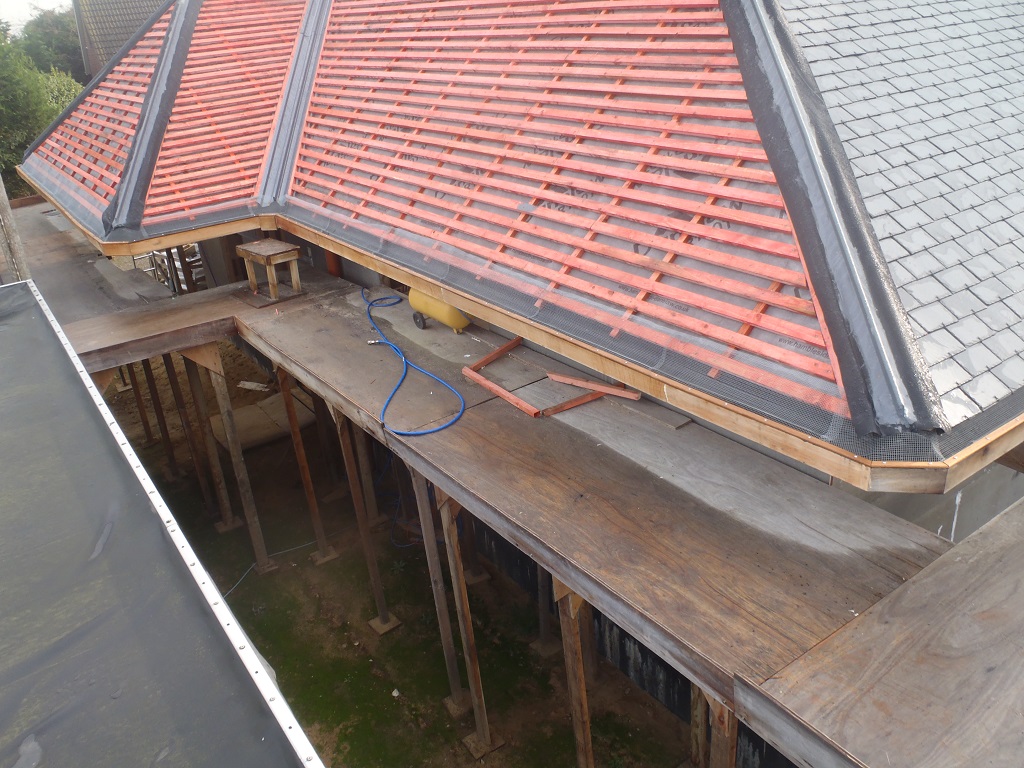
    We got on with putting the rubber liners in the three gutters for section ‘F’, ‘G’ and ‘H’, all stuck down. Mind you, we had to dry the gutters out first beforehand, with several towels and a heat gun running at 500°C!! The two ends of each rubber liner was stuck down on to the fibre-glass resined corners of the guttering with contact glue as we have done all the while and so finally, we have done the very last three corners.
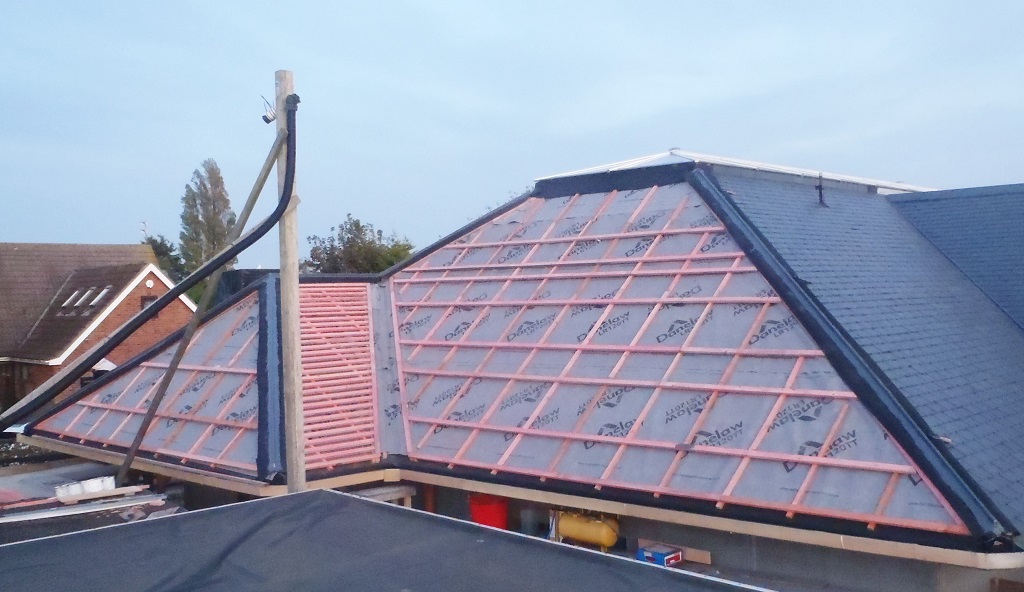
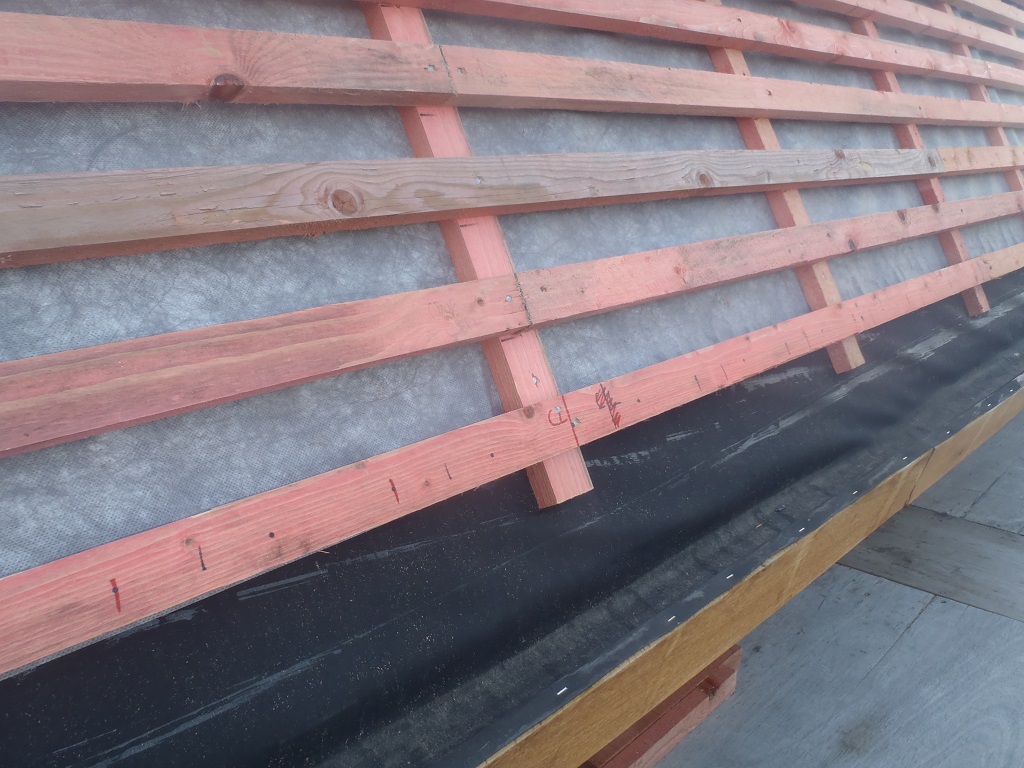
    The last little task was to put up the valley membrane and wooden counter battens, ready to support and hold the grey glass-fibre valley trough.

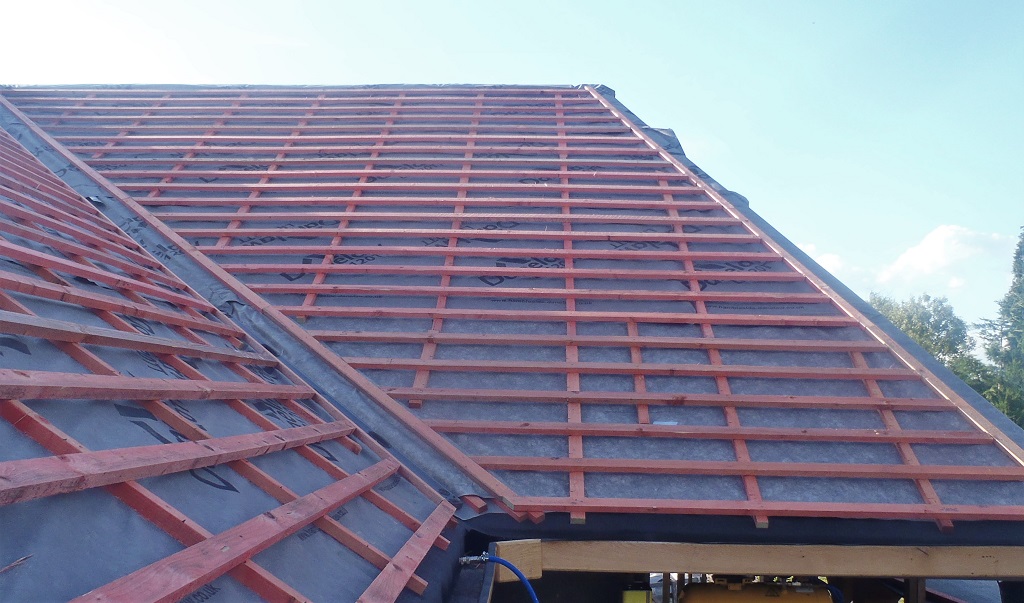
    Tuesday and Wednesday, we got all the breathable membrane up along with their counter vertical battens to hold it down, plus some widely spaced out tile battens so we could climb up and down easily. The last job before it got dark was to nail all the flashing battens on the Hips and Ridges, 4 hips and 1 ridge sections.
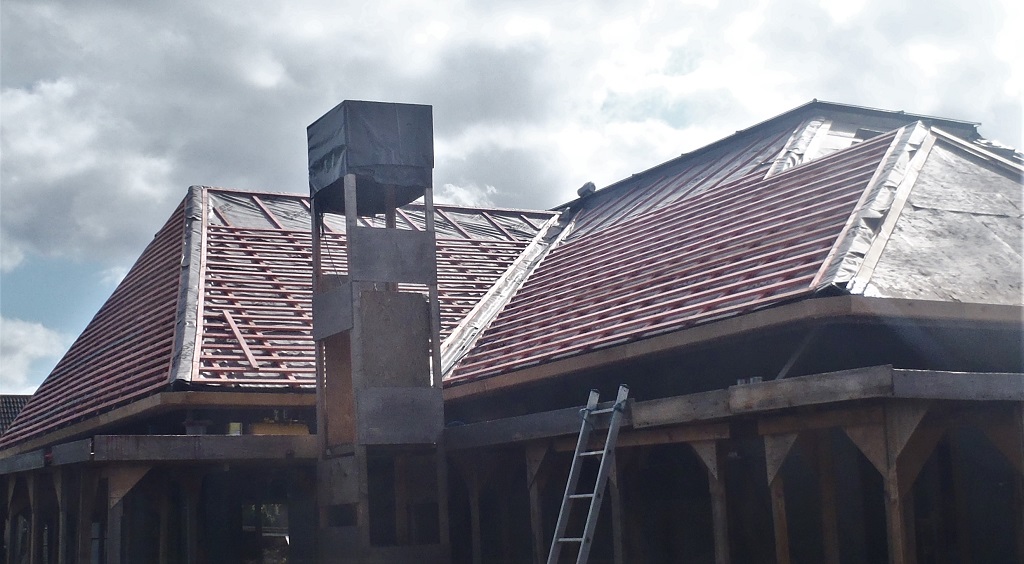
    With these last three sections of roof (‘F’, ‘G’ and ‘H’) done, this means that we now have at last, a completely waterproof roof right across the whole building!

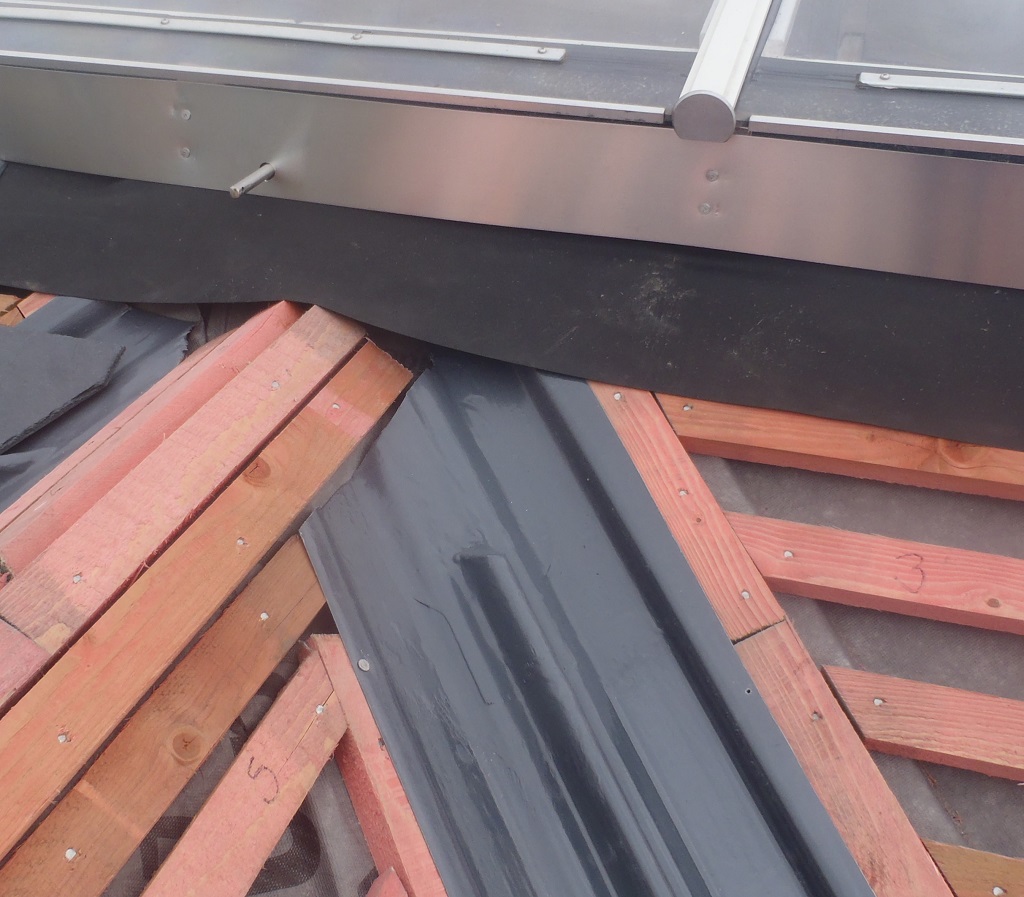
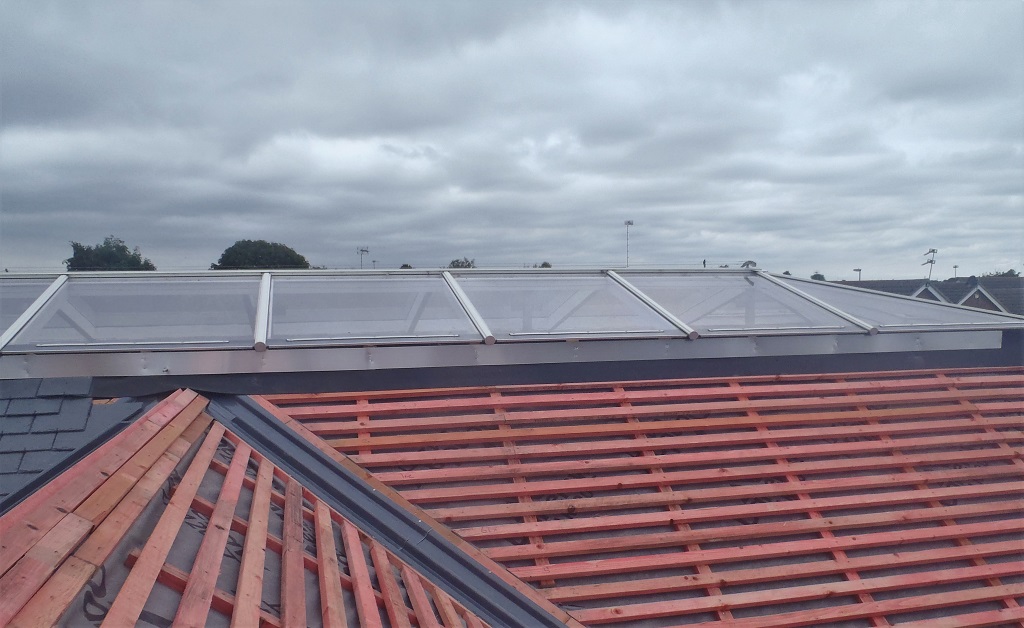
    Thursday was a good day, still chilly but with sunny intervals. Firstly, we put up the spacers up on the kerb of the Skylight and stapled on the rubber strip ready for the slates and the aluminium protective strip to go up. Then we managed to get all the rubber membrane up on the flashing battens, followed by the OSB bull-nose strips and covered with the glass-fibre ribbon.
    And then coated it in two layers of resin to produce our bull nose protection to divert the rain water away from the joints between the roof sections. All done before the forecast of rain arriving in the early morning hours of Friday. This was the last of this type of task, no more glass-fibre and resin out on the roof or gutters… all done now!
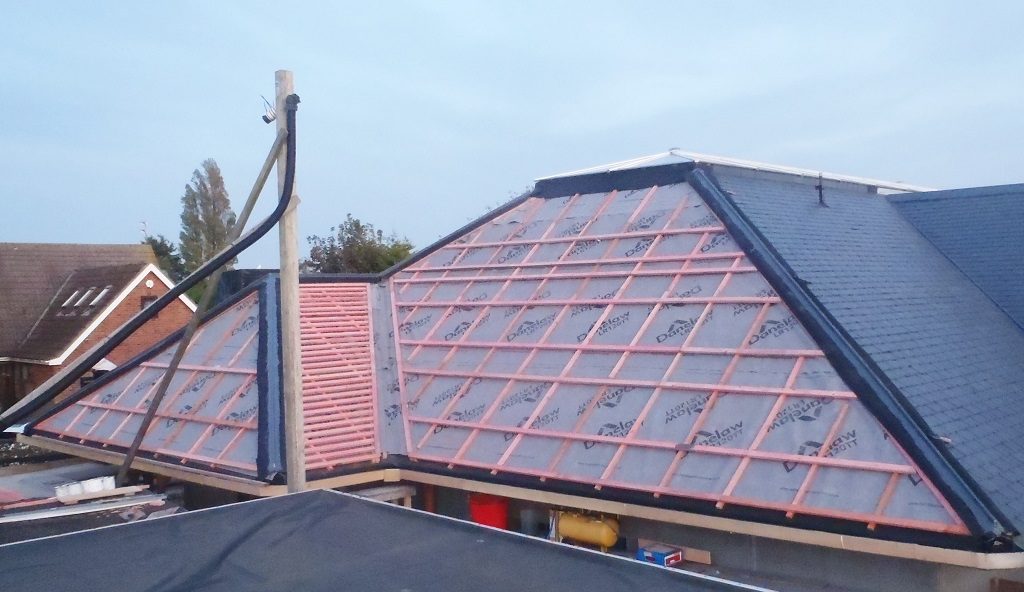
    Hip-Flashing-for-FG-H-finished

    Hip-Flashing-for-FG-H-finished

    Friday was an alternative day of meetings and other commitments [It also rained a bit].

    Saturday was rather wet and we only managed to do a couple of hours on the roof, putting up some tile battens and instead worked in the workshop making a sound reducing cabinet for our little CNC milling machine.

    Monday was a slow start because of another appointment but we did work in the afternoon on the roof and got all of ‘F’ and half of ‘H’ done with the tile battens. When it got dark (at 5pm), we continued in the workshop to continue with our cabinet.

    Tuesday was a nice day, well almost a nice day until the gentle showery weather arrived late in the afternoon. We got all the tile battens up, we put up the first section of trough in up the valley and cut the top smaller section to fit and did the necessaries to slice off the bull nose and then glass-fibre and resin the hole to hold the rain water in.

    We also started putting on the metal mesh along the guttering.

    Wednesday saw the completion of the mesh over the guttering along the ‘F’, ‘G’ and ‘H’ sections. We now have fully finished all the guttering right around the whole house. We only just made it and we had one 300mm strip left over from an original roll of metal mesh 900mm wide by 25metres long.
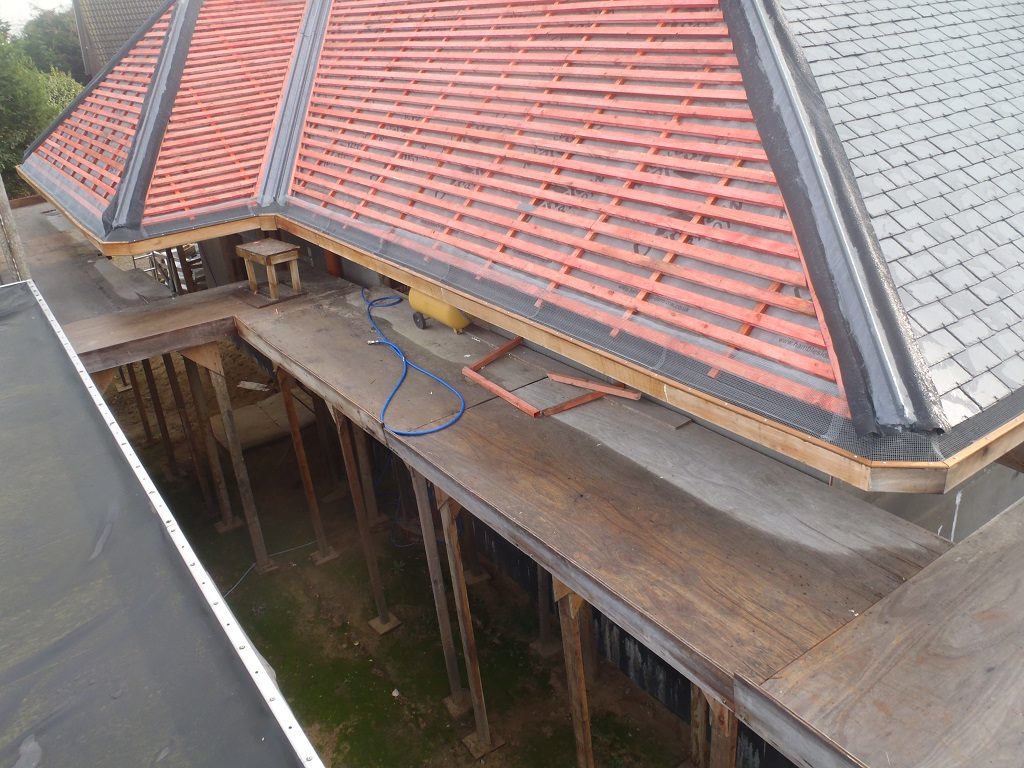
    Mesh-on-gutters-complete

    Mesh-on-gutters-complete

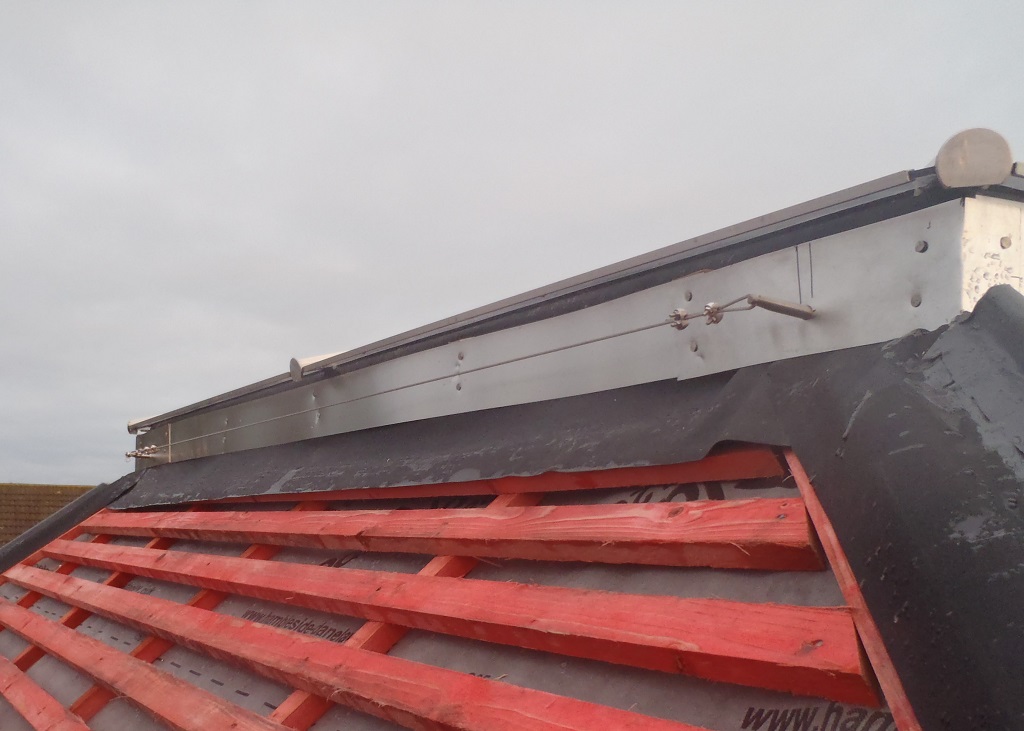
    The afternoon task was to replace the first section of the skylight kerb we did back in March where we had originally put up slate pieces to protect the rubber membrane and we had decided to switch over to the better looking aluminium strip instead. So we had to break off the slates, reposition the spacers to align with the 2metre strips and then nail on the replacement pieces (all done whilst sitting on the skylight working between our legs). We also got the last section all done on the end of the skylight including the support rods for the safety wire.

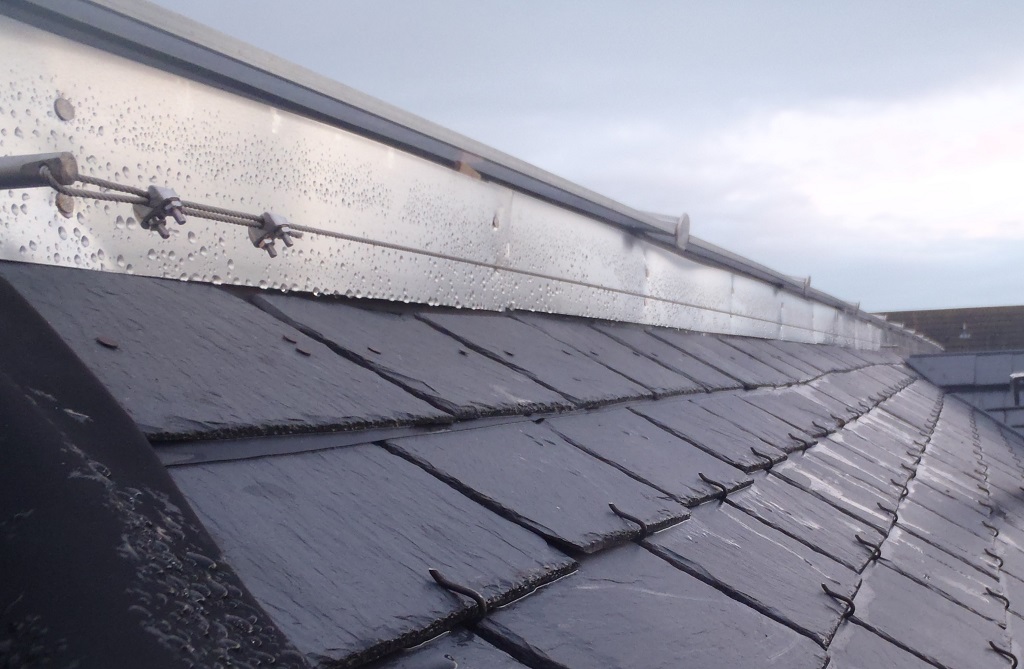
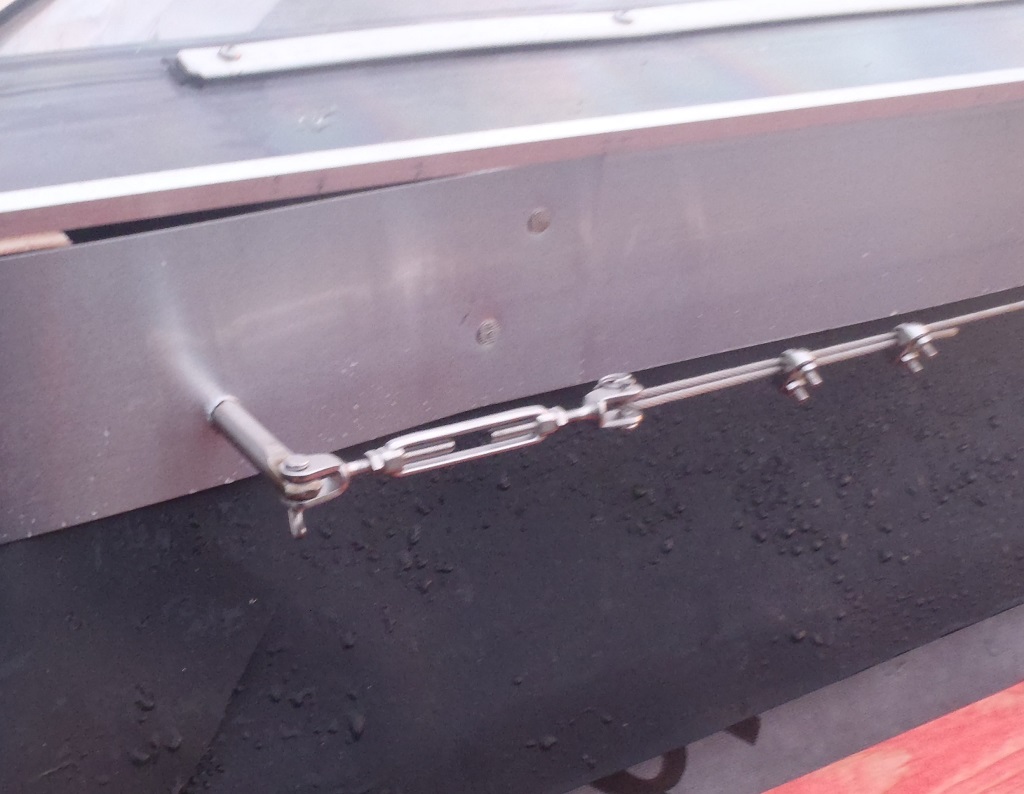
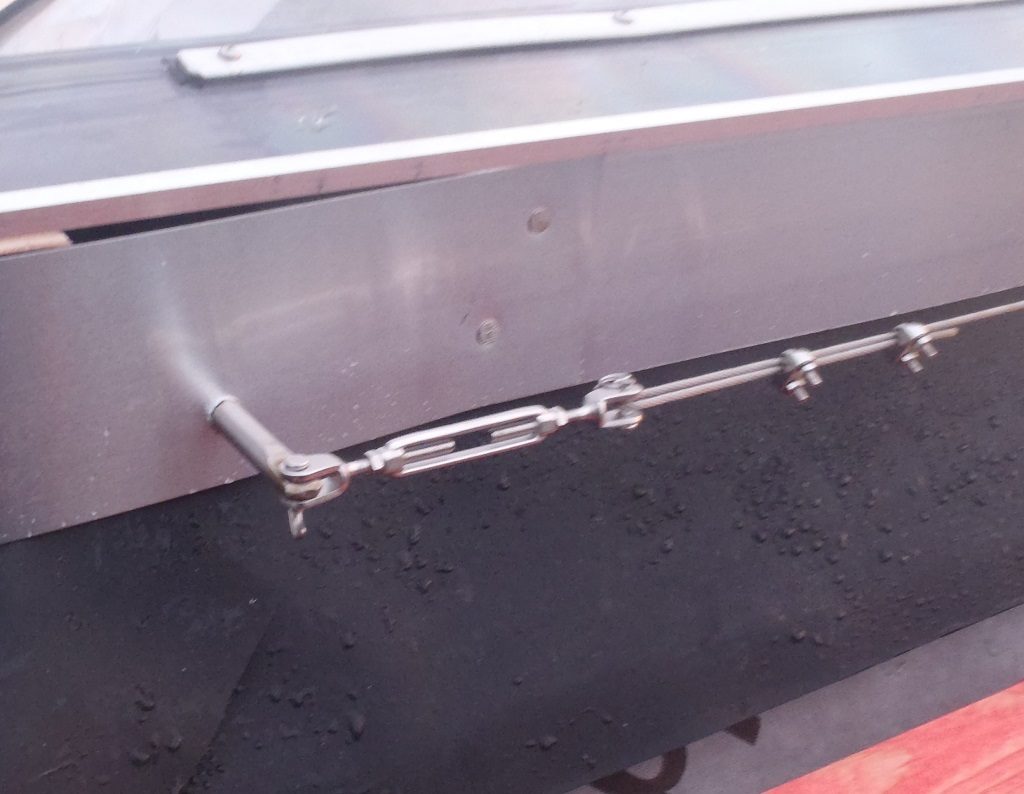
    Thursday, we got the safety wire strung up on all the support rods, on each side of the skylight. We did this by shuffling sideways on the windows of the skylight and leaning down to deal with the stainless steel wire. Each wire, four of them, one for each side of the kerb, was clamped into place and then tightened up until the wire was good and solid, with a minimum slack in the length, ready for when we clip on a ladder or a safety harness to enable us to service the skylight or roof.
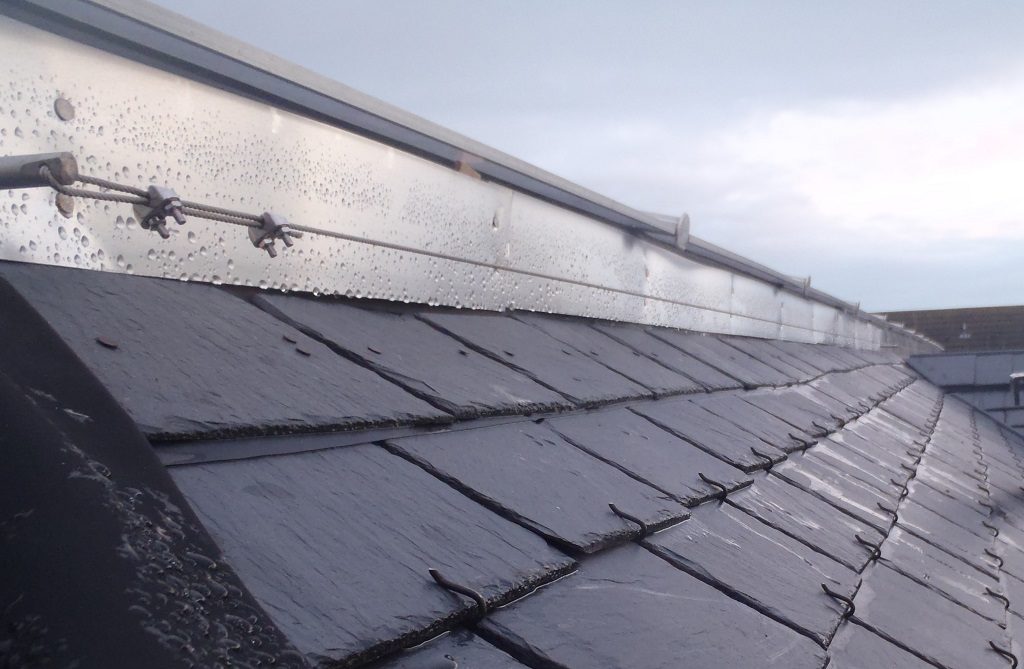
    Safety-Wire-along-IM
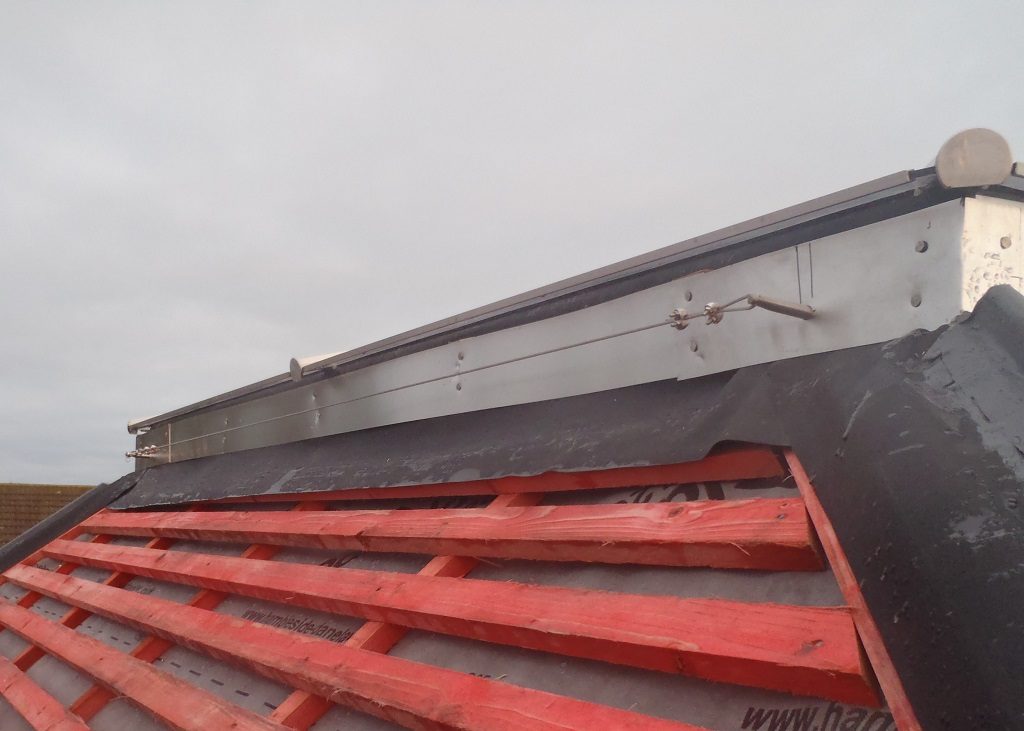
    Safety-Wire-along-IM

    Safety-Wire-along-H
    Safety-Wire-along-H

    Safety-Wire-tensioning-buckle

    Safety-Wire-tensioning-buckle


    Friday we got the preparations all done for the last three sections of roof, namely ‘F’, ‘G’ and ‘H’, marking up where the initial hook nails goes for the first line of slates under the metal mesh, before folding the mesh down on top of the batten. We also projected a vertical line up the ‘H’ roof and then marked off the beginnings of each batten so we can be assured that all the slates on each row will align up, all nice and neat.
    Then spent the rest of the morning and afternoon, putting up the last hundred or so slates on the ‘E’ roof we left unfinished because we didn’t have easy access (and safe) to lean over the hips and ridges to get them in.
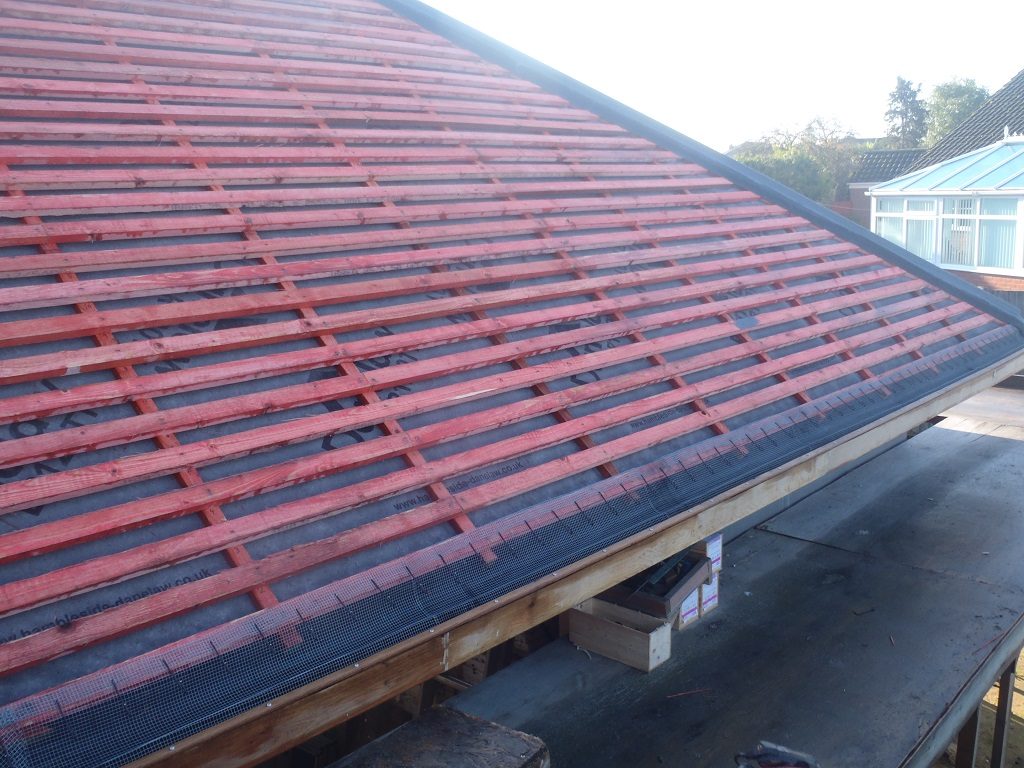
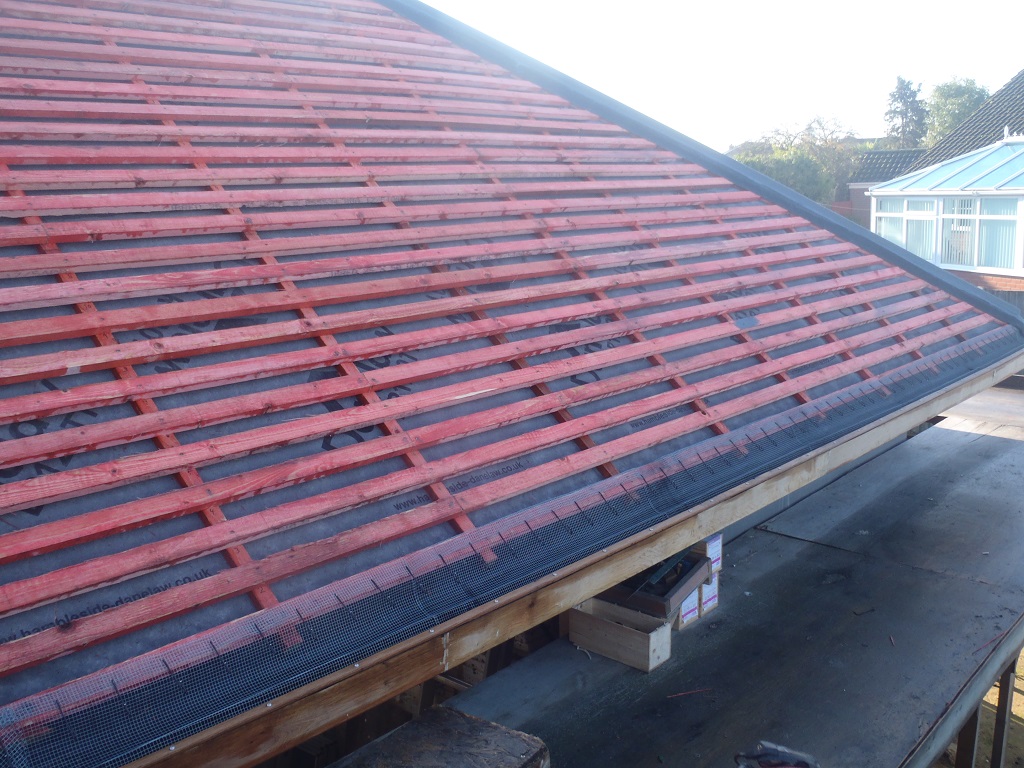
    Mesh-and-bottom-row-of-hooks-on-H

    Mesh-and-bottom-row-of-hooks-on-H

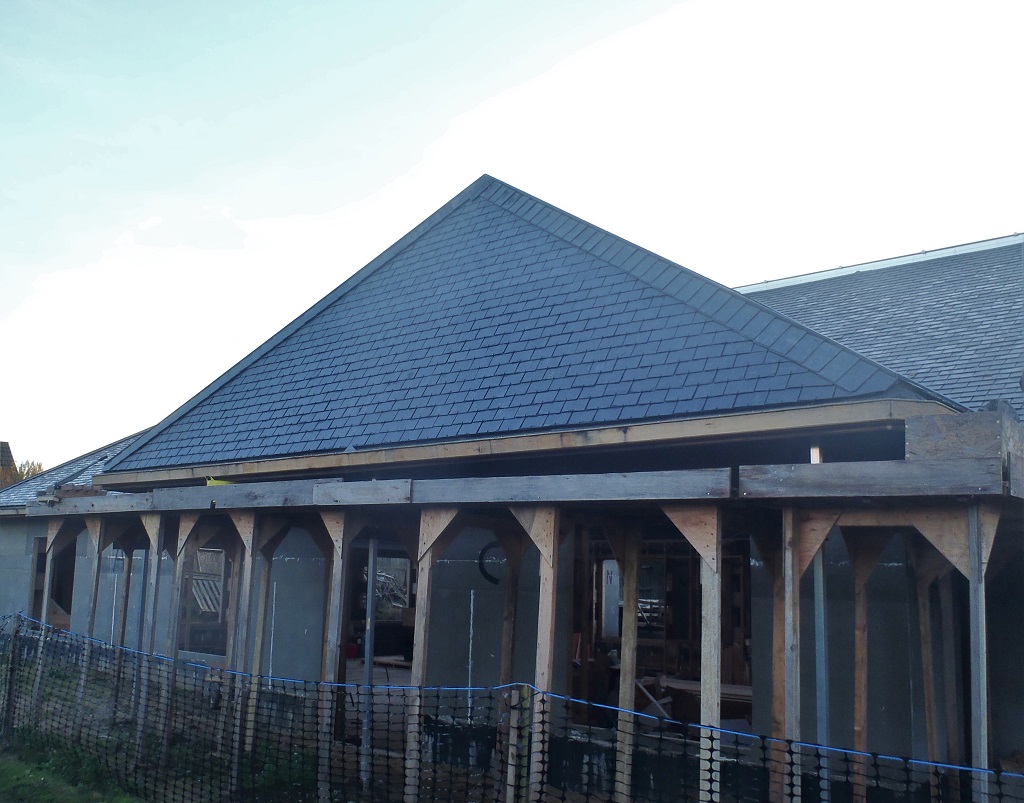
    Saturday’s work got the flashing slates done on the ‘E’ section and then the whole of the ‘F’ section was completed too except for the flashing slates on the right hand side.
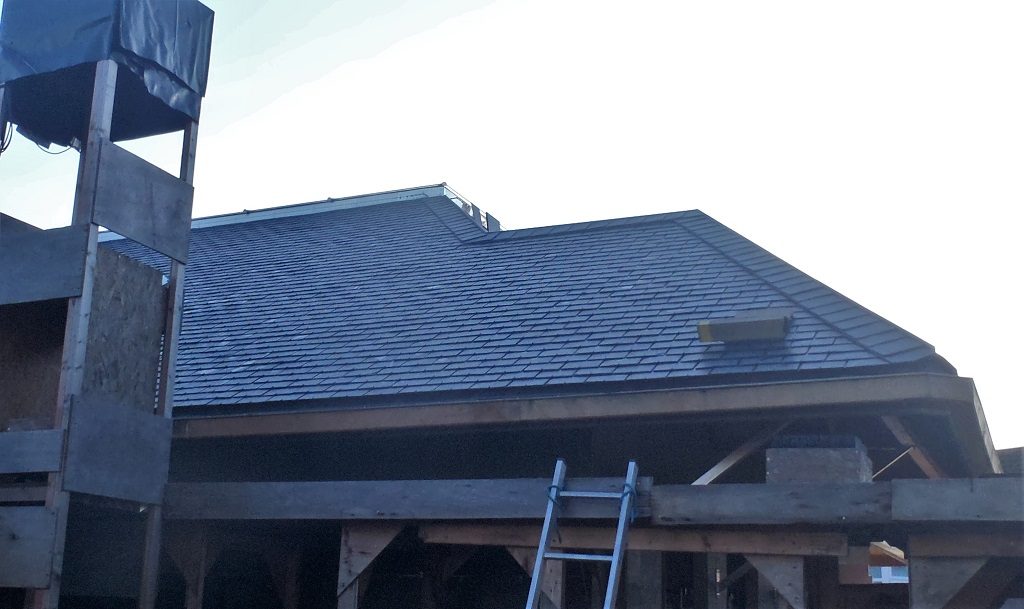
    E-Slating-Finished
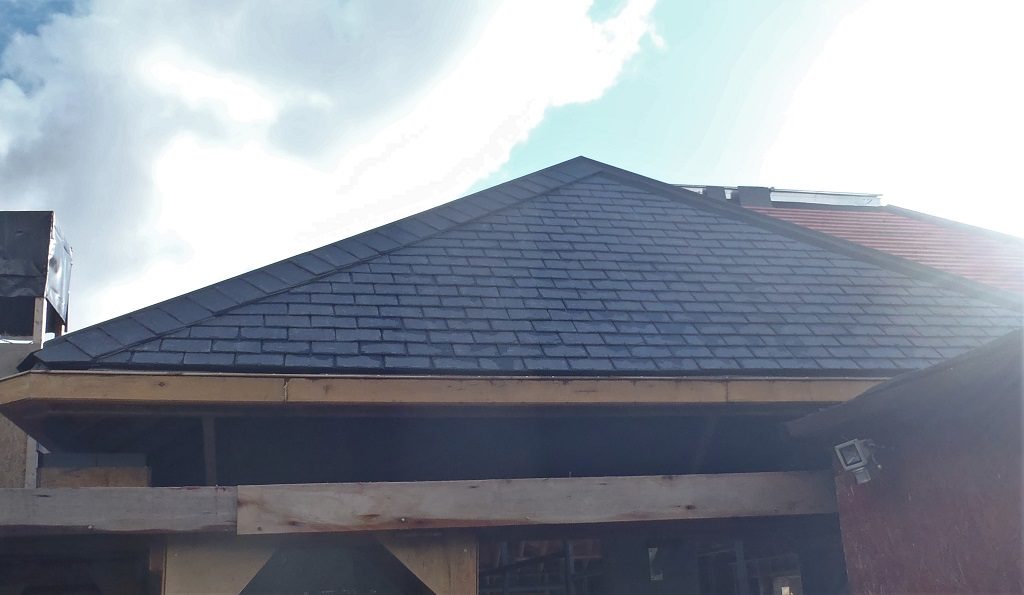
    E-Slating-Finished

    F-slating-done-almost

    F-slating-done-almost


    Next week will get the ‘G’ roof section done and hopefully most, and perhaps get all, of the ‘H’ section finished too.
  • Gutters Covered and a Good Half of “D” Roof Section Covered in Slates

    For this week of many disrupted days, we managed only to get a little progress on putting the slates on the roof. We didn’t get going until mid-week where we finally got enough dry weather to complete the repair work on the corner of the gutters, the C-D outside corner of the front porch. This finally allowed us to complete the task of installing the metal mesh onto the guttering plus also mounting the oak strips to clamp down the mesh and rubber edges, finishing off the “B” section, the “C”, “D” and almost all the “E” too.
    We then put on the first two rows of slates along the bottom of the “C” section to protect the metal mesh and got started on the “D” side section of the front porch module. We did managed to get two solid days of work in and we mounted about 500 slates on to the roof. A slow task as we have short diagonal strips with the valley and hip ends fairly close together, so lots of cutting and moving equipment many times.

    Most-of-D-slated

    Most-of-D-slated


    Next week, we hope to get much better weather, hence less interruptions and get more slates on the “D” and “E” sections.

  • Slates on Section B, Mesh Covered On Gutter plus Repair to C-D Corner

    A very disrupted week with a major family commitment and duty to perform, we got only a couple of days of work done. But we managed to complete the “B” section of the roof plus also a repair job on the corner of the guttering.
    We did some slates on Monday morning and then resumed Thursday and Saturday, to install a further 700 more slates. It was quite tricky leaning over the very steep side of the “C” roof in doing the edge and also putting on the flashing slates too, but it is all done now apart from just a dozen flashing slates along the ridge line towards the skylight.
    We also put on some of the metal mesh covers on the gutters, just enough so we could complete this roof section but still do some further work in another part of the guttering.

    B-Slating-Finished

    B-Slating-Finished


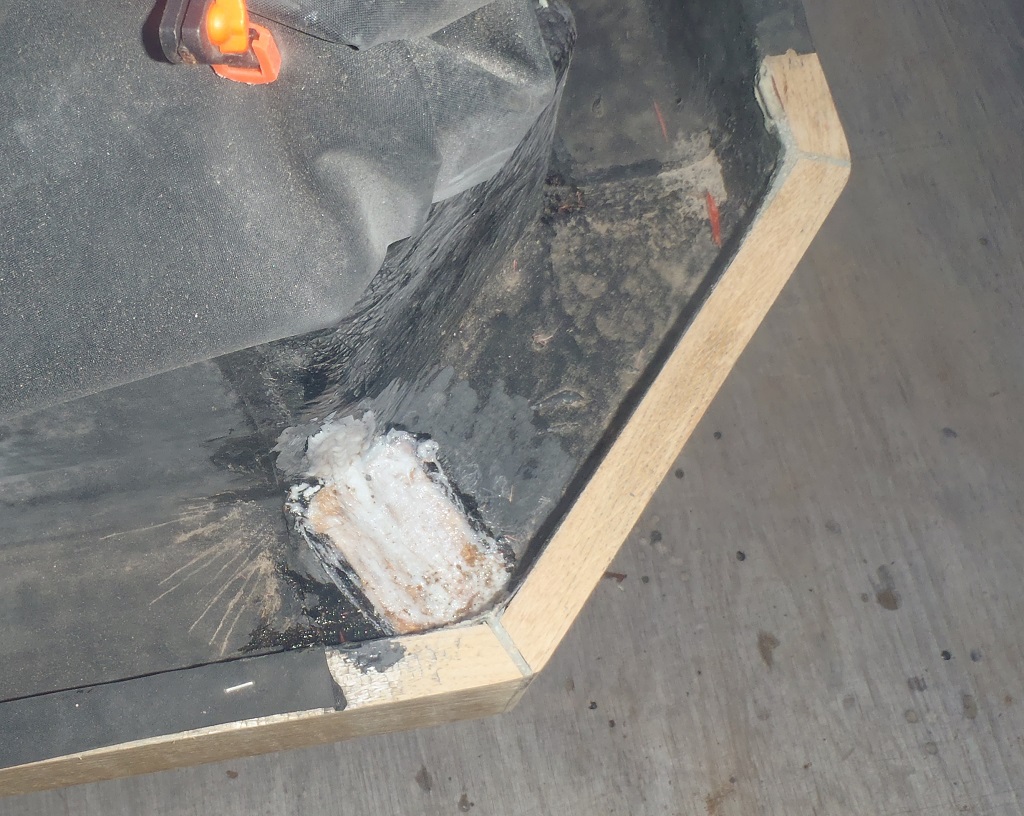
    During the week, on one of the odd mornings, we noticed that in the C-D corner of the gutters, there was a crack in the fibre glass which was caused by the whole fabric being stressed too much when the joint of the D side of the guttering had warped. We had fixed that problem last week and it seems to be holding now, but the damaged was already done to the fibre-glass layer over the other side of the corner. It was leaking rain water and that how we noticed the fault. So after filing away the fibre-glass and resin material to a width of about an inch on each side of the joint of the oak underneath, plus also grinding away a shallow gulley into the wood itself, we then cleaned out the joint with the compressed air, blasting right through. We then push an amount of our PU solid glue and worked it into the joint on both side and including the fascia joint too and left it to cure and set rock hard.
    Repairing-CD-corner-gutter

    Repairing-CD-corner-gutter


    We will put on a final coating of resin with glass-fibre to recombine the original membrane of the glass-fibre resin layer and resurface it back to a smooth finish and then put on more mesh covers on the rest of the gutters.
    That about concludes this week’s work and we say a sad goodbye to our Aunty Melba whom we all said our farewell on Tuesday, and we will continue next week in her honour to get on with our house.

  • Roof Section D and E Covered in Membrane and Battens and Slates Coverage Progresses on Section B.

    For the start of the week, under a damp chilly sky, we gave our nail gun a inspection and discovered that it needed oiling in the drive piston  chamber. It was rather dry and sticky with old oil. But the air line should be supplying a tiny amount of oil every time the gun is fired but the device is not apparently working. But at least after cleaning and oiling it , we now have a fully working gun back again!

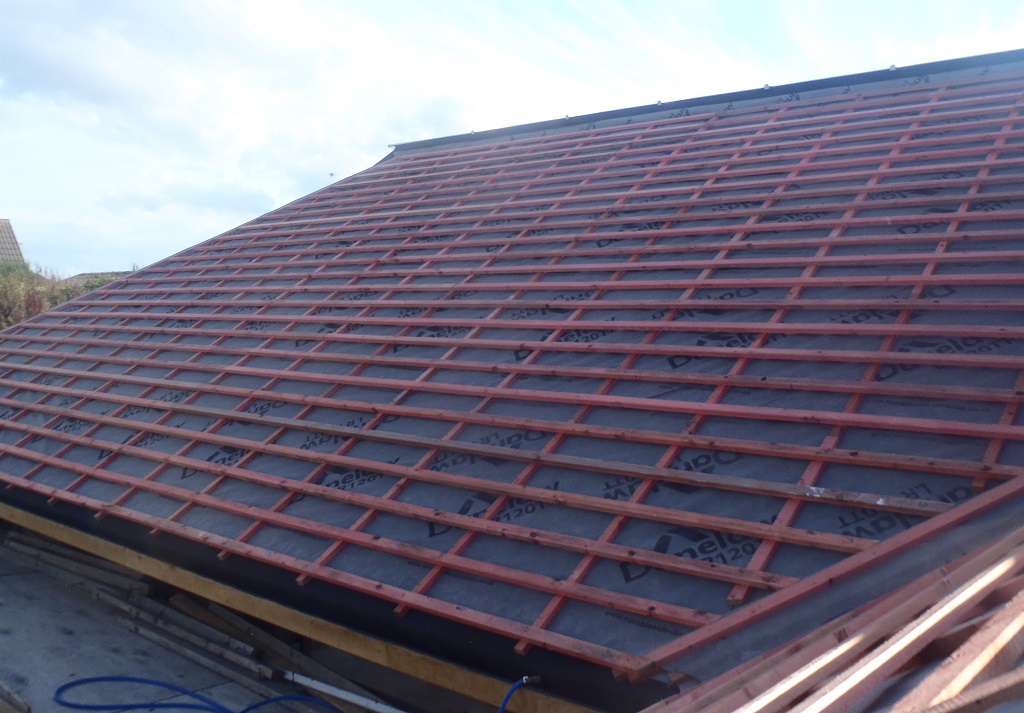
    We proceeded to cover the “D” and “E” sections of the roof with the breathable membrane and put on all the wooden tile battens which makes it now waterproof and ready for slates to be mounted. This took the whole day Monday, the mornings of Tuesday and Wednesday plus morning of Thursday to complete.

    D-E-partially-battened

    D-E-partially-battened

    D-E-fully-battened

    D-E-fully-battened


    The latter half of Tuesday was spent making the third aluminium support arm for holding up the Side Porch. The new length of the 2inch square tube arrived last week and we were able to complete this task of reinforcing the roof of the Side Porch.
    Center-porch-support-made

    Center-porch-support-made


    And the latter half of Wednesday was spent making stainless steel support posts for our skylight to attach a hook wire around for safety and ladders. We needed one more pillar post as we seemed to have mislaid one or miscounted when we made the original set.

    We continued on Thursday afternoon and also most of Friday, putting up more wooden battens that forms the structure for holding the flashing slates. We used the string to maintain a straight line, but the right hip has a slight curve in it so we had to follow this curve. It probably wouldn’t be noticeable unless one looks very carefully. We had to skip the remainder of Thursday afternoon so we resumed Friday (and took most of the day) putting on the rubber membrane band and the bull-nose wooden strip which was then covered in the fibre-glass + dark grey resin coating.

    Rubber-and-bullnose-on-BCD-hips-and-ridge-

    Rubber-and-bullnose-on-BCD-hips-and-ridge-


    For late Thursday afternoon, we needed to do the valley trough, installing two full lengths and a specially modified shorter piece that fits right up where the ridge and the skylight meets together. The modifications were done late in the workshop after 6pm so that would be ready in the morning.
    Top-of-DE-valley-trough

    Top-of-DE-valley-trough


    We also (again late Thursday afternoon) completed putting up the flashing rubber membrane strip along the kerb of the skylight and covered it up with the aluminium protection horizontal band.
    Skylight-kerb-flashed

    Skylight-kerb-flashed


    The next job, after finishing the flashing protection strips, from mid-afternoon of Friday, was to cut strips of the metal mesh off our supply roll. We finished off the entire roll and we now have a pile of mesh with a bent bump near the front of each strip to act as a rain water drip deflector. We hope we have enough to finish the job of covering the remaining gutters from “C” to “H”.
    On Saturday, we did a little repair job on the C-D corner of the gutters where the joint has warped a bit and there wasn’t enough PU glue in first place. so we clamped the oak timber back into shape again and filled all the gaps with more PU glue after we had sanded and rubbed inside the joint to get some clean surfaces again.

    So we decided that because the glue and clamps are in the way, we would instead continue on putting up slates. We got back to the “B” section of the roof and spent some time marking out the initial positions of each row going up the valley using our large framing square and string to get a vertical line to project back on each row to the valley to mark the regular nailing points. Then we also did the same on the “C” section but this time, exactly in the middle so we know where to start the slates from when we want to cover the roof and generate our special pattern.
    And finally, for the rest of the day, we started putting up more slates, on the “B” roof portion, another 150 slates, going up the valley, doing all the angled slices in the slate hanging over the valley trough. It is a long laborious job but we got there, right to the top!

    Slating-started-on-B

    Slating-started-on-B

    C-Roof-slate-alignment-marked

    C-Roof-slate-alignment-marked


    So for the start of the new week, we will put on the metal mesh over the gutters and then continue putting up a further 3500 slates to cover all the roof sections from “B” to “E” we have prepared.

  • Roof Section A More or Less Complete and Three New Aluminium Posts Created for Front Porch

    We had a bank holiday Monday to our week so we did a slow day of measuring the Front Porch various elements so we can adjust the level of the Porch with our new aluminium posts. The spreadsheet gave us the relationship between the three concrete pads we done ten days ago and they are now hard enough for supporting the load of the Porch and the roof with the slates, and the support beams and the gutters itself.
    We used our laser level site to get the numbers and we now have three length to make our aluminium posts with top and bottom plates to help spread the load and fix the posts to the wooden beam and also keep it stable on the concrete.
    The posts are in the order of 3200mm long, plus or minus 3mm.
    It was very hot and we decided to avoid working on the roof until the next day Tuesday.
    So Tuesday, half a day Wednesday (afternoon) and half a day of Thursday (morning), we got the rest of the largest ‘A’ section all covered in slates, an additional 1,200 of them, making a total of 2,500!
    The temperature was still very hot and it climbed to 29°C on Tuesday but was cooler on the following days. We drank lots of water more or less every hour. Phew!

    Roof-A-complete

    Roof-A-complete


    The remaining part of Thursday was spent tidying up our platform walkways, moving the trolleys of slates back to ground level, moving equipment and materials around so we could start undoing the modules along ‘A’ and the ‘P’ sections. We need to do this because we need to gain access to the other half of the main front roof, the ‘E’ section on the other side of the front porch.
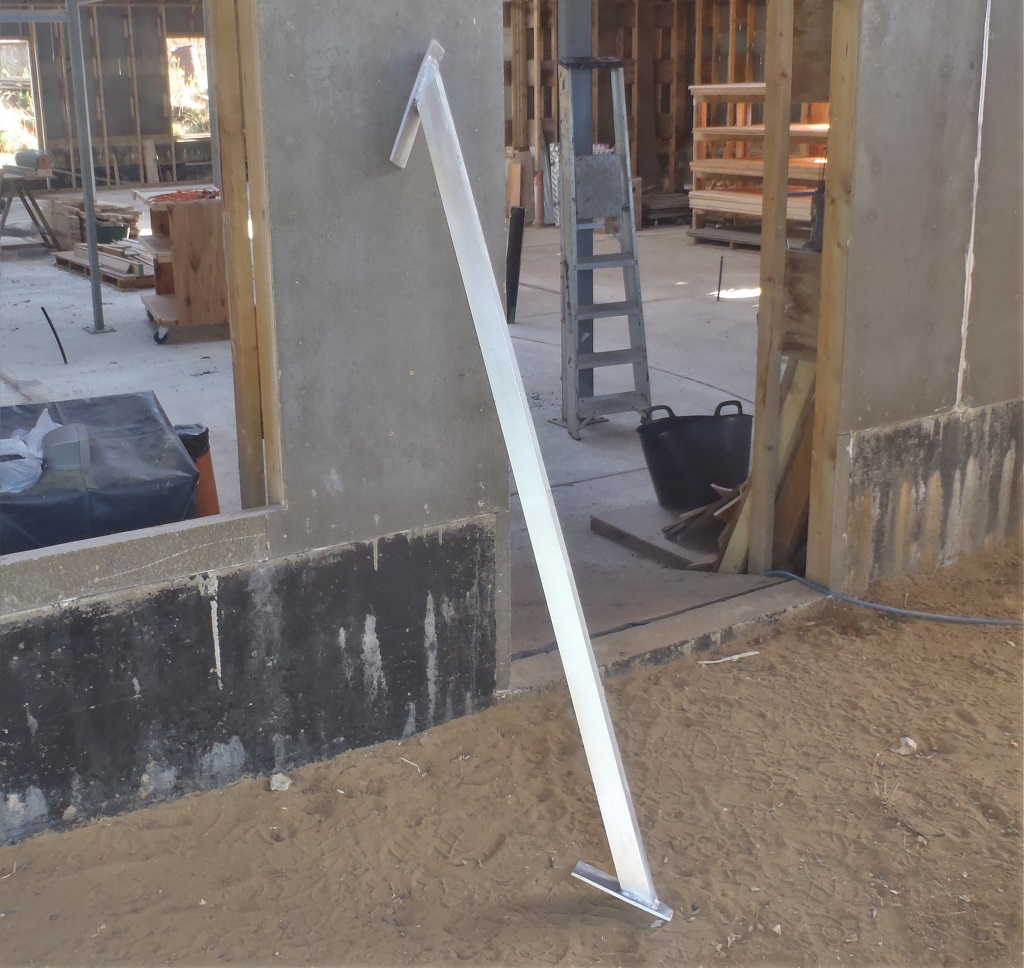
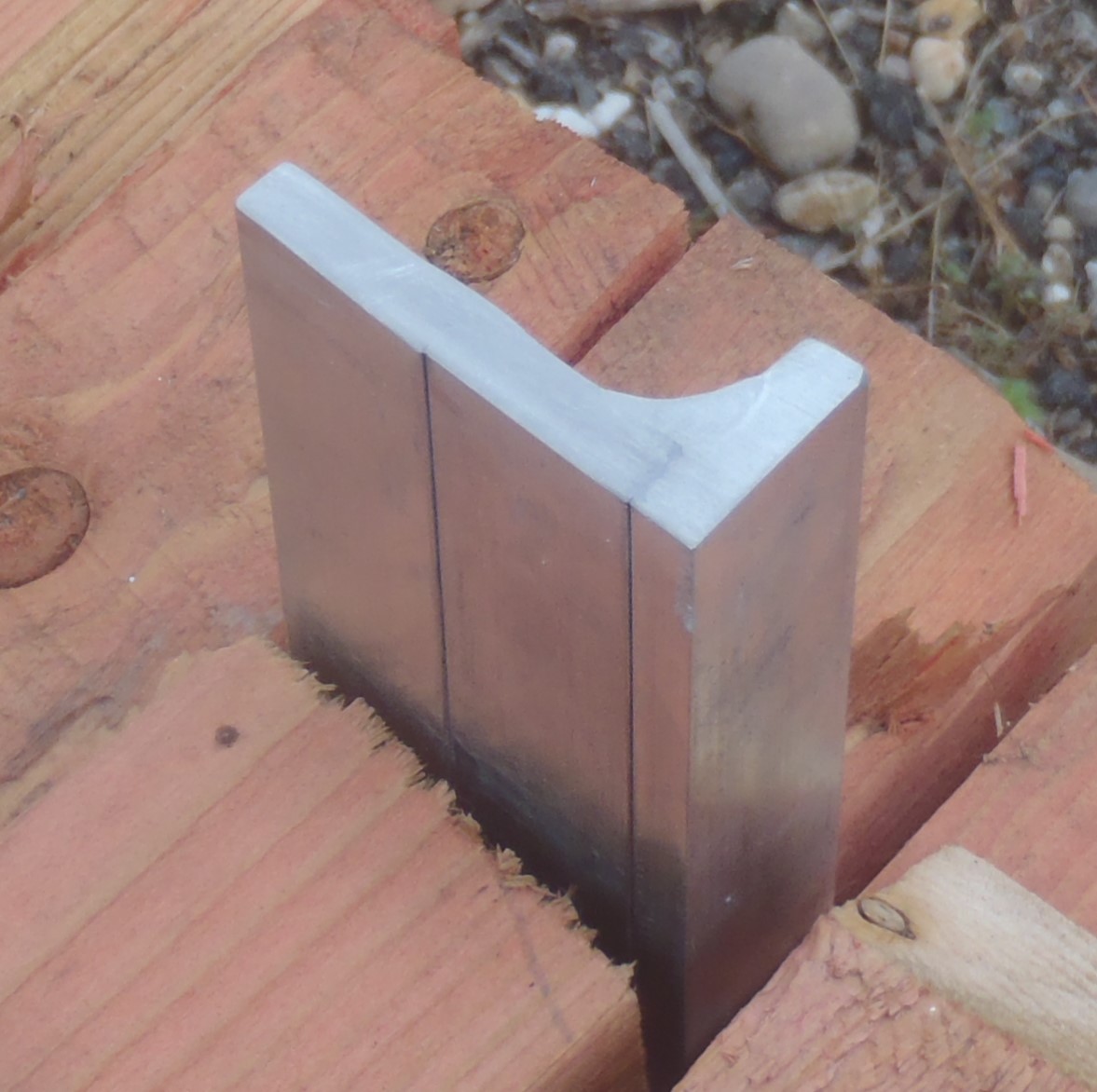
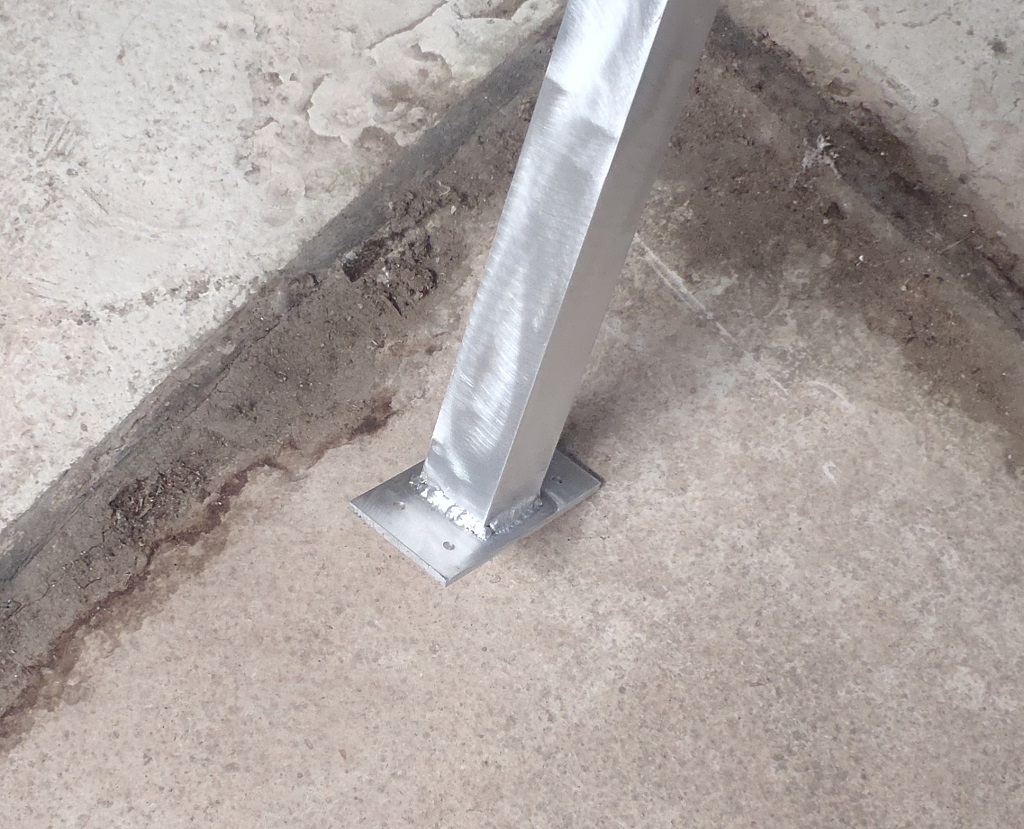
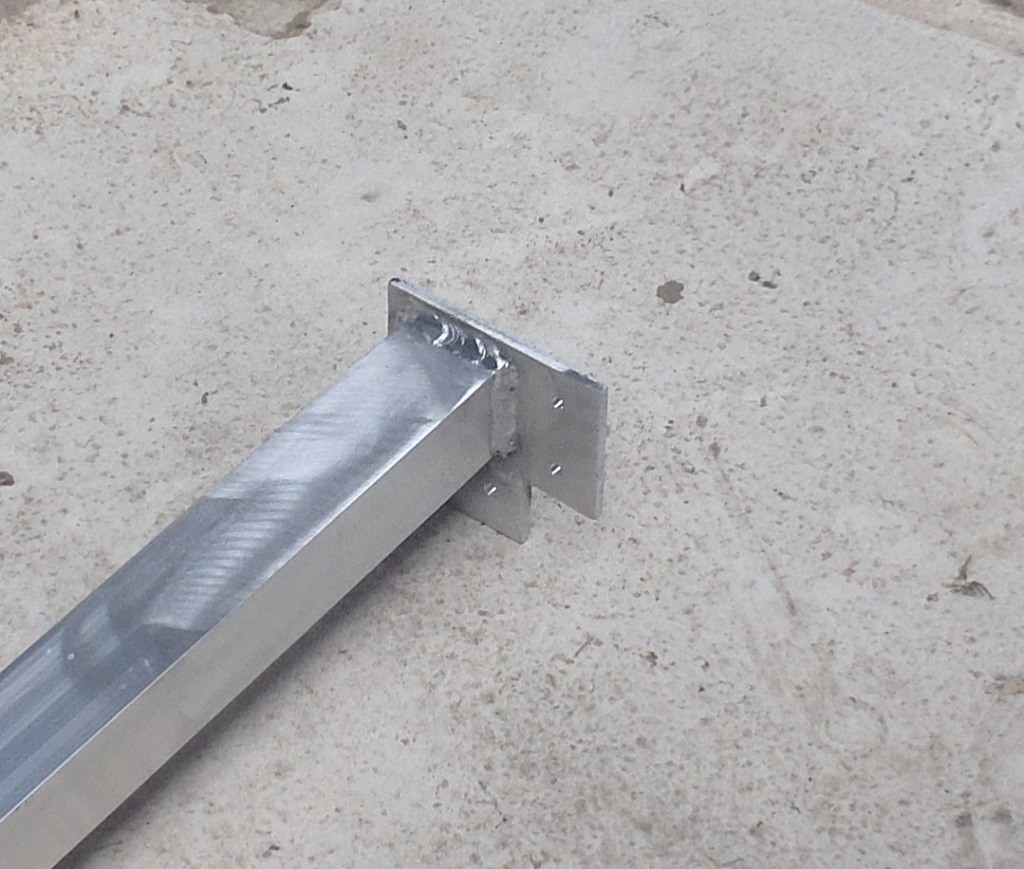
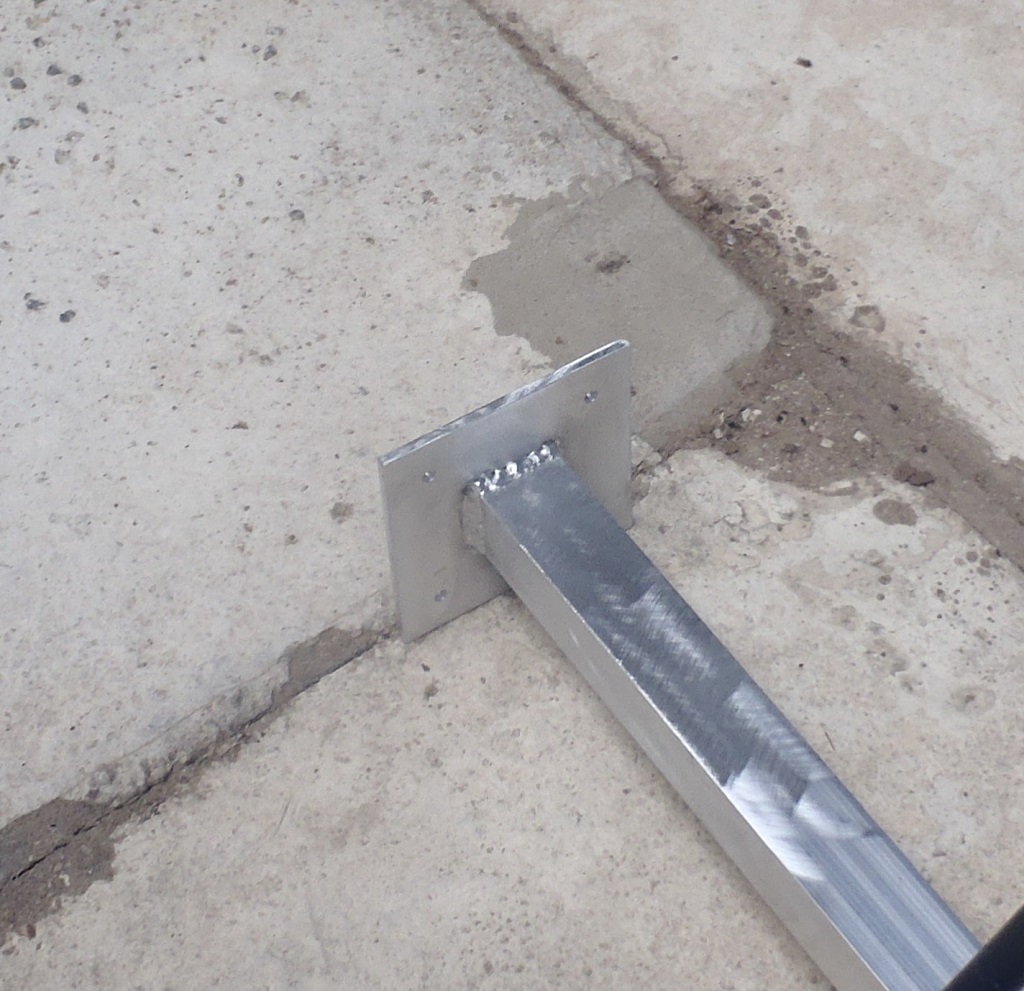
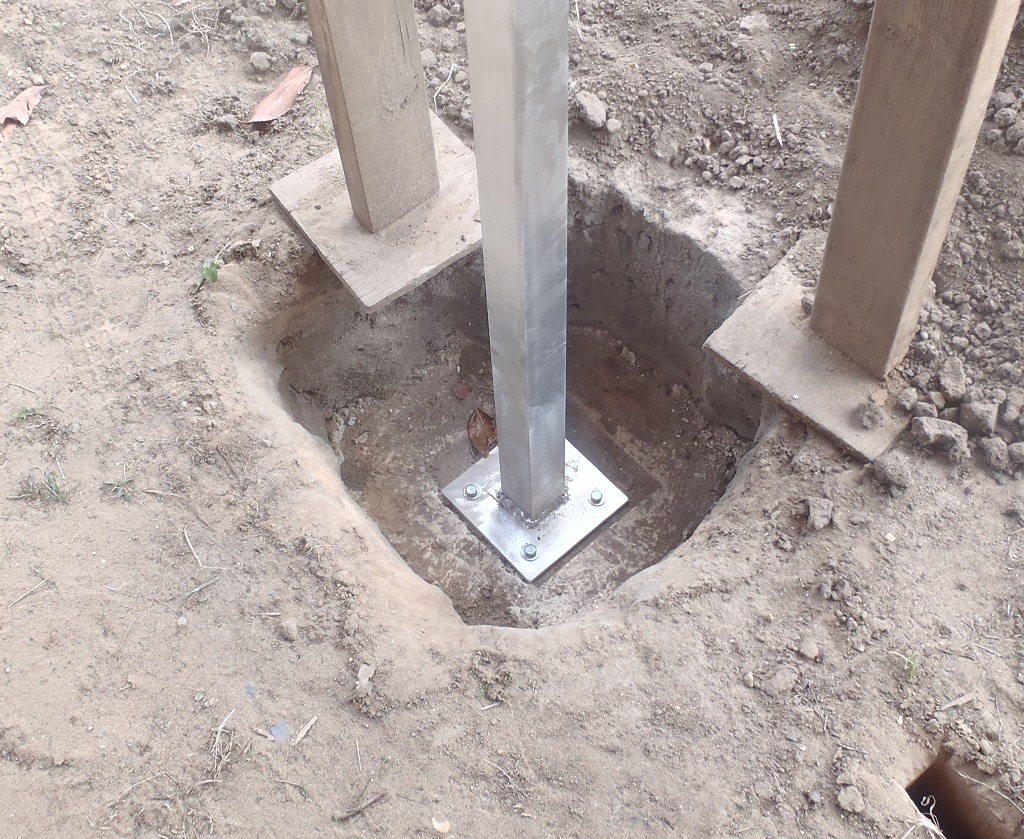
    For Friday and Saturday, while one half of the work force was occupied elsewhere, the metalwork was done on the posts for the Front Porch. There are three aluminium square posts, measuring 50mm a side and 3200mm tall. Each end has a flat metal plate welded, to help spread the load across the interface; the concrete pad at the bottom and the wooden beam up inside the porch roof. The bottom pad is a solid 150mm square and 6mm thick and the top piece is 75mm wide and also 6mm thick. The top plates comes in two shapes; a straight one measuring 125mm long for the middle leg, and two L shaped one for the corners. The first thing Stephen need to do was learn how to weld aluminium, this need changes to the welding machine and learning a new technique for the welding. This took up most of Friday morning (doing many practice welds and checking quality)!
    Aluminium-welding-Cross-section

    Aluminium-welding-Cross-section

    Then the plates were cut and butt welded. The on Saturday the plates were welded to the posts.

    Porch-legs-1

    Porch-legs-1

    Porch-legs-2

    Porch-legs-2

    Porch-legs-3

    Porch-legs-3


    We started installing them Saturday afternoon and we got one up in the C-D corner but we were trying to lift up the other corner, the B-C corner, to slide the metal leg under the beam, only 10mm to lift but it is proving difficult to do. We are using a car hydraulic jack but can’t get a stable base to apply the force to lift up the beam and the roof that 10mm.
    Porch-leg-base

    Porch-leg-base

    Porch-leg-top

    Porch-leg-top


    We will resume on Monday! Once the metal posts are in place, we can rearrange the working platform modules again so we can get access to the whole of the ‘E’ section and around along the Side Porch too. Then we can do more guttering and inserting the rubber liner.
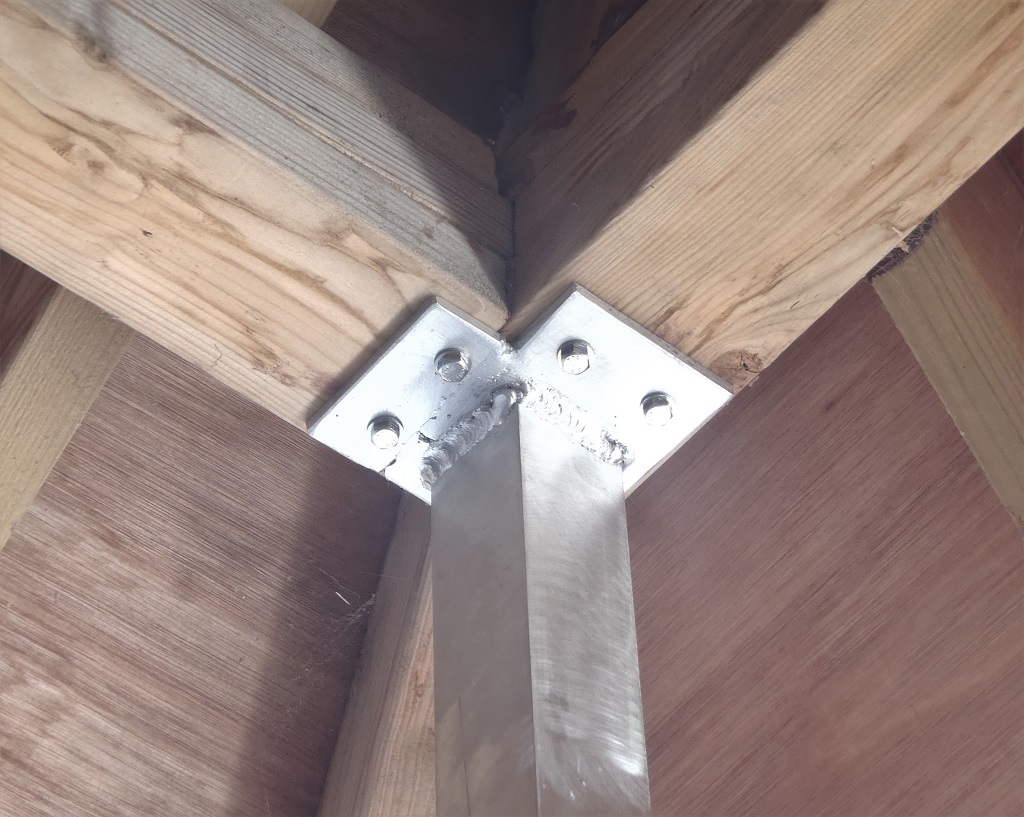
  • “P” Roof All Complete, Mesh on “A” Gutter, Half of “A” Roof Covered in Slates and Flashing Installed Along Skylight

    Another week is complete, with lots of Slates being mounted plus some little bit of work on the window’s octagon pillars.
    The hip flashing was first to be done, with the bull-nose shaped fibre-glass covered in the dark grey resin, going up the P-A intersection of the roof.
    Then we went to work on the “P” section of the roof and finished it off, as now we have means and support to climb up (on the “A” roof) to gain access to “P”.

    P-Finally-finished

    P-Finally-finished


    We also put up the Skylight rubber flashing along the “A” section to the “C” ridge line and put up the aluminium cover strips too.
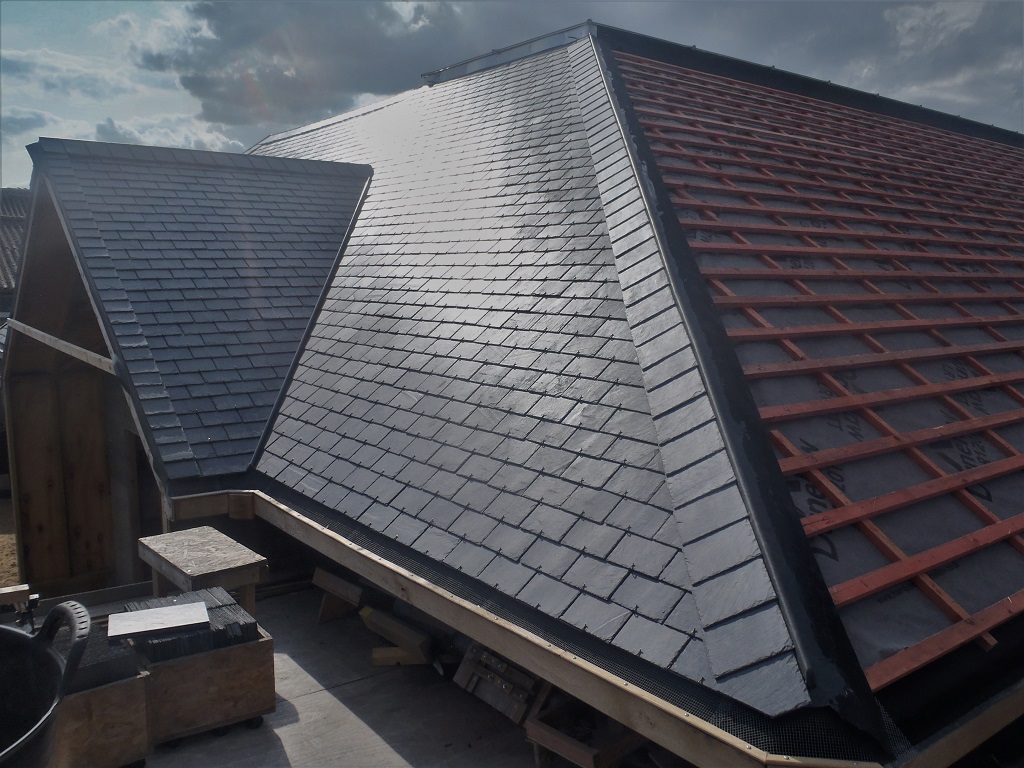
    We then installed the other half of the slating battens on ‘A’ (another 24 rows and about 260m long)

    Roof-A-all-battened-up

    Roof-A-all-battened-up


    Next, the metal mesh (for the guttering) was cut into strips off the roll, but with an additional modification applied at the same time. we put on a steel rod on to the jig so we could push and squash the mesh around the rod to make a “bump”, sticking up into the air. We are hoping that this will solve the annoying and troublesome rainwater from running across the mesh without dripping off into the gutters and dribbling over the edge down to the ground. This bump will, fingers crossed, interrupt the flow of the water and force it to drop into the gutter as it should do in the first place!
    We then proceeded to cover all the way along the “A” section and half of the “B” section including the valley corner. We had already, by then, installed two 3metre valley trough modules up the A-B valley.
    Gutter-Mesh-on-A

    Gutter-Mesh-on-A


    For the last two days, we got on with slating the “A” roof and we have managed to do about a one thousand three hundred slates.
    A-Slating-Day-1

    A-Slating-Day-1

    A-Slating-Day-2

    A-Slating-Day-2


    There were interruptions during the week, some due to bad weather where we worked in the workshop on our windows and continuing with the task of shaping our octagon pillar pieces, but we had other little interruptions too.
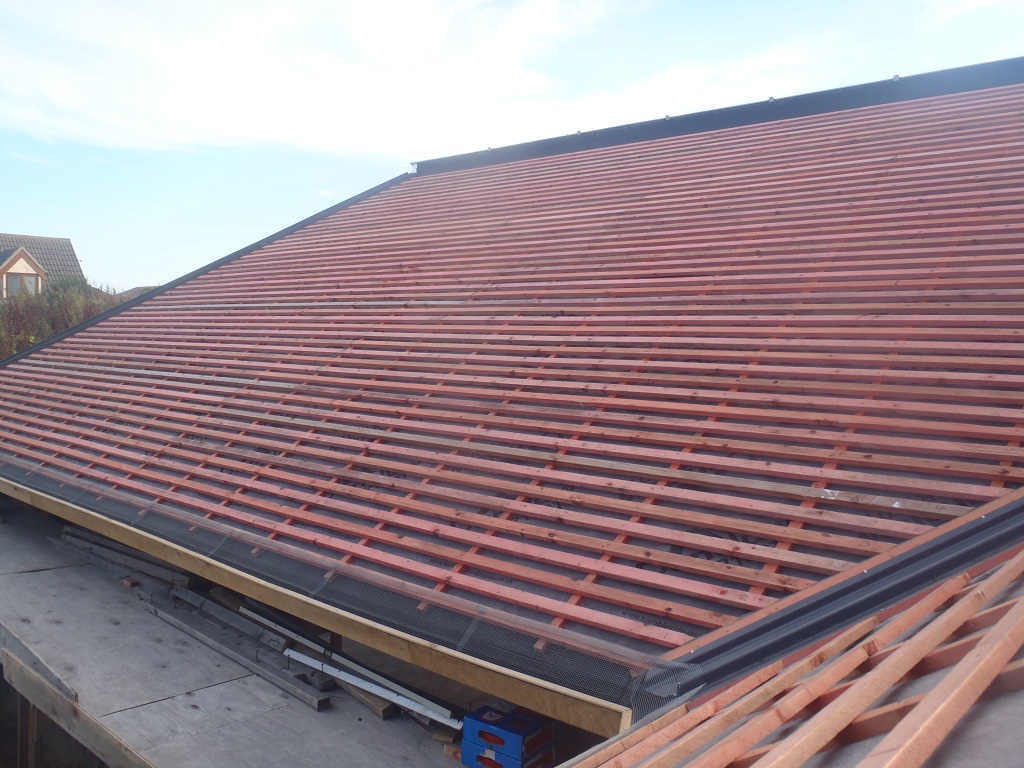
    Next week, we will carry on with the “A” section and put up another 1500 slates, up the valley and to complete that. Then will do the three porch metal posts and get them done before we start putting on more weight on the roof and the porch.
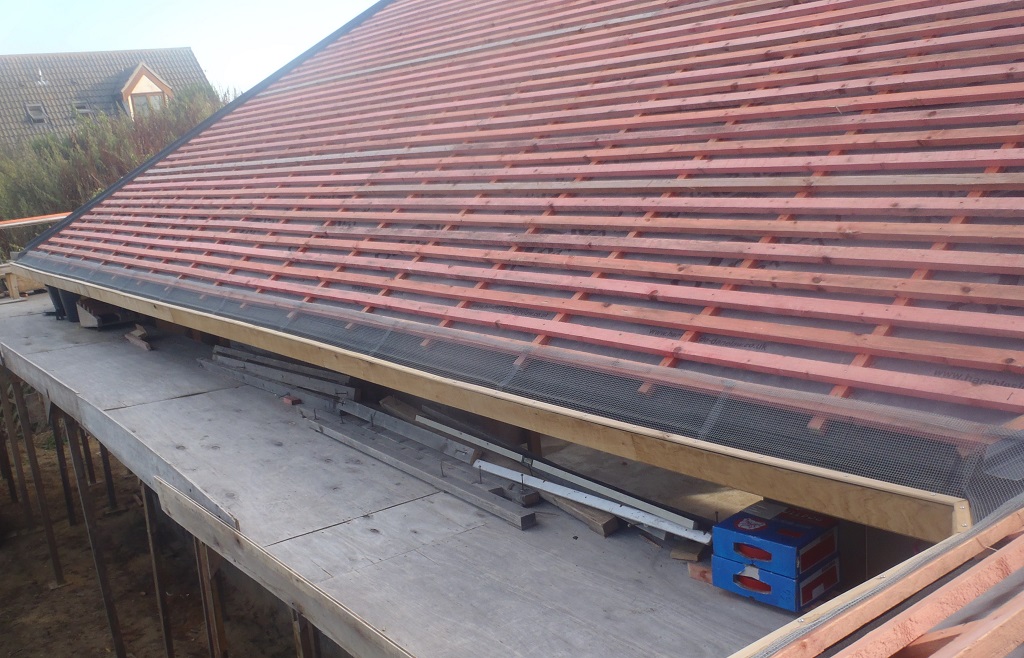
  • Membrane Installed on Section A and B with Half of Wooden Battens Plus Work on Oak Timber for Windows

    This report is for the last two weeks of work, we had some of the days on other commitments, but we mostly worked on our roof with some in our workshop processing more oak during the wet days.
    The first task was to put in our Rubber liner into the gutters, in section “A”, “B”, “C” and “D”,. It was a bit hit and miss in finding clear weather but we managed to complete this task over two afternoons.

    The next task was to complete the Hips and Ridge lines, building up the layers to form the edge of the main slate surface and allow for our flashing slates to protect these edges.

    Then we concentrated on putting up the breathable membrane on just the “A” and “B” sections, to allow us, later on, to get on with the job of putting up slates (which will, in turn, allow us to do another rearrangement of our working platforms so we can reach the remaining of the “E” section and go around the corner onto the “F” Side Door Porch).
    The “A” roof is the largest section and it needs 55 rows of tile battens, each one being at least 10 metres long each. By the end of the 2 weeks, we have got that done with half the battens installed, but at least, we now have two sections rainwater proof.

    Roof-A-half-battened

    Roof-A-half-battened

    Roof-B-half-battened

    Roof-B-half-battened


    When it was raining or strongly forecast to be (which amounted to about 4 days in total), we got on with the operation of planing our Oak timber to make the decorative Octagon shaped ‘pillar’ that stands on each side of each window. We had sliced wider planks in half with a 45degree cut and we had thought that we weren’t going to get very thick finished pieces because there seems to be lots of patches of “dips” and “bulges”. We did actually reject about ten planks anyway and got replacement ones from storage. We learnt a valuable lesson about Oak timber (well any timber!) and how random and natural they are!
    We ended up with 54 finished, all 20mm thick after planing . Half are the slightly wider ones for the front facing piece and another 27 smaller ones for the angled piece going into the window frame.
    Oak-window-octagon-parts-planed

    Oak-window-octagon-parts-planed

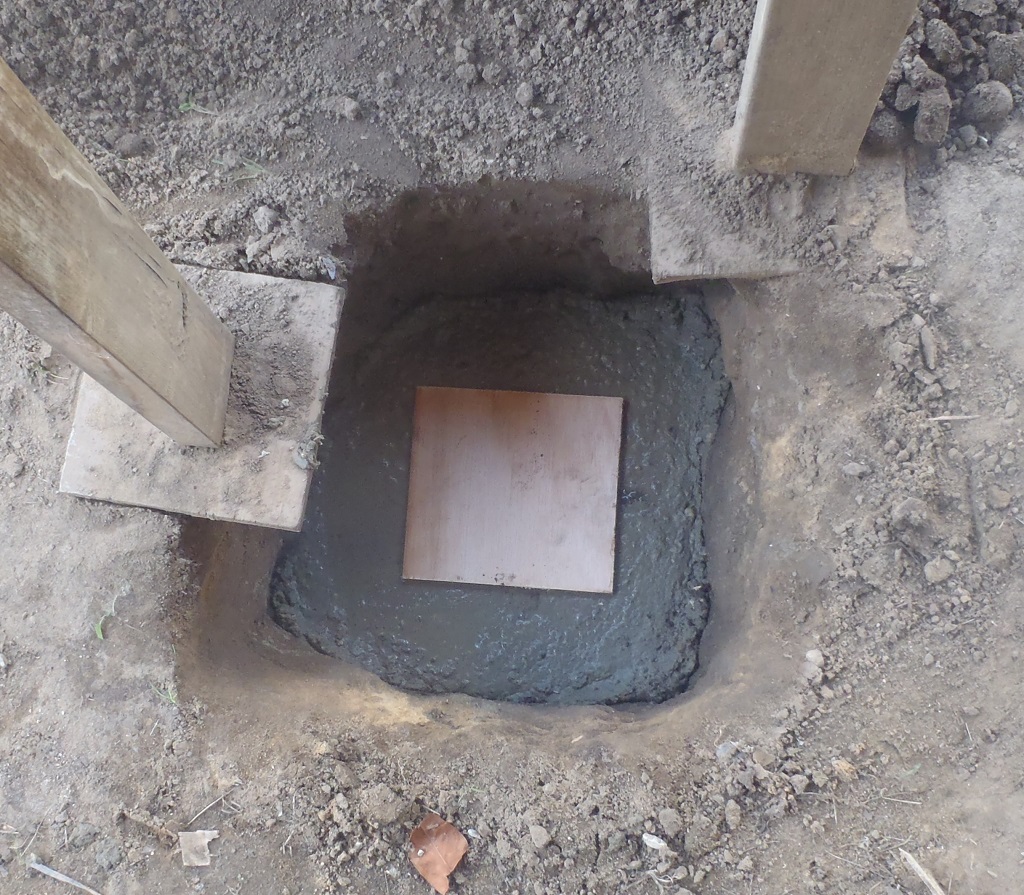
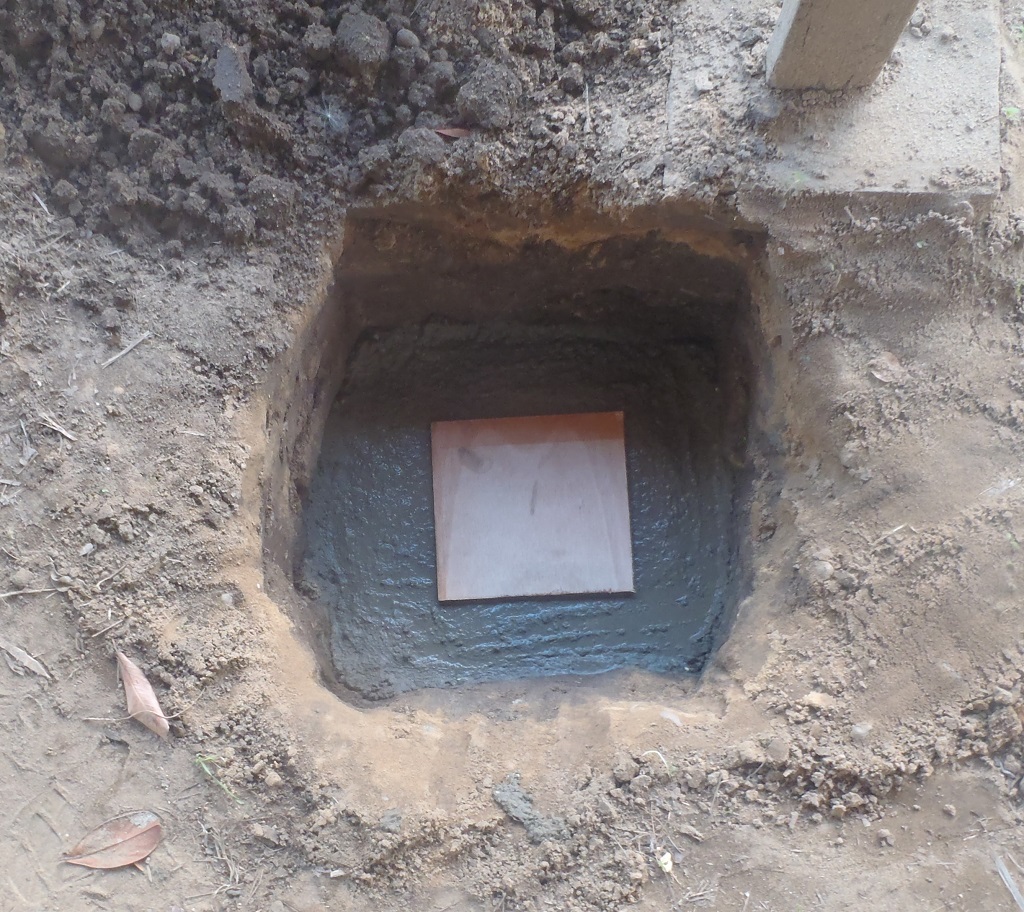
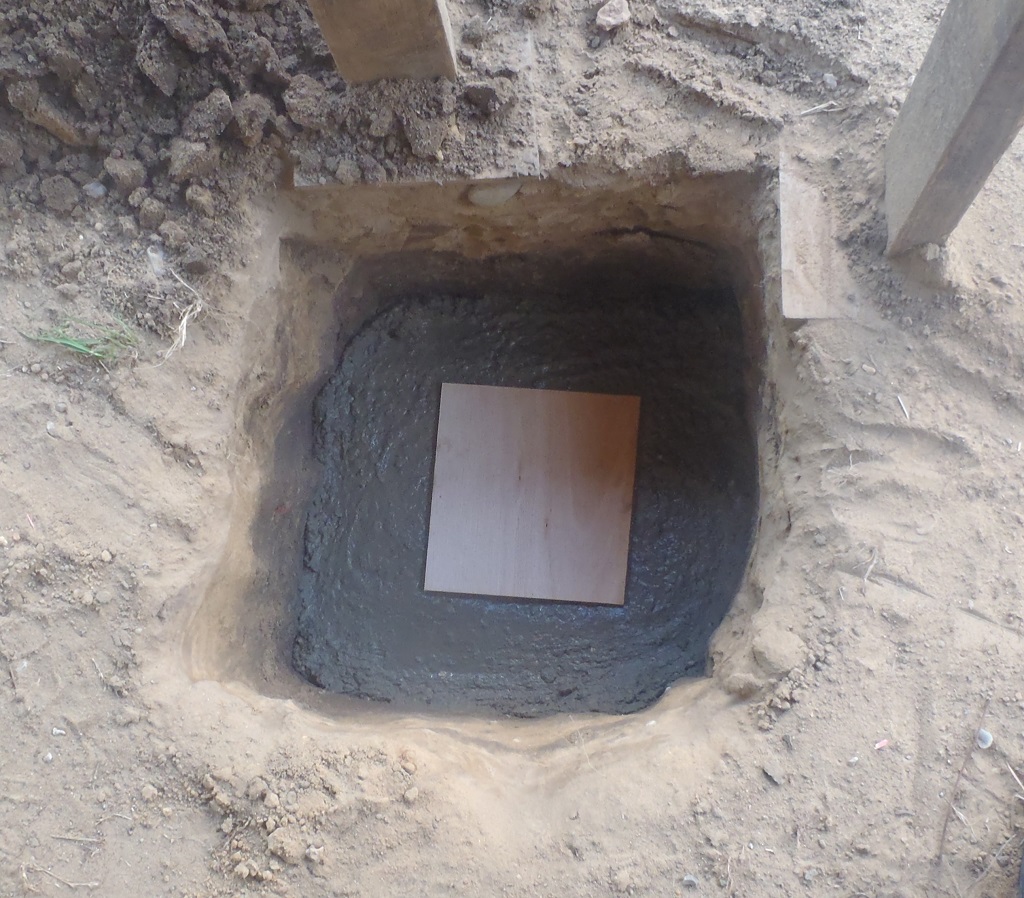
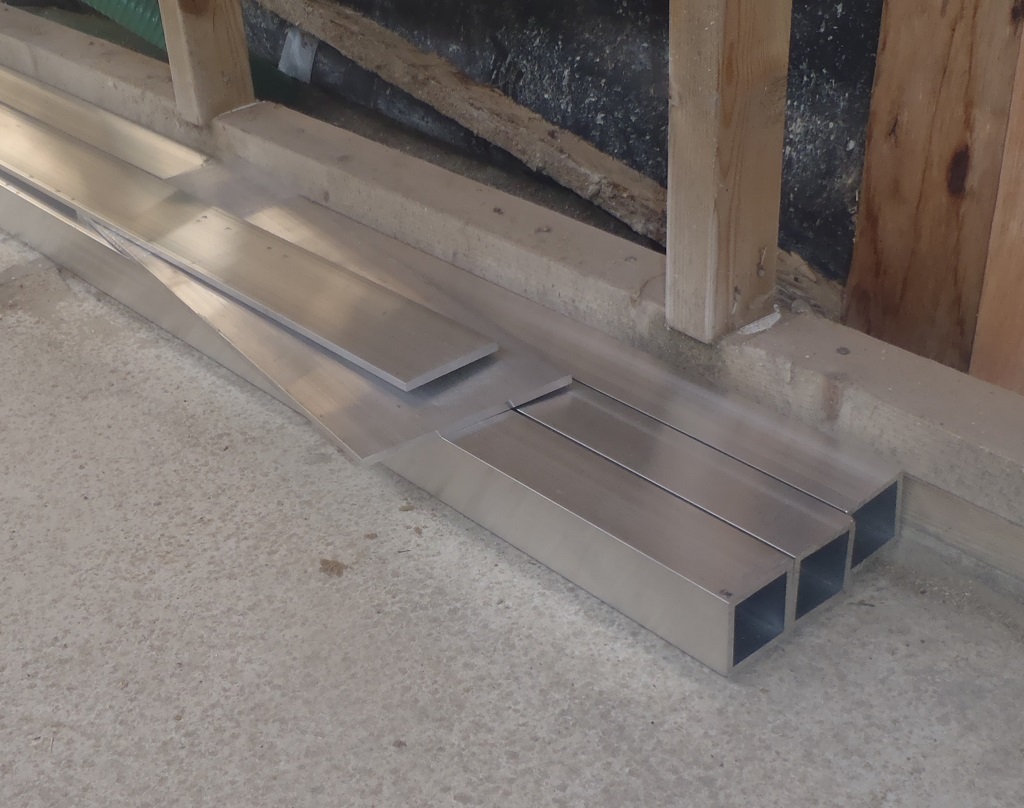
    After the gutter rubber was installed we noticed that water collected in the front porch gutter i.e. the ‘C’ gutter, It was over 20mm deep before starting to flow away. This shows that the temporary legs we installed when we built the porch are not supporting the roof properly. We need to install proper support before loading hundreds of kilos of slates on the roof! We need strong legs which will stand up to being bashed by materials moving around, so we decided to use metal posts. As the posts go into the ground we wanted rust proof ones, we started looking at stainless steel and even got as far as trying to order some but the supplier did not deliver to our location. Whilst searching for other suppliers we looked at aluminium (which is as strong as Stainless steel) and found it was half the price of stainless so we bought Aluminium instead. The post will be 50mm square hollow tubes with 4mm thick walls with 6mm thick plates at the top and bottom. The final task of this period of work, was to dig three holes at the spots where the metal posts will go. The holes were dug down 450mm to the standard frost level point and concrete was poured in to form solid pads about 450mm square and 150mm thick. The metal posts will then stand on these pads and stretch up to connect to the framework forming the porch, about 3.2metres high.

    1st-Hole-for-prch-post

    1st-Hole-for-prch-post

    2nd-Hole-for-prch-post

    2nd-Hole-for-prch-post

    3rd-Hole-for-prch-post

    3rd-Hole-for-prch-post

    Aluminium-ready-for-porch-posts

    Aluminium-ready-for-porch-posts


    Next week, we will carry on installing all the other half of the wooden battens for “A” and “B” roof sections while we wait for the concrete to cure and strengthen and start putting up Slates, firstly to finish off the last little bit of the “P” and around onto to “A”.