Author: Shaun

  • Entertainment room – Ceiling Completed and Wooden Walls Constructed

    We decided to have a go at finishing the Entertainment Room after we had finished the ventilation system. So these last few weeks, saw us sort out the ceiling. We wanted to build the complete ceiling, which means putting in the conduits and channels to allow us to thread wiring and cables from each of the light placement to next light placement. The ceiling is a solid concrete blocks affair on concrete beams so there is very limited space up there. We had already mounted beams of 63mm CLS timber up underneath the concrete blocks (we screwed 6inch long screws down through the entire concrete block and glued the wooden beams up as well) and these beams are just large enough to clear the concrete beams too. We decided that we can have seven lighting units per controller, and that we will have four lamps in one row, with its three siblings in the next row over, staggered. But, in order to feed the power cable from the controller board, we needed to mount aluminium channels up across the wooden and concrete beams. We tried to cut away a bit of the wooden beam, a diagonal slot but we discovered that quite a bit of the concrete beam needed to be grinded away to make room for the aluminium channel as well. That was far too much effort, and also running a risk of disturbing, and weakening, the strength of the concrete beams. So, the solution was to cut up a load of old left-over pieces of our 11mm OSB boards, into narrow 40mm wide strips and staple and glue them up on the underside of the CLS beams, deliberately leaving a gap for the aluminium channels to be glued up, going diagonally from the first three lamps, to their siblings.

    We did four sets of seven lighting units, plus half a set of just four units in the last odd row, finishing off the ceiling. There are a total of thirty-two concealed lighting units, each one with a fully controllable white brightness level plus some splash of colour too.The next job was to install our fire suppression system up into the ceiling space as well. We already had a 15mm plastic pipe threaded up through the wall into the ceiling space so we simply just took some 10mm plastic water pipe and threaded that down inside the 15mm pipe (the other end appears under the floorboards out in the hallway) and then put on a couple of T-junctions to split the water supply off into three different directions. One hovering near the window, two feet in. One in the middle and the third one nearer the back of the room. They all have 90degrees bends on them, going into a short piece of copper pipe, this goes through a small chunk of CLS timber and connects to the end cap which will have the spray nozzle fitted later on. We got these wooden blocks done now so we can reach up later on to screw them into place when we are lifting up the ceiling boards up into place. We tested all the joints by pressurising this section with compressed air and squirted washing up liquid around each joint to make sure that there weren’t any bubbles coming out.
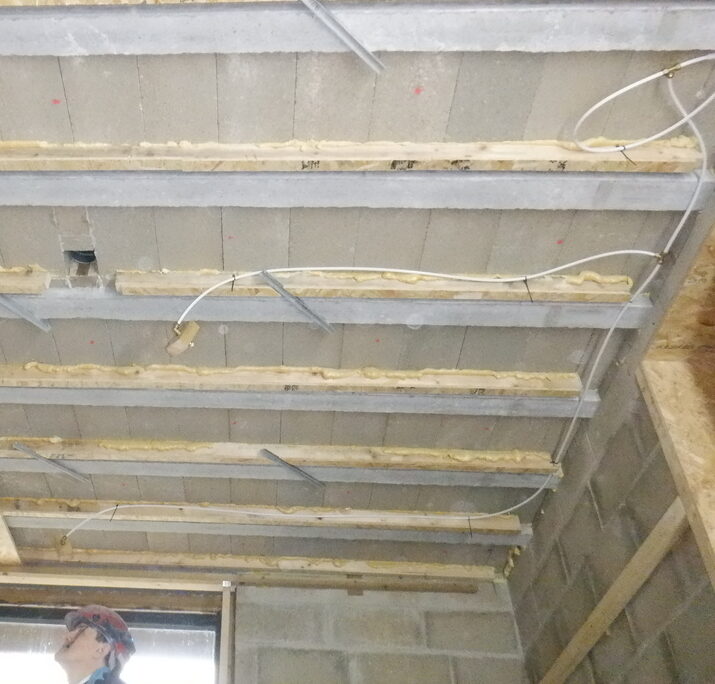
    Entertainment room fire supression pipe work

    Entertainment room fire supression pipe work


    Talking about ceiling boards, that is our next step. We took six sheets of our 18mm OSB boards and laid them out in our Great Room, lifted up off the floor with several full lengths of CLS timber. But, before we did that, we had all six of them stacked them up in a pile, on our work table. We proceeded to cut tongues and grooves in the appropriate edges so that the six sheets will fit together into a single combined ceiling, three boards wide and two boards long in the 8feet direction. The room is basically 12feet wide and just under 16feet long. We assembled them into that pattern on the floor and then tied them together using ratchets and straps to draw the tongue and groove together nice and tight, as if they were fully engaged up on the ceiling.

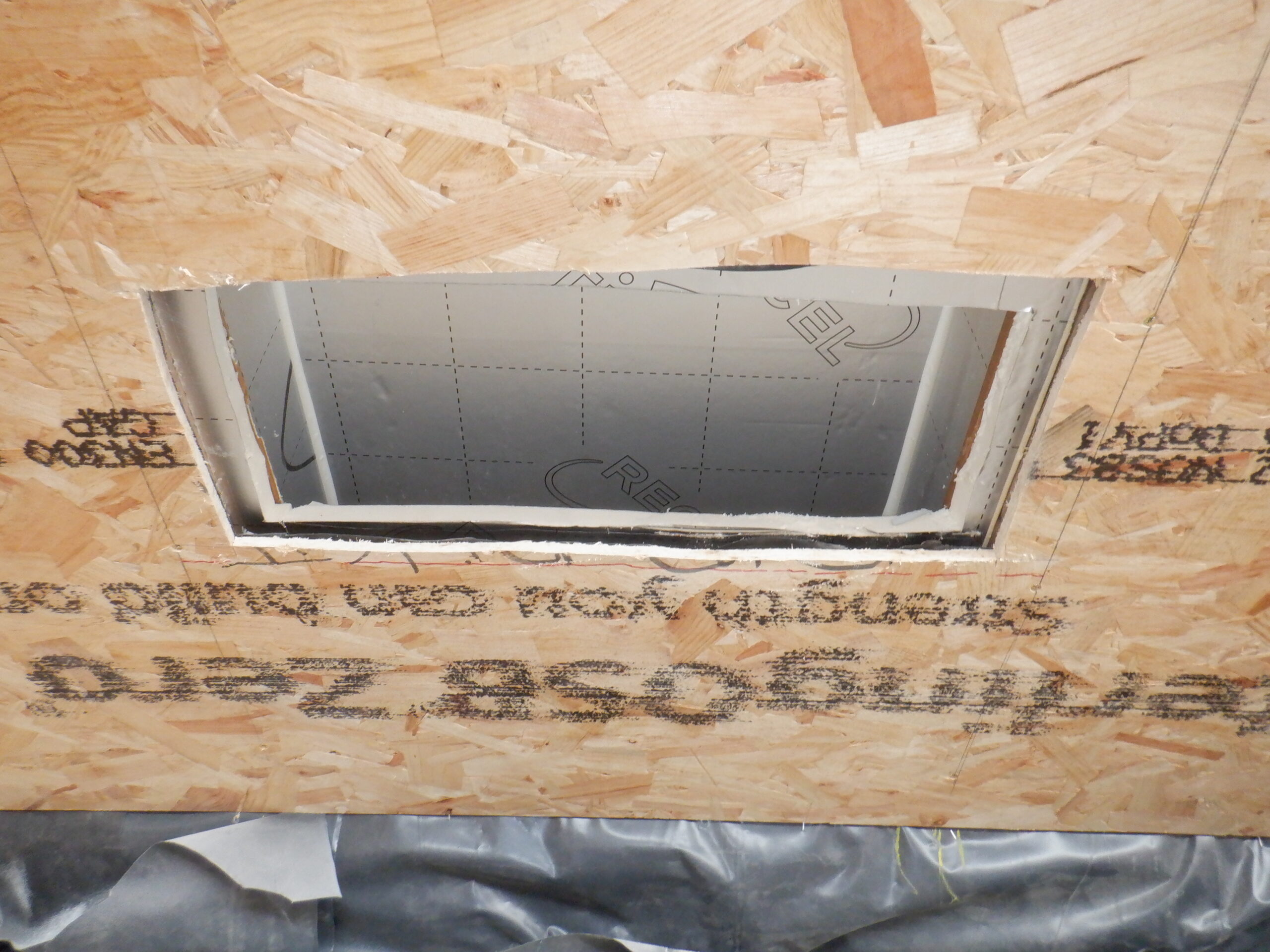
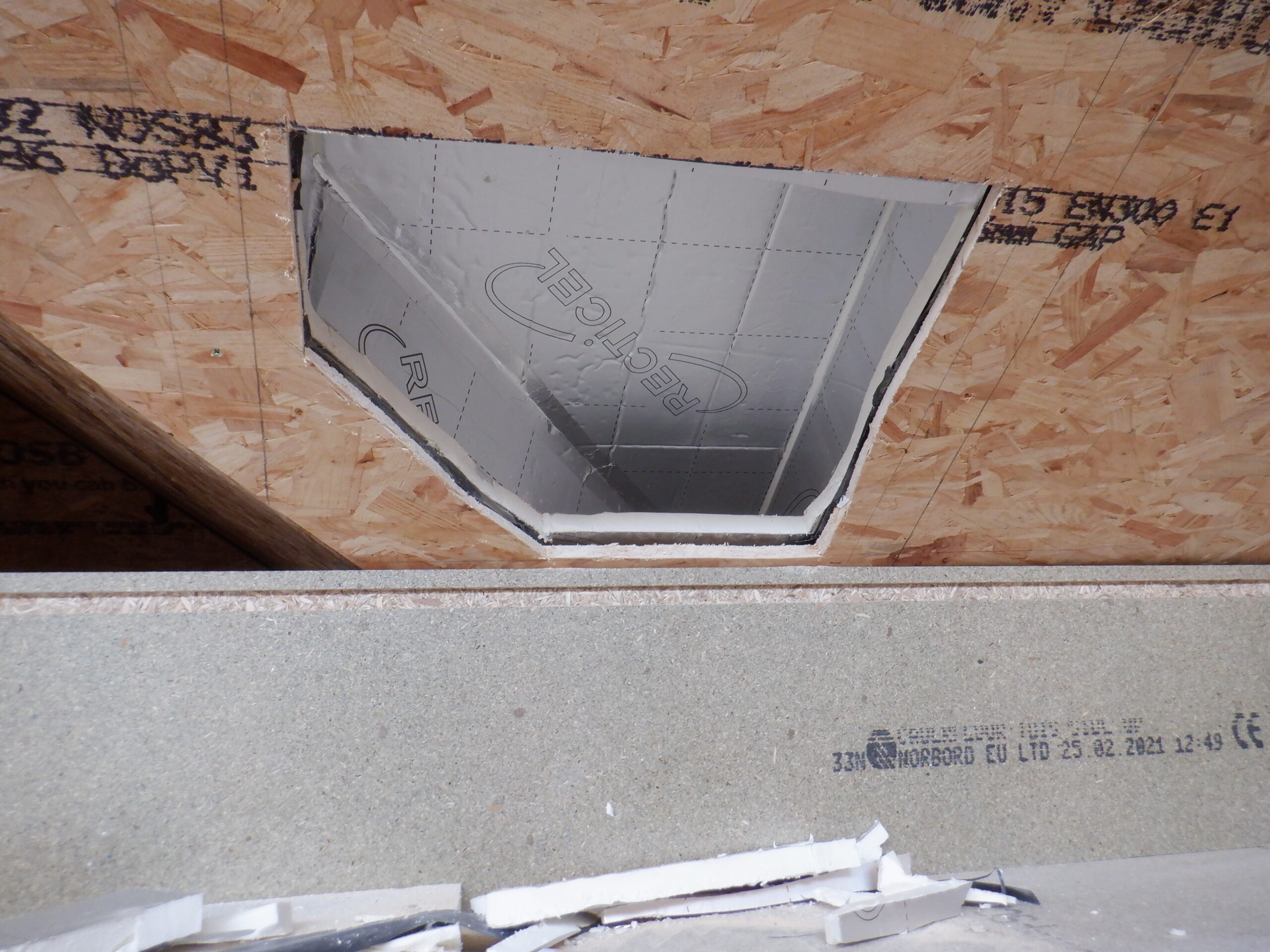
    Now we can mark out where we want all the lighting units, plus also the air ventilation port as well onto the boards. We knew that the distance between each of the concrete plus wooden beams is 520mm, and each one occupies approximately 200mm, which means that there is a space of about 300mm that we can lay out and position our lamps. We decided that we would randomly shift each lamp position around a bit so that we do not create a ?boring? grid like pattern. We used our Tungsten carbide tipped core cutter measuring 95mm in diameter, and we made short work on drilling out 33 holes, especially using our mains powered Black & Decker electric drill!!
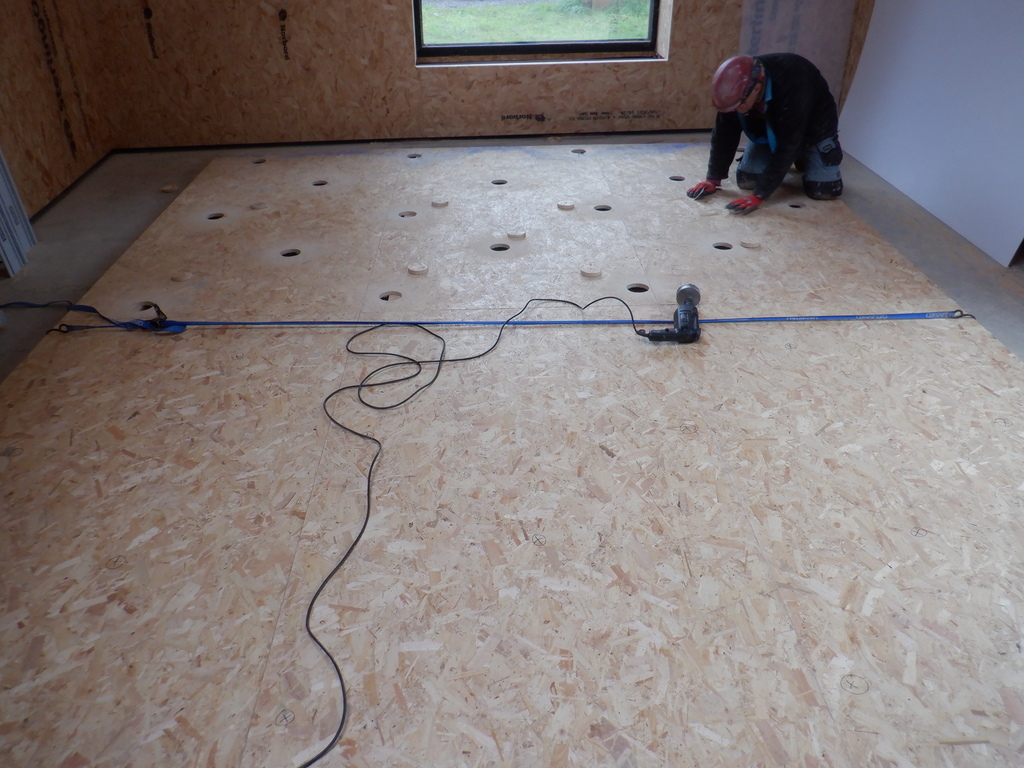
    Entertainment room ceiling have light holes cut

    Entertainment room ceiling have light holes cut

    We are nearly to mount these six boards up to the wooden beams, but first, we had to unscrew the top horizontal rail off the concrete walls because it is in the way of the OSB boards going up, plus also the carpet we are going to stick up later on. But, we realised that the top rail that is going across the window is completely glued in, and the wooden ceiling beam is hidden behind it, where we needed to screw up the ceiling boards. This meant that we had to chisel away a fair chunk of this top rail, to increase the gap above so that we can slide in our 18mm thick OSB boards plus the 11mm padding layer we have put up on all our wooden beams. What a fuss!! This is what you get when an original idea didn?t quite work out completely correctly. But, We made it.

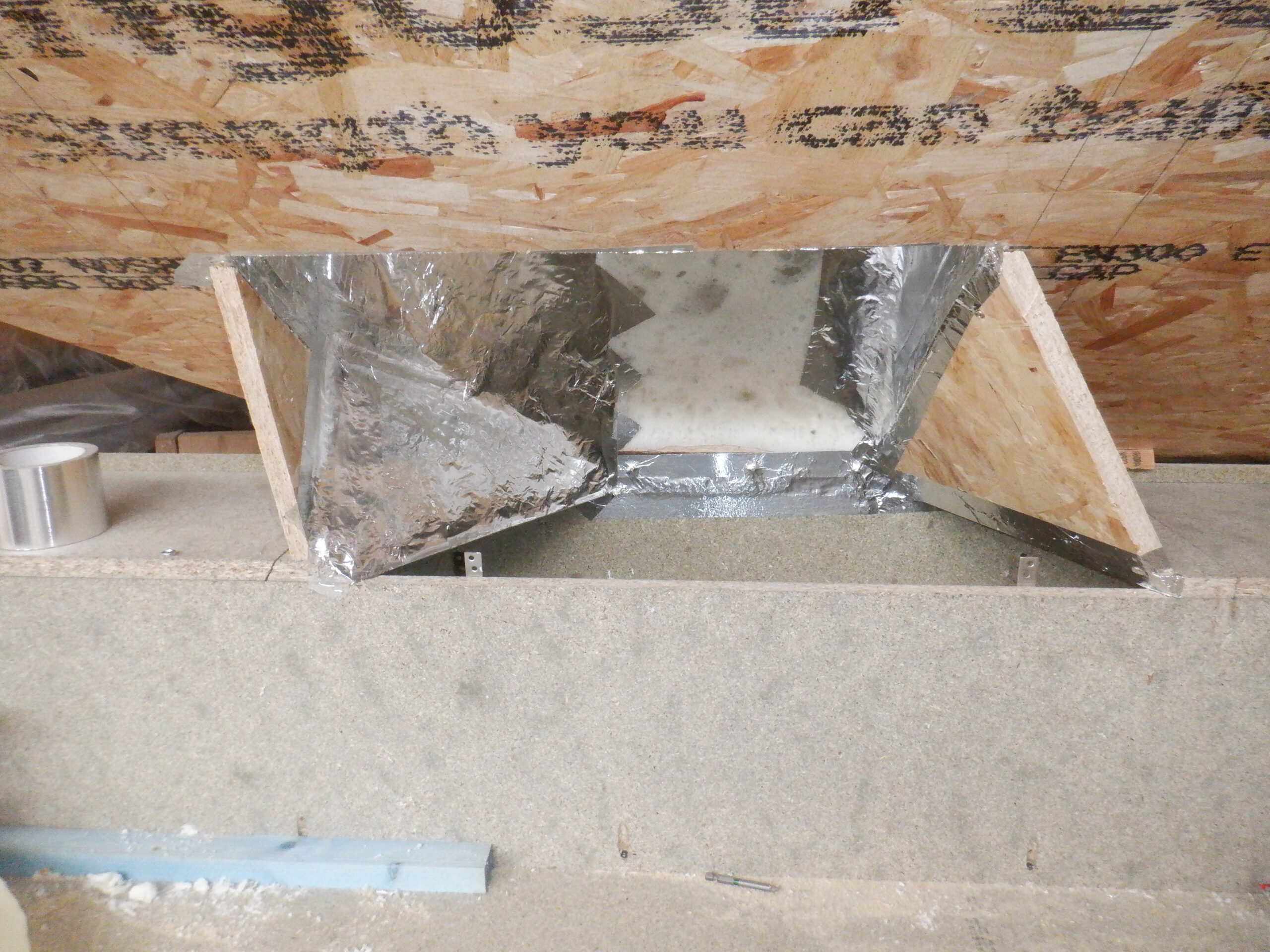
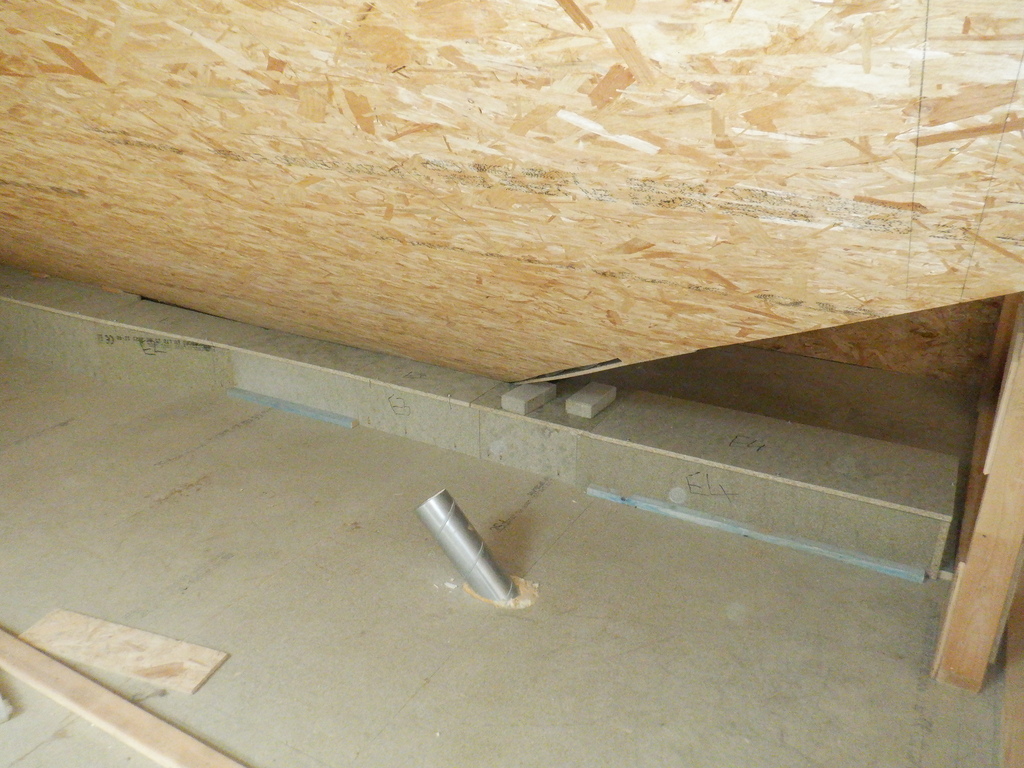
    Oh yes, one of the last thing to do while the ceiling is open, is to glue up some pieces of concrete blocks up around the metal air vent pipe that is sticking downwards, ready to be attached to the pretty vent cover. There is a gap between two neighbouring concrete blocks so we needed to fill in that gap with more heavy mass material, to reduce the amount of audio sound waves escaping out of this room. We found some left-over pieces outside in our swimming lane, sliced down to the required dimensions and then glued it up into place using PU Construction glue, and a tall prop to hold the block up while the glue set.

    The next job, the big one, of putting up each OSB board up to the wooden beams, screw and glue them into place. We got out our massive board lifter mechanism we bought ten years ago and it effortlessly lifted these 27kg heavy boards up with ease. We carefully aligned the long edge against a set of marks that represented the wall surface and shoved the short end into the gap above the window. It got all glued and screwed in at that point.
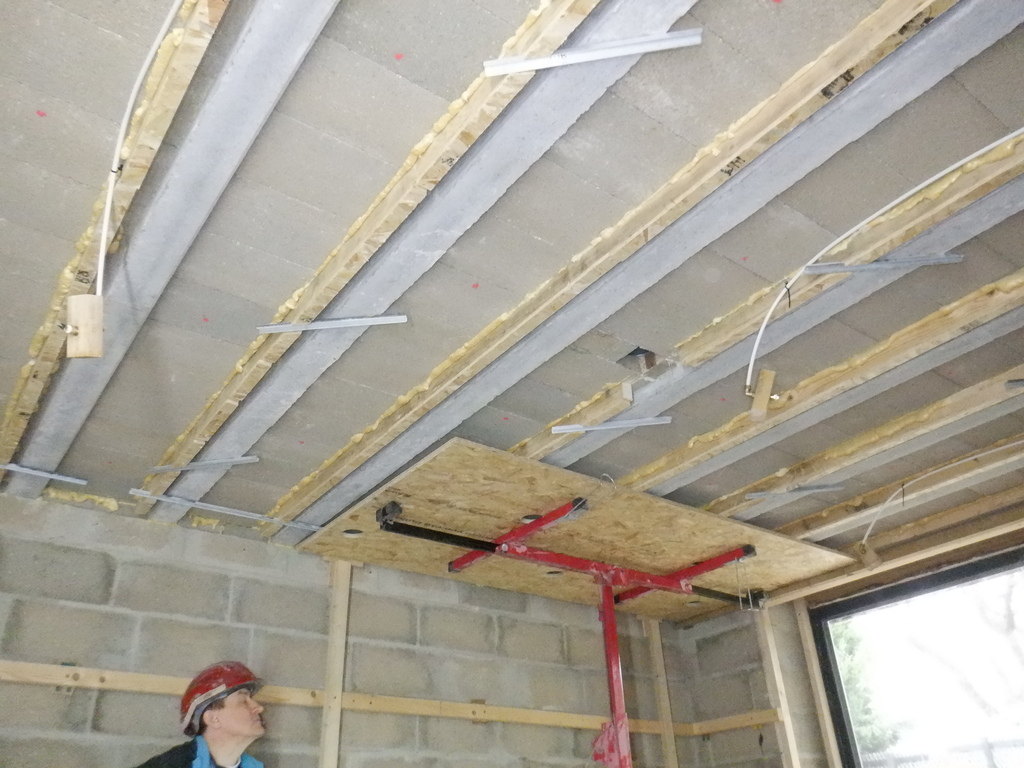
    Entertainment room ceiling showing conduits and first board test fitting

    Entertainment room ceiling showing conduits and first board test fitting

    We then put up the second board along that line, after slicing off about 120mm off the end. We engaged the tongue and groove joint, made sure that it was very straight and then also glued and screwed that one up too. We repeated this twice more to put up the remaining four sheets. It was jolly hard work but we made it !!

    We remembered to drill a small hole to let the fire suppression spray nozzle through and glued liberally the nozzle into place with PU construction so that we could undo the nozzle cap later on. We screwed the wooden blocks to help lock them in tight.

    Then other thing we did up on the new ceiling, was to enlarges the ventilation hole. We did only a 95mm hole because we knew that we could be slightly off position and we wanted to see where we managed to get the original position. We were pretty close actually! It just needed a slight shift by 5mm away from the window and we cut out a new 220mm hole, ready to take the ventilation cover.
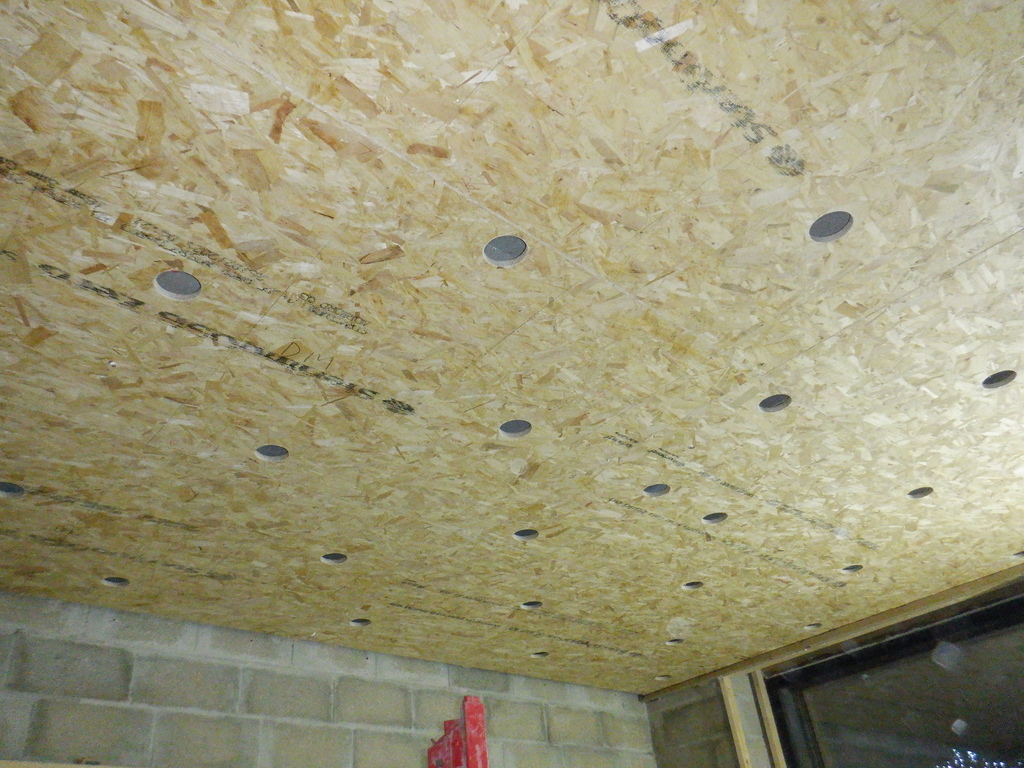
    Entertainment room ceiling boarded

    Entertainment room ceiling boarded

    Now the next job is to put up the carpet!!

    We ordered five pieces of carpets, the cheapest ones we could find and ended up paying well over £350!! We were going for a darker shade of colouring, but our head of the household put her foot down and selected a paler set of colours!! We ordered a 4.8metre by 4metre width for our ceiling, in a steel blue speckled colouring. It has a felt backing. We knew that it will glue just fine because we had previously got free samples and we tried various types of glues, to see which one is practical to use, to see how each one dried and see how strong the bond was afterwards. We tried wallpaper paste, a latex rubber glue and a contact glue. The wallpaper paste completely failed to stick at all, the latex rubber glue took absolutely ages to dry and wasn’t sticky enough to do the job of holding up the carpet while it finished drying. In another test, we did successfully use this latex rubber glue to stick a piece of carpet to the wooden board very well indeed which will be good for the walls. Anyway, we settled on the third type of glue, the contact glue (Evostick), because it dried very quickly within 10 to 15 minutes and we could press the two halves together and proved very strong. We tried ripping the sample carpet off and it started tearing the carpet itself instead of the glue. So we knew what type of glue to use.

    Just a quick note about the cost of the carpet mentioned above. Yes, it is an extra cost to our overall build, but actually, it is not that high an extra, because we saved money by not having to put up our high precision plasterboards, which would have cost about £250 (13 sheets worth) so the extra on top is only £100 .. We Can Live With That!

    The next trick we had to perform, is to get this twenty square metre carpet up onto the ceiling, upside down! We built a tall mobile wall with a shelf to hold the excess carpet in a fanfold arrangement. We needed a flat vertical surface so that the carpet’s backside is laid out flat, ready for the contact glue to be painted on. This flat surface is almost the entire width of the room (3.6metres – 12feet) and we decided not to paint to the very edge because the carpet is still at its original 4metres width and it needed extra room to ‘flop’ down.
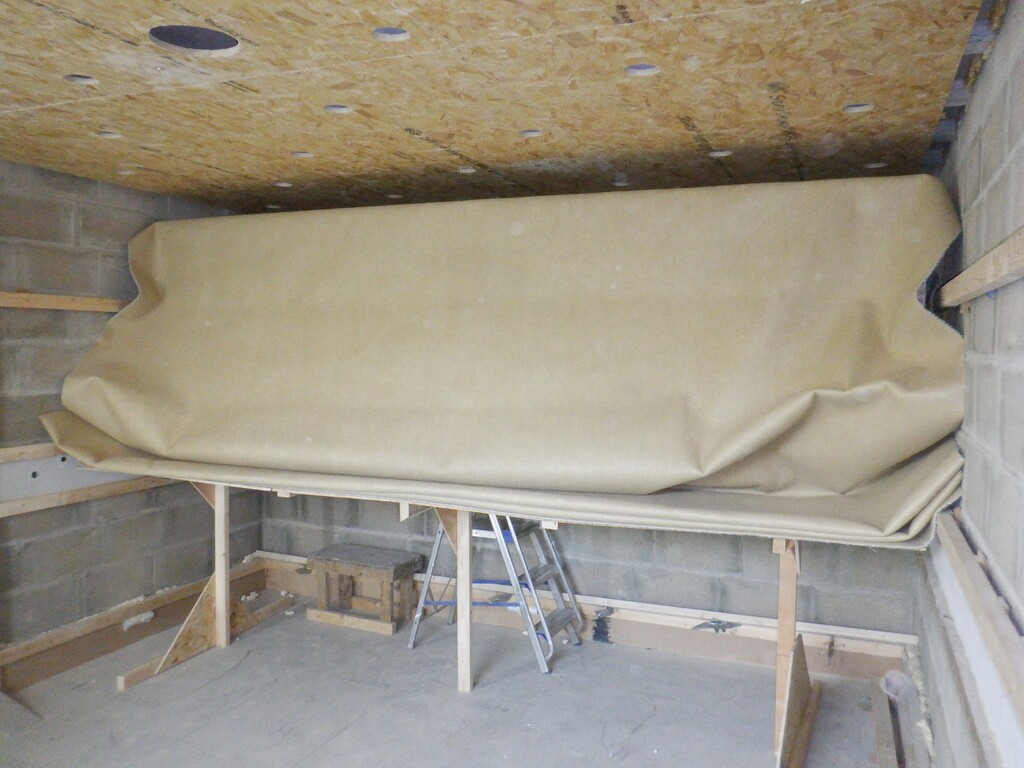
    Ready to hang ceiling carpet folded up waiting

    Ready to hang ceiling carpet folded up waiting

    In order to make sure that the very first attempt of pushing up the first edge of carpet goes on flat and without any wrinkles or ruts, we stapled on a 3.6metre length of 63mm CLS timber to the very edge of it, with equal amount of excess carpet left and right. We pulled the carpet up and draped it over our mobile wall so we had about 1metre dangling down. The mobile wall was then shifted so that it was about a 1metre from the end wall (furthest from the window). Once we have painted a strip about 900mm wide on the back side of the carpet, and a similar width up on the wooden ceiling with the contact glue, allowing it to become tact-free, we could lift up the CLS timber above our head while we stood on a ladder and a foot stool. We deliberately positioned the CLS plank against the surface of the concrete wall, sliding it up against it. We had previously marked the concrete wall near the ceiling so we knew where to position the plank so we arrived at the ceiling with the carpet and press hard upwards to get the two glue surfaces to bond together. Now, using a second similar plank but a bit shorter so we didn’t jam up too badly on the side walls, we used this piece of timber to press the carpet upwards continuously, bit by bit, moving further and further away from the completed section.
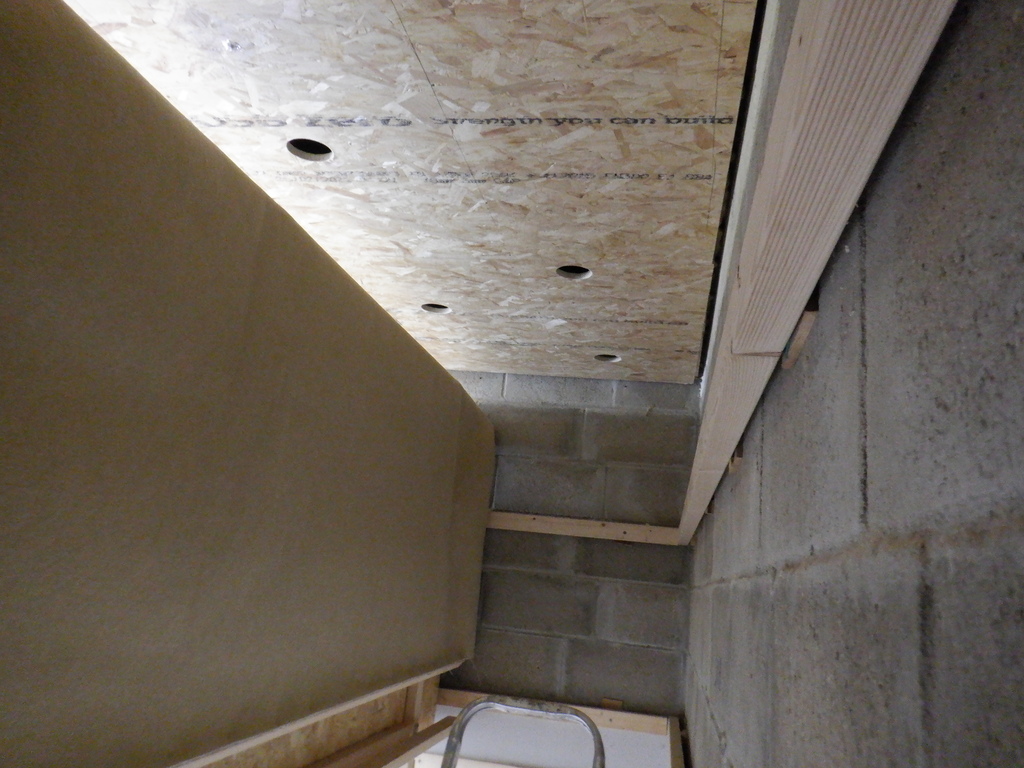
    Ready to hang ceiling carpet first strip

    Ready to hang ceiling carpet first strip

    One aspect of this task of putting up all this contact glue, is the very strong chemical solvent smell coming off all the painted surfaces. So, we had to bring in a giant fan to stuck out as much of the fumes as possible. Also, we connected up our 6inch fan to the purple 100mm pipe out in the hallway, underneath the floorboards, and blow in fresh air via the ventilation outlets (four of them) we got in the room. Plus also, we opened the front door and the side door to allow clean fresh air into the house too. We even turned on our main ventilation fan we had previously installed and got it to stir the air around the entire house.

    Now, we could duck under our mobile wall, and paint the next section, another 900mm strip, on the carpet and again the ceiling as well, wait for it to tack-free and then move our mobile wall along that 900mm. It was a wiggle, keeping the carpet straight and flat but we got there. then, we then ducked back under to the other side and picked up our rolling CLS timber, to continue pressing the carpet along bit by bit until all the glued strip is done.

    We repeated this process another three times and arrived at the window. We discovered that the supplier had given us another 500mm of carpet because it turned out to be the end of their roll so they just gave us the excess for free? very nice of them!!
    We had to prop up the last bit of carpet with three extending legs because the weight of that excess carpet was heavy enough to make it not stick up on the glue properly.

    We then dismantled our mobile wall, and then went around trimming all the excess carpet off the edges. After that, it was the case of finding all the round holes, all 33 of them, and cut out the carpets, one by one. Oh yes, we also located the three water spray nozzle points and carefully cut around the little metal plate.
    And then, finally, we went around the edges of the ceiling, to apply glue to the dangling bit of the carpets and stick that up to get it all finished.
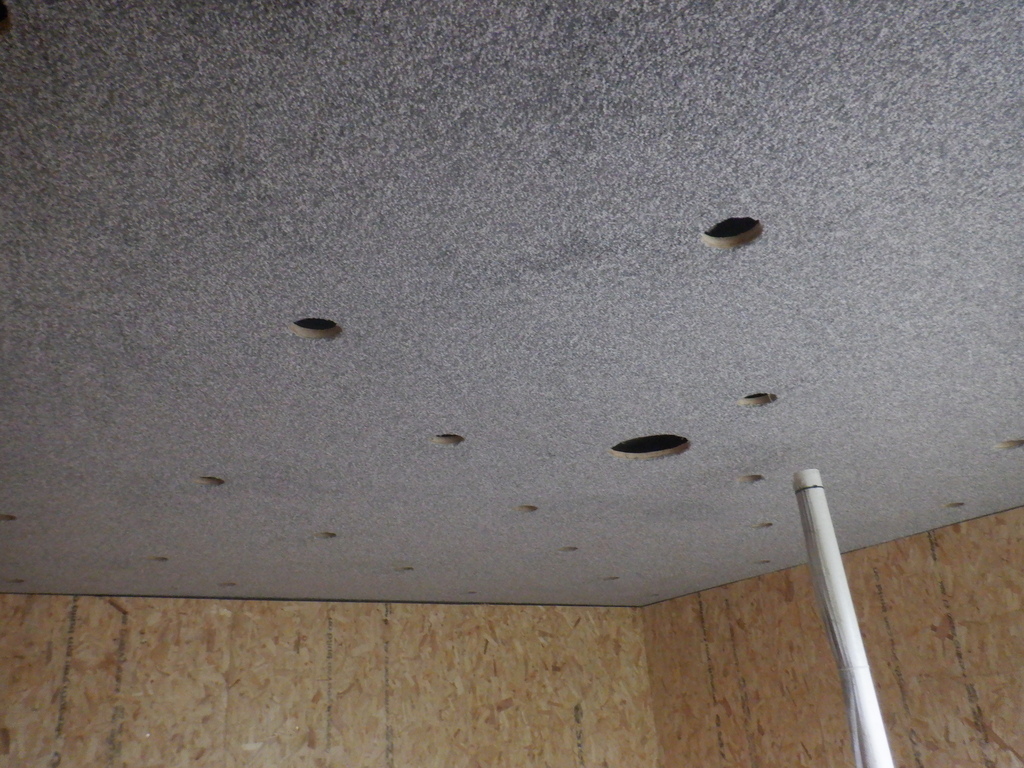
    Ceiling carpet glued up

    Ceiling carpet glued up

    We then remounted the top horizontal rail back up on the wall, making sure that the rail was levelled with the lower rails, by using our six foot long spirit level. We had to drill new holes into the concrete and adjusting the piles of wooden shims, to secure the rail dead flat.

    The next job, before we put up the wall boards, is to insert the little plastic hanging hooks up inside the Utility Channel, every 12inches or so, right around the whole room. These hooks will hold up the high voltage mains cabling so that we can supply the old AC electricity to a socket if we need some equipment to be powered by AC power instead of our 50V electricity from our solar or batteries. Plus also, we inserted a length of 20mm white plastic conduit pipe going from the Utility Channel in the far corner furthest away from the window, and threaded the pipe up behind the other horizontal rails, and with a 90degree bend, poked the top end up inside the ceiling space towards the first lighting unit hole. We now can reach in with a hand and grab the cables that will come up from the Utility Channel, to supply power and network connections to our lamps.

    Now it is time to insert the sound deadening material in between the wooden rails, plus also to spray PU foam behind each rail plus also the Utility Channel too. We pulled out rolls of our 100mm thick glass wool and cut lengths off, folded them over and stapled them in each gap, hanging down. The space we needed to fill is about 50mm thick, sometimes as much as 100mm in some areas so we realised that putting up double layered of the wool, will bulge out a great deal. This is what we were looking for, in order to increase the density of the glass wool, to help absorb the sound vibrations.
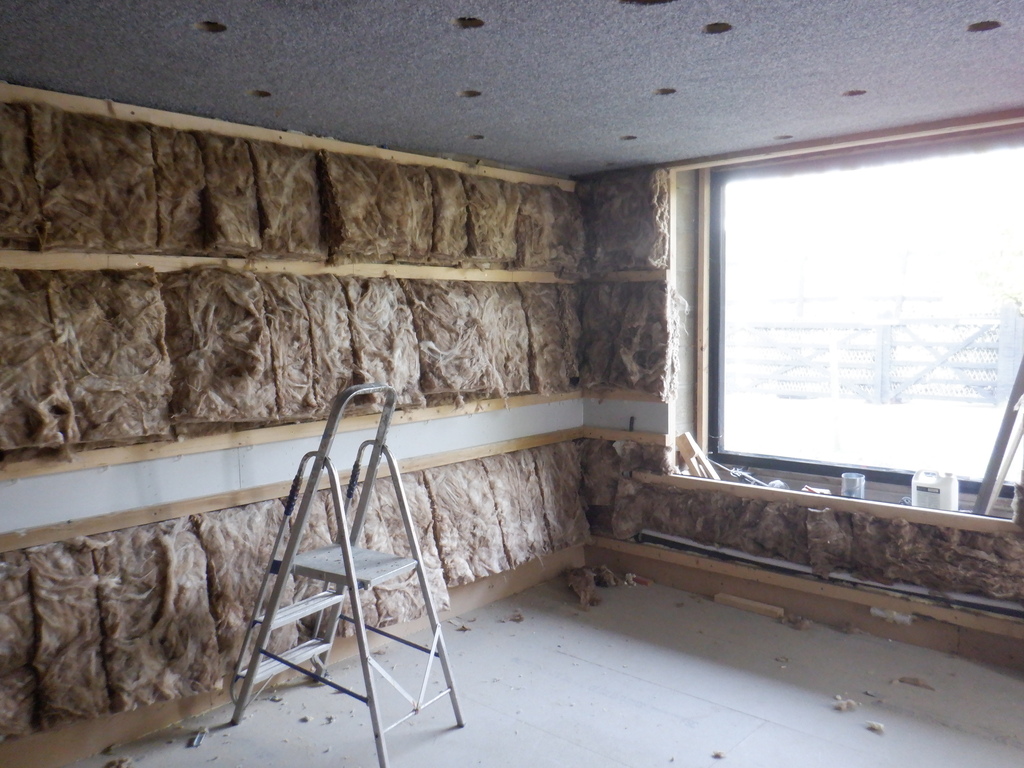
    Overfilled with insulation (1)
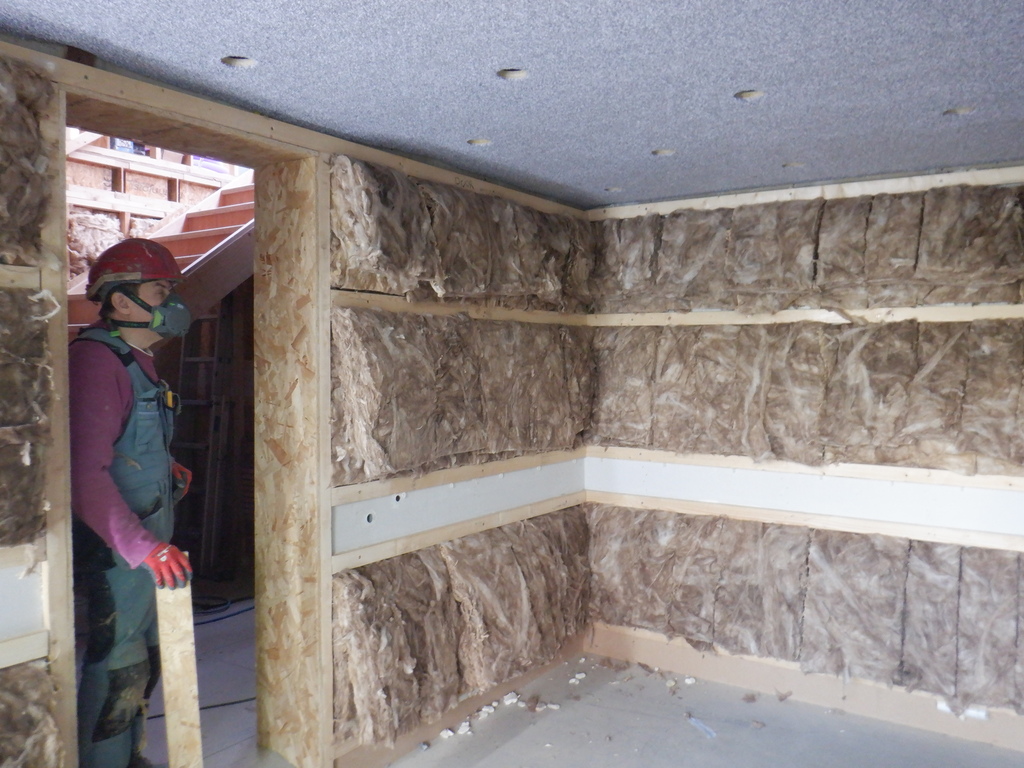
    Overfilled with insulation (1)

    Overfilled with insulation (2)
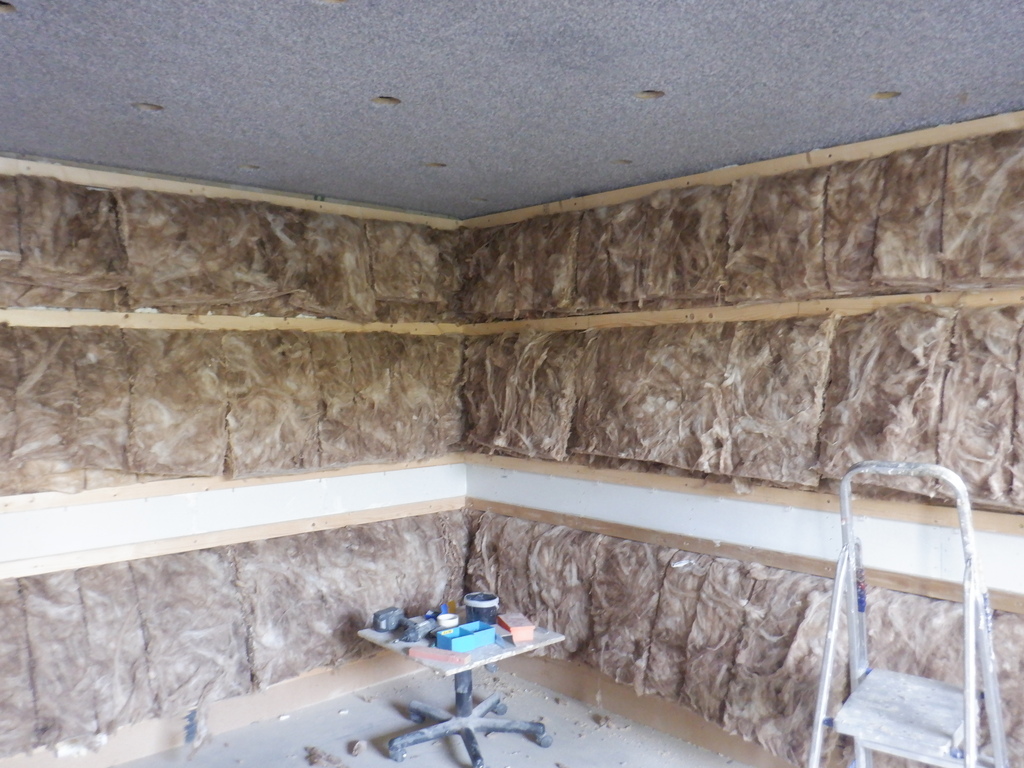
    Overfilled with insulation (2)

    Overfilled with insulation (3)

    Overfilled with insulation (3)


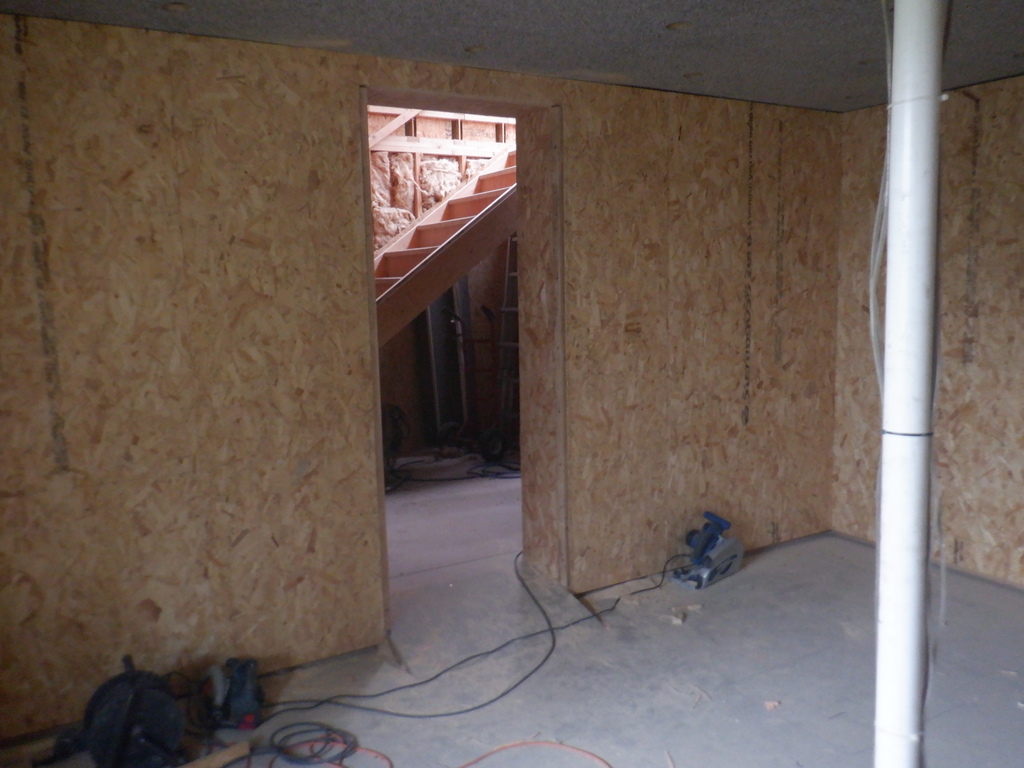
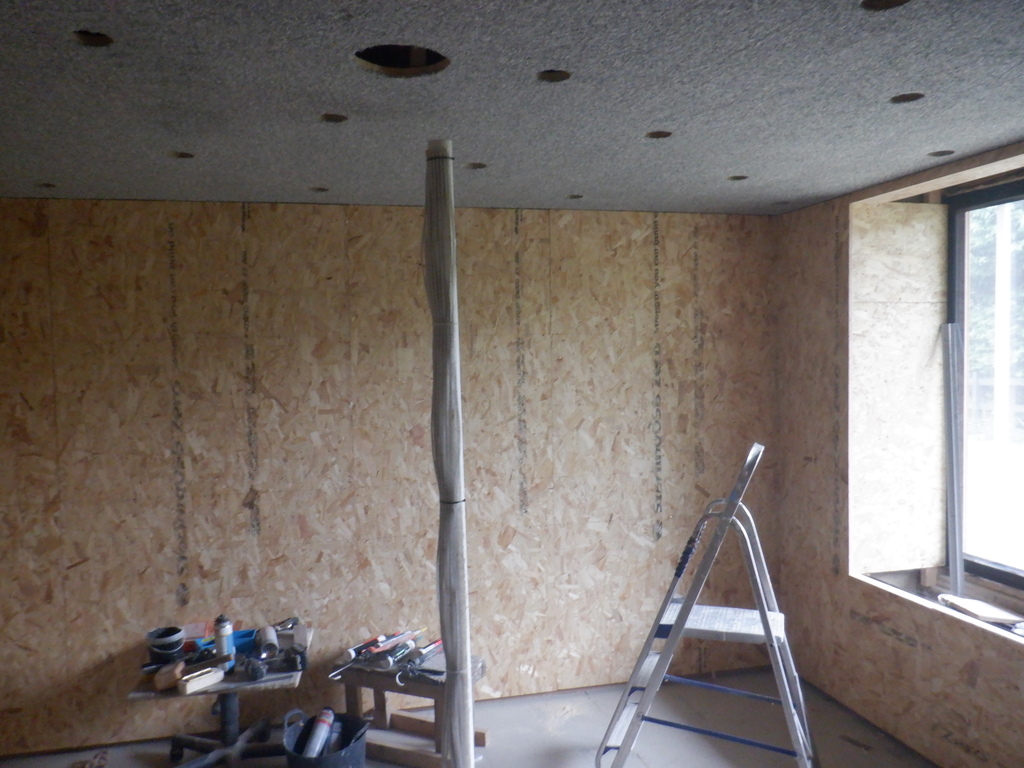
    Now it is the turn of the 18mm OSB boards, to be glued and screwed up onto the rails. We decided that we would not employ our normal step of cutting tongue and groove in the vertical edges, to lock the boards together, to make a smooth surface. This made it very much easier to put up each board, especially considering the swollen glass wool all over the wall! We did glue each joint with our PU construction glue so it was locked together after all. But, we did notice that the joint isn’t as smooth as we normally get. We will solve that problem by sanding the joints with our belt sander and then the carpet will go over it, which will hide all these tiny bits of imperfections!! We went around our walls, putting up three sheets on the side wall, then almost four sheets along the long wall, went around the window and finally, two whole sheets on either sides of the doorway, plus a couple of shorter ones to go up and over the door hole. We wanted extra bits around the door because we needed to sliced into the edge with a 15degree angle, in order to remove a chunk of the OSB edges, to replace it with a strip of solid Oak timber instead. We knew that we are going to be hanging a very heavy dense door and we needed to make sure that the hinges will stay put when screwed into the wooden material. We found a plank of Oak in our garden shed (measuring 95mm wide by 30mm thick and a good 2.4metres long), sliced it in half and sanded all the old weathered surfaces. We glued two strips on both vertical edges of the doorway because we haven’t quite decided on which way around the door will be hung. These Oak strips were glued and screwed into place, including lots of large clamps to ensure the glue joint is squashed as tight as possible.
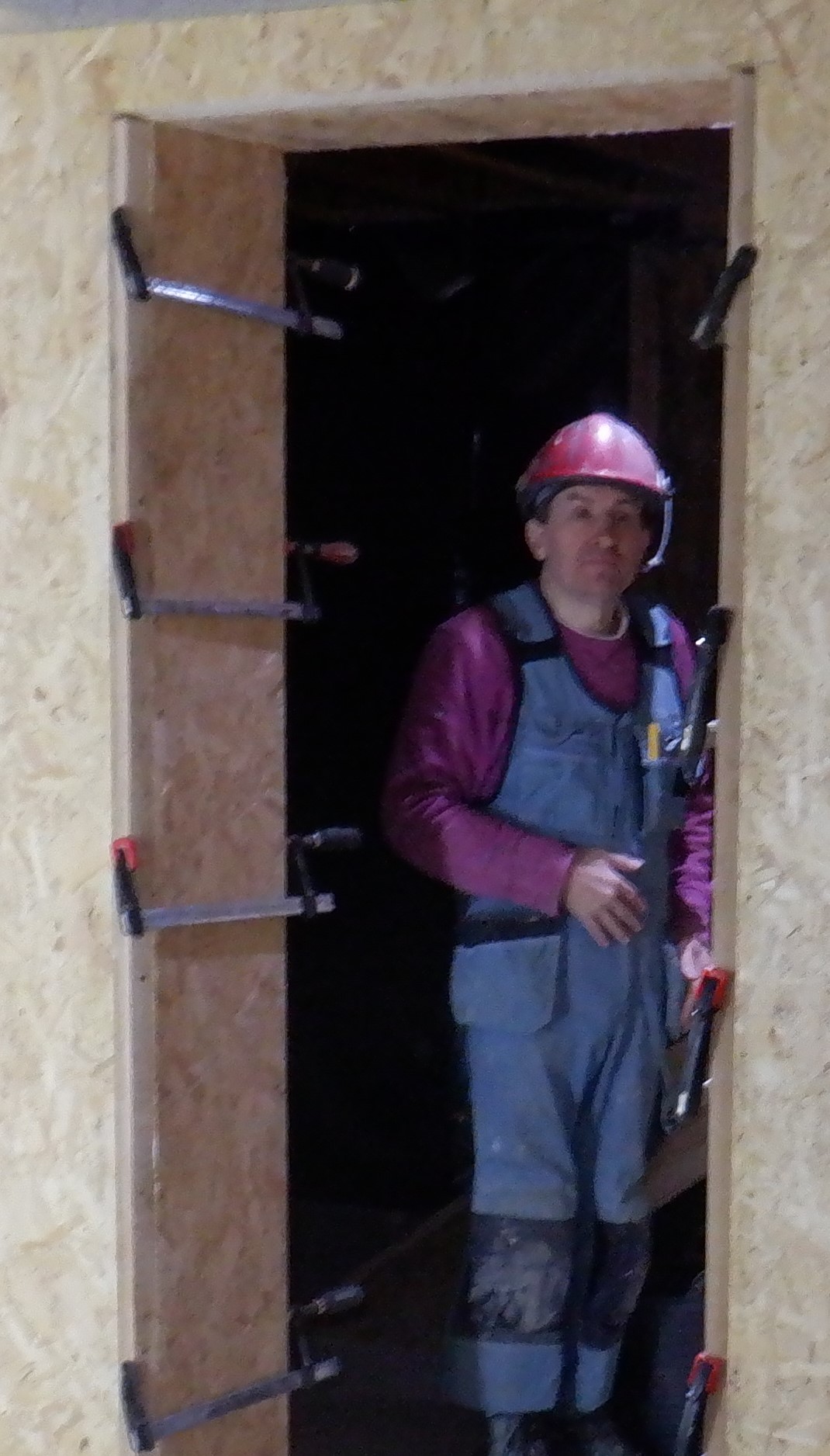
    Oak strip clamped on
    Oak strip clamped on

    Entertainment wall OSB installed (1)
    Entertainment wall OSB installed (1)

    Entertainment wall OSB installed (2)
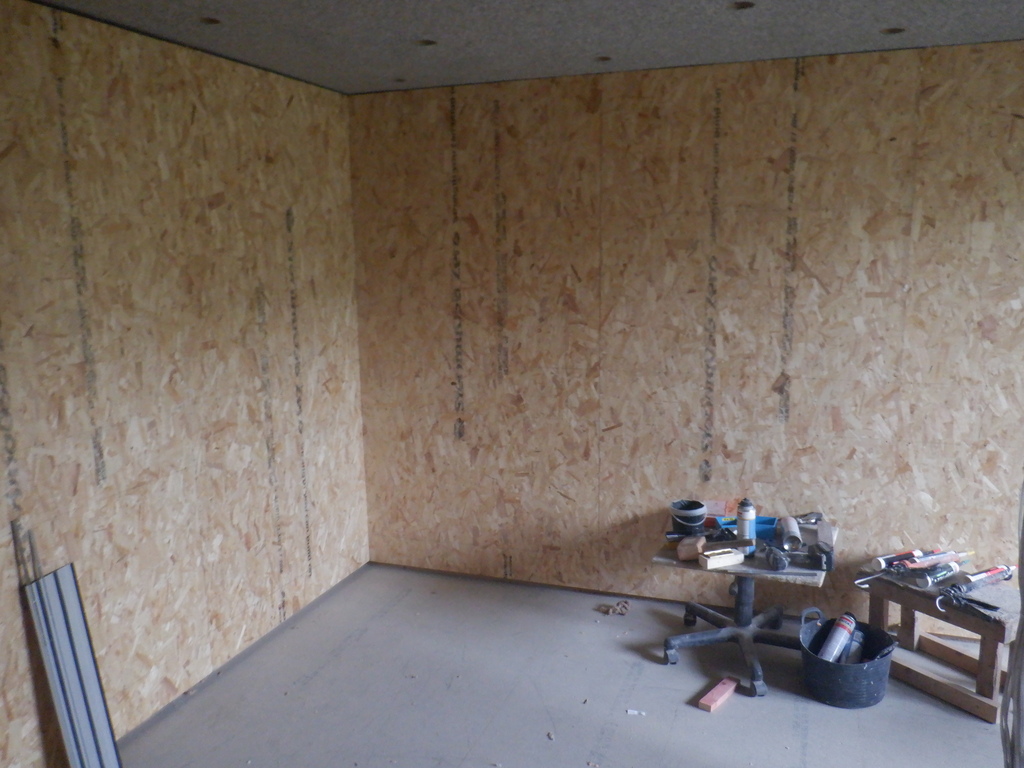
    Entertainment wall OSB installed (2)

    Entertainment wall OSB installed (3)

    Entertainment wall OSB installed (3)


    We finished off the week of work, well actually, finished off a whole year of work, by enclosing the window’s alcove with 11mm OSB boards, to hide the last parts of the concrete blocks. The two vertical sides got covered up from front to back, touching the window frame itself. And we put half a piece up on the top surface including several pieces of 1mm thick steel plates, glued to the backside of the 11mm OSB material. These will serve as magnetic attachment points, to hold up the ?lid? that is covering up the mechanisms for the automated blinds.
    And finally, we glued on a narrow strip of 18mm thick OSB board, 45mm wide, to go over the top of the window hole, to bring it up to the same level as the rest of the wall surface.

    This concludes the work for this year. But, we haven’t finish by a long shot !
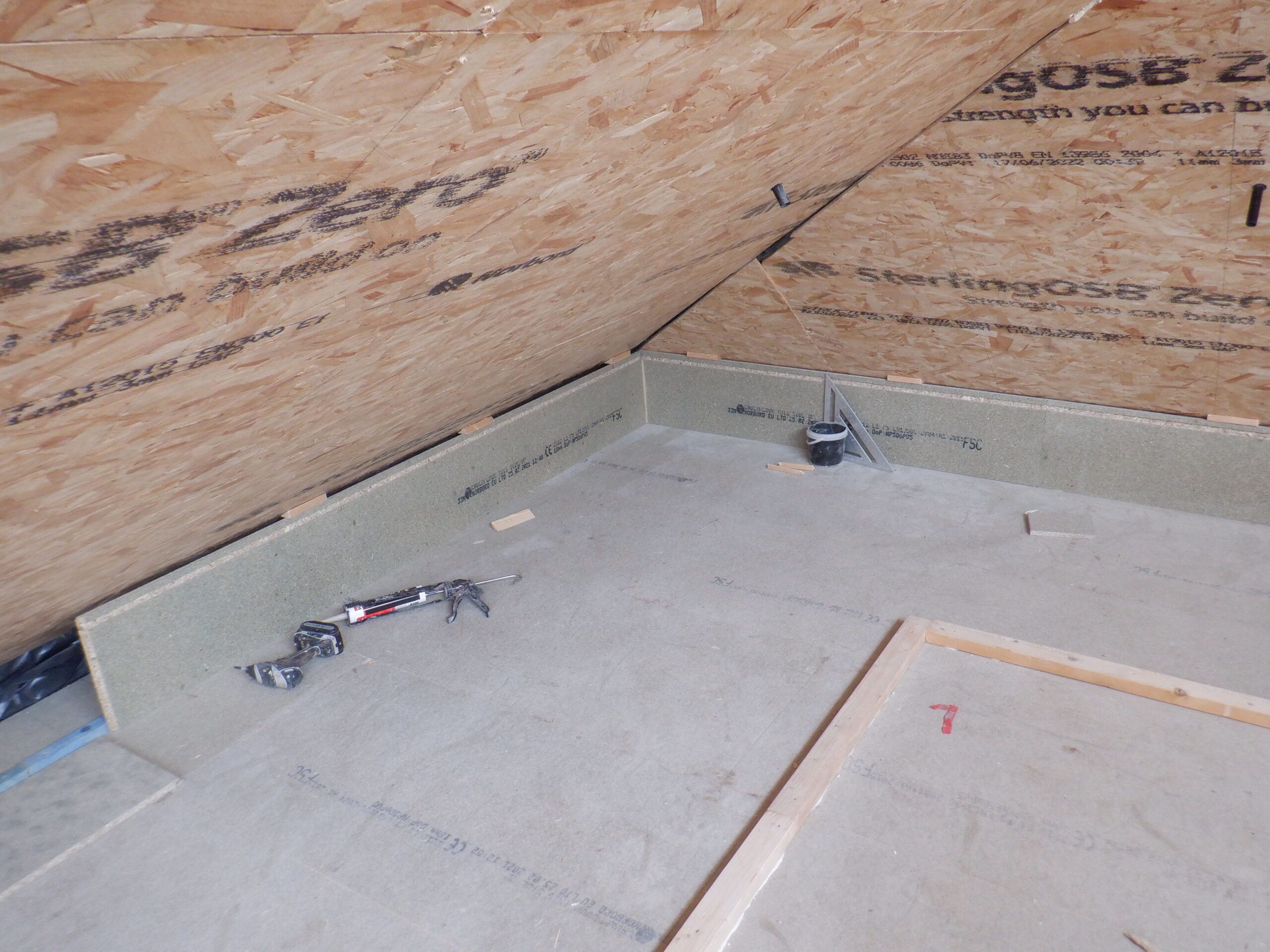
  • Preparation And Construction of Waste Air Ventilation Ducting

    This report covers all the work for building the Waste Air Ventilation main ducting, divertors and connecting of the first fan. We had started this particular job way back at the beginning of Summer but due to various issues including the temperature being too unbearable upstairs and being interrupted to do other tasks, it has taken this long to complete.

    Preparation

    Over the last few months, being interrupted by various things including very hot weather which made the upper floor almost unbearable, we have been preparing the materials so that we construct the Air Ducting upstairs. We ordered another pack of 25mm by 38mm battens which will be used to help anchor the sides of the air ducting.
    The material we are using, is all the left-over sheets of the chipboard floorboard pieces. We have 17 sheets of 18mm thick boards and 14 sheets of the 22mm boards. We are going to use the 18mm thick ones for the upstairs air ducts.
    But first, we wanted to give all these sheets, both of the thicknesses, a couple of coats of acrylic varnish, to provide moisture resistance and a smoother surface inside the ducting. So, we laid out all the pieces of the 18mm boards right across our Great Room, pushing them together using their tongue and groove joints, and then sprayed the varnish all over.
    We also ordered another tin, this time a 20litre giant pot of satin finish varnish for only £100.
    Then, we repeated the same job and did the 22mm thick boards as well, using some of the new varnish.

    The next job is to slice off the two long edges of tongues and grooves by running all of them through our table saw, with the fence set to trim off the tongue and grooves. We now have two piles measuring 580mm wide pieces of material, ready to be sliced up to make the pieces for the Air Duct.

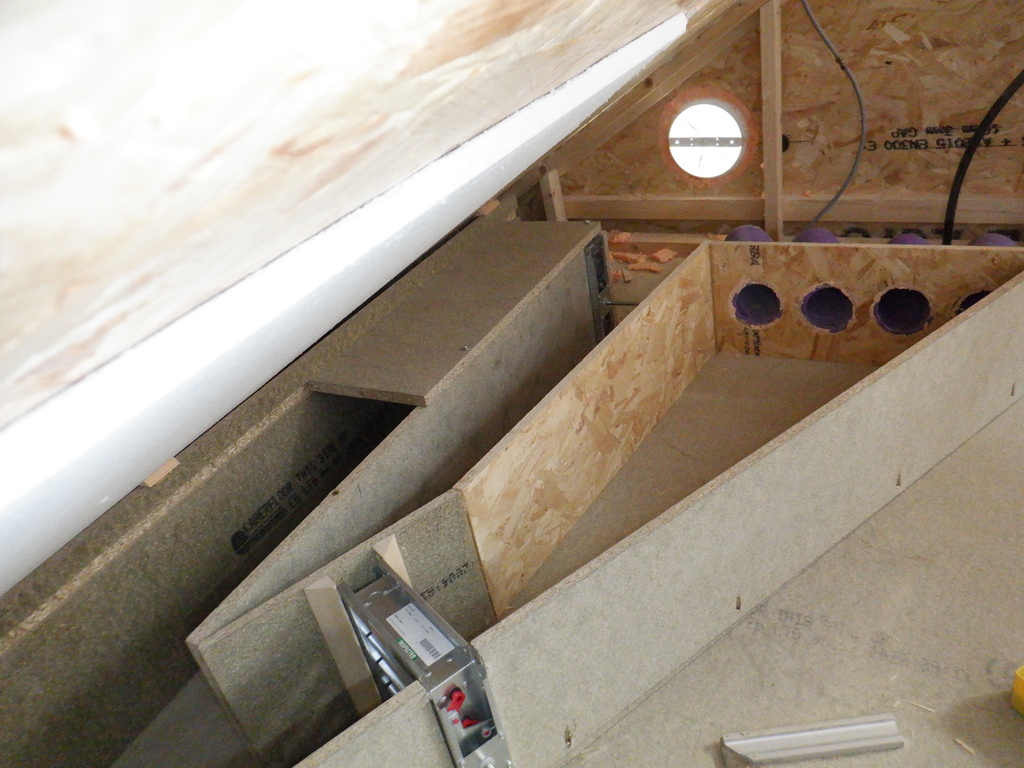
    Then, we sliced up the 18mm boards, into two pieces, measuring 270mm wide and the left-over piece measuring about 305mm wide. We decided that the maximum size of Air Duct we can make by using these chipboard pieces, will be 270mm tall by 250mm wide internal dimensions. We going to mount the Air Ducting tucked hard underneath the sloping roof so the design will be having a taller back vertical piece (the ones measuring 305mm high), which will have an 18mm wide slot cutting 10mm into the surface, near the top, so that it will support the lid, without needing a screw or bolt. This slot will be 270mm off the bottom edge, which of course, matches the height of the front vertical piece which also measures 270mm tall and the lid will go flat over that piece and get bolted down. We had 17sheets and therefore we had sliced 12 of them to create the first batch of pieces, and then we sliced the remaining five sheets exactly in half, measuring 287mm wide. We now have ten pieces which will go towards the pile of lids to cover the Air Ducts.

    The next step is to cut that groove in nine of the wider 305mm pieces, so we set up the router machine into our modular bench and used a 12mm diameter square cutter. We set the fence so that we could cut this slot at exactly 270mm from one edge.

    One problem we had with this task, was that our cutter bit broke. We were working it too hard and it was only on a quarter inch shaft. So we swopped over to half inch shaft but the only short cutter we had is 19mm wide (exactly three quarters of an inch), but that was ok because we have decided that the slot needs to be very slightly bigger than 18mm because of very slight wobbles in the creation of the slot, plus also the lids are not absolutely flat as well. We didn’t want to have to push hard or hammer the lids into the slot, and causing problems later on. We will put in a rubber draught excluder strips in the back of the slots so that the lids will form an air tight seals.

    Construction

    The next stage is to work out the minimum position for the back vertical piece (the one with the slot in) so that it sits as near as possible to the sloping roof, but maintain a dead straight line. We achieved this by using our trusty old green laser line generator, stretching all the way from the Gallery end, to the other end of the house, some 15metres away. We are doing the back triangular void spaces and it is one of the major Air Ducts, to carry the waste air away from the Skylight and the Great Room, plus also waste air from all the bedrooms downstairs, the bathroom, Tech Cupboard and all three ensuites too.
    We had to move the laser line out away from the sloping roof a bit, to make sure that our vertical piece fits anywhere along a straight line. Then, we screwed down a line of 25mm by 38mm battens, which will serve a solid anchoring points to hold up the back vertical pieces. We turned the corner to go along the H section and finally a short section, another right angle corner, going towards the hole going down into the Utility Cupboard downstairs.

    We then started laying out the prepared ducting pieces, specifically the back vertical wall, and realised that three lengths is too big to fit into the large open space behind the cold water header tank. These three vertical pieces are smaller and do not have a slot cut into them, because they will have more normal lids screwed down on both back and front edges. But, three lengths, each measuring 2.4metres long, adds up to 7.2metres, and it is too long. Both ends is intruding into the tight sloping roof and therefore we cannot use screws to clamp down the lid. This means that we had to remove 1 of these pieces, and situated the two remaining pieces so that they align with the access doorway for this storage area. It turned out rather fortunate because it ended up with a whole 2.4metres length piece just terminating nicely at the corner at the H roof.
    So we trimmed off the unnecessary groove end and slid every board along so it is good and tight on all the tongue and groove joints.

    We then turned the corner and here we decided that we could use that third piece that got rejected from earlier, and position it into the dormer section so that we could put on a larger piece to serve both a lid for the air duct, but also provide a shelf connecting back to the back wall of the dormer. This left a piece of 1570mm long at the beginning and a second 500mm piece to finish off the H section, just after the dormer piece. The final E section, was easily accommodated with a single length, which will have to be trimmed down when we are ready to design and build a shaped and smooth divertor to get the waste air down into the Utility Cupboard.

    One of the task to do, was to glue in little wedges between the sloping ceiling and the top of these back boards so that the whole ducting is good and solid. We had loads of cut-off pieces from another job a couple of years ago, an angled piece and it was very handy chopped up into 4inch pieces.

    Starting the Extract ducting

    Starting the Extract ducting

    Now, we proceeded to mount the front pieces of the air ducting, which all has now eight little pocket holes drilled out along the bottom edge on each board. We put on the lid and drilled bolt holes, two of them, in each lid. The front pieces had their original tongue and grooves so we could just slot them together to form a continuous line and once we had put on all the lids and their bolts, we could drive screws into the pocket holes and anchor the front board into place. When we got to a right angle turn, we stopped 700mm from the end, to allow for a decent sweep bend to help guide the air around these sharp right angle bends. We continued along the next section, the H, and again stopped 700mm short and finally, put the last front piece, but not fixed down, ready for the transition for the air to be bent downwards into the Utility Room.

    The next task was to cut upwards into the roof rafters, at very specific locations, to open up access to the air duct we had previously built many months ago, that runs inside the roof rafter space. There are two of these “chimneys” that will draw the waste air from up in the Skylight and it is a rather major element of our ventilation system. So, we needed to gain access to these chimneys. We carefully sliced our way through the 11mm OSB layer, and then sliced into the 25mm thick PU foam boards as well.

    Exit of left duct from skylight

    Exit of left duct from skylight

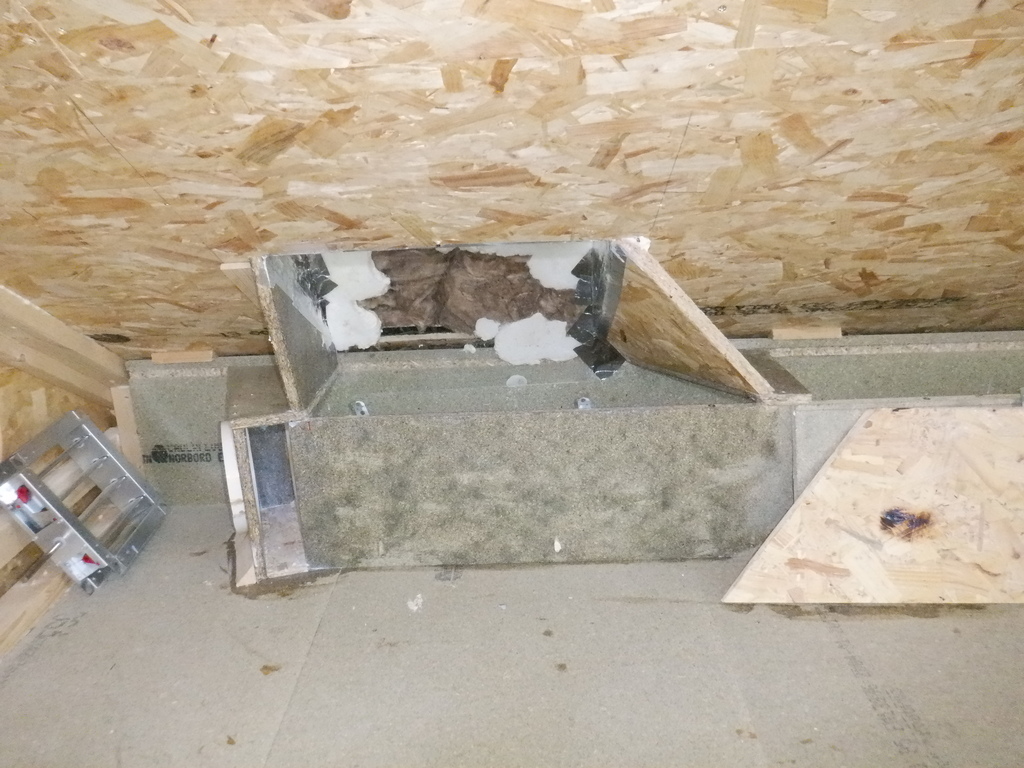
    The second chimney, located at the north end of the Skylight, has the valley ridge beam intersecting at the bottom of the chimney which added to the complexity but we we fitted a small piece of flexible thin plastic sheet material and curved it from the sloping chimney, on the right side, and terminated it on the wooden back board of the air ducting. Next, on the right side again, we put an angled piece of board to join from the sloping edge of the chimney’s hole and the lid of the air ducting. We then put another triangular piece of chipboard “lid” on the left side and then fitted a vertical piece to join to the left side of the chimney’s hole. Now we proceeded to spray PU foam into the corners, mostly concentrating on the left side, to build up a solid layer which we then scraped it to form a gentle curving surfaces to guide the air around that is gusting down the chimney. We covered up everything with aluminium tape to seal it up and give it a nice smooth surface. The final piece to make is a removable front cover which we used a piece of 12mm ply.

    Exit of right duct from skylight

    Exit of right duct from skylight

    Connecting waste air from skylight to duct (I Wall)

    Connecting waste air from skylight to duct (I Wall)


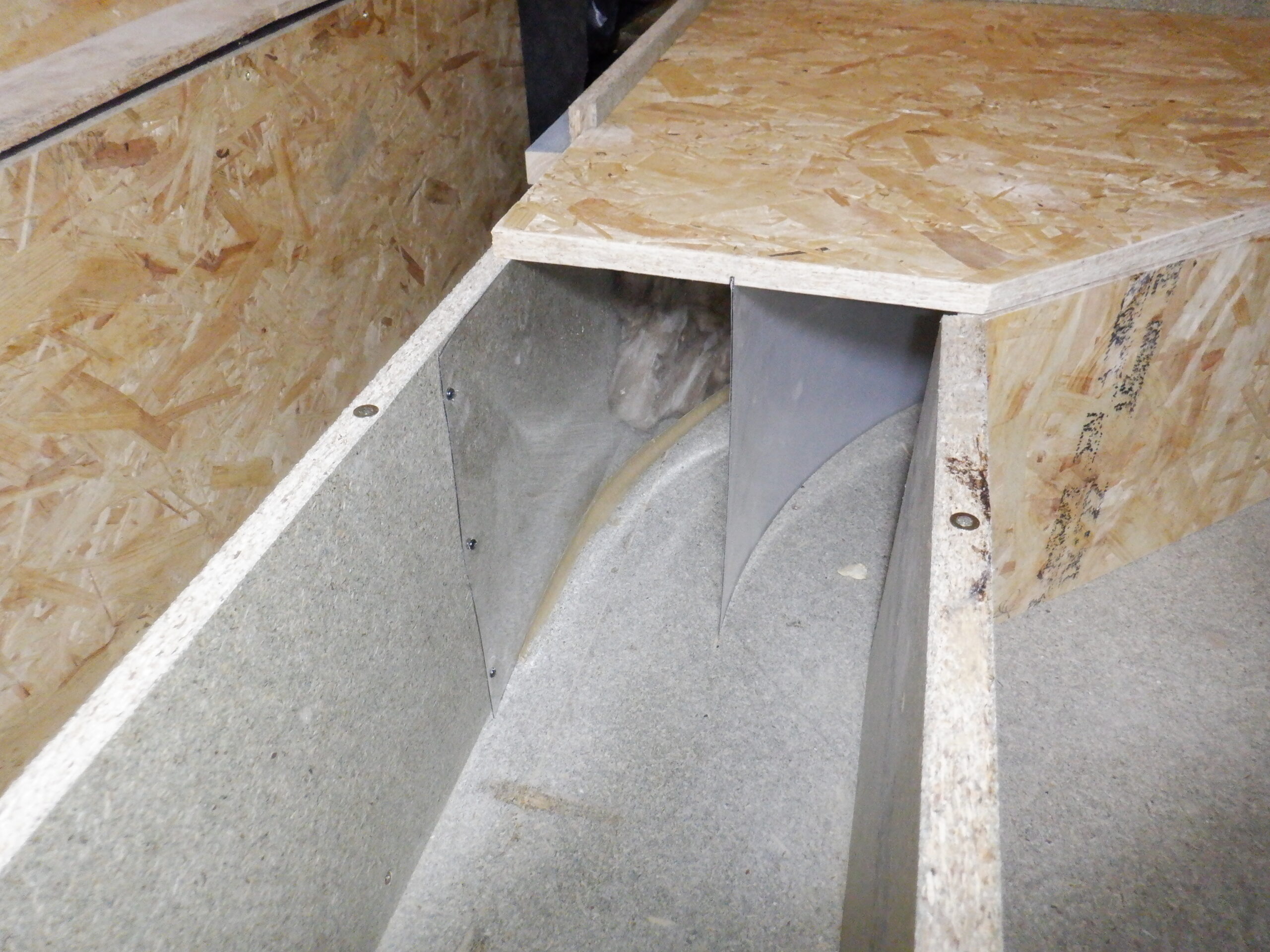
    Moving along the ducting, to the first corner, what we call the H-I corner and then created a sweep bend by inserting three more pieces of the thin plastic sheet material. We cut a tiny little groove into the floor by using a router with a tiny 3mm cutter bit. The router was then affixed to a long piece of ply where we could screw through at various radius positions into the floor, which then guided the router to move in a perfect curve. We did this for our second middle strip of plastic because it was in the middle of the air stream and it needed minimal fittings to keep the air flowing smoothly. We did a mirror of this slot in a piece of OSB board that forms the lid. It measures more than 700mm square. We pulled the second strip of plastic into the slot and then applied a little bit of construction glue to fix it into place. The first and third strip of plastic were fixed to the back of the ducting and around the inside of the front board respectively. These were fixed into place using short little dome head screws and a strip of aluminium tape covering up the edges. Finally, we inserted a diagonal piece of vertical board to close off and protect the plastic.

    Air duct corner with vanes

    Air duct corner with vanes

    We then repeated the whole process again for the second corner, in the H-E corner.

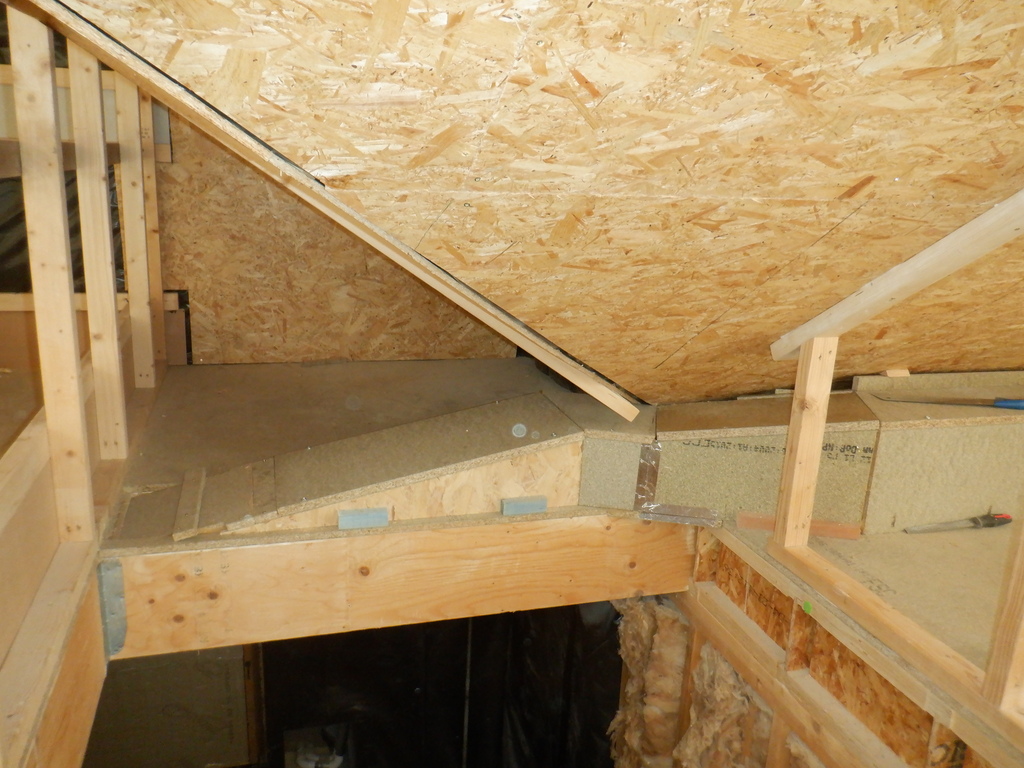
    The next situation to deal with, is the point where the air needs to join together with the other main air ducting coming along the front of the house, and then being swept down into the Utility Cupboard downstairs in the Utility Room. The hole in the floor is tucked right underneath the sloping ceiling as it needed to enter into the cupboard downstairs as close to the back wall of the cupboard as possible. This means that the main ducting has to be slightly bent backwards and also reduced in height as well. We carefully slice up some of our chipboard material to form a back vertical piece measuring 190mm high and we glued and fixed this piece to a batten screwed into the floor just behind the hole. Then, we cut an angled sloping piece for the left side that goes from the back of the hole and grows taller slowly until it reaches the end of the normal ducting back board (the one that has the slot in it). It is quite a way away so it is a gentle change of direction.
    Now tackling the other side, the right hand side, we decided to keep the ducting height at the same height because all we needed to do was to join up to the channel that has been running under the floorboard (inside the first floor joist space), bridging across the Study. The channel comes up through a hole measuring 350mm wide so we knew that it was ok to keep the internal height to the 190mm we already used earlier because the total cross sectional area is comparable to the rest of the air ducts. So we cut and screwed into place several pieces to form a box and a lid for the hole and connected back up to the Utility hole.

    Waste Air from Kitchen and Great room 1

    Waste Air from Kitchen and Great room 1

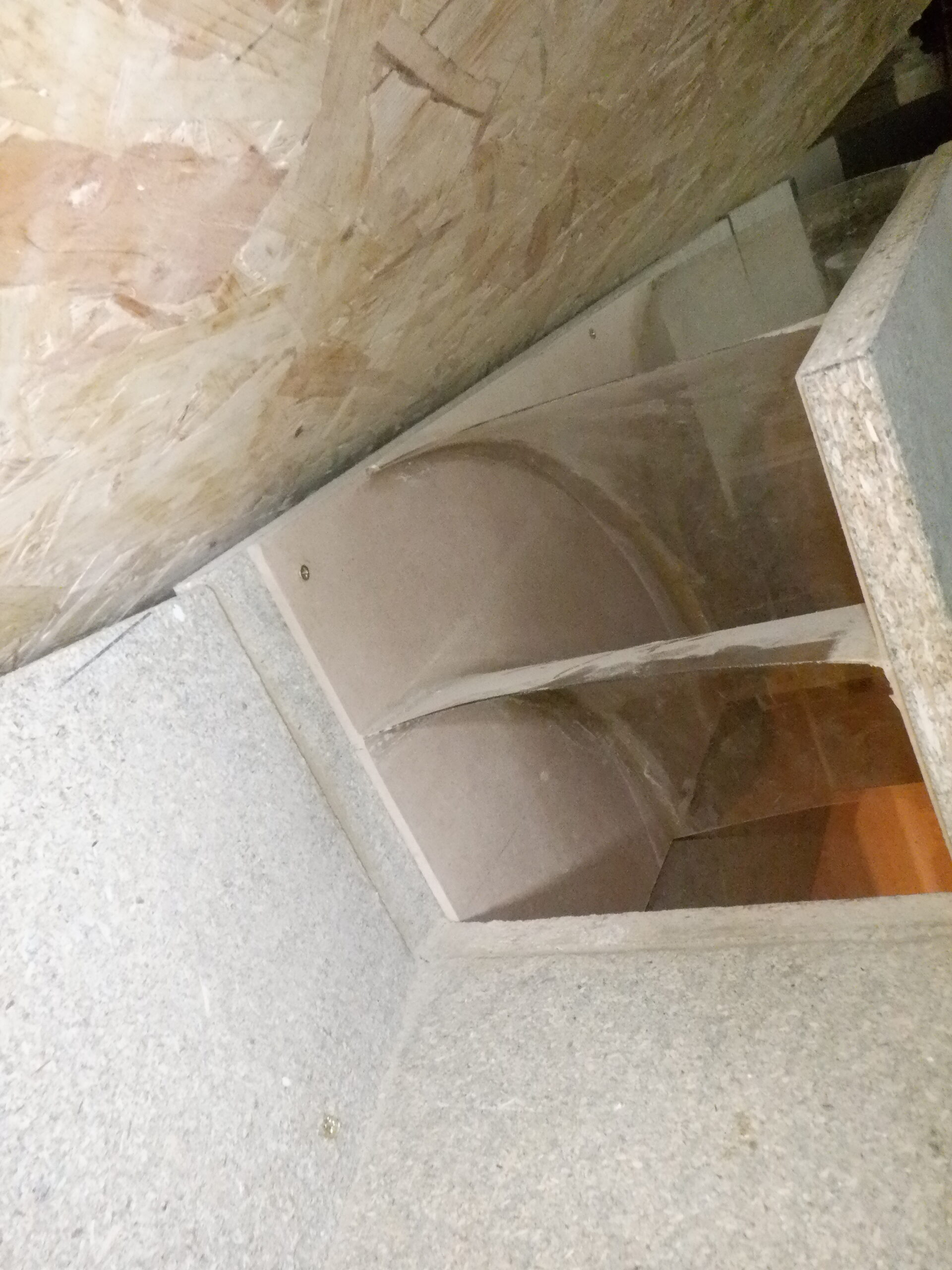
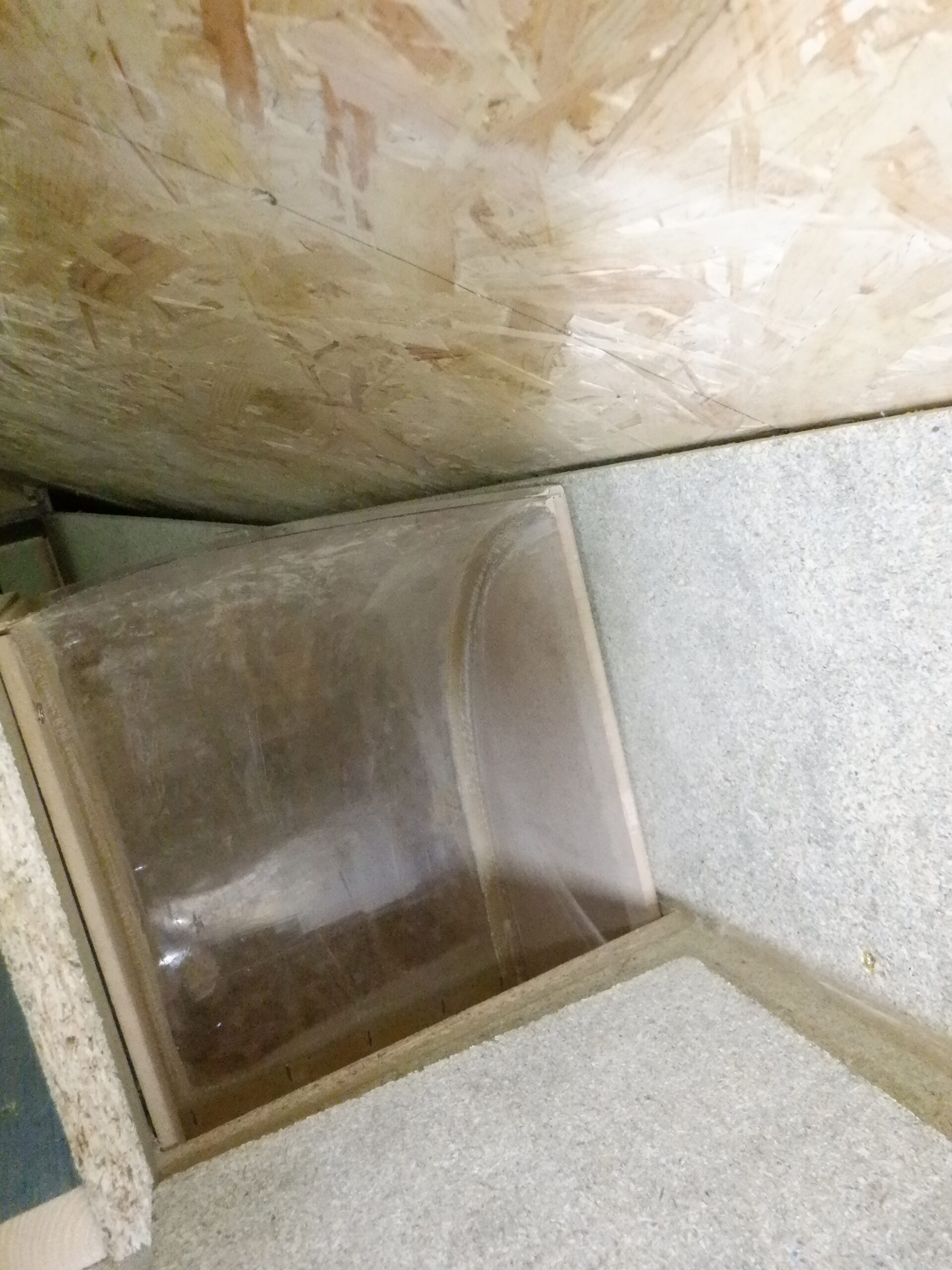
    At this point, we needed an air diverter module, to help join the two stream of air and sweep both of them downwards. We got two pieces of 6mm MDF sheets and cut a series of shallow curving slots, using our router on the rotating arm like before. The hole in the floor that we wanted to bend the air around, measures 230mm wide by 570mm long and we decided that two thirds of the left side of the hole will serve the air ducting coming from the left (this has the majority of all the building’s waste air coming from the Skylight, Great Room, and all the rooms at the back half of the house) and the other third will serve the right hand ducting (air coming from the Conservatory, a bit of Great Room, Kitchen and Entertainment rooms). So we needed two curving strips of plastic for the left side, and one piece for the right side. We drew out the curves on the MDF to make sure that we got the layout correct and then cut the three slots. We mirrored the slots in a second piece. So using construction glue, and lots of fingers, wiggles and cursing managed to get all three plastic pieces into their slots and placed four bricks on top to hold everything together while the glue cures.

    We then trimmed the excess MDF material away so we ended up with a neat module that would slide up from below. Well, that was the plan. We discovered that we very slightly made the width a couple of millimetres too wide. When we pushed the module up, it started buckling the thin plastic curved bends. So, we had to get our power planer to remove a thin layer of the chipboard material that has lined the hole. After making that awkward adjustment, we finally got the divertor module up into place and locked down with screws.

    Air duct connecting upstair to utilty (1)

    Air duct connecting upstair to utilty (1)

    Air duct connecting upstair to utilty (2)

    Air duct connecting upstair to utilty (2)


    Now, we can put the various lids on top, some of them were permanently glued and screwed down, while the remainders were bolted so we could lift a lid section for maintenance etc.

    We now have that section done! We are getting there!

    The next bit to do, is the ducting running along the front of the building, as mentioned already, coming from the Conservatory etc. At this point, we have run out of 18mm thick chipboard planks, especially the back with the slot pieces, and also lids. Therefore, we had to cut up several boards from our 22mm pile. This meant that the slot needed to enlarge to 22mm wide, which means that the height of the front piece had to reduce to 260mm (losing 10mm, which is not too critical). So we made two back boards (measuring 2400mm long) and we did our trick like before, using our green laser line generator to find the best line to follow underneath the sloping ceiling. We put down a length of batten and then screwed these pieces into place. The only complication, well, a major one, is the left end where we needed to duck under the slope of the corner of the ceiling, cut across the corner of the stairs and join up with that bridging channel going under the Study. It is definitely much more of a bend and we needed to control the air flow more neatly, with proper sloping lids etc.

    At this moment, we realised that we needed some more ducting mechanical devices, mainly, flow control valves so we decided to order a whole heap of bits and pieces. We ordered twelve round 150mm air vents, two 200mm air vents (for left and right side of the Great Room) and a single large 250mm air vent (that goes right at the top of the Great Room, right up in the Skylight). Plus also a couple of 100mm and 80mm air vents too. Next, we added a piece of aluminium flexible corrugated “stretchable” pipe measuring 200mm wide and finally, we put in two 50mm thick by 300mm square dust filters. That took a week to come.

    So, we carried on getting that complicated ducting built. It took a lot of measuring, fiddling, trimming etc. before we managed to get a completed duct.

    Waste Air from Kitchen and Great room 2

    Waste Air from Kitchen and Great room 2

    Another section that we also started working on while we waited for that order to come, is building the divertor and filter that goes in the Utility Cupboard downstairs, to join to that hole (now in the ceiling ) that joins to the air ducting from upstairs. We needed to get the filter (the one we are ordering) to be removable because the cupboard is only 500mm deep and the filter is 300mm square and we would need another 300mm of clearance. Then, the fan motor itself needed to be positioned, before the output of that goes into the heat exchanger. We bought some 25mm right angle “l” shape plastic so that we could make a cage like section to hold the filter and allow it to slide in and out. We also created two large circular collars to make an adapters for connecting to the fan.

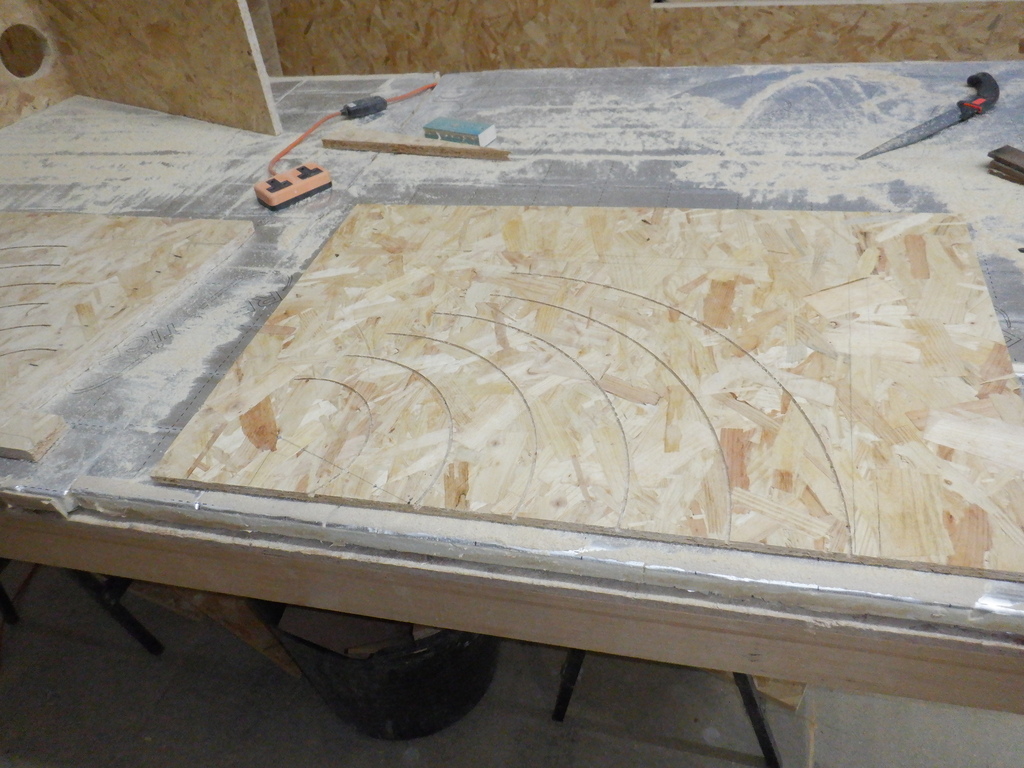
    Then we progress to creating the large box that will sit underneath the chimney and inside this box will have sweeping curves of plastic to help guide the air around the corner as it is being sucked downwards through the hole in the ceiling. We put in six curves, ranging from a tight 100mm radius curve near the filter, gradually stretching out the curves until the outer bend is measuring 400mm radius. We marked out the centre points for each quarter circle on both the back of the back and the front (the “lid”) and used our little router on a rotating arm to cut all the slots.

    Redirect and Filter box side with slots for vanes

    Redirect and Filter box side with slots for vanes


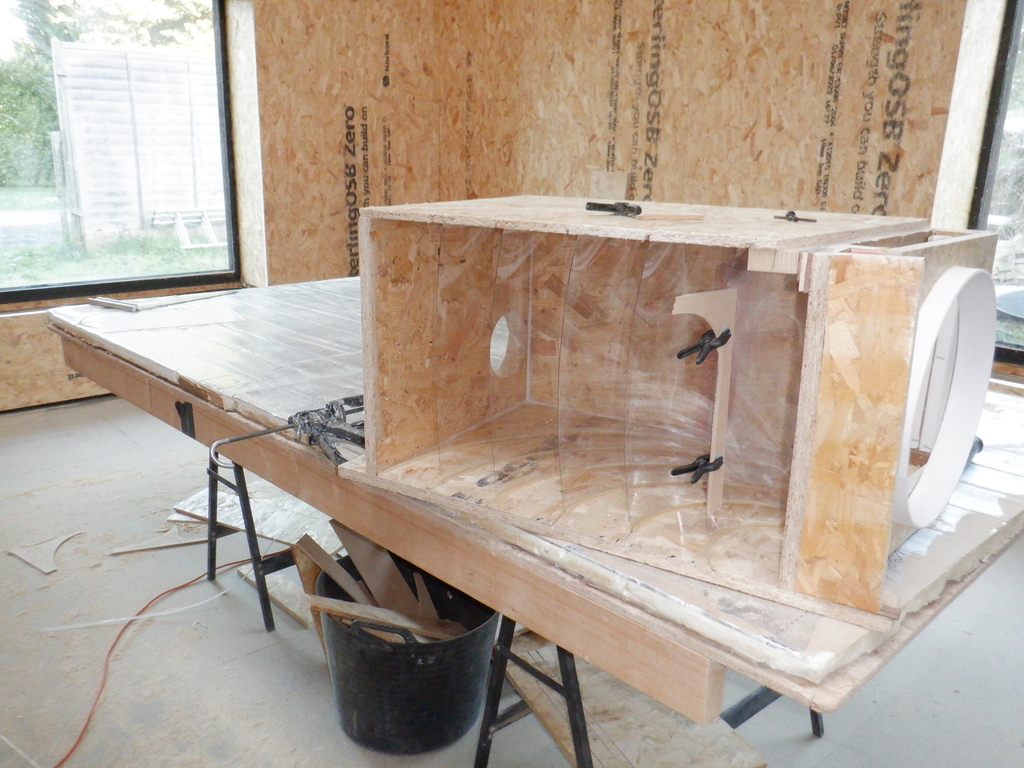
    We measured the height inside the box which was 361mm to 362mm and the slots we just cut were 5mm deep so we proceeded to slice our sheet of thin plastic, cutting a strip of 370mm wide. The width of the sheet is 1250mm and we realised that we could generate three of the curves out of one strip, namely the 400mm curve, the 340mm curve and the smallest one and there is no left-over. So with the second strip, we cut the final three pieces, the 280mm curve, the 220mm and the 160mm radius and we had about a 200mm left-over piece.
    Redirect and Filter box with vanes installed

    Redirect and Filter box with vanes installed


    Now, we wanted to test fit the whole box module for real, up inside our Utility Cupboard, before we glue it all together and make sure that it fits as we planned. And, the result of the test fit was .. .. OK! At least, within acceptable tolerances. It is not perfect but it will do!

    One thing we needed in this box, is a 100mm flexible pipe socket so that we had the capability of drawing air from inside our Utility Cupboard like for example, the Central Vacuum system and the Drying Cabinet. We glues on an extra 150mm square piece of 18mm OSB on the right hand side of the box near the bottom, and then proceeded to cut a 114mm diameter hole.
    We also put in a “end-stop” on the inside of the hole, to make sure that the flexible pipe won’t crash right through and damage the internal curving vanes

    We now can proceed to glue the lid on and apply glue around the inside corners of the box and screw everything tight. We then gave the whole thing a good thick coat of acrylic varnish.
    After lunch, we glued in all six curving vanes with more construction glue and left that to set hard overnight. We then constructed the lid for the filter compartment, using two bolts and captive nuts to hold it down tight on a double circumference of draught excluder rubber strips.

    Next, we put the electric fan unit standing next to our divertor module on the floor (it being a nice flat surface) and made a couple of wooden battens for the fan to sit on. We happened to find an Oak piece of wood that was thick enough (27mm thick to be precise) and we prepared this batten with further holes so we are ready to mount the fan up on the wall inside our Utility Cupboard. We are using 50mm long coach screws with a hex nut heads, to make it easier to use an long extending bar to reach pass the bulk of the fan. We also used the same type of screws for holding up our divertor, one in each of the four corners, which we prepared as well.
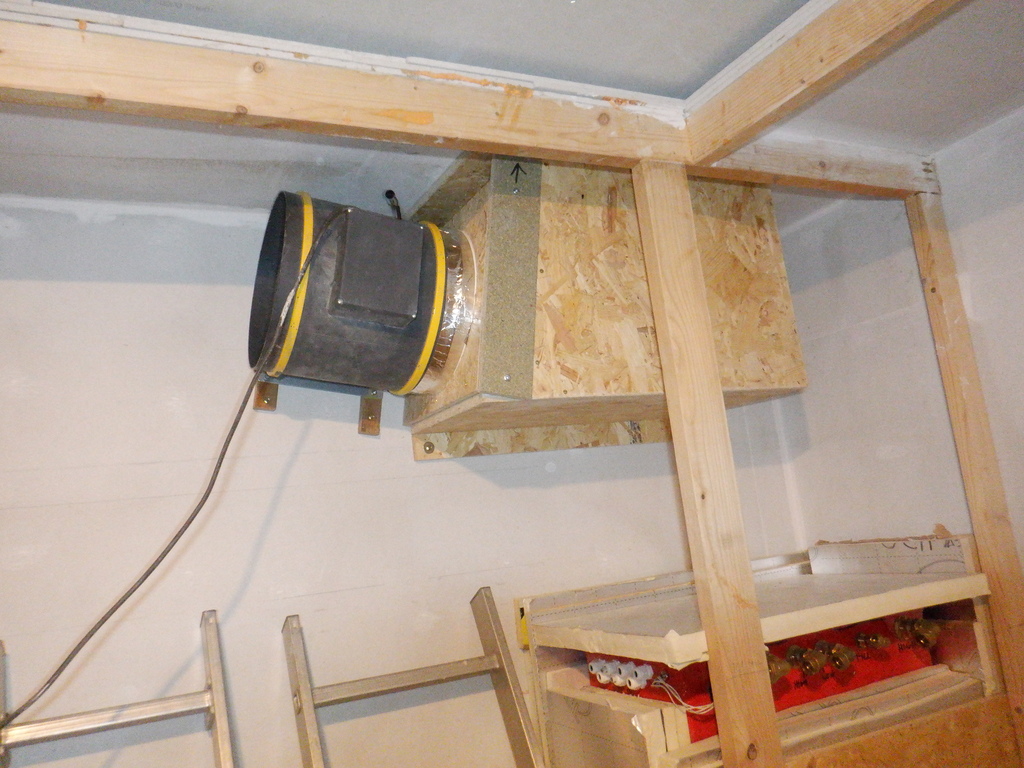
    Then, we manhandled it up onto the wall, aligning it up to the hole in the ceiling and applied a good thick dollop of construction glue around the rim of the divertor and pushed it hard up on the ceiling, and carefully drive in the four coach screws to lock it into place. It was the fan’s turn next and we got that up onto the wall as well, aligned it up to the divertor so that the circular adaptor joined together with the fan and also drove the screws home.

    Redirect and Filter box installed

    Redirect and Filter box installed


    We did a quick test by plugging in the electrics and gave it a quick run at various different power levels. All our upstairs ducting all had air being sucked down the open ends, there were three open ends at the moment. We will measure the air flow rates later on but for now, it is looking very good. We did noticed that a section running through the ceiling space above the Front Door, at the bottom of the staircase, had an obvious air rushing noise but we do not have the ceiling plasterboard up there yet, and also the fan was running at maximum power too.

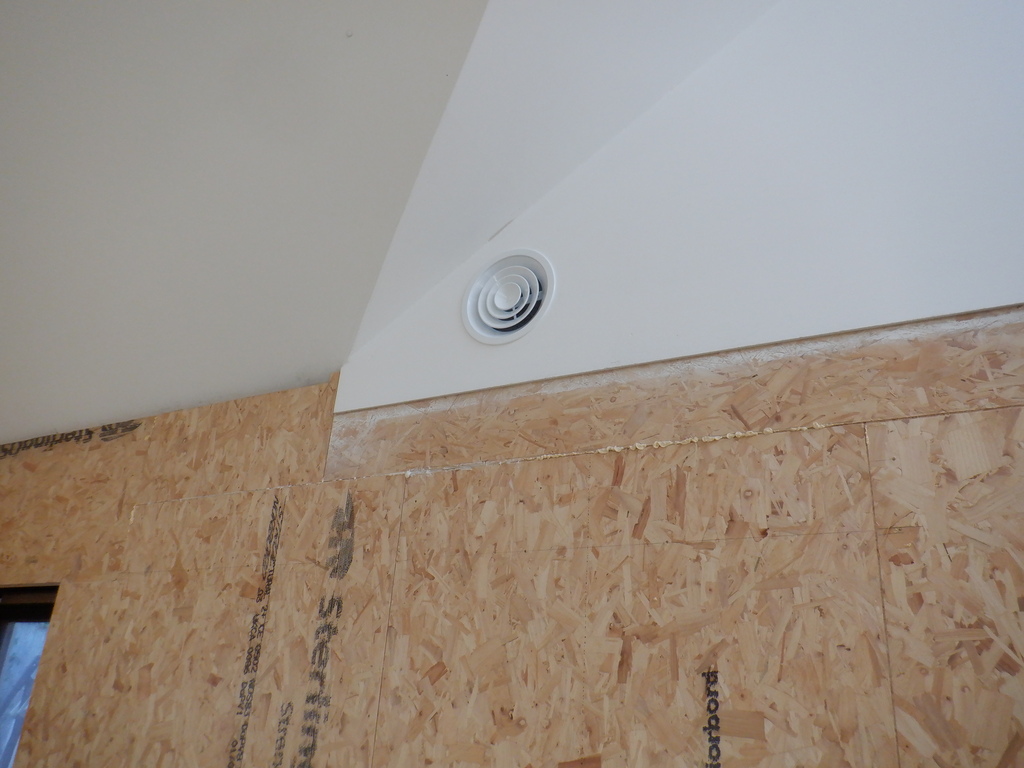
    In the meantime, we carried on with the main airduct upstairs and we fitted our two new larger air vent covers that pokes into the Great Room, one at each end of the Gallery 8feet up. These air-vents are 310mm in width so we needed to cut a circular hole 270mm diameter using our jigsaw. We then sprayed in loads of PU foaming glue to stick the white coated metal into place, without having to use a cross bracket etc. We used a length of string tie to a large concrete block to pull tight the air-vent while the glue finished expanding and cured solid.

    Great room waste air grill

    Great room waste air grill


    We cleaned up the excess foam and fitted the inner white cones and we now have two white air vent covers in place.

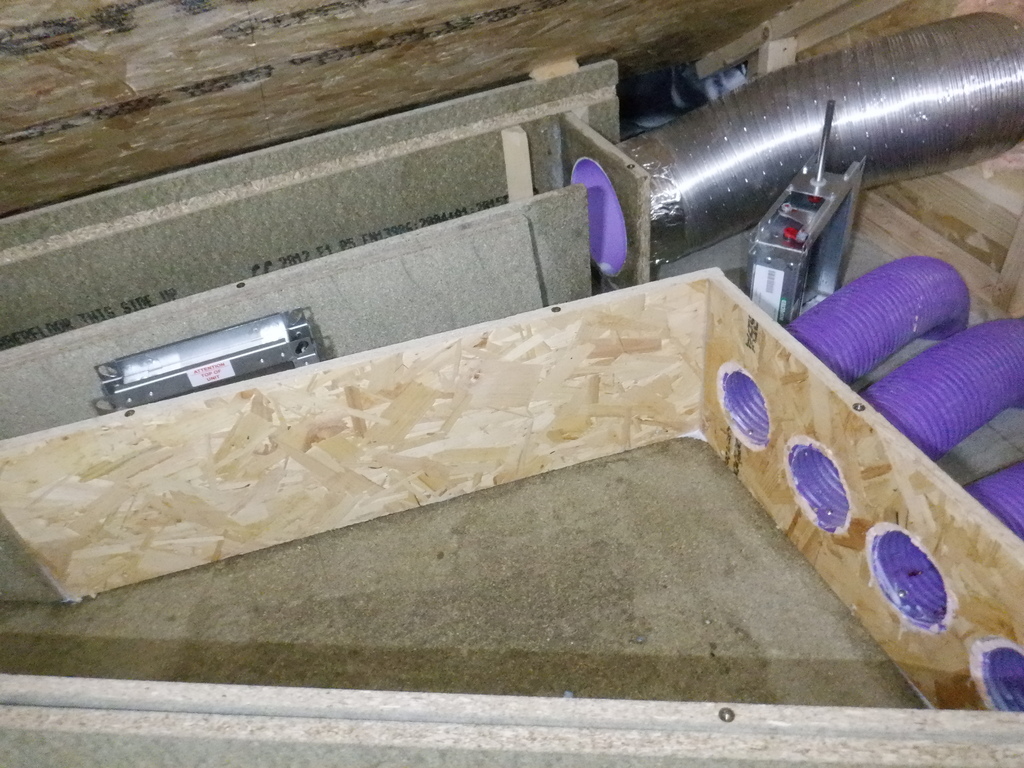
    The next job was to mount the metal air flow dampener unit (it has four rotating narrow vanes that opens, or closes, to control the amount of air flow), it measures 200mm internal air flow width but the whole thing including its flanges measures 260mm across and 70mm thick. We have three of these units, one for the air inlet on the left end of the Great Room, a second one for the right side of the Great Room and the third one for the ventilation coming from the Conservatory.

    After considering the placement of the Conservatory side channel and where it will connect to the main ducting, we constructed the rest of the front portion of the duct going towards the Great Room where we located the metal gate valve. We had to make another circular adaptor, this time only 200mm diameter, to connect up the flexible aluminium pipe to the air vent in the Great Room wall.

    We did the same for the other side of the building, to get the right side ventilation connected to its gate valve unit but we had a slightly more complex situation to deal with, in being very close to the chimney that is coming down from the Skylight. One of the thing we wanted to insert into the air stream, is a fir flow rate measurer, a temperature and humidity sensor as well. But we don’t have enough room for a removable lid and slide in a square module etc. So, decided that we would slightly rotate the circular adaptor by 20degrees so it pointing towards the vent sitting in the Great Room wall. Because the lid is relatively small, we decided to glue and screw it down permanently.

    Then, we went back to doing the side branch of the ducting, for the Conservatory ventilation, coming through four purple 100mm wide plastic pipes. We bent them down and put all four of them into an single line, held in place with a block of wood measuring 260mm high and 600mm wide, which had four 114mm holes drilled into it. This in turn was screwed down onto the floorboard slightly angled so it is pointing towards the main air ducting. We established a good location for the gate valve and built a receptacle with more little pieces of 45degree triangle battens and then built up the back and front walls to and from the purple pipe adaptor. The last piece of front wall was extended with a little piece and that was glued and screwed into place too. Finally, two lids were constructed to cover up this side branch, held down with the usual metal bolts and captive nuts.

    Great room and Conservatory waste air join main duct 1

    Great room and Conservatory waste air join main duct 1

    Great room and Conservatory waste air join main duct 2

    Great room and Conservatory waste air join main duct 2


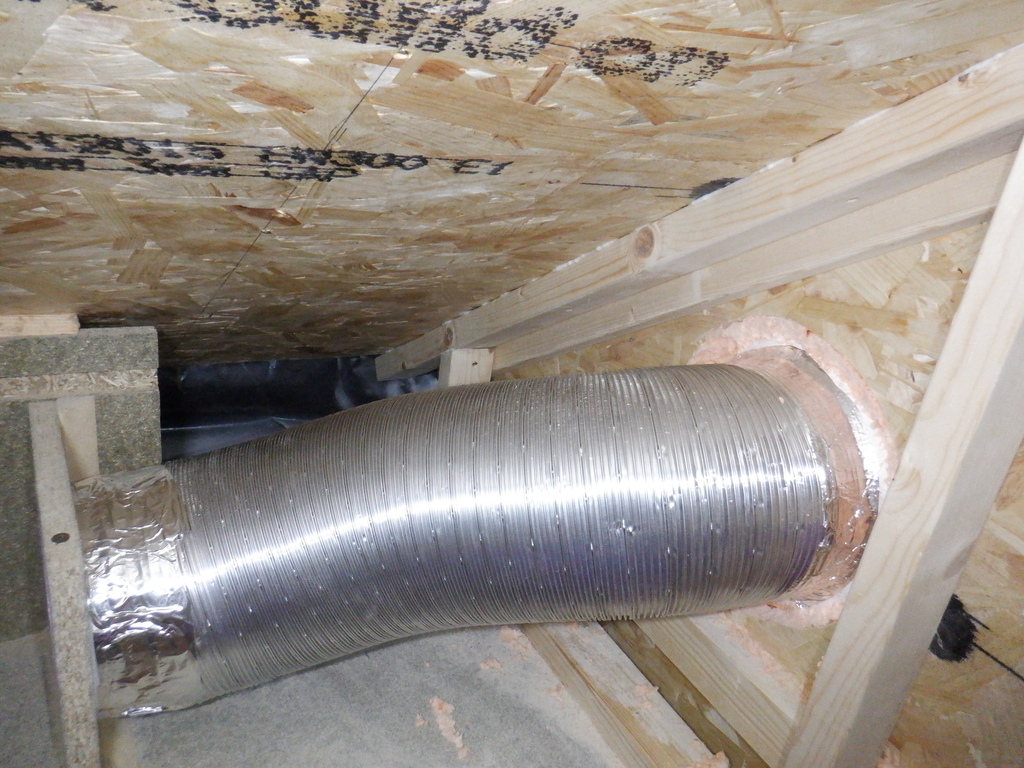
    Then we tackled the fiddly job of putting on a flexible ducting, to connect up the Great Room vent to the end of the main ducting. We used 200mm diameter aluminium corrugated tubing, which allowed us to stretch and bend the pipe so it can transfer the air from the Great Room in a reasonably gentle way. The vent on the Great Room wall had only a 15mm lip to attach the pipe to, so we decided to assist this by sticking on lots of acrylic double sided sticky tape, going around several times this lip on the vent. We cut a 500mm length off our stock and managed to slide it on to the metal vent and pressed the aluminium hard down into the thick sticky surface. We reinforced this joint with two 400mm long plastic cable ties to hold it tight. But, it was quite a struggle to pull and stretch the tubing, and then bending it over so that it can slide onto the circular adaptor we made sticking out of the main ducting. We eventually got there without ripping the aluminium foil that this tubing is made of.
    We stuck it into place with lots of aluminium sticky tape on both ends.

    Great room connected to waste air duct

    Great room connected to waste air duct

    To finish this very long drawn out task of building the Waste Air Ducting that has stretched across many months of elapsed time, but only a few weeks in actual work time .. We built a curving divertor for the second chimney coming down from the Skylight and built a boxing around the hole in the ceiling. It is a repeat of the first chimney we did earlier, but it was a little bit simpler this time, not having a diagonal valley beam intruding.

    Waste air chimney joins duct @M end

    Waste air chimney joins duct @M end

    While we are doing this particular job of building the ducting, we thought we had better do one of the final jobs, which is to varnish the internal surfaces of the air duct, especially along the floorboard surfaces. So, we unscrewed all the lids, then vacuumed every inch and painted a good thick layer of acrylic varnish on all exposed wooden surfaces, to help seal it against moisture and reduce the chances of unwanted biologicals gaining a foot hold.

    With removable lids, we can inspect any part of our ducting and give it a thorough clean every now and again.

    Testing and Results

    So before we put the lids back on, we then tested the flow rates in various positions with our new portable anemometer and seeing what volume of air we can generate. We wanted to learn to how much air the fan is able to pull, with and without the filter, with and without long ducting so we can detect and appreciate problems, and fix them if we have any.
    We deliberately blocked one half so that we could measure the air flow down along one ducting journey and learn how the air flow rates changes. We did the same in the other half of the system.

    We started at the beginning, immediately just above the Utility Room and measured each side just at the point where the ducting is turned downwards. We left both sides unblocked, and we also took out our filter which is situated just before the fan downstairs in the Utility Cupboard. Our new air flow measurer, can calculate the volume of air movement in real time, so long as we had supplied the cross sectional area of the ducting we are measuring. For example, the “holes” on either side of our divertor, measures 230mm wide and 180mm tall, which makes a cross sectional area of 0.041 square metre. The meter needed the final number in square metres, hence the fractional number. Then we got a series of readings in various bits of the air flow, and calculated the average between those readings. The very clever hand held meter also performed this calculation as well!
    Here are the results:

    • Right side (no filter) – 15 cubic metres per minute (m³/min)
    • Left side (no filter) – 31 m³/min
    • Right side (with filter) – 12 m³/min
    • Left (with filter) – 22 m³/min

    If we combined the figures for the “no filter” mode, we get an accumulated value of 46c.m./min and if we multiply that up to cubic metres per hour, which is 2760 cubic metres every hour, this value is very close to the advertised performance as specified by the manufacturer. This is very good !!
    By the way, we are deliberately running the fan at maximum power, just to see what we can get. It is more likely that we will be dynamically controlling the fan speed all the while, and keeping it as low as possible, while fulfilling the demands that each room is wanting.

    Then, we proceeded to block each side and see what the new flow rate was on the other side .. as follows:

    • Left (with filter) – 28 m³/min
    • Right (with filter) – 25 m³/min

    So leaving one blockage in place, on the left side, so we could test several parts of the ducting, going along the front of the house, as we put back the lids again. We measured the flow rates and it seems to settle down to about 23 m³/minutes by the time we reach the Great Room vent and the side branch that is going off to the Conservatory. That is not too bad!

    Then, we went around the other half, putting back the lids and measuring the flow at various points, and we were getting a value of 28 m³/minute.
    It really didn’t start dropping off until we reached the far end, coming up to the other end of the Great Room. We were reading a value of 20 m³/min. which is not surprising considering how long our ducting is!

    And finally, we tested the two chimneys going up to the Skylight and they gave a flow rate of 18 and 20 m³/min for the South chimney and North chimney respectively.

    This concludes most of the work upstairs for the main bulk of getting the waste air drawn out of our house. There are little jobs left to do upstairs but we will do those later. We want to start on a different job!!

  • Created Oak Utility Panels

    Today, we decided to complete one of the last things to do inside our Cloakroom, namely making two Oak panels for covering up two Utility Channel “holes”. We found a planed plank of Oak timber on our rack in our garden shed. We must have had some left-over pieces from a previous job couple of years ago. It was a large enough piece to fit the requirements of making a 125mm tall panel cover and long enough to cover up two holes measuring 365mm (one near the toilet) and 400mm long (near the basin). These Oak covers will overlap the holes by 12mm on the top and bottom edges and at least 25mm at the beginning and end of the covers. This will protect the edges of wallpaper all around, but the larger overlaps will allow for magnets to be stuck into the wall and the Oak, to help hold the panel in place. Our piece of Oak we pulled out of the shed was 1200mm long by 160mm wide. We first trimmed it down to 125mm using our bench circular saw and then got out our router. We used a large 19mm straight cutter to cut away the back to form the lip on the top and bottom edges first. We noticed on our test piece revealed that the cutter would “chip” off huge splinters as the cutter was travelling along the Oak and hit certain grain in the wood which ripped large chunks off. So, we changed our approached and very delicately cut a very slim 1mm groove instead of trying to do 5mm in one go. This worked much better and this allowed us to carry on cutting the rest of the wood away without causing these splinters. We then changed over to the chamfer cutter to cut a 45degrees slope on the front, to make it a softer profile. Now, we can chop this long piece into two smaller lengths, measuring 425mm and 460mm each. Next, we trimmed all four corners off and applied the chamfer again on each end. Finally, we switched back to the straight cutter to remove the back material to make the larger lip at the ends.

    The last job was to fit some small magnets to both the Oak panel and into the wall surface as well. We found twenty little round ones measuring 6mm in diameter and 3mm long. We drilled a flat bottomed 6mm holes in four locations, two at each end of each panel and glued them in with superglue. Now, we put magnets on top of the ones buried in the wood so that we could mark on the wall where we would need to drill those holes. We put a blob of gel paint on the magnets and that successfully marked the wall when we carefully placed the panels back in position. We drilled the holes and at this point, we thought that the 3mm length would not be long enough to be successfully glued into the wall, so we changed over to 6mm length ones instead. We put on parcel tape on the back of the Oak panels and then put the magnets back on, put construction glue into the holes in the walls, making sure that all the dust have been removed, and finally, very carefully put back the panel on the wall, with the sticking out magnets squidging into the glue. We put a spreader clamp across to the opposite wall to help hold the panels in place while the glue sets.

    Oh yes, We gave the Oak three coats of Acrylic transparent varnish to protect the surface from dirty fingers and grease.

    We now have two Oak covers, ready for switches, displays, speakers, microphones, buttons and all sorts to be installed later on!

  • Repair and Upgrade of Storage Heater Number Two!

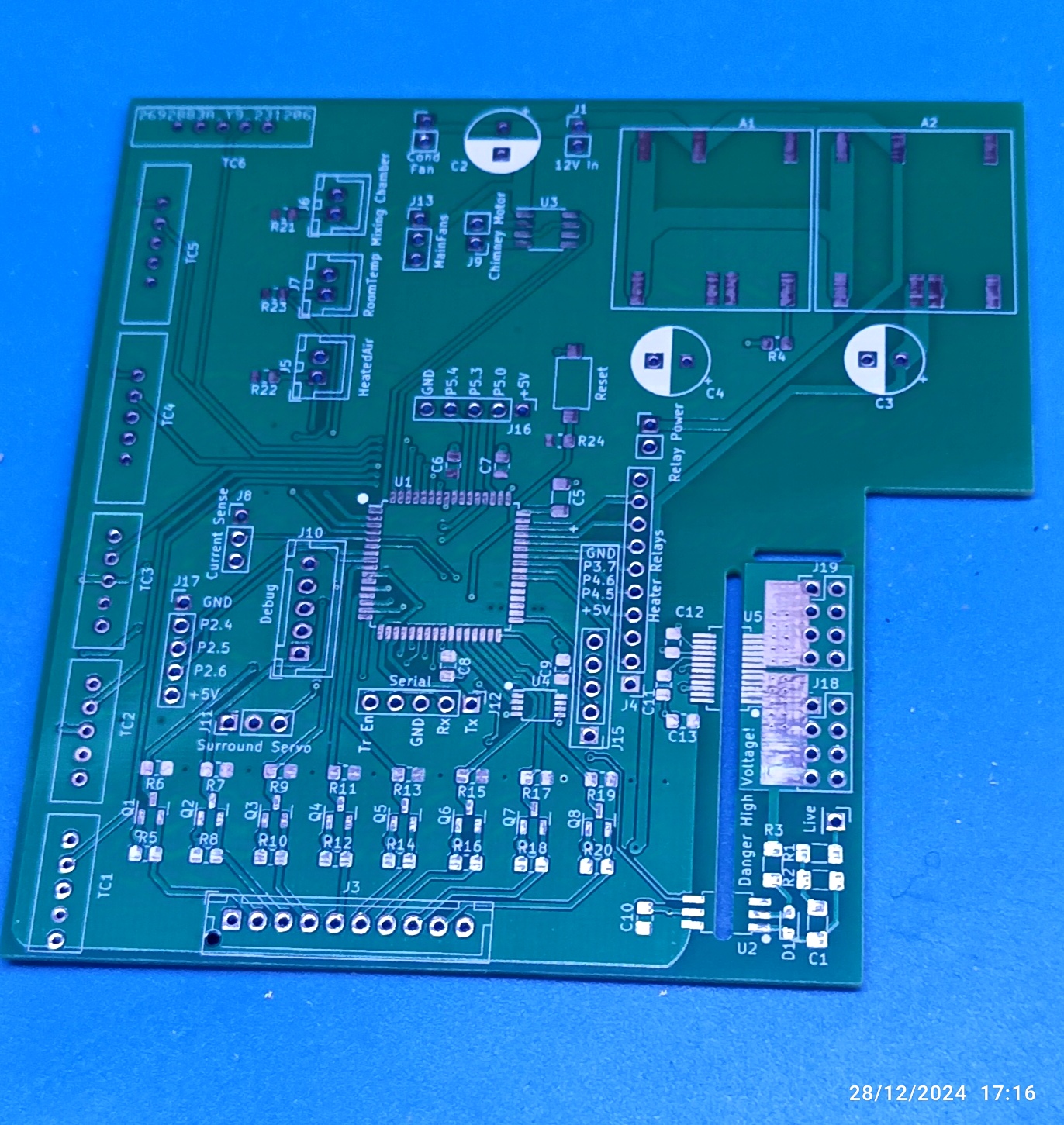
    Here we are .. just to the start of Winter .. and we are having to service our homemade Storage Heater, to make it fully functional again. Also, we are taking the opportunity to upgrade the control board as we had a proper PCB made earlier in the year when we did some lighting modules so we included a design to allow us to put on a new larger micro-controller chip.

    New Stoarge Heater control PCB

    New Stoarge Heater control PCB


    We undid all the wiring and devices from the old control board and populate the new PCB with those, plus some new extra ones too.
    There were some minor corrections needed to be executed on the PCB and other slight modifications but we now have a new working control board without the forest of looping wires shooting all over the place.

    The next job is to get access to the trays of bricks so we undid the front panel, loosen the wire mesh, carefully picked off the glass wool and untangle the inner wire mesh as well and bent them open to the sides. At this point, we discovered that some of the insulation was very fragile and crumbled when we touched the wires coming out of the trays, especially the top ones.
    So, it was a case of replacing all the wiring with better high temperature resistant insulated wires which we found on the web. We bought two rolls of 12metres of three layers; one woven glass fibre on the outside, a middle layer of Mylar and an inner layer of more woven glass fibre, protecting a 0.75square millimetres of 10 stranded copper wire. The whole wire is rated for 500°C !!

    We also noticed that the spade terminals plugged onto the elements inside the bricks, were not tight anymore and this has caused corrosion, probably caused by electric arcing damaging the surface. So we needed to solder the new wires directly on to the terminals on each element. This meant finding a high temperature solder and it turned out to be a silver copper alloy that has a melting point of 750°C to 800°C which is high enough for our requirements! We bought a tiny little syringe weighing just 5grams costing £10!! Silver is not cheap!
    This syringe also has a special flux mixed in with the silver and copper particles.

    Once these items arrived in the post, we proceeded to lay in the new wires, a pair for each tray, going out sideways and then up to the top of the cabinet and then up into the control board area where they were terminated with a solid caps and then screwed into a line of terminal blocks. One thing we discovered was that one of the rolls was only 11metres long and not 12metres!! What Cheek of the manufacturer! We had to borrow a short length of our old wiring for the last section going up to the top of the cabinet which is fortunately outside the hottest zones. So should be ok.

    Next, by pulling each tray out a few inches, we scrubbed the two iron tabs of the elements using a ‘scotch-brite’ wheel, to clean up the corrosion and rust.
    We then expose several inches of the wire, twisted the strands together and then poke the end through the little hole in the middle of the tab and wrap it around twice, before arriving back to the incoming wire where it was twisted together. We had some old flux which we revitalised and applied a blob to the contact area and using a miniature blow torch using liquid propane gas, heated up the tab until it started glowing orange hot. It said on the web that bright red for iron has a temperature of about 730°C and orange is a temperature of 930°C which is high enough to melt the silver solder.
    We did the second tab the same way and then to make sure that we got a good soldered connection, we measured the resistant between the two wires up on our control board and if it reads approximately 67ohms which is the internal resistant of the element themselves, we therefore got a good connection.
    We repeated this task for the next seven trays (one of them had a resistant of 98ohms which meant the soldering didn?t work terribly well so we redid it again).

    Now that is all done, we could reassemble the wire mesh and put back the glass wool. But before putting on the outer layer of the wire mesh, we got some more glass wool and thickened up the two outer vertical edges and also folded a double thick layer for the upper 6inches above the trays of bricks. It was showing signs of being rather patchy.
    This will hopefully help reduce various hot spots on the cabinet, especially near the top on the right side. We will see!

    The final wire mesh was inserted into place and after double checking all the electrical connections to each tray again, we put the front panel back on.

    The new micro-controller was tested and the software was modified so that we can now switch on any of the eight trays. The display is working, the menu button and selector is working, the mains electricity sensor to measure the current is working, the 50hz signal is being picked up, the motor for the chimney flap is working and all six thermocouple probes are reading ok too. We double checked all the electrical connections at the relays and the row of terminal blocks and we did discover a left-over wire link in the back of the last terminal block. It was reading 0ohms between the live and neutral lines and only after leaning over and cranking one’s head (a very tight gap between the ceiling and Storage heater) to see behind the terminal block, we could see this rather hidden link! The next test was to measure the resistant of each circuit after all the relays were told to switch over to the ‘on’ position and we discovered another problem. It seems that we may have burnt out the internal contacts as most of them shows very high resistant levels so we had to order a replacement eight-way relay module.

    This duly arrived within a day and we did the laborious job of unscrewing all the connections to release the wires off the old module and then slide in the new one, putting all the dozens of wires back.
    After testing the new relays, which are all working just fine, we proceeded to a full test where we set the temperature to a low 100°C and set the clock so it thinks it is in Economy 7 mode.
    It switched on five of the eight trays at a time, using the pattern of on, on, off, on, on, off, on, off for tray 1 through tray 8 respectively. Then, every five minutes, it would rotate this pattern, one tray position, around the eight trays so that all the trays would eventually get equal amount of charging.

    And ..

    All is successful! It got to the required temperature and stopped charging in just under an hour. Yippeee!

    Now we can reset the clock to the correct time and set the target temperature to 300°C and leave it to run overnight.

  • Cloakroom Decoration Phase Two, Final Top Coat For Floor And Sliding Door Installed

    We proceeded to paint the ceiling in the Cloakroom a nice sky blue colour (to match the colours in our wallpaper), but we also wanted to create some fluffy clouds so we cut some paper and stuck them to the ceiling, to cover the air vent and the three lighting units. They are of variable size and shape.
    We then decided that the clouds are not working so we painted the air vent the sky blue colour, to make it blend in more, and dab various colours of grey and white and blue to make the clouds more fluffy.

    Then, we painted the alcove where the vanity unit is going, including either side of the door entrance. This is a blue grey colour that approximately matches the colours in our wallpaper.

    Now we are ready to apply the final finishing top coat of resin to the floor. It is a pale grey colour. But, first, we sanded the rough surface, to reduce the obvious join lines and other bumps and rubbed around the edges. We noticed that there were holes so we filled them up with more filler.

    Cloakroom floor filled and sanded

    Cloakroom floor filled and sanded


    After, we were satisfied with the condition of the floor, we proceeded to paint the final resin top coat all over.
    While the resin was still wet, we sprinkled icing sugar all over the surface, to help roughen up the surface, to make it a better non-slip surface.
    Topcoat applied and sugared

    Topcoat applied and sugared


    After a day of waiting for the resin to fully cure, we then got a bucket of hot water and poured it all over the floor. Because we deliberately had a small slope rising towards the doorway, none of the water escaped the room at all. We used a sponge to stir the water, to dissolve the sugar and then picked up the dirty water with a couple of sponges. We repeated again with more hot fresh water and sponged it dry. We now have one finished flooring, fully waterproof and easy to clean right around the whole room, including underneath the toilet.
    Washing the Sugar off

    Washing the Sugar off

    The next job is to lay on the wallpaper we have bought for our cloakroom. It is special wallpaper and we carefully lined each strip starting with the one immediately behind the toilet and then working one way, leftwards towards the door, and then doing the final two strips to the right of the toilet, coming around on to the linen cupboard and turning a few inches on the side wall. We then carefully trimmed the bottom edge so it neatly terminated to the skirting and then did the same at the top. We had to dab a few edges and joints with more paste to help stick it down.

    The next step in decorating the walls, is to put on several coats of varnish all over the wallpaper, to provide a protective and water resistant surface. We put on a third coat immediately behind the toilet itself because it will get even more scrubbed as you would expect.

    We then sliced a thin piece of oak off one of our planks and then run it through our router to give it a gentle moon crescent shape. We rubbed it smooth and then gave it a coat of PU varnish with a mid-brown dye. We stuck it on the edge of the wallpaper that just came around the linen cupboard corner. This will protect the edge of the paper from being damaged.

    Then we noticed that some of the blue grey walls were showing signs of wear and tear, probably caused by when we were doing the vanity unit and the lower shelf underneath. So, we gave the grey walls a touch up coat of paint.

    The next step is a very important one, is the mounting of the toilet!! We carefully cut through the wallpaper to where the two pipes needed to come through the wall, then the two bolts sticking out, ready for the toilet and finally, the square push button module for flushing the toilet. We followed the instructions for measuring the length of the two plastic pipes, one for supplying the flushing water and the bigger pipe to take away the water. We then push the toilet on to the two bolts and made sure that it was level. We tightened the nuts until the toilet was nearly back against the wall, at which point, we ran a line of clear PU sealant between the edge of the toilet and the wall and finish doing up the nuts tight. We carefully scraped any excess away.
    And finally, we installed the flush buttons module. We connected the tiny air pipe from the cistern and then clicked the module into place. It has magnets to hold it tight. Very clever.

    We then press the button .. and it flushes !!
    And no leaks !!

    The other thing we did was to connect up a temporary tap to our cold water supply. It is an ordinary tap, with a multi turn knob. Nothing fancy. We now have the ability to have running water. We got soap in a bottle, plus also a bar of soap. We did buy a plug for the sink but it wasn’t a very good quality as it doesn’t hold the water for hours and hours. We will have to find another one.

    We then ordered a large mirror measuring 600mm wide by 1200mm tall. It is a frameless and also has hidden hooks so it hangs slightly proud of the wall. We also bought a toilet roll holder and a hand towel holder, plus also a toilet brush and finally, a small swing lid rubbish bin.

    Cloakroom Finished 1

    Cloakroom Finished 1

    Cloakroom Finished 2

    Cloakroom Finished 2


    The last thing we did for the Cloakroom, was to install the sliding door module. We didn’t get as far as implementing the compress air system because we decided that the sliding mechanism we spent a few weeks designing isn’t working as well as we hoped. We will mount what we got and make use of it for now, but, we will use a different sliding mechanism in the future and replace this one with a new one. We probably will move it to the Kitchen because it is likely that the sliding doors will be rarely used.
    So we managed to get the module up inside the wall and screwed it into position. We then got a sheet of OSB board and sliced it up into two 450mm wide by 2100mm tall pieces. We then cut a narrow piece of MDF board and glue that to the edge. Next, we bent a couple pieces of aluminium 40mm wide flat bar to make a couple of L shaped brackets, with a slot cut in the top to allow the hanging of the two halves of the door to hook onto the carriage. We then cut a couple of finger grooves on the edge of both doors, on both sides so that one could open and close them. The last thing we did, was to use short length of draught excluder brushes and mount them near the bottom of the door, one on each side of the door so that the brushes are very slightly pressing into the surface and this holds the door nice and steady.

    Temporary Cloackroom sliding doors

    Temporary Cloackroom sliding doors

    This is just a temporary doors, as it is only 11mm thick. We will replace them with proper 45mm thick ones with frosted patterned glass later on.

  • Solving Condensation Issues!

    Over the last three or four weeks, while dodging rain showers, we tackled the problem of moisture up inside our Skylight. See the following posts for more details:
    * Installation of Skylight Double Glazing Units – Part 2
    * First Stage of Improving Our Skylight Windows
    The solution to this annoying problem is to ventilate the gap between the double glazing glass units and the plastic polycarbonate outer layer. We decided that a neater solution is to drill air holes between each window section and then have one larger hole drilled in the middle position, through the central ridge beam, back into the boxing underneath the solar panels, where an additional fan can be installed, to force the air through all the windows in a loop and the “moist” air returns back into the boxing at each ends.

    It is quite a complicated task and we had to work from the roof side completely. We didn’t want to disturb the glass units because they were already fixed in with lots of sealant, but also they are damn heavy. Plus also, we cannot access the triangle windows over the Great Room. So, it was from the roof that we did all the work.

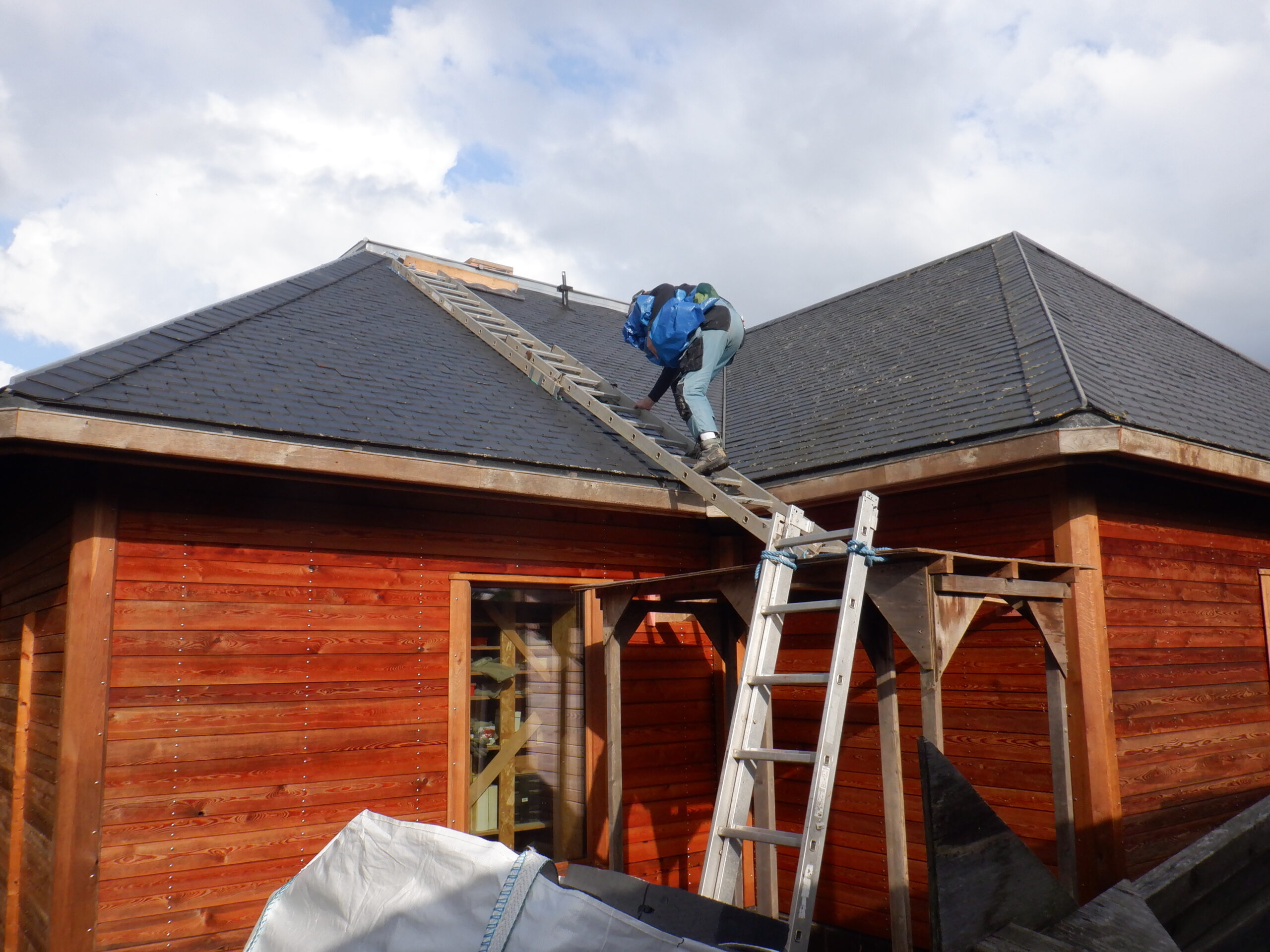
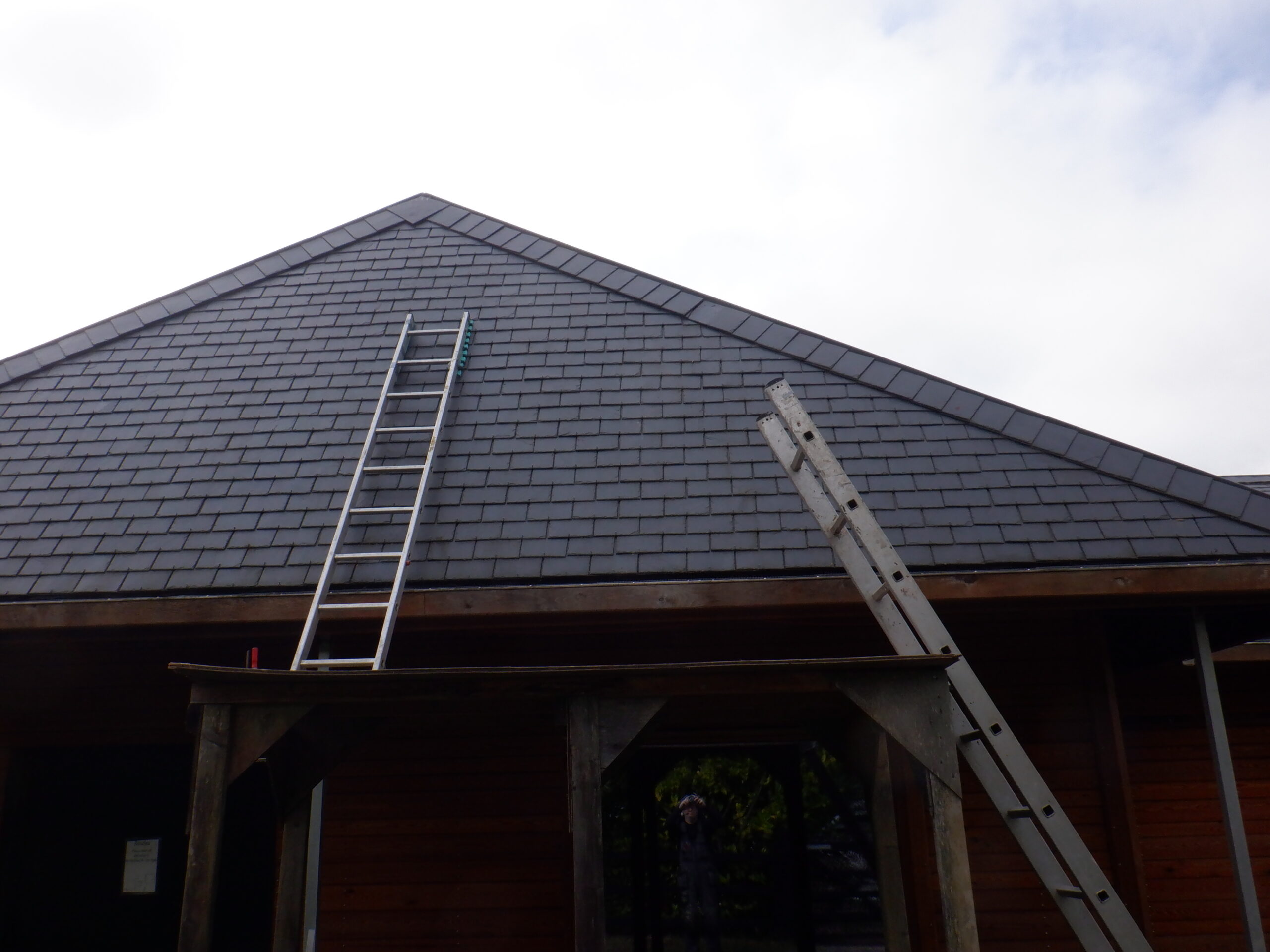
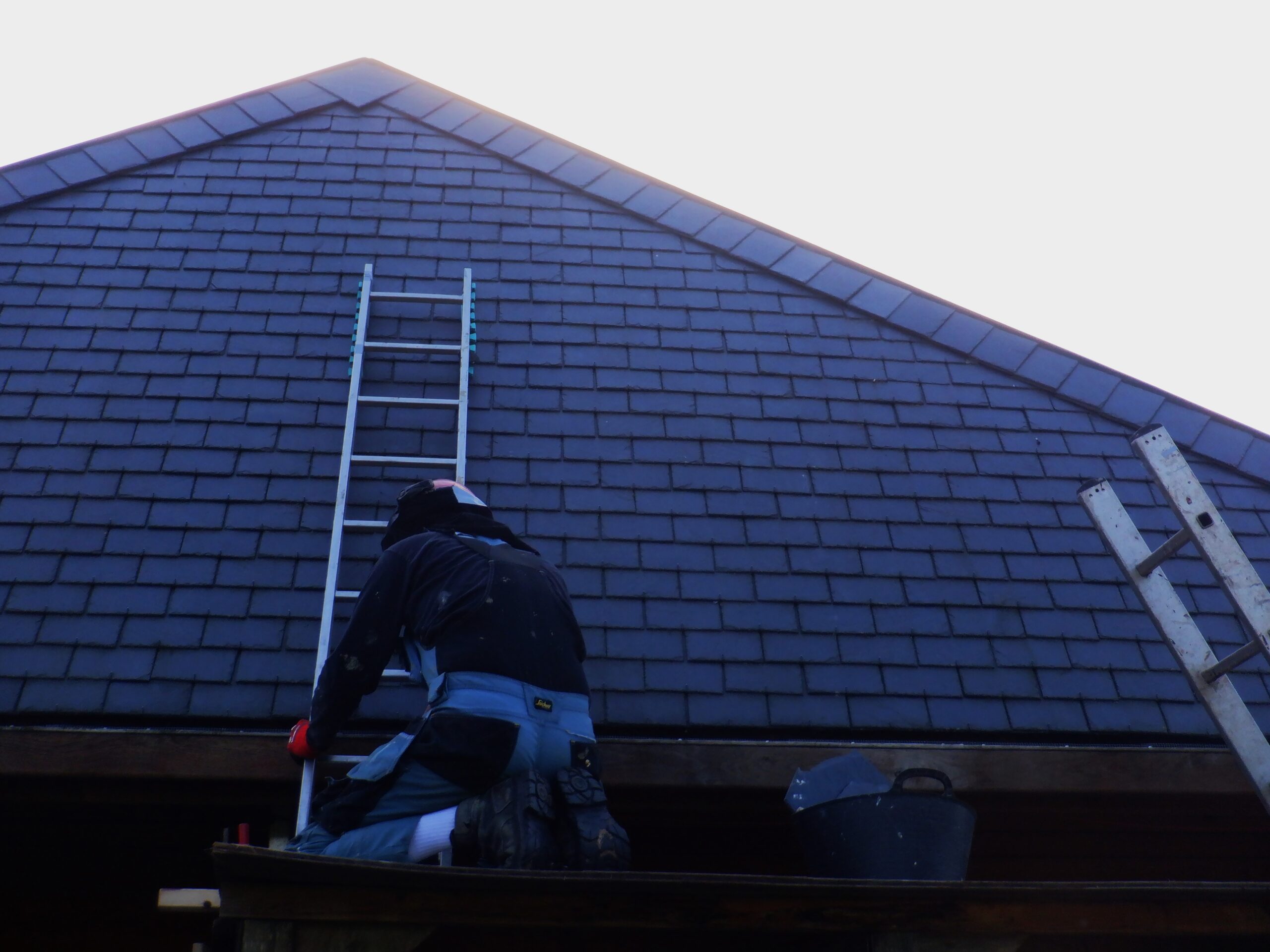
    It was slow work, as we needed to be safe while we got up onto the roof. Towards this safety, we assembled one of our old wooden platforms and positioned it around the back of the house, in the corner of one of our extensions. We then placed our giant extension ladder, using two of its triple segments. We taped on pieces of rubber foam to the top and bottom edges of the ladder, to cushion against the nails and bumps of the slate tiles. The foot of the ladder was fixed down to the wooden platform with a block of wood and rope. Then we had a smaller ladder to allow us to gain access to the platform.

    Setting up access for Skylight refurbishment

    Setting up access for Skylight refurbishment

    Next, the next step towards our safety regime, was to build three little foot rests that was connected to our steel wire we got running around the whole Skylight. we found some 11mm OSB left-over boards from when we were making the hot and cold water tanks, and screwed on a length of 2by4 timber along its length. This timber had a hole at each ends for a rope and a clip hook attached, ready to quickly hook to the steel wire. The other thing we did was to stick all over the underside of these foot rest with a thin layer of PU foam underlay we had lying around. This would provide some extra grip on the slate nails and also not to put too much pressure on the roof tiles as well.

    Now we are ready to get up on the roof.

    The first job was to undo the bird scarer. This is a set of three thin stainless steel wires stretched down the whole length of the ridge line of the Skylight. We rolled this up on a cardboard tube and then unbolted the brackets and lifted off the rain deflectors, which was in five segments. All these items were brought down to ground level and stored on our swimming lane cover for the short term.

    Then, we started on the first Skylight window, which is a triangular one and we undid the clamping bars that are holding down the plastic polycarbonate sheets. Once we got the cover off, we could remove the little aluminium tray of the desiccant crystals (which is now mostly a liquid). We put this into a large rubbish trug we had up with us (it had a couple of bricks in the bottom to hold it against the chance of winds). Then, we washed the desiccant chemicals away with a damp cloth and then tackled the job of drilling holes.
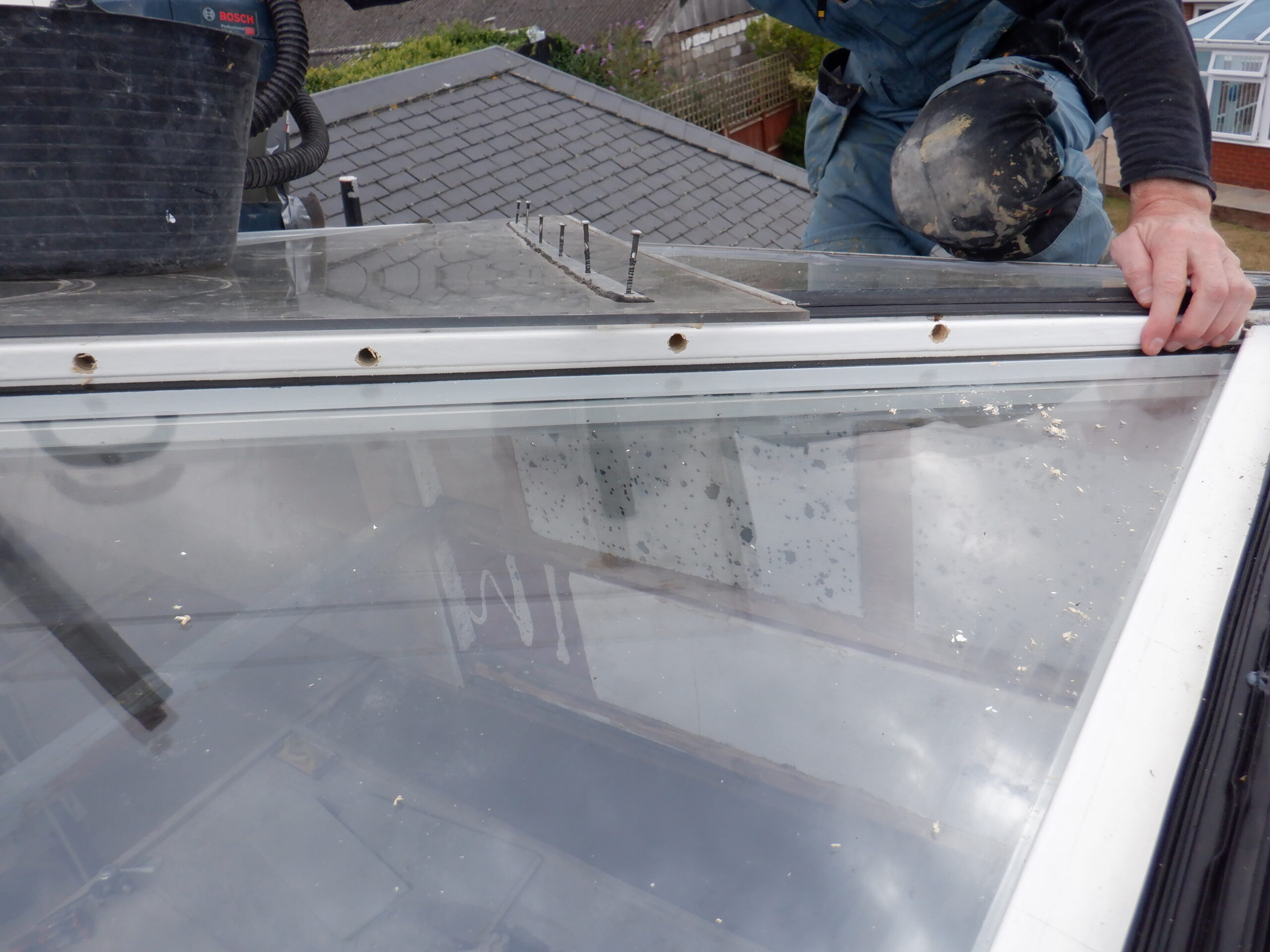
    We used a 16mm sized drill bit to make a good air holes.

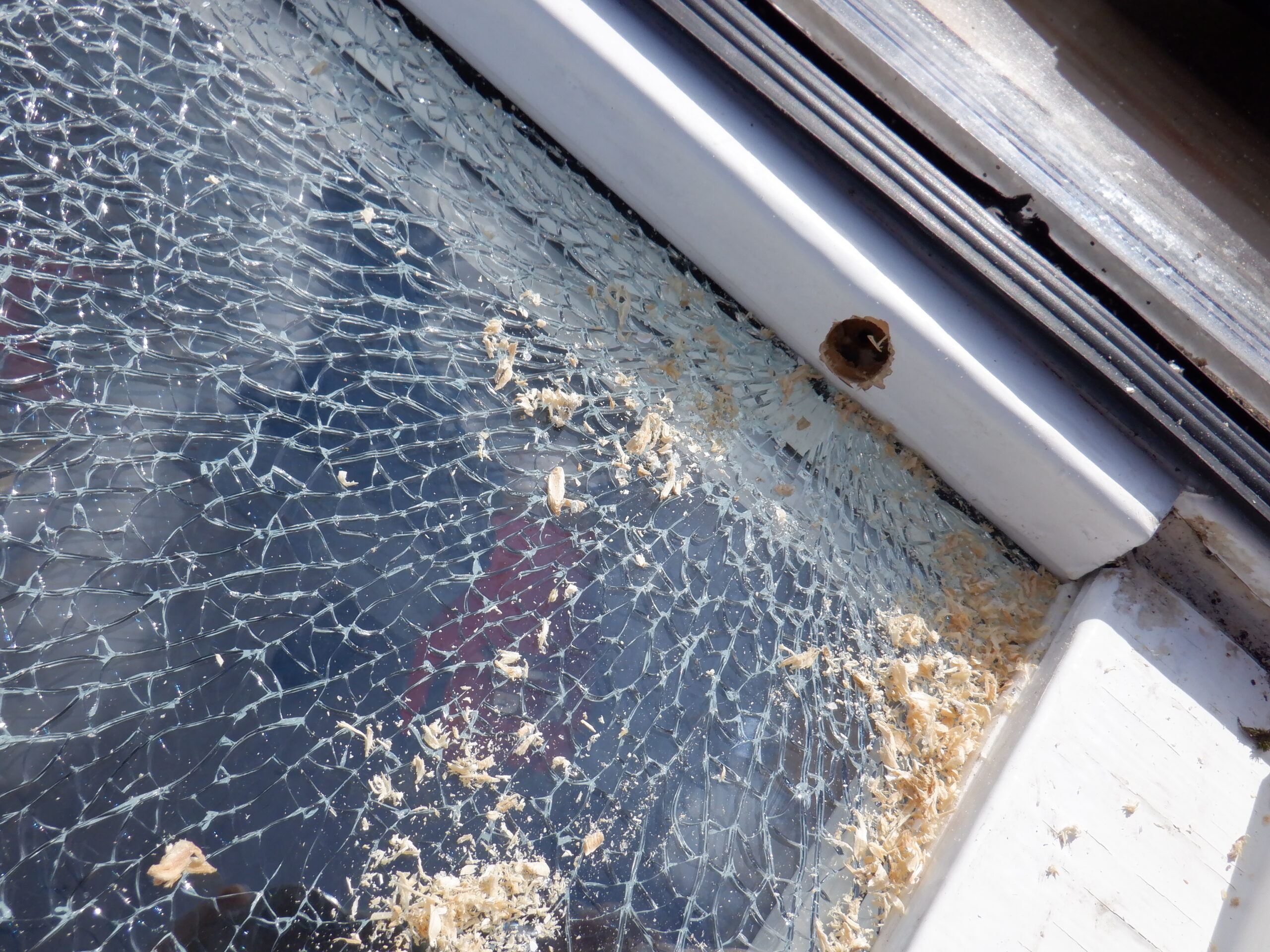
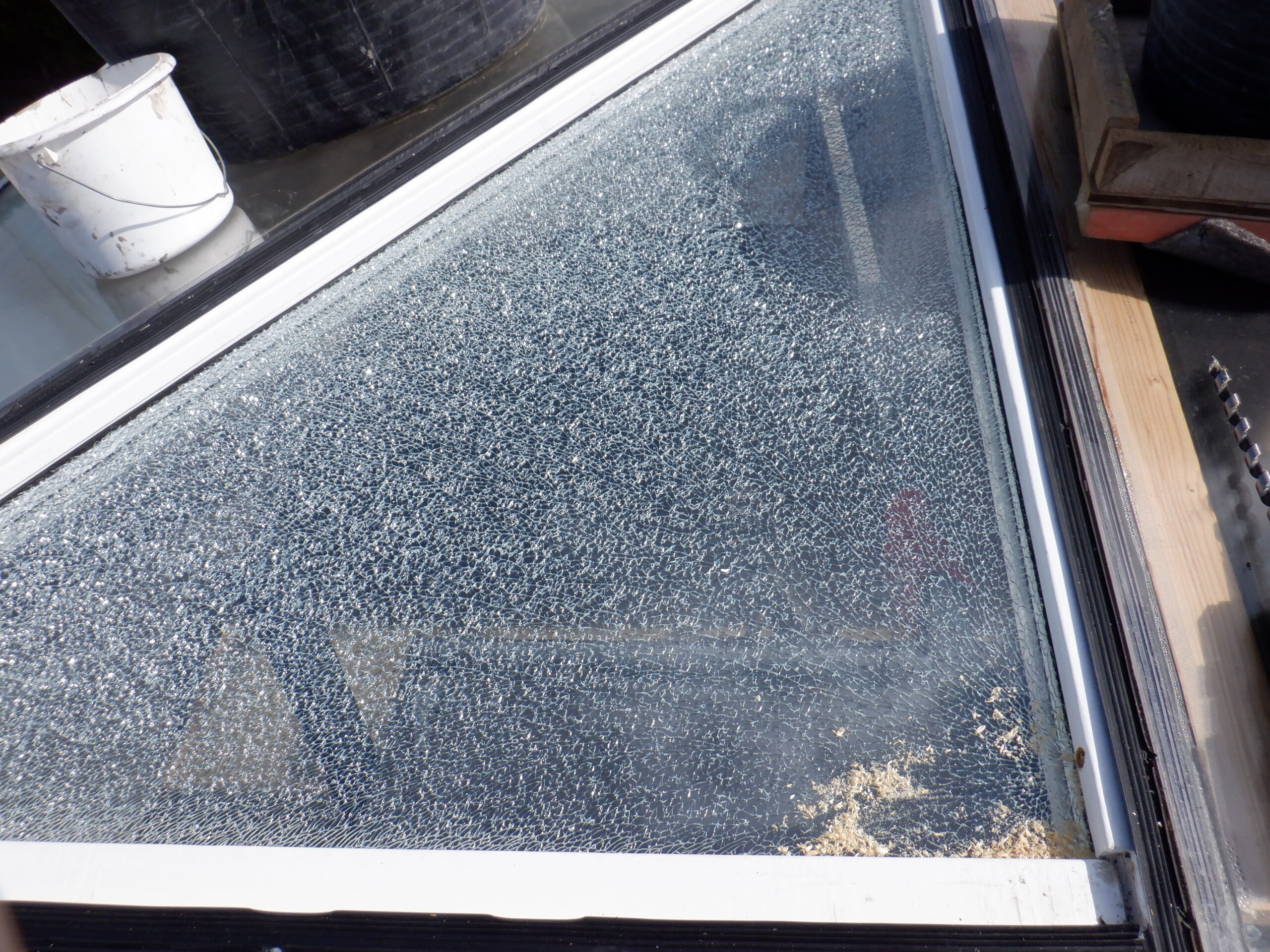
    This first window is different to the other windows because it is a start (or an end) of the sequence of windows that we are planning to allow a flow of fresh air to blow around the skylight. So one side has horizontal holes to connect to the next window in sequence, but, the other edge needed diagonal holes drilled downwards so the air could escape back into the boxing that we will build to cover up the air ducting and solar panels etc. It was all guesswork so we probed by drilling a thin drill through and we can discover where the drill came out underneath. We wanted to miss the solar panel but also avoid coming out on the bottom edge of the joist. We had to be careful because the double glazing unit is sitting right there underneath where we are sitting! BUT, when we changed to the fatter drill bit, and proceeded to drill the larger holes, we must have very slightly clipped the edge of the glass and .. unfortunately .. scattered the whole pane of glass. It was toughened glass so it broke up into thousands of little pieces as it supposed to do. We had few choice words to say out loud !!!!

    Drilling a air vent and clipped the glass

    Drilling a air vent and clipped the glass

    Oops! We broke a window pane

    Oops! We broke a window pane


    We learnt a valuable, or rather, an expensive lesson! We scooped up all the broken glass into another smaller trug and disposed of that in the recycle bin.
    PHEW!

    So we adjusted our approach in drilling these diagonal holes and we were able to continue to produce five air holes.
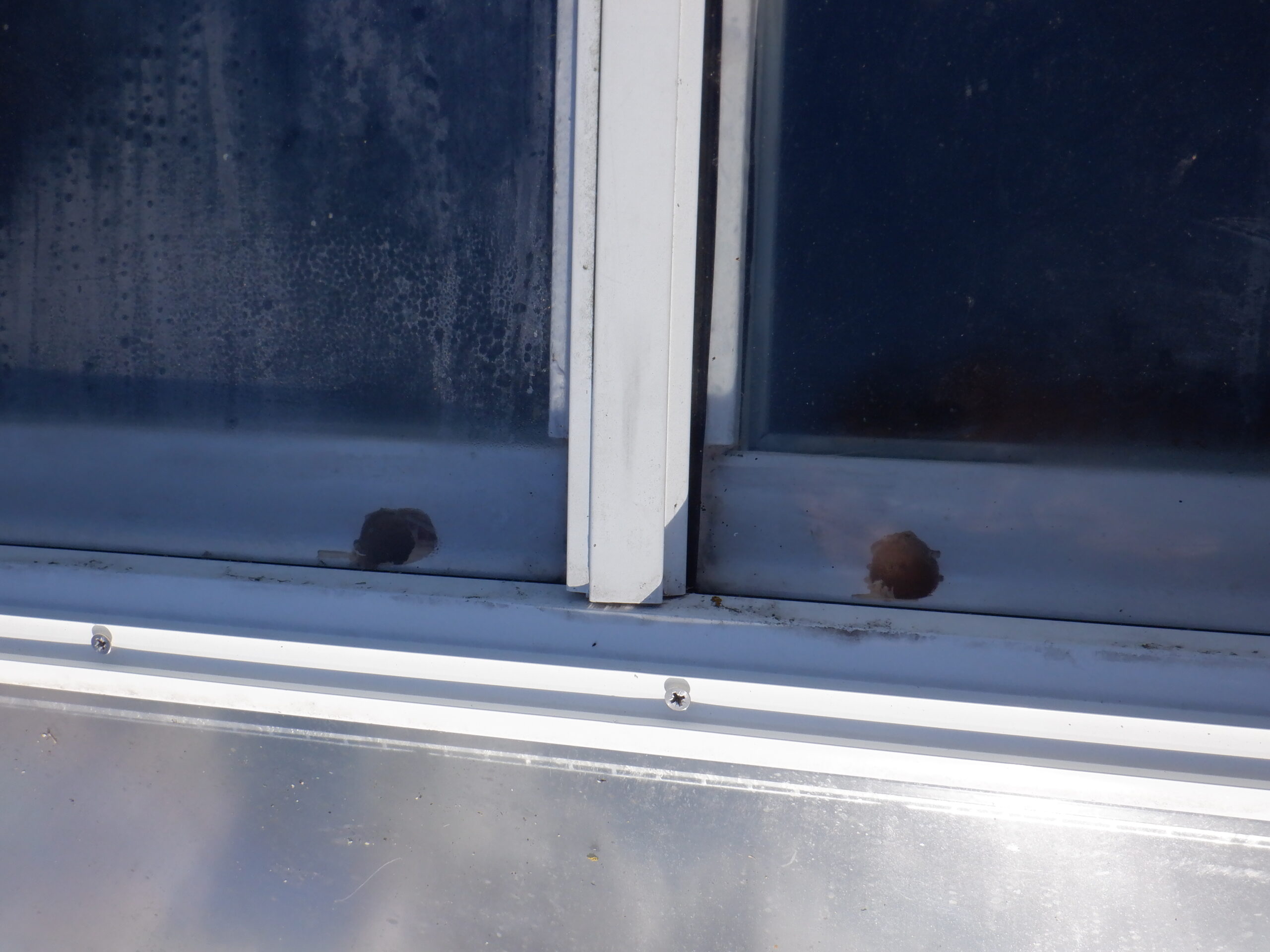
    And then, we drilled horizontally on the other side, to connect this window to the next one. We did have to remove the polycarbonate sheet because the drilling angle meant that we could have scratched the plastic as the drill bit came out the other side.

    We then vacuumed up the wooden mess and and put back the cover, all the while in trying to minimise other dust and bits being blown in the wind. It was tricky. But, unfortunately, we discovered later on that our new air holes themselves actually allowed some of the wooden rubbish to be blown backwards into the previous window so we realised that we couldn’t rely on getting each window perfectly clear so we decided that we would have to perform a final vacuum on the return trip, once we got to the very end of doing all the windows, all twenty-two of them!!

    Drill holes to join up the window spaces

    Drill holes to join up the window spaces

    As you can imagine, it was a slow job in opening up one window at a time, removing the desiccant tray, cleaning, drilling holes, vacuuming the dust and then putting the cover back on. Including screwing the clamping bar back down with two screws (there were six or seven screw in total) and then moving on to the next window. We were using our foot rests so they needed to be moved along as well. Plus, on top of all that, we would get the occasional rain shower, which meant that we had to quickly cover things up and wait. Sometimes, we lost a whole day because of little rain showers coming and going. Phew!

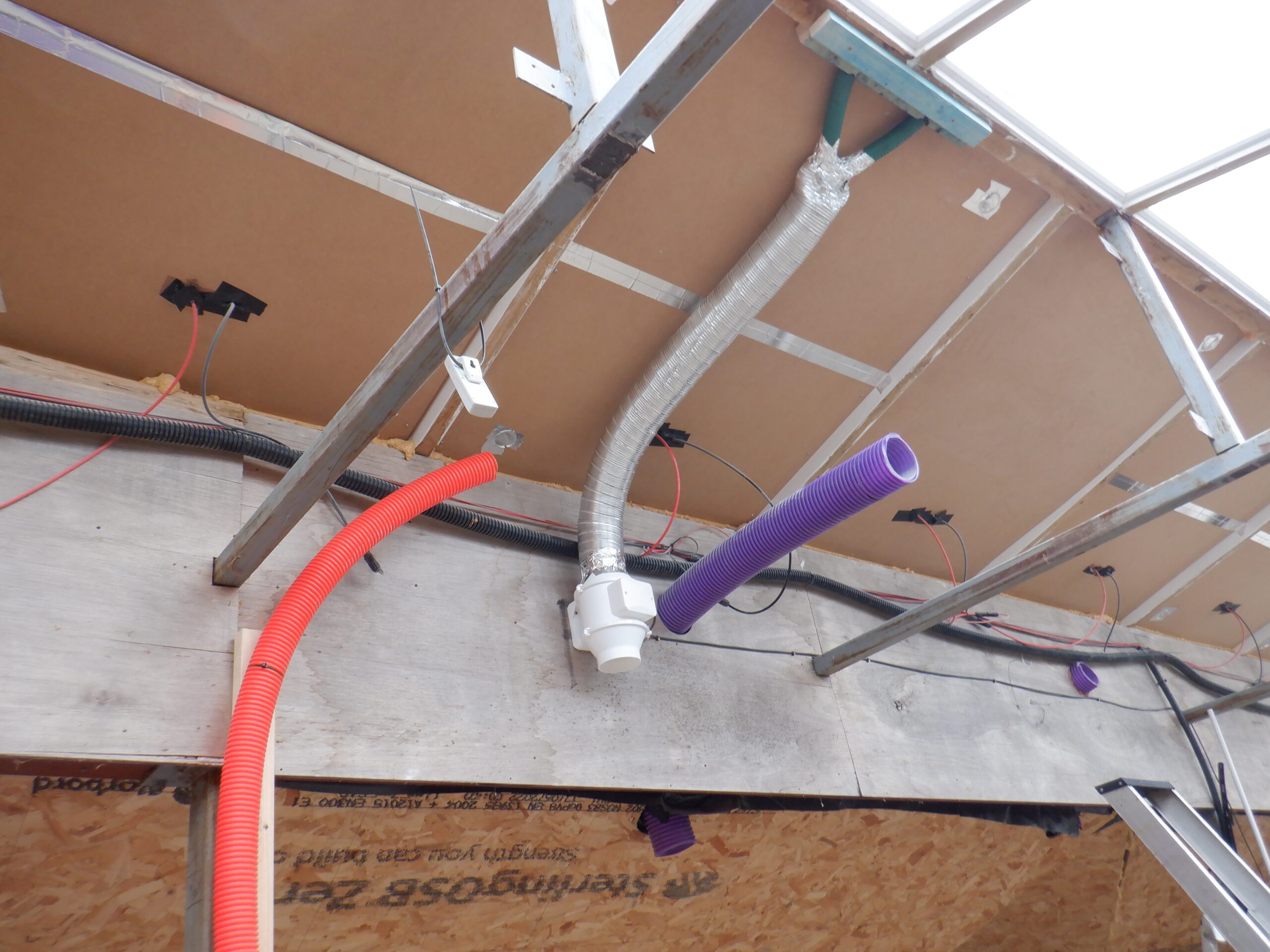
    One different occurred for the middle set of windows, right over the staircase, because this is where we needed to provide a much larger single hole for the fresh “dry” air to get into this thin gap in the first place. We took the advantage of this situation over the staircase because there are two slightly narrower window modules so these became the beginning of the “circuit” for the fresh air to travel around all the air holes. So we drilled a large 25mm wide hole diagonally down through the central ridge beam, two of them, one for each of these windows. They popped out just below the solar panel as well, ready for tubing to be connected from a fan. More later.

    Holes through the ridge beam into skylight box

    Holes through the ridge beam into skylight box

    Re resumed doing the rest of the windows, going towards the Great Room and arrived at the final window before the start of the solar panels. Here we had to drill another set of diagonal air holes like last time .. but we were very careful and got five holes done without mishaps this time!!

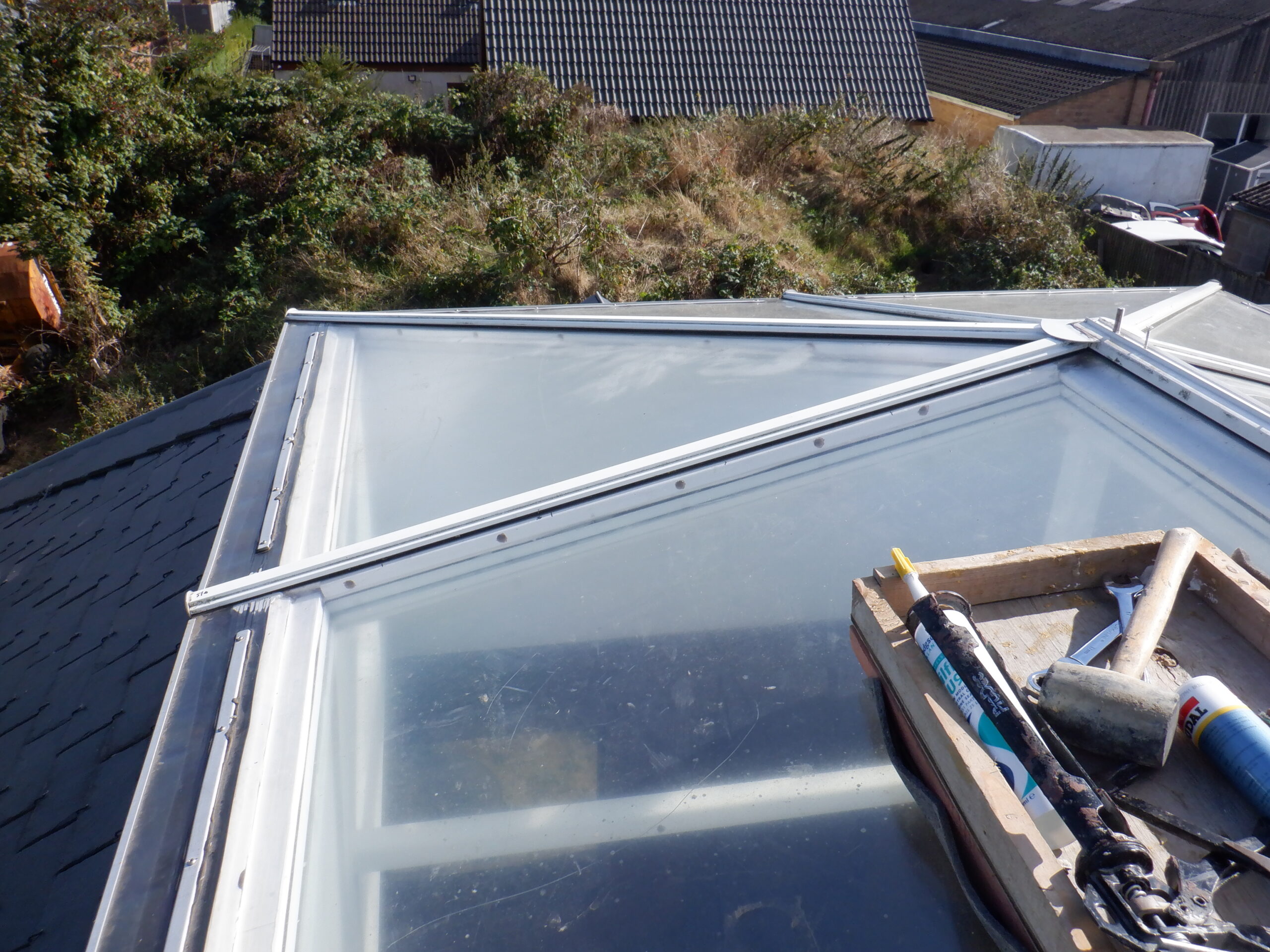
    So after we had removed all the trugs of aluminium bars, dirty water and cloth and most of the tools, replacing them with the vacuum cleaner and one or two tools like screwdrivers, we started our return trip. We opened each window up in turn, vacuumed the last pieces of sawdust and put in plenty of glazing sealant on the joints of the rubber seals and then laid the cover back on and this time put all the screws back in the clamp bars. We put more sealant at the top of the clamp bars before putting the rain covers back on.

    We made steady progress, working our way back along the whole Skylight and in a few hours, got back to the beginning again.

    Nearly done

    Nearly done


    The final job was to remount the central ridge rain deflectors and then unwound the three thin wires back along the ridge and bolting the “arms” back into place to pull tight the wires.

    We have finished the external work of this task so we took everything back down again including the three foot platforms, a rain tarpaulin cover that we had tied a brick in each corner but we never got to use! We then carefully lowered the heavy ladder and put that away too. the final tidy up job was to disassemble the two platforms and return them to the storage stack in the swimming lane.

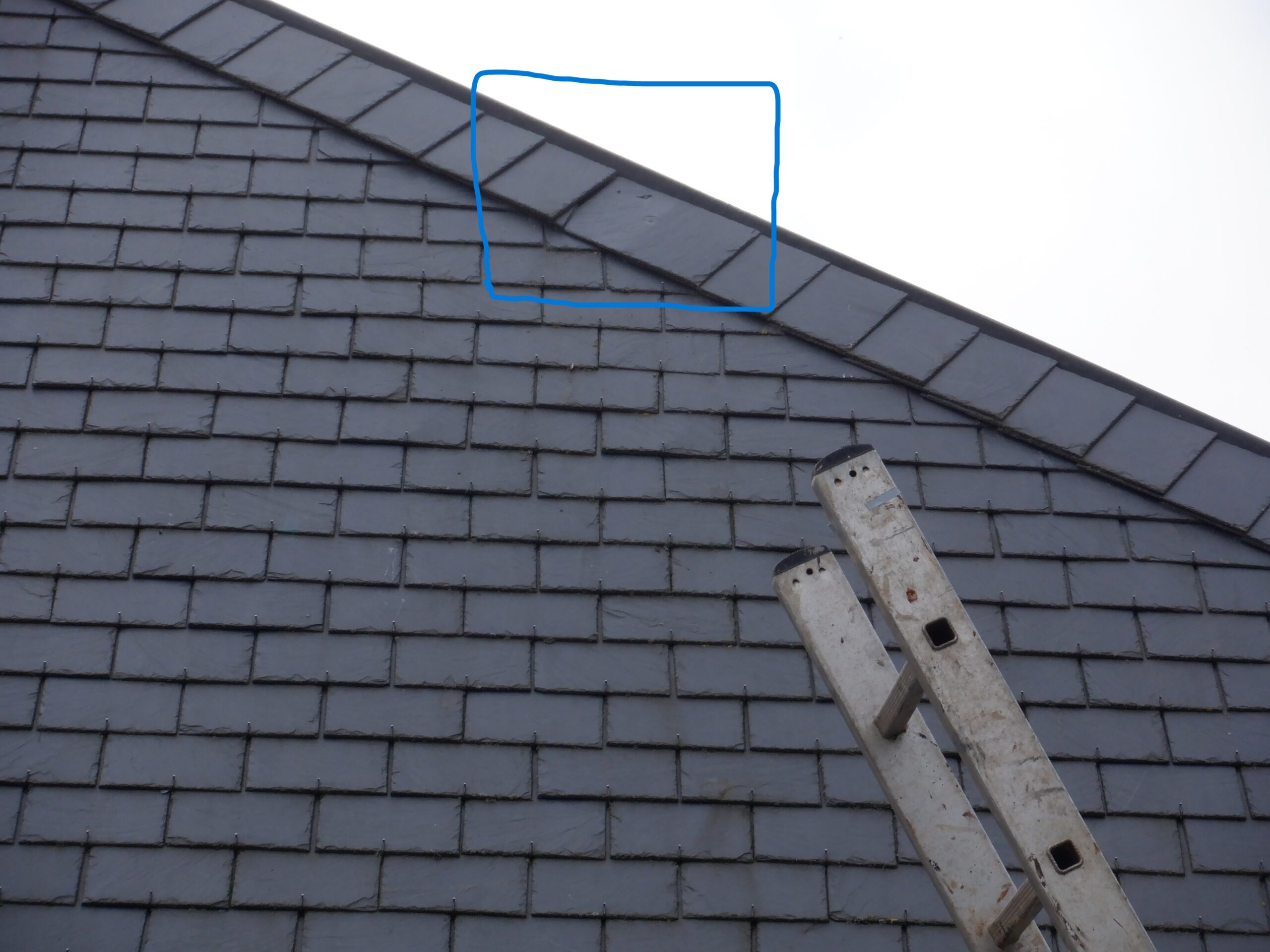
    Oh yes, one of the things we did while we had a platform assembled, was to do a repair job on the Front Porch roof. We had a slate split along an unseen fault line and half the slate had slithered out and a little way down the slope. The slate in question forms part of a line protecting the hip ridge line, on the right side of the porch. So we anchored the platform underneath the spot and proceeded to remove all the slates above the broken one, all the way to the top and levered them off their copper nails. We did end up breaking a couple more slates because the copper nails were ring shank types and really were stuck in the wood. We even broke the large central piece at the top as well! But, fortunately, we had a couple of spare large slates (measuring 300mm square). We then replaced all the slates again, including the new slates and nailed the final central slate back at the top.

    Repairing a broken slate on C roof Hip

    Repairing a broken slate on C roof Hip

    This the the broken one

    This the the broken one

    Slates removed to the top

    Slates removed to the top

    C roof All repaired

    C roof All repaired


    That concludes all the outside work but one of the consequences, is that we have scratched the polycarbonate plastic sheets up there and we will have to spend some future time to polish the scratches out, but when it is better weather and warmer!!

    We just needed to finish this particular job by installing a small fan we ordered off the web, connect it to a length of flexible aluminium “stretchable” 100mm pipe, which in turn got squashed down into two separate smaller flexible pipe that then plugs right up through the two big holes we drilled through the ridge beam. The fan is currently just plugged into the mains socket by hand when we can see that the Skylight needs blowing out, to evaporate the condensation accumulating up there. But, eventually, we will automate this process so that a timer will control when to run the fan and for how long. And possibly, detect the humidity levels up there and switch the fresh air supply on and off automatically

    Fan to ventilate the skylight glazing gap

    Fan to ventilate the skylight glazing gap

    This concludes this necessary work, in correcting a poor design choice we made at the start. We will have to live with this. But, it is now sorted!

  • Vanity Unit Designed and Created

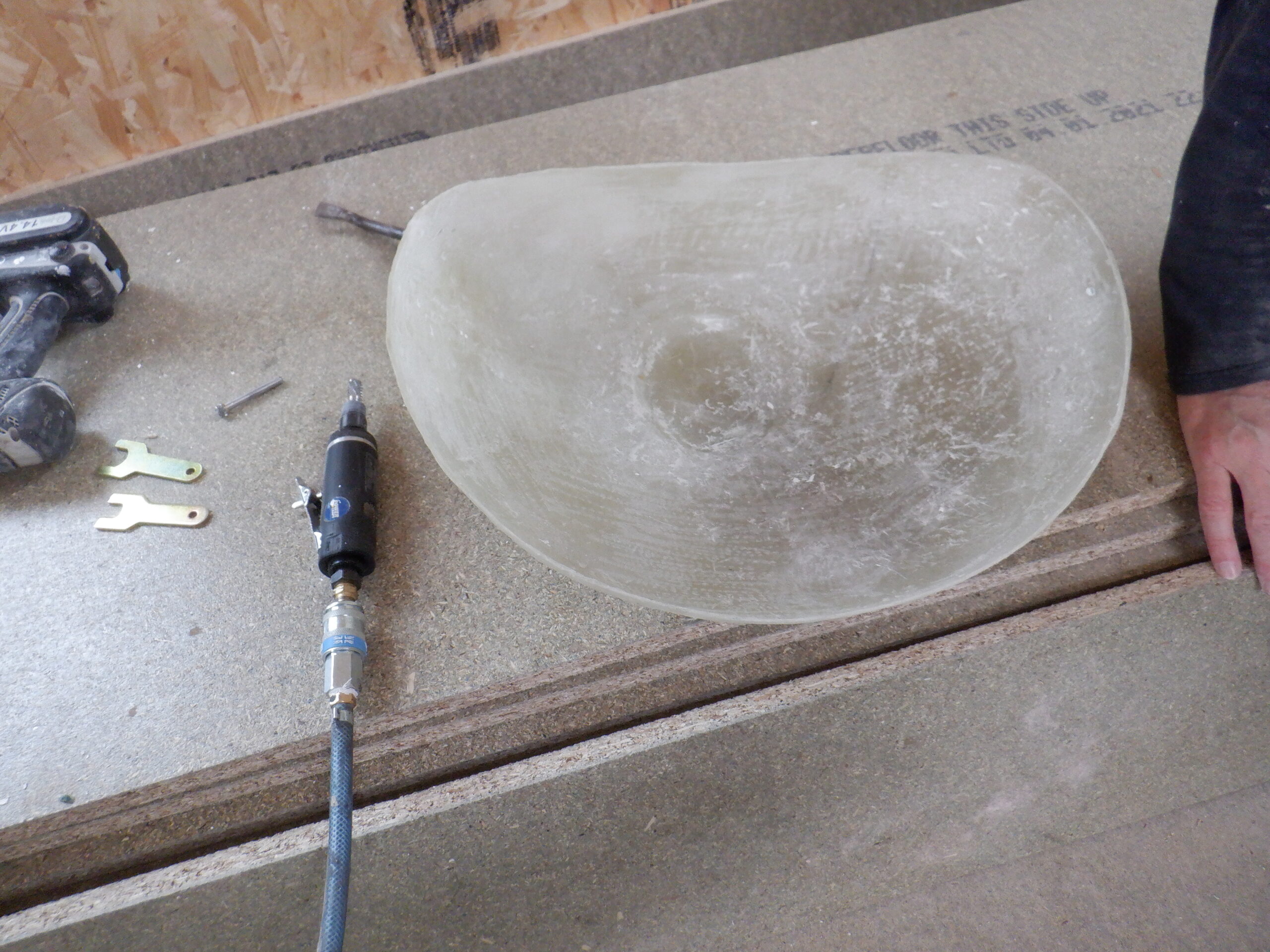
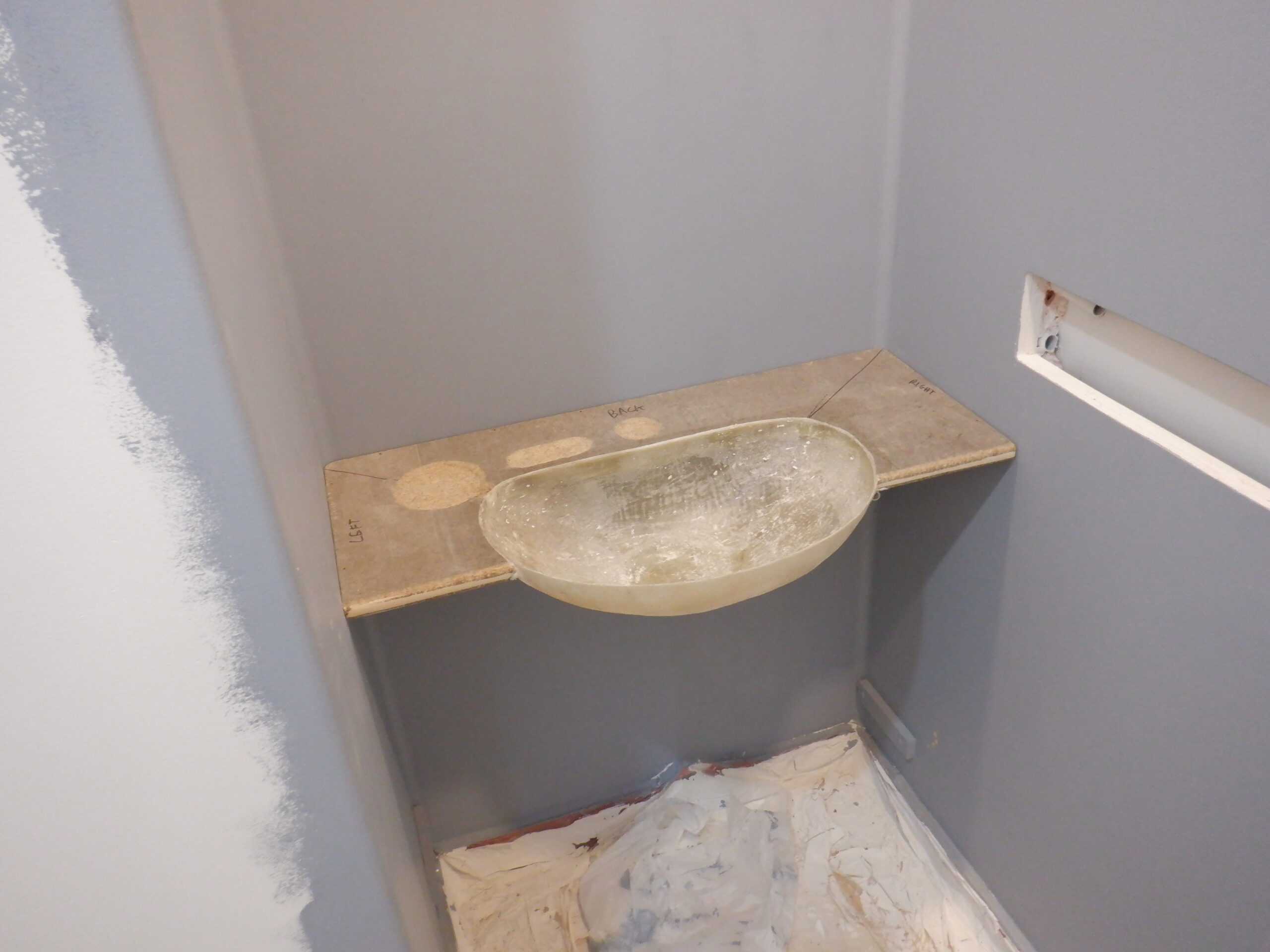
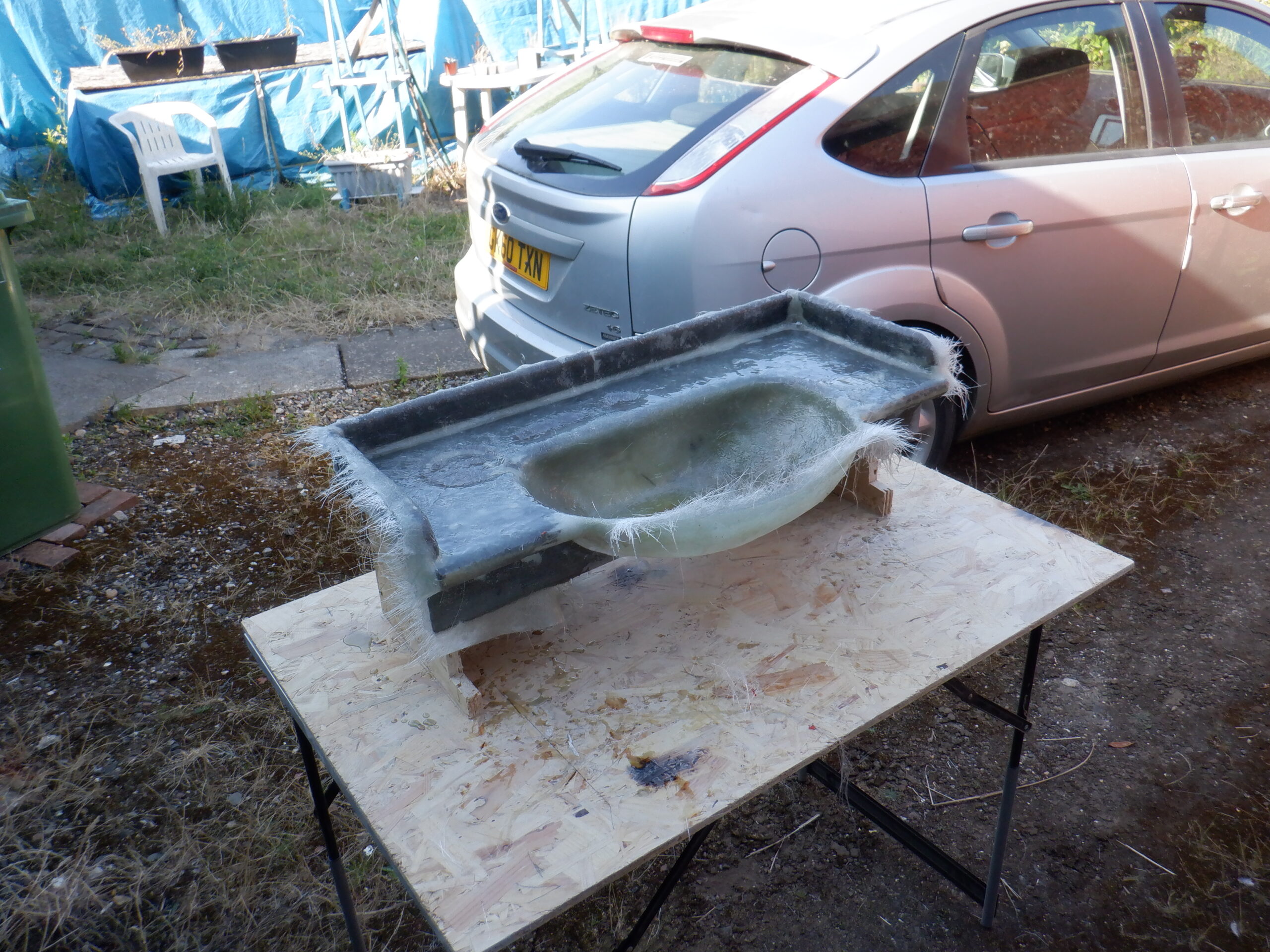
    We started another job recently, this time to design and create our Vanity Unit for our Cloakroom. We wanted a simple design, in a natural darker colour, to match the décor and not to be too big, or too small, but just right! We always liked the design of the basin bowl to be “cut” into the vanity work surface itself so that everything is flush and smoothly flowing from one surface into another.

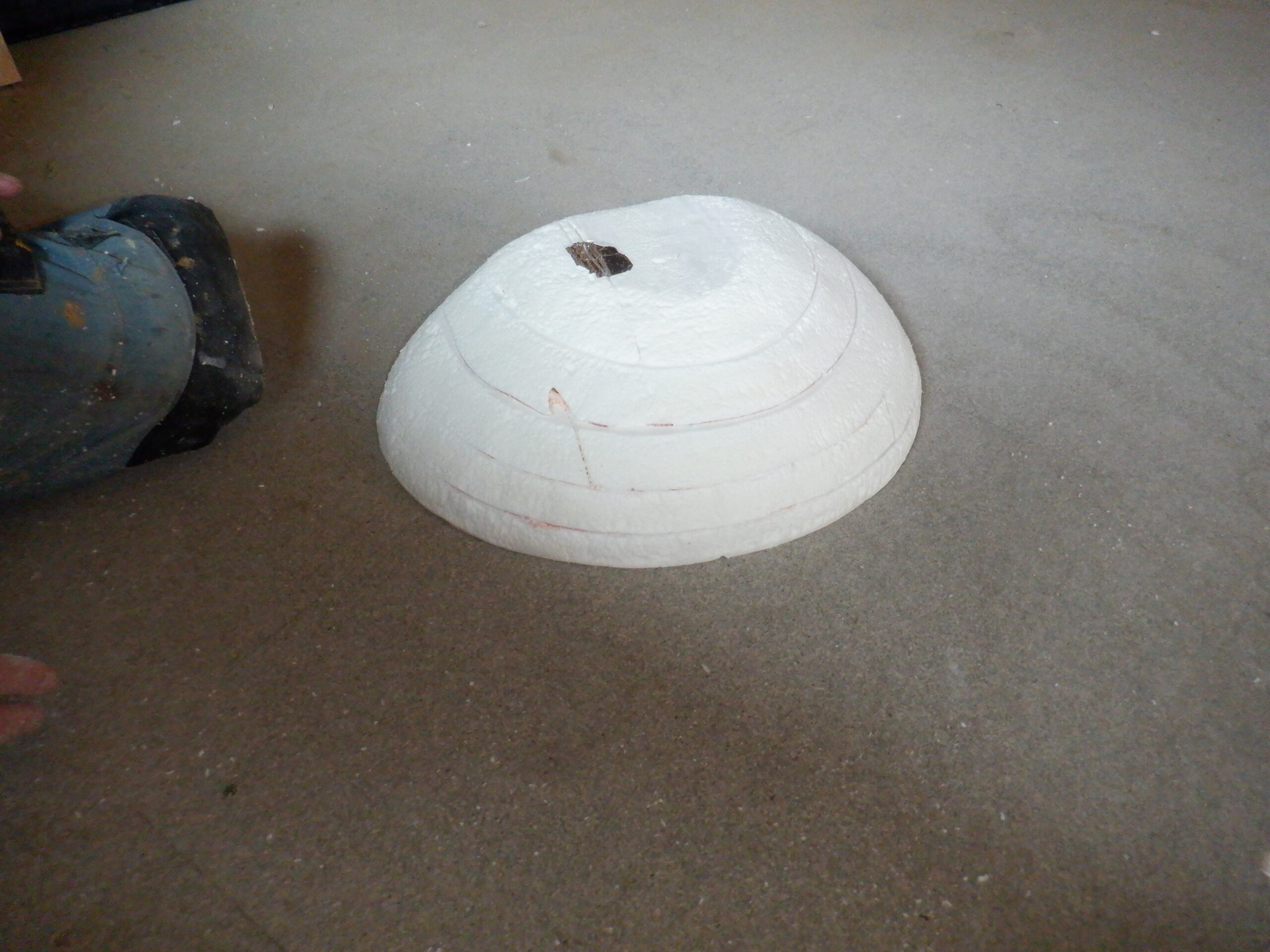
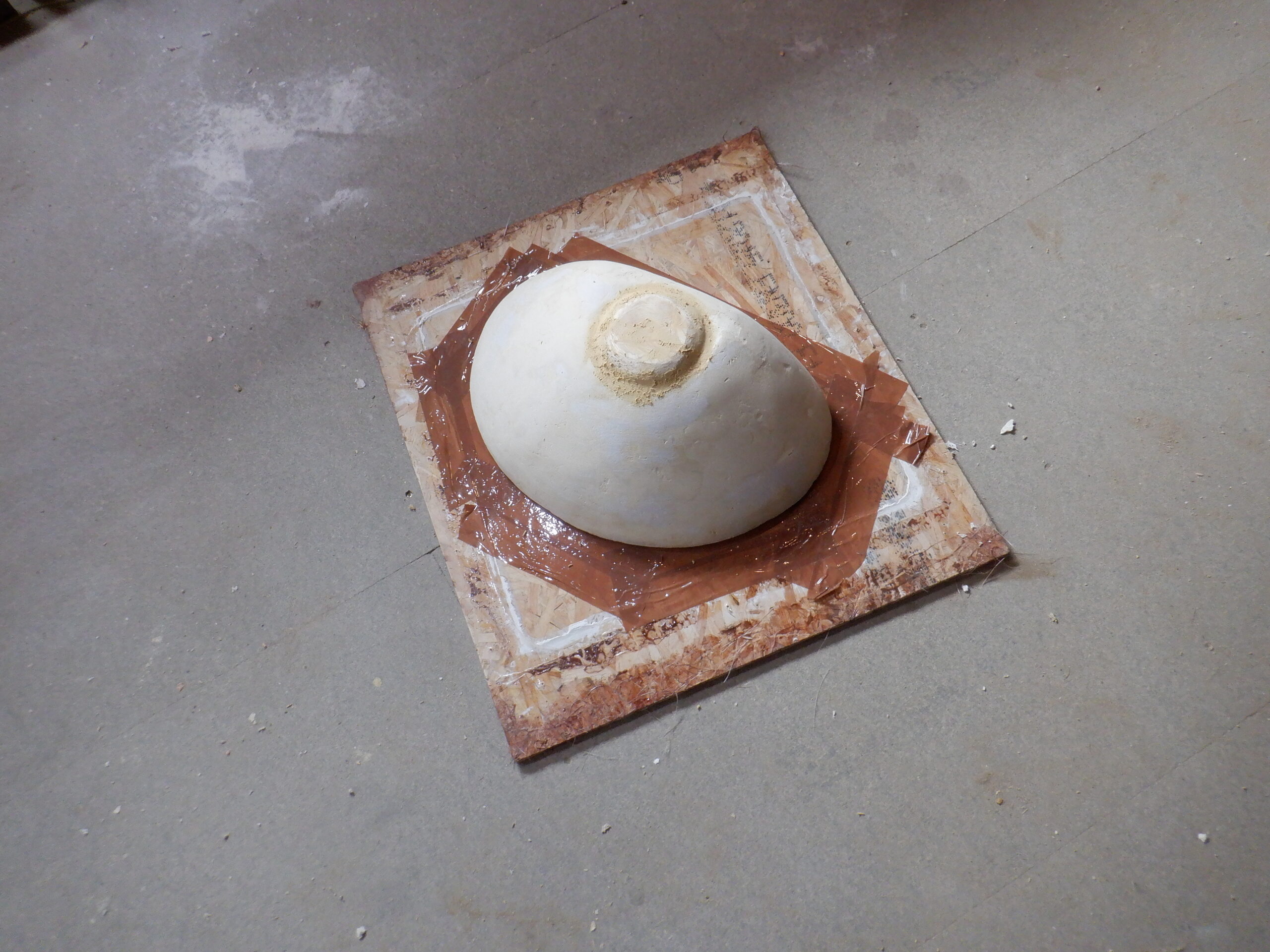
    So, the first job is to design and make a mould for the bowl itself. We glued together five layers of 25mm thick insulation boards, the largest one measuring 270mm wide by 450mm wide, shaped like a letter D. Then, the next layers were consecutively shrinking smaller around the curvy parts, but aligned up on the flat edge. It is now looking like a domed shaped pyramid, with the steps to get to the next level. We then, used a surfform shaper to remove the excess material from these steps, to smooth out the whole thing into a gentle curving bowl.

    Starting the bowl blank

    Starting the bowl blank

    We then scraped around the flat back edge, to give it a pleasing softness to the two outside wings and scraped all over the bowl to improve the shape.

    We then covered this foam layered object with two-part wood filler material, to fill in all the holes that accidentally get created and then sand it more thoroughly all over again. We repeated this process several times, patching small areas with more filler, until it was looking good.

    The last piece to add to the mould, was the reinforcing drain hole layer. We will need to drill a hole in the bottom of the bowl eventually, therefore, it would be good if that area of the bowl should be reinforced with extra layers of glass fibre when we come to make the actual bowl itself. So, we found an old 100mm diameter disc and chamfered one edge with a flat 45degree slope, to make the glass fibre strands to bend and lie into the mould without sticking up. We stuck this wooden disc, which was only 11mm thick with more of the wood filler and then filled in around the edges, to make sure that it doesn’t have any “concave” hollows or pits, for the finished product to accidentally get stuck to the mould when we try taking them apart!

    We noticed that the edge around the top of the bowl mould was rather jagged and we couldn’t get the wood filler to stick strongly enough so we went on to Plan B.
    We laid the mould flat on a large smooth board with had parcel brown tape stuck to it and then covered the whole thing with Gel Coat resin and leave it to set.

    Blank filled and sanded

    Blank filled and sanded

    While that was setting, we got some 10mm thick cement board and sliced it up into two 300mm wide pieces. We then glued them together using PU gun foam glue and flattened them together with six 25kg concrete blocks. Next, we very carefully measured the gap in the Cloakroom where the Vanity Unit is going, into the alcove that is formed by the Linen cupboard. We needed to measure both the widths at the back and front, plus also measure the angle of the wall surfaces which turned out to be 89.6° for the left back corner, and 91.6° for the right back corner. The back width was 755mm and the front edge measured 760mm wide. So we transferred these measurements to our double thick cement board and sliced the left and right edge very carefully.
    In order to help us fit this cement board “worktop” into this alcove, we got two pieces of battens and screwed them onto the wall at a point so the top surface will be at 800mm off the floor. Even though we were very careful in slicing the cement board, it still needed rasping on some parts of the left edge, to make it slide in and fit right back against the wall. We also had to rasp the two corners because they are gently curving as well.

    When we carefully cut around the edge of the mould, to release it from the flat base, we noticed that there were still missing chunks around the edge, the resin is transparent so we couldn’t see how much resin there was and also we were running out of that particular batch.

    We took this opportunity to install a releasing mechanism to our mould, by drilling a 6mm hole right through the middle so that we could glue in an air pipe. We also widen out the entrance to the hole, the one at the bottom of the bowl, so that when we come to glue the flexible pipe in, we will seal up the joint between the resin skin and the pipe itself.

    so we stuck the mould back down again on the base (after putting more parcel tape over it) and mixed up a little bit more resin, this time adding a bit of colour, green. We blobbed a line of it all the way around the edge of the mould and also we dribbled some into our new hole to doubly make sure that the compressed air won’t “peal” off the wrong layer !!

    While that coat of filler was setting, we went off to cut two more pieces of cement boards, but this time only 200mm deep, and glued them together with the same PU foam glue as before, weighted down with four concrete blocks.
    Then, while we waited for that glue to set, we sliced 50mm wide strips off a 12mm thick cement board, to start making the upstand strip that will go around the edge of the vanity unit. We carefully drilled screw holes through the base board and up into the upstand pieces. We had to replace one piece because we didn’t drill out the pilot hole wide enough to allow the screw to go in without breaking the hard cement strip apart. We were successful the second time around after testing various sizes. It needed a 3mm pilot hole and a 3.5mm clearance hole, to allow the 40mm long 3.5mm wide screw to go in fully.

    By this time, the glue had set so we got our 200mm wide strip and place on top the other base board, because the same shape and size also fitted very well at the lower shelf position. So, we placed the larger piece on top of the 200mm piece and sliced off the excess ends. We rounded the back two corners, just like the base board and both of them slid into place very neatly.
    We positioned the batten for the lower shelf so it just sat slightly higher than the waste drain hole going through the side wall. We drilled a clearance large hole through the batten and then screwed the two pieces on to the wall. We decided that we only needed two of them, a left one and a right one only.

    We then painted them the same grey colour as the rest of the wall. We did the other battens for the main vanity unit as well.

    One of the last things we did at the end of one of our days doing this job, was to finish filling in the mould around the edge with the wood filler. We now can get that nice and smooth and we had enough time at the end of the day, to coat a final top-coat resin all over and let it set overnight.

    Upon the following day, we trimmed off the various drip marks hanging off the bottom of the mould and then proceeded to polish the mould with layers and layers of wax. We had a special tin of wax release substance that is especially designed for glass fibre resin production where the wax is put on to the mould so that the resin cannot stick to it and should pop off fairly easily .. we hope !!
    We put on six layers in total, each layer needing 15minutes for the wax to dry before applying the next layer.

    While we waited, we got on with another task of shaping the 50mm wide upstand pieces that we previously have cut and screwed. We put on a 50mm radius curves on the beginning of the two side upstands, and then, routed a quarter round on the front edge of all four upstand pieces. We continued to use this quarter round cutter to trim the front edge of the flat top of the vanity unit, on both top edge and bottom edge, to form a bull nose profile. We also did the same to the lower shelf as well.

    Now, we dived into the deep end and went ahead to cover our basin mould with three layers of glass fibre, with regular resin on each layer, and allowed it to cure and harden.
    We then trimmed the dangling “curtain” of glass fibre off the bottom of the mould, tidied up the edge

    Bowl with initial fibreglass layers

    Bowl with initial fibreglass layers


    Then we attempted to “blow-off” the finished basin off the mould by squirting in compressed air down the air pipe we had installed .. but .. alas .. it didn’t work!! OOOO Boy!
    We tried to jam two crowbars deep into the foam base of the mould, tied some string between them and tried yanking the mould off .. but .. alas .. NO Joy! It broke the foam material.
    This meant that we had to destroy our lovely mould! We hacked out all the foam and started nibbling the inner mould layer. It seems that the glass fibre basin part had stuck to our mould in several places, hence why we couldn’t release the mould. It seems that the waxing process didn’t do a complete coverage all over the mould. We are not sure to why. Phew!!
    It took us several hours to rip the foam stuff out and then carefully, chip away the thin layer of resin from the basin bowl. We ended up with a couple of spots that needed grinding to remove the excess material. We eventually got our basin bowl out of it .. But, we will have to make another mould for the other wet rooms that contains a vanity unit with a basin. Phew!
    Struggling to remove the foam plug

    Struggling to remove the foam plug

    Cleaned up!

    Cleaned up!


    Now, we can mark out the cut out shape for the bowl, on the cement base board of our Vanity Unit, and proceeded to cut the piece so we ended up with the bowl fitting snuggly into place. We blunted the blade on the jigsaw as it is very hard cement material.

    Now that we have a boundary between the flat surface of the vanity unit and the bowl, we now can position the locations for the soap depression, plus also for the nail brush and the plug itself. We set up the router to use a hemisphere cutter bit and using a pre-made template (a piece of 6mm MDF board with a 100mm circle for the soap dish, an oval elongated shape for the nail brush and a smaller round one for the plug) and carefully cut away the cement material until we had three depressions, neatly arranged around the edge of the basin bowl, starting on the left hand side and finishing with the plug depression centred, above the overflow outlet and the drain hole. There would be room for a bottle of liquid soap and then finally, the spout itself to give a gentle fountain of water etc.

    We then glued the basin bowl into the cut out zone of the cement base board, using lots of PU construction glue which is very sticky and very tough once it is set. We left it 24 hours to cure and harden. We stuck a couple of bricks on top to hold down the bowl (which is upside down) sitting on our work table.

    Glued in the top

    Glued in the top


    Then, we proceeded to put a little vertical piece of the same cement sandwich board we had left-over, to form a little barrier just under the front edge of the vanity unit and connects to the curve of the bowl. We did this on both left- and right- and sides. We use a small piece of 20mm wooden batten to help secure these pieces into place and then we put a gentle quarter round on the lower edge to remove any sharp edges, before we continued to glue these two pieces into place using 5minutes PU glue, we also stuck down the four pieces of our upstand that goes around the edge of the work top.

    It is getting there .. !
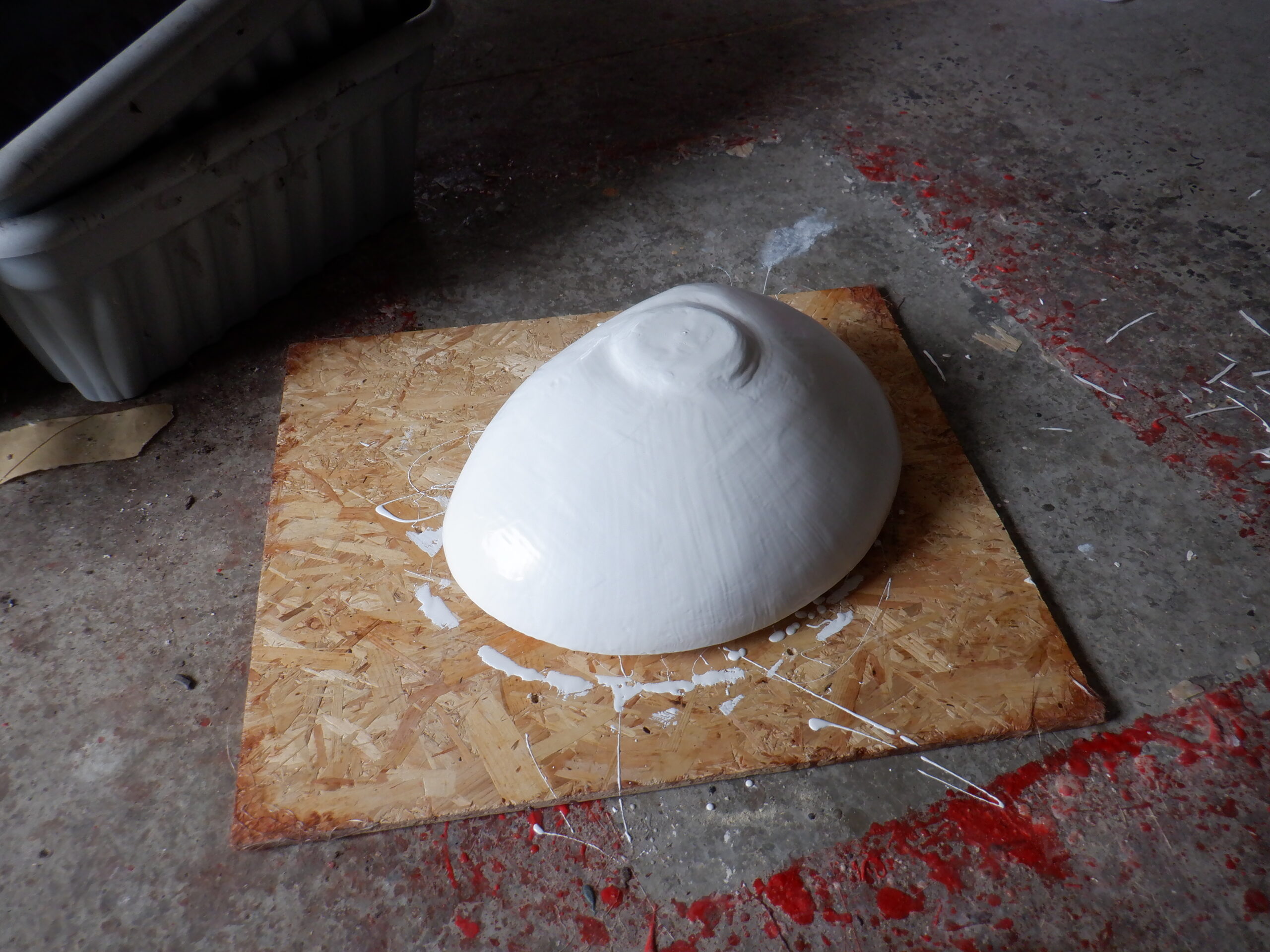
    The next task is to fill in all the corners with two-part resin base filler, to smooth the transition on all the joints, to provide a curve so that the glass fibre can be encouraged to bend around the corners without breaking, or popping clear of the resin before it had set.

    While we remembered, one of the final use of the router, was to cut another quarter round on the edge of the basin bowl that is touching the cement work top, again to allow the glass fibre to bend down into the bowl itself.

    We put in more filler around the upstand and use a 22mm tube to form a curved profile on all the 90degree corners and that was rubbed down smooth.

    We built a little “stand” to hold the vanity unit up and clear off the table so we can apply the fibre glass and resin all over, without sticking to the table etc.

    So, after rubbing down all the fillings, we blasted the whole thing with compressed air and move this and the stand to the Garage and stuck on two layers of glass fibre with resin all over the top surface and bowl.

    Fibreglassed all over

    Fibreglassed all over

    While that was curing, we got the second shelf and drilled a large clearance hole at the back of the shelf, centred. It is a 50mm wide hole to allow the push fit plumbing right angle connector up underneath so it can receive the waste pipe coming down from the trap and the bottom of the bowl itself. We then made a quick and easy legs to hold up the shelf, using two small pieces of OSB and carefully screwed two long screws on each narrow ends of the shelf, through a small piece of plastic pipe to act as a spacer. The whole thing held the shelf well clear of the table.

    Upon the following day, We then trimmed off all the sticking out straggling strands of glass fibre and turned over the whole thing so we could resin and apply more fibre glass underneath the vanity unit and especially doing the front half of the bowl, to strengthen it so it will be much stronger and resistance to being bumped into in the Cloakroom.

    While that was setting, we also did the second shelf and we covered it in glass fibre in one go, doing both sides at the same time, including going over the drain hole as well.

    Lower shelf resin coated

    Lower shelf resin coated


    After lunch, We proceeded to trimmed all the loose strands off both the vanity unit and the second shelf. Then rub all over everywhere and we put in extra filler here and there, to touch up areas that became a bit too thin after sanding the lumps away. We also thickened up the edge around the bowl and filling in air gaps that accidentally formed during the second stage of putting glass fibre on. We also decided to put the white filler on all the flat surface, to help remove much of the gently wavy surface.
    All filled and sanded

    All filled and sanded

    At this point, we are reaching the moment where we need to apply the final colouring layers, but, we do need various plumbing bits and pieces, like the over-flow and the drain hole, to come from our suppliers.

    So, in the meantime, while we waited for our plumbing order to arrive, we got on with colouring up the second shelf, with the final dark grey with a hint of blue in it. We also collected up a collection of tiny pieces of glitter of various colours, sieving out all the larger lumps. We put the shelf back on the support stand so that we could coat both sides in one go. We mixed 200g of the grey / blue mixture we previously settled on. We experimented with lots of different shades of greys and different levels of blues as well

    And we settled on this darker shade of grey and were happy with the blue content as well.
    So we coated the second shelf with the grey colour and while it is still tacky, carefully sprinkled on our tiny pieces of glitter all over, on both sides of the shelf. Then, later on, several hours later, we applied a protective clear coat of resin which is designed to help seal everything in and provide a very smooth finish.

    By now, our plumbing items arrives, a over-flow plastic pipe so we drilled a new hole into our basin bowl, just below the rim, using a core drill of 27mm diameter and then digging out a little bit of the cement board underneath and behind the bowl. We then glued this plastic right angle pipe in with lots of the plastic filler, covering up the threaded part and over the flange at the back, and squashing it all together by using the nut to push the filler tight into the thread and the surrounding area. After it had set, we sliced off the plastic nut and the remaining pipe that was sticking out into the bowl area. We sanded it smooth and then touched up some small hollow bits until we got it lovely and smooth.

    The next job was to install the drain hole and plug. It measures 41mm across on the threaded section and the flange is 61mm across. So, we used a 44mm core drill but we added an extra piece of wood, cut into a circle, a piece of 3mm thick plywood, also cut to a 61mm circle and positioned it behind the core drill bit. We stuck on a small piece of 60grit sandpaper on the wooden disc and then locked the core drill on to its holder. We then got a middle position in the bottom of the basin bowl and drilled through the thick layers of glass fibre and resin material from underneath first, then turning over the whole thing, continued to cut the remainder of the hole from the bowl side downwards. Then, we did continue grinding the surface away using the little sanding disc we had attached so it created a little hollow for the flange of the drain hole to sit neatly into place and just be below the surface. We chamfered the hole a little bit to allow the plastic moulded drain hole unit to fit in better etc.

    We then trimmed down the long threaded part so there was just enough thread left to attach a solvent weld adapter to let us fit a right angle 32mm waste pipe piece, to bring the waste pipe back towards the wall and then turn to go down towards the second shelf and the large clearance hole we have already made.

    The last thing we did for this particular day, is to coat the grey / blue gel coat on to the under side of the vanity unit all over and then sprinkle our glitter everywhere. We used a small fan to provide a gentle wind to blow the glitter up onto the vertical surfaces. We have just been holding up a pinch of the sparkles about 2 feet above the target area and sprinkle it that way. but, that doesn’t work so well for vertical surfaces so we used a little fan instead.

    Upon the next day, an interrupted day with a external meeting to attend, we put on the final glossy top-coat resin on to the back half of the vanity unit (it is still upside-down) because the grey resin is very slightly tacky and we felt that turning it over wouldn’t be a good idea without causing problems like getting stuck etc. So, the top-coat went on to cover up the grey and provides a very hard finish.

    We had a little bit of time before lunch so we took our finished second shelf, cleaned off all the dribbles around the back edges and fitted it in our Cloakroom. Well, not actually fitted exactly, I mean, with glue and everything! Just resting there on the support battens so we can sort out the waste plumbing pipes that will be coming down from the bowl. We are using push-fit plumbing parts, to take the waste water through the trap (which is above the shelf) and then turns a right angle immediately underneath the shelf. Then, a short distance at an angle to a second bend but this time only a 45degrees bend before a longer straight run all the way to the final socket that is buried in the linen cupboard wall.
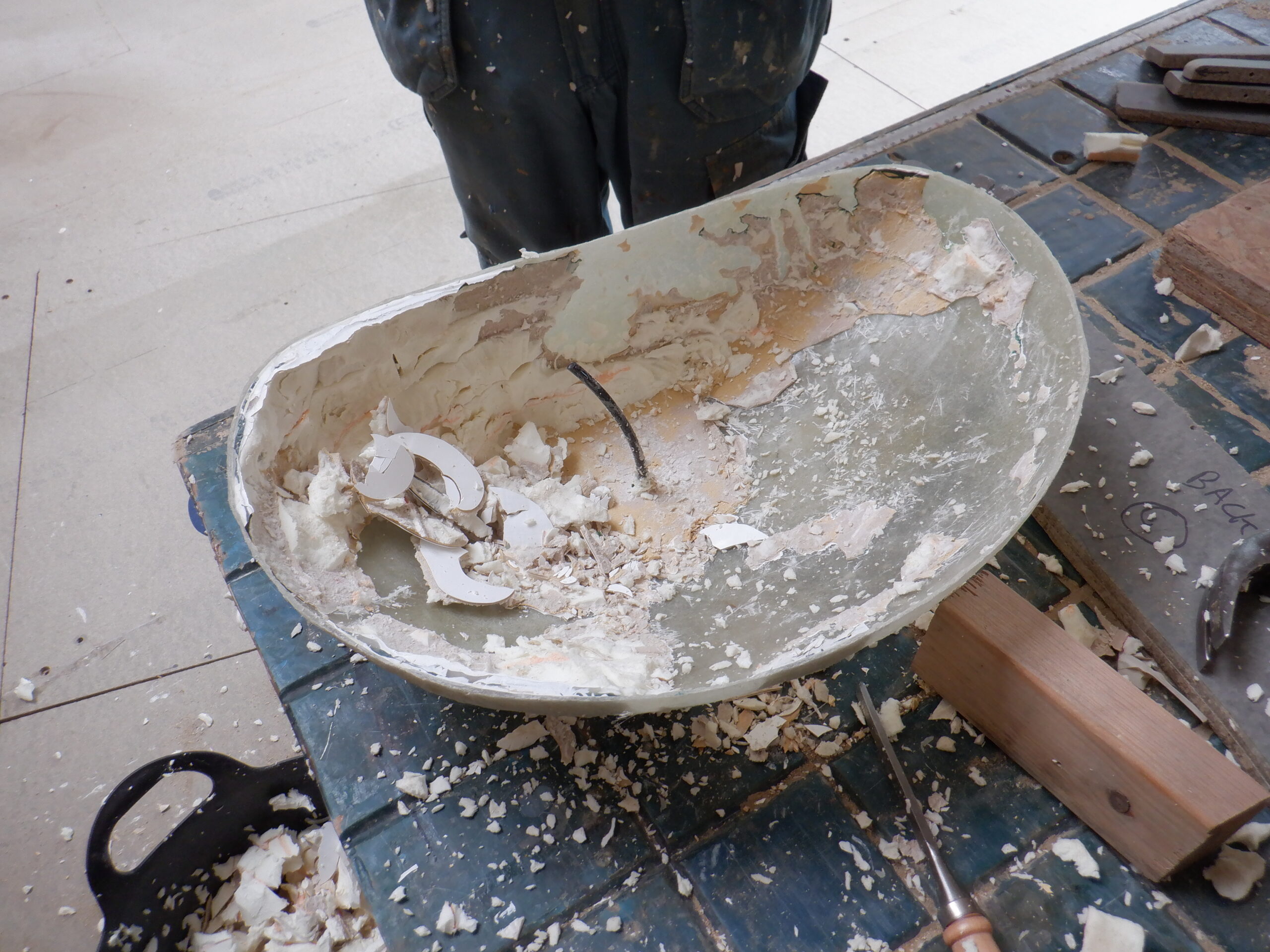
    Waste Plumbing connections

    Waste Plumbing connections

    Just before lunch, the glossy top-coat has harden completely so we turned the whole Vanity unit over and then applied the grey / blue gel-coat mixture all over the top surfaces and inside the bowl, to complete the coverage.

    Then, after the aforementioned meeting, we use the last hour of the day to apply the glossy top-coat resin all over the grey surfaces, all in one go so that we do not get a join line or something.

    The last job to do was to clean all the back edges, similar to what we did to the second shelf and tidied up the drain hole so it will provide a flat surface for the attachment to fit snuggly down tight, which we sealed in with black sealant. We then finished off the last bit of the waste pipe from underneath the bowl, including connecting the overflow output and join into the vertical trap. We cut down the long excess lengths of the drain hole attachment so it fitted closer to the bowl and reduce the unsightly views of waste pipes etc.

    Vanity unit complete

    Vanity unit complete

    That pretty much finishes the construction of the Vanity Unit for our Cloakroom. The next job is to make our waterfall tap and we have some ideas which we would like to try out first. We may have to buy a waterfall tap but they are difficult to find without any mixer handle built-in.

  • Hall Hatches Improved and Ready for Bolts

    While we waited for our latest modification we have done to our basin bowl mould, we decided to do one of the tasks that have been outstanding for quite a while now, which is to do two things. One was to glue in the captive nuts in the lid. We noticed that sometimes, they would pop out when we push in our special hatch keys, to screw the handle and then lift the hatch up, but instead, would pop the nut out. So, we went around all twenty-three of them and glued all these captive nuts back into place using construction glue. We also populated missing ones as well.
    The second task we did to these hatch lids, is to drill out a clearance embedded hollows, to take a 14mm washer and hide the head of a bolt so that both are below the surface. Then, we drilled a 6mm hole through the rest of the material which will allow a 35mm length bolt to poke through and will connect to another captive nut that will be screwed into the framework of the floor joists. We have positioned four of these “fixing down” points around the four corners of the hatches, 60mm in from each edge. We will have to glue a block of wood into each of the corners of the framework, but, we can do that later on.

    We had selected two of these hatches, to test out this technique last week and glued in a 63mm square block of wood in each of the four corners, and so we could see that when the 6mm hole was drilled, it went into the block underneath which was widened out to a 8mm hole, to allow for the captive nut to be itself screwed in as well. Then, the lid was bolted down nice and tight, to stop the various clunking noises when walking up and down the hallways.
    It worked very well.

    Right, that is another job done .. well half done .. we still have to glue in those wooden corner blocks .. but that it another time .. while we are waiting for glue or paint to dry somewhere!!

  • Hot Water Tank Kitted Out and Installed Into Utility Cupboard

    One of the jobs we have been working on now and again, in between other jobs, is putting together all the internal bits and pieces for our Hot Water Tank. The heat exchanger is now ready and we slid it into the tank. Then, we aligned the three pipes inside, with their elbow bends on top, and drilled clearance holes for a series of tank connectors, one for the 28mm pipe and two for the 22mm pipes. Plus also another 28mm one for a short piece of pipe, to pair up with the other 28mm pipe that goes down to the bottom of the tank. That covers the two main types of water flowing in and out of the tank. All four needed their elbow bends to be soldered into place.
    But, that is not the end of these tank connectors, we then did another one for a 15mm pipe, a piece of copper pipe which we put a 90degrees bend on it and that will be a cold water feed to top up the hot tank if necessary. The final water type tank connector we inserted, is for the overflow relief pipe, just in case the filling mechanism didn’t halt the filling when it should have done so.
    All those connectors were mounted just under the flange at the top of the tank, on the long side, and they all have external right angle bends, ready for plastic pipes to be inserted in.So, on the short side of the tank, we then drilled a series of holes, this time, for the electrical types of connections going in and out of the tank. The first two were float switches, for controlling the cold water filling system. They are positioned so one will detect the water level dropping below the 100mm mark which will cause more cold water to be fed in. The second float switch is positioned just underneath the overflow outlet so we can detect a failure to halt the filling process and cut off the electric supply to the pump or valve etc.
    Then, the next holes to drill out, were seven holes, to allow nylon glands to be fitted, which has a screw cap that tightens down on electrical wires (two of them actually have 10mm plastic microbore water pipes coming through as these are conduits for two temperature sensors to be inserted into the water). The other five glands will have a bunch of electrical wires going to a mixture of 50V DC heating elements and a couple of 230V AC Mains heating elements, to dangle down inside the tank near the bottom.

    Hot tank with everything plumbed in

    Hot tank with everything plumbed in

    Now having fitted everything that will go inside the Hot Water Tank, we moved it into the Utility Cupboard, to end up in the corner, tucked out of the way.

    But first, we need to put in a solid block of PU insulation foam boards, to surround the tank, to insulate the tank, with a thickness of 100mm all around. We had a collection of 25mm thick sheets that were left-over from other jobs so we put in four layers on the bottom, measuring 800mm deep and 500mm wide. Then, we put in a piece of DPM plastic across the whole area, sandwiched between the third and fourth layers, to act as a captive water tight barrier, so we can detect any future leaks, using an electronic sensor. This is a last ditch detection system so that we are made aware that the tank is leaking somewhere and that we have to rescue the situation.
    Next, we put in four more layers of the PU sheets, this time, the left-hand side of the tank. They are 800mm wide and went to a height of 1800mm for the first three layers and a slightly shorter 1700mm high piece for the final layer that is next to the tank and fits just under the flange.

    The third block of insulation is the back wall, this time measuring 400mm wide and a similar height as the previous load. We jammed them in so it keeps the left side layers nice and tight.

    Start of hot water tank insulation

    Start of hot water tank insulation

    We can now man-handle the tank into position, sitting on the block of insulation and shoved over so it is tight next the left block. We then resumed sliding in more sheets, this time, only measuring 700mm wide but we could only get 90mm of foam boards into the available gap, which we achieved by putting two layers of 25mm sheets and a single 40mm thick sheet. Also, we reduced the height by 100mm as well, because all the pipe connections are in this location. We will probably fill in this gap with glass wool insulation later on once we have fitted the various pipes into place. We are also likely to slide in an additional 40mm PU board that will fit in between two CLS wooden legs that are part of the cupboard framework. That will provide some extra insulation as well.

    The final step in covering up the tank is the front and we put in two layers of 25mm sheets measuring just 300mm wide and 1600mm high, and a final 40mm thick one to finish off.

    Fitting last of the insulation to the hot tank

    Fitting last of the insulation to the hot tank

    The final piece for the tank, the lid. We got a small left-over piece of 12mm cement board and cut it down to fit on the full dimension of the tank plus the flange around the top, and cut it to fit. We stuck a couple of layers of 40mm foam board on top as well.

    That concludes the assembling of the Hot Water Tank and fitting it into the Utility Cupboard, with its insulation completely surrounding it. We will do another soak test and this time, rig up an electrical circuit and heat up the water to a good 90°C to test everything. This is a good time to do that as the electricity prices are very cheap during the night, plus also, we are getting lots of solar at the moment, which will help reduce the cost of heating up 288litres of water and then letting it cool down by natural means so we can find out how long it takes with the amount of insulation we have put on.

  • Repair the Hot Water Tank

    At last, we tackled the annoying problem of fixing a leak in our new Hot Water Tank we constructed a few weeks ago. Just to recap the situation, we discovered that our mould we had made to shape the fibre glass resin on to, had little ripples in the release tape we had stuck on. These little ripples has create little grooves in the finished resin surface. One of these grooves was deep enough to breach the inner skin and this allowed the water to escape. That is the situation .. O Boy!
    So, we tackled this problem by having to climb, or rather, crawl inside the tank which is lying on its side. We vacuumed the inside and then rigged up a fan to blow forced air into the tank, to make absolutely sure that we are getting fresh oxygen and removing the chemical vapours. We went through the whole tank and scrubbed all these grooves with acetone, to clean out them and prepare the surfaces ready for a fresh application of more resin. We have to do this work in two stages because we cannot turn ourselves over to work upwards, so, we had to rotate the tank over.
    We mixed a small quantity of resin and added some yellow dye, which turned the red colour to an orange shade. This will give us a feedback to where we had applied the resin. While wearing our mask with the activated carbon filters, we proceeded to dab each of these grooves. We turned the tank over and did the other half as well.

    Sealed up the defects in Hopt Tank

    Sealed up the defects in Hopt Tank

    We left it to cure and harden overnight.
    Now, it is time to give it another leak test, we got out our garden hose again and started filling. .. In the meantime, while it was filling, we went to find a piece of 12mm cement board, traced the outline of the top of the tank and sliced it into a lid. This will sit on top, on a ring of rubber around the edge and keep the steam and hot air in the tank.
    Oh No !! !!
    We still have the same leak as last time !
    After trying to see where the hole is, on the inside of the tank, we had the idea of using compressed air to blow backwards from the spot where the water is steeping out and force air through the skin and hopefully make air bubbles appear on the inside. We eventually stuck on a 4inch square piece of thick plastic, with a ring of butyl thick glue around a circle and then clamped it on over the site. We carefully sent small burst of air into the white plastic pad, through a hole in the middle and .. we had a stream of air bubbles blowing into the water!
    Plate attached to allow air injection

    Plate attached to allow air injection

    Injecting air to find the leak

    Injecting air to find the leak

    Bubbles showing where leak is

    Bubbles showing where leak is


    We got a dark wax crayons and drew a small circle around the site where the bubbles came out. It had to work underwater!!
    Then, we drained the tank so that the level of the water was 6inches below the “hole” and then drew a wider circle using our marker pen. We sanded heavily this zone, to make sure that the surface is well “roughened”, to help stick the new layer of resin over that spot. We also heated up both sides with a hot air gun, set to 100°C maximum, to thoroughly dry the fibre glass and drive out any moisture trapped within the fibre glass itself. It needed to be as dry as possible so that the new resin will stick properly. We rubbed the entire zone with more acetone, to soften the resin and make it more attractive for the new liquid resin to stick better as well. We mixed a small amount and then applied it to the 4inch zone inside the tank. We had left-over so we painted the wall near the top of the tank, where we are planning to have various connections made to pipes etc.
    Again, we left it overnight to allow the resin to cure fully, before refilling the tank back up to normal levels again. To see whether we have fixed the leak .. or not!!
    ..
    No Leaks!! Hurray! Yippeeeee!
    At last!
    We left it full of water all day and it is looking good.
    We now have a repaired Hot Water Tank! Ready for the next stage of fitting the connectors and the heat exchanger coils ..