
Rotating CLS
Just to recap to what we got up there in the Skylight, is a 50mm square steel beams going across from one side to the other side, that supports a similar 50mm square steel post going upwards which has the wooden ridge beam running on top, supporting the Skylight Windows themselves. These steel beams will define and form the basic shell, or box, to cover up the solar panels, to hide the air ducting and provide somewhere to house the Window Blinds and lighting units as well.
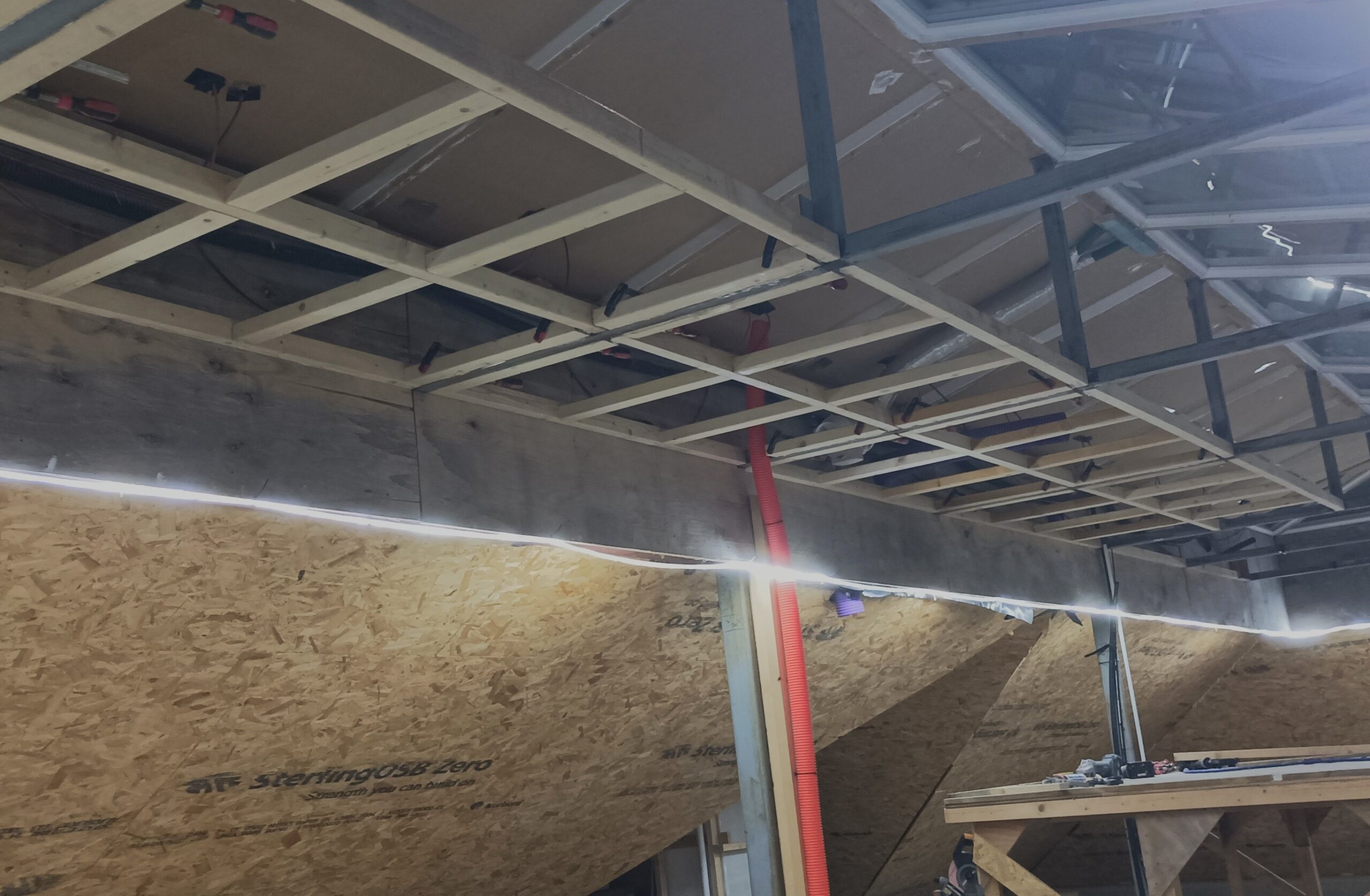
So, we needed to construct a wooden framework that goes from one steel cross tie, to the next cross tie. They are like upside down capital T. But, in order to attach the wooden elements to the steel, there needs to be metal tabs welded on to the sides of the steel tube. We already had two pairs of tabs going up the vertical post, ready to take a 38mm thick CLS timber, but, we needed two more pairs of tabs to take a 50mm thick piece of timber, this thickness matches the size of the steel tubes. These pieces of timber will support both the layer of OSB boards that is going inside the boxing, sitting on top of the steel frames, and also to allow the plasterboard to be glued and screwed upwards, to encapsulate the steel bars from underneath. Both surfaces needed this timber framework so that we could screw the materials in place quickly, without having to resort to wet slow drying glue as the sole fixing method.
So, we needed twenty-eight more steel tabs. We looked on our steel material rack and found a strip of 5mm thick bar measuring 70mm wide and we did sliced off twenty-eight pieces, measuring 48mm long. We did have to run our belt sander all over the steel bar because it had a rather gritty coating of rust, and after we had cut the pieces, plus drilling two 4mm holes, we put them all in a solution of anti-rust liquid and hung them up to dry on a length of string, like a necklace!!
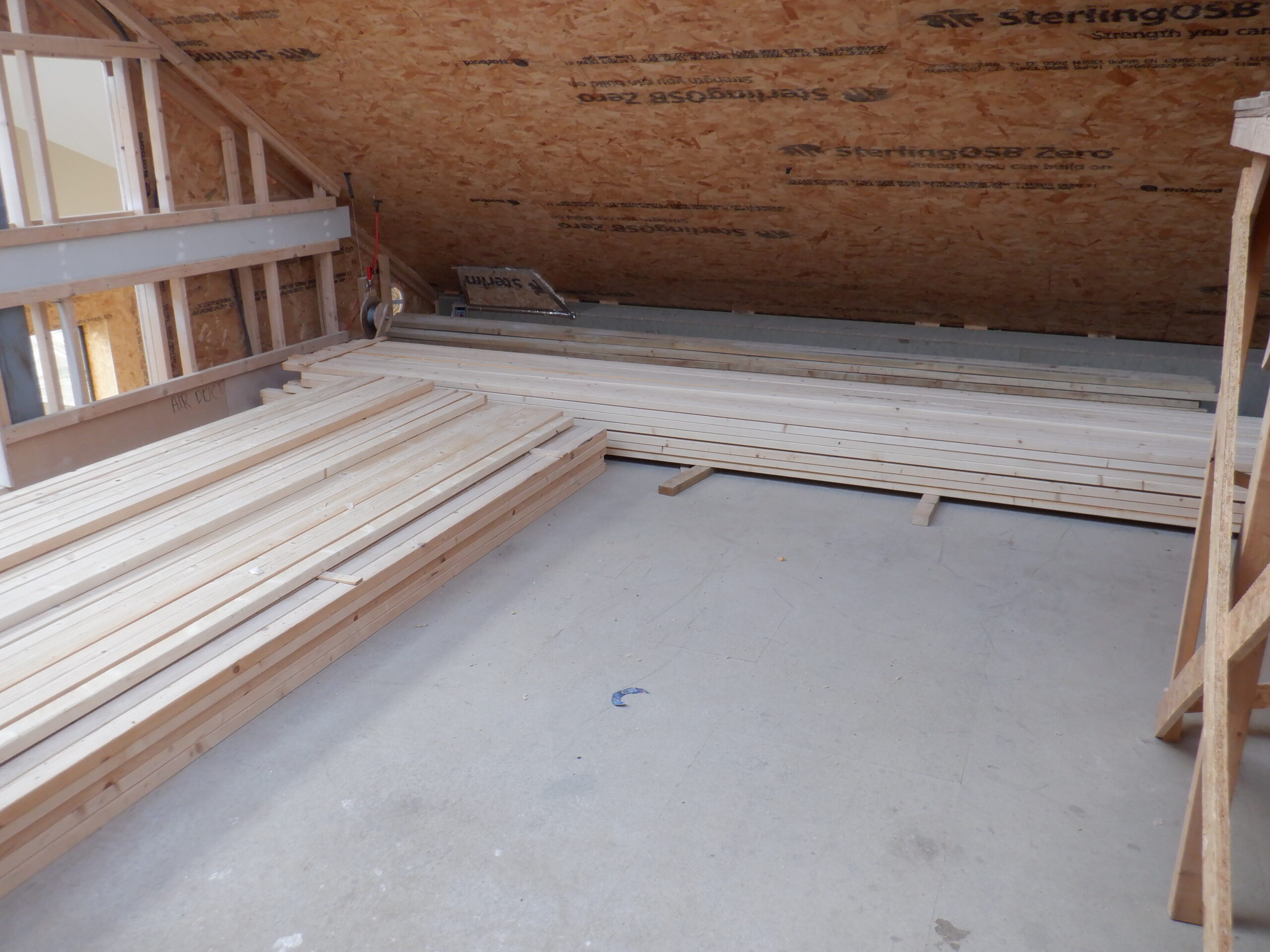
There are seven sections that needed these extra timber pieces spanning the gap between the ties, varying from 1495mm, 1520mm, 1595mm and 2140mm. We found the straightest 63mm CLS planks and created seven triplets. We did add an inch to the lengths, just in case there were local variations. All the timber pieces were taken to our table saw and proceeded to slice them down to exactly 50mm wide. We now have a heap of 12mm thick thin strips which probably will be useful in some future job!
Before we can fix these pieces in place, we had to weld our new tabs on to the side of the horizontal steel tube. The first one is positioned in the middle of the steel bar so that the wooden piece will go aligned to the front surface of the vertical steel posts. This is where we will put our plasterboard sheets on that flat vertical plane. The second tab is just approximately half way along the tube heading towards the edge of the Skylight, so we had a template to position that second tab consistently on all sections. We moved the platform along to do each section. We did have to design and build a mobile welding station, with drawers etc. see Building Welding Station. It made things so much easier in having the welder close to our work.
Now, back upstairs, with our pile of 50mm by 38mm pieces of wood, we went along gluing and screwing the three pieces in each section. The first one on the front, glued and screwed into place, making sure that the alignment was good, followed by the second one in the middle, and finally, the third planed piece of wood is glued directly on to the plywood surface using PU construction glue, and screws to anchor it down while the glue sets. The plywood surface was thoroughly sanded using an orbital sander with a rough paper loaded, to get rid of the weathering.
While we are in a section, after we had put in the three pieces, we also put in four short lengths of 63mm CLS pieces, flat, going right angles to the other framework, to join them together and provide a flat surface for the plasterboard to be glued and screwed into. Without them, the plasterboard is not strong enough to be supported 600mm from joist to joist. Hence these extra pieces being glued and nailed into place.
Skylight Base Frame
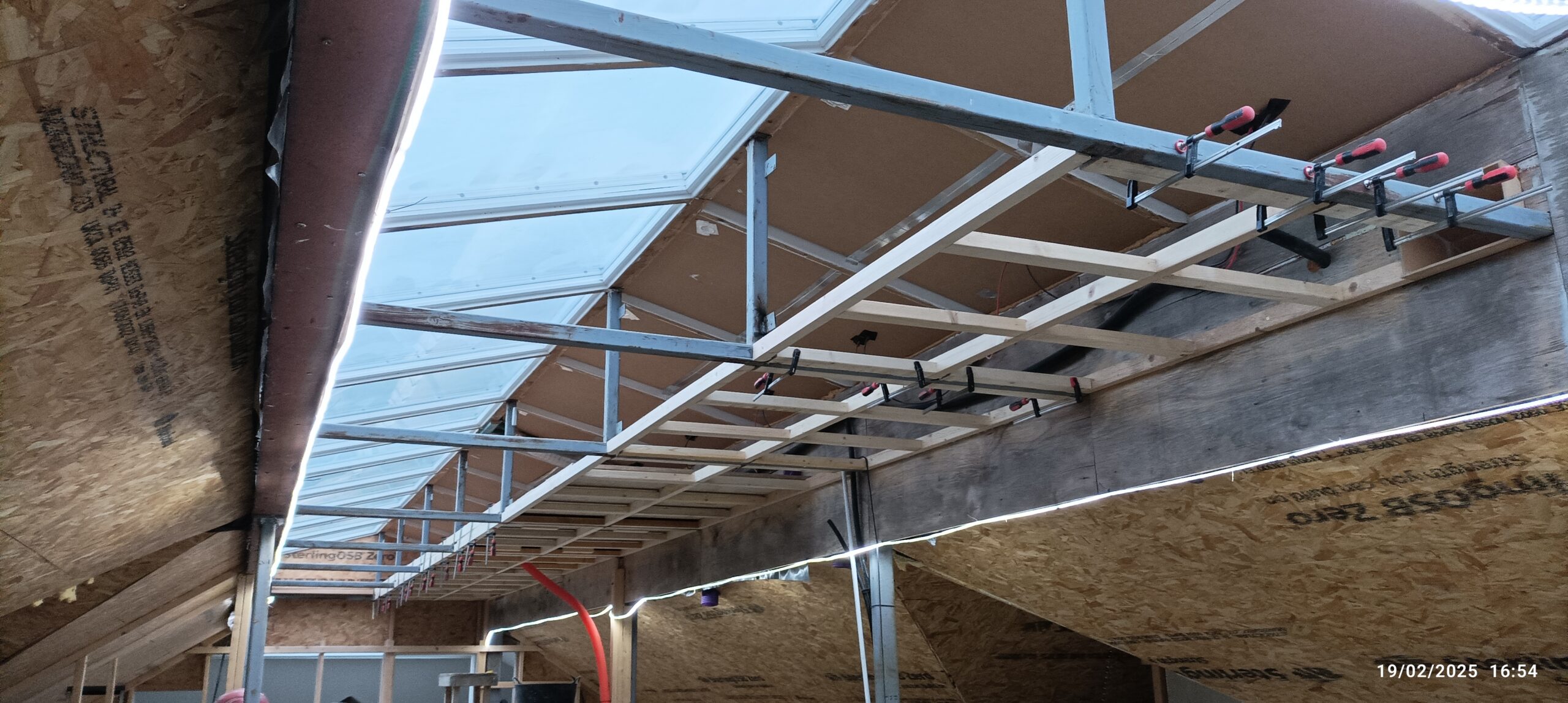
Now, we proceeded to haul up sheets of 18mm OSB board pieces. We had a pile of already used boards and they are a bit painty with white emulsion. These came from the time we had built the temporary platform when we were constructing the ceiling and Gallery in the Great Room. There were eight half boards and one two-thirds sheets and turned out to just fit the entire length of this new boxing, a total of 11660mm end to end!
We had to cut notches in each board piece, to go around the steel post, also wide enough to avoid the two metal tabs as well, when we lower each sheet into place. It got the usual PU glue and dozen screws to fix it down tight. The first three sections working from the Great Room end, had the board trimmed by about 30mm and the final four sections, had only 10mm bit sticking out to be trimmed off.
Next, we put in the first horizontal CLS piece that is sitting on the newly created OSB floor, all glued and then screwed using the metal tabs to anchor it. This helped to stiffen up the framework very nicely.
Skylight Frame 2
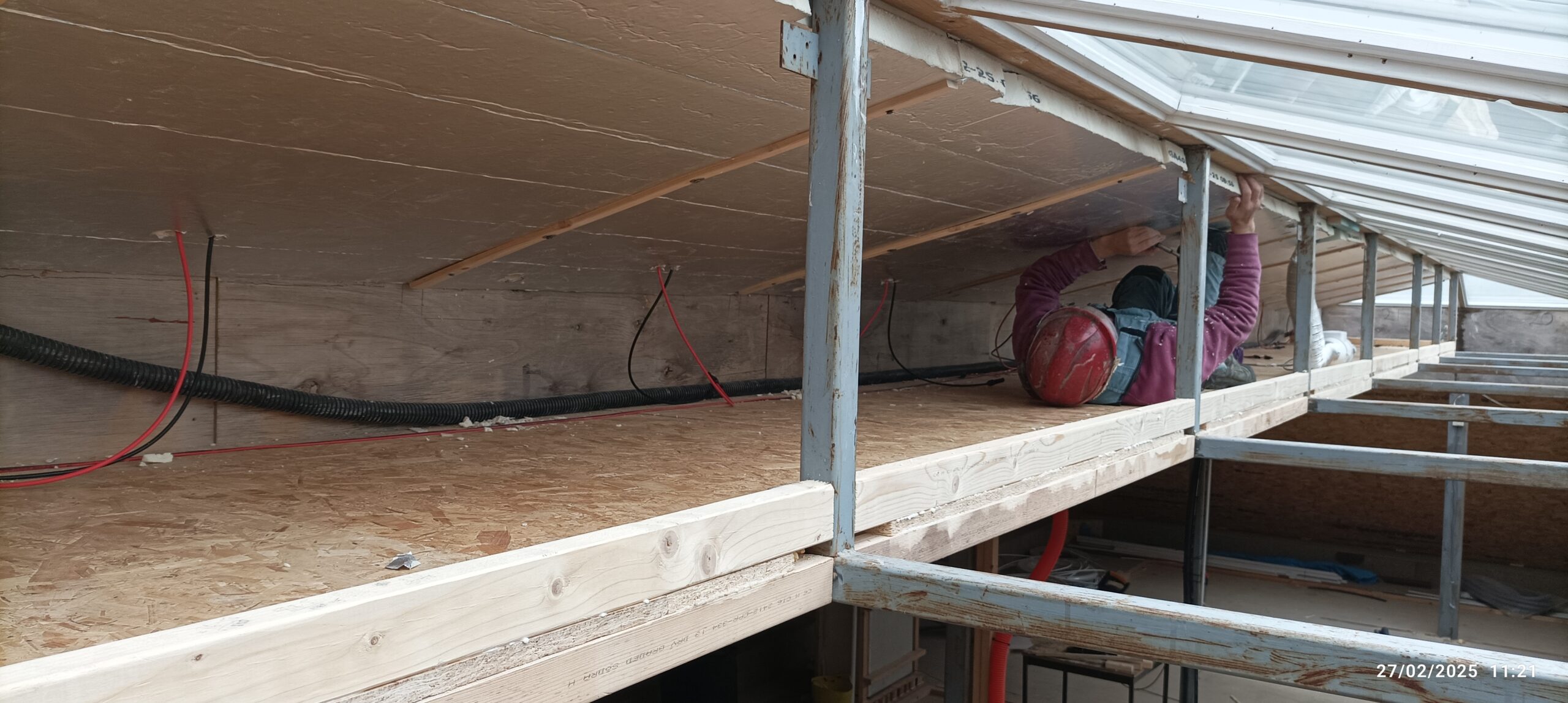
by this time, our delivery of eleven sheets of PIR insulation 50mm thick boards had arrived. This type of insulation is the modern version of the old PU foam and offers a much better fire safety response. PIR stands for PolyIsocyanuRate and it is only slightly worse thermal properties than PU foam.
We needed this insulation boards because we need to protect our house energy where the solar panels are situated as there is no double glazing etc. So, we went along underneath each solar panel section, there are eleven of them in all, and cut an almost square pieces, measuring 1040mm wide by 1170mm high. We had to create a template to locate the four holes (two air holes for cooling down the solar panels, and two smaller holes which has the electrical cables coming through) and using this template, we could drill out the holes and insert the foam sheet up into place. It was a bit fiddly at times, and one of our solar panels had a different positions for the air holes, but, we made it all the way along. We then repeated the process again for the second layer of foam boards, this time anchoring the sheets up by using a strip of 12mm thick CLS left-over pieces and screwed them up to grip the edge of two boards with four screws. Finally, we used the left-over pieces of foam, to stick on the plywood panels at the back of the compartment which improved our house insulation a little bit.
Insulating Solar Panels
Now that we got up the insulation panels, we reconnected the cables from the eleven solar panels and tested each one to make sure that all eleven are still working. BUT, No! The first one (nearest the Great Room end) was not working. It was reading zero volts! Oh No! This meant that we had to undo the two layers of the 50mm thick foam pieces, unscrew the MDF 6mm thick board, to gain access to the solar panel itself. Then, we could see that the wire coming from the back of the solar cells and going into an adapter box, the soldered connection was very poor so we used our gas powered soldering iron, with fresh solder, and we got the wire solidly resoldered much better this time. We now have proper amount of voltage coming down the wires, some 20volts since it was a bright sunny day. We reassembled the cover, and the foam pieces, clamping it back down again.
We next tackled the task of installing an air supply to the Solar Panels, at the bottom, using 40mm diameter white plastic plumbing pipe, with push fit T-junctions for the middle nine panels and right angle bends for the outer two panels. We are planning to have air supply coming up from the main air duct running downstairs underneath the hall, going through a 50mm flexible conduit and that terminates into a switching chamber where the air can be diverted to either the Solar Panels to cool them down during sunny periods, or, through the gap above the double glazing to control the condensation. The cool air will push the hot air out via the upper air hole and will be taken away via several valves on the air duct that we got running inside our Skylight Box.
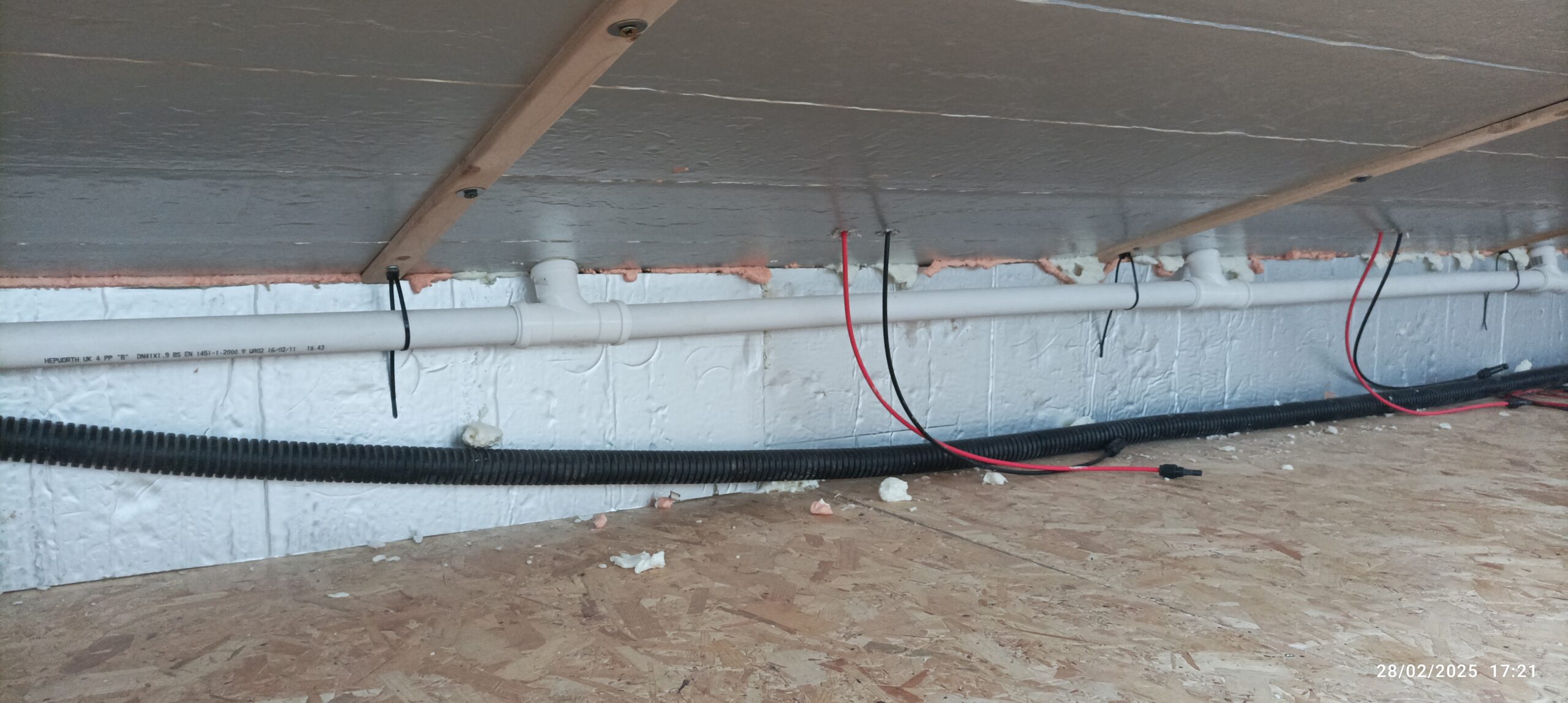
Air to the Solar panels
Talking about our air duct, that is what we did next. We took three sheets of 18mm OSB boards, laid them out on the floor in our Great Room and proceeded to give them a double coat of polyester resin, to give a smoother finish, filling in all the holes in among the strands of wood, plus also to prevent moisture to build up in the fabric of the wood as well.
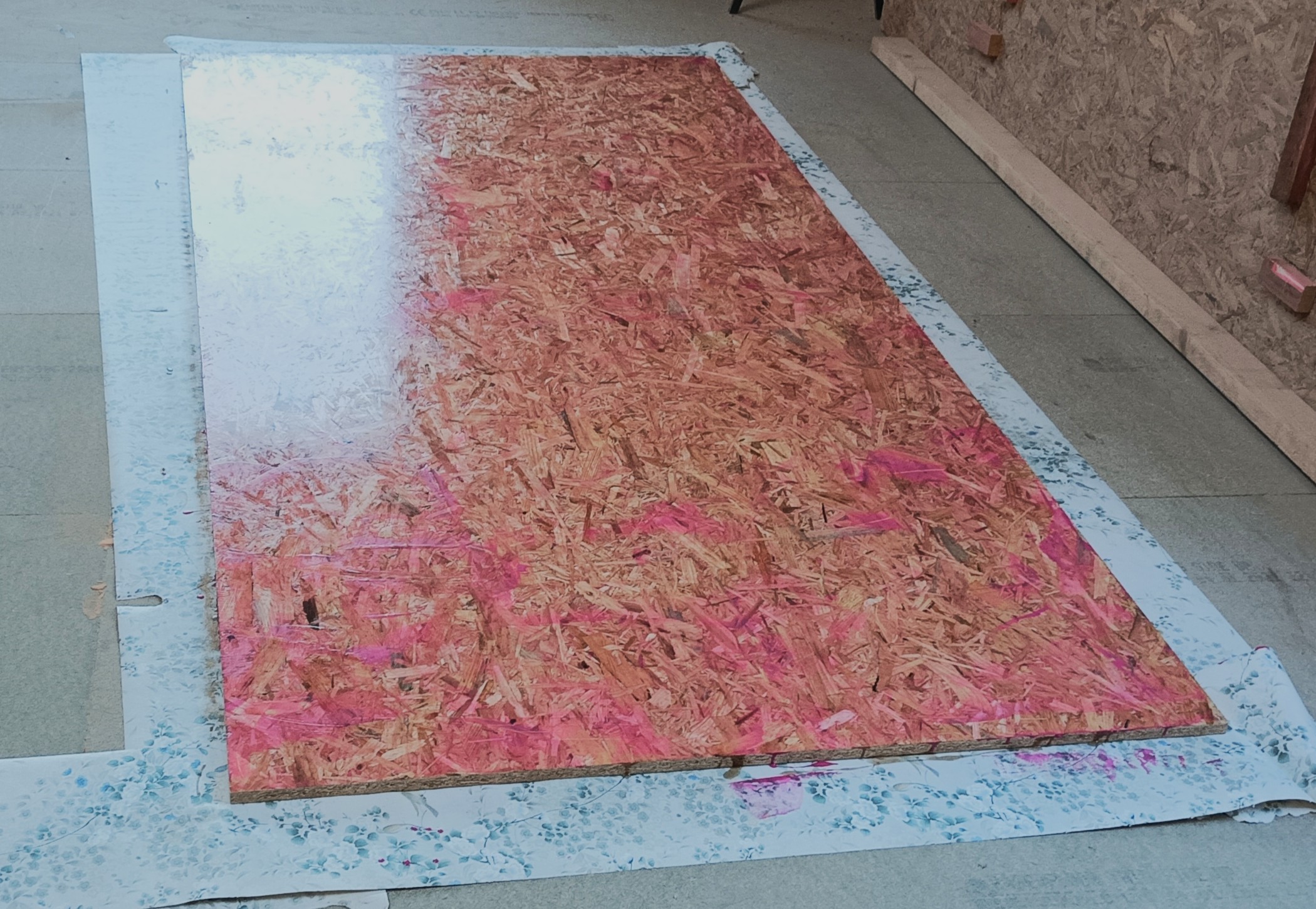
Varnished OSB
Then we sliced up two of those boards, into eight 150mm wide strips from the first sheet, and then eight 300mm wide strips off the second one. These will form the main duct running along the whole Skylight Boxing, fitting just nicely in between the two “chimneys” that will take the waste air away. We fixed them using small pieces of 25mm by 38mm battens, using three of them on each 150mm high 8foot vertical sides, gluing and screwing them into place. We used the 300mm wide lids as a spacer to position the second line of battens at the back. We had previously set our green laser line generator to give us a ruler straight line for the front side of the ducting. We marked the surface with lots of dashes.
Next, we looked at the beginning of the ducting, the furthest end away from the Great Room, and designed a gentle curving duct that flows the air around ninety degrees and also to bend slightly downwards. It also had to squeeze the air a little bit, to fit the chimney hole itself, before it spreads out in the channel down inside the sloping roof, to the main duct running around the first floor.
We used a piece of our 1mm thick flexible plastic to provide that gentle curve, to encourage the air to flow around the bend smoothly. We then finally put on a lid to cover everything up. Eventually, all these joints will have aluminium sticky tape to seal against any leaks etc.
Next, we proceeded along the length of the ducting, to drill holes into the lid and sides, to screw in a captive nut, and then screw down the lid with steel bolts. We used all eight of our 300mm wide by 4foot length pieces.
Now we are at the other end of the duct, there is a far more complicated situation to deal with. As well as the chimney to connect to, we also had a large round vent to connect with, this being the vent for the Skylight inside the Great Room. It was a case that this 250mm diameter circular vent is positioned in the middle and we had a metal square post only a few inches away. Plus, another issue was that we needed to have a valve somewhere near by to control the amount of air being drawn from the Great Room. This louver valve is square, also 250mm internal size. Furthermore, the round vent hole is much higher than the rest of the ducting so indeed, we had to design a sloping downward construction, incorporated that 50mm square post, pass through the gate valve and then squeezes down and widens out to join with both the main duct running down the Skylight Box and also to the chimney. After careful measuring and thinking about shapes and angles, cutting pieces of cardboard to test things, we finally got a wooden square like object, with extra bits and pieces to help convert to the round shape, plus lots of spray PU foam, to allow us to rasp the hardened foam material into a morphing design to transform from that round hole, to roughly the square ducting. We then covered up all the foam, which is rather rough, with lots of aluminium sticky tape which has a very smooth metal finish. We also covered up the other joints and transitional surfaces and edges, in and around the chimney with more aluminium tape.
We only just had enough of our third resin coated OSB board to make this complicated adapter and putting up the sides and on a lid etc.
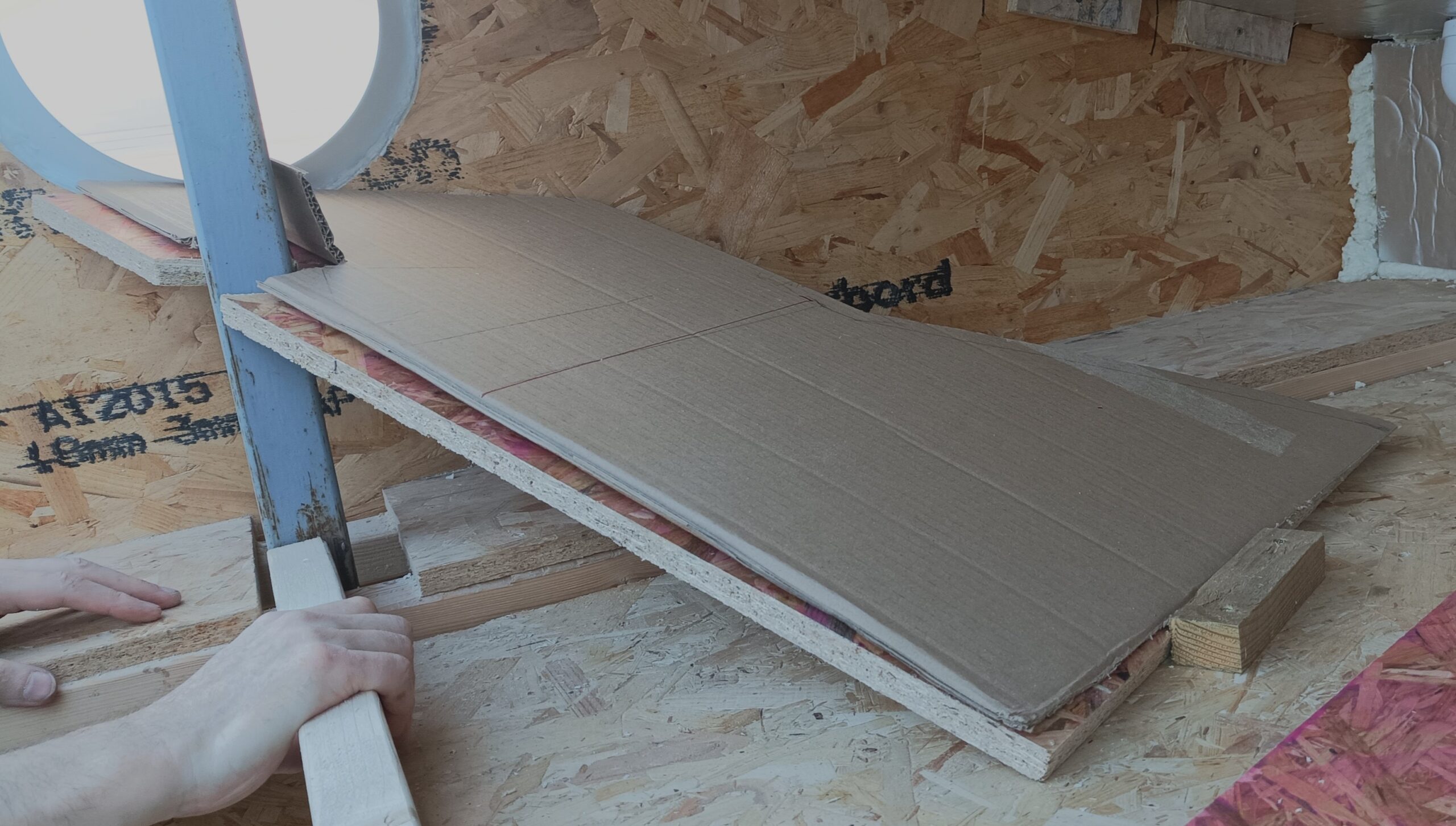
Tamplate for Central Duct connection
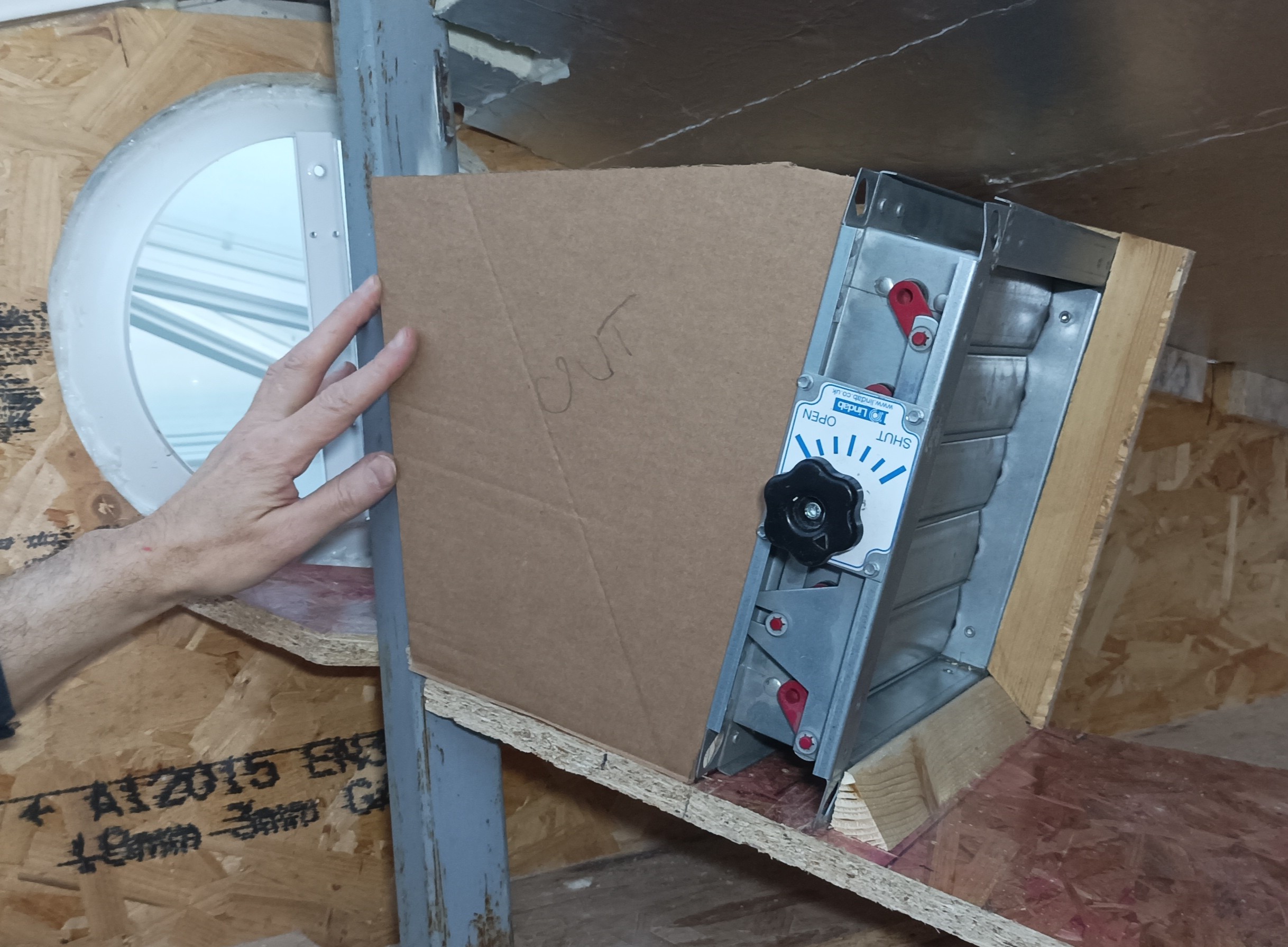
Templ;ate for side of duct
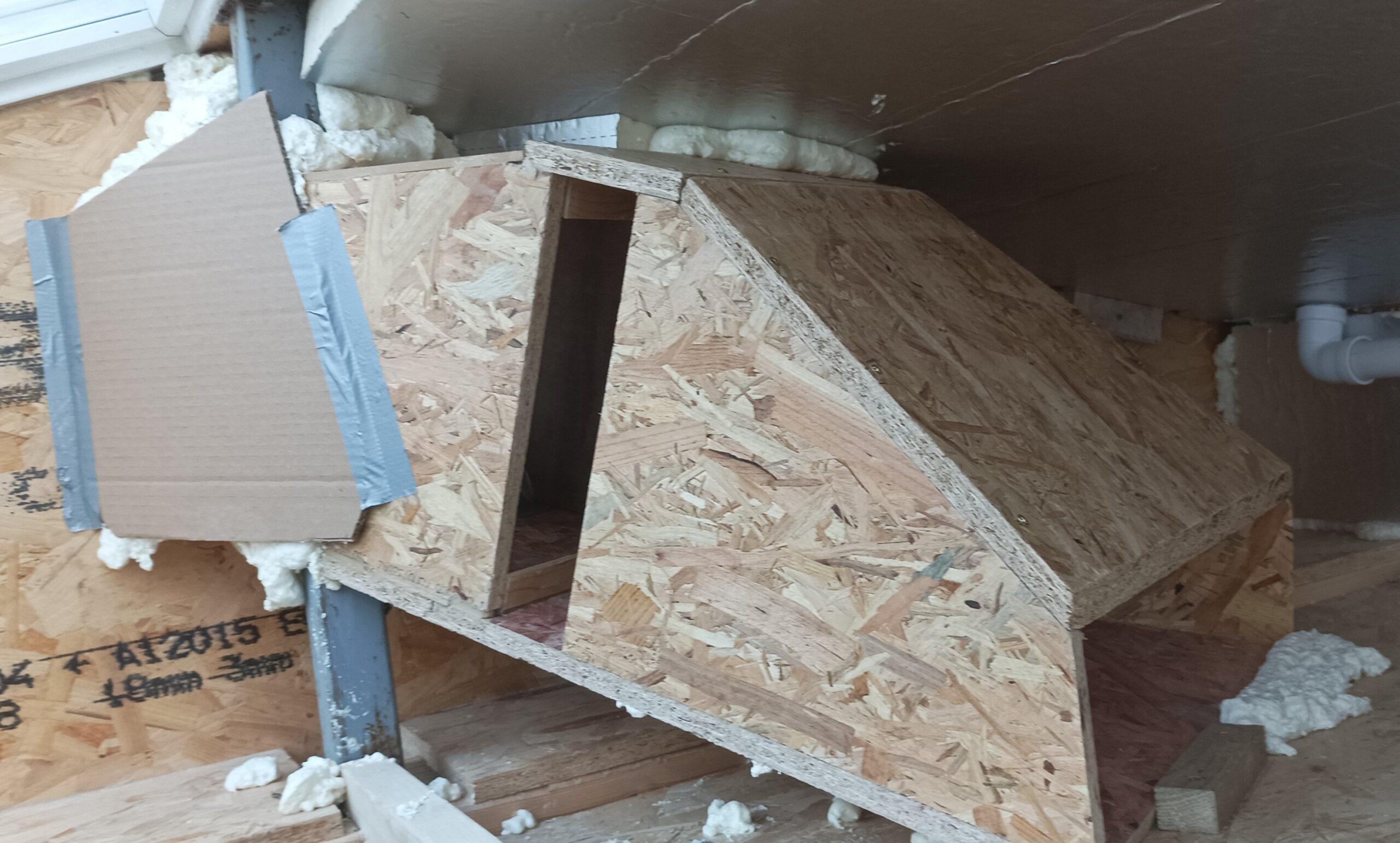
Central duct built
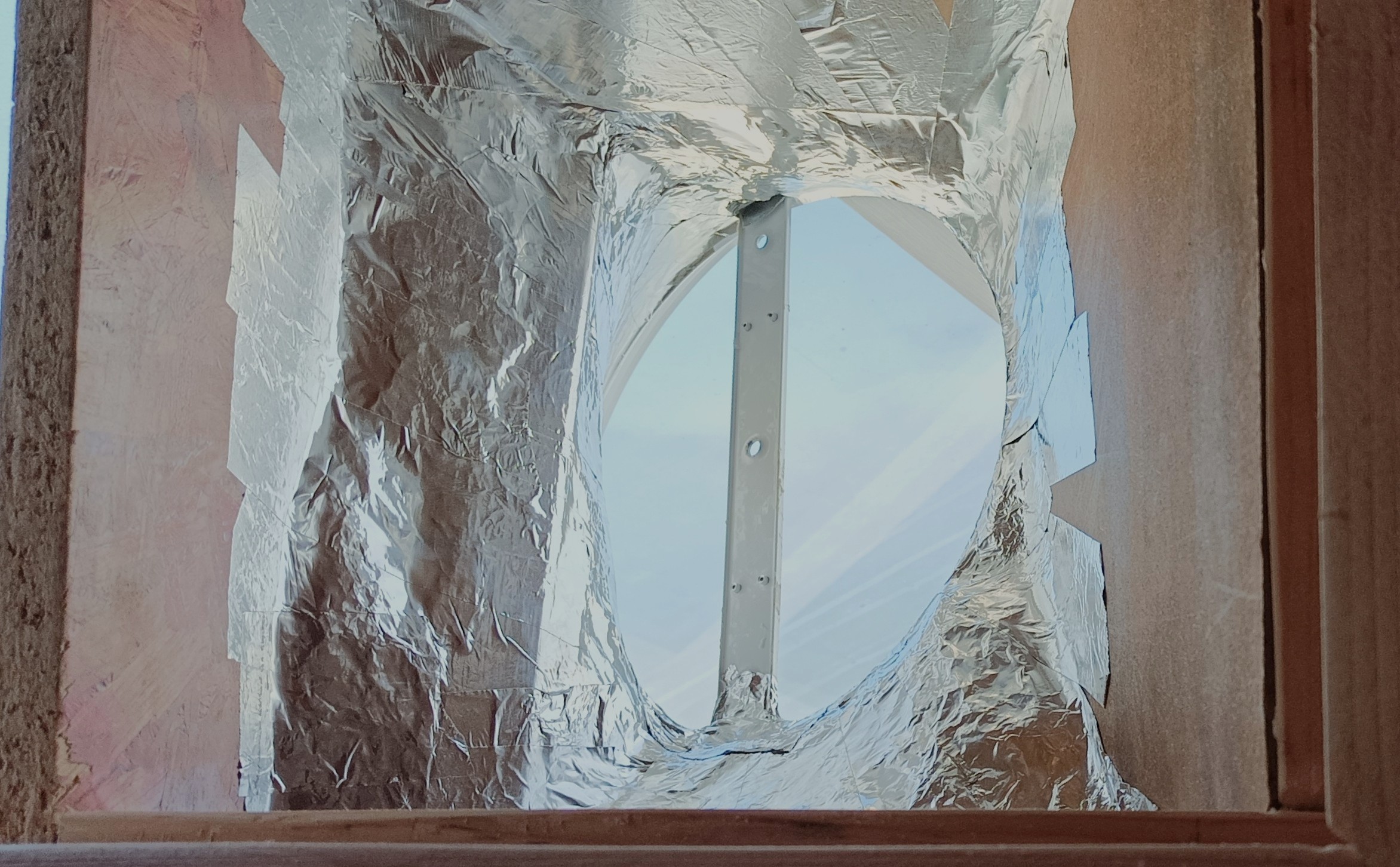
Lots of foil tape
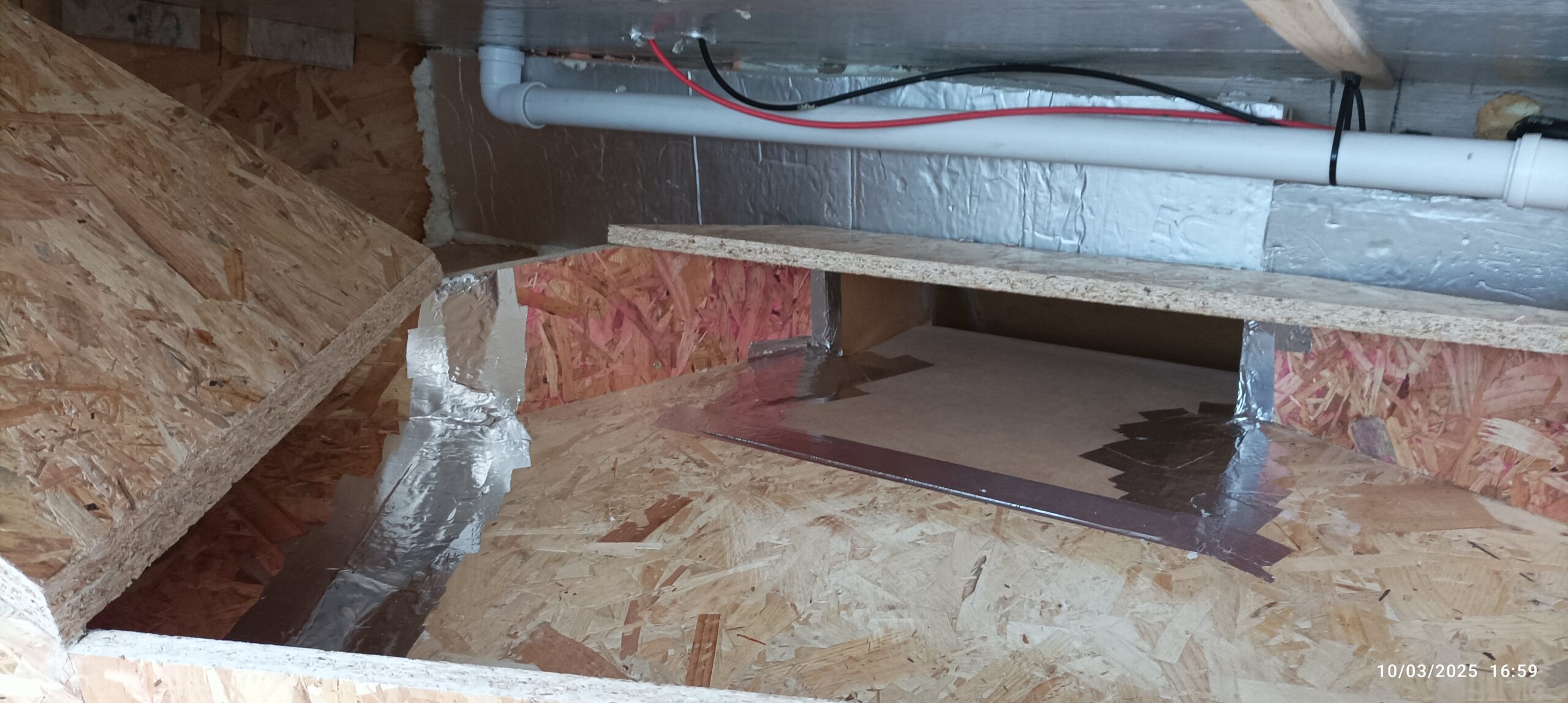
Duct ready for the lid
This concludes most of the structural work for our Skylight for the time being. We now have to tackle the problem of the desiccant dribbling all over our plywood lining. Phew!